منطقة ونغ يانغ الصناعية يويتشينغ ونتشو 325000
ساعات العمل
من الاثنين إلى الجمعة: 7 صباحاً - 7 مساءً
عطلة نهاية الأسبوع 10 صباحاً - 5 مساءً
منطقة ونغ يانغ الصناعية يويتشينغ ونتشو 325000
ساعات العمل
من الاثنين إلى الجمعة: 7 صباحاً - 7 مساءً
عطلة نهاية الأسبوع 10 صباحاً - 5 مساءً

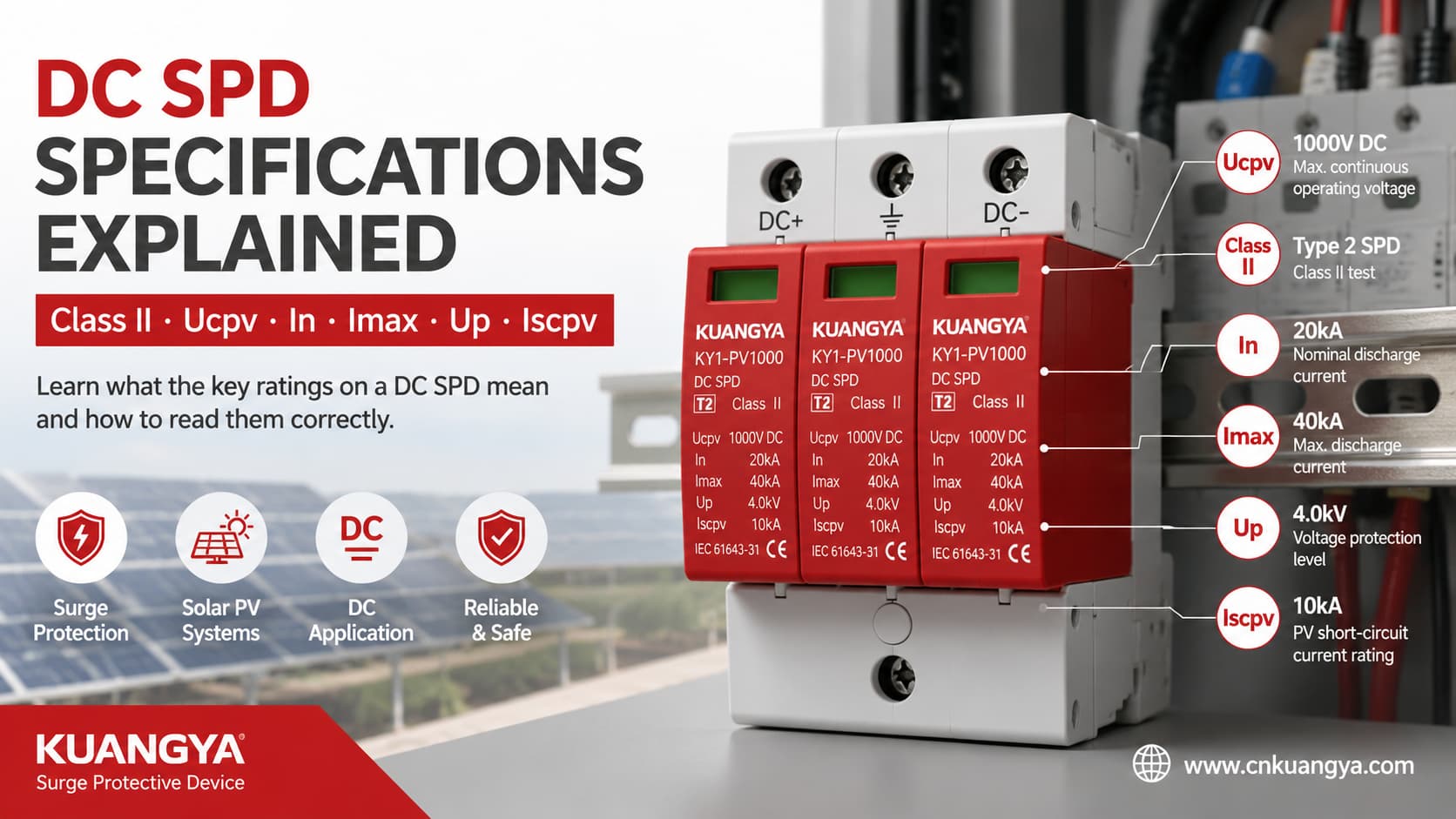
قد يبدو جهاز الحماية من زيادة التيار المستمر بسيطاً من الخارج، لكن العلامات المطبوعة على ملصقه تحتوي على معلومات مهمة حول أماكن استخدامه وكيفية أدائه.
تأمل هذا المثال لجهاز حماية من زيادة التيار (SPD) شمسي بجهد 1000 فولت تيار مستمر:
Ucpv: 1000 فولت تيار مستمر
الفئة الثانية
In: 20 كيلو أمبير
Imax: 40 كيلو أمبير
Up: 4.0 كيلو فولت
Iscpv: 10kA
-40 درجة مئوية إلى +85 درجة مئوية
للاستخدام الداخلي، درجة الحماية IP20
بالنسبة لمهندس كهرباء متمرس، هذه الاختصارات مألوفة.
أما بالنسبة للمشتري أو الموزع أو فني تركيب أنظمة الطاقة الشمسية أو مسؤول المشتريات في المشاريع، فقد تصبح مربكة بسهولة.
هل الفئة الثانية تعني جهاز حماية من اندفاع التيار (SPD) من الدرجة الثانية؟
هل 40kA Imax هل هو أفضل تلقائياً من 20 كيلو أمبير؟
لماذا يظهر جهاز الحماية من الصواعق (SPD) نفسه كلاً من 1000V و 4.0 كيلو فولت?
هل تيار الدائرة القصيرة الكهروضوئي (Iscpv) 10 كيلو أمبير هل يعني ذلك أن جهاز الحماية من الصواعق يمكنه تفريغ صاعقة بقوة 10 كيلو أمبير؟
الإجابة المختصرة هي: لا يوجد رقم واحد يصف جهاز الحماية من الصواعق بالكامل.
يجب قراءة جهاز الحماية من الصواعق (DC SPD) كمجموعة كاملة من الخصائص الكهربائية. إذا كنت مبتدئاً في مجال الحماية من الصواعق، فافهم أولاً كيفية عمل جهاز الحماية من التيار المستمر (DC SPD) في أنظمة الطاقة الشمسية الكهروضوئية يمكن أن تجعل هذه المواصفات أسهل في المتابعة.
يشرح هذا الدليل كيفية قراءة تلك العلامات بشكل صحيح، باستخدام جهاز حماية من التيار المستمر (DC SPD) من الفئة الثانية بجهد 1000 فولت كمثال عملي.
شاهد هذا الدليل السريع لمعرفة كيفية قراءة العلامات الرئيسية على لوحة بيانات جهاز الحماية من التيار المستمر (DC SPD).
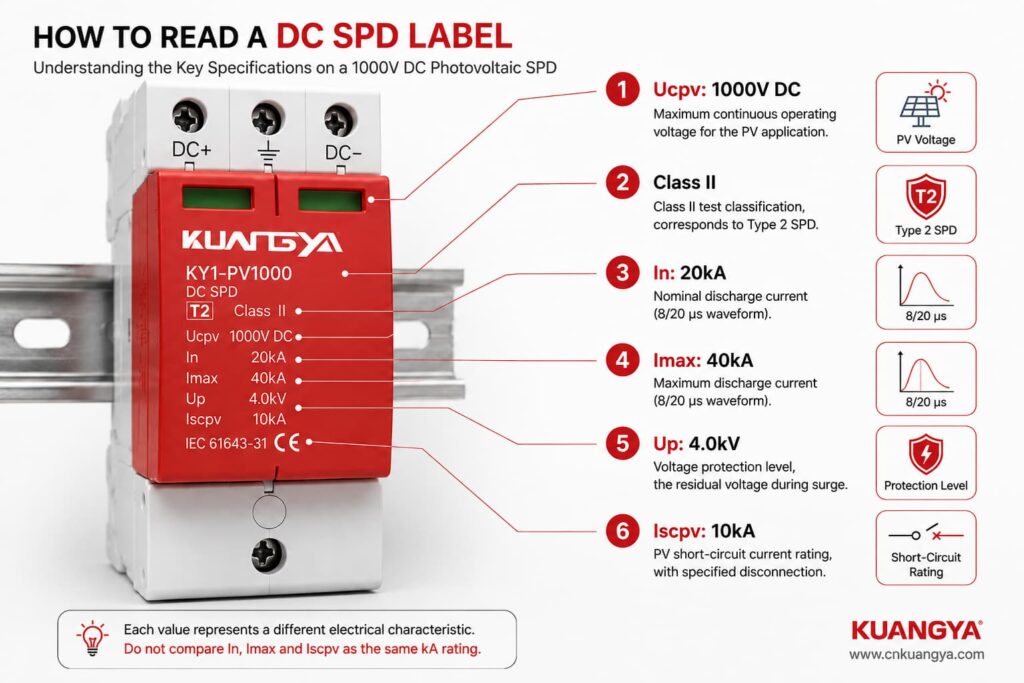
قبل الخوض في التفاصيل الفنية، يقدم الجدول أدناه نظرة عامة بسيطة.
| وضع العلامات | مثال على ذلك | المعنى البسيط |
|---|---|---|
| Ucpv | 1000 فولت تيار مستمر | أقصى جهد تشغيل مستمر لتطبيقات الطاقة الشمسية الكهروضوئية |
| الفئة الثانية | الفئة الثانية | جهاز حماية من اندفاع التيار (SPD) مختبر من الفئة الثانية، مرتبط بالحماية من الاندفاع من النوع 2 |
| في | 20 كيلو أمبير | تيار التفريغ الاسمي |
| إيماكس | 40 كيلو أمبير | أقصى تيار تفريغ |
| لأعلى | 4.0 كيلو فولت | مستوى الحماية من الجهد المعلن |
| تيار القصر الكهروضوئي (Iscpv) | 10 كيلو أمبير | تصنيف تيار القصر الكهروضوئي لجهاز الحماية من اندفاع التيار |
| درجة الحرارة | -40 درجة مئوية إلى +85 درجة مئوية | نطاق درجة حرارة التشغيل المعلن |
| الرطوبة | 5%–95% | نطاق الرطوبة المعلن |
| داخلي | داخلي | مخصص لظروف التركيب المحمية |
| IP20 | IP20 | درجة حماية غلاف جهاز الحماية من اندفاع التيار (SPD) |
النقطة الأكثر أهمية هي:
لا تقارن أجهزة الحماية من اندفاع التيار (DC SPDs) بناءً على أكبر رقم بالكيلو أمبير (kA) مطبوع على الملصق فقط.
على سبيل المثال،, أقصى تيار تفريغ (Imax) 40 كيلو أمبير, التيار الاسمي (In) 20 كيلو أمبير و تيار الدائرة القصيرة الكهروضوئي (Iscpv) 10 كيلو أمبير جميعها تستخدم وحدة الكيلو أمبير (kA)، لكنها تصف خصائص مختلفة تماماً.
عندما يرى المشترون ورقة بيانات جهاز الحماية من التيار المستمر (SPD) لأول مرة، فإنهم غالباً ما يبدأون بالرقم الأكبر.
عادة ما يكون هذا نهجاً خاطئاً.
ترتيب القراءة الأكثر فائدة هو:
يسمح هذا الترتيب برفض المنتجات غير المناسبة قبل مقارنة أرقام تيار الاندفاع الرئيسية.
تستخدم شركة VIOX نهجاً مشابهاً يتمثل في “رفض المواصفات غير المتوافقة أولاً” في دليل ورقة البيانات الخاص بها؛ وبالنسبة لتطبيقات الطاقة الشمسية الكهروضوئية (PV)، يصبح هذا المنطق أكثر أهمية لأن جهد التشغيل المستمر (Ucpv) وسلوك الدائرة القصيرة في أنظمة الطاقة الشمسية يتطلبان اهتماماً خاصاً.
إحدى العلامات الأولى على ملصق المثال هي:
الفئة الثانية
هذا لا لا يعني جودة من الدرجة الثانية.
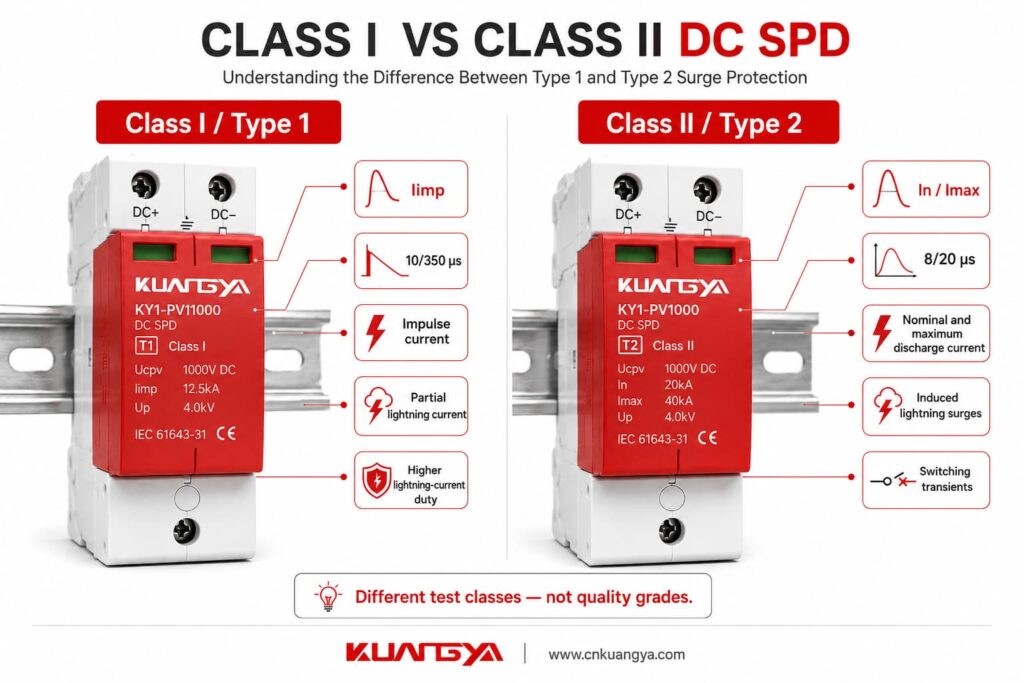
تشير الفئة الأولى والفئة الثانية والفئة الثالثة إلى تصنيفات اختبار أجهزة الحماية من اندفاع التيار (SPD) الموحدة، وليس إلى درجات جودة المنتج.
بالنسبة لأجهزة الحماية من اندفاع التيار الكهروضوئية (PV)، يرتبط جهاز الحماية من النوع 2 بـ اختبار الفئة الثانية.
ولهذا السبب قد يستخدم المصنعون المختلفون أو أوراق البيانات علامات مثل:
إنها تشير إلى مفاهيم تصنيف واختبار مترابطة بشكل وثيق، على الرغم من أنها من الناحية الفنية “Type” و “test class” ليسا مجرد طريقتين مختلفتين لكتابة المصطلح نفسه.
بالنسبة لمعظم المشترين، يمكن فهم العلاقة العملية على النحو التالي:
| تصنيف أجهزة الحماية من زيادة التيار (SPD) | فئة الاختبار | المعلمة الرئيسية للتيار | شكل موجة الاختبار الشائع |
|---|---|---|---|
| النوع 1 | الفئة الأولى | إيمب | 10/350 μs |
| النوع 2 | الفئة الثانية | إن/إيماكس | 8/20 μs |
| النوع 3 | الفئة الثالثة | معلمات اختبار منسقة أخرى | اختبار الموجة المركبة |
بالنسبة للمثال الوارد في هذا المقال:
الفئة الثانية (Class II) ← اتجاه التطبيق من النوع 2 (Type 2)
وبالتالي فإن أهم معايير التيار الموضحة هي:
In = 20kA
Imax = 40kA
لا يوجد.
هذا أحد أكثر المفاهيم الخاطئة شيوعاً عند مقارنة أجهزة الحماية من اندفاع التيار (SPDs).
قد تبدو كلمتا الفئة الأولى (Class I) والفئة الثانية (Class II) وكأنهما تصنيف للمستوى:
الفئة الأولى = أفضل
الفئة الثانية = أرخص أو أضعف
ليس هذا هو المقصود من تصنيف أجهزة الحماية من زيادة التيار (SPD).
فهي مخصصة لـ ظروف مختلفة لزيادة التيار.
يتم تقييم جهاز الحماية من زيادة التيار (SPD) من النوع 1 / الفئة الأولى بناءً على قدرته على تحمل تيار نبضة البرق، حيث قد يلزم التعامل مع تيار البرق الجزئي عند نقطة التركيب.
يُستخدم جهاز الحماية من زيادة التيار (SPD) من النوع 2 / الفئة الثانية عادةً للحد من الجهد الزائد العابر الناتج عن تأثيرات البرق المستحثة وأحداث التبديل.
لذلك، السؤال الصحيح ليس:
أي فئة هي الأفضل؟
بل هو:
ما هو نوع جهاز الحماية من الصواعق (SPD) المطلوب في نقطة التركيب هذه؟
لا يعتبر جهاز الحماية من الصواعق من النوع 1 الخيار الصحيح تلقائياً لكل تركيبات الطاقة الشمسية الكهروضوئية، كما أن النوع 2 ليس غير كافٍ لمجرد وجود النوع 1.
إذا كنت بحاجة إلى شرح مفصل حول مسألة الاختيار هذه، راجع دليلنا:
مقالك الحالي يتعمق أكثر في التعرض للصواعق، وموقع التركيب، ومتى يجب تقييم الحاجة إلى قدرة النوع 1.
يصبح الفرق التقني الأكبر أكثر وضوحاً عند النظر إلى تيار الاختبار.
يرتبط جهاز الحماية من اندفاع التيار (SPD) من النوع 1 بتصنيف تيار النبضة:
إيمب
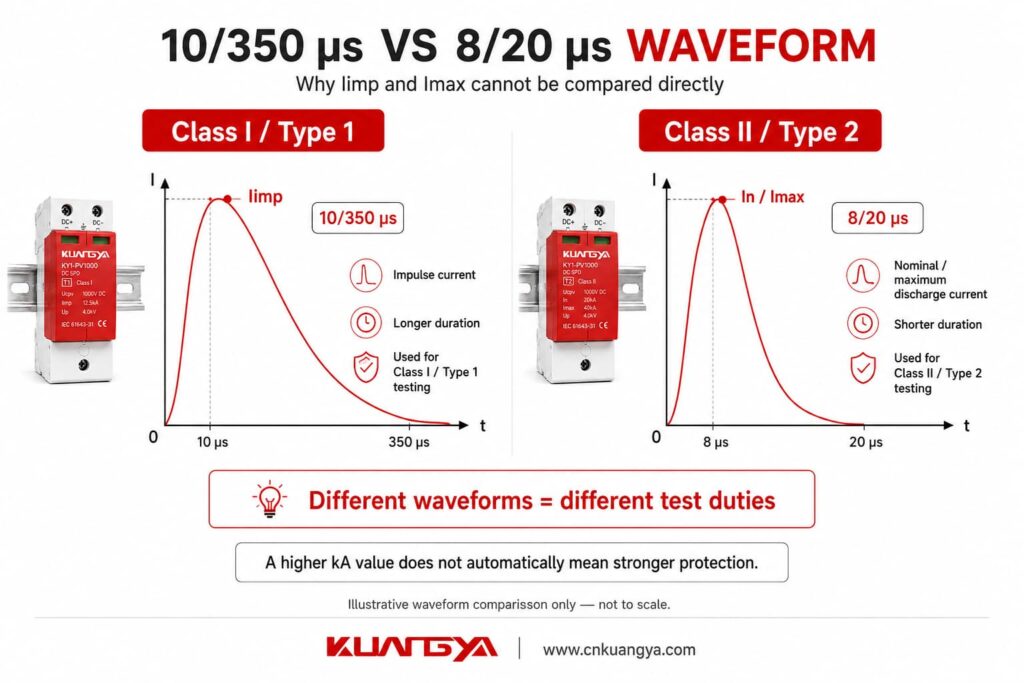
و 10/350 μs يرتبط شكل موجة التيار عادةً باختبارات الفئة الأولى (Class I).
يمثل شكل الموجة 10/350 ميكروثانية حملاً طاقياً للتيار يختلف كثيراً عن شكل الموجة 8/20 ميكروثانية المستخدم لتقييم النوع 2.
وهذا يعني:
لا يمكن مقارنة تيار النبضة (Iimp) مباشرة بالتيار الأقصى (Imax) لمجرد أن كلاهما معبر عنه بالكيلو أمبير (kA).
على سبيل المثال:
تيار النبضة (Iimp) = 12.5 كيلو أمبير.
و
Imax = 40kA
لا يعني أن منتج النوع 2 بقدرة 40 كيلو أمبير “أقوى”.”
فهما يشيران إلى أشكال موجات اختبار مختلفة وخصائص أداء مختلفة.
يتميز جهاز الحماية من اندفاع التيار (SPD) من النوع 2 بشكل أساسي باستخدام:
يرتبط شكل موجة التيار 8/20 ميكروثانية باختبار تيار التفريغ للفئة الثانية.
يتم تقييم أجهزة الحماية من اندفاع التيار (SPD) للتيار المستمر من النوع 2 بشكل شائع للاستخدام في مواقع مثل:
ومع ذلك، يجب أن يعتمد نوع جهاز الحماية من اندفاع التيار (SPD) النهائي على تصميم الحماية من الصواعق الفعلي وظروف التركيب.
توجد الفئة الثالثة ضمن التصنيف العام لأجهزة الحماية من اندفاع التيار (SPD)، ولكن لا ينبغي أن تصبح الموضوع الرئيسي عند مناقشة الاختيار النموذجي لأجهزة الحماية من اندفاع التيار للأنظمة الكهروضوئية (PV DC).
ترتبط الحماية من الفئة الثالثة عموماً بالحماية الدقيقة المنسقة بالقرب من المعدات الحساسة.
بالنسبة للحماية من التيار المستمر في الأنظمة الشمسية الكهروضوئية، سيواجه المشترون بشكل أكثر شيوعاً:
ولهذا السبب تركز هذه المقالة بشكل أساسي على الفئة الثانية وعلاقتها بأجهزة الحماية من اندفاع التيار للتيار المستمر من النوع 2, بدلاً من التعامل مع الفئات الأولى والثانية والثالثة كفئات منتجات طاقة شمسية متساوية الشيوع.
توضح ملصقة المثال ما يلي:
Ucpv: 1000 فولت تيار مستمر
يعني Ucpv:
أقصى جهد تشغيل مستمر لتطبيقات الطاقة الشمسية الكهروضوئية.
بعبارات بسيطة:
يخبرك Ucpv بأقصى جهد تيار مستمر يمكن تطبيقه بشكل مستمر على نمط الحماية الخاص بجهاز الحماية من اندفاع التيار (SPD).
تُعرّف المواصفة IEC 61643-32 مصطلح Ucpv بهذه الطريقة جوهرياً، وتنص على أنه يجب أن يكون مساوياً أو أعلى من أقصى جهد للدائرة المفتوحة لنظام الطاقة الشمسية الكهروضوئية ذي الصلة بالتركيب.
هذا يجعل Ucpv واحدة من أوائل المواصفات التي يجب التحقق منها عند اختيار جهاز حماية من التيار المستمر (SPD) لأنظمة الطاقة الشمسية.
ليس بالضرورة.
هذا أمر مهم.
لا ينبغي تقييم النظام الكهروضوئي باستخدام ملصق اسمي مريح فقط مثل:
نظام شمسي بجهد 1000 فولت
يعتمد الحد الأقصى الفعلي لجهد التيار المستمر لسلسلة الألواح الكهروضوئية على عوامل تشمل:
PV module open-circuit voltage normally increases when temperature falls.
For a broader explanation of PV array voltage, string design and related system requirements, see our IEC 62548 PV array design guide.
Therefore, the selection process should be based on the maximum calculated PV open-circuit voltage, rather than simply copying the nominal inverter or system voltage.
A simplified workflow is:
Module Voc
→ عدد الوحدات الموصلة على التوالي
→ Low-temperature correction
→ Maximum PV open-circuit voltage
→ Select suitable Ucpv
We have already covered this subject separately in our DC SPD Voltage Selection Guide, including 600V, 1000V and 1500V DC applications.
So in this article, the important point is simply:
Ucpv is a continuous-voltage compatibility rating, not a surge-current rating.
This is another common source of confusion.
Our example SPD shows:
Ucpv = 1000V DC
و
Up = 4.0kV
A buyer may reasonably ask:
Why does a 1000V SPD also have a 4kV voltage rating?
Because these two values describe different things.
| المعلمة | مثال على ذلك | ما يصفه |
|---|---|---|
| Ucpv | 1000 فولت تيار مستمر | Continuous PV operating voltage |
| لأعلى | 4.0 كيلو فولت | Voltage protection level during surge testing |
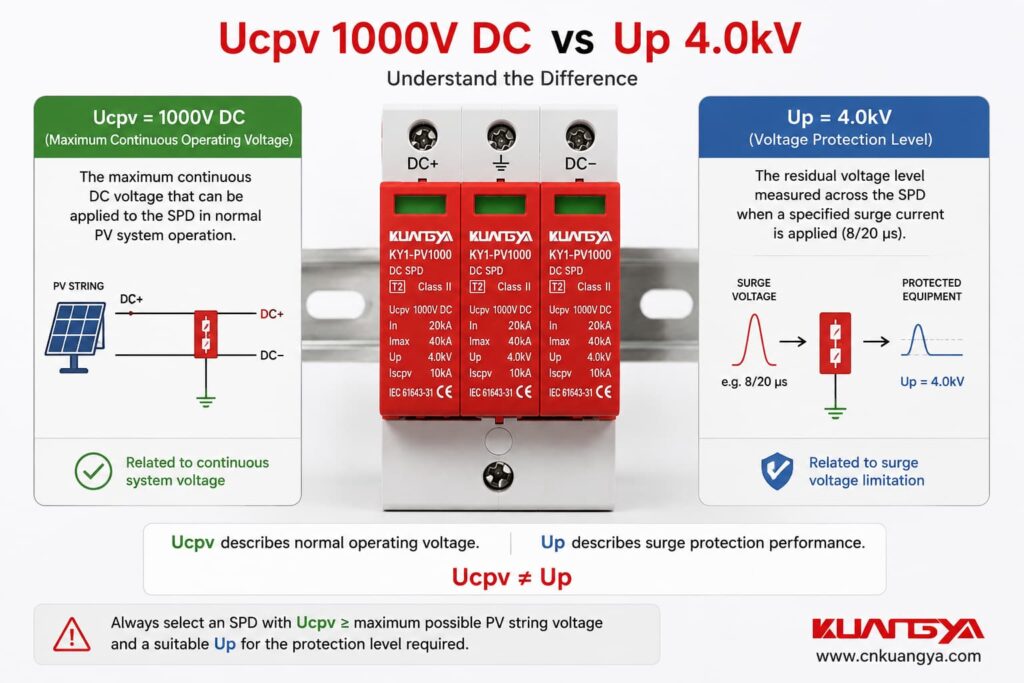
إذن:
Ucpv is about surviving normal system operation.
Up is about limiting transient surge voltage.
They should never be treated as interchangeable voltage ratings.
The label shows:
In: 20 كيلو أمبير
In means:
تيار التفريغ الاسمي
For a Type 2 / Class II SPD, In is associated with an شكل موجة التيار 8/20 ميكروثانية.
In technical terms, it represents the crest value of the current through the SPD having the specified 8/20 μs waveshape under the relevant standardized test conditions.
That definition is accurate, but for a buyer it can be simplified:
In is one of the main ratings used to describe the tested surge-discharge performance of a Type 2 SPD.
For this product:
In = 20kA
The important word here is nominal.
It should not be confused with Imax.
The same SPD also shows:
Imax: 40 كيلو أمبير
Imax means:
Maximum Discharge Current
For a Type 2 SPD, Imax is also normally associated with the شكل موجة التيار 8/20 ميكروثانية.
It represents the manufacturer’s declared maximum discharge-current capability under the applicable test conditions.
بناءً على ذلك:
In 20kA and Imax 40kA are not duplicate specifications.
They represent different test-duty levels.
This is one of the most important parts of the entire datasheet.
Consider the example:
| المعلمة | القيمة |
|---|---|
| في | 20 كيلو أمبير |
| إيماكس | 40 كيلو أمبير |
| شكل الموجة | 8/20 μs |
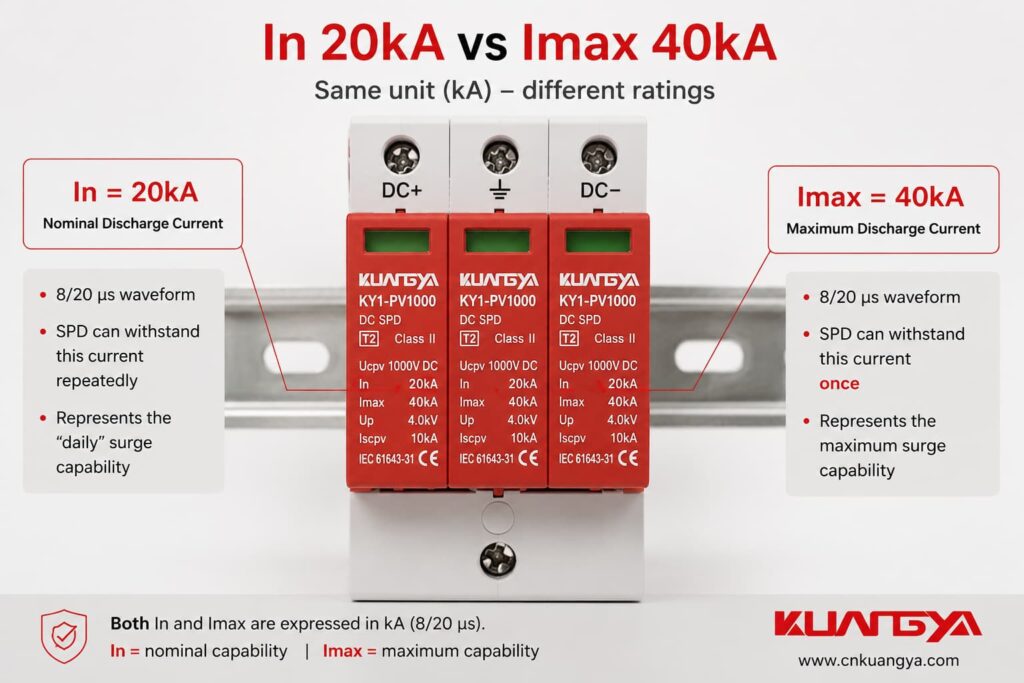
A simple way to understand them is:
في = nominal discharge-current rating.
إيماكس = maximum declared discharge-current rating.
One common purchasing mistake is to look only at Imax because it is the larger number.
على سبيل المثال:
SPD A: In 20kA / Imax 40kA
SPD B: In 10kA / Imax 40kA
A buyer may see “40kA” on both products and assume that their surge performance is equivalent.
That conclusion is incomplete.
The full declared performance needs to be checked.
VIOX makes the same useful procurement distinction in its SPD datasheet guide: In and Imax should be read separately, and Imax should not be interpreted as the SPD’s normal repeated discharge capacity.
لا يوجد.
This is probably the most useful purchasing rule in this article:
The highest kA value does not automatically identify the best SPD.
Suppose two products are advertised as:
It would be incorrect to select SPD B immediately just because:
60kA > 40kA.
Other questions still matter:
A larger number may be useful when the complete design calls for it.
But:
More kA is not a substitute for correct coordination.
Not simply because it says 40kA.
This is another very common mistake.
A Type 2 product may show:
Imax = 40kA, 8/20 μs
while a Type 1 product may show:
Iimp = 12.5kA, 10/350 μs
Looking only at the peak current numbers:
40 > 12.5
may make the Type 2 SPD appear stronger.
But that comparison is technically incorrect.
The two values are based on different test waveforms and different protection duties.
بناءً على ذلك:
Imax cannot be used as a substitute for a specified Iimp requirement.
If the project requires Type 1 lightning-current capability, a large Type 2 Imax value alone does not satisfy that requirement.
توضح ملصقة المثال ما يلي:
Up: 4.0 كيلو فولت
Up means:
مستوى حماية الجهد الكهربائي
It describes the SPD’s declared voltage-limiting performance under specified standardized test conditions.
In practical terms, Up helps answer the question:
How effectively does the SPD limit the transient voltage during the relevant test?
Generally, a lower Up can provide a lower level of surge voltage at the SPD terminals.
However, this needs an important qualification.
The printed Up value should لا be treated as the exact maximum voltage that every connected inverter or device will experience in a real installation.
لماذا؟
Because the actual voltage seen by the protected equipment can also be affected by:
VIOX correctly makes the same distinction: the declared Up is established at the SPD under standardized conditions, while installation conductors can increase the voltage presented to the protected equipment.
Not by itself.
It is reasonable to prefer effective voltage limitation, but the selection must remain compatible with the complete electrical system.
A low Up does not compensate for:
So instead of saying:
“Always buy the SPD with the lowest Up.”
A more technically correct rule is:
Select an SPD with a suitable Up while also verifying Ucpv, SPD Type, protected equipment withstand level and installation coordination.
Now we come to one of the most misunderstood PV-specific parameters:
Iscpv: 10kA
This is particularly important because it also uses the unit kA.
It is easy to look at:
التيار الاسمي (In) 20 كيلو أمبير
أقصى تيار تفريغ (Imax) 40 كيلو أمبير
تيار الدائرة القصيرة الكهروضوئي (Iscpv) 10 كيلو أمبير
and assume they are three levels of surge current.
فهي ليست كذلك.
Iscpv means:
Short-Circuit Current Rating of the SPD for the PV application.
IEC terminology defines Iscpv as the maximum prospective short-circuit current from the power system for which the SPD, together with the specified disconnector, is rated.
A simpler explanation is:
Iscpv tells you whether the SPD and its specified disconnection arrangement are suitable for the prospective PV short-circuit current at the installation point.
هذه مسألة fault-current / short-circuit characteristic.
It is not a lightning-surge rating.
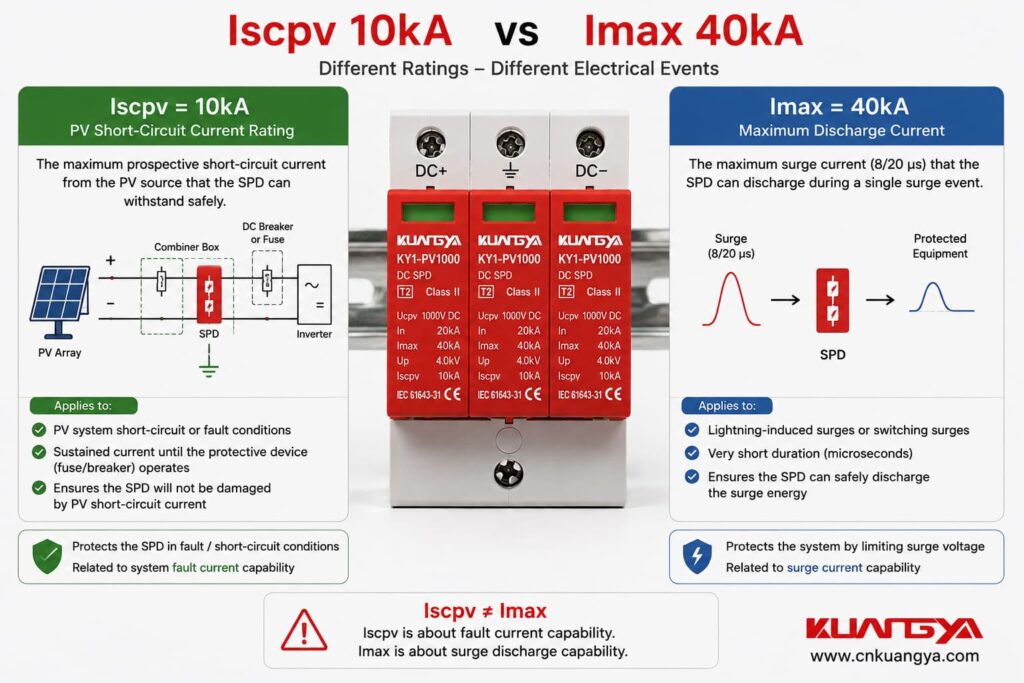
This distinction deserves to be stated clearly:
Iscpv ≠ Imax
Even though both can be expressed in kA.
على سبيل المثال:
Describes surge discharge-current performance.
Describes the SPD’s PV short-circuit-current rating in conjunction with the specified disconnection arrangement.
So on our example product:
Imax = 40kA
does not mean:
PV short-circuit rating = 40kA.
And:
Iscpv = 10kA
does not mean:
The SPD can only discharge a 10kA surge.
These numbers belong to different electrical events.
PV DC circuits behave differently from ordinary AC circuits.
One important difference is that DC current does not naturally pass through zero every half-cycle as AC current does.
For protection devices, switching equipment and disconnecting arrangements, this makes DC fault interruption an important design consideration.
That is one reason PV-specific SPDs have characteristics and test requirements beyond simply printing:
“DC 1000V”
on an AC-style product.
IEC 61643-31 is specifically intended for SPDs connected to the DC side of photovoltaic installations and establishes PV-specific requirements, ratings and test methods.
Therefore, when buying a PV SPD, do not ask only:
“Is this 1000V DC?”
Also ask:
What is the declared Iscpv and required disconnection arrangement?
The easiest way to remember these parameters is with this table:
| التقييم | Main Meaning | Typical Context |
|---|---|---|
| في | تيار التفريغ الاسمي | Type 2 / Class II surge performance |
| إيماكس | أقصى تيار تفريغ | Type 2 maximum declared surge-current performance |
| إيمب | Impulse current | Type 1 / Class I lightning-current capability |
| تيار القصر الكهروضوئي (Iscpv) | PV short-circuit current rating | PV fault-current compatibility |
Notice something important:
Three or four specifications can all contain:
kA
but this does not mean they can be compared directly.
Before comparing any two kA ratings, first ask:
This prevents a large number of purchasing errors.
The label also declares:
-40 درجة مئوية إلى +85 درجة مئوية
This is the manufacturer’s declared temperature range for the product.
Environmental ratings should not be ignored simply because electrical parameters look correct.
PV equipment may be installed in:
The internal temperature of an enclosure can be very different from the normal outdoor air temperature.
Therefore, project engineers should confirm that the SPD’s declared environmental conditions are suitable for the actual enclosure and installation environment.
Where the datasheet declares:
5%–95%
this normally represents the manufacturer’s declared relative humidity operating range.
However, humidity specifications should always be read together with conditions such as:
The percentage alone does not mean that an exposed SPD can be installed directly in rain or other outdoor environments.
The label states:
داخلي
This does not necessarily mean that the SPD can never form part of an outdoor PV installation.
It means the SPD itself is intended for a protected environment according to its declared construction and installation conditions.
For example, an indoor-rated SPD may be installed inside:
The important distinction is:
The SPD can be inside outdoor equipment without the SPD itself being directly exposed to outdoor conditions.
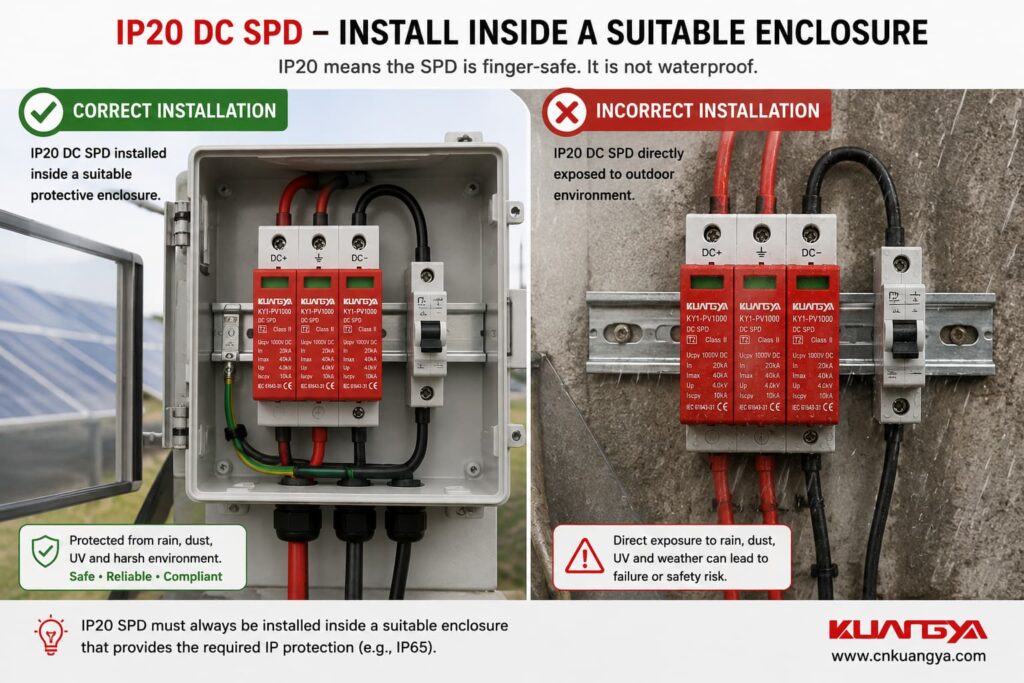
IP20 is the enclosure protection rating shown for the SPD itself.
It should not be interpreted as a weatherproof rating.
A DIN-rail SPD with IP20 is normally installed inside another suitable enclosure or cabinet.
For an outdoor PV installation, the final environmental protection depends on the complete enclosure, not only the bare SPD module.
إذن:
IP20 SPD inside a suitable outdoor enclosure
can be a normal arrangement.
But:
IP20 SPD directly exposed to rain, dust and outdoor weather
should not be assumed to be acceptable.
Now we can return to the original example.
Ucpv: 1000 فولت تيار مستمر
الفئة الثانية
In: 20 كيلو أمبير
Imax: 40 كيلو أمبير
Up: 4.0 كيلو فولت
Iscpv: 10kA
Instead of reading each number independently, read it as one technical description.
This tells us the declared maximum continuous PV operating voltage of the SPD.
This indicates Class II testing / Type 2 application direction.
This is the nominal discharge-current rating associated with the relevant Type 2 surge test.
This is the declared maximum discharge-current rating.
This is the declared voltage protection level.
This is the PV short-circuit-current rating and must be understood together with the applicable disconnector/protection arrangement.
Now the label makes much more sense.
It is not saying:
“1000V, 20kA, 40kA, 10kA — bigger numbers are better.”
It is describing different electrical functions and limits of the same SPD.
Incorrect:
Class I is premium and Class II is lower quality.
Correct:
Class I and Class II represent different test/protection classifications.
Incorrect:
This one says 60kA, so it is automatically better than the 40kA model.
Correct:
Check:
before making the comparison.
Incorrect:
Imax 40kA is higher than Iimp 12.5kA, so Type 2 is stronger.
Correct:
Iimp and Imax refer to different test waveforms and different surge duties.
Incorrect:
The SPD is rated 1000V but Up is 4kV, so the specifications conflict.
Correct:
Ucpv and Up describe different voltage characteristics.
Incorrect:
Iscpv 10kA means the SPD can discharge 10kA of lightning current.
Correct:
Iscpv is a PV short-circuit-current rating.
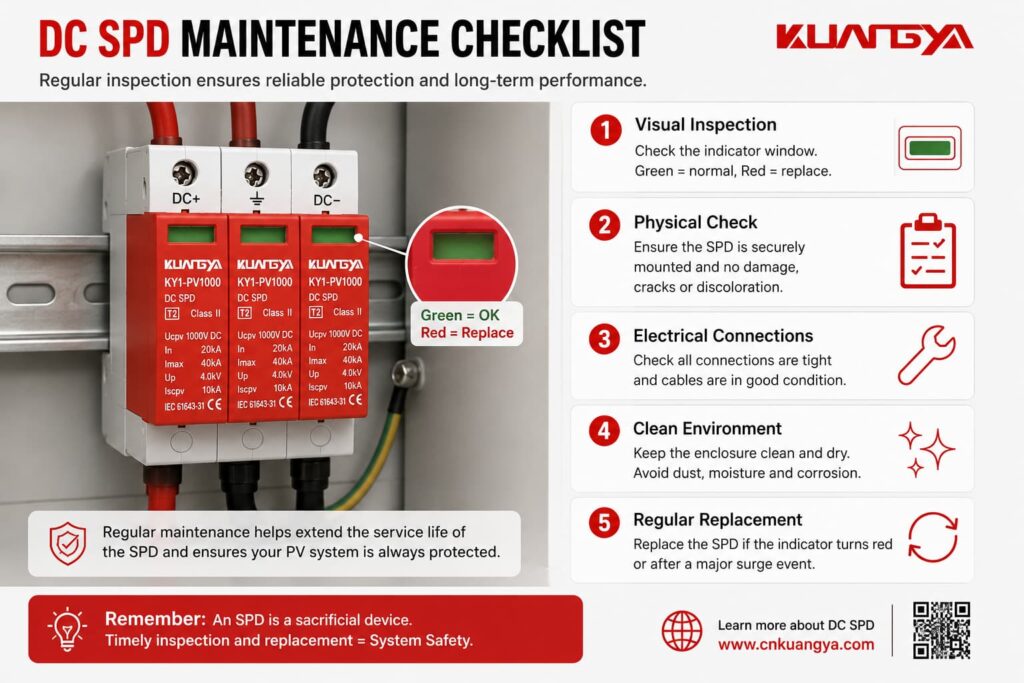
Even a correctly selected SPD can provide poor protection if installation is poor.
Important details include:
A datasheet tells you what the device is capable of under defined conditions.
Installation determines how effectively that capability is used in the real system.
The SPD should also be considered together with other solar PV electrical protection devices, including DC fuses, isolators, circuit breakers and the overall protection arrangement.
For buyers, distributors and EPC procurement teams, the following sequence is more useful than simply asking for:
“1000V 40kA SPD price.”
Is the product specifically intended for:
PV DC surge protection?
Do not assume an AC SPD with a similar voltage or current marking is interchangeable.
Determine the maximum possible PV open-circuit voltage.
Then confirm that the selected Ucpv is suitable.
For the full calculation method, refer to the DC SPD Voltage Selection Guide mentioned earlier.
Determine whether the installation requires:
Do not make this decision simply from product price or kA rating.
Our detailed Type 1 vs Type 2 vs Type 1+2 DC SPD guide explains this separately.
For a Type 2 / Class II SPD, confirm both values.
Do not check only Imax.
Verify the declared voltage protection level and whether it is appropriate for the protected equipment and protection concept.
Confirm that the SPD and specified disconnection/protection arrangement are compatible with the prospective short-circuit current of the PV system.
Confirm:
تحقق من ذلك:
For PV DC SPDs, IEC 61643-31 is an important product standard to check.
IEC 61643-31:2018 covers SPDs intended for the DC side of photovoltaic installations up to 1500V DC, while IEC 61643-32:2017 addresses their selection, installation and coordination.
Depending on the project and market, buyers may also need:
Do not assume that a logo printed on a product is sufficient evidence.
Match the documentation to the exact model being purchased.
Before approving a PV SPD, use the following checklist.
| تحقق | سؤال |
|---|---|
| التطبيق | Is it specifically suitable for PV DC? |
| Ucpv | Is it suitable for maximum PV open-circuit voltage? |
| نوع SPD | Does Type 1 / Type 2 / Type 1+2 match the installation design? |
| فئة الاختبار | Is the declared classification clear? |
| في | Is the nominal discharge-current rating specified? |
| إيماكس | Is the maximum discharge-current rating specified? |
| إيمب | If Type 1 is required, is Iimp declared? |
| لأعلى | Is the protection level suitable? |
| تيار القصر الكهروضوئي (Iscpv) | Is the PV short-circuit rating adequate? |
| الأسلاك | Is the correct DC connection diagram available? |
| الحماية | Is required backup protection identified? |
| البيئة | Are temperature, IP and enclosure conditions suitable? |
| قياسي | Is the applicable PV SPD standard stated? |
| التوثيق | Do certificates/test reports match the exact model? |
A weak RFQ might say:
Please quote 1000V 40kA solar SPD.
This leaves many important questions unanswered.
A better RFQ is:
Please quote a Type 2 / Class II PV DC SPD for a 1000V DC application. Please confirm Ucpv, In, Imax, Up, Iscpv, pole configuration, required backup protection, IEC 61643-31 documentation and wiring diagram.
If known, also include:
This allows the manufacturer to evaluate the complete requirement instead of matching only the words:
“1000V” and “40kA.”
They are closely related but technically describe classification/testing from slightly different perspectives.
For practical PV product selection, a Type 2 SPD is associated with اختبار الفئة الثانية, which is why labels and datasheets may show Type 2, T2 or Class II terminology.
لا يوجد.
Class I and Class II are not quality levels.
They are intended for different surge-protection duties and test conditions.
In is the nominal discharge current.
Imax is the maximum discharge current.
For Type 2 SPDs, both are normally associated with the 8/20 μs waveform, but they represent different test-duty levels.
Not enough information is available to answer that from Imax alone.
A proper comparison also requires Ucpv, Type, In, Up, Iscpv, standard, protection configuration and installation conditions.
Not simply because its peak current number is larger.
Type 1 is characterized by lightning impulse-current capability such as Iimp and the associated Class I test conditions.
Imax and Iimp should not be directly compared.
Ucpv is the maximum continuous operating voltage for the PV application.
لأعلى is the declared voltage protection level under specified surge test conditions.
They perform completely different functions in the datasheet.
Iscpv is the short-circuit current rating of the PV SPD.
More precisely, it describes the maximum prospective short-circuit current for which the SPD, together with its specified disconnector arrangement, is rated.
لا يوجد.
Imax is a surge discharge-current rating.
Iscpv is a short-circuit-current rating.
The fact that both use kA does not make them interchangeable.
Not automatically.
Maximum PV open-circuit voltage should be calculated under the project’s design conditions before selecting Ucpv.
For more detail, see our دليل اختيار جهاز الحماية من التيار المستمر (DC SPD): كيفية اختيار الجهد الكهربائي المناسب.
It may be installed inside a suitable outdoor enclosure, provided the complete installation satisfies the required environmental protection.
IP20 on the SPD itself should not be treated as a weatherproof outdoor rating.
IEC 61643-31 covers requirements and test methods for SPDs intended for the DC side of photovoltaic installations up to 1500V DC.
IEC 61643-32 provides selection and application principles for PV SPDs.
Reading a DC SPD datasheet becomes much easier once each parameter is treated according to its actual purpose.
For the example:
الفئة الثانية
جهد التشغيل المستمر الأقصى لنظام الطاقة الشمسية 1000 فولت تيار مستمر
التيار الاسمي (In) 20 كيلو أمبير
أقصى تيار تفريغ (Imax) 40 كيلو أمبير
Up 4.0kV
تيار الدائرة القصيرة الكهروضوئي (Iscpv) 10 كيلو أمبير
the correct interpretation is not simply:
“This is a 1000V, 40kA SPD.”
A more complete interpretation is:
Each specification answers a different engineering question.
That leads to one simple purchasing principle:
Never select a DC SPD from one voltage number, one kA number or one Type label alone.
The correct SPD is the one whose complete set of ratings matches the PV system voltage, surge environment, equipment protection requirements, short-circuit conditions and installation design.
For solar PV projects requiring 600V, 1000V or 1500V surge protection, explore KUANGYA DC surge protective devices to compare available Type 2 and Type 1+2 models by voltage rating, discharge-current capability and application.

