WengYang Industriegebiet Yueqing Wenzhou 325000
Arbeitszeiten
Montag bis Freitag: 7AM - 7PM
Am Wochenende: 10AM - 5PM
WengYang Industriegebiet Yueqing Wenzhou 325000
Arbeitszeiten
Montag bis Freitag: 7AM - 7PM
Am Wochenende: 10AM - 5PM

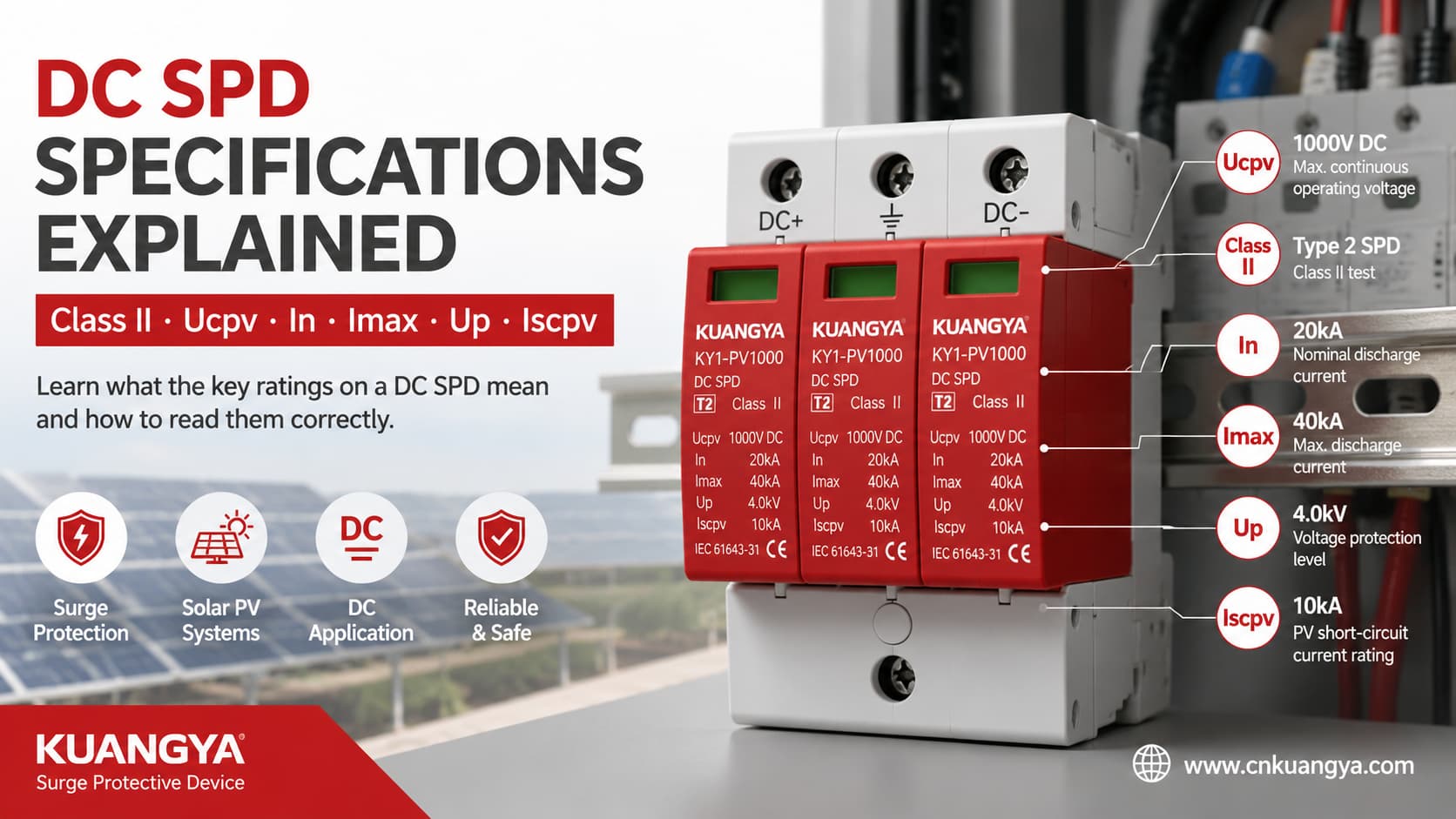
Ein DC-Überspannungsschutzgerät mag von außen einfach aussehen, aber die auf dem Etikett aufgedruckten Kennzeichnungen enthalten wichtige Informationen darüber, wo das SPD eingesetzt werden kann und wie es funktioniert.
Betrachten Sie dieses Beispiel eines 1000V DC Solar-SPD:
Ucpv: 1000V DC
Klasse II
In: 20kA
Imax: 40kA
Up: 4,0kV
Iscpv: 10kA
-40°C bis +85°C
Innenbereich, IP20
Für einen erfahrenen Elektroingenieur sind diese Abkürzungen vertraut.
Für einen Einkäufer, Händler, Solarinstallateur oder Projekteinkäufer können sie jedoch leicht verwirrend sein.
Bedeutet Klasse II einen SPD der Klasse II?
Ist 40kA Imax automatisch besser als 20kA?
Warum zeigt dasselbe SPD beides 1000V und 4,0kV?
Bedeutet Iscpv 10kA bedeutet das, dass das SPD einen 10kA-Blitzstoßstrom ableiten kann?
Die kurze Antwort lautet: keine einzelne Zahl beschreibt das gesamte SPD.
Ein DC-SPD sollte als vollständiger Satz elektrischer Kenndaten gelesen werden. Wenn Sie neu im Bereich Überspannungsschutz sind, verstehen Sie zuerst Funktionsweise eines DC-Überspannungsschutzgeräts (SPD) in einer Photovoltaikanlage kann die Einhaltung dieser Spezifikationen erleichtern.
Dieser Leitfaden erklärt, wie diese Kennzeichnungen korrekt gelesen werden, unter Verwendung eines Typ 2 1000V DC-Überspannungsschutzgeräts als praktisches Beispiel.
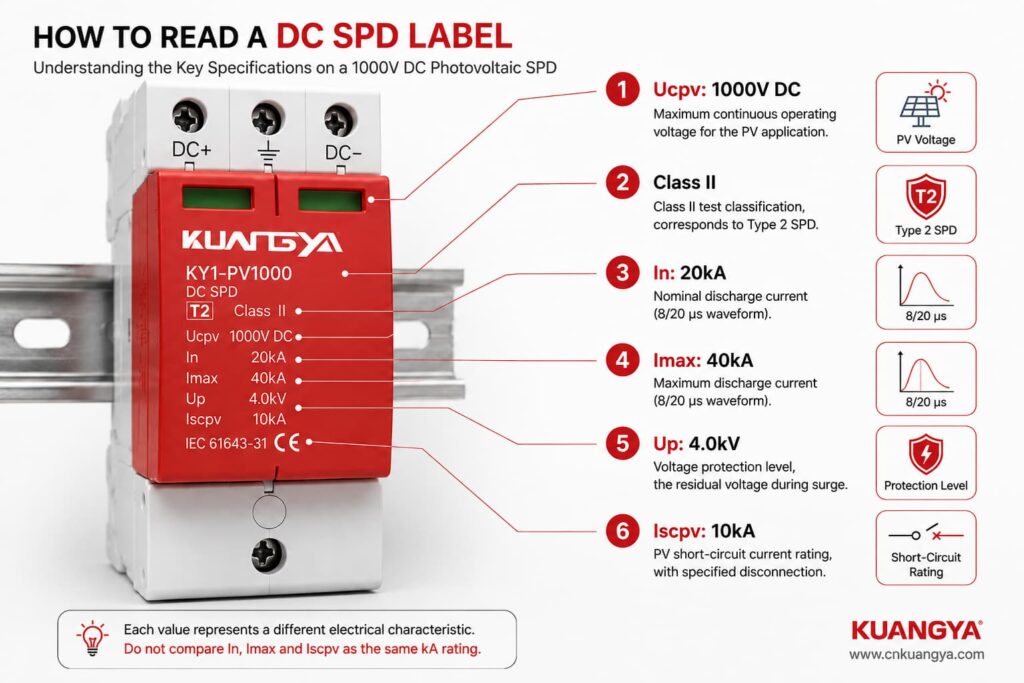
Sehen Sie sich diese Kurzanleitung an, um zu erfahren, wie die wichtigsten Kennzeichnungen auf dem Typenschild eines DC-ÜSS zu lesen sind.
Bevor wir auf die technischen Details eingehen, bietet die folgende Tabelle einen einfachen Überblick.
| Kennzeichnung | Beispiel | Einfache Bedeutung |
|---|---|---|
| Ucpv | 1000V DC | Maximale Dauerspannung für die PV-Anwendung |
| Klasse II | Klasse II | Klasse II geprüfter SPD, zugeordnet zum Typ 2 Überspannungsschutz |
| Unter | 20kA | Nennableitstoßstrom |
| Imax | 40kA | Maximaler Ableitstoßstrom |
| Nach oben | 4,0kV | Deklarierter Spannungsschutzpegel |
| Iscpv | 10kA | PV-Kurzschlussstromfestigkeit des SPD |
| Temperatur | -40°C bis +85°C | Deklarierter Betriebstemperaturbereich |
| Luftfeuchtigkeit | 5%–95% | Deklarierter Feuchtigkeitsbereich |
| Innenbereich | Innenbereich | Vorgesehen für geschützte Installationsbedingungen |
| IP20 | IP20 | Schutzart des SPD-Gehäuses |
Der wichtigste Punkt ist:
Vergleichen Sie DC-Überspannungsschutzgeräte nicht nur anhand der größten auf dem Etikett aufgedruckten kA-Zahl.
Zum Beispiel, Imax 40kA, In 20kA und Iscpv 10kA alle verwenden die Einheit kA, beschreiben jedoch völlig unterschiedliche Eigenschaften.
Wenn Käufer zum ersten Mal ein Datenblatt für einen Überspannungsschutz (ÜSS) sehen, beginnen sie oft mit der größten Zahl.
Das ist meistens der falsche Ansatz.
Eine sinnvollere Lesereihenfolge ist:
Diese Reihenfolge ermöglicht es, ungeeignete Produkte abzulehnen, bevor die Überspannungsstrom-Kennzahlen verglichen werden.
VIOX verwendet in seinem Datenblatt-Leitfaden einen ähnlichen Ansatz (“zuerst inkompatible Spezifikationen ablehnen”); bei PV-Anwendungen wird diese Logik noch wichtiger, da Ucpv und das PV-Kurzschlussverhalten besondere Aufmerksamkeit erfordern.
Eine der ersten Kennzeichnungen auf dem Beispiel-Etikett lautet:
Klasse II
Dies bedeutet nicht nicht eine zweitklassige Qualität.
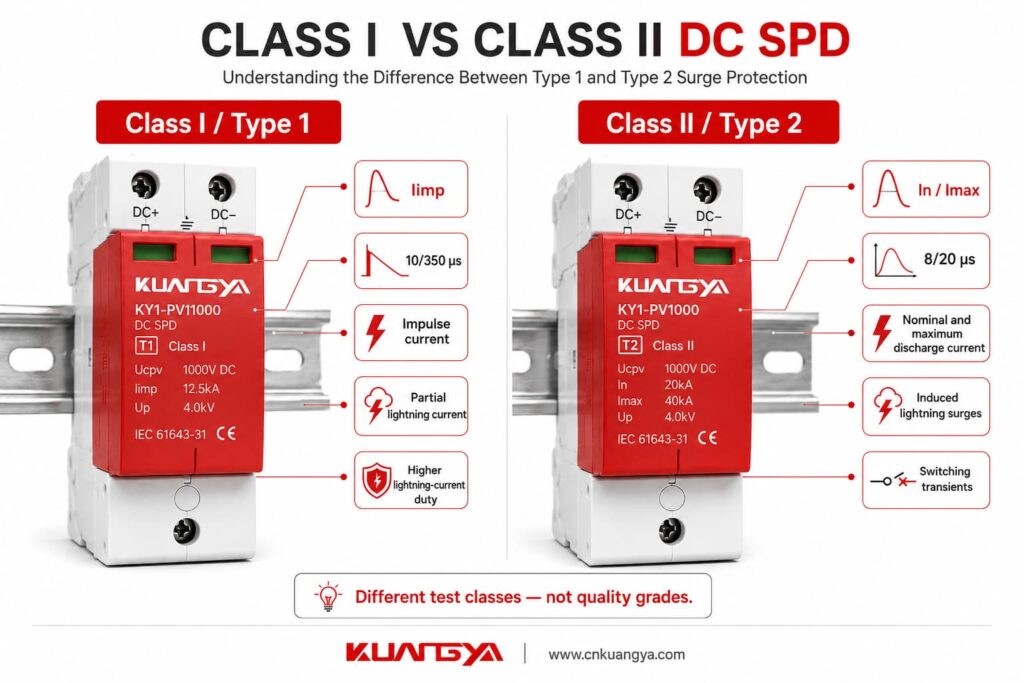
Klasse I, Klasse II und Klasse III beziehen sich auf standardisierte SPD-Prüfklassifizierungen, nicht auf Qualitätsstufen der Produkte.
Bei PV-Überspannungsschutzgeräten ist ein Typ-2-SPD verbunden mit Klasse-II-Prüfung.
Deshalb verwenden verschiedene Hersteller oder Datenblätter möglicherweise Kennzeichnungen wie:
Sie beziehen sich auf eng verwandte Klassifizierungs- und Prüfkonzepte, obwohl sie technisch gesehen “Typ” und “Prüfklasse” sind nicht einfach zwei verschiedene Schreibweisen desselben Begriffs.
Für die meisten Käufer lässt sich der praktische Zusammenhang wie folgt verstehen:
| SPD-Klassifizierung | Prüfklasse | Hauptstromparameter | Übliche Prüfwellenform |
|---|---|---|---|
| Typ 1 | Klasse I | Iimp | 10/350 μs |
| Typ 2 | Klasse II | In / Imax | 8/20 μs |
| Typ 3 | Klasse III | Weitere koordinierte Prüfparameter | Kombinationswellenprüfung |
Für das Beispiel in diesem Artikel:
Klasse II → Anwendungsrichtung Typ 2
und daher sind die wichtigsten angezeigten Stromparameter:
In = 20kA
Imax = 40kA
Nein.
Dies ist eines der häufigsten Missverständnisse beim Vergleich von Überspannungsschutzgeräten (SPDs).
Die Begriffe Klasse I und Klasse II können wie eine Rangfolge klingen:
Klasse I = besser
Klasse II = günstiger oder schwächer
So funktioniert die SPD-Klassifizierung nicht.
Sie sind vorgesehen für unterschiedliche Überspannungsbedingungen.
Ein Typ 1 / Klasse I SPD wird hinsichtlich seiner Blitzstoßstrom-Tragfähigkeit bewertet, da am Installationsort gegebenenfalls Teilblitzströme abgeleitet werden müssen.
Ein Typ 2 / Klasse II SPD wird üblicherweise verwendet, um transiente Überspannungen zu begrenzen, die durch induzierte Blitzeinwirkungen und Schaltvorgänge verursacht werden.
Daher lautet die richtige Frage nicht:
Welche Klasse ist besser?
Sie lautet:
Welcher SPD-Typ ist an diesem Installationspunkt erforderlich?
Ein Typ-1-Überspannungsschutz (SPD) ist nicht automatisch die richtige Wahl für jede PV-Anlage, und ein Typ-2-SPD ist nicht automatisch unzureichend, nur weil ein Typ 1 existiert.
Wenn Sie eine detaillierte Erläuterung zu dieser Auswahlfrage benötigen, lesen Sie unseren Leitfaden:
Typ 1 vs. Typ 2 vs. Typ 1+2 DC-ÜSS für Photovoltaikanlagen
Ihr bestehender Artikel geht tiefer auf Blitzexponierung, Installationsort und die Bewertung der Notwendigkeit von Typ-1-Fähigkeit ein.
Der größte technische Unterschied wird deutlicher, wenn wir den Prüfstrom betrachten.
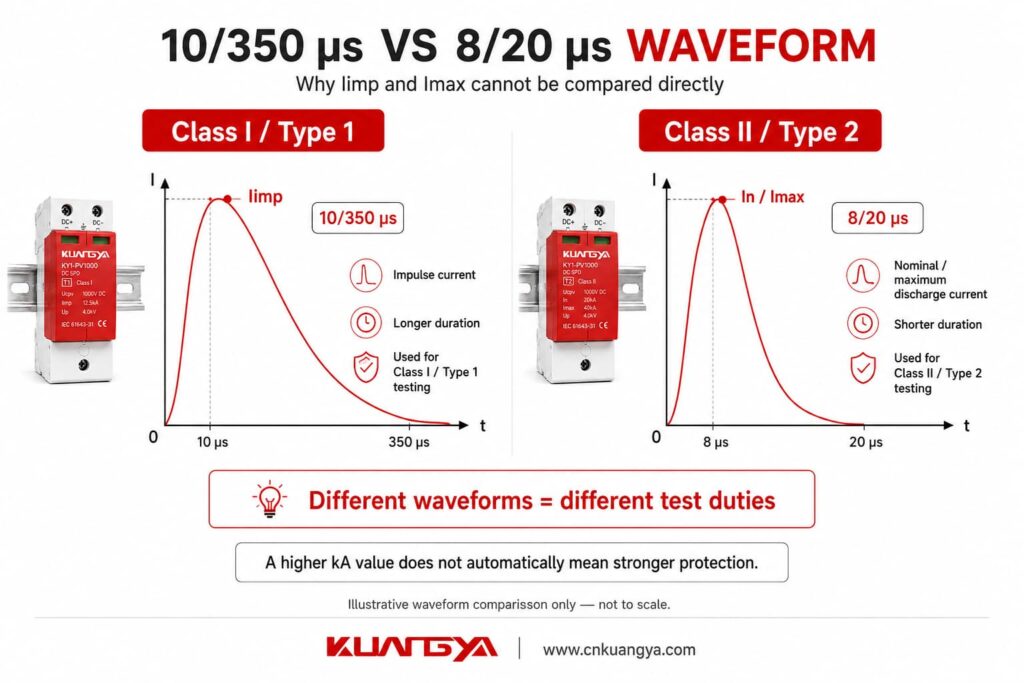
Ein Typ-1-Überspannungsschutzgerät (SPD) ist mit einem Stoßstrom-Bemessungswert assoziiert:
Iimp
und eine 10/350 μs Stromwellenform wird üblicherweise mit der Prüfung der Klasse I assoziiert.
Die 10/350 μs-Wellenform stellt eine wesentlich andere Stromenergiebelastung dar als die 8/20 μs-Wellenform, die für die Bewertung von Typ 2 verwendet wird.
Dies bedeutet:
Iimp kann nicht direkt mit Imax verglichen werden, nur weil beide in kA angegeben sind.
Zum Beispiel:
Iimp = 12,5 kA
und
Imax = 40kA
bedeutet nicht, dass das 40 kA-Produkt vom Typ 2 “stärker” ist.”
Sie beziehen sich auf unterschiedliche Prüfwellenformen und verschiedene Leistungsmerkmale.
Ein Typ 2 SPD wird hauptsächlich wie folgt charakterisiert:
Die 8/20 μs Stromwellenform ist mit der Ableitstromprüfung der Klasse II verbunden.
Typ 2 DC-Überspannungsschutzgeräte werden üblicherweise für den Einsatz an folgenden Orten bewertet:
Der endgültige SPD-Typ muss jedoch weiterhin vom tatsächlichen Blitzschutzkonzept und den Installationsbedingungen abhängen.
Klasse III existiert innerhalb der allgemeinen SPD-Klassifizierung, sollte jedoch bei der Diskussion über die typische Auswahl von PV-DC-Überspannungsschutzgeräten nicht das Hauptthema sein.
Der Schutz der Klasse III wird im Allgemeinen mit einem koordinierten Feinschutz in der Nähe empfindlicher Geräte in Verbindung gebracht.
Beim DC-Schutz für Photovoltaikanlagen werden Käufer weitaus häufiger auf Folgendes stoßen:
Deshalb konzentriert sich dieser Artikel hauptsächlich auf Klasse II und deren Beziehung zu Typ 2 DC-Überspannungsschutzgeräten, anstatt Klasse I, II und III als drei gleichermaßen verbreitete PV-Produktkategorien zu behandeln.
Das Beispiel-Etikett zeigt:
Ucpv: 1000V DC
Ucpv bedeutet:
Maximale Dauerspannung für PV-Anwendungen
Einfach ausgedrückt:
Ucpv gibt die maximale Gleichspannung an, die dauerhaft am Schutzpfad des SPD anliegen darf.
Die IEC 61643-32 definiert Ucpv im Wesentlichen auf diese Weise und legt fest, dass dieser Wert gleich oder höher als die für die Installation relevante maximale Leerlaufspannung der PV-Anlage sein muss.
Dies macht Ucpv zu einer der ersten Spezifikationen, die bei der Auswahl eines Solar-DC-SPD überprüft werden sollten.
Nicht unbedingt.
Dies ist wichtig.
Eine PV-Anlage sollte nicht allein anhand einer bequemen Nennbezeichnung bewertet werden, wie zum Beispiel:
1000V-Solaranlage
Die tatsächliche maximale Gleichspannung eines PV-Strangs hängt von Faktoren ab, darunter:
Die Leerlaufspannung von PV-Modulen steigt normalerweise bei sinkender Temperatur an.
Für eine umfassendere Erläuterung der PV-Generator-Spannung, der Strangauslegung und der damit verbundenen Systemanforderungen siehe unseren IEC 62548 Leitfaden zur PV-Anlagenauslegung.
Daher sollte der Auswahlprozess auf der maximal berechneten PV-Leerlaufspannung basieren, anstatt einfach die nominale Wechselrichter- oder Systemspannung zu übernehmen.
Ein vereinfachter Arbeitsablauf ist:
Modul-Leerlaufspannung (Voc)
→ Anzahl der Module in Reihe
→ Niedrigtemperatur-Korrektur
→ Maximale PV-Leerlaufspannung
→ Geeignete Ucpv auswählen
Wir haben dieses Thema bereits separat behandelt in unserem Leitfaden zur Auswahl von DC-Überspannungsschutzgeräten (SPD), einschließlich 600V-, 1000V- und 1500V-DC-Anwendungen.
Daher ist der wichtige Punkt in diesem Artikel einfach:
Ucpv ist ein Bemessungswert für die Dauerspannungsfestigkeit, kein Stoßstrom-Bemessungswert.
Dies ist eine weitere häufige Fehlerquelle.
Unser Beispiel-SPD zeigt:
Ucpv = 1000V DC
und
Up = 4,0kV
Ein Käufer könnte berechtigterweise fragen:
Warum hat ein 1000V-SPD auch eine 4kV-Spannungsbemessung?
Weil diese beiden Werte unterschiedliche Dinge beschreiben.
| Parameter | Beispiel | Was es beschreibt |
|---|---|---|
| Ucpv | 1000V DC | Kontinuierliche PV-Betriebsspannung |
| Nach oben | 4,0kV | Spannungsschutzpegel während der Stoßspannungsprüfung |
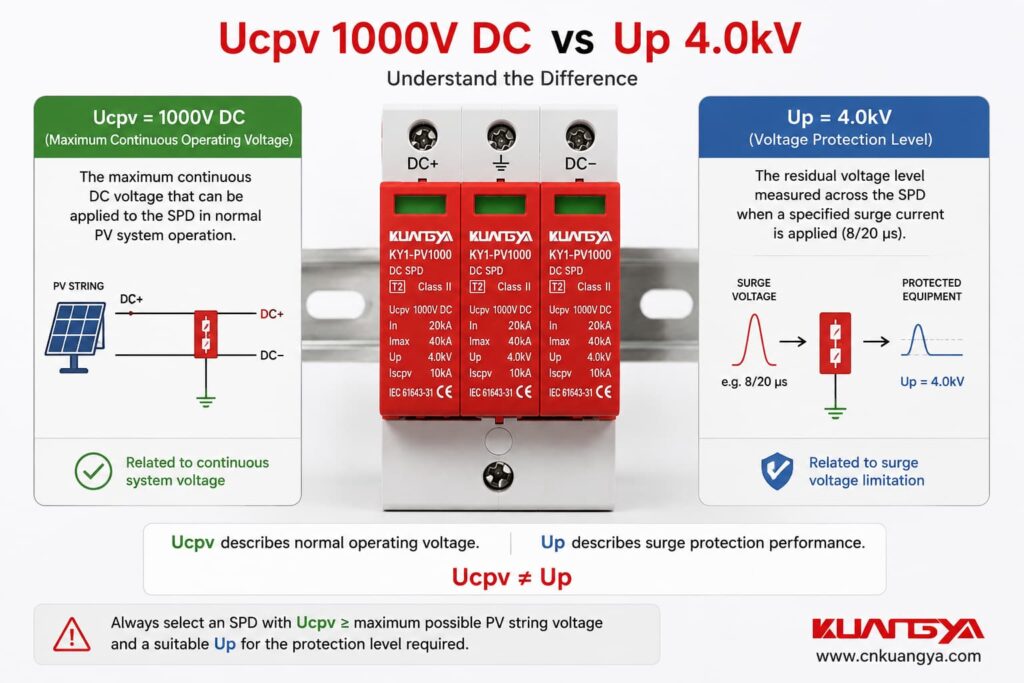
Also:
Ucpv bezieht sich auf das Bestehen des normalen Systembetriebs.
Up bezieht sich auf die Begrenzung transienter Stoßspannungen.
Sie sollten niemals als austauschbare Spannungswerte betrachtet werden.
Das Etikett zeigt:
In: 20kA
In bedeutet:
Nenn-Entladestrom
Für einen Typ 2 / Klasse II Überspannungsschutz (SPD) ist In mit einer 8/20 μs Stromwellenform assoziiert.
Fachsprachlich ausgedrückt stellt es den Scheitelwert des Stroms durch den SPD dar, der unter den relevanten standardisierten Testbedingungen die spezifizierte 8/20 μs Wellenform aufweist.
Diese Definition ist präzise, kann aber für einen Käufer vereinfacht werden:
In ist einer der wichtigsten Nennwerte zur Beschreibung der geprüften Ableitfähigkeit eines Typ 2 SPD.
Für dieses Produkt:
In = 20kA
Das wichtige Wort hierbei ist nominal.
Es sollte nicht mit Imax verwechselt werden.
Dasselbe SPD zeigt auch:
Imax: 40kA
Imax bedeutet:
Maximaler Entladestrom
Bei einem Typ-2-SPD wird Imax normalerweise auch mit dem 8/20 μs Stromwellenform assoziiert.
Es stellt die vom Hersteller deklarierte maximale Ableitstromkapazität unter den geltenden Testbedingungen dar.
Daher:
In 20kA und Imax 40kA sind keine doppelten Spezifikationen.
Sie repräsentieren unterschiedliche Prüfklassen.
This is one of the most important parts of the entire datasheet.
Consider the example:
| Parameter | Wert |
|---|---|
| Unter | 20kA |
| Imax | 40kA |
| Wellenform | 8/20 μs |
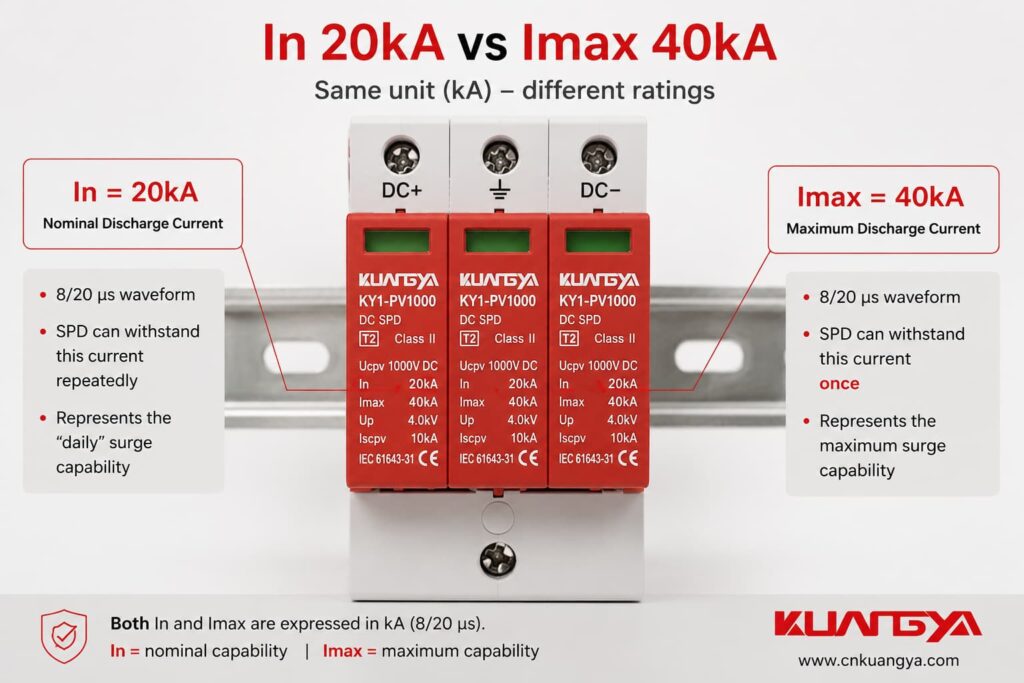
A simple way to understand them is:
Unter = nominal discharge-current rating.
Imax = maximum declared discharge-current rating.
One common purchasing mistake is to look only at Imax because it is the larger number.
Zum Beispiel:
SPD A: In 20kA / Imax 40kA
SPD B: In 10kA / Imax 40kA
A buyer may see “40kA” on both products and assume that their surge performance is equivalent.
That conclusion is incomplete.
The full declared performance needs to be checked.
VIOX makes the same useful procurement distinction in its SPD datasheet guide: In and Imax should be read separately, and Imax should not be interpreted as the SPD’s normal repeated discharge capacity.
Nein.
This is probably the most useful purchasing rule in this article:
The highest kA value does not automatically identify the best SPD.
Suppose two products are advertised as:
It would be incorrect to select SPD B immediately just because:
60kA > 40kA.
Other questions still matter:
A larger number may be useful when the complete design calls for it.
But:
More kA is not a substitute for correct coordination.
Not simply because it says 40kA.
This is another very common mistake.
A Type 2 product may show:
Imax = 40kA, 8/20 μs
while a Type 1 product may show:
Iimp = 12.5kA, 10/350 μs
Looking only at the peak current numbers:
40 > 12.5
may make the Type 2 SPD appear stronger.
But that comparison is technically incorrect.
The two values are based on different test waveforms and different protection duties.
Daher:
Imax cannot be used as a substitute for a specified Iimp requirement.
If the project requires Type 1 lightning-current capability, a large Type 2 Imax value alone does not satisfy that requirement.
Das Beispiel-Etikett zeigt:
Up: 4,0kV
Up means:
Spannung Schutzniveau
It describes the SPD’s declared voltage-limiting performance under specified standardized test conditions.
In practical terms, Up helps answer the question:
How effectively does the SPD limit the transient voltage during the relevant test?
Generally, a lower Up can provide a lower level of surge voltage at the SPD terminals.
However, this needs an important qualification.
The printed Up value should nicht be treated as the exact maximum voltage that every connected inverter or device will experience in a real installation.
Warum?
Because the actual voltage seen by the protected equipment can also be affected by:
VIOX correctly makes the same distinction: the declared Up is established at the SPD under standardized conditions, while installation conductors can increase the voltage presented to the protected equipment.
Not by itself.
It is reasonable to prefer effective voltage limitation, but the selection must remain compatible with the complete electrical system.
A low Up does not compensate for:
So instead of saying:
“Always buy the SPD with the lowest Up.”
A more technically correct rule is:
Select an SPD with a suitable Up while also verifying Ucpv, SPD Type, protected equipment withstand level and installation coordination.
Now we come to one of the most misunderstood PV-specific parameters:
Iscpv: 10kA
This is particularly important because it also uses the unit kA.
It is easy to look at:
In 20kA
Imax 40kA
Iscpv 10kA
and assume they are three levels of surge current.
Sie sind es nicht.
Iscpv means:
Short-Circuit Current Rating of the SPD for the PV application.
IEC terminology defines Iscpv as the maximum prospective short-circuit current from the power system for which the SPD, together with the specified disconnector, is rated.
A simpler explanation is:
Iscpv tells you whether the SPD and its specified disconnection arrangement are suitable for the prospective PV short-circuit current at the installation point.
Dies ist ein fault-current / short-circuit characteristic.
It is not a lightning-surge rating.
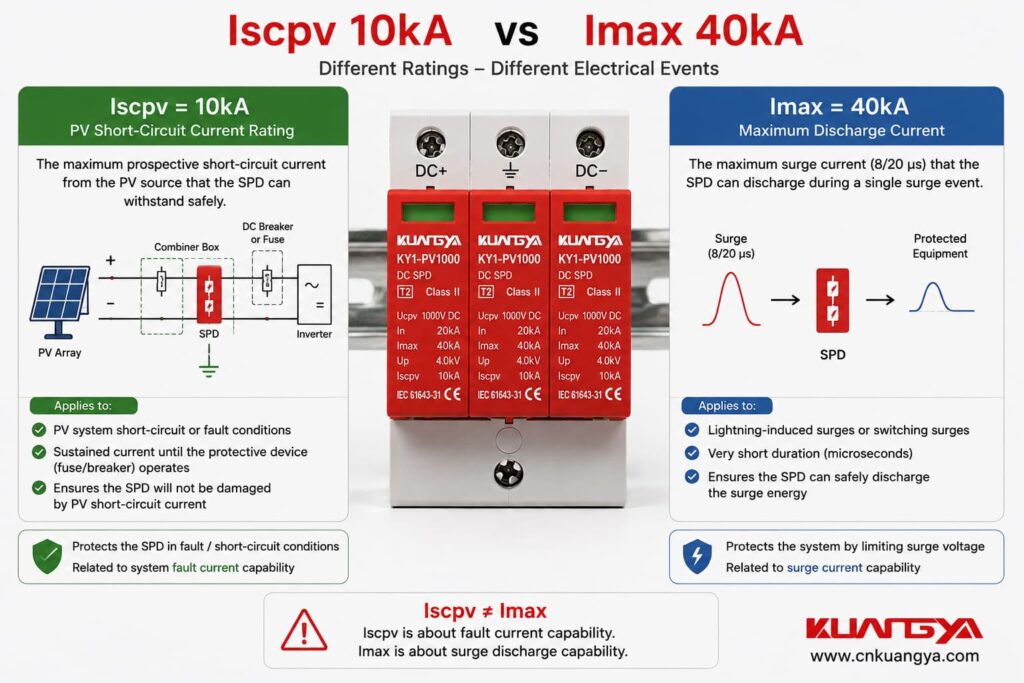
This distinction deserves to be stated clearly:
Iscpv ≠ Imax
Even though both can be expressed in kA.
Zum Beispiel:
Describes surge discharge-current performance.
Describes the SPD’s PV short-circuit-current rating in conjunction with the specified disconnection arrangement.
So on our example product:
Imax = 40kA
does not mean:
PV short-circuit rating = 40kA.
And:
Iscpv = 10kA
does not mean:
The SPD can only discharge a 10kA surge.
These numbers belong to different electrical events.
PV DC circuits behave differently from ordinary AC circuits.
One important difference is that DC current does not naturally pass through zero every half-cycle as AC current does.
For protection devices, switching equipment and disconnecting arrangements, this makes DC fault interruption an important design consideration.
That is one reason PV-specific SPDs have characteristics and test requirements beyond simply printing:
“DC 1000V”
on an AC-style product.
IEC 61643-31 is specifically intended for SPDs connected to the DC side of photovoltaic installations and establishes PV-specific requirements, ratings and test methods.
Therefore, when buying a PV SPD, do not ask only:
“Is this 1000V DC?”
Also ask:
What is the declared Iscpv and required disconnection arrangement?
The easiest way to remember these parameters is with this table:
| Bewertung | Main Meaning | Typical Context |
|---|---|---|
| Unter | Nennableitstoßstrom | Type 2 / Class II surge performance |
| Imax | Maximaler Ableitstoßstrom | Type 2 maximum declared surge-current performance |
| Iimp | Impulse current | Type 1 / Class I lightning-current capability |
| Iscpv | PV short-circuit current rating | PV fault-current compatibility |
Notice something important:
Three or four specifications can all contain:
kA
but this does not mean they can be compared directly.
Before comparing any two kA ratings, first ask:
This prevents a large number of purchasing errors.
The label also declares:
-40°C bis +85°C
This is the manufacturer’s declared temperature range for the product.
Environmental ratings should not be ignored simply because electrical parameters look correct.
PV equipment may be installed in:
The internal temperature of an enclosure can be very different from the normal outdoor air temperature.
Therefore, project engineers should confirm that the SPD’s declared environmental conditions are suitable for the actual enclosure and installation environment.
Where the datasheet declares:
5%–95%
this normally represents the manufacturer’s declared relative humidity operating range.
However, humidity specifications should always be read together with conditions such as:
The percentage alone does not mean that an exposed SPD can be installed directly in rain or other outdoor environments.
The label states:
Innenbereich
This does not necessarily mean that the SPD can never form part of an outdoor PV installation.
It means the SPD itself is intended for a protected environment according to its declared construction and installation conditions.
For example, an indoor-rated SPD may be installed inside:
The important distinction is:
The SPD can be inside outdoor equipment without the SPD itself being directly exposed to outdoor conditions.
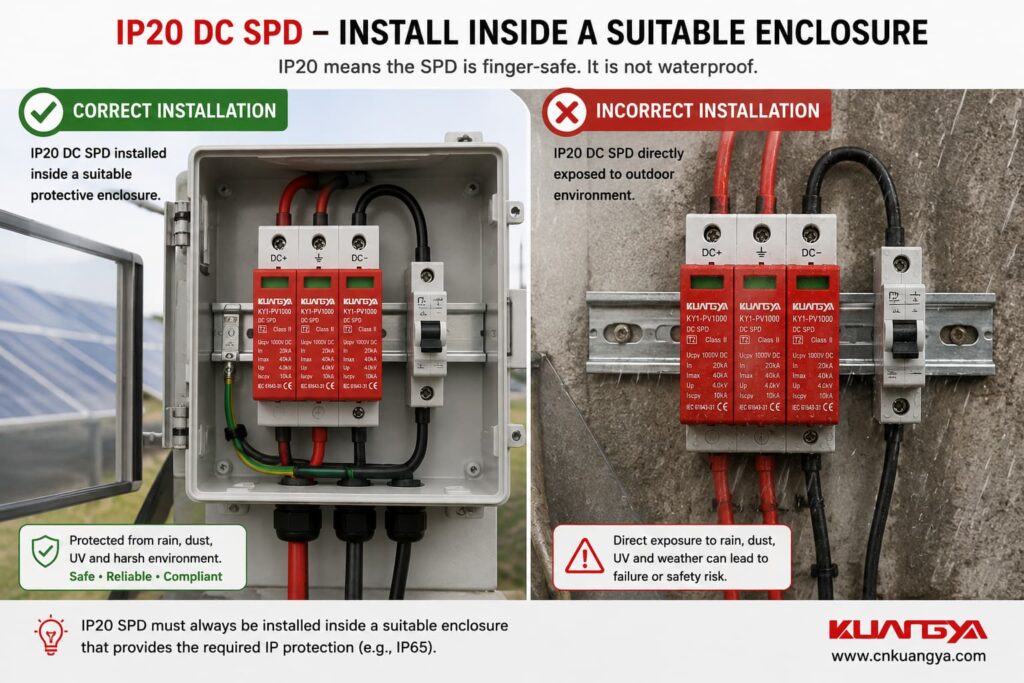
IP20 is the enclosure protection rating shown for the SPD itself.
It should not be interpreted as a weatherproof rating.
A DIN-rail SPD with IP20 is normally installed inside another suitable enclosure or cabinet.
For an outdoor PV installation, the final environmental protection depends on the complete enclosure, not only the bare SPD module.
Also:
IP20 SPD inside a suitable outdoor enclosure
can be a normal arrangement.
But:
IP20 SPD directly exposed to rain, dust and outdoor weather
should not be assumed to be acceptable.
Now we can return to the original example.
Ucpv: 1000V DC
Klasse II
In: 20kA
Imax: 40kA
Up: 4,0kV
Iscpv: 10kA
Instead of reading each number independently, read it as one technical description.
This tells us the declared maximum continuous PV operating voltage of the SPD.
This indicates Class II testing / Type 2 application direction.
This is the nominal discharge-current rating associated with the relevant Type 2 surge test.
This is the declared maximum discharge-current rating.
This is the declared voltage protection level.
This is the PV short-circuit-current rating and must be understood together with the applicable disconnector/protection arrangement.
Now the label makes much more sense.
It is not saying:
“1000V, 20kA, 40kA, 10kA — bigger numbers are better.”
It is describing different electrical functions and limits of the same SPD.
Incorrect:
Class I is premium and Class II is lower quality.
Correct:
Class I and Class II represent different test/protection classifications.
Incorrect:
This one says 60kA, so it is automatically better than the 40kA model.
Correct:
Check:
before making the comparison.
Incorrect:
Imax 40kA is higher than Iimp 12.5kA, so Type 2 is stronger.
Correct:
Iimp and Imax refer to different test waveforms and different surge duties.
Incorrect:
The SPD is rated 1000V but Up is 4kV, so the specifications conflict.
Correct:
Ucpv and Up describe different voltage characteristics.
Incorrect:
Iscpv 10kA means the SPD can discharge 10kA of lightning current.
Correct:
Iscpv is a PV short-circuit-current rating.
Even a correctly selected SPD can provide poor protection if installation is poor.
Important details include:
A datasheet tells you what the device is capable of under defined conditions.
Installation determines how effectively that capability is used in the real system.
The SPD should also be considered together with other solar PV electrical protection devices, including DC fuses, isolators, circuit breakers and the overall protection arrangement.
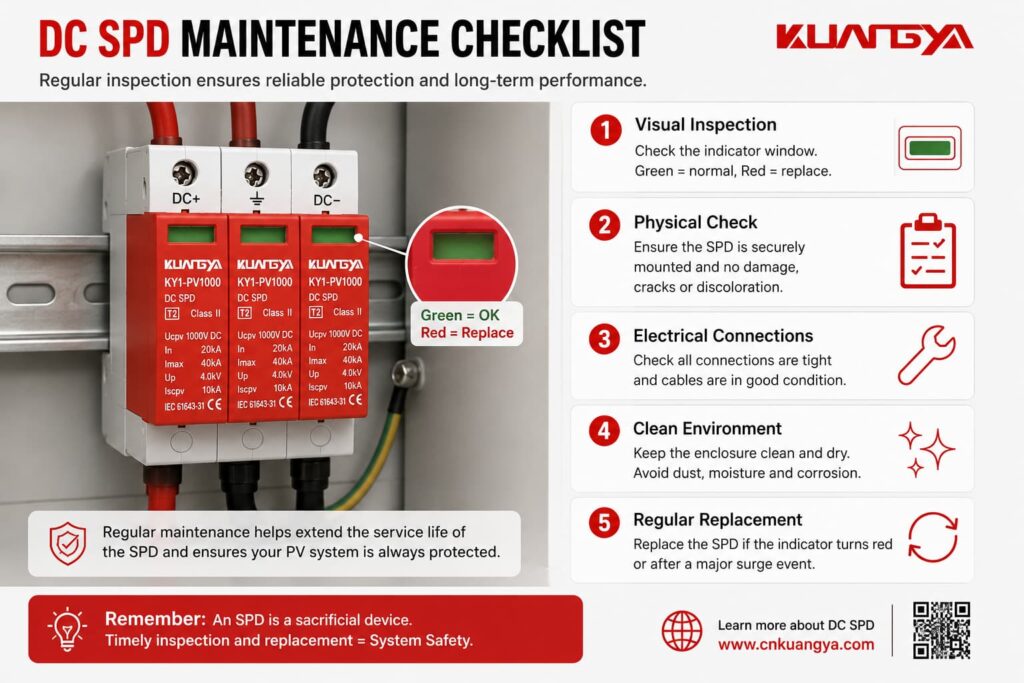
For buyers, distributors and EPC procurement teams, the following sequence is more useful than simply asking for:
“1000V 40kA SPD price.”
Is the product specifically intended for:
PV DC surge protection?
Do not assume an AC SPD with a similar voltage or current marking is interchangeable.
Determine the maximum possible PV open-circuit voltage.
Then confirm that the selected Ucpv is suitable.
For the full calculation method, refer to the DC SPD Voltage Selection Guide mentioned earlier.
Determine whether the installation requires:
Do not make this decision simply from product price or kA rating.
Our detailed Type 1 vs Type 2 vs Type 1+2 DC SPD guide explains this separately.
For a Type 2 / Class II SPD, confirm both values.
Do not check only Imax.
Verify the declared voltage protection level and whether it is appropriate for the protected equipment and protection concept.
Confirm that the SPD and specified disconnection/protection arrangement are compatible with the prospective short-circuit current of the PV system.
Confirm:
Überprüfen:
For PV DC SPDs, IEC 61643-31 is an important product standard to check.
IEC 61643-31:2018 covers SPDs intended for the DC side of photovoltaic installations up to 1500V DC, while IEC 61643-32:2017 addresses their selection, installation and coordination.
Depending on the project and market, buyers may also need:
Do not assume that a logo printed on a product is sufficient evidence.
Match the documentation to the exact model being purchased.
Before approving a PV SPD, use the following checklist.
| Siehe | Frage |
|---|---|
| Anmeldung | Is it specifically suitable for PV DC? |
| Ucpv | Is it suitable for maximum PV open-circuit voltage? |
| SPD-Typ | Does Type 1 / Type 2 / Type 1+2 match the installation design? |
| Prüfklasse | Is the declared classification clear? |
| Unter | Is the nominal discharge-current rating specified? |
| Imax | Is the maximum discharge-current rating specified? |
| Iimp | If Type 1 is required, is Iimp declared? |
| Nach oben | Is the protection level suitable? |
| Iscpv | Is the PV short-circuit rating adequate? |
| Verkabelung | Is the correct DC connection diagram available? |
| Schutz | Is required backup protection identified? |
| Umwelt | Are temperature, IP and enclosure conditions suitable? |
| Standard | Is the applicable PV SPD standard stated? |
| Dokumentation | Do certificates/test reports match the exact model? |
A weak RFQ might say:
Please quote 1000V 40kA solar SPD.
This leaves many important questions unanswered.
A better RFQ is:
Please quote a Type 2 / Class II PV DC SPD for a 1000V DC application. Please confirm Ucpv, In, Imax, Up, Iscpv, pole configuration, required backup protection, IEC 61643-31 documentation and wiring diagram.
If known, also include:
This allows the manufacturer to evaluate the complete requirement instead of matching only the words:
“1000V” and “40kA.”
They are closely related but technically describe classification/testing from slightly different perspectives.
For practical PV product selection, a Type 2 SPD is associated with Klasse-II-Prüfung, which is why labels and datasheets may show Type 2, T2 or Class II terminology.
Nein.
Class I and Class II are not quality levels.
They are intended for different surge-protection duties and test conditions.
In is the nominal discharge current.
Imax is the maximum discharge current.
For Type 2 SPDs, both are normally associated with the 8/20 μs waveform, but they represent different test-duty levels.
Not enough information is available to answer that from Imax alone.
A proper comparison also requires Ucpv, Type, In, Up, Iscpv, standard, protection configuration and installation conditions.
Not simply because its peak current number is larger.
Type 1 is characterized by lightning impulse-current capability such as Iimp and the associated Class I test conditions.
Imax and Iimp should not be directly compared.
Ucpv is the maximum continuous operating voltage for the PV application.
Nach oben is the declared voltage protection level under specified surge test conditions.
They perform completely different functions in the datasheet.
Iscpv is the short-circuit current rating of the PV SPD.
More precisely, it describes the maximum prospective short-circuit current for which the SPD, together with its specified disconnector arrangement, is rated.
Nein.
Imax is a surge discharge-current rating.
Iscpv is a short-circuit-current rating.
The fact that both use kA does not make them interchangeable.
Not automatically.
Maximum PV open-circuit voltage should be calculated under the project’s design conditions before selecting Ucpv.
For more detail, see our DC-Überspannungsschutz-Auswahlleitfaden: So wählen Sie die richtige Nennspannung.
It may be installed inside a suitable outdoor enclosure, provided the complete installation satisfies the required environmental protection.
IP20 on the SPD itself should not be treated as a weatherproof outdoor rating.
IEC 61643-31 covers requirements and test methods for SPDs intended for the DC side of photovoltaic installations up to 1500V DC.
IEC 61643-32 provides selection and application principles for PV SPDs.
Reading a DC SPD datasheet becomes much easier once each parameter is treated according to its actual purpose.
For the example:
Klasse II
Ucpv 1000V DC
In 20kA
Imax 40kA
Up 4.0kV
Iscpv 10kA
the correct interpretation is not simply:
“This is a 1000V, 40kA SPD.”
A more complete interpretation is:
Each specification answers a different engineering question.
That leads to one simple purchasing principle:
Never select a DC SPD from one voltage number, one kA number or one Type label alone.
The correct SPD is the one whose complete set of ratings matches the PV system voltage, surge environment, equipment protection requirements, short-circuit conditions and installation design.
For solar PV projects requiring 600V, 1000V or 1500V surge protection, explore KUANGYA DC surge protective devices to compare available Type 2 and Type 1+2 models by voltage rating, discharge-current capability and application.

