웽양 공업구 웨칭 원저우 325000
근무 시간
월요일~금요일: 오전 7시~오후 7시
주말: 주말: 오전 10시 - 오후 5시
웽양 공업구 웨칭 원저우 325000
근무 시간
월요일~금요일: 오전 7시~오후 7시
주말: 주말: 오전 10시 - 오후 5시

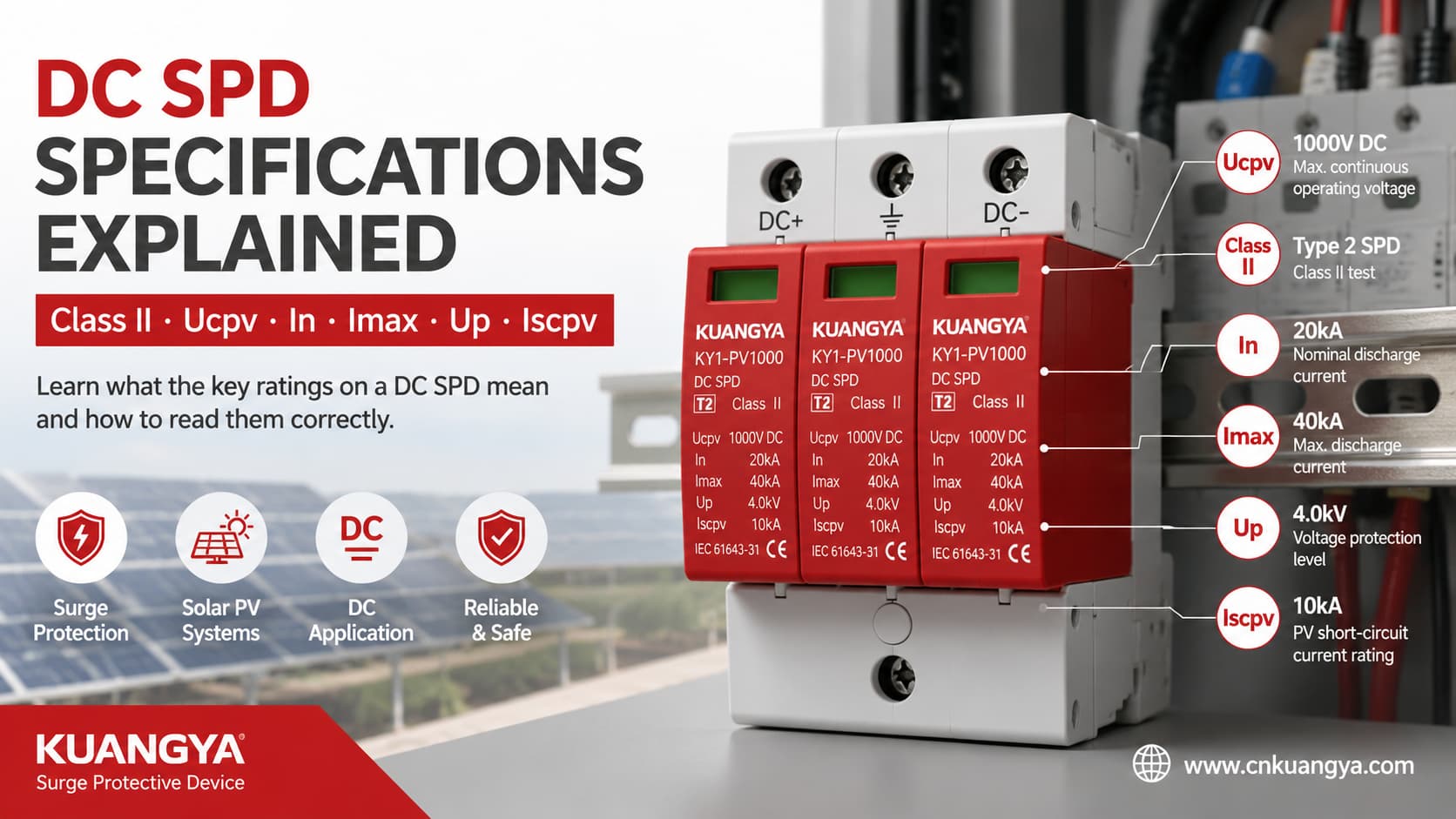
DC 서지 보호 장치는 외관상 단순해 보일 수 있지만, 라벨에 인쇄된 표기에는 해당 SPD의 사용처와 성능에 관한 중요한 정보가 포함되어 있습니다.
1000V DC 태양광 SPD의 다음 예시를 고려하십시오:
Ucpv: 1000V DC
클래스 II
In: 20kA
Imax: 40kA
Up: 4.0kV
Iscpv: 10kA
-40°C ~ +85°C
실내용, IP20
숙련된 전기 엔지니어에게 이러한 약어는 익숙합니다.
하지만 구매자, 유통업체, 태양광 설치업체 또는 프로젝트 구매자에게는 쉽게 혼란을 줄 수 있습니다.
이것이 클래스 II 2등급 SPD를 의미합니까?
이것이 40kA Imax입니까? 20kA보다 자동으로 더 우수한가요?
왜 동일한 SPD에 두 가지가 모두 표시되나요? 1000V 및 4.0kV?
이것이 Iscpv 10kA SPD가 10kA의 낙뢰 서지를 방전할 수 있다는 의미인가요?
간단한 답변은 다음과 같습니다: 단일 수치 하나만으로는 SPD 전체를 설명할 수 없습니다.
DC SPD는 완전한 전기적 특성 세트로 해석해야 합니다. 서지 보호 장치를 처음 접하신다면, 먼저 다음을 이해해야 합니다. 태양광 PV 시스템에서 DC SPD가 작동하는 방식 이러한 사양을 더 쉽게 이해할 수 있습니다.
이 가이드는 해당 표시를 올바르게 읽는 방법을 설명하며, Class II 1000V DC SPD를 실용적인 예시로 사용합니다.
DC SPD 명판의 주요 표시 사항을 읽는 방법을 알아보려면 이 빠른 가이드를 시청하십시오.
기술적인 세부 사항을 살펴보기 전에 아래 표에서 간단한 개요를 확인하십시오.
| 표시 | 예 | 간단한 의미 |
|---|---|---|
| Ucpv | 1000V DC | 태양광(PV) 애플리케이션을 위한 최대 연속 동작 전압 |
| 클래스 II | 클래스 II | Class II 시험 완료 SPD, Type 2 서지 보호 장치 관련 |
| In | 20kA | 공칭 방전 전류 |
| Imax | 40kA | 최대 방전 전류 |
| Up | 4.0kV | 선언된 전압 보호 레벨 |
| Iscpv | 10kA | SPD의 태양광(PV) 단락 전류 정격 |
| 온도 | -40°C ~ +85°C | 선언된 동작 온도 범위 |
| 습도 | 5%–95% | 선언된 습도 범위 |
| 실내용 | 실내용 | 보호된 설치 환경을 위한 용도 |
| IP20 | IP20 | SPD 외함의 보호 등급 |
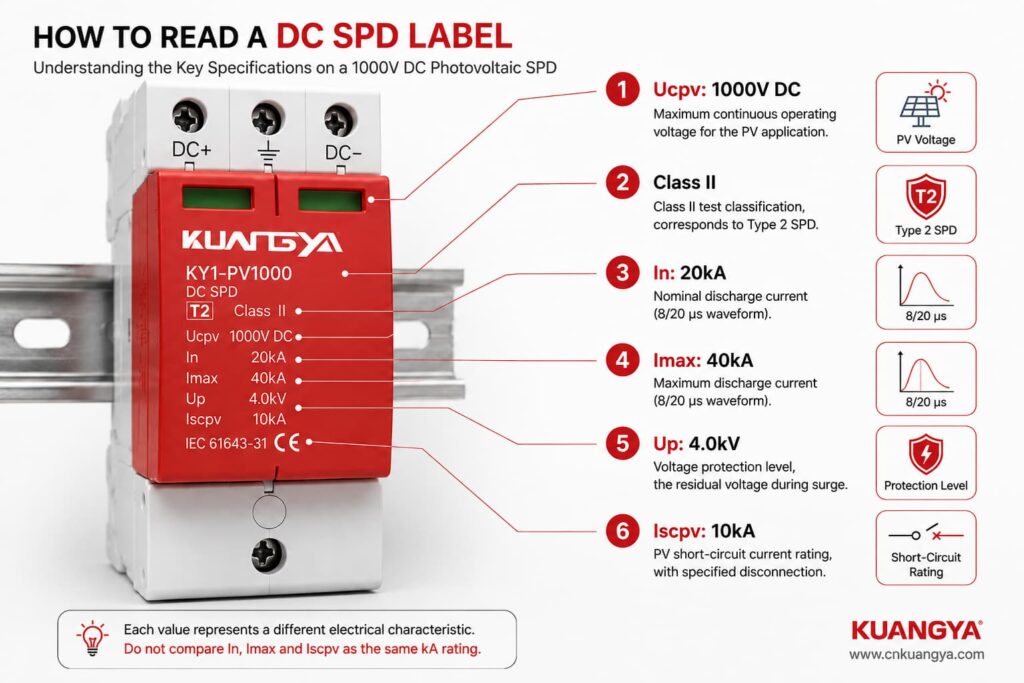
가장 중요한 점은 다음과 같습니다:
DC SPD를 라벨에 인쇄된 가장 큰 kA 수치만으로 비교하지 마십시오.
예를 들어, Imax 40kA, In 20kA 및 Iscpv 10kA 모두 kA 단위를 사용하지만, 완전히 다른 특성을 설명합니다.
구매자가 SPD 데이터시트를 처음 볼 때, 종종 가장 큰 숫자부터 확인하곤 합니다.
이는 대개 잘못된 접근 방식입니다.
더 유용한 읽기 순서는 다음과 같습니다:
이 순서를 따르면 주요 서지 전류 수치를 비교하기 전에 부적합한 제품을 사전에 배제할 수 있습니다.
VIOX는 데이터시트 가이드에서 이와 유사한 “부적합 사양 우선 배제” 방식을 사용합니다. PV 애플리케이션의 경우 Ucpv 및 PV 단락 동작에 특별한 주의가 필요하므로 이러한 논리가 더욱 중요해집니다.
예시 라벨에 표시된 첫 번째 표기 중 하나는 다음과 같습니다.
클래스 II
이것은 not 2등급 품질을 의미합니다.
Class I, Class II 및 Class III은 제품의 품질 등급이 아닌 표준화된 SPD 시험 분류를 의미합니다.
태양광(PV) 서지 보호 장치의 경우, Type 2 SPD는 다음 항목과 관련이 있습니다. Class II 시험.
이것이 바로 서로 다른 제조사나 데이터시트에서 다음과 같은 표기를 사용하는 이유입니다.
이들은 기술적으로는 서로 다르지만 밀접하게 관련된 분류 및 시험 개념을 지칭합니다. “Type”과 “test class”는 단순히 동일한 용어의 다른 표기법이 아닙니다..
대부분의 구매자에게 실질적인 관계는 다음과 같이 이해될 수 있습니다.
| SPD 분류 | 시험 등급 | 주 전류 매개변수 | 일반적인 시험 파형 |
|---|---|---|---|
| 유형 1 | 클래스 I | Iimp | 10/350 μs |
| 유형 2 | 클래스 II | In / 아이맥스 | 8/20 μs |
| 유형 3 | 클래스 III | 기타 조정된 시험 매개변수 | 조합 파형 시험 |
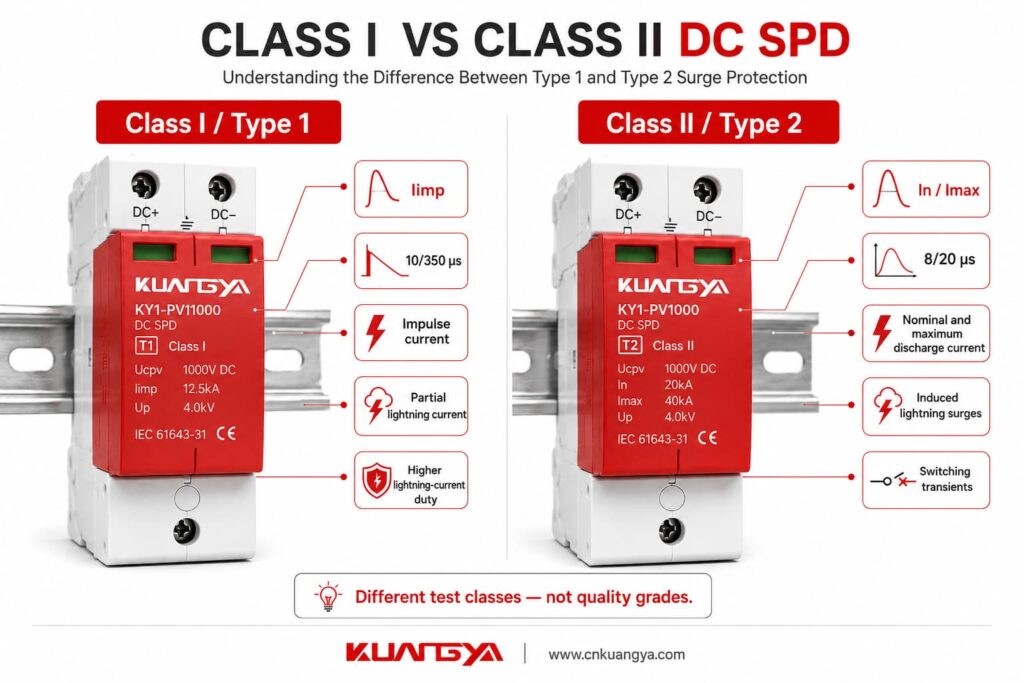
본 문서의 예시의 경우:
Class II → Type 2 적용 방향
따라서 가장 중요한 전류 매개변수는 다음과 같습니다:
In = 20kA
Imax = 40kA
아니요.
이는 서지 보호 장치(SPD)를 비교할 때 가장 흔한 오해 중 하나입니다.
Class I과 Class II라는 용어는 등급처럼 들릴 수 있습니다:
Class I = 더 우수함
Class II = 더 저렴하거나 성능이 낮음
SPD 분류는 그런 식으로 작동하지 않습니다.
이것들은 다음을 위해 의도된 것입니다. 서로 다른 서지 조건.
Type 1 / Class I SPD는 낙뢰 임펄스 전류 용량에 대해 평가되며, 설치 지점에서 부분적인 낙뢰 전류를 처리해야 할 수 있습니다.
Type 2 / Class II SPD는 일반적으로 유도 낙뢰 효과 및 스위칭 이벤트로 인한 과도 과전압을 제한하는 데 사용됩니다.
따라서 올바른 질문은 다음과 같지 않습니다.
어떤 등급이 더 나은가요?
올바른 질문은 다음과 같습니다.
이 설치 지점에 필요한 SPD 유형은 무엇입니까?
Type 1 SPD가 모든 태양광(PV) 설치에 항상 올바른 선택인 것은 아니며, Type 1이 존재한다고 해서 Type 2 SPD가 무조건 부적합한 것도 아닙니다.
이 선택 질문에 대한 자세한 설명이 필요하시면 당사의 가이드를 참조하십시오:
태양광 PV용 Type 1 vs Type 2 vs Type 1+2 DC SPD
기존 기사에서는 낙뢰 노출, 설치 위치 및 Type 1 성능을 평가해야 하는 시기에 대해 더 자세히 다룹니다.
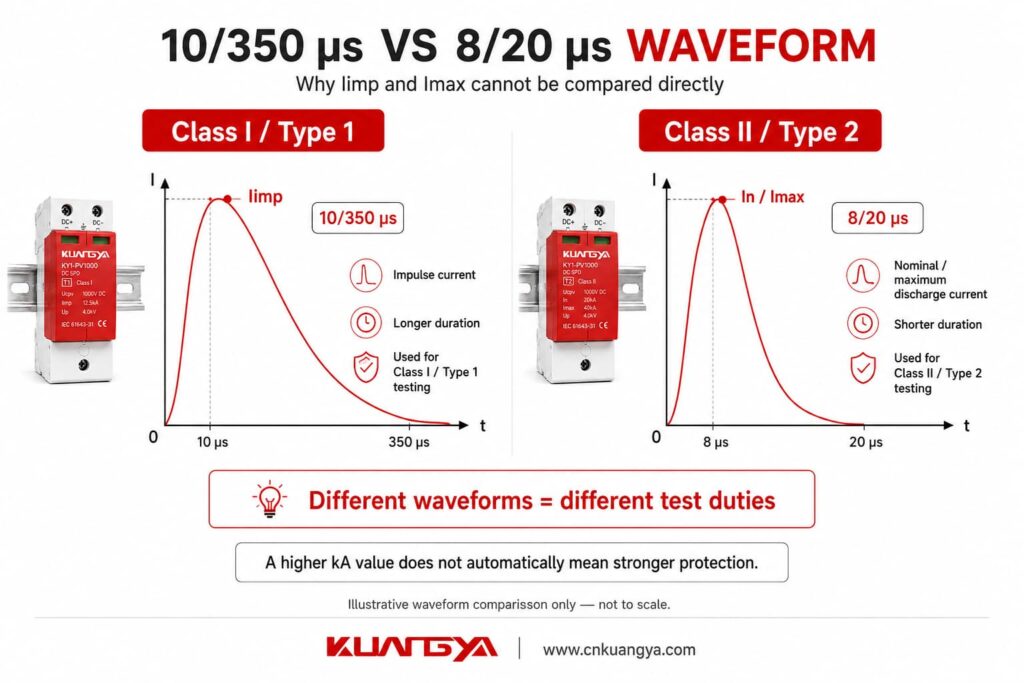
테스트 전류를 살펴보면 가장 큰 기술적 차이가 더 명확해집니다.
Type 1 SPD는 임펄스 전류 정격과 관련이 있습니다.
Iimp
그리고 10/350 μs 전류 파형은 일반적으로 Class I 테스트와 관련이 있습니다.
10/350 μs 파형은 Type 2 평가에 사용되는 8/20 μs 파형보다 훨씬 다른 전류-에너지 부하를 나타냅니다.
즉,
Iimp와 Imax는 둘 다 kA로 표시된다는 이유만으로 직접 비교할 수 없습니다.
예를 들어
Iimp = 12.5kA
및
Imax = 40kA
40kA Type 2 제품이 더 “강하다”는 것을 의미하지 않습니다.”
이는 서로 다른 테스트 파형과 서로 다른 성능 특성을 나타냅니다.
Type 2 SPD는 주로 다음을 사용하여 특성화됩니다:
8/20 μs 전류 파형은 Class II 방전 전류 테스트와 관련이 있습니다.
Type 2 DC SPD는 일반적으로 다음과 같은 위치에서의 사용을 위해 평가됩니다:
그러나 최종 SPD 유형은 여전히 실제 낙뢰 보호 설계 및 설치 조건에 따라 결정되어야 합니다.
Class III는 일반적인 SPD 분류 내에 존재하지만, 일반적인 태양광 DC SPD 선정에 대해 논의할 때 주요 주제가 되어서는 안 됩니다.
Class III 보호는 일반적으로 민감한 장비 근처의 정밀한 협조 보호와 관련이 있습니다.
태양광 DC 보호의 경우, 구매자는 다음과 같은 유형을 훨씬 더 자주 접하게 됩니다:
이것이 바로 이 글에서 주로 다루는 이유입니다. Class II와 Type 2 DC SPD와의 관계, Class I, II, III를 세 가지 동일하게 일반적인 태양광 제품 범주로 취급하는 대신 말입니다.
예시 라벨은 다음과 같습니다:
Ucpv: 1000V DC
Ucpv의 의미:
태양광(PV) 애플리케이션을 위한 최대 연속 동작 전압
간단히 말해서:
Ucpv는 서지 보호 장치(SPD)의 보호 모드에 지속적으로 인가될 수 있는 최대 직류(DC) 전압을 나타냅니다.
IEC 61643-32는 Ucpv를 본질적으로 이러한 방식으로 정의하며, 해당 전압은 설치 환경과 관련된 최대 태양광 개방 회로 전압 조건과 같거나 더 높아야 한다고 명시하고 있습니다.
따라서 Ucpv는 태양광 DC SPD를 선정할 때 가장 먼저 확인해야 할 사양 중 하나입니다.
꼭 그렇지는 않습니다.
이는 중요한 사항입니다.
PV 시스템은 다음과 같은 편리한 공칭 라벨만 사용하여 평가해서는 안 됩니다:
1000V 태양광 시스템
PV 스트링의 실제 최대 DC 전압은 다음을 포함한 여러 요인에 따라 달라집니다:
PV 모듈의 개방 전압은 일반적으로 온도가 낮아질 때 상승합니다.
PV 어레이 전압, 스트링 설계 및 관련 시스템 요구 사항에 대한 자세한 설명은 다음을 참조하십시오. IEC 62548 PV 어레이 설계 가이드.
따라서 선정 과정은 다음을 기준으로 해야 합니다. 계산된 최대 PV 개방 전압, 인버터나 시스템의 공칭 전압을 단순히 복사하는 것이 아닙니다.
간소화된 작업 흐름은 다음과 같습니다.
모듈 Voc
→ 직렬 모듈 수
→ 저온 보정
→ 최대 태양광(PV) 개방 전압
→ 적절한 Ucpv 선택
이 주제는 별도로 다룬 바 있습니다. DC 서지 보호 장치(SPD) 전압 선택 가이드, 600V, 1000V 및 1500V DC 애플리케이션을 포함합니다.
따라서 이 글에서 중요한 점은 간단합니다.
Ucpv는 서지 전류 정격이 아닌 연속 전압 호환성 정격입니다.
이것은 또 다른 흔한 혼동의 원인입니다.
당사의 SPD 예시는 다음을 보여줍니다:
Ucpv = 1000V DC
및
Up = 4.0kV
구매자는 다음과 같이 합리적으로 질문할 수 있습니다:
왜 1000V SPD가 4kV의 전압 정격을 동시에 가지고 있습니까?
왜냐하면 이 두 값은 서로 다른 것을 설명하기 때문입니다.
| 매개변수 | 예 | 설명하는 내용 |
|---|---|---|
| Ucpv | 1000V DC | 연속 태양광(PV) 동작 전압 |
| Up | 4.0kV | 서지 테스트 중 전압 보호 레벨 |
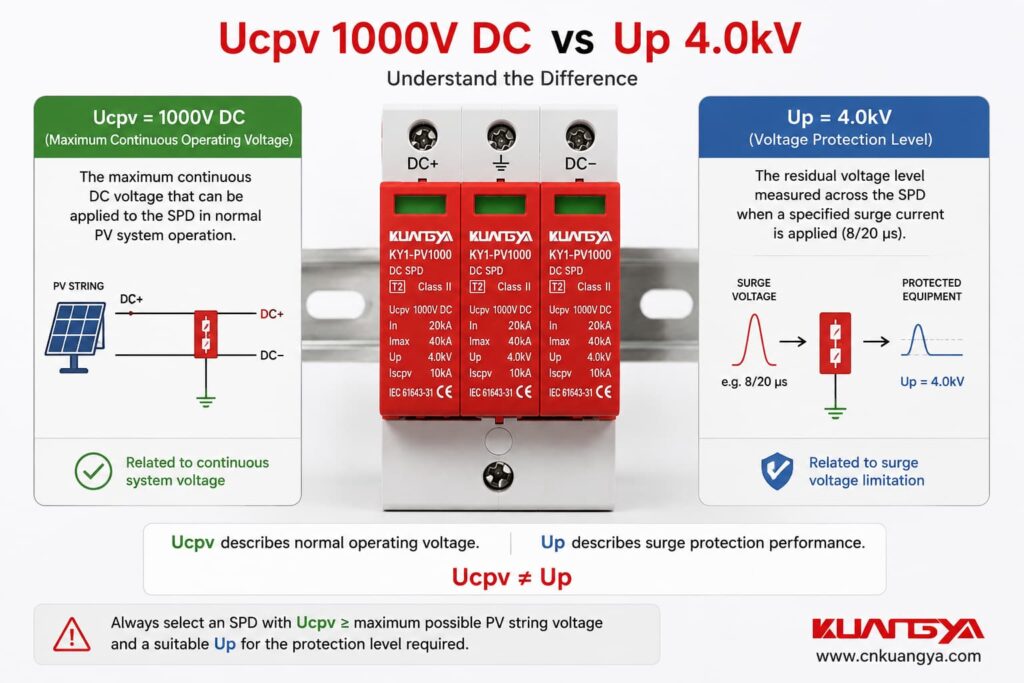
따라서:
Ucpv는 정상적인 시스템 작동을 견디는 것과 관련이 있습니다.
Up은 과도 서지 전압을 제한하는 것과 관련이 있습니다.
이 두 가지를 상호 교환 가능한 전압 정격으로 간주해서는 안 됩니다.
라벨에 표시된 내용은 다음과 같습니다:
In: 20kA
In의 의미:
공칭 방전 전류
Type 2 / Class II SPD의 경우, In은 다음 항목과 관련이 있습니다: 8/20 μs 전류 파형.
기술적 용어로, 이는 관련 표준 시험 조건 하에서 지정된 8/20 μs 파형을 가진 SPD를 통과하는 전류의 최대값을 의미합니다.
해당 정의는 정확하지만, 구매자를 위해 다음과 같이 단순화할 수 있습니다:
In은 Type 2 SPD의 시험된 서지 방전 성능을 설명하는 데 사용되는 주요 정격 중 하나입니다.
본 제품의 경우:
In = 20kA
여기서 중요한 단어는 정격(nominal).
Imax와 혼동해서는 안 됩니다.
동일한 SPD에 다음 사항도 표시되어 있습니다:
Imax: 40kA
Imax의 의미:
최대 방전 전류
Type 2 SPD의 경우, Imax는 일반적으로 다음 항목과도 관련이 있습니다. 8/20 μs 전류 파형.
이는 해당 시험 조건 하에서 제조사가 선언한 최대 방전 전류 용량을 나타냅니다.
따라서
In 20kA와 Imax 40kA는 중복된 사양이 아닙니다.
이들은 서로 다른 시험 부하 수준을 나타냅니다.
This is one of the most important parts of the entire datasheet.
Consider the example:
| 매개변수 | 가치 |
|---|---|
| In | 20kA |
| Imax | 40kA |
| 파형 | 8/20 μs |
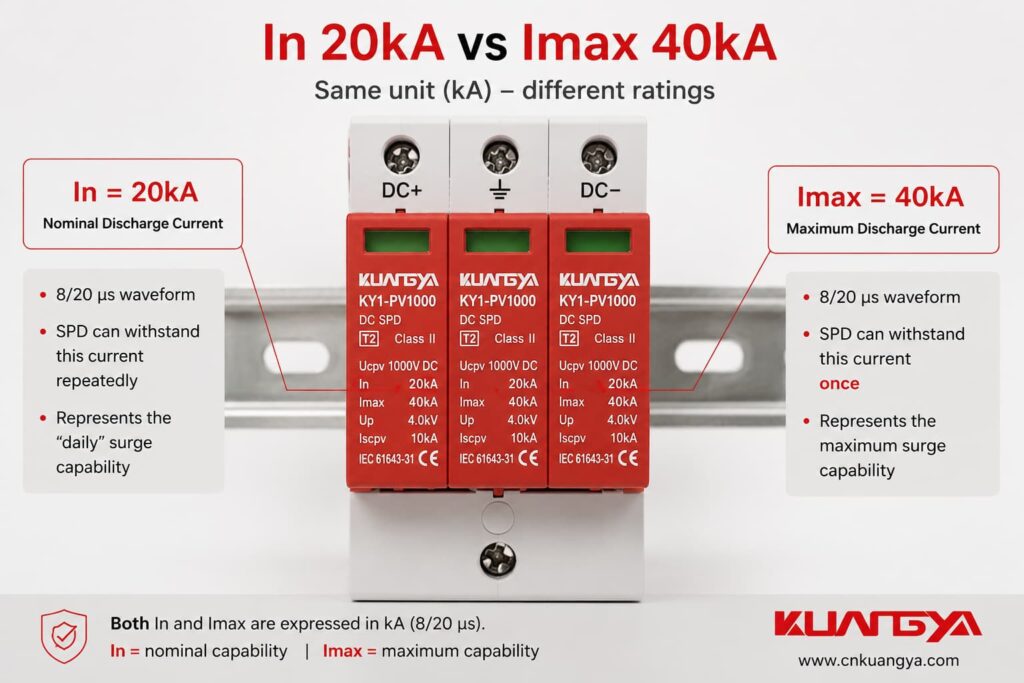
A simple way to understand them is:
In = nominal discharge-current rating.
Imax = maximum declared discharge-current rating.
One common purchasing mistake is to look only at Imax because it is the larger number.
예를 들어
SPD A: In 20kA / Imax 40kA
SPD B: In 10kA / Imax 40kA
A buyer may see “40kA” on both products and assume that their surge performance is equivalent.
That conclusion is incomplete.
The full declared performance needs to be checked.
VIOX makes the same useful procurement distinction in its SPD datasheet guide: In and Imax should be read separately, and Imax should not be interpreted as the SPD’s normal repeated discharge capacity.
아니요.
This is probably the most useful purchasing rule in this article:
The highest kA value does not automatically identify the best SPD.
Suppose two products are advertised as:
It would be incorrect to select SPD B immediately just because:
60kA > 40kA.
Other questions still matter:
A larger number may be useful when the complete design calls for it.
But:
More kA is not a substitute for correct coordination.
Not simply because it says 40kA.
This is another very common mistake.
A Type 2 product may show:
Imax = 40kA, 8/20 μs
while a Type 1 product may show:
Iimp = 12.5kA, 10/350 μs
Looking only at the peak current numbers:
40 > 12.5
may make the Type 2 SPD appear stronger.
But that comparison is technically incorrect.
The two values are based on different test waveforms and different protection duties.
따라서
Imax cannot be used as a substitute for a specified Iimp requirement.
If the project requires Type 1 lightning-current capability, a large Type 2 Imax value alone does not satisfy that requirement.
예시 라벨은 다음과 같습니다:
Up: 4.0kV
Up means:
전압 보호 수준
It describes the SPD’s declared voltage-limiting performance under specified standardized test conditions.
In practical terms, Up helps answer the question:
How effectively does the SPD limit the transient voltage during the relevant test?
Generally, a lower Up can provide a lower level of surge voltage at the SPD terminals.
However, this needs an important qualification.
The printed Up value should not be treated as the exact maximum voltage that every connected inverter or device will experience in a real installation.
왜 그럴까요?
Because the actual voltage seen by the protected equipment can also be affected by:
VIOX correctly makes the same distinction: the declared Up is established at the SPD under standardized conditions, while installation conductors can increase the voltage presented to the protected equipment.
Not by itself.
It is reasonable to prefer effective voltage limitation, but the selection must remain compatible with the complete electrical system.
A low Up does not compensate for:
So instead of saying:
“Always buy the SPD with the lowest Up.”
A more technically correct rule is:
Select an SPD with a suitable Up while also verifying Ucpv, SPD Type, protected equipment withstand level and installation coordination.
Now we come to one of the most misunderstood PV-specific parameters:
Iscpv: 10kA
This is particularly important because it also uses the unit kA.
It is easy to look at:
In 20kA
Imax 40kA
Iscpv 10kA
and assume they are three levels of surge current.
그렇지 않습니다.
Iscpv means:
Short-Circuit Current Rating of the SPD for the PV application.
IEC terminology defines Iscpv as the maximum prospective short-circuit current from the power system for which the SPD, together with the specified disconnector, is rated.
A simpler explanation is:
Iscpv tells you whether the SPD and its specified disconnection arrangement are suitable for the prospective PV short-circuit current at the installation point.
이는 fault-current / short-circuit characteristic.
It is not a lightning-surge rating.
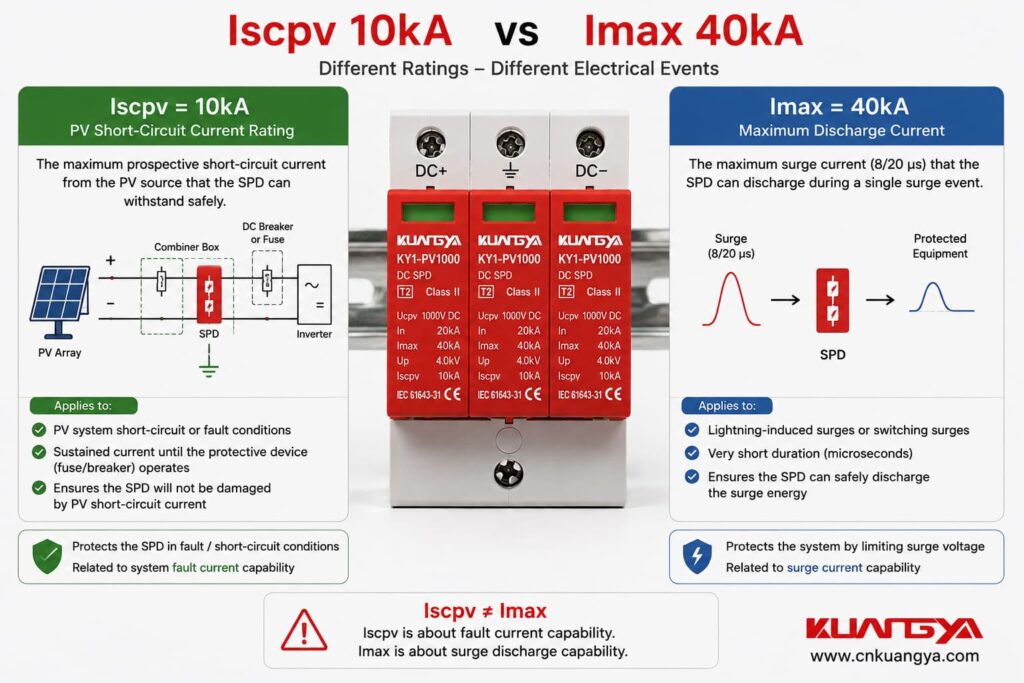
This distinction deserves to be stated clearly:
Iscpv ≠ Imax
Even though both can be expressed in kA.
예를 들어
Describes surge discharge-current performance.
Describes the SPD’s PV short-circuit-current rating in conjunction with the specified disconnection arrangement.
So on our example product:
Imax = 40kA
does not mean:
PV short-circuit rating = 40kA.
And:
Iscpv = 10kA
does not mean:
The SPD can only discharge a 10kA surge.
These numbers belong to different electrical events.
PV DC circuits behave differently from ordinary AC circuits.
One important difference is that DC current does not naturally pass through zero every half-cycle as AC current does.
For protection devices, switching equipment and disconnecting arrangements, this makes DC fault interruption an important design consideration.
That is one reason PV-specific SPDs have characteristics and test requirements beyond simply printing:
“DC 1000V”
on an AC-style product.
IEC 61643-31 is specifically intended for SPDs connected to the DC side of photovoltaic installations and establishes PV-specific requirements, ratings and test methods.
Therefore, when buying a PV SPD, do not ask only:
“Is this 1000V DC?”
Also ask:
What is the declared Iscpv and required disconnection arrangement?
The easiest way to remember these parameters is with this table:
| 평가 | Main Meaning | Typical Context |
|---|---|---|
| In | 공칭 방전 전류 | Type 2 / Class II surge performance |
| Imax | 최대 방전 전류 | Type 2 maximum declared surge-current performance |
| Iimp | Impulse current | Type 1 / Class I lightning-current capability |
| Iscpv | PV short-circuit current rating | PV fault-current compatibility |
Notice something important:
Three or four specifications can all contain:
kA
but this does not mean they can be compared directly.
Before comparing any two kA ratings, first ask:
This prevents a large number of purchasing errors.
The label also declares:
-40°C ~ +85°C
This is the manufacturer’s declared temperature range for the product.
Environmental ratings should not be ignored simply because electrical parameters look correct.
PV equipment may be installed in:
The internal temperature of an enclosure can be very different from the normal outdoor air temperature.
Therefore, project engineers should confirm that the SPD’s declared environmental conditions are suitable for the actual enclosure and installation environment.
Where the datasheet declares:
5%–95%
this normally represents the manufacturer’s declared relative humidity operating range.
However, humidity specifications should always be read together with conditions such as:
The percentage alone does not mean that an exposed SPD can be installed directly in rain or other outdoor environments.
The label states:
실내용
This does not necessarily mean that the SPD can never form part of an outdoor PV installation.
It means the SPD itself is intended for a protected environment according to its declared construction and installation conditions.
For example, an indoor-rated SPD may be installed inside:
The important distinction is:
The SPD can be inside outdoor equipment without the SPD itself being directly exposed to outdoor conditions.
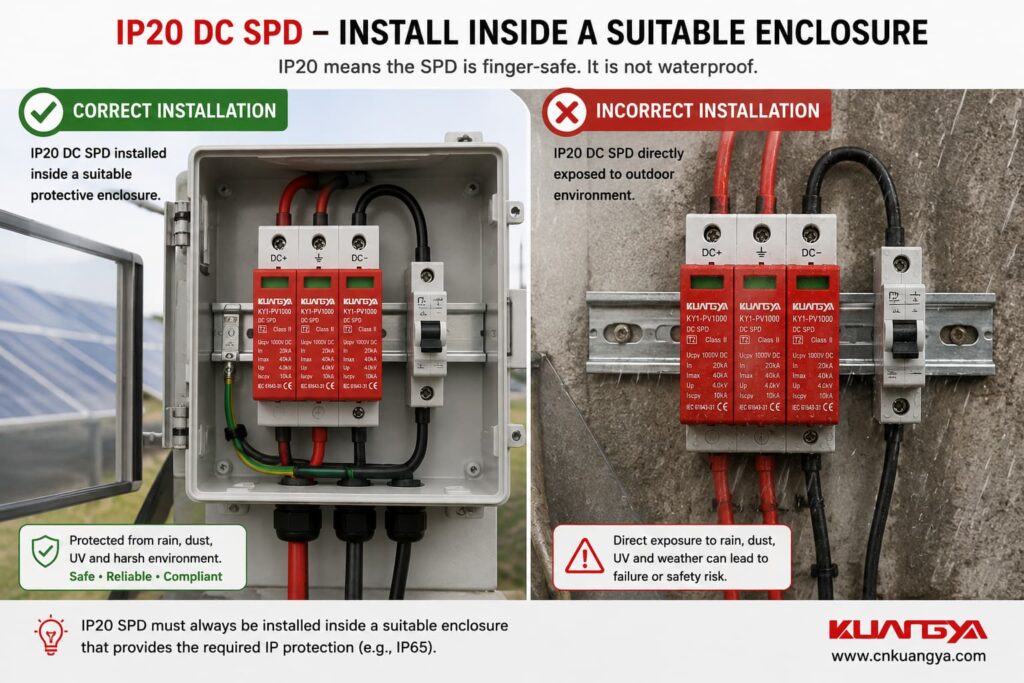
IP20 is the enclosure protection rating shown for the SPD itself.
It should not be interpreted as a weatherproof rating.
A DIN-rail SPD with IP20 is normally installed inside another suitable enclosure or cabinet.
For an outdoor PV installation, the final environmental protection depends on the complete enclosure, not only the bare SPD module.
따라서:
IP20 SPD inside a suitable outdoor enclosure
can be a normal arrangement.
But:
IP20 SPD directly exposed to rain, dust and outdoor weather
should not be assumed to be acceptable.
Now we can return to the original example.
Ucpv: 1000V DC
클래스 II
In: 20kA
Imax: 40kA
Up: 4.0kV
Iscpv: 10kA
Instead of reading each number independently, read it as one technical description.
This tells us the declared maximum continuous PV operating voltage of the SPD.
This indicates Class II testing / Type 2 application direction.
This is the nominal discharge-current rating associated with the relevant Type 2 surge test.
This is the declared maximum discharge-current rating.
This is the declared voltage protection level.
This is the PV short-circuit-current rating and must be understood together with the applicable disconnector/protection arrangement.
Now the label makes much more sense.
It is not saying:
“1000V, 20kA, 40kA, 10kA — bigger numbers are better.”
It is describing different electrical functions and limits of the same SPD.
Incorrect:
Class I is premium and Class II is lower quality.
Correct:
Class I and Class II represent different test/protection classifications.
Incorrect:
This one says 60kA, so it is automatically better than the 40kA model.
Correct:
Check:
before making the comparison.
Incorrect:
Imax 40kA is higher than Iimp 12.5kA, so Type 2 is stronger.
Correct:
Iimp and Imax refer to different test waveforms and different surge duties.
Incorrect:
The SPD is rated 1000V but Up is 4kV, so the specifications conflict.
Correct:
Ucpv and Up describe different voltage characteristics.
Incorrect:
Iscpv 10kA means the SPD can discharge 10kA of lightning current.
Correct:
Iscpv is a PV short-circuit-current rating.
Even a correctly selected SPD can provide poor protection if installation is poor.
Important details include:
A datasheet tells you what the device is capable of under defined conditions.
Installation determines how effectively that capability is used in the real system.
The SPD should also be considered together with other solar PV electrical protection devices, including DC fuses, isolators, circuit breakers and the overall protection arrangement.
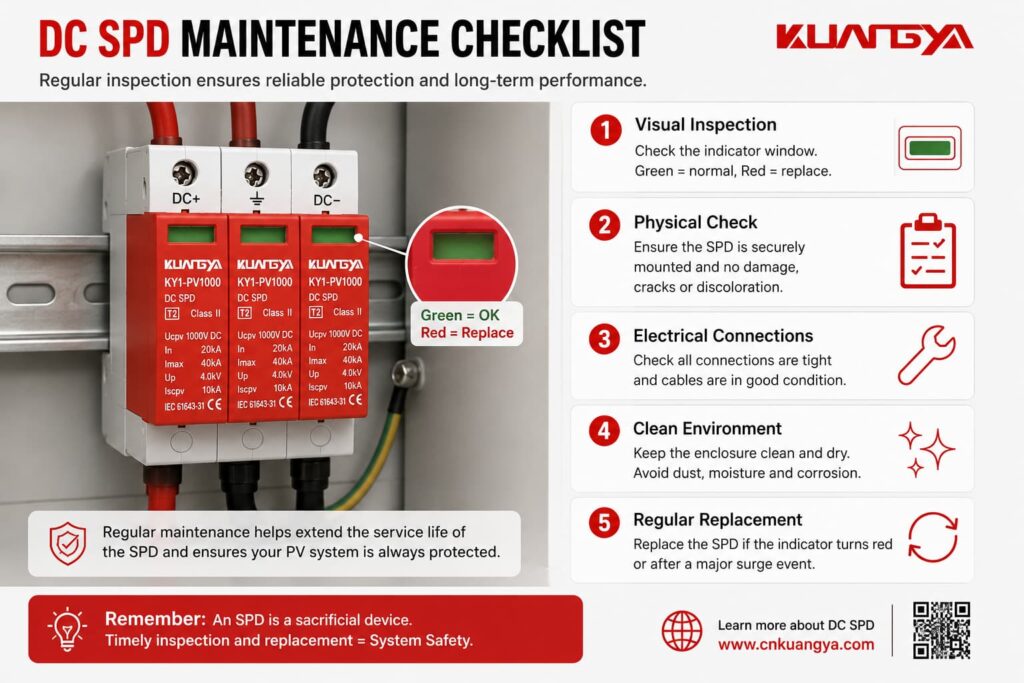
For buyers, distributors and EPC procurement teams, the following sequence is more useful than simply asking for:
“1000V 40kA SPD price.”
Is the product specifically intended for:
PV DC surge protection?
Do not assume an AC SPD with a similar voltage or current marking is interchangeable.
Determine the maximum possible PV open-circuit voltage.
Then confirm that the selected Ucpv is suitable.
For the full calculation method, refer to the DC SPD Voltage Selection Guide mentioned earlier.
Determine whether the installation requires:
Do not make this decision simply from product price or kA rating.
Our detailed Type 1 vs Type 2 vs Type 1+2 DC SPD guide explains this separately.
For a Type 2 / Class II SPD, confirm both values.
Do not check only Imax.
Verify the declared voltage protection level and whether it is appropriate for the protected equipment and protection concept.
Confirm that the SPD and specified disconnection/protection arrangement are compatible with the prospective short-circuit current of the PV system.
Confirm:
확인합니다:
For PV DC SPDs, IEC 61643-31 is an important product standard to check.
IEC 61643-31:2018 covers SPDs intended for the DC side of photovoltaic installations up to 1500V DC, while IEC 61643-32:2017 addresses their selection, installation and coordination.
Depending on the project and market, buyers may also need:
Do not assume that a logo printed on a product is sufficient evidence.
Match the documentation to the exact model being purchased.
Before approving a PV SPD, use the following checklist.
| 확인 | 질문 |
|---|---|
| 애플리케이션 | Is it specifically suitable for PV DC? |
| Ucpv | Is it suitable for maximum PV open-circuit voltage? |
| SPD 유형 | Does Type 1 / Type 2 / Type 1+2 match the installation design? |
| 시험 등급 | Is the declared classification clear? |
| In | Is the nominal discharge-current rating specified? |
| Imax | Is the maximum discharge-current rating specified? |
| Iimp | If Type 1 is required, is Iimp declared? |
| Up | Is the protection level suitable? |
| Iscpv | Is the PV short-circuit rating adequate? |
| 배선 | Is the correct DC connection diagram available? |
| 보호 | Is required backup protection identified? |
| 환경 | Are temperature, IP and enclosure conditions suitable? |
| 표준 | Is the applicable PV SPD standard stated? |
| 문서 | Do certificates/test reports match the exact model? |
A weak RFQ might say:
Please quote 1000V 40kA solar SPD.
This leaves many important questions unanswered.
A better RFQ is:
Please quote a Type 2 / Class II PV DC SPD for a 1000V DC application. Please confirm Ucpv, In, Imax, Up, Iscpv, pole configuration, required backup protection, IEC 61643-31 documentation and wiring diagram.
If known, also include:
This allows the manufacturer to evaluate the complete requirement instead of matching only the words:
“1000V” and “40kA.”
They are closely related but technically describe classification/testing from slightly different perspectives.
For practical PV product selection, a Type 2 SPD is associated with Class II 시험, which is why labels and datasheets may show Type 2, T2 or Class II terminology.
아니요.
Class I and Class II are not quality levels.
They are intended for different surge-protection duties and test conditions.
In is the nominal discharge current.
Imax is the maximum discharge current.
For Type 2 SPDs, both are normally associated with the 8/20 μs waveform, but they represent different test-duty levels.
Not enough information is available to answer that from Imax alone.
A proper comparison also requires Ucpv, Type, In, Up, Iscpv, standard, protection configuration and installation conditions.
Not simply because its peak current number is larger.
Type 1 is characterized by lightning impulse-current capability such as Iimp and the associated Class I test conditions.
Imax and Iimp should not be directly compared.
Ucpv is the maximum continuous operating voltage for the PV application.
Up is the declared voltage protection level under specified surge test conditions.
They perform completely different functions in the datasheet.
Iscpv is the short-circuit current rating of the PV SPD.
More precisely, it describes the maximum prospective short-circuit current for which the SPD, together with its specified disconnector arrangement, is rated.
아니요.
Imax is a surge discharge-current rating.
Iscpv is a short-circuit-current rating.
The fact that both use kA does not make them interchangeable.
Not automatically.
Maximum PV open-circuit voltage should be calculated under the project’s design conditions before selecting Ucpv.
For more detail, see our DC SPD 선정 가이드: 적절한 전압 정격 선택 방법.
It may be installed inside a suitable outdoor enclosure, provided the complete installation satisfies the required environmental protection.
IP20 on the SPD itself should not be treated as a weatherproof outdoor rating.
IEC 61643-31 covers requirements and test methods for SPDs intended for the DC side of photovoltaic installations up to 1500V DC.
IEC 61643-32 provides selection and application principles for PV SPDs.
Reading a DC SPD datasheet becomes much easier once each parameter is treated according to its actual purpose.
For the example:
클래스 II
Ucpv 1000V DC
In 20kA
Imax 40kA
Up 4.0kV
Iscpv 10kA
the correct interpretation is not simply:
“This is a 1000V, 40kA SPD.”
A more complete interpretation is:
Each specification answers a different engineering question.
That leads to one simple purchasing principle:
Never select a DC SPD from one voltage number, one kA number or one Type label alone.
The correct SPD is the one whose complete set of ratings matches the PV system voltage, surge environment, equipment protection requirements, short-circuit conditions and installation design.
For solar PV projects requiring 600V, 1000V or 1500V surge protection, explore KUANGYA DC surge protective devices to compare available Type 2 and Type 1+2 models by voltage rating, discharge-current capability and application.

