Zone industrielle WengYang Yueqing Wenzhou 325000
Heures de travail
Du lundi au vendredi : de 7h00 à 19h00
Le week-end : 10H00 - 17H00
Zone industrielle WengYang Yueqing Wenzhou 325000
Heures de travail
Du lundi au vendredi : de 7h00 à 19h00
Le week-end : 10H00 - 17H00

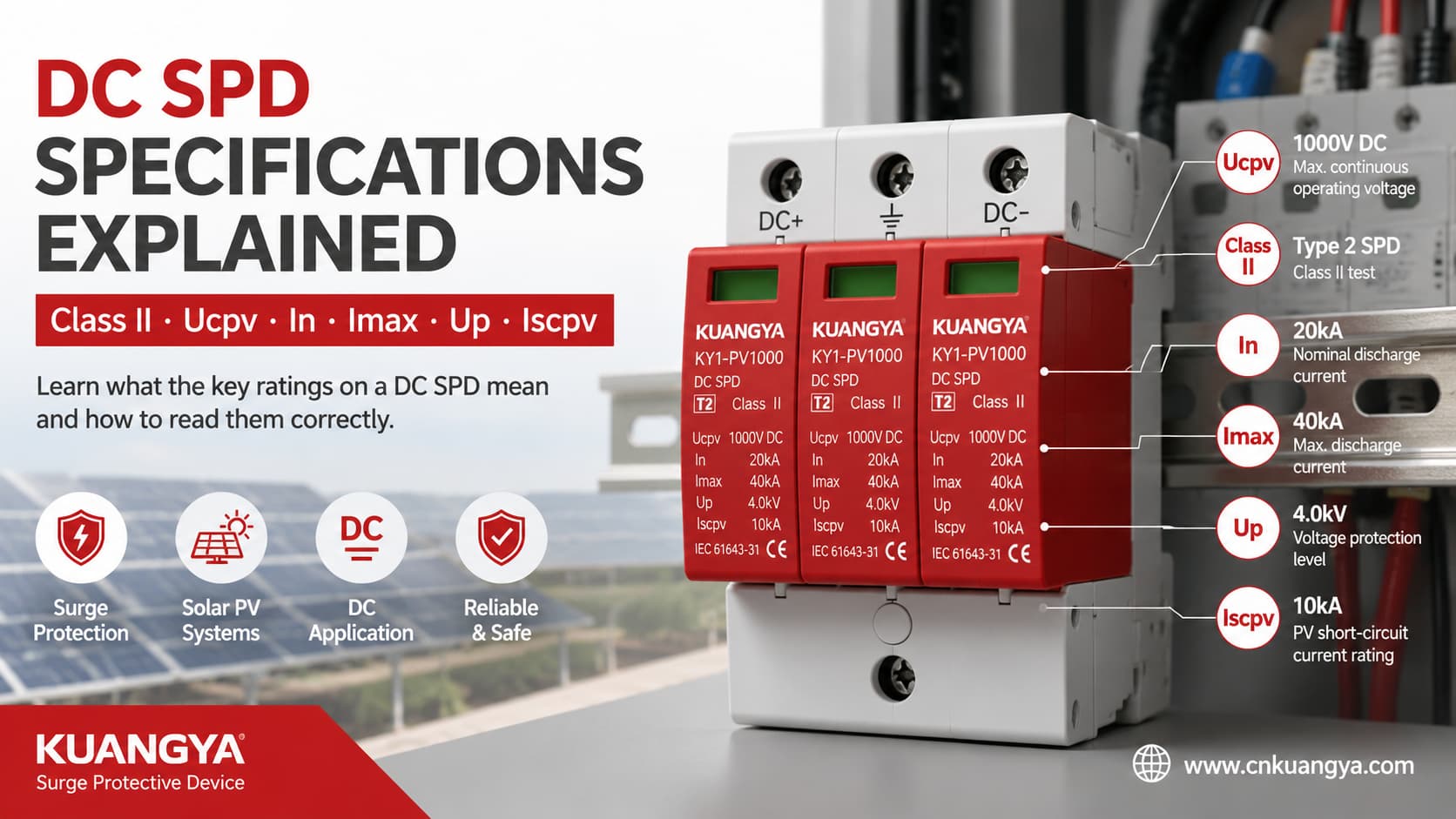
Un parafoudre DC peut sembler simple à l'extérieur, mais les marquages imprimés sur son étiquette contiennent des informations importantes sur l'endroit où le parafoudre peut être utilisé et sur ses performances.
Prenons cet exemple d'un parafoudre solaire DC 1000V :
Ucpv : 1000V DC
Classe II
In : 20kA
Imax : 40kA
Up : 4,0kV
Iscpv : 10kA
-40°C à +85°C
Intérieur, IP20
Pour un ingénieur électricien expérimenté, ces abréviations sont familières.
Pour un acheteur, un distributeur, un installateur solaire ou un responsable des achats de projet, cependant, elles peuvent facilement devenir déroutantes.
Est-ce que Classe II signifie un parafoudre de type 2 ?
Est-ce que 40kA Imax automatiquement meilleur que 20kA ?
Pourquoi le même parafoudre affiche-t-il à la fois 1000V et 4,0 kV?
Est-ce que Iscpv 10kA signifie-t-il que le parafoudre peut décharger une surtension de foudre de 10kA ?
La réponse courte est : aucun chiffre unique ne décrit l'ensemble du parafoudre.
Un parafoudre DC doit être interprété comme un ensemble complet de caractéristiques électriques. Si vous débutez dans la protection contre les surtensions, comprenez d'abord comment un parafoudre DC fonctionne dans un système solaire photovoltaïque peut faciliter le respect de ces spécifications.
Ce guide explique comment lire correctement ces marquages, en utilisant un parafoudre (SPD) CC de classe II 1000V comme exemple pratique.
Regardez ce guide rapide pour apprendre à lire les marquages clés sur la plaque signalétique d'un parafoudre DC.
Avant d'entrer dans les détails techniques, le tableau ci-dessous donne un aperçu simple.
| Marquage | Exemple | Signification simple |
|---|---|---|
| Ucpv | 1000V DC | Tension de fonctionnement continu maximale pour l'application photovoltaïque |
| Classe II | Classe II | Parafoudre testé de classe II, associé à une protection contre les surtensions de type 2 |
| En | 20kA | Courant de décharge nominal |
| Imax | 40kA | Courant de décharge maximal |
| Haut de la page | 4,0 kV | Niveau de protection en tension déclaré |
| Iscpv | 10kA | Courant de court-circuit PV nominal du parafoudre |
| Température | -40°C à +85°C | Plage de température de fonctionnement déclarée |
| Humidité | 5%–95% | Plage d'humidité déclarée |
| Intérieur | Intérieur | Destiné à des conditions d'installation protégées |
| IP20 | IP20 | Degré de protection du boîtier du parafoudre |
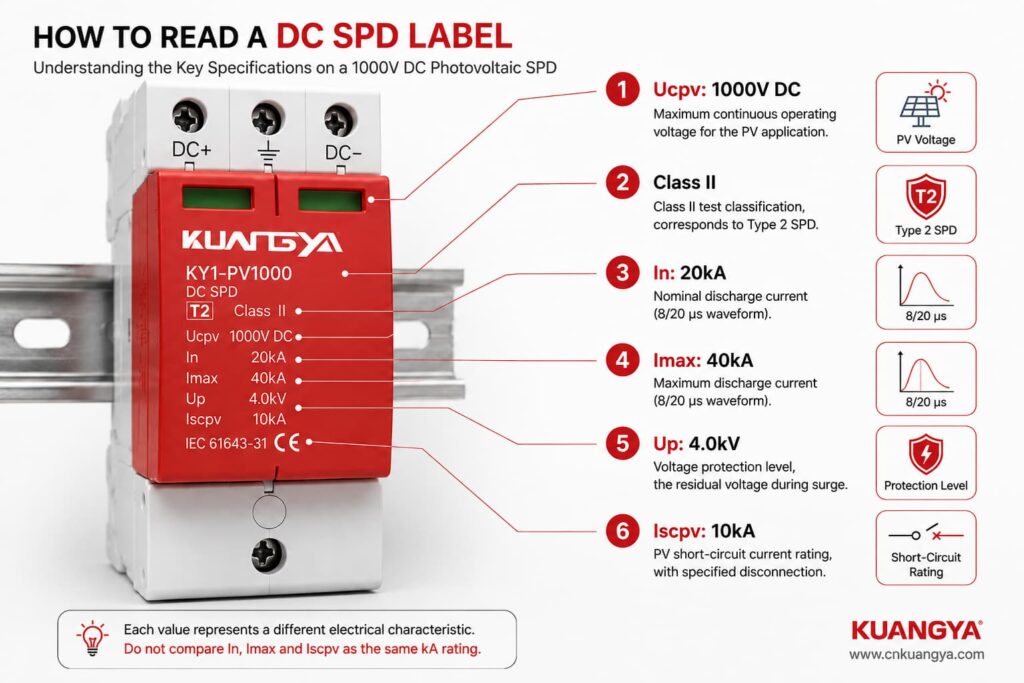
Le point le plus important est :
Ne comparez pas les parafoudres DC uniquement sur la base de la valeur kA la plus élevée imprimée sur l'étiquette.
Par exemple, Imax 40kA, In 20kA et Iscpv 10kA utilisent tous l'unité kA, mais ils décrivent des caractéristiques totalement différentes.
Lorsque les acheteurs voient pour la première fois une fiche technique de parafoudre, ils commencent souvent par le chiffre le plus élevé.
C'est généralement la mauvaise approche.
Un ordre de lecture plus utile est :
Cet ordre permet d'écarter les produits inadaptés avant de comparer les chiffres de courant de choc nominaux.
VIOX utilise une approche similaire consistant à “ rejeter d'abord les spécifications incompatibles ” dans son guide de fiches techniques ; pour les applications photovoltaïques, cette logique devient encore plus importante car l'Ucpv et le comportement en court-circuit du PV nécessitent une attention particulière.
L'un des premiers marquages sur l'étiquette d'exemple est :
Classe II
Ceci fait pas signifie une qualité de seconde classe.
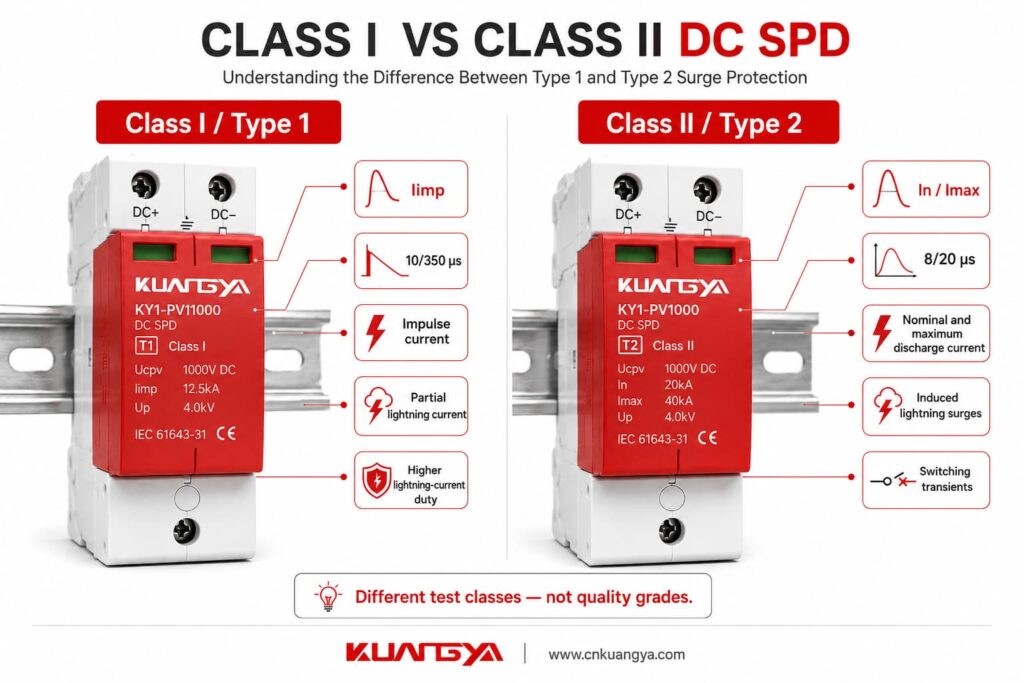
Les classes I, II et III font référence aux classifications de test normalisées des parafoudres (SPD), et non aux niveaux de qualité des produits.
Pour les parafoudres photovoltaïques, un parafoudre de type 2 est associé à un test de classe II.
C'est pourquoi différents fabricants ou fiches techniques peuvent utiliser des marquages tels que :
Ils font référence à des concepts de classification et de test étroitement liés, bien que techniquement “ Type ” et “ classe de test ” ne sont pas simplement deux orthographes différentes du même terme.
Pour la plupart des acheteurs, la relation pratique peut être comprise comme suit :
| Classification des parafoudres | Classe d'essai | Paramètre de courant principal | Forme d'onde d'essai commune |
|---|---|---|---|
| Type 1 | Classe I | Iimp | 10/350 μs |
| Type 2 | Classe II | In / Imax | 8/20 μs |
| Type 3 | Classe III | Autres paramètres d'essai coordonnés | Essai par onde combinée |
Pour l'exemple dans cet article :
Classe II → Direction d'application de type 2
et par conséquent, les paramètres de courant les plus importants indiqués sont :
In = 20kA
Imax = 40kA
Non.
C'est l'un des malentendus les plus courants lors de la comparaison des parafoudres (SPD).
Les termes Classe I et Classe II peuvent ressembler à un classement :
Classe I = meilleur
Classe II = moins cher ou moins performant
Ce n'est pas ainsi que fonctionne la classification des parafoudres (SPD).
Ils sont destinés à différentes conditions de surtension.
Un parafoudre de Type 1 / Classe I est évalué pour sa capacité à supporter des courants de choc de foudre, là où un courant de foudre partiel peut devoir être évacué au point d'installation.
Un parafoudre de Type 2 / Classe II est couramment utilisé pour limiter les surtensions transitoires causées par les effets induits de la foudre et les manœuvres de commutation.
Par conséquent, la bonne question n'est pas :
Quelle classe est la meilleure ?
C'est :
Quel type de parafoudre (SPD) est requis à ce point d'installation ?
Un parafoudre de type 1 n'est pas automatiquement le choix approprié pour chaque installation photovoltaïque, et un parafoudre de type 2 n'est pas automatiquement inadapté simplement parce qu'un type 1 existe.
Si vous avez besoin d'une explication détaillée sur cette question de sélection, consultez notre guide :
SPD CC Type 1 vs Type 2 vs Type 1+2 pour le solaire photovoltaïque
Votre article existant approfondit les sujets de l'exposition à la foudre, de l'emplacement de l'installation et du moment où la capacité de Type 1 doit être évaluée.
La plus grande différence technique devient plus claire lorsque nous examinons le courant d'essai.
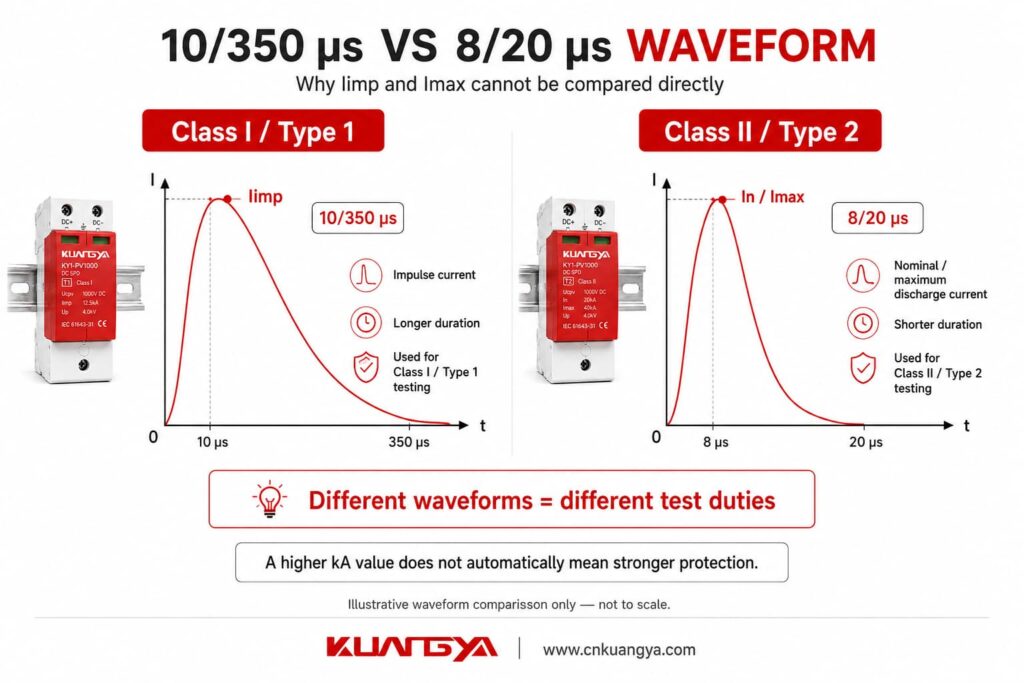
Un SPD de Type 1 est associé à une valeur nominale de courant d'impulsion :
Iimp
et un 10/350 μs La forme d'onde de courant est généralement associée aux essais de classe I.
La forme d'onde 10/350 μs représente une contrainte en courant et en énergie très différente de la forme d'onde 8/20 μs utilisée pour l'évaluation de type 2.
Cela signifie que :
Iimp ne peut pas être directement comparé à Imax simplement parce que les deux sont exprimés en kA.
Par exemple :
Iimp = 12,5 kA
et
Imax = 40kA
ne signifie pas que le produit de type 2 de 40 kA est “ plus robuste ”.”
Ils font référence à des formes d'onde d'essai et à des caractéristiques de performance différentes.
Un parafoudre de type 2 est principalement caractérisé par :
La forme d'onde de courant 8/20 μs est associée aux essais de courant de décharge de classe II.
Les parafoudres CC de type 2 sont généralement évalués pour une utilisation dans des emplacements tels que :
Cependant, le type de parafoudre final doit toujours dépendre de la conception réelle de la protection contre la foudre et des conditions d'installation.
La classe III existe au sein de la classification générale des parafoudres, mais elle ne devrait pas devenir le sujet principal lors de la discussion sur la sélection typique des parafoudres CC photovoltaïques.
La protection de classe III est généralement associée à une protection fine coordonnée à proximité des équipements sensibles.
Pour la protection CC des installations solaires photovoltaïques, les acheteurs rencontreront beaucoup plus couramment :
C'est pourquoi cet article se concentre principalement sur La classe II et sa relation avec les parafoudres CC de type 2, plutôt que de traiter les classes I, II et III comme trois catégories de produits photovoltaïques aussi courantes les unes que les autres.
L'étiquette d'exemple indique :
Ucpv : 1000V DC
Ucpv signifie :
Tension maximale de fonctionnement continu pour application photovoltaïque
En termes simples :
Ucpv indique la tension continue maximale pouvant être appliquée en permanence au mode de protection du parafoudre.
La norme IEC 61643-32 définit l'Ucpv essentiellement de cette manière et stipule qu'elle doit être égale ou supérieure à la tension maximale en circuit ouvert photovoltaïque correspondant à l'installation.
Cela fait de l'Ucpv l'une des premières spécifications à vérifier lors du choix d'un parafoudre DC pour installation solaire.
Pas nécessairement.
Ceci est important.
Un système photovoltaïque ne doit pas être évalué uniquement à l'aide d'une étiquette nominale pratique telle que :
système solaire 1000V
La tension continue maximale réelle d'une chaîne photovoltaïque dépend de facteurs incluant :
La tension en circuit ouvert d'un module photovoltaïque augmente normalement lorsque la température chute.
Pour une explication plus détaillée de la tension des champs photovoltaïques, de la conception des chaînes et des exigences système associées, veuillez consulter notre Guide de conception des champs photovoltaïques selon la norme CEI 62548.
Therefore, the selection process should be based on the maximum calculated PV open-circuit voltage, rather than simply copying the nominal inverter or system voltage.
A simplified workflow is:
Module Voc
→ Number of modules in series
→ Low-temperature correction
→ Maximum PV open-circuit voltage
→ Select suitable Ucpv
We have already covered this subject separately in our DC SPD Voltage Selection Guide, including 600V, 1000V and 1500V DC applications.
So in this article, the important point is simply:
Ucpv is a continuous-voltage compatibility rating, not a surge-current rating.
This is another common source of confusion.
Our example SPD shows:
Ucpv = 1000V DC
et
Up = 4.0kV
A buyer may reasonably ask:
Why does a 1000V SPD also have a 4kV voltage rating?
Because these two values describe different things.
| Paramètres | Exemple | Ce qu'il décrit |
|---|---|---|
| Ucpv | 1000V DC | Continuous PV operating voltage |
| Haut de la page | 4,0 kV | Voltage protection level during surge testing |
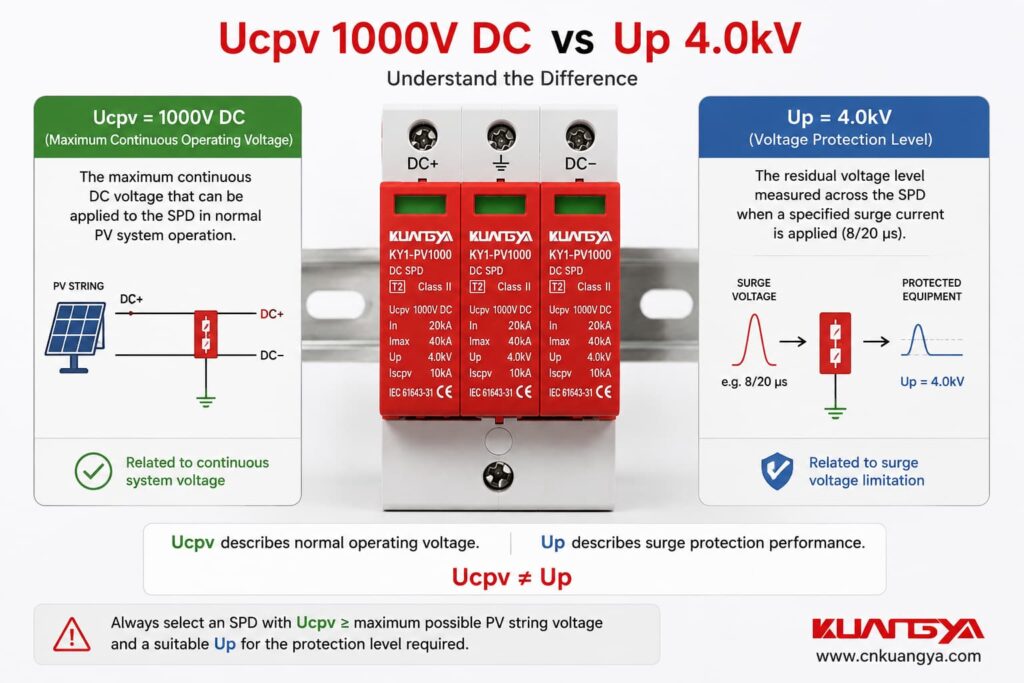
Donc :
Ucpv is about surviving normal system operation.
Up is about limiting transient surge voltage.
They should never be treated as interchangeable voltage ratings.
The label shows:
In : 20kA
In means:
Courant de décharge nominal
For a Type 2 / Class II SPD, In is associated with an la forme d'onde de courant 8/20 μs.
In technical terms, it represents the crest value of the current through the SPD having the specified 8/20 μs waveshape under the relevant standardized test conditions.
That definition is accurate, but for a buyer it can be simplified:
In is one of the main ratings used to describe the tested surge-discharge performance of a Type 2 SPD.
For this product:
In = 20kA
The important word here is nominal.
It should not be confused with Imax.
The same SPD also shows:
Imax : 40kA
Imax means:
Courant de décharge maximal
For a Type 2 SPD, Imax is also normally associated with the la forme d'onde de courant 8/20 μs.
It represents the manufacturer’s declared maximum discharge-current capability under the applicable test conditions.
Par conséquent :
In 20kA and Imax 40kA are not duplicate specifications.
They represent different test-duty levels.
This is one of the most important parts of the entire datasheet.
Consider the example:
| Paramètres | Valeur |
|---|---|
| En | 20kA |
| Imax | 40kA |
| Forme d'onde | 8/20 μs |
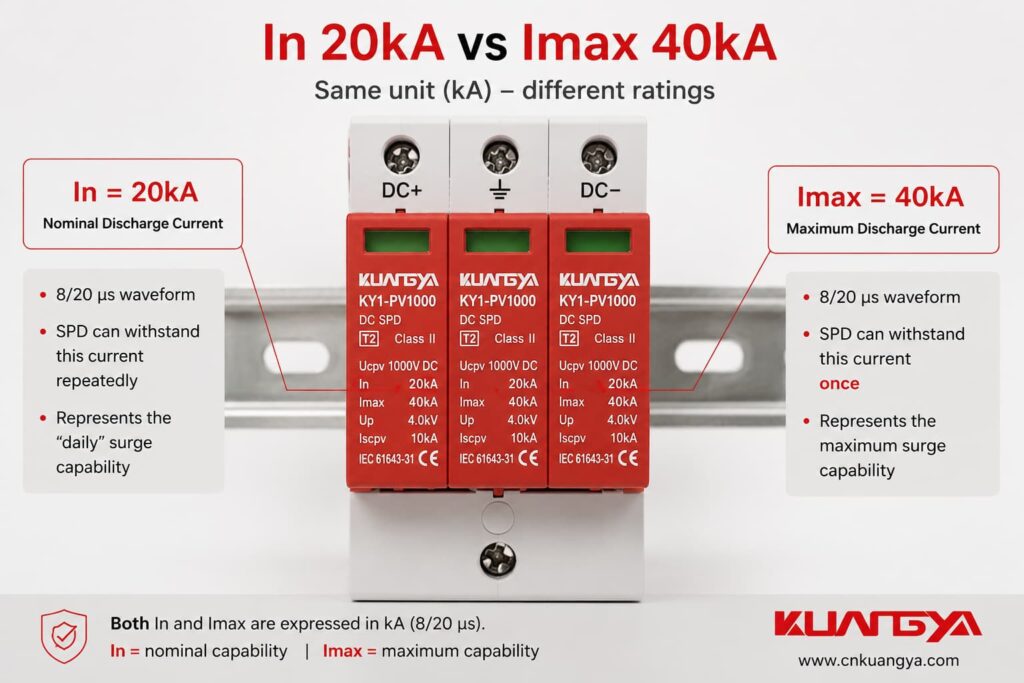
A simple way to understand them is:
En = nominal discharge-current rating.
Imax = maximum declared discharge-current rating.
One common purchasing mistake is to look only at Imax because it is the larger number.
Par exemple :
SPD A: In 20kA / Imax 40kA
SPD B: In 10kA / Imax 40kA
A buyer may see “40kA” on both products and assume that their surge performance is equivalent.
That conclusion is incomplete.
The full declared performance needs to be checked.
VIOX makes the same useful procurement distinction in its SPD datasheet guide: In and Imax should be read separately, and Imax should not be interpreted as the SPD’s normal repeated discharge capacity.
Non.
This is probably the most useful purchasing rule in this article:
The highest kA value does not automatically identify the best SPD.
Suppose two products are advertised as:
It would be incorrect to select SPD B immediately just because:
60kA > 40kA.
Other questions still matter:
A larger number may be useful when the complete design calls for it.
But:
More kA is not a substitute for correct coordination.
Not simply because it says 40kA.
This is another very common mistake.
A Type 2 product may show:
Imax = 40kA, 8/20 μs
while a Type 1 product may show:
Iimp = 12.5kA, 10/350 μs
Looking only at the peak current numbers:
40 > 12.5
may make the Type 2 SPD appear stronger.
But that comparison is technically incorrect.
The two values are based on different test waveforms and different protection duties.
Par conséquent :
Imax cannot be used as a substitute for a specified Iimp requirement.
If the project requires Type 1 lightning-current capability, a large Type 2 Imax value alone does not satisfy that requirement.
L'étiquette d'exemple indique :
Up : 4,0kV
Up means:
Niveau de protection de la tension
It describes the SPD’s declared voltage-limiting performance under specified standardized test conditions.
In practical terms, Up helps answer the question:
How effectively does the SPD limit the transient voltage during the relevant test?
Generally, a lower Up can provide a lower level of surge voltage at the SPD terminals.
However, this needs an important qualification.
The printed Up value should pas be treated as the exact maximum voltage that every connected inverter or device will experience in a real installation.
Pourquoi ?
Because the actual voltage seen by the protected equipment can also be affected by:
VIOX correctly makes the same distinction: the declared Up is established at the SPD under standardized conditions, while installation conductors can increase the voltage presented to the protected equipment.
Not by itself.
It is reasonable to prefer effective voltage limitation, but the selection must remain compatible with the complete electrical system.
A low Up does not compensate for:
So instead of saying:
“Always buy the SPD with the lowest Up.”
A more technically correct rule is:
Select an SPD with a suitable Up while also verifying Ucpv, SPD Type, protected equipment withstand level and installation coordination.
Now we come to one of the most misunderstood PV-specific parameters:
Iscpv : 10kA
This is particularly important because it also uses the unit kA.
It is easy to look at:
In 20kA
Imax 40kA
Iscpv 10kA
and assume they are three levels of surge current.
Ce n'est pas le cas.
Iscpv means:
Short-Circuit Current Rating of the SPD for the PV application.
IEC terminology defines Iscpv as the maximum prospective short-circuit current from the power system for which the SPD, together with the specified disconnector, is rated.
A simpler explanation is:
Iscpv tells you whether the SPD and its specified disconnection arrangement are suitable for the prospective PV short-circuit current at the installation point.
Il s'agit d'un fault-current / short-circuit characteristic.
It is not a lightning-surge rating.
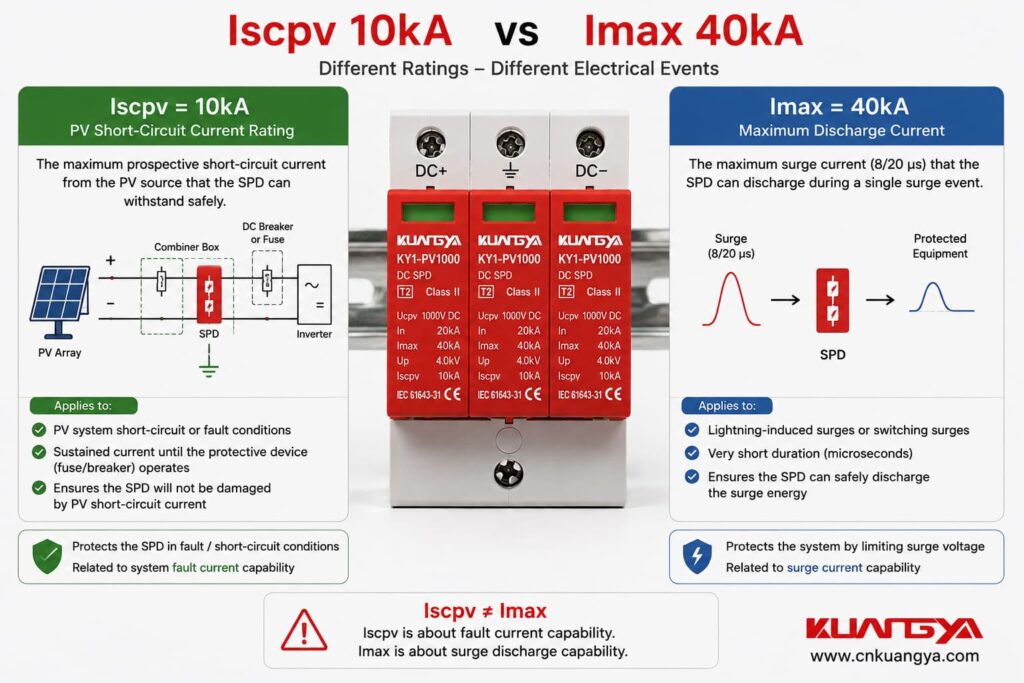
This distinction deserves to be stated clearly:
Iscpv ≠ Imax
Even though both can be expressed in kA.
Par exemple :
Describes surge discharge-current performance.
Describes the SPD’s PV short-circuit-current rating in conjunction with the specified disconnection arrangement.
So on our example product:
Imax = 40kA
does not mean:
PV short-circuit rating = 40kA.
And:
Iscpv = 10kA
does not mean:
The SPD can only discharge a 10kA surge.
These numbers belong to different electrical events.
PV DC circuits behave differently from ordinary AC circuits.
One important difference is that DC current does not naturally pass through zero every half-cycle as AC current does.
For protection devices, switching equipment and disconnecting arrangements, this makes DC fault interruption an important design consideration.
That is one reason PV-specific SPDs have characteristics and test requirements beyond simply printing:
“DC 1000V”
on an AC-style product.
IEC 61643-31 is specifically intended for SPDs connected to the DC side of photovoltaic installations and establishes PV-specific requirements, ratings and test methods.
Therefore, when buying a PV SPD, do not ask only:
“Is this 1000V DC?”
Also ask:
What is the declared Iscpv and required disconnection arrangement?
The easiest way to remember these parameters is with this table:
| Evaluation | Main Meaning | Typical Context |
|---|---|---|
| En | Courant de décharge nominal | Type 2 / Class II surge performance |
| Imax | Courant de décharge maximal | Type 2 maximum declared surge-current performance |
| Iimp | Impulse current | Type 1 / Class I lightning-current capability |
| Iscpv | PV short-circuit current rating | PV fault-current compatibility |
Notice something important:
Three or four specifications can all contain:
kA
but this does not mean they can be compared directly.
Before comparing any two kA ratings, first ask:
This prevents a large number of purchasing errors.
The label also declares:
-40°C à +85°C
This is the manufacturer’s declared temperature range for the product.
Environmental ratings should not be ignored simply because electrical parameters look correct.
PV equipment may be installed in:
The internal temperature of an enclosure can be very different from the normal outdoor air temperature.
Therefore, project engineers should confirm that the SPD’s declared environmental conditions are suitable for the actual enclosure and installation environment.
Where the datasheet declares:
5%–95%
this normally represents the manufacturer’s declared relative humidity operating range.
However, humidity specifications should always be read together with conditions such as:
The percentage alone does not mean that an exposed SPD can be installed directly in rain or other outdoor environments.
The label states:
Intérieur
This does not necessarily mean that the SPD can never form part of an outdoor PV installation.
It means the SPD itself is intended for a protected environment according to its declared construction and installation conditions.
For example, an indoor-rated SPD may be installed inside:
The important distinction is:
The SPD can be inside outdoor equipment without the SPD itself being directly exposed to outdoor conditions.
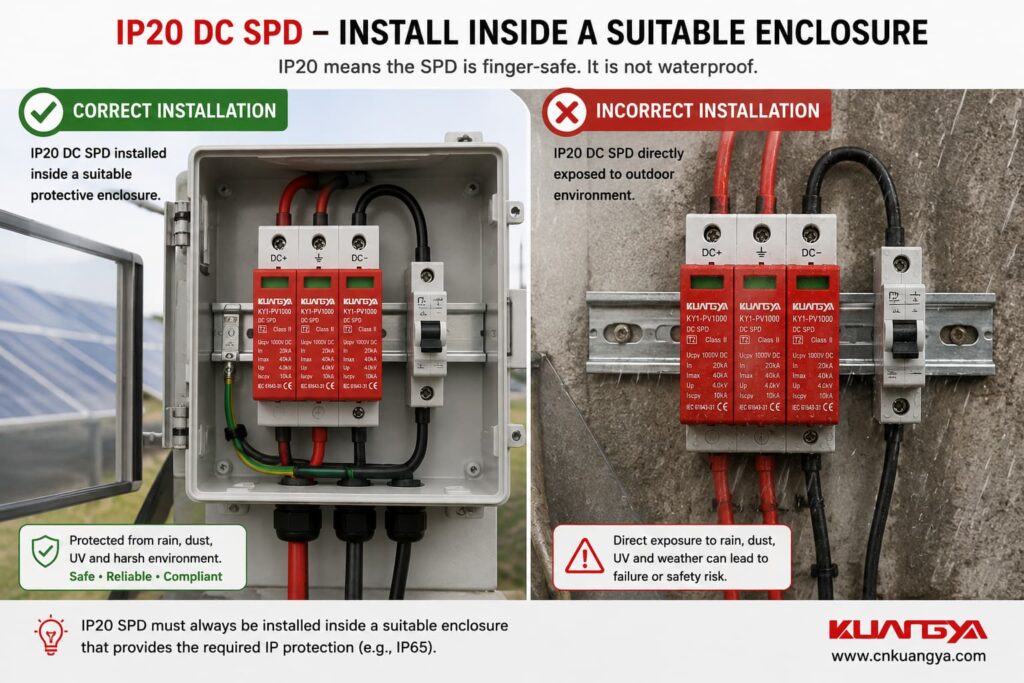
IP20 is the enclosure protection rating shown for the SPD itself.
It should not be interpreted as a weatherproof rating.
A DIN-rail SPD with IP20 is normally installed inside another suitable enclosure or cabinet.
For an outdoor PV installation, the final environmental protection depends on the complete enclosure, not only the bare SPD module.
Donc :
IP20 SPD inside a suitable outdoor enclosure
can be a normal arrangement.
But:
IP20 SPD directly exposed to rain, dust and outdoor weather
should not be assumed to be acceptable.
Now we can return to the original example.
Ucpv : 1000V DC
Classe II
In : 20kA
Imax : 40kA
Up : 4,0kV
Iscpv : 10kA
Instead of reading each number independently, read it as one technical description.
This tells us the declared maximum continuous PV operating voltage of the SPD.
This indicates Class II testing / Type 2 application direction.
This is the nominal discharge-current rating associated with the relevant Type 2 surge test.
This is the declared maximum discharge-current rating.
This is the declared voltage protection level.
This is the PV short-circuit-current rating and must be understood together with the applicable disconnector/protection arrangement.
Now the label makes much more sense.
It is not saying:
“1000V, 20kA, 40kA, 10kA — bigger numbers are better.”
It is describing different electrical functions and limits of the same SPD.
Incorrect:
Class I is premium and Class II is lower quality.
Correct:
Class I and Class II represent different test/protection classifications.
Incorrect:
This one says 60kA, so it is automatically better than the 40kA model.
Correct:
Check:
before making the comparison.
Incorrect:
Imax 40kA is higher than Iimp 12.5kA, so Type 2 is stronger.
Correct:
Iimp and Imax refer to different test waveforms and different surge duties.
Incorrect:
The SPD is rated 1000V but Up is 4kV, so the specifications conflict.
Correct:
Ucpv and Up describe different voltage characteristics.
Incorrect:
Iscpv 10kA means the SPD can discharge 10kA of lightning current.
Correct:
Iscpv is a PV short-circuit-current rating.
Even a correctly selected SPD can provide poor protection if installation is poor.
Important details include:
A datasheet tells you what the device is capable of under defined conditions.
Installation determines how effectively that capability is used in the real system.
The SPD should also be considered together with other solar PV electrical protection devices, including DC fuses, isolators, circuit breakers and the overall protection arrangement.
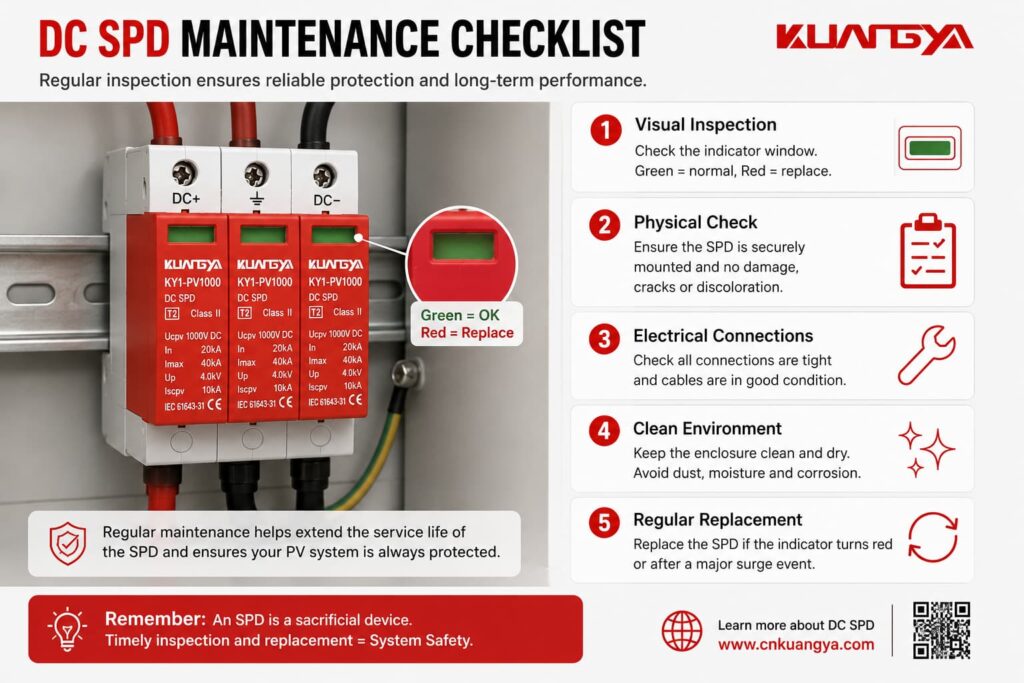
For buyers, distributors and EPC procurement teams, the following sequence is more useful than simply asking for:
“1000V 40kA SPD price.”
Is the product specifically intended for:
PV DC surge protection?
Do not assume an AC SPD with a similar voltage or current marking is interchangeable.
Determine the maximum possible PV open-circuit voltage.
Then confirm that the selected Ucpv is suitable.
For the full calculation method, refer to the DC SPD Voltage Selection Guide mentioned earlier.
Determine whether the installation requires:
Do not make this decision simply from product price or kA rating.
Our detailed Type 1 vs Type 2 vs Type 1+2 DC SPD guide explains this separately.
For a Type 2 / Class II SPD, confirm both values.
Do not check only Imax.
Verify the declared voltage protection level and whether it is appropriate for the protected equipment and protection concept.
Confirm that the SPD and specified disconnection/protection arrangement are compatible with the prospective short-circuit current of the PV system.
Confirm:
Vérifier :
For PV DC SPDs, IEC 61643-31 is an important product standard to check.
IEC 61643-31:2018 covers SPDs intended for the DC side of photovoltaic installations up to 1500V DC, while IEC 61643-32:2017 addresses their selection, installation and coordination.
Depending on the project and market, buyers may also need:
Do not assume that a logo printed on a product is sufficient evidence.
Match the documentation to the exact model being purchased.
Before approving a PV SPD, use the following checklist.
| Vérifier | Question |
|---|---|
| Application | Is it specifically suitable for PV DC? |
| Ucpv | Is it suitable for maximum PV open-circuit voltage? |
| Type de DOCUP | Does Type 1 / Type 2 / Type 1+2 match the installation design? |
| Classe d'essai | Is the declared classification clear? |
| En | Is the nominal discharge-current rating specified? |
| Imax | Is the maximum discharge-current rating specified? |
| Iimp | If Type 1 is required, is Iimp declared? |
| Haut de la page | Is the protection level suitable? |
| Iscpv | Is the PV short-circuit rating adequate? |
| Câblage | Is the correct DC connection diagram available? |
| Protection de l'environnement | Is required backup protection identified? |
| Environnement | Are temperature, IP and enclosure conditions suitable? |
| Standard | Is the applicable PV SPD standard stated? |
| Documentation | Do certificates/test reports match the exact model? |
A weak RFQ might say:
Please quote 1000V 40kA solar SPD.
This leaves many important questions unanswered.
A better RFQ is:
Please quote a Type 2 / Class II PV DC SPD for a 1000V DC application. Please confirm Ucpv, In, Imax, Up, Iscpv, pole configuration, required backup protection, IEC 61643-31 documentation and wiring diagram.
If known, also include:
This allows the manufacturer to evaluate the complete requirement instead of matching only the words:
“1000V” and “40kA.”
They are closely related but technically describe classification/testing from slightly different perspectives.
For practical PV product selection, a Type 2 SPD is associated with un test de classe II, which is why labels and datasheets may show Type 2, T2 or Class II terminology.
Non.
Class I and Class II are not quality levels.
They are intended for different surge-protection duties and test conditions.
In is the nominal discharge current.
Imax is the maximum discharge current.
For Type 2 SPDs, both are normally associated with the 8/20 μs waveform, but they represent different test-duty levels.
Not enough information is available to answer that from Imax alone.
A proper comparison also requires Ucpv, Type, In, Up, Iscpv, standard, protection configuration and installation conditions.
Not simply because its peak current number is larger.
Type 1 is characterized by lightning impulse-current capability such as Iimp and the associated Class I test conditions.
Imax and Iimp should not be directly compared.
Ucpv is the maximum continuous operating voltage for the PV application.
Haut de la page is the declared voltage protection level under specified surge test conditions.
They perform completely different functions in the datasheet.
Iscpv is the short-circuit current rating of the PV SPD.
More precisely, it describes the maximum prospective short-circuit current for which the SPD, together with its specified disconnector arrangement, is rated.
Non.
Imax is a surge discharge-current rating.
Iscpv is a short-circuit-current rating.
The fact that both use kA does not make them interchangeable.
Not automatically.
Maximum PV open-circuit voltage should be calculated under the project’s design conditions before selecting Ucpv.
For more detail, see our Guide de sélection des parafoudres CC : comment choisir la tension nominale appropriée.
It may be installed inside a suitable outdoor enclosure, provided the complete installation satisfies the required environmental protection.
IP20 on the SPD itself should not be treated as a weatherproof outdoor rating.
IEC 61643-31 covers requirements and test methods for SPDs intended for the DC side of photovoltaic installations up to 1500V DC.
IEC 61643-32 provides selection and application principles for PV SPDs.
Reading a DC SPD datasheet becomes much easier once each parameter is treated according to its actual purpose.
For the example:
Classe II
Ucpv 1000V DC
In 20kA
Imax 40kA
Up 4.0kV
Iscpv 10kA
the correct interpretation is not simply:
“This is a 1000V, 40kA SPD.”
A more complete interpretation is:
Each specification answers a different engineering question.
That leads to one simple purchasing principle:
Never select a DC SPD from one voltage number, one kA number or one Type label alone.
The correct SPD is the one whose complete set of ratings matches the PV system voltage, surge environment, equipment protection requirements, short-circuit conditions and installation design.
For solar PV projects requiring 600V, 1000V or 1500V surge protection, explore KUANGYA DC surge protective devices to compare available Type 2 and Type 1+2 models by voltage rating, discharge-current capability and application.

