Zona industrial de WengYang Yueqing Wenzhou 325000
Horas de trabajo
De lunes a viernes: de 7.00 a 19.00 horas
Fin de semana: 10.00 A 17.00 HORAS
Zona industrial de WengYang Yueqing Wenzhou 325000
Horas de trabajo
De lunes a viernes: de 7.00 a 19.00 horas
Fin de semana: 10.00 A 17.00 HORAS

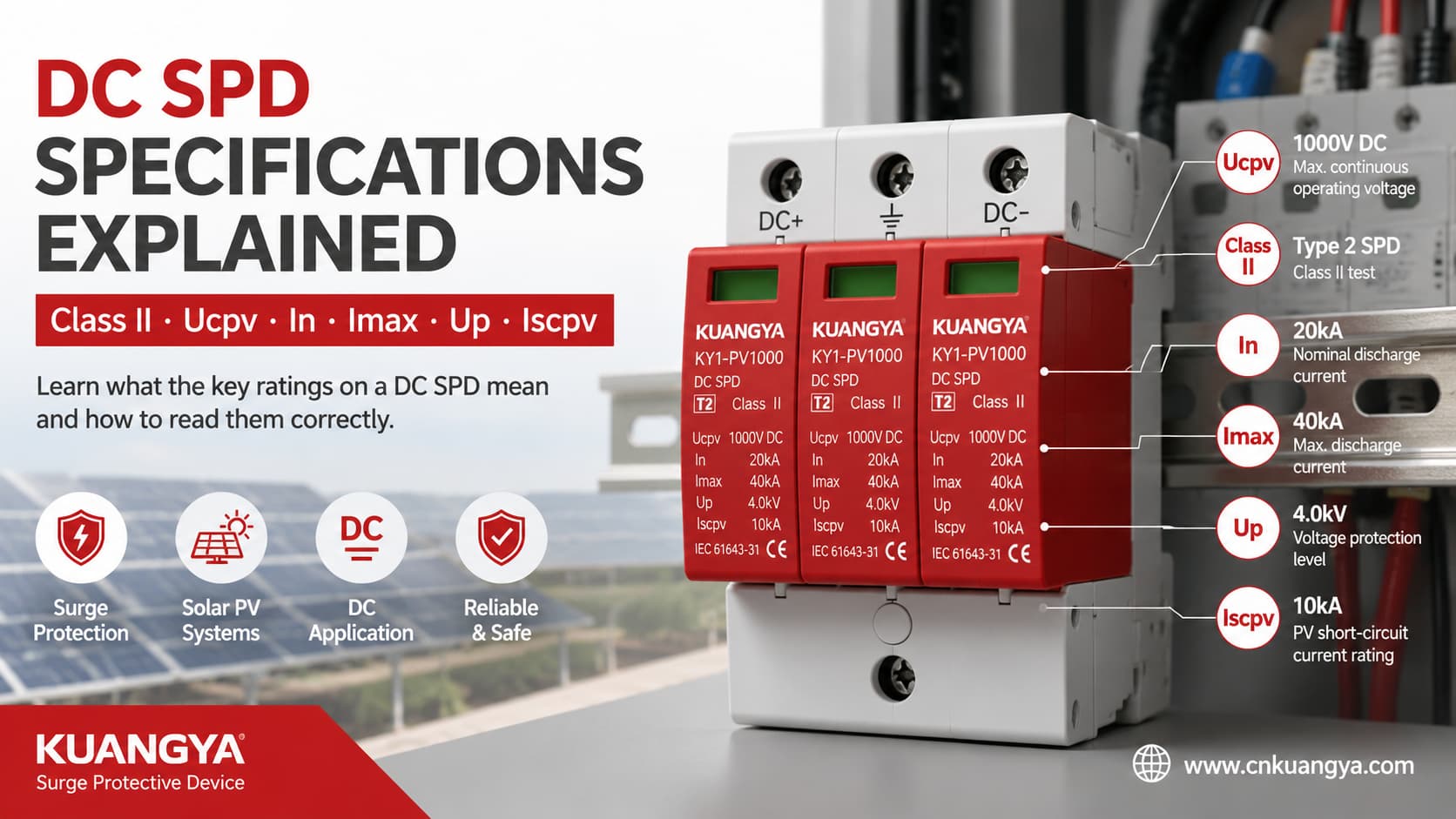
Un dispositivo de protección contra sobretensiones de CC puede parecer simple por fuera, pero las marcas impresas en su etiqueta contienen información importante sobre dónde se puede utilizar el SPD y cuál es su rendimiento.
Considere este ejemplo de un SPD solar de 1000V CC:
Ucpv: 1000V CC
Clase II
In: 20kA
Imax: 40kA
Up: 4.0kV
Iscpv: 10kA
-40°C a +85°C
Interior, IP20
Para un ingeniero eléctrico experimentado, estas abreviaturas son familiares.
Sin embargo, para un comprador, distribuidor, instalador solar o responsable de compras de proyectos, pueden resultar confusas fácilmente.
¿Significa Clase II un SPD de segundo grado?
¿Es 40kA Imax automáticamente mejor que 20kA?
¿Por qué el mismo SPD muestra ambos 1000V y 4,0 kV?
¿Significa Iscpv 10kA ¿significa que el SPD puede descargar una sobretensión de rayo de 10kA?
La respuesta corta es: ningún número por sí solo describe la totalidad del SPD.
Un SPD de CC debe interpretarse como un conjunto completo de características eléctricas. Si es nuevo en la protección contra sobretensiones, primero comprender cómo funciona un SPD de CC en un sistema solar fotovoltaico puede facilitar la comprensión de estas especificaciones.
Esta guía explica cómo leer esas marcas correctamente, utilizando un SPD de Clase II de 1000V CC como ejemplo práctico.
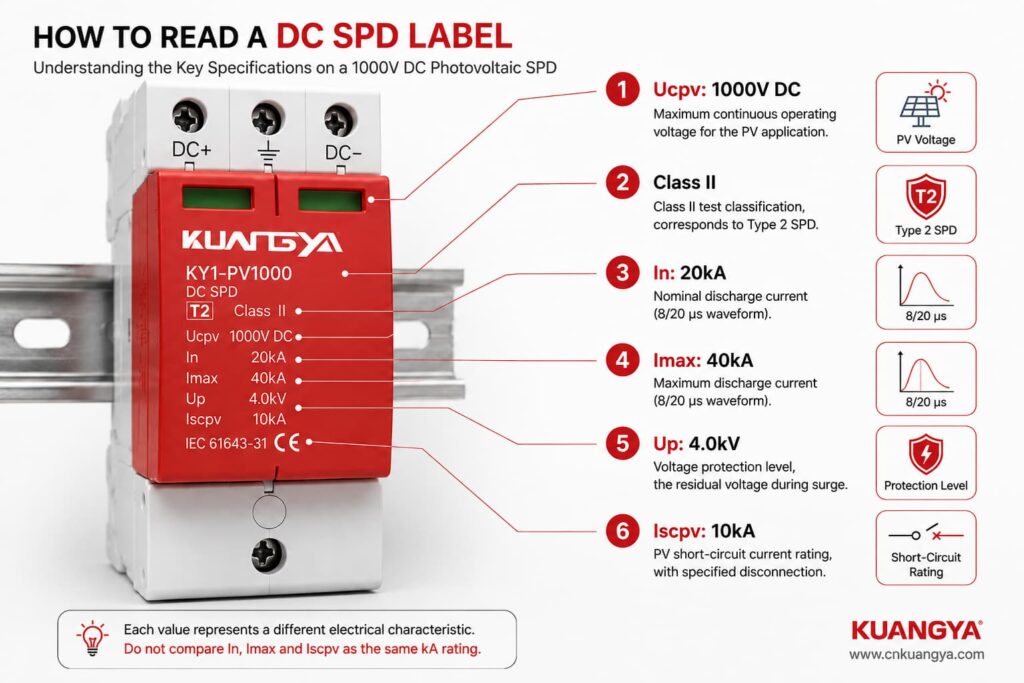
Vea esta guía rápida para saber cómo leer las marcas clave en la placa de características de un SPD de CC.
Antes de entrar en los detalles técnicos, la siguiente tabla ofrece una visión general sencilla.
| Marcado | Ejemplo | Significado sencillo |
|---|---|---|
| Ucpv | 1000 V CC | Tensión máxima de funcionamiento continuo para la aplicación fotovoltaica |
| Clase II | Clase II | SPD probado de Clase II, asociado con protección contra sobretensiones de Tipo 2 |
| En | 20kA | Corriente de descarga nominal |
| Imax | 40kA | Corriente de descarga máxima |
| Arriba | 4,0 kV | Nivel de protección de tensión declarado |
| Iscpv | 10kA | Corriente de cortocircuito fotovoltaica nominal del SPD |
| Temperatura | -40°C a +85°C | Rango de temperatura de funcionamiento declarado |
| Humedad | 5%–95% | Rango de humedad declarado |
| Interior | Interior | Destinado a condiciones de instalación protegidas |
| IP20 | IP20 | Grado de protección de la envolvente del SPD |
El punto más importante es:
No compare los SPD de CC basándose únicamente en el número de kA más grande impreso en la etiqueta.
Por ejemplo, Imax 40kA, In 20kA y Iscpv 10kA ambos utilizan la unidad kA, pero describen características completamente diferentes.
Cuando los compradores ven por primera vez una hoja de datos de un SPD, a menudo comienzan por la cifra más alta.
Por lo general, ese es el enfoque incorrecto.
A more useful reading order is:
This order allows unsuitable products to be rejected before comparing headline surge-current figures.
VIOX uses a similar “reject incompatible specifications first” approach in its datasheet guide; for PV applications, the logic becomes even more important because Ucpv and PV short-circuit behavior need specific attention.
One of the first markings on the example label is:
Clase II
This does no mean second-class quality.
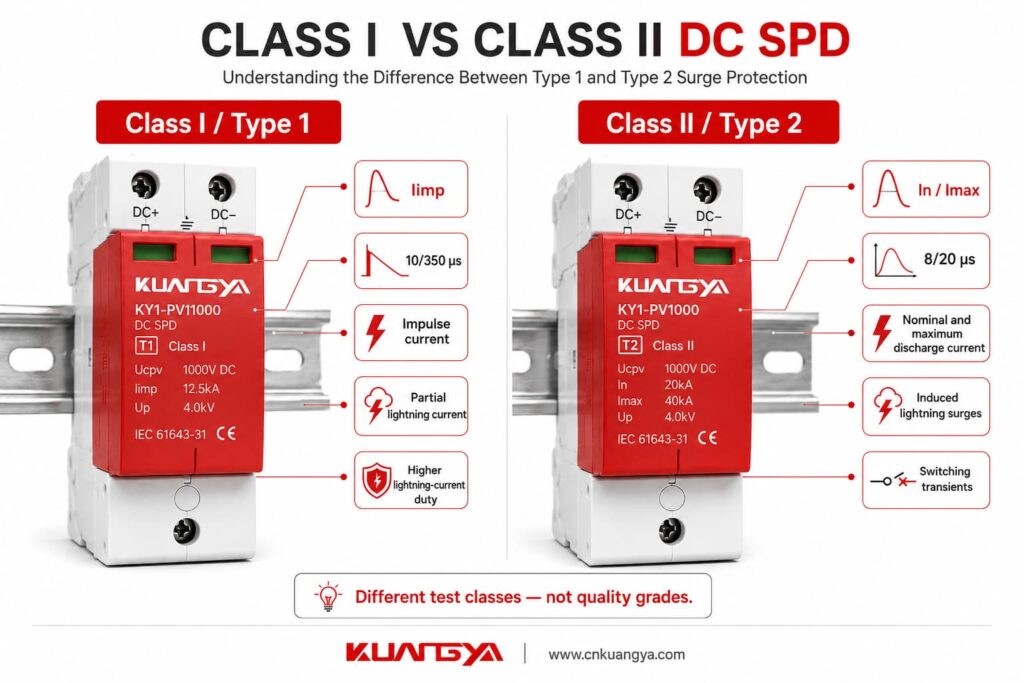
Class I, Class II and Class III refer to standardized SPD test classifications, not product quality grades.
For PV surge protective devices, a Type 2 SPD is associated with Class II testing.
This is why different manufacturers or datasheets may use markings such as:
They refer to closely related classification and testing concepts, although technically “Type” and “test class” are not simply two different spellings of the same term.
For most buyers, the practical relationship can be understood as follows:
| SPD Classification | Test Class | Main Current Parameter | Common Test Waveform |
|---|---|---|---|
| Tipo 1 | Clase I | Iimp | 10/350 μs |
| Tipo 2 | Clase II | In / Imax | 8/20 μs |
| Tipo 3 | Clase III | Other coordinated test parameters | Combination-wave testing |
For the example in this article:
Class II → Type 2 application direction
and therefore the most important current parameters shown are:
In = 20kA
Imax = 40kA
No.
This is one of the most common misunderstandings when comparing SPDs.
The words Class I and Class II can sound like a ranking:
Class I = better
Class II = cheaper or weaker
That is not how SPD classification works.
They are intended for different surge conditions.
A Type 1 / Class I SPD is evaluated for lightning impulse-current capability, where partial lightning current may need to be handled at the installation point.
A Type 2 / Class II SPD is commonly used to limit transient overvoltages caused by induced lightning effects and switching events.
Therefore, the correct question is not:
Which class is better?
Es:
Which SPD type is required at this installation point?
A Type 1 SPD is not automatically the correct choice for every PV installation, and a Type 2 SPD is not automatically inadequate simply because Type 1 exists.
If you need a detailed explanation of this selection question, see our guide:
Type 1 vs Type 2 vs Type 1+2 DC SPD for Solar PV
Your existing article goes deeper into lightning exposure, installation location and when Type 1 capability should be evaluated.
The biggest technical difference becomes clearer when we look at the test current.
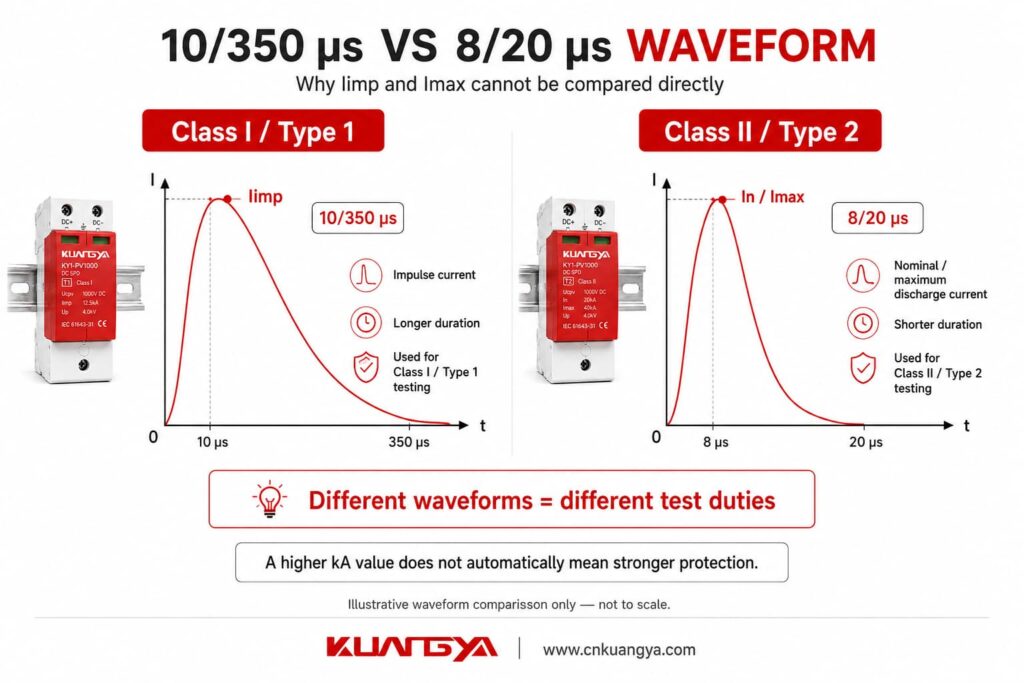
A Type 1 SPD is associated with an impulse-current rating:
Iimp
and a 10/350 μs current waveform is commonly associated with Class I testing.
The 10/350 μs waveform represents a much different current-energy duty than the 8/20 μs waveform used for Type 2 evaluation.
Es decir:
Iimp cannot be directly compared with Imax just because both are shown in kA.
Por ejemplo:
Iimp = 12.5kA
y
Imax = 40kA
do not mean that the 40kA Type 2 product is “stronger.”
They refer to different test waveforms and different performance characteristics.
A Type 2 SPD is mainly characterized using:
The 8/20 μs current waveform is associated with Class II discharge-current testing.
Type 2 DC SPDs are commonly evaluated for use in locations such as:
However, the final SPD type must still depend on the actual lightning protection design and installation conditions.
Class III exists within general SPD classification, but it should not become the main subject when discussing typical PV DC SPD selection.
Class III protection is generally associated with coordinated fine protection close to sensitive equipment.
For solar PV DC protection, buyers will much more commonly encounter:
That is why this article focuses mainly on Class II and its relationship with Type 2 DC SPDs, rather than treating Class I, II and III as three equally common PV product categories.
The example label shows:
Ucpv: 1000V CC
Ucpv means:
Maximum Continuous Operating Voltage for PV Application
In simple terms:
Ucpv tells you the maximum DC voltage that may be continuously applied to the SPD’s mode of protection.
IEC 61643-32 defines Ucpv in essentially this way and states that it must be equal to or higher than the maximum PV open-circuit voltage condition relevant to the installation.
This makes Ucpv one of the first specifications that should be checked when selecting a solar DC SPD.
No necesariamente.
This is important.
A PV system should not be evaluated using only a convenient nominal label such as:
1000V solar system
The actual maximum DC voltage of a PV string depends on factors including:
PV module open-circuit voltage normally increases when temperature falls.
For a broader explanation of PV array voltage, string design and related system requirements, see our IEC 62548 PV array design guide.
Therefore, the selection process should be based on the maximum calculated PV open-circuit voltage, rather than simply copying the nominal inverter or system voltage.
A simplified workflow is:
Module Voc
→ Número de módulos en serie
→ Low-temperature correction
→ Maximum PV open-circuit voltage
→ Select suitable Ucpv
We have already covered this subject separately in our DC SPD Voltage Selection Guide, including 600V, 1000V and 1500V DC applications.
So in this article, the important point is simply:
Ucpv is a continuous-voltage compatibility rating, not a surge-current rating.
This is another common source of confusion.
Our example SPD shows:
Ucpv = 1000V DC
y
Up = 4.0kV
A buyer may reasonably ask:
Why does a 1000V SPD also have a 4kV voltage rating?
Because these two values describe different things.
| Parámetro | Ejemplo | Lo que describe |
|---|---|---|
| Ucpv | 1000 V CC | Continuous PV operating voltage |
| Arriba | 4,0 kV | Voltage protection level during surge testing |
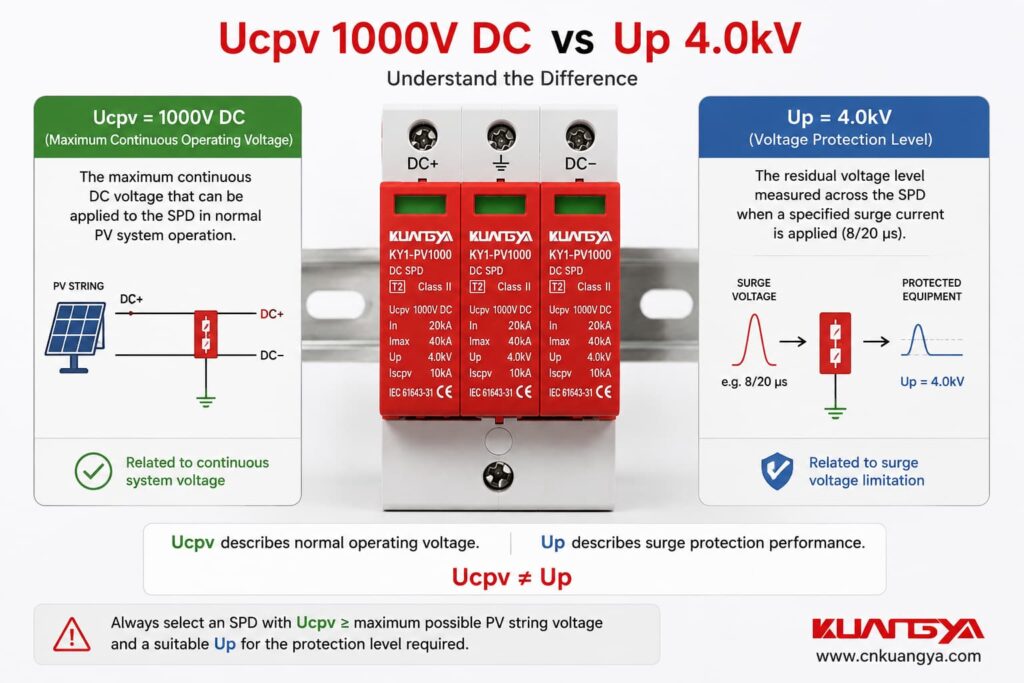
Por lo tanto:
Ucpv is about surviving normal system operation.
Up is about limiting transient surge voltage.
They should never be treated as interchangeable voltage ratings.
The label shows:
In: 20kA
In means:
Corriente nominal de descarga
For a Type 2 / Class II SPD, In is associated with an forma de onda de corriente de 8/20 μs.
In technical terms, it represents the crest value of the current through the SPD having the specified 8/20 μs waveshape under the relevant standardized test conditions.
That definition is accurate, but for a buyer it can be simplified:
In is one of the main ratings used to describe the tested surge-discharge performance of a Type 2 SPD.
For this product:
In = 20kA
The important word here is nominal.
It should not be confused with Imax.
The same SPD also shows:
Imax: 40kA
Imax means:
Corriente máxima de descarga
For a Type 2 SPD, Imax is also normally associated with the forma de onda de corriente de 8/20 μs.
It represents the manufacturer’s declared maximum discharge-current capability under the applicable test conditions.
Por lo tanto:
In 20kA and Imax 40kA are not duplicate specifications.
They represent different test-duty levels.
This is one of the most important parts of the entire datasheet.
Consider the example:
| Parámetro | Valor |
|---|---|
| En | 20kA |
| Imax | 40kA |
| Forma de onda | 8/20 μs |
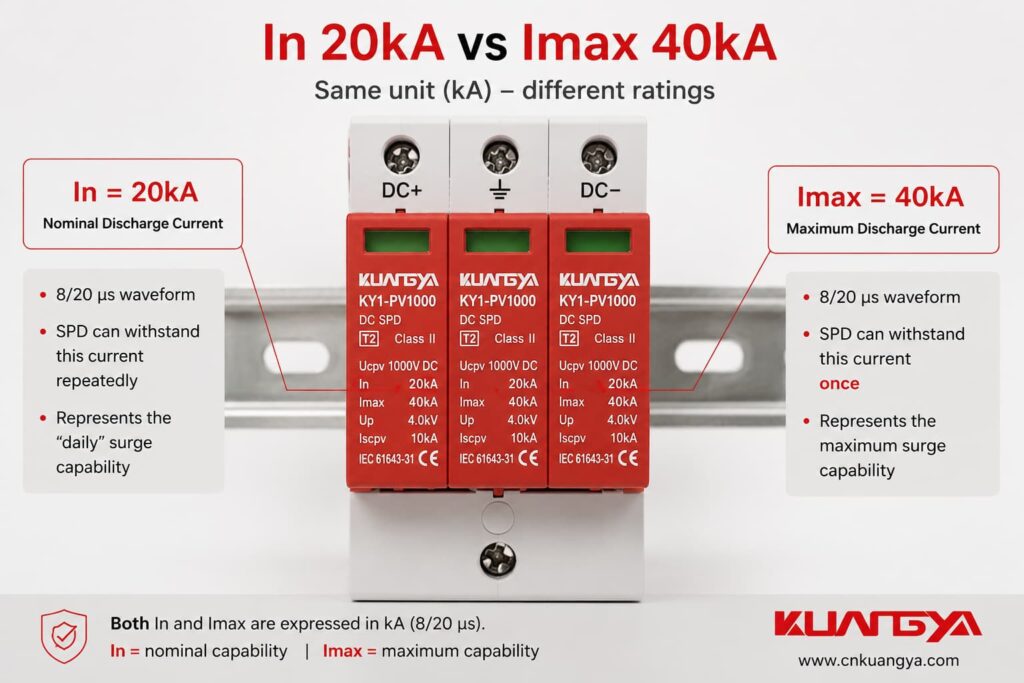
A simple way to understand them is:
En = nominal discharge-current rating.
Imax = maximum declared discharge-current rating.
One common purchasing mistake is to look only at Imax because it is the larger number.
Por ejemplo:
SPD A: In 20kA / Imax 40kA
SPD B: In 10kA / Imax 40kA
A buyer may see “40kA” on both products and assume that their surge performance is equivalent.
That conclusion is incomplete.
The full declared performance needs to be checked.
VIOX makes the same useful procurement distinction in its SPD datasheet guide: In and Imax should be read separately, and Imax should not be interpreted as the SPD’s normal repeated discharge capacity.
No.
This is probably the most useful purchasing rule in this article:
The highest kA value does not automatically identify the best SPD.
Suppose two products are advertised as:
It would be incorrect to select SPD B immediately just because:
60kA > 40kA.
Other questions still matter:
A larger number may be useful when the complete design calls for it.
But:
More kA is not a substitute for correct coordination.
Not simply because it says 40kA.
This is another very common mistake.
A Type 2 product may show:
Imax = 40kA, 8/20 μs
while a Type 1 product may show:
Iimp = 12.5kA, 10/350 μs
Looking only at the peak current numbers:
40 > 12.5
may make the Type 2 SPD appear stronger.
But that comparison is technically incorrect.
The two values are based on different test waveforms and different protection duties.
Por lo tanto:
Imax cannot be used as a substitute for a specified Iimp requirement.
If the project requires Type 1 lightning-current capability, a large Type 2 Imax value alone does not satisfy that requirement.
The example label shows:
Up: 4.0kV
Up means:
Nivel de protección de tensión
It describes the SPD’s declared voltage-limiting performance under specified standardized test conditions.
In practical terms, Up helps answer the question:
How effectively does the SPD limit the transient voltage during the relevant test?
Generally, a lower Up can provide a lower level of surge voltage at the SPD terminals.
However, this needs an important qualification.
The printed Up value should no be treated as the exact maximum voltage that every connected inverter or device will experience in a real installation.
¿Por qué?
Because the actual voltage seen by the protected equipment can also be affected by:
VIOX correctly makes the same distinction: the declared Up is established at the SPD under standardized conditions, while installation conductors can increase the voltage presented to the protected equipment.
Not by itself.
It is reasonable to prefer effective voltage limitation, but the selection must remain compatible with the complete electrical system.
A low Up does not compensate for:
So instead of saying:
“Always buy the SPD with the lowest Up.”
A more technically correct rule is:
Select an SPD with a suitable Up while also verifying Ucpv, SPD Type, protected equipment withstand level and installation coordination.
Now we come to one of the most misunderstood PV-specific parameters:
Iscpv: 10kA
This is particularly important because it also uses the unit kA.
It is easy to look at:
In 20kA
Imax 40kA
Iscpv 10kA
and assume they are three levels of surge current.
No lo son.
Iscpv means:
Short-Circuit Current Rating of the SPD for the PV application.
IEC terminology defines Iscpv as the maximum prospective short-circuit current from the power system for which the SPD, together with the specified disconnector, is rated.
A simpler explanation is:
Iscpv tells you whether the SPD and its specified disconnection arrangement are suitable for the prospective PV short-circuit current at the installation point.
Este es un fault-current / short-circuit characteristic.
It is not a lightning-surge rating.
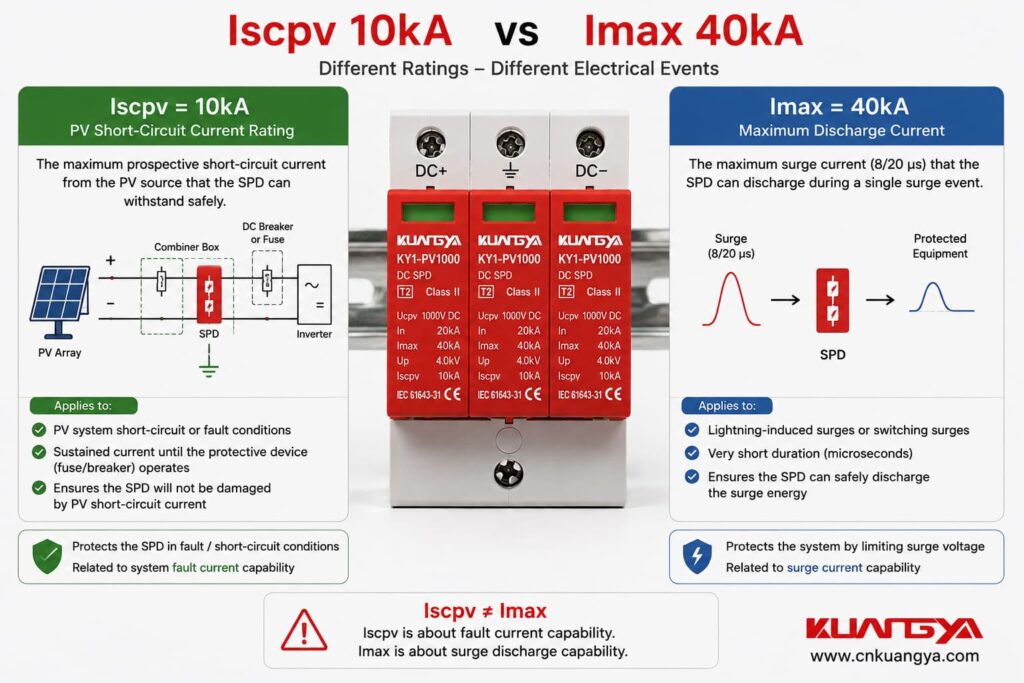
This distinction deserves to be stated clearly:
Iscpv ≠ Imax
Even though both can be expressed in kA.
Por ejemplo:
Describes surge discharge-current performance.
Describes the SPD’s PV short-circuit-current rating in conjunction with the specified disconnection arrangement.
So on our example product:
Imax = 40kA
does not mean:
PV short-circuit rating = 40kA.
And:
Iscpv = 10kA
does not mean:
The SPD can only discharge a 10kA surge.
These numbers belong to different electrical events.
PV DC circuits behave differently from ordinary AC circuits.
One important difference is that DC current does not naturally pass through zero every half-cycle as AC current does.
For protection devices, switching equipment and disconnecting arrangements, this makes DC fault interruption an important design consideration.
That is one reason PV-specific SPDs have characteristics and test requirements beyond simply printing:
“DC 1000V”
on an AC-style product.
IEC 61643-31 is specifically intended for SPDs connected to the DC side of photovoltaic installations and establishes PV-specific requirements, ratings and test methods.
Therefore, when buying a PV SPD, do not ask only:
“Is this 1000V DC?”
Also ask:
What is the declared Iscpv and required disconnection arrangement?
The easiest way to remember these parameters is with this table:
| Clasificación | Main Meaning | Typical Context |
|---|---|---|
| En | Corriente de descarga nominal | Type 2 / Class II surge performance |
| Imax | Corriente de descarga máxima | Type 2 maximum declared surge-current performance |
| Iimp | Impulse current | Type 1 / Class I lightning-current capability |
| Iscpv | PV short-circuit current rating | PV fault-current compatibility |
Notice something important:
Three or four specifications can all contain:
kA
but this does not mean they can be compared directly.
Before comparing any two kA ratings, first ask:
This prevents a large number of purchasing errors.
The label also declares:
-40°C a +85°C
This is the manufacturer’s declared temperature range for the product.
Environmental ratings should not be ignored simply because electrical parameters look correct.
PV equipment may be installed in:
The internal temperature of an enclosure can be very different from the normal outdoor air temperature.
Therefore, project engineers should confirm that the SPD’s declared environmental conditions are suitable for the actual enclosure and installation environment.
Where the datasheet declares:
5%–95%
this normally represents the manufacturer’s declared relative humidity operating range.
However, humidity specifications should always be read together with conditions such as:
The percentage alone does not mean that an exposed SPD can be installed directly in rain or other outdoor environments.
The label states:
Interior
This does not necessarily mean that the SPD can never form part of an outdoor PV installation.
It means the SPD itself is intended for a protected environment according to its declared construction and installation conditions.
For example, an indoor-rated SPD may be installed inside:
The important distinction is:
The SPD can be inside outdoor equipment without the SPD itself being directly exposed to outdoor conditions.
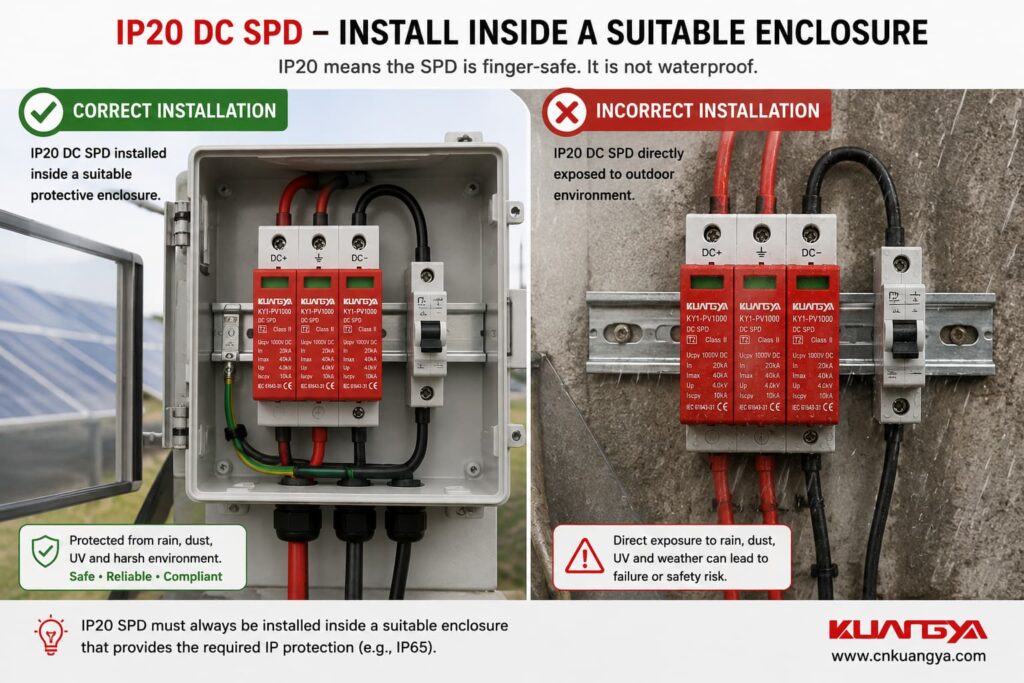
IP20 is the enclosure protection rating shown for the SPD itself.
It should not be interpreted as a weatherproof rating.
A DIN-rail SPD with IP20 is normally installed inside another suitable enclosure or cabinet.
For an outdoor PV installation, the final environmental protection depends on the complete enclosure, not only the bare SPD module.
Por lo tanto:
IP20 SPD inside a suitable outdoor enclosure
can be a normal arrangement.
But:
IP20 SPD directly exposed to rain, dust and outdoor weather
should not be assumed to be acceptable.
Now we can return to the original example.
Ucpv: 1000V CC
Clase II
In: 20kA
Imax: 40kA
Up: 4.0kV
Iscpv: 10kA
Instead of reading each number independently, read it as one technical description.
This tells us the declared maximum continuous PV operating voltage of the SPD.
This indicates Class II testing / Type 2 application direction.
This is the nominal discharge-current rating associated with the relevant Type 2 surge test.
This is the declared maximum discharge-current rating.
This is the declared voltage protection level.
This is the PV short-circuit-current rating and must be understood together with the applicable disconnector/protection arrangement.
Now the label makes much more sense.
It is not saying:
“1000V, 20kA, 40kA, 10kA — bigger numbers are better.”
It is describing different electrical functions and limits of the same SPD.
Incorrect:
Class I is premium and Class II is lower quality.
Correct:
Class I and Class II represent different test/protection classifications.
Incorrect:
This one says 60kA, so it is automatically better than the 40kA model.
Correct:
Check:
before making the comparison.
Incorrect:
Imax 40kA is higher than Iimp 12.5kA, so Type 2 is stronger.
Correct:
Iimp and Imax refer to different test waveforms and different surge duties.
Incorrect:
The SPD is rated 1000V but Up is 4kV, so the specifications conflict.
Correct:
Ucpv and Up describe different voltage characteristics.
Incorrect:
Iscpv 10kA means the SPD can discharge 10kA of lightning current.
Correct:
Iscpv is a PV short-circuit-current rating.
Even a correctly selected SPD can provide poor protection if installation is poor.
Important details include:
A datasheet tells you what the device is capable of under defined conditions.
Installation determines how effectively that capability is used in the real system.
The SPD should also be considered together with other solar PV electrical protection devices, including DC fuses, isolators, circuit breakers and the overall protection arrangement.
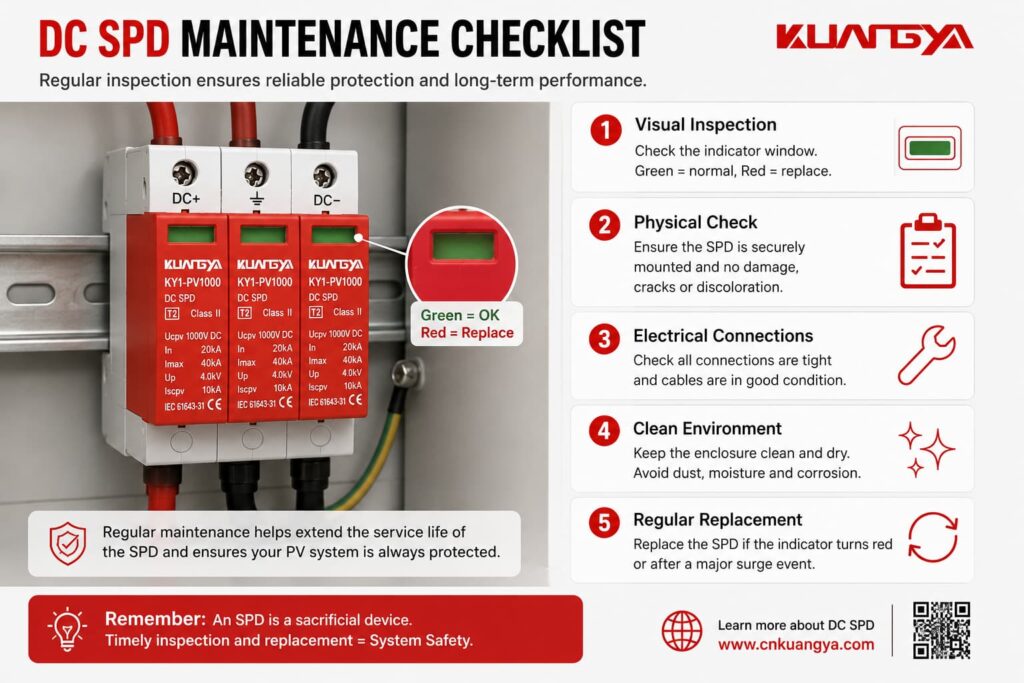
For buyers, distributors and EPC procurement teams, the following sequence is more useful than simply asking for:
“1000V 40kA SPD price.”
Is the product specifically intended for:
PV DC surge protection?
Do not assume an AC SPD with a similar voltage or current marking is interchangeable.
Determine the maximum possible PV open-circuit voltage.
Then confirm that the selected Ucpv is suitable.
For the full calculation method, refer to the DC SPD Voltage Selection Guide mentioned earlier.
Determine whether the installation requires:
Do not make this decision simply from product price or kA rating.
Our detailed Type 1 vs Type 2 vs Type 1+2 DC SPD guide explains this separately.
For a Type 2 / Class II SPD, confirm both values.
Do not check only Imax.
Verify the declared voltage protection level and whether it is appropriate for the protected equipment and protection concept.
Confirm that the SPD and specified disconnection/protection arrangement are compatible with the prospective short-circuit current of the PV system.
Confirm:
Verifícalo:
For PV DC SPDs, IEC 61643-31 is an important product standard to check.
IEC 61643-31:2018 covers SPDs intended for the DC side of photovoltaic installations up to 1500V DC, while IEC 61643-32:2017 addresses their selection, installation and coordination.
Depending on the project and market, buyers may also need:
Do not assume that a logo printed on a product is sufficient evidence.
Match the documentation to the exact model being purchased.
Before approving a PV SPD, use the following checklist.
| Consulte | Pregunta |
|---|---|
| Aplicación | Is it specifically suitable for PV DC? |
| Ucpv | Is it suitable for maximum PV open-circuit voltage? |
| Tipo de SPD | Does Type 1 / Type 2 / Type 1+2 match the installation design? |
| Test Class | Is the declared classification clear? |
| En | Is the nominal discharge-current rating specified? |
| Imax | Is the maximum discharge-current rating specified? |
| Iimp | If Type 1 is required, is Iimp declared? |
| Arriba | Is the protection level suitable? |
| Iscpv | Is the PV short-circuit rating adequate? |
| Cableado | Is the correct DC connection diagram available? |
| Protección | Is required backup protection identified? |
| Medio ambiente | Are temperature, IP and enclosure conditions suitable? |
| Estándar | Is the applicable PV SPD standard stated? |
| Documentación | Do certificates/test reports match the exact model? |
A weak RFQ might say:
Please quote 1000V 40kA solar SPD.
This leaves many important questions unanswered.
A better RFQ is:
Please quote a Type 2 / Class II PV DC SPD for a 1000V DC application. Please confirm Ucpv, In, Imax, Up, Iscpv, pole configuration, required backup protection, IEC 61643-31 documentation and wiring diagram.
If known, also include:
This allows the manufacturer to evaluate the complete requirement instead of matching only the words:
“1000V” and “40kA.”
They are closely related but technically describe classification/testing from slightly different perspectives.
For practical PV product selection, a Type 2 SPD is associated with Class II testing, which is why labels and datasheets may show Type 2, T2 or Class II terminology.
No.
Class I and Class II are not quality levels.
They are intended for different surge-protection duties and test conditions.
In is the nominal discharge current.
Imax is the maximum discharge current.
For Type 2 SPDs, both are normally associated with the 8/20 μs waveform, but they represent different test-duty levels.
Not enough information is available to answer that from Imax alone.
A proper comparison also requires Ucpv, Type, In, Up, Iscpv, standard, protection configuration and installation conditions.
Not simply because its peak current number is larger.
Type 1 is characterized by lightning impulse-current capability such as Iimp and the associated Class I test conditions.
Imax and Iimp should not be directly compared.
Ucpv is the maximum continuous operating voltage for the PV application.
Arriba is the declared voltage protection level under specified surge test conditions.
They perform completely different functions in the datasheet.
Iscpv is the short-circuit current rating of the PV SPD.
More precisely, it describes the maximum prospective short-circuit current for which the SPD, together with its specified disconnector arrangement, is rated.
No.
Imax is a surge discharge-current rating.
Iscpv is a short-circuit-current rating.
The fact that both use kA does not make them interchangeable.
Not automatically.
Maximum PV open-circuit voltage should be calculated under the project’s design conditions before selecting Ucpv.
For more detail, see our Guía de selección de SPD de CC: Cómo elegir la tensión nominal adecuada.
It may be installed inside a suitable outdoor enclosure, provided the complete installation satisfies the required environmental protection.
IP20 on the SPD itself should not be treated as a weatherproof outdoor rating.
IEC 61643-31 covers requirements and test methods for SPDs intended for the DC side of photovoltaic installations up to 1500V DC.
IEC 61643-32 provides selection and application principles for PV SPDs.
Reading a DC SPD datasheet becomes much easier once each parameter is treated according to its actual purpose.
For the example:
Clase II
Ucpv 1000V CC
In 20kA
Imax 40kA
Up 4.0kV
Iscpv 10kA
the correct interpretation is not simply:
“This is a 1000V, 40kA SPD.”
A more complete interpretation is:
Each specification answers a different engineering question.
That leads to one simple purchasing principle:
Never select a DC SPD from one voltage number, one kA number or one Type label alone.
The correct SPD is the one whose complete set of ratings matches the PV system voltage, surge environment, equipment protection requirements, short-circuit conditions and installation design.
For solar PV projects requiring 600V, 1000V or 1500V surge protection, explore KUANGYA DC surge protective devices to compare available Type 2 and Type 1+2 models by voltage rating, discharge-current capability and application.

