Zona industriale di WengYang Yueqing Wenzhou 325000
Orario di lavoro
Da lunedì a venerdì: dalle 7.00 alle 19.00
Fine settimana: 10.00 - 17.00
Zona industriale di WengYang Yueqing Wenzhou 325000
Orario di lavoro
Da lunedì a venerdì: dalle 7.00 alle 19.00
Fine settimana: 10.00 - 17.00

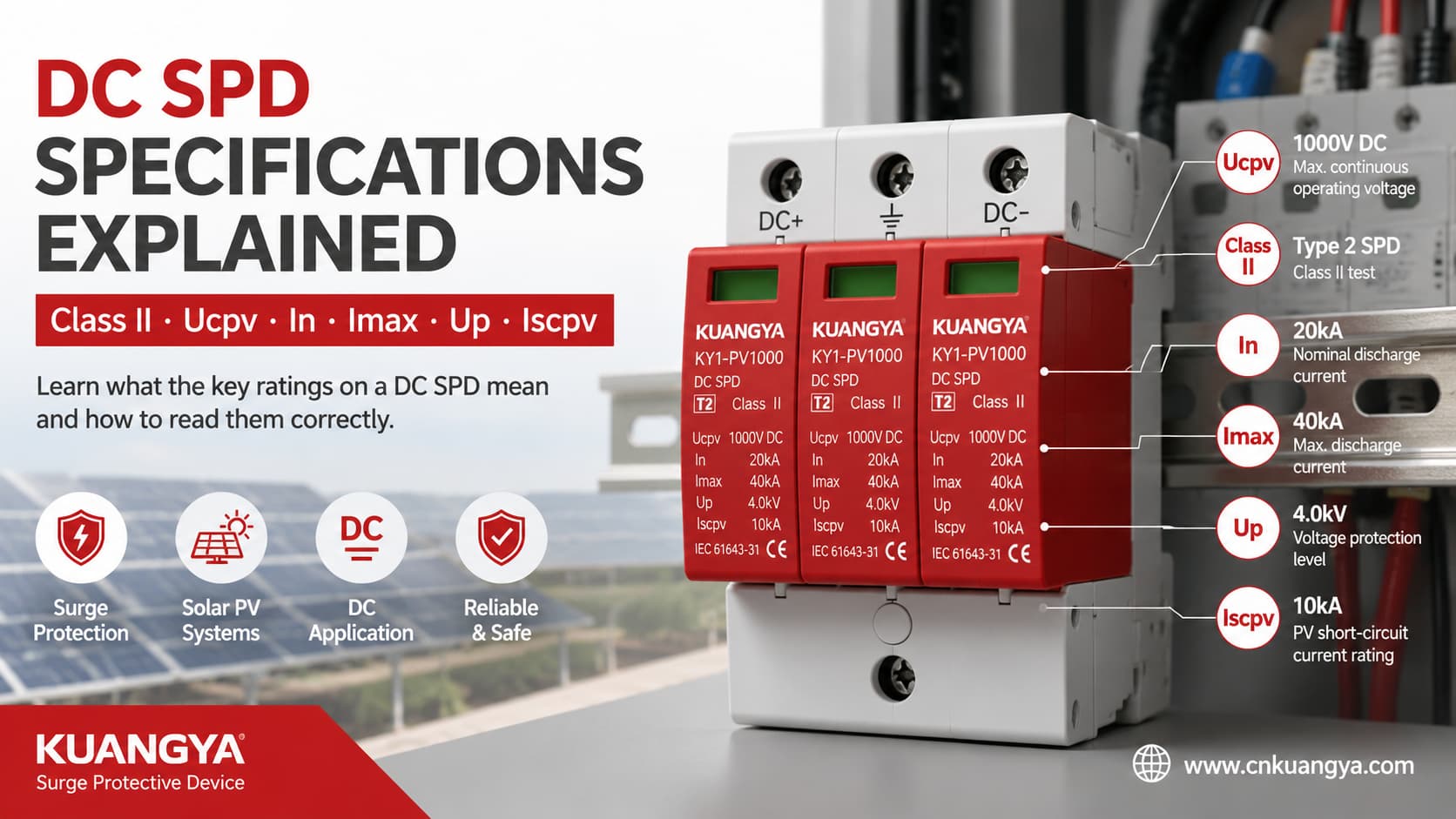
Un dispositivo di protezione contro le sovratensioni (SPD) in corrente continua può sembrare semplice all'esterno, ma le marcature stampate sulla sua etichetta contengono informazioni importanti su dove l'SPD può essere utilizzato e sulle sue prestazioni.
Consideriamo questo esempio tratto da un SPD solare CC da 1000V:
Ucpv: 1000V CC
Classe II
In: 20kA
Imax: 40kA
Up: 4.0kV
Iscpv: 10kA
Da -40°C a +85°C
Interno, IP20
Per un ingegnere elettrico esperto, queste abbreviazioni sono familiari.
Per un acquirente, un distributore, un installatore di impianti solari o un responsabile acquisti di progetto, tuttavia, possono facilmente creare confusione.
Significa Classe II un SPD di classe II?
È 40kA Imax automaticamente migliore di 20kA?
Perché lo stesso SPD mostra entrambi 1000V e 4,0kV?
Significa Iscpv 10kA significa che l'SPD può scaricare una sovratensione da fulmine di 10kA?
La risposta breve è: nessun singolo numero descrive l'intero SPD.
Un SPD DC dovrebbe essere letto come un insieme completo di caratteristiche elettriche. Se sei nuovo alla protezione contro le sovratensioni, prima comprendi come funziona un SPD DC in un sistema solare fotovoltaico può rendere queste specifiche più facili da seguire.
Questa guida spiega come leggere correttamente tali marcature, utilizzando un SPD in CC di Classe II da 1000V come esempio pratico.
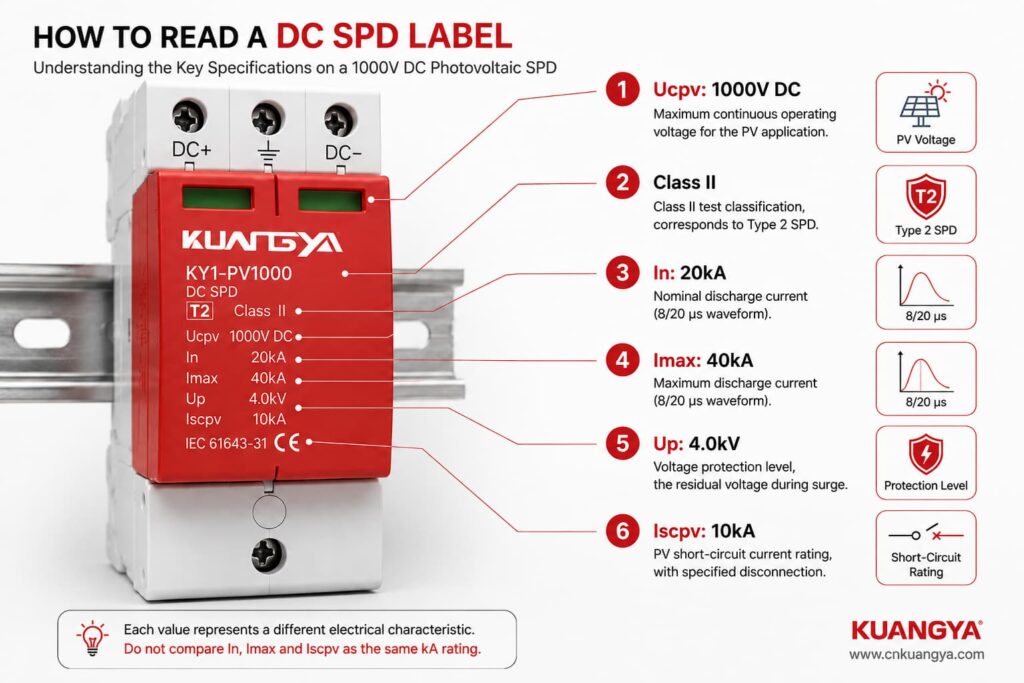
Guarda questa guida rapida per imparare a leggere le marcature principali sulla targhetta di un SPD CC.
Prima di entrare nei dettagli tecnici, la tabella seguente fornisce una semplice panoramica.
| Marcatura | Esempio | Significato semplice |
|---|---|---|
| Ucpv | 1000V CC | Tensione massima di esercizio continuativo per l'applicazione fotovoltaica |
| Classe II | Classe II | SPD testato in Classe II, associato alla protezione contro le sovratensioni di Tipo 2 |
| In | 20kA | Corrente nominale di scarica |
| Imax | 40kA | Corrente massima di scarica |
| Su | 4,0kV | Livello di protezione di tensione dichiarato |
| Iscpv | 10kA | Corrente di cortocircuito FV nominale dell'SPD |
| Temperatura | Da -40°C a +85°C | Intervallo di temperatura operativa dichiarato |
| Umidità | 5%–95% | Intervallo di umidità dichiarato |
| Interno | Interno | Destinato a condizioni di installazione protette |
| IP20 | IP20 | Grado di protezione dell'involucro dell'SPD |
Il punto più importante è:
Non confrontare gli SPD DC basandosi solo sul valore kA più alto stampato sull'etichetta.
Per esempio, Imax 40kA, In 20kA e Iscpv 10kA utilizzano tutti l'unità kA, ma descrivono caratteristiche completamente differenti.
Quando gli acquirenti vedono per la prima volta una scheda tecnica di un SPD, spesso iniziano dal numero più grande.
Di solito è l'approccio sbagliato.
Un ordine di lettura più utile è:
Questa procedura consente di scartare i prodotti non idonei prima di confrontare i valori nominali di corrente di scarica.
VIOX utilizza un approccio simile di “scarto preventivo delle specifiche incompatibili” nella sua guida alle schede tecniche; per le applicazioni fotovoltaiche, questa logica diventa ancora più importante poiché Ucpv e il comportamento in cortocircuito del fotovoltaico richiedono un'attenzione specifica.
Una delle prime indicazioni sull'etichetta di esempio è:
Classe II
Questo non non significa qualità di seconda classe.
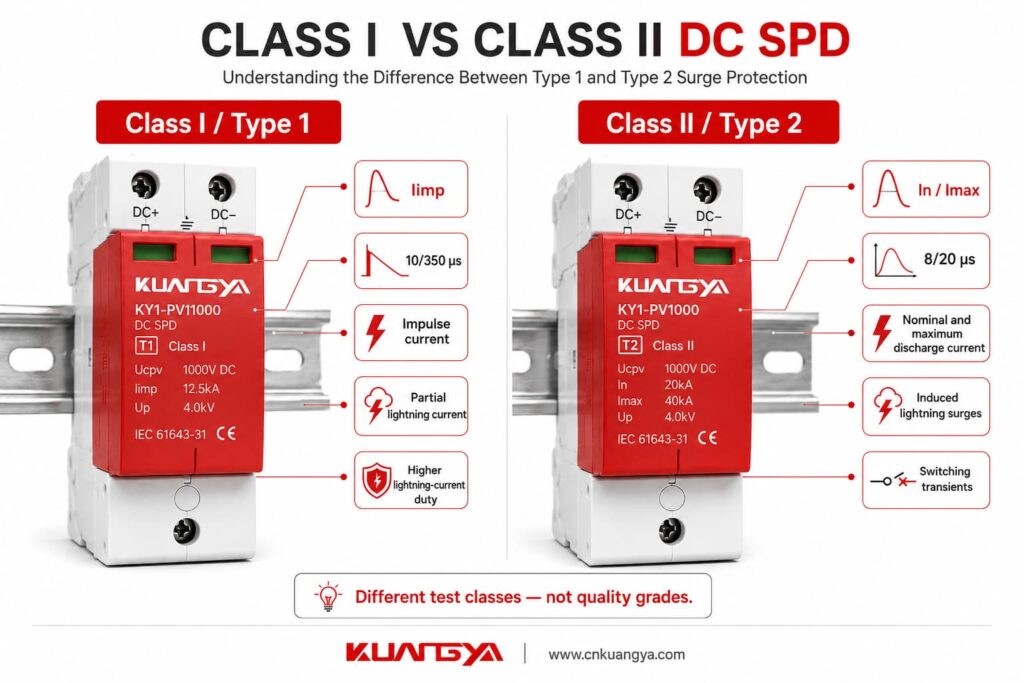
Classe I, Classe II e Classe III si riferiscono alle classificazioni di prova standardizzate degli SPD, non ai livelli di qualità del prodotto.
Per i dispositivi di protezione contro le sovratensioni (SPD) fotovoltaici, un SPD di Tipo 2 è associato a Test di Classe II.
Ecco perché diversi produttori o schede tecniche possono utilizzare diciture come:
Si riferiscono a concetti di classificazione e test strettamente correlati, sebbene tecnicamente “Tipo” e “classe di prova” non sono semplicemente due grafie diverse dello stesso termine.
Per la maggior parte degli acquirenti, la relazione pratica può essere intesa come segue:
| Classificazione SPD | Classe di prova | Parametro di corrente principale | Forma d'onda di prova comune |
|---|---|---|---|
| Tipo 1 | Classe I | Iimp | 10/350 μs |
| Tipo 2 | Classe II | In / Imax | 8/20 μs |
| Tipo 3 | Classe III | Altri parametri di prova coordinati | Prova con onda combinata |
Per l'esempio in questo articolo:
Classe II → direzione di applicazione Tipo 2
e pertanto i parametri di corrente più importanti mostrati sono:
In = 20kA
Imax = 40kA
No.
Questo è uno dei malintesi più comuni quando si confrontano gli SPD.
I termini Classe I e Classe II possono sembrare una classificazione gerarchica:
Classe I = migliore
Classe II = più economico o meno potente
Non è così che funziona la classificazione degli SPD.
Sono destinati a diverse condizioni di sovratensione.
Un SPD di Tipo 1 / Classe I è valutato per la capacità di corrente impulsiva da fulmine, laddove nel punto di installazione potrebbe essere necessario gestire correnti parziali di fulmine.
Un SPD di Tipo 2 / Classe II è comunemente utilizzato per limitare le sovratensioni transitorie causate da effetti indotti dai fulmini e da manovre di commutazione.
Pertanto, la domanda corretta non è:
Quale classe è migliore?
È:
Quale tipo di SPD è richiesto in questo punto di installazione?
Un SPD di Tipo 1 non è automaticamente la scelta corretta per ogni impianto fotovoltaico, e un SPD di Tipo 2 non è automaticamente inadeguato solo perché esiste il Tipo 1.
Se necessiti di una spiegazione dettagliata su questa questione di selezione, consulta la nostra guida:
SPD CC Tipo 1 vs Tipo 2 vs Tipo 1+2 per impianti fotovoltaici
Il tuo articolo esistente approfondisce l'esposizione ai fulmini, il luogo di installazione e quando valutare la capacità di Tipo 1.
La maggiore differenza tecnica diventa più chiara quando esaminiamo la corrente di prova.
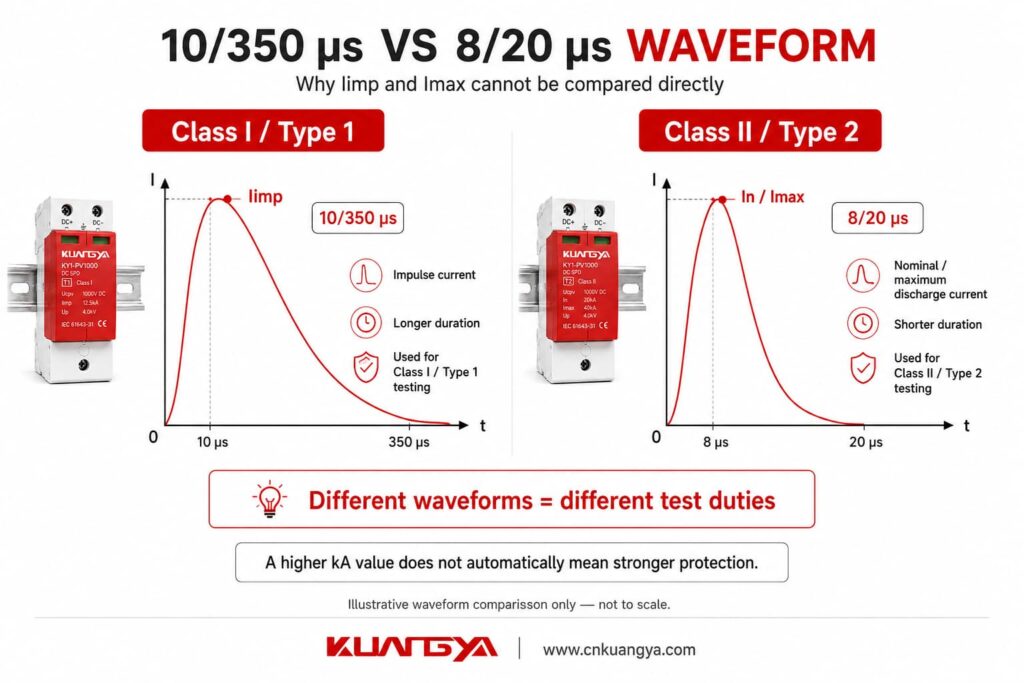
Un SPD di Tipo 1 è associato a un valore nominale di corrente impulsiva:
Iimp
e una 10/350 μs forma d'onda di corrente è comunemente associata ai test di Classe I.
La forma d'onda 10/350 μs rappresenta un carico di energia-corrente molto diverso rispetto alla forma d'onda 8/20 μs utilizzata per la valutazione di Tipo 2.
Ciò significa che:
Iimp non può essere confrontato direttamente con Imax solo perché entrambi sono espressi in kA.
Ad esempio:
Iimp = 12,5 kA
e
Imax = 40kA
non significa che il prodotto di Tipo 2 da 40 kA sia “più robusto”.”
Si riferiscono a diverse forme d'onda di prova e a diverse caratteristiche prestazionali.
Un SPD di Tipo 2 è caratterizzato principalmente da:
La forma d'onda di corrente 8/20 μs è associata ai test di corrente di scarica di Classe II.
Gli SPD CC di Tipo 2 sono comunemente valutati per l'uso in luoghi come:
Tuttavia, il tipo di SPD finale deve comunque dipendere dal progetto di protezione contro i fulmini e dalle condizioni di installazione effettive.
La Classe III esiste all'interno della classificazione generale degli SPD, ma non dovrebbe essere l'argomento principale quando si discute della selezione tipica degli SPD CC per impianti fotovoltaici.
La protezione di Classe III è generalmente associata a una protezione fine coordinata in prossimità di apparecchiature sensibili.
Per la protezione CC negli impianti solari fotovoltaici, gli acquirenti incontreranno molto più comunemente:
Ecco perché questo articolo si concentra principalmente su Classe II e la sua relazione con gli SPD CC di Tipo 2, piuttosto che trattare le Classi I, II e III come tre categorie di prodotti fotovoltaici ugualmente comuni.
L'etichetta di esempio mostra:
Ucpv: 1000V CC
Ucpv significa:
Tensione massima di esercizio continuo per applicazioni fotovoltaiche
In termini semplici:
Ucpv indica la tensione continua massima che può essere applicata costantemente alla modalità di protezione dell'SPD.
La norma IEC 61643-32 definisce l'Ucpv essenzialmente in questo modo e stabilisce che deve essere uguale o superiore alla condizione di tensione a circuito aperto fotovoltaico massima pertinente all'installazione.
Questo rende l'Ucpv una delle prime specifiche da verificare quando si seleziona un SPD solare in corrente continua.
Non necessariamente.
Questo è importante.
Un impianto fotovoltaico non dovrebbe essere valutato utilizzando solo una comoda etichetta nominale come:
impianto solare da 1000V
La tensione massima effettiva in corrente continua di una stringa fotovoltaica dipende da fattori quali:
La tensione a circuito aperto del modulo fotovoltaico aumenta normalmente al diminuire della temperatura.
Per una spiegazione più ampia sulla tensione dell'array fotovoltaico, sulla progettazione delle stringhe e sui relativi requisiti di sistema, consultare il nostro Guida alla progettazione di impianti fotovoltaici IEC 62548.
Pertanto, il processo di selezione dovrebbe basarsi sulla tensione a circuito aperto (Voc) massima calcolata del fotovoltaico, piuttosto che limitarsi a copiare la tensione nominale dell'inverter o del sistema.
Un flusso di lavoro semplificato è:
Voc del modulo
→ Numero di moduli in serie
→ Correzione per bassa temperatura
→ Tensione massima a circuito aperto FV
→ Selezionare l'Ucpv idoneo
Abbiamo già trattato questo argomento separatamente nella nostra Guida alla selezione della tensione per SPD CC, incluse le applicazioni a 600V, 1000V e 1500V CC.
Quindi, in questo articolo, il punto importante è semplicemente:
Ucpv è un valore nominale di compatibilità della tensione continua, non un valore nominale di corrente di sovratensione.
Questa è un'altra fonte comune di confusione.
Il nostro esempio di SPD mostra:
Ucpv = 1000V DC
e
Up = 4.0kV
Un acquirente potrebbe ragionevolmente chiedere:
Perché un SPD da 1000V ha anche una tensione nominale di 4kV?
Perché questi due valori descrivono cose diverse.
| Parametro | Esempio | Cosa descrive |
|---|---|---|
| Ucpv | 1000V CC | Tensione operativa continua FV |
| Su | 4,0kV | Livello di protezione dalla tensione durante i test di sovratensione |
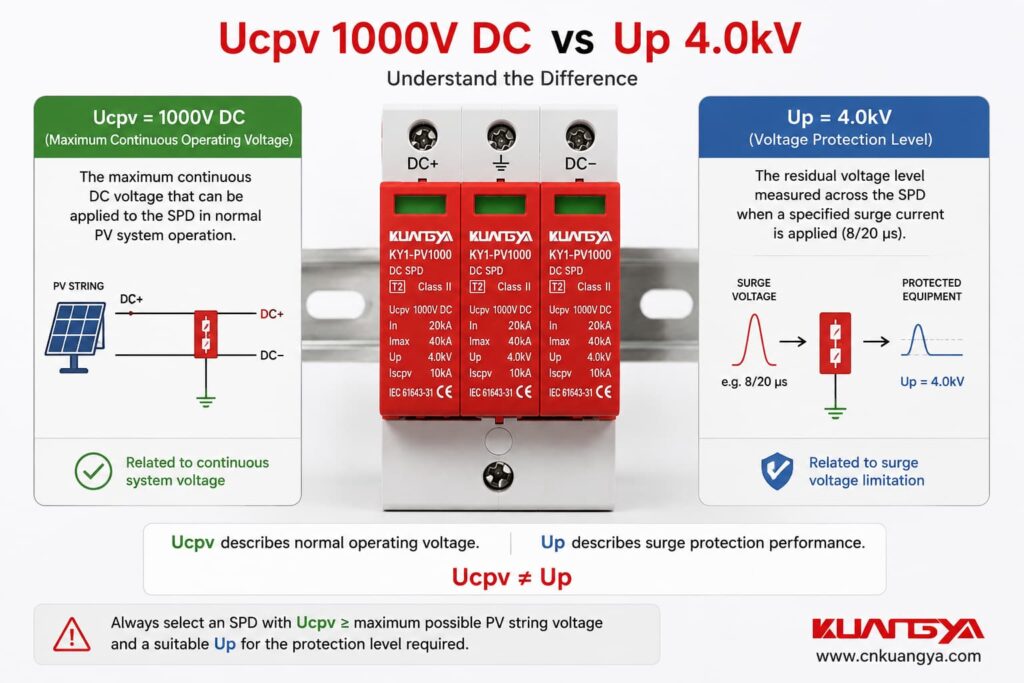
Quindi:
Ucpv riguarda la resistenza durante il normale funzionamento del sistema.
Up riguarda la limitazione della sovratensione transitoria.
Non dovrebbero mai essere considerati come valori di tensione intercambiabili.
L'etichetta indica:
In: 20kA
In significa:
Corrente di scarica nominale
Per un SPD di Tipo 2 / Classe II, In è associato a una forma d'onda di corrente 8/20 μs.
In termini tecnici, rappresenta il valore di cresta della corrente che attraversa l'SPD con la forma d'onda 8/20 μs specificata, nelle condizioni di prova standardizzate pertinenti.
Tale definizione è accurata, ma per un acquirente può essere semplificata:
In è uno dei principali valori nominali utilizzati per descrivere le prestazioni di scarica delle sovratensioni testate di un SPD di Tipo 2.
Per questo prodotto:
In = 20kA
La parola importante qui è nominale.
Non deve essere confuso con Imax.
Lo stesso SPD indica anche:
Imax: 40kA
Imax significa:
Corrente di scarica massima
Per un SPD di Tipo 2, Imax è solitamente associato anche alla forma d'onda di corrente 8/20 μs.
Rappresenta la capacità massima di corrente di scarica dichiarata dal produttore nelle condizioni di prova applicabili.
Pertanto:
In 20kA e Imax 40kA non sono specifiche duplicate.
Rappresentano diversi livelli di prova.
This is one of the most important parts of the entire datasheet.
Consider the example:
| Parametro | Valore |
|---|---|
| In | 20kA |
| Imax | 40kA |
| Forma d'onda | 8/20 μs |
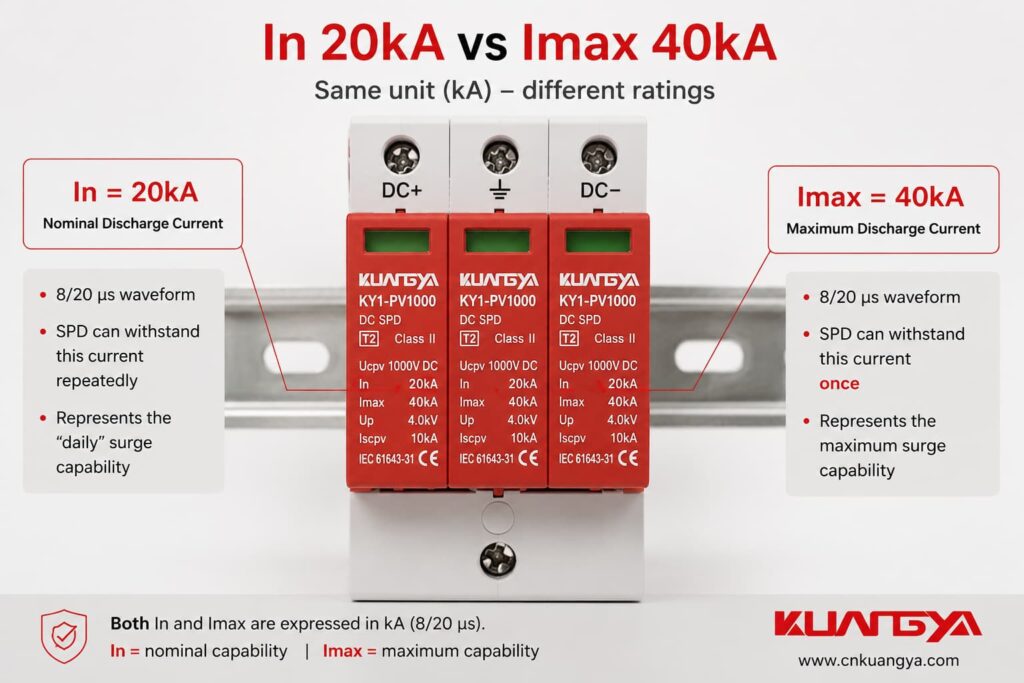
A simple way to understand them is:
In = nominal discharge-current rating.
Imax = maximum declared discharge-current rating.
One common purchasing mistake is to look only at Imax because it is the larger number.
Ad esempio:
SPD A: In 20kA / Imax 40kA
SPD B: In 10kA / Imax 40kA
A buyer may see “40kA” on both products and assume that their surge performance is equivalent.
That conclusion is incomplete.
The full declared performance needs to be checked.
VIOX makes the same useful procurement distinction in its SPD datasheet guide: In and Imax should be read separately, and Imax should not be interpreted as the SPD’s normal repeated discharge capacity.
No.
This is probably the most useful purchasing rule in this article:
The highest kA value does not automatically identify the best SPD.
Suppose two products are advertised as:
It would be incorrect to select SPD B immediately just because:
60kA > 40kA.
Other questions still matter:
A larger number may be useful when the complete design calls for it.
But:
More kA is not a substitute for correct coordination.
Not simply because it says 40kA.
This is another very common mistake.
A Type 2 product may show:
Imax = 40kA, 8/20 μs
while a Type 1 product may show:
Iimp = 12.5kA, 10/350 μs
Looking only at the peak current numbers:
40 > 12.5
may make the Type 2 SPD appear stronger.
But that comparison is technically incorrect.
The two values are based on different test waveforms and different protection duties.
Pertanto:
Imax cannot be used as a substitute for a specified Iimp requirement.
If the project requires Type 1 lightning-current capability, a large Type 2 Imax value alone does not satisfy that requirement.
L'etichetta di esempio mostra:
Up: 4.0kV
Up means:
Livello di protezione della tensione
It describes the SPD’s declared voltage-limiting performance under specified standardized test conditions.
In practical terms, Up helps answer the question:
How effectively does the SPD limit the transient voltage during the relevant test?
Generally, a lower Up can provide a lower level of surge voltage at the SPD terminals.
However, this needs an important qualification.
The printed Up value should non be treated as the exact maximum voltage that every connected inverter or device will experience in a real installation.
Perché?
Because the actual voltage seen by the protected equipment can also be affected by:
VIOX correctly makes the same distinction: the declared Up is established at the SPD under standardized conditions, while installation conductors can increase the voltage presented to the protected equipment.
Not by itself.
It is reasonable to prefer effective voltage limitation, but the selection must remain compatible with the complete electrical system.
A low Up does not compensate for:
So instead of saying:
“Always buy the SPD with the lowest Up.”
A more technically correct rule is:
Select an SPD with a suitable Up while also verifying Ucpv, SPD Type, protected equipment withstand level and installation coordination.
Now we come to one of the most misunderstood PV-specific parameters:
Iscpv: 10kA
This is particularly important because it also uses the unit kA.
It is easy to look at:
In 20kA
Imax 40kA
Iscpv 10kA
and assume they are three levels of surge current.
Non lo sono.
Iscpv means:
Short-Circuit Current Rating of the SPD for the PV application.
IEC terminology defines Iscpv as the maximum prospective short-circuit current from the power system for which the SPD, together with the specified disconnector, is rated.
A simpler explanation is:
Iscpv tells you whether the SPD and its specified disconnection arrangement are suitable for the prospective PV short-circuit current at the installation point.
Si tratta di un fault-current / short-circuit characteristic.
It is not a lightning-surge rating.
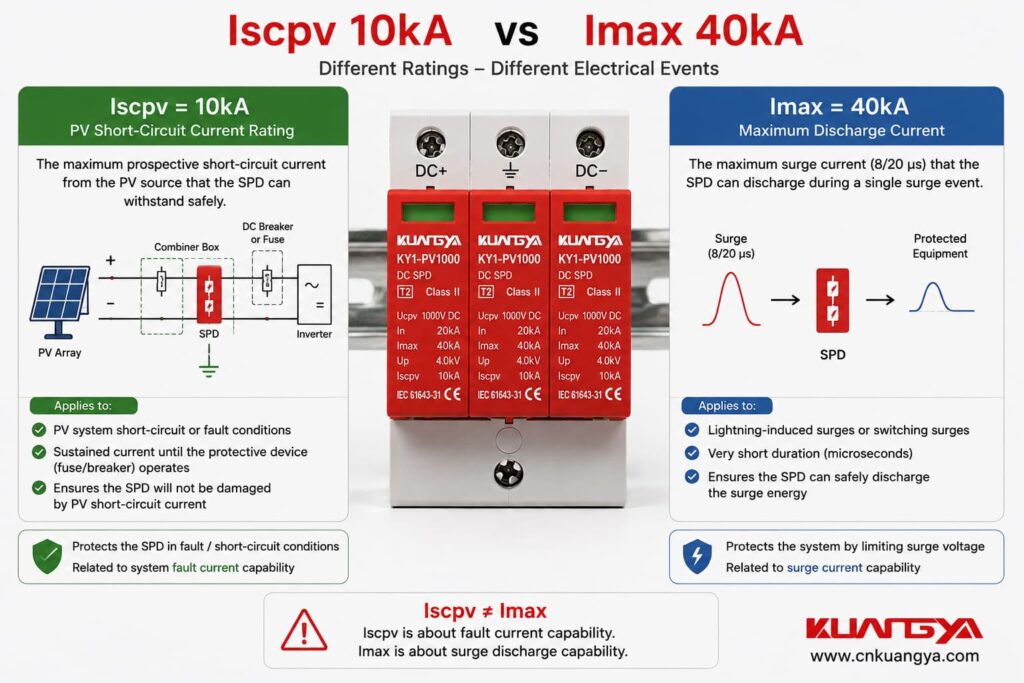
This distinction deserves to be stated clearly:
Iscpv ≠ Imax
Even though both can be expressed in kA.
Ad esempio:
Describes surge discharge-current performance.
Describes the SPD’s PV short-circuit-current rating in conjunction with the specified disconnection arrangement.
So on our example product:
Imax = 40kA
does not mean:
PV short-circuit rating = 40kA.
And:
Iscpv = 10kA
does not mean:
The SPD can only discharge a 10kA surge.
These numbers belong to different electrical events.
PV DC circuits behave differently from ordinary AC circuits.
One important difference is that DC current does not naturally pass through zero every half-cycle as AC current does.
For protection devices, switching equipment and disconnecting arrangements, this makes DC fault interruption an important design consideration.
That is one reason PV-specific SPDs have characteristics and test requirements beyond simply printing:
“DC 1000V”
on an AC-style product.
IEC 61643-31 is specifically intended for SPDs connected to the DC side of photovoltaic installations and establishes PV-specific requirements, ratings and test methods.
Therefore, when buying a PV SPD, do not ask only:
“Is this 1000V DC?”
Also ask:
What is the declared Iscpv and required disconnection arrangement?
The easiest way to remember these parameters is with this table:
| Valutazione | Main Meaning | Typical Context |
|---|---|---|
| In | Corrente nominale di scarica | Type 2 / Class II surge performance |
| Imax | Corrente massima di scarica | Type 2 maximum declared surge-current performance |
| Iimp | Impulse current | Type 1 / Class I lightning-current capability |
| Iscpv | PV short-circuit current rating | PV fault-current compatibility |
Notice something important:
Three or four specifications can all contain:
kA
but this does not mean they can be compared directly.
Before comparing any two kA ratings, first ask:
This prevents a large number of purchasing errors.
The label also declares:
Da -40°C a +85°C
This is the manufacturer’s declared temperature range for the product.
Environmental ratings should not be ignored simply because electrical parameters look correct.
PV equipment may be installed in:
The internal temperature of an enclosure can be very different from the normal outdoor air temperature.
Therefore, project engineers should confirm that the SPD’s declared environmental conditions are suitable for the actual enclosure and installation environment.
Where the datasheet declares:
5%–95%
this normally represents the manufacturer’s declared relative humidity operating range.
However, humidity specifications should always be read together with conditions such as:
The percentage alone does not mean that an exposed SPD can be installed directly in rain or other outdoor environments.
The label states:
Interno
This does not necessarily mean that the SPD can never form part of an outdoor PV installation.
It means the SPD itself is intended for a protected environment according to its declared construction and installation conditions.
For example, an indoor-rated SPD may be installed inside:
The important distinction is:
The SPD can be inside outdoor equipment without the SPD itself being directly exposed to outdoor conditions.
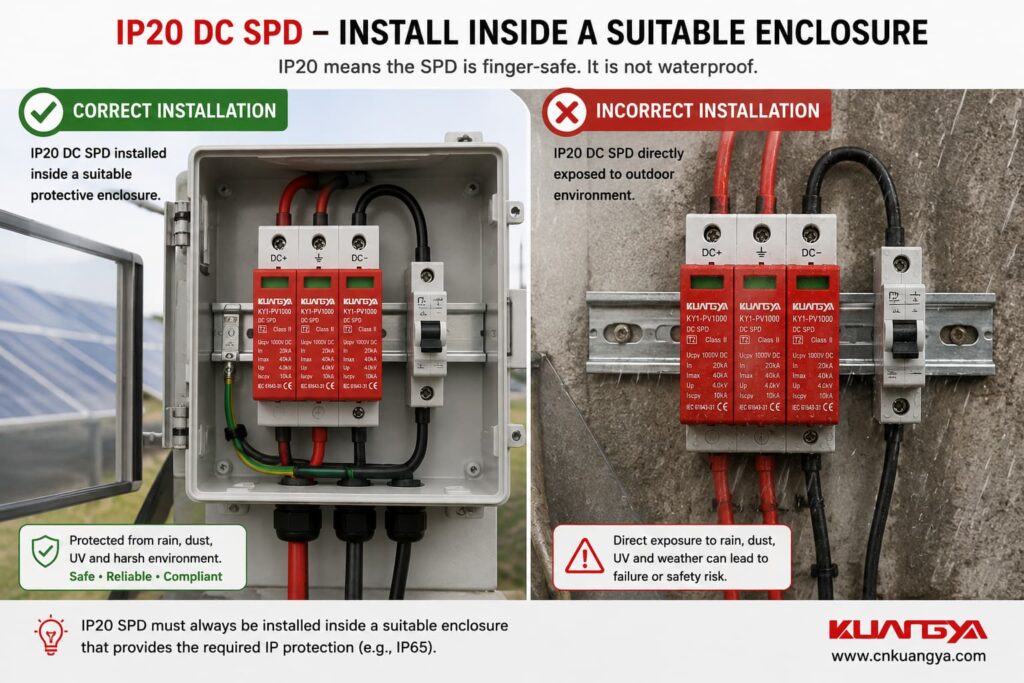
IP20 is the enclosure protection rating shown for the SPD itself.
It should not be interpreted as a weatherproof rating.
A DIN-rail SPD with IP20 is normally installed inside another suitable enclosure or cabinet.
For an outdoor PV installation, the final environmental protection depends on the complete enclosure, not only the bare SPD module.
Quindi:
IP20 SPD inside a suitable outdoor enclosure
can be a normal arrangement.
But:
IP20 SPD directly exposed to rain, dust and outdoor weather
should not be assumed to be acceptable.
Now we can return to the original example.
Ucpv: 1000V CC
Classe II
In: 20kA
Imax: 40kA
Up: 4.0kV
Iscpv: 10kA
Instead of reading each number independently, read it as one technical description.
This tells us the declared maximum continuous PV operating voltage of the SPD.
This indicates Class II testing / Type 2 application direction.
This is the nominal discharge-current rating associated with the relevant Type 2 surge test.
This is the declared maximum discharge-current rating.
This is the declared voltage protection level.
This is the PV short-circuit-current rating and must be understood together with the applicable disconnector/protection arrangement.
Now the label makes much more sense.
It is not saying:
“1000V, 20kA, 40kA, 10kA — bigger numbers are better.”
It is describing different electrical functions and limits of the same SPD.
Incorrect:
Class I is premium and Class II is lower quality.
Correct:
Class I and Class II represent different test/protection classifications.
Incorrect:
This one says 60kA, so it is automatically better than the 40kA model.
Correct:
Check:
before making the comparison.
Incorrect:
Imax 40kA is higher than Iimp 12.5kA, so Type 2 is stronger.
Correct:
Iimp and Imax refer to different test waveforms and different surge duties.
Incorrect:
The SPD is rated 1000V but Up is 4kV, so the specifications conflict.
Correct:
Ucpv and Up describe different voltage characteristics.
Incorrect:
Iscpv 10kA means the SPD can discharge 10kA of lightning current.
Correct:
Iscpv is a PV short-circuit-current rating.
Even a correctly selected SPD can provide poor protection if installation is poor.
Important details include:
A datasheet tells you what the device is capable of under defined conditions.
Installation determines how effectively that capability is used in the real system.
The SPD should also be considered together with other solar PV electrical protection devices, including DC fuses, isolators, circuit breakers and the overall protection arrangement.
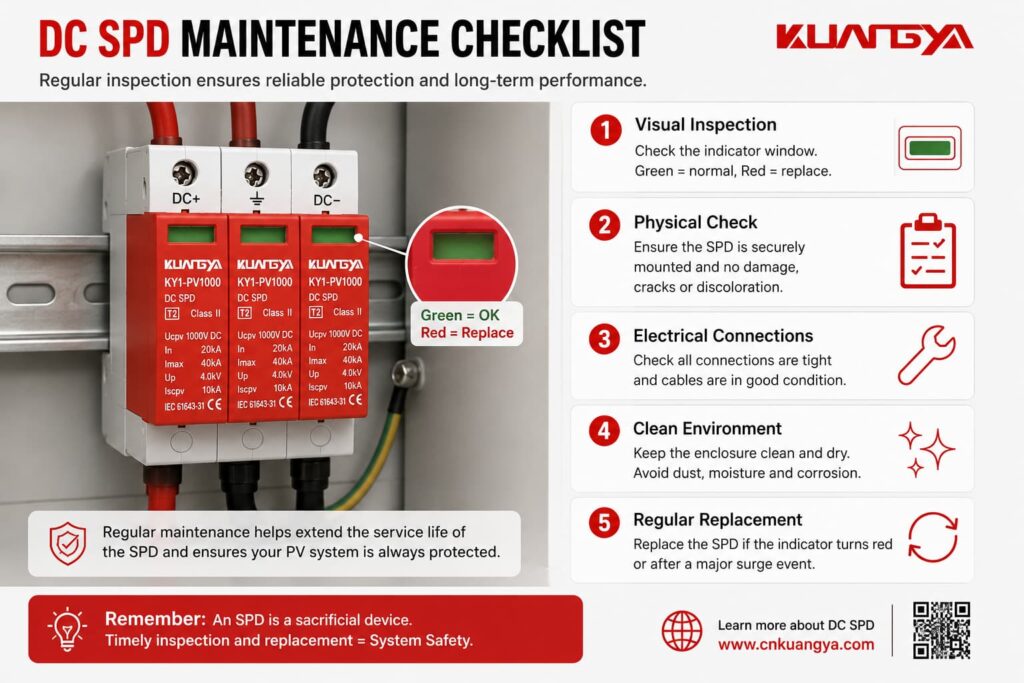
For buyers, distributors and EPC procurement teams, the following sequence is more useful than simply asking for:
“1000V 40kA SPD price.”
Is the product specifically intended for:
PV DC surge protection?
Do not assume an AC SPD with a similar voltage or current marking is interchangeable.
Determine the maximum possible PV open-circuit voltage.
Then confirm that the selected Ucpv is suitable.
For the full calculation method, refer to the DC SPD Voltage Selection Guide mentioned earlier.
Determine whether the installation requires:
Do not make this decision simply from product price or kA rating.
Our detailed Type 1 vs Type 2 vs Type 1+2 DC SPD guide explains this separately.
For a Type 2 / Class II SPD, confirm both values.
Do not check only Imax.
Verify the declared voltage protection level and whether it is appropriate for the protected equipment and protection concept.
Confirm that the SPD and specified disconnection/protection arrangement are compatible with the prospective short-circuit current of the PV system.
Confirm:
Verificate:
For PV DC SPDs, IEC 61643-31 is an important product standard to check.
IEC 61643-31:2018 covers SPDs intended for the DC side of photovoltaic installations up to 1500V DC, while IEC 61643-32:2017 addresses their selection, installation and coordination.
Depending on the project and market, buyers may also need:
Do not assume that a logo printed on a product is sufficient evidence.
Match the documentation to the exact model being purchased.
Before approving a PV SPD, use the following checklist.
| Controllo | Domanda |
|---|---|
| Applicazione | Is it specifically suitable for PV DC? |
| Ucpv | Is it suitable for maximum PV open-circuit voltage? |
| Tipo SPD | Does Type 1 / Type 2 / Type 1+2 match the installation design? |
| Classe di prova | Is the declared classification clear? |
| In | Is the nominal discharge-current rating specified? |
| Imax | Is the maximum discharge-current rating specified? |
| Iimp | If Type 1 is required, is Iimp declared? |
| Su | Is the protection level suitable? |
| Iscpv | Is the PV short-circuit rating adequate? |
| Cablaggio | Is the correct DC connection diagram available? |
| Protezione | Is required backup protection identified? |
| Ambiente | Are temperature, IP and enclosure conditions suitable? |
| Standard | Is the applicable PV SPD standard stated? |
| Documentazione | Do certificates/test reports match the exact model? |
A weak RFQ might say:
Please quote 1000V 40kA solar SPD.
This leaves many important questions unanswered.
A better RFQ is:
Please quote a Type 2 / Class II PV DC SPD for a 1000V DC application. Please confirm Ucpv, In, Imax, Up, Iscpv, pole configuration, required backup protection, IEC 61643-31 documentation and wiring diagram.
If known, also include:
This allows the manufacturer to evaluate the complete requirement instead of matching only the words:
“1000V” and “40kA.”
They are closely related but technically describe classification/testing from slightly different perspectives.
For practical PV product selection, a Type 2 SPD is associated with Test di Classe II, which is why labels and datasheets may show Type 2, T2 or Class II terminology.
No.
Class I and Class II are not quality levels.
They are intended for different surge-protection duties and test conditions.
In is the nominal discharge current.
Imax is the maximum discharge current.
For Type 2 SPDs, both are normally associated with the 8/20 μs waveform, but they represent different test-duty levels.
Not enough information is available to answer that from Imax alone.
A proper comparison also requires Ucpv, Type, In, Up, Iscpv, standard, protection configuration and installation conditions.
Not simply because its peak current number is larger.
Type 1 is characterized by lightning impulse-current capability such as Iimp and the associated Class I test conditions.
Imax and Iimp should not be directly compared.
Ucpv is the maximum continuous operating voltage for the PV application.
Su is the declared voltage protection level under specified surge test conditions.
They perform completely different functions in the datasheet.
Iscpv is the short-circuit current rating of the PV SPD.
More precisely, it describes the maximum prospective short-circuit current for which the SPD, together with its specified disconnector arrangement, is rated.
No.
Imax is a surge discharge-current rating.
Iscpv is a short-circuit-current rating.
The fact that both use kA does not make them interchangeable.
Not automatically.
Maximum PV open-circuit voltage should be calculated under the project’s design conditions before selecting Ucpv.
For more detail, see our Guida alla selezione degli SPD DC: come scegliere la tensione nominale corretta.
It may be installed inside a suitable outdoor enclosure, provided the complete installation satisfies the required environmental protection.
IP20 on the SPD itself should not be treated as a weatherproof outdoor rating.
IEC 61643-31 covers requirements and test methods for SPDs intended for the DC side of photovoltaic installations up to 1500V DC.
IEC 61643-32 provides selection and application principles for PV SPDs.
Reading a DC SPD datasheet becomes much easier once each parameter is treated according to its actual purpose.
For the example:
Classe II
Ucpv 1000V DC
In 20kA
Imax 40kA
Up 4.0kV
Iscpv 10kA
the correct interpretation is not simply:
“This is a 1000V, 40kA SPD.”
A more complete interpretation is:
Each specification answers a different engineering question.
That leads to one simple purchasing principle:
Never select a DC SPD from one voltage number, one kA number or one Type label alone.
The correct SPD is the one whose complete set of ratings matches the PV system voltage, surge environment, equipment protection requirements, short-circuit conditions and installation design.
For solar PV projects requiring 600V, 1000V or 1500V surge protection, explore KUANGYA DC surge protective devices to compare available Type 2 and Type 1+2 models by voltage rating, discharge-current capability and application.

