WengYang Industriegebiet Yueqing Wenzhou 325000
Arbeitszeiten
Montag bis Freitag: 7AM - 7PM
Am Wochenende: 10AM - 5PM
WengYang Industriegebiet Yueqing Wenzhou 325000
Arbeitszeiten
Montag bis Freitag: 7AM - 7PM
Am Wochenende: 10AM - 5PM

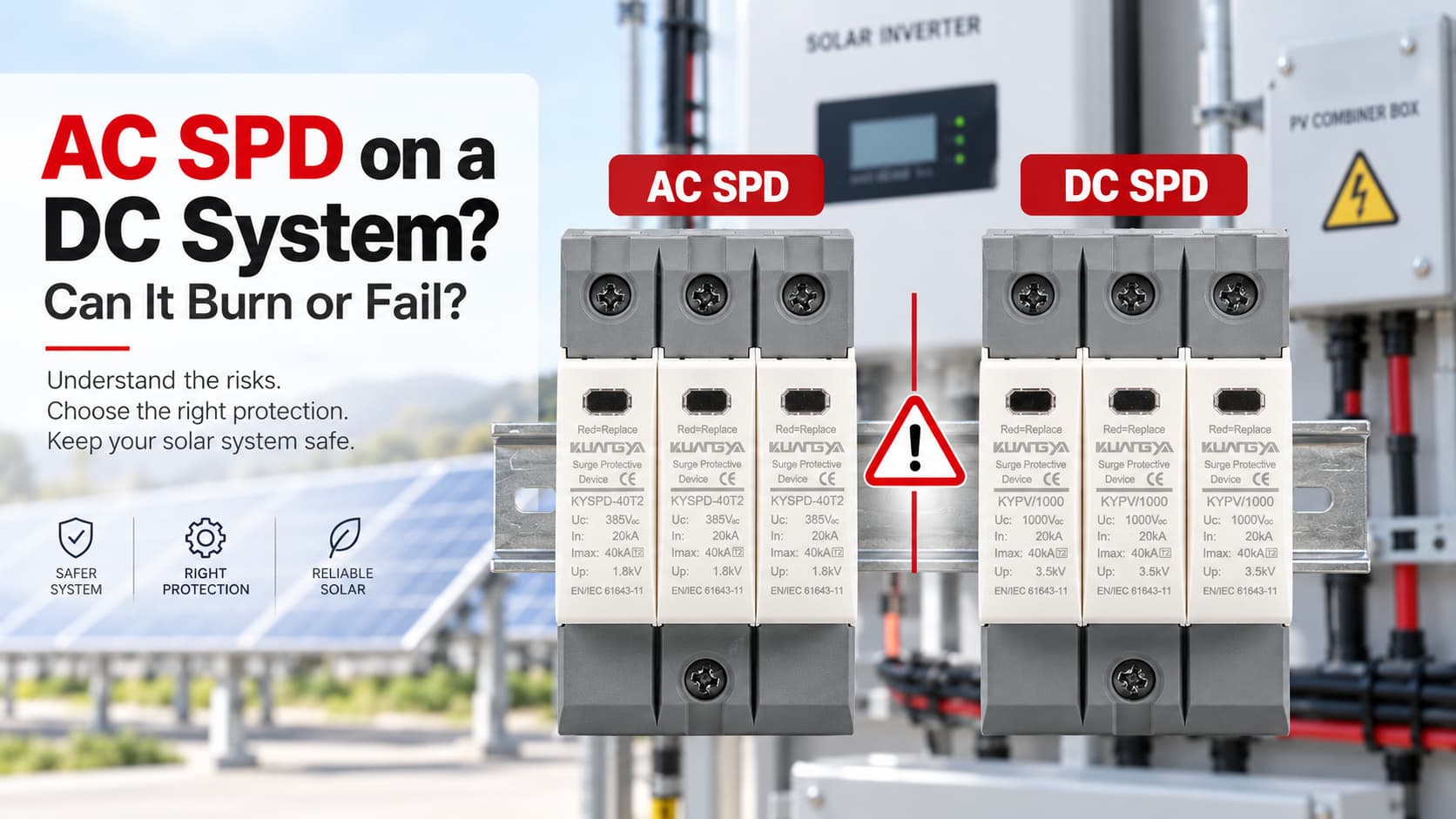
Die Verwendung eines AC-SPD in einem DC-System kann gefährlich sein, wenn das Gerät nicht ausdrücklich für die DC-Anwendung spezifiziert ist.
Ein AC-SPD und ein DC-SPD können äußerlich sehr ähnlich aussehen, sind aber nicht automatisch austauschbar. Einer der häufigsten Fehler besteht darin, nur die auf dem Etikett aufgedruckte Spannung zu vergleichen. Beispielsweise könnte jemand “1000V” auf einem SPD sehen und annehmen, dass es in einer 1000V-DC-Solaranlage installiert werden kann.
Diese Annahme kann gefährlich sein.
Ein SPD sollte nur dann in einem DC-System installiert werden, wenn der Hersteller es ausdrücklich für diese DC-Anwendung spezifiziert hat und seine elektrischen Eigenschaften mit dem System übereinstimmen.
Die Verwendung eines reinen AC-Überspannungsschutzgeräts (SPD) in einem DC-Stromkreis kann zu Überhitzung, zum Versagen des internen Trennmechanismus, zu anhaltender Lichtbogenbildung, Verbrennungen oder einem Brand führen. Bei einem schwerwiegenden Defekt kann das Gehäuse des SPD zudem bersten.
Kann also ein AC-SPD explodieren, wenn es an Gleichstrom angeschlossen wird?
Nicht zwangsläufig. Die Verwendung des falschen SPD kann jedoch ein ernstes Ausfallrisiko darstellen, und ein schwerer thermischer oder elektrischer Defekt kann zum Bersten des Gehäuses führen.
Ein AC-SPD sollte nicht allein deshalb in einem DC-System verwendet werden, weil der Spannungswert ähnlich erscheint.
Ein Gerät, das nur für den AC-Betrieb gekennzeichnet ist, wurde für die Bedingungen von Wechselstromsystemen entwickelt und geprüft. Ein Photovoltaik-DC-SPD ist für die kontinuierliche Gleichspannung, Fehlerbedingungen, Systemkonfigurationen und Trennanforderungen ausgelegt, die auf der DC-Seite einer PV-Anlage vorliegen.
Überprüfen Sie bei PV-Systemen immer die vollständige SPD-Spezifikation, insbesondere Ucpv, In, Imax, Iimp (sofern zutreffend), Up, Iscpv, SPD-Typ, Anschlusskonfiguration und geltende Norm.
Normalerweise sollten Sie keinen reinen AC-ÜSS in einem DC-System verwenden.
Das wichtige Wort ist “bemessen”.”
Wenn ein Hersteller ausdrücklich angibt, dass ein bestimmter ÜSS sowohl für AC- als auch für DC-Anwendungen geeignet ist, darf dieser innerhalb der angegebenen Bemessungswerte und Installationsbedingungen verwendet werden.
Ein ÜSS, der nur für AC gekennzeichnet ist, sollte jedoch nicht automatisch in einem DC-Stromkreis installiert werden.
Zum Beispiel:
| ÜSS-Kennzeichnung | System | Geeignet? |
|---|---|---|
| Uc 275V AC | 600V DC PV-Anlage | Nein |
| Uc 440V AC | 1000V DC PV-Anlage | Nein |
| Ucpv 1000V DC | Geeignete PV-Anlage innerhalb der Bemessungswerte | Möglicherweise ja |
| AC/DC-kombinierter Überspannungsschutz (SPD) | Passendes AC- oder DC-System | Herstellerangaben prüfen |
Deshalb reicht es nicht aus, nur den Spannungswert zu lesen.
1000V AC und 1000V DC sind nicht dieselbe Anwendungsbemessung.
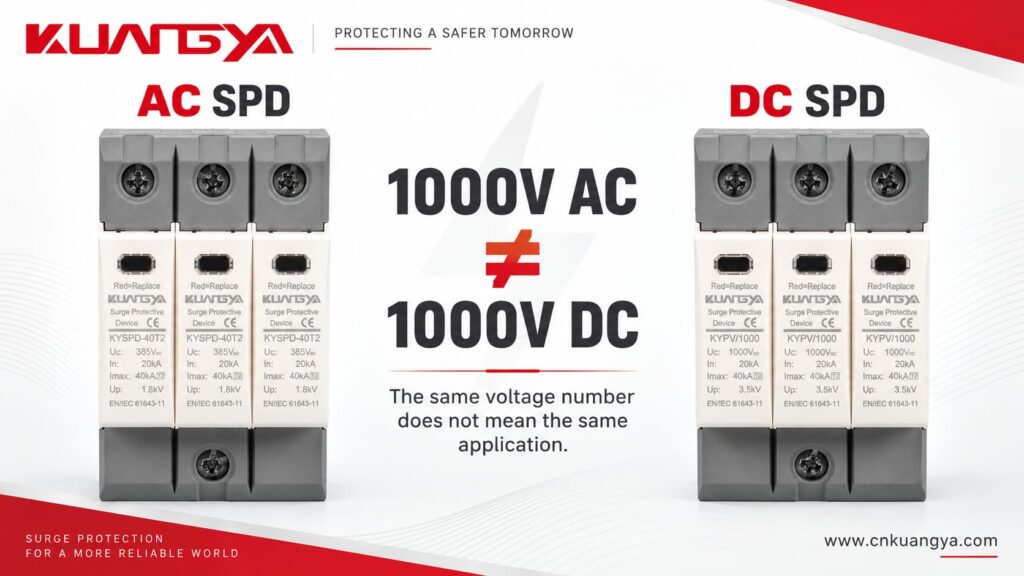
Die Buchstaben nach der Zahl sind entscheidend.
Beide, AC- und DC-SPDs, erfüllen dieselbe grundlegende Aufgabe: Sie helfen, transiente Überspannungen zu begrenzen und Stoßströme von empfindlichen Geräten abzuleiten.
Aber die elektrischen Umgebungen, in denen sie betrieben werden, sind unterschiedlich.
Dieser Unterschied wird bei anormalen Bedingungen und am Ende der Lebensdauer des SPD besonders wichtig.
In einem normalen sinusförmigen Wechselstromsystem durchlaufen die Momentanwerte von Spannung und Strom periodisch den Nullpunkt.
Bei 50 Hz oder 60 Hz geschieht dies mehrmals pro Sekunde.
Natürliche Nulldurchgänge können beim Öffnen eines Schalt- oder Trenngeräts dazu beitragen, einen Lichtbogen zu löschen.
Dies ist ein Grund, warum bei Geräten, die für das Schalten von Wechselstrom und die Fehlerunterbrechung ausgelegt sind, nicht automatisch davon ausgegangen werden kann, dass sie unter Gleichstrombedingungen sicher funktionieren.
Eine Gleichstromquelle behält die gleiche Polarität bei und durchläuft den Nullpunkt nicht auf die gleiche Weise wie Wechselstrom.
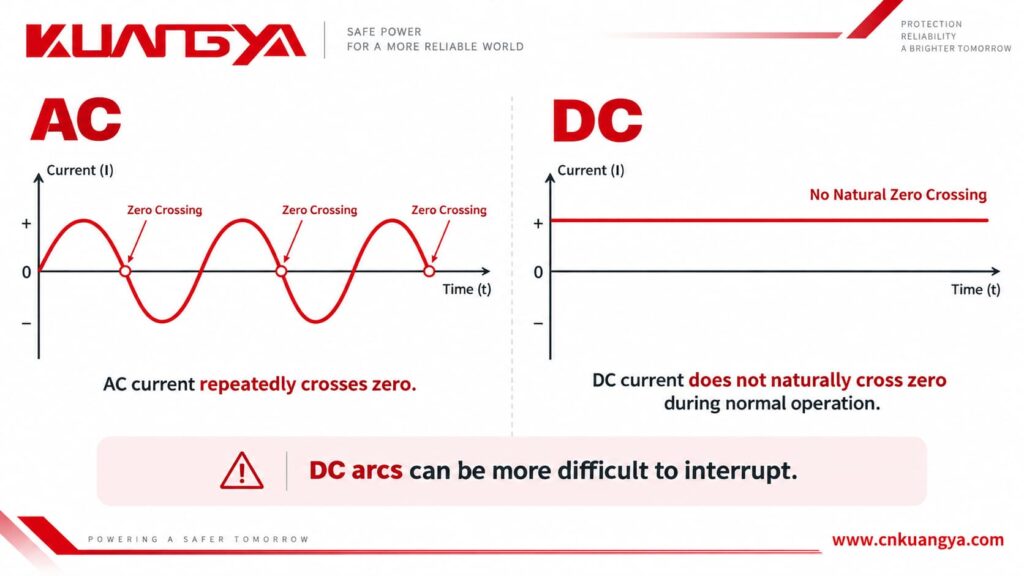
Wenn ein Lichtbogen bei Gleichstrom entsteht, kann dieser daher schwieriger zu unterbrechen sein.
Dies ist bei Photovoltaikanlagen von Bedeutung, da das Solarmodulfeld weiterhin Gleichstrom liefern kann, solange Sonnenlicht vorhanden ist.
Wenn ein Überspannungsschutzgerät (SPD) überlastet wird und sein internes Trennsystem die defekte Schutzkomponente isolieren muss, muss das Gerät so ausgelegt sein, dass es die Gleichstrombedingungen sicher bewältigt.
Dies ist ein Grund, warum spezielle PV-DC-Überspannungsschutzgeräte Konstruktionen und Trennvorrichtungen verwenden, die für Gleichstromanwendungen vorgesehen sind.
Phoenix Contact erklärt zudem, dass sich Gleichstromsysteme anders verhalten als Wechselstromsysteme und daher Überspannungsschutzgeräte erfordern, die für Gleichstromanwendungen ausgelegt sind..
Die Installation eines AC-Überspannungsschutzgeräts in einem Gleichstromsystem führt möglicherweise nicht zu einem sofort sichtbaren Ausfall, und es gibt keinen einheitlichen Fehlerverlauf.
Das Ergebnis hängt von der Bauweise des Überspannungsschutzgeräts, der Gleichspannung, dem verfügbaren Strom, der Systemkonfiguration, der Temperatur, der Belastungshistorie und der Art des Ausfalls des Geräts ab.
Ein falsch ausgewählter SPD kann zunächst sogar normal erscheinen.
Genau das macht den Fehler gefährlich.
| Möglicher Zustand | Was passieren kann |
|---|---|
| Unmittelbar nach der Installation | SPD kann völlig normal erscheinen |
| Kontinuierliche Überspannungsbelastung | MOV oder andere Schutzkomponenten können sich erhitzen |
| Bauteildegradation | Ableitstrom kann ansteigen |
| Thermische Überlastung | Interner thermischer Trennschalter kann auslösen |
| Unsachgemäße DC-Unterbrechung | Ein Lichtbogen kann nach Beginn der Trennung bestehen bleiben |
| Schwerwiegender Fehler | Verbrennungen, Rauch oder Feuer können auftreten |
| Schwerwiegender Ausfall | Das Gehäuse kann reißen oder bersten |
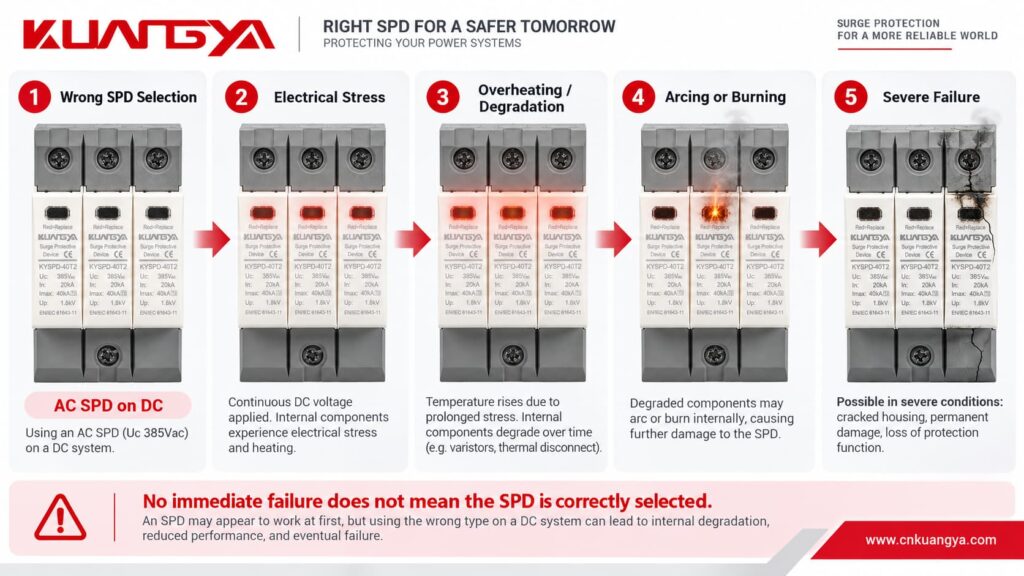
Der entscheidende Punkt ist:
Ein ausbleibender sofortiger Ausfall bedeutet nicht, dass der SPD korrekt ausgewählt wurde.
Ein falsch eingesetzter SPD kann wochen- oder monatelang installiert bleiben, bevor ein Überspannungsereignis, eine Temperaturänderung, Netzbedingungen, Isolationsprobleme oder eine Bauteilalterung zu einem Ausfall führen.
Video ansehen: Was passiert, wenn ein falscher SPD in einem Gleichstromsystem verwendet wird?
Diese Frage erfordert eine sorgfältige Antwort.
Der Anschluss eines AC-Überspannungsschutzgeräts (SPD) an Gleichstrom bedeutet nicht, dass es sofort explodiert.
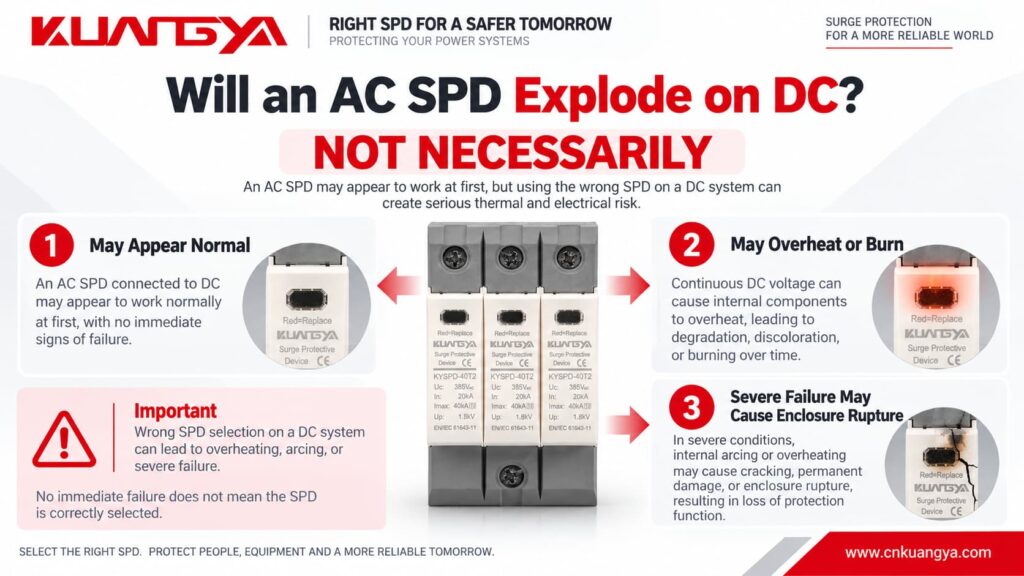
Bei vielen fehlerhaften Installationen passiert zunächst nichts Dramatisches.
Das eigentliche Problem ist, was passiert, wenn das SPD elektrischer oder thermischer Belastung ausgesetzt ist.
Eine vereinfachte Fehlersequenz könnte wie folgt aussehen:
Falsche SPD-Auswahl → übermäßige elektrische Belastung → Erwärmung oder Degradation → ansteigender Leck- oder Fehlerstrom → Schwierigkeiten bei der Abschaltung → Lichtbogenbildung oder Verbrennung → mögliches Bersten des Gehäuses
Daher die Aussage:
“Ein AC-Überspannungsschutzgerät (SPD) explodiert, wenn es an Gleichstrom angeschlossen wird.”
ist zu absolut formuliert.
Eine technisch präzisere Aussage lautet:
Die Verwendung eines SPD, das nicht für die DC-Anwendung ausgelegt ist, kann ein ernstes Überhitzungs- und Brandrisiko darstellen. Unter schweren Fehlerbedingungen kann das SPD verbrennen oder sein Gehäuse kann bersten.
“Explosion” wird oft umgangssprachlich verwendet, um ein beschädigtes oder geborstenes SPD zu beschreiben, aber gewaltsames Bersten des Gehäuses ist eine präzisere technische Beschreibung.
Wenn ein SPD bereits installiert ist und Sie befürchten, dass es beschädigt worden sein könnte, lesen Sie unseren Leitfaden zu wie man erkennt, ob ein SPD defekt ist.
Viele SPDs verwenden Metalloxid-Varistoren, allgemein als MOVs bezeichnet.
During normal operation, a correctly selected MOV-based SPD has very low leakage current.
During a transient overvoltage, the MOV becomes conductive and diverts surge current.
After the surge disappears, it should return to its high-resistance state.
However, repeated surge events, temporary overvoltage, excessive continuous voltage, aging, or incorrect application can gradually degrade the MOV.
As degradation progresses, leakage current may increase.
More leakage current creates more heat.
More heat may cause additional degradation.
This process can eventually result in thermal runaway if the device is not safely disconnected.
Modern SPDs therefore commonly include a thermal disconnection mechanism designed to isolate an overloaded MOV.
In a DC application, that disconnection mechanism must also be capable of safely dealing with the DC conditions that appear when the device disconnects.
Imagine two contacts beginning to separate while current is flowing.
As the gap becomes larger, an electrical arc can form between them.
In AC, the current naturally passes through zero periodically. This can assist arc extinction.
In DC, there is no equivalent natural current zero during normal operation.
The arc can therefore continue unless the device has been designed with an appropriate method to interrupt it.
This principle is not limited to SPDs.
It is also one reason why DC circuit breakers, DC isolators, contactors, and fuses need appropriate DC ratings.
The same general rule applies:
Never assume an AC electrical device is suitable for DC only because the voltage appears similar.
If you also want to understand how a typical power SPD is connected in the circuit, see our guide on why an SPD is connected in parallel instead of series.
Nein.
Voltage is only one part of SPD selection.
For a photovoltaic DC SPD, several parameters need to be considered together.
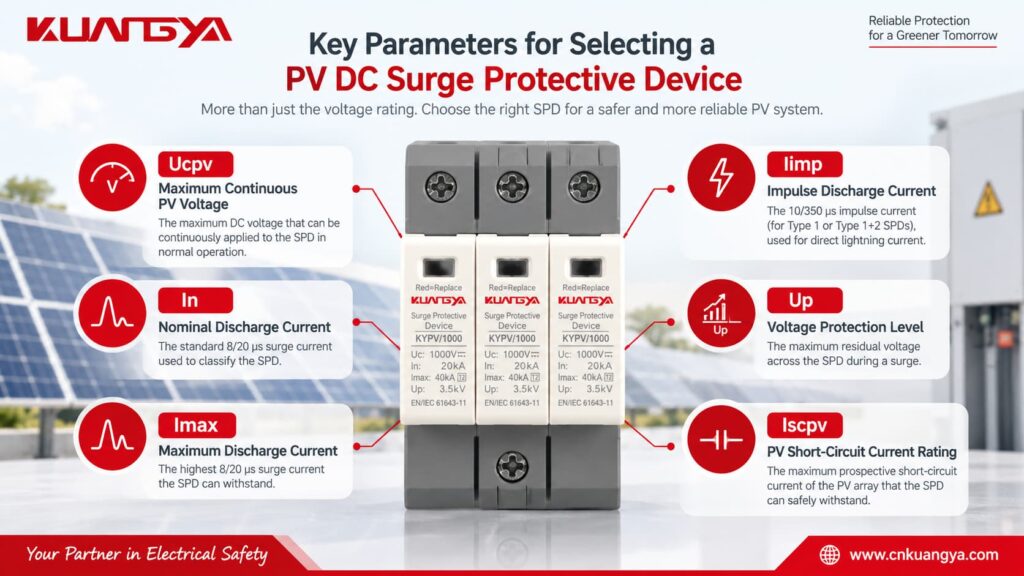
Ucpv is one of the most important parameters on a PV SPD.
It indicates the maximum DC voltage that may be continuously applied to the SPD under the specified conditions.
The selected Ucpv must be suitable for the highest voltage that can actually appear from the PV array.
Do not simply use the inverter’s nominal voltage.
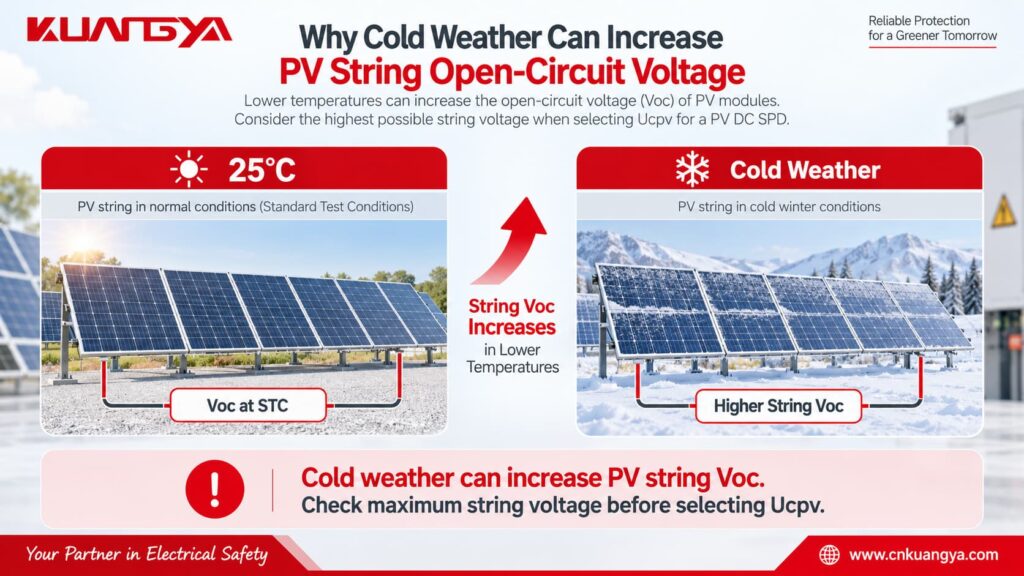
PV module open-circuit voltage increases when temperature decreases, so the maximum string voltage can be higher on a cold day than the value calculated from nominal operating voltage.
A simplified engineering calculation is:
Voc,max = Ns × Voc,STC × [1 + |βVoc| × (25°C − Tmin)]
Wo:
Voc,max = estimated maximum string open-circuit voltage
Ns = number of modules connected in series
Voc,STC = module open-circuit voltage at STC
βVoc = module Voc temperature coefficient expressed per °C
Tmin = minimum design temperature at the installation site
This simplified formula assumes the manufacturer’s temperature coefficient is applicable over the temperature range being considered.
For an actual project, always follow the PV module manufacturer’s calculation method and applicable electrical design requirements.
The important selection relationship is:
Ucpv ≥ maximum PV voltage that can continuously appear at the SPD
A safety margin or additional design factor may also be required by the applicable standard, manufacturer, or project specification.
In is the nominal discharge current that the SPD can withstand repeatedly under the specified test waveform.
For Type 2 SPDs, the commonly used test waveform is 8/20 μs.
A higher In generally indicates greater repetitive surge-current capability, but In should never be considered alone.
Imax is the maximum value of the 8/20 μs surge current that a Type 2 SPD can discharge under its specified test conditions.
It describes a maximum capability rather than normal repetitive operation.
Iimp is particularly important for Type 1 SPDs.
It is associated with the 10/350 μs lightning-current waveform and is used when the SPD may need to handle partial lightning current.
Up indicates the voltage protection level provided by the SPD during surge discharge.
A lower Up can provide better voltage limitation, but it still needs to be coordinated with the protected equipment and the rest of the surge protection system.
The SPD should limit the surge to a level compatible with the impulse withstand capability of the equipment being protected.
Iscpv is especially important for photovoltaic SPDs.
It represents the maximum prospective PV DC short-circuit current for which the SPD’s end-of-life and disconnection behavior has been evaluated.
The SPD must be suitable for the prospective short-circuit current available at the installation point.
This is another reason why choosing a PV SPD only by voltage is not enough.
Quick Check: Use the simple tool below to see whether the basic SPD application type and voltage marking appear compatible with your system.
Select the system type and the marking shown on the SPD. This quick check only evaluates basic AC/DC application compatibility and does not replace a full technical selection.
For PV systems, enter the maximum expected DC operating voltage rather than only the nominal inverter voltage.
Haftungsausschluss: This tool is for preliminary selection only. Always verify the SPD datasheet, system configuration, maximum operating voltage, short-circuit conditions, and applicable standards before installation.
This is one of the most common misunderstandings.
Suppose two SPDs are placed next to each other.
One says:
Uc: 1000V AC
The other says:
Ucpv: 1000V DC
Both contain the number “1000V,” but that does not make them interchangeable.
Their application ratings, test conditions, internal arrangement, insulation design, disconnection behavior, and applicable standards may be different.
Always read the complete marking.
Never remove “AC,” “DC,” or “PV” from the voltage specification when comparing products.
The differences are easier to understand when they are compared directly.
| Merkmal | AC SPD | PV DC SPD |
|---|---|---|
| Main application | AC power distribution | DC side of PV systems |
| Supply | AC | DC |
| Natural zero crossing | Ja | Nein |
| Typical voltage marking | Uc AC | Ucpv / Uc DC |
| DC fault interruption | Not assumed unless specified | Designed/tested for stated DC application |
| Common installation | Main distribution board, sub-panel | Combiner box, PV DC distribution, inverter DC side |
| Relevant IEC product standard | IEC 61643-11 | IEC 61643-31 |
| Maximale Systemspannung | According to AC rating | According to specified PV DC rating |
| PV short-circuit consideration | Not a PV rating | Iscpv may be specified |
| Typical protection types | Type 1, Type 1+2, Type 2 | PV Type 1, Type 1+2, Type 2 |
The most important difference is not the appearance of the product.
It is what electrical system the SPD has actually been designed, rated, and tested for.
The same principle works in reverse.
Do not assume a DC SPD can be installed on AC simply because its DC voltage rating is higher than the AC system voltage.
Zum Beispiel:
A 1000V DC PV SPD is not automatically suitable for a 230V or 400V AC distribution board.
The manufacturer must provide an appropriate AC rating for that application.
If the device has both AC and DC ratings, follow the relevant rating for the system being protected.
If it is marked only as a PV DC SPD, use it only for the application specified by the manufacturer.
Not unless the manufacturer specifically provides a DC rating that covers that DC circuit.
A label such as:
Uc = 275V AC
does not mean:
275V DC
and certainly does not mean the device can be used on a 600V, 1000V, or 1500V PV system.
This is particularly important because 275V AC Type 2 SPDs are very common in low-voltage AC distribution systems.
Their familiar appearance can lead to incorrect use in DC equipment.
Always check the complete specification.
A better selection process starts with the electrical system, not with the SPD catalogue.
First determine where the SPD will be installed.
Zum Beispiel:
PV modules → DC combiner box → DC cables → inverter DC input → inverter AC output
The SPD installed before the inverter on the PV side is protecting a DC circuit.
The SPD installed on the inverter's AC output is protecting an AC circuit.
These two locations normally require different SPD specifications.
If your inverter already includes surge protection, see our guide on whether a solar inverter with a built-in SPD still needs an external SPD.
Check the number of modules in series, module Voc, temperature coefficient, and minimum expected module temperature.
Do not rely only on the inverter's nominal operating voltage.
Cold weather can increase the open-circuit voltage of a PV string.
The selected Ucpv must be suitable for the highest expected PV voltage.
The appropriate SPD type depends on the lightning protection concept and installation.
A Type 2 PV SPD is widely used for protection against induced and switching surges.
A Type 1 or Type 1+2 SPD may be required where partial lightning current has to be handled, depending on the installation and lightning protection design.
Do not choose Type 1, Type 1+2, or Type 2 based only on the kA number printed on the front.
After confirming the voltage and SPD type, compare the discharge-current parameters and voltage protection level.
For a Type 2 SPD, In and Imax are especially relevant.
For a Type 1 or Type 1+2 SPD, Iimp is also important.
Up should be coordinated with the impulse withstand level of the equipment being protected.
The prospective short-circuit current at the installation point also matters.
Check whether the SPD's Iscpv is suitable for the PV source.
Also confirm the system configuration and the required protection modes between positive, negative, and PE.
For dedicated photovoltaic DC SPDs, look for documentation relevant to PV DC applications, such as IEC 61643-31 compliance where applicable.
Do not rely solely on the product's external appearance.
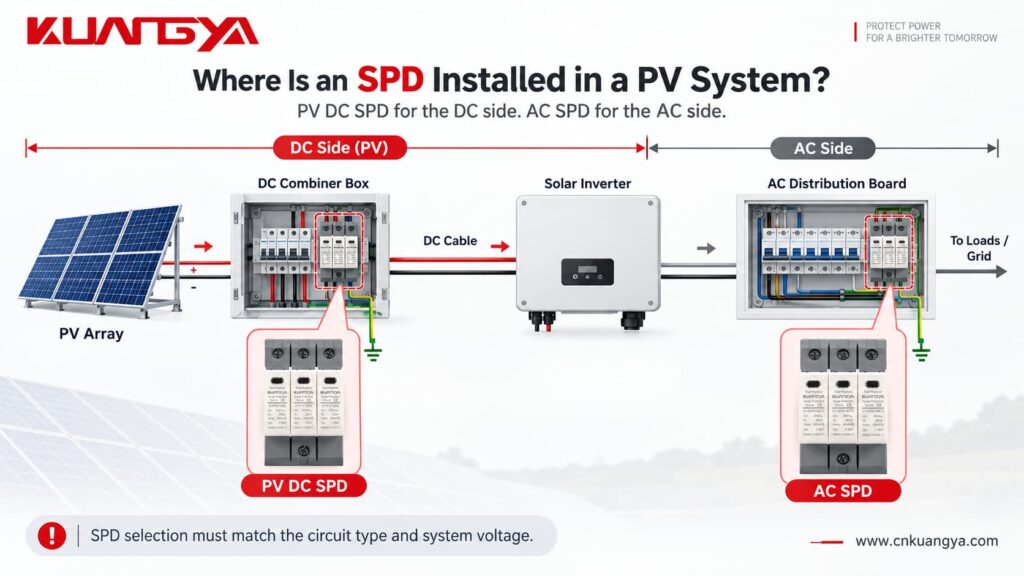
Common locations include the DC combiner box and the DC input side of the inverter.
In a larger PV system, protection may be required at more than one location depending on cable length, lightning protection design, equipment withstand level, and installation conditions.
The distance between the SPD and the protected inverter also matters.
Long connection conductors add inductive voltage during a surge, which can increase the effective voltage seen by the protected equipment.
Therefore, the SPD should not only be correctly selected — it should also be installed with short, direct connection conductors wherever possible.
If you want to understand this part in more detail, see:
Spielt der Abstand zwischen dem SPD und dem Wechselrichter eine Rolle?
Nein.
This is another common misunderstanding.
An incorrectly selected AC SPD installed on a DC system may not fail immediately.
Under normal conditions, the SPD is usually in a high-impedance standby state.
That means the installation can appear to operate normally even though the SPD is not correctly rated for the application.
The real problem may appear only when:
a strong surge occurs, the MOV ages, leakage current increases, the SPD experiences a temporary overvoltage, the device reaches end of life, or the thermal disconnector needs to operate.
Daher:
“It has not failed yet” is not proof that an SPD is correctly selected.
Check its ratings instead.
A common mistake is using an AC SPD on a DC system simply because the voltage number printed on the device appears to match. Other common mistakes include ignoring the AC/DC marking, assuming a higher voltage rating automatically makes an SPD safer, ignoring the maximum PV open-circuit voltage in cold conditions, overlooking Iscpv, choosing an SPD only by Imax, and assuming a green status window proves that the SPD is correct for the application.
A green indicator normally tells you something about the current mechanical or electrical status of the protection module.
It does nicht prove that the model was correctly selected for the system.
Before installing an SPD, answer these questions:
| Siehe | Frage |
|---|---|
| System | Is the circuit AC or DC? |
| Anmeldung | Is it specifically a PV circuit? |
| Spannung | What is the maximum continuous system voltage? |
| SPD rating | Is Uc or Ucpv suitable for that voltage? |
| SPD-Typ | Type 1, Type 1+2, or Type 2? |
| Surge current | Are In, Imax and/or Iimp appropriate? |
| Protection level | Is Up coordinated with the equipment? |
| Short-circuit capability | Is Iscpv suitable for the PV source? |
| Konfiguration | Does the connection arrangement match the PV system? |
| Standard | Is the SPD designed and tested for the intended application? |
If any of these points are unclear, check the manufacturer's datasheet before energizing the circuit.
Only if the manufacturer specifically provides a DC rating for the device and that rating is suitable for the DC system. An SPD marked only for AC operation should not automatically be used on a DC circuit.
Not necessarily. It may initially appear to operate normally. However, an incorrectly rated SPD can overheat or fail to disconnect safely under abnormal conditions. Severe failure may result in arcing, burning, fire, or enclosure rupture.
No. A 275V AC rating does not make the device suitable for a 600V DC PV system. Use an SPD specifically rated for the required DC voltage and PV application.
Do not assume that you can. The identical voltage number does not mean the application ratings are equivalent. Check whether the manufacturer explicitly provides an appropriate 1000V DC rating.
Uc generally refers to maximum continuous operating voltage. For photovoltaic applications, Ucpv specifically identifies the maximum continuous DC voltage applicable to the PV SPD. The selected value must be suitable for the highest PV voltage that can occur at the installation.
The SPD may be subjected to excessive continuous electrical stress. This can increase leakage current, accelerate degradation, cause overheating, and eventually trigger or damage the disconnection mechanism.
Nein.
Ucpv must be high enough for the PV system, but SPD selection is a balance between continuous operating voltage and protection performance.
You should also consider Up, discharge-current ratings, equipment withstand voltage, system configuration, and manufacturer recommendations.
Check the product label and datasheet.
Look for clear markings such as:
275V AC
Uc 440V AC
Ucpv 1000V DC
Ucpv 1500V DC
Also check the applicable product standard and wiring configuration.
Never identify an AC or DC SPD only by its shape or number of poles.
An AC SPD and a DC SPD may look almost identical, but that does not mean they can be used interchangeably.
The biggest mistake is choosing an SPD only by the voltage number printed on the front.
A 1000V rating does not tell the whole story.
You also need to know whether the rating applies to AC or DC, whether the SPD is suitable for photovoltaic use, its maximum continuous operating voltage, discharge-current capability, voltage protection level, short-circuit capability, system configuration, and applicable standard.
Using an AC SPD on a DC system does not mean it will immediately explode, but the device must have a suitable DC rating for the application.
However, an SPD that is not designed for the DC application may experience excessive stress and may not disconnect safely at the end of its life. This can lead to overheating, sustained arcing, burning, fire, and in severe cases enclosure rupture.
For a photovoltaic DC system, use a surge protective device specifically designed and rated for the PV DC application.
KUANGYA provides DC surge protection solutions for different photovoltaic system voltages, including 600V DC, 1000V DC, and 1500V DC applications, with different SPD configurations available for solar PV protection.

