Zona industrial de WengYang Yueqing Wenzhou 325000
Horas de trabajo
De lunes a viernes: de 7.00 a 19.00 horas
Fin de semana: 10.00 A 17.00 HORAS
Zona industrial de WengYang Yueqing Wenzhou 325000
Horas de trabajo
De lunes a viernes: de 7.00 a 19.00 horas
Fin de semana: 10.00 A 17.00 HORAS

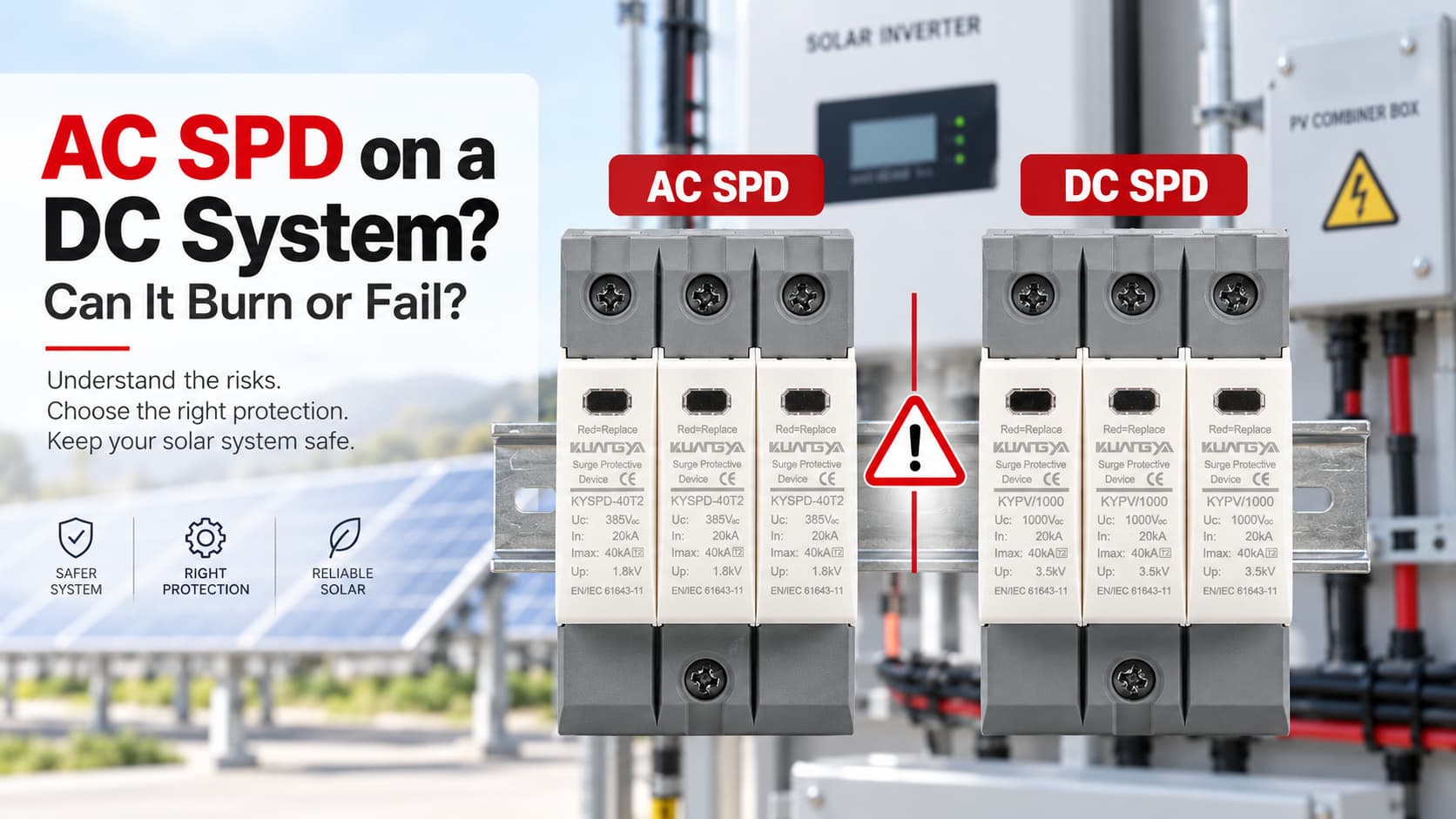
Utilizar un SPD de CA en un sistema de CC puede ser peligroso si el dispositivo no está específicamente clasificado para la aplicación de CC.
Un SPD de CA y un SPD de CC pueden parecer muy similares desde el exterior, pero no son intercambiables automáticamente. Uno de los errores más comunes es comparar únicamente el voltaje impreso en la etiqueta. Por ejemplo, alguien puede ver “1000V” en un SPD y asumir que puede instalarse en un sistema solar de 1000V CC.
Esa suposición puede ser peligrosa.
Un SPD solo debe instalarse en un sistema de CC cuando el fabricante lo clasifica específicamente para esa aplicación de CC y sus características eléctricas coinciden con las del sistema.
El uso de un SPD solo para CA en un circuito de CC puede causar sobrecalentamiento, fallo del mecanismo de desconexión interna, arco sostenido, quemaduras o incendio. En caso de un fallo grave, la carcasa del SPD también podría romperse.
Entonces, ¿puede un SPD de CA explotar cuando se conecta a CC?
No necesariamente. Pero utilizar el SPD incorrecto puede crear un riesgo grave de fallo, y un fallo térmico o eléctrico severo puede resultar en la ruptura de la carcasa.
Un SPD de CA no debe utilizarse en un sistema de CC simplemente porque el valor de tensión parezca similar.
Un dispositivo marcado solo para funcionamiento en CA ha sido diseñado y probado para las condiciones de sistemas de CA. Un SPD de CC para fotovoltaica está diseñado para la tensión continua de CC, las condiciones de fallo, la configuración del sistema y los requisitos de desconexión que se encuentran en el lado de CC de una instalación fotovoltaica.
Para sistemas fotovoltaicos, verifique siempre la clasificación completa del SPD, especialmente: Ucpv, In, Imax, Iimp cuando corresponda, Up, Iscpv, tipo de SPD, configuración de conexión y norma aplicable..
Normalmente, no debe utilizar un SPD de solo CA en un sistema de CC.
La palabra importante es “nominal”.”
Si un fabricante especifica claramente que un SPD en particular es adecuado tanto para aplicaciones de CA como de CC, puede utilizarse dentro de los valores nominales y las condiciones de instalación indicadas.
Sin embargo, un SPD marcado solo para uso en CA no debe instalarse automáticamente en un circuito de CC.
Por ejemplo:
| Marcado del SPD | Sistema | ¿Adecuado? |
|---|---|---|
| Uc 275V CA | Sistema fotovoltaico de 600V CC | No |
| Uc 440V CA | Sistema fotovoltaico de 1000V CC | No |
| Ucpv 1000V CC | Sistema fotovoltaico adecuado dentro de la capacidad nominal | Potencialmente sí |
| SPD con doble clasificación CA/CC | Sistema de CA o CC correspondiente | Compruebe las especificaciones del fabricante. |
Por esta razón, leer solo el valor de tensión no es suficiente.
1000V CA y 1000V CC no tienen la misma clasificación de aplicación.
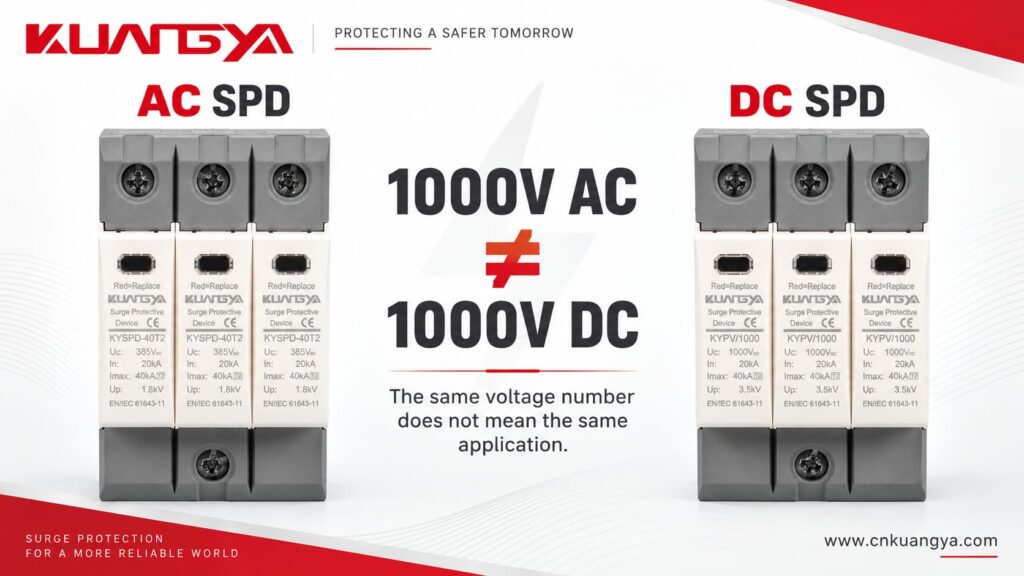
Las letras después del número son importantes.
Tanto los SPD de CA como los de CC realizan la misma función básica: ayudan a limitar la sobretensión transitoria y a desviar la corriente de sobretensión lejos de los equipos sensibles.
Pero los entornos eléctricos en los que operan son diferentes.
Esa diferencia se vuelve especialmente importante durante condiciones anormales y al final de la vida útil del SPD.
En un sistema de CA sinusoidal normal, el voltaje y la corriente instantáneos pasan periódicamente por cero.
A 50 Hz o 60 Hz, esto ocurre repetidamente cada segundo.
Los cruces por cero naturales pueden ayudar a extinguir un arco cuando se abre un dispositivo de conmutación o desconexión.
Esta es una de las razones por las que no se puede asumir automáticamente que los equipos diseñados para conmutación de CA e interrupción de fallas funcionen de manera segura bajo condiciones de CC.
Una fuente de CC mantiene la misma polaridad y no pasa naturalmente por cero de la misma manera que la CA.
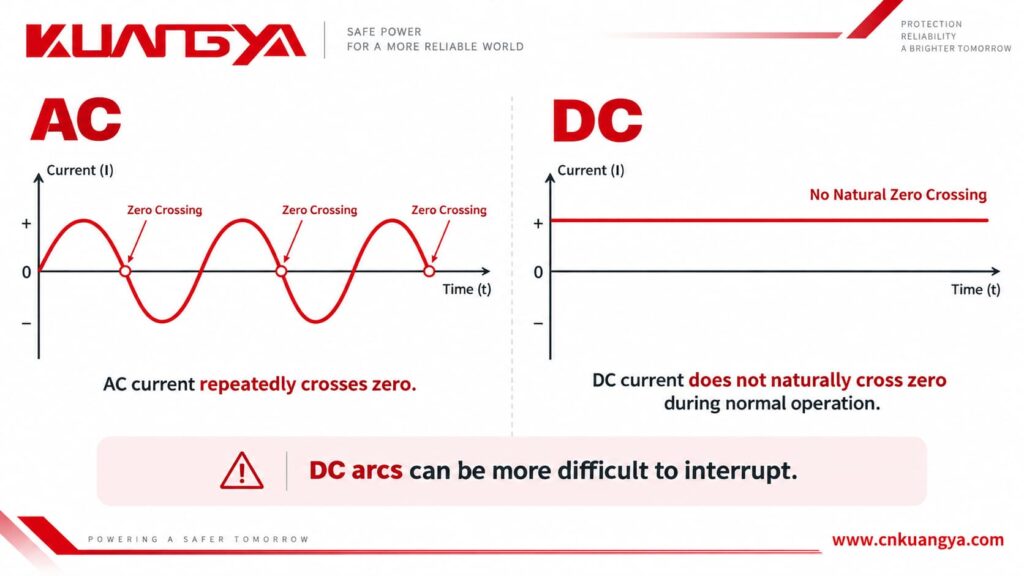
Por lo tanto, si se forma un arco de corriente continua, puede resultar más difícil de interrumpir.
Esto es importante en sistemas fotovoltaicos porque el arreglo solar puede seguir suministrando energía de CC mientras haya luz solar disponible.
Si un SPD se sobrecarga y su sistema de desconexión interno debe aislar el componente de protección fallido, el dispositivo debe estar diseñado para manejar las condiciones de CC de forma segura.
Esta es una de las razones por las que los SPD de CC para sistemas fotovoltaicos utilizan diseños y disposiciones de desconexión destinados a aplicaciones de CC.
Phoenix Contact también explica que los sistemas de CC se comportan de manera diferente a los sistemas de CA y, por lo tanto, requieren dispositivos de protección contra sobretensiones diseñados para aplicaciones de CC.
Instalar un SPD de CA en un sistema de CC puede no causar una falla visible inmediata, y no existe una secuencia de falla única.
El resultado depende del diseño del SPD, el voltaje de CC, la corriente disponible, la configuración del sistema, la temperatura, el historial de sobretensiones y la forma en que falla el SPD.
Un SPD seleccionado incorrectamente puede incluso parecer normal al principio.
Eso es lo que hace que el error sea peligroso.
| Condición posible | Qué puede suceder |
|---|---|
| Inmediatamente después de la instalación | El SPD puede parecer completamente normal |
| Estrés por sobretensión continua | El MOV u otros componentes de protección pueden calentarse |
| Degradación de los componentes | La corriente de fuga puede aumentar |
| Sobrecarga térmica | El desconectador térmico interno puede activarse |
| Interrupción de CC inadecuada | Puede persistir un arco eléctrico después de iniciarse la separación |
| Fallo grave | Puede producirse combustión, humo o incendio |
| Fallo extremo | La carcasa puede agrietarse o romperse |
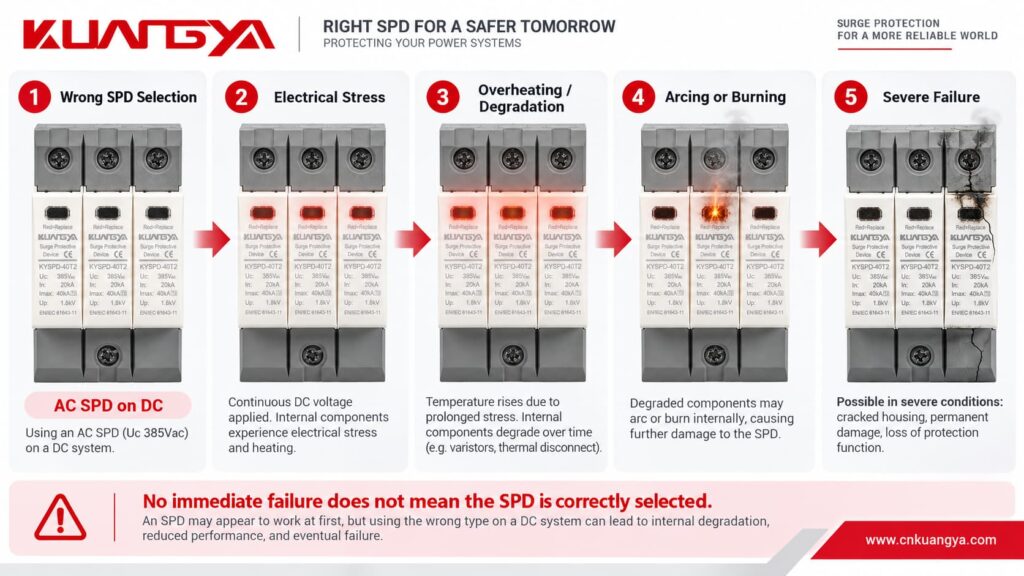
El punto clave es:
La ausencia de un fallo inmediato no significa que el SPD esté correctamente seleccionado.
Un SPD aplicado erróneamente puede permanecer instalado durante semanas o meses antes de que una sobretensión, un cambio de temperatura, una condición de la red, un problema de aislamiento o la degradación de los componentes provoquen un fallo.
Vídeo: ¿Qué sucede cuando se utiliza un SPD incorrecto en un sistema de CC?
Esta pregunta requiere una respuesta cuidadosa.
Conectar un SPD de CA a CC no significa que explotará instantáneamente.
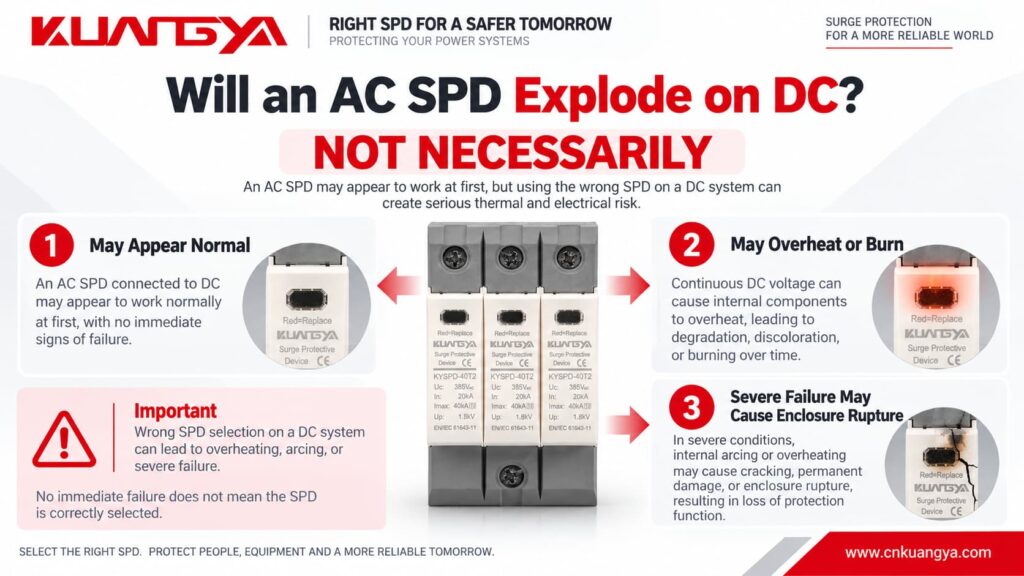
En muchas instalaciones incorrectas, no sucede nada drástico de inmediato.
La verdadera preocupación es lo que sucede cuando el SPD experimenta estrés eléctrico o térmico.
Una secuencia de falla simplificada podría verse así:
Selección incorrecta del SPD → estrés eléctrico excesivo → calentamiento o degradación → aumento de la corriente de fuga o de falla → dificultad de desconexión → formación de arco o combustión → posible ruptura de la envolvente
Por lo tanto, decir:
“Un SPD de CA explotará si se conecta a CC.”
es demasiado absoluto.
Una afirmación técnicamente más precisa es:
El uso de un SPD que no está clasificado para la aplicación de CC puede crear un riesgo grave de sobrecalentamiento e incendio. En condiciones de falla severa, el SPD puede quemarse o su carcasa puede romperse.
“Explosión” se utiliza a menudo de forma casual para describir un SPD dañado o roto, pero ruptura violenta de la carcasa es una descripción técnica más precisa.
Si ya hay un SPD instalado y le preocupa que pueda haber sido dañado, consulte nuestra guía sobre cómo saber si un SPD está defectuoso.
Muchos SPD utilizan varistores de óxido metálico, comúnmente llamados MOV.
During normal operation, a correctly selected MOV-based SPD has very low leakage current.
During a transient overvoltage, the MOV becomes conductive and diverts surge current.
After the surge disappears, it should return to its high-resistance state.
However, repeated surge events, temporary overvoltage, excessive continuous voltage, aging, or incorrect application can gradually degrade the MOV.
As degradation progresses, leakage current may increase.
More leakage current creates more heat.
More heat may cause additional degradation.
This process can eventually result in thermal runaway if the device is not safely disconnected.
Modern SPDs therefore commonly include a thermal disconnection mechanism designed to isolate an overloaded MOV.
In a DC application, that disconnection mechanism must also be capable of safely dealing with the DC conditions that appear when the device disconnects.
Imagine two contacts beginning to separate while current is flowing.
As the gap becomes larger, an electrical arc can form between them.
In AC, the current naturally passes through zero periodically. This can assist arc extinction.
In DC, there is no equivalent natural current zero during normal operation.
The arc can therefore continue unless the device has been designed with an appropriate method to interrupt it.
This principle is not limited to SPDs.
It is also one reason why DC circuit breakers, DC isolators, contactors, and fuses need appropriate DC ratings.
The same general rule applies:
Never assume an AC electrical device is suitable for DC only because the voltage appears similar.
If you also want to understand how a typical power SPD is connected in the circuit, see our guide on why an SPD is connected in parallel instead of series.
No.
Voltage is only one part of SPD selection.
For a photovoltaic DC SPD, several parameters need to be considered together.
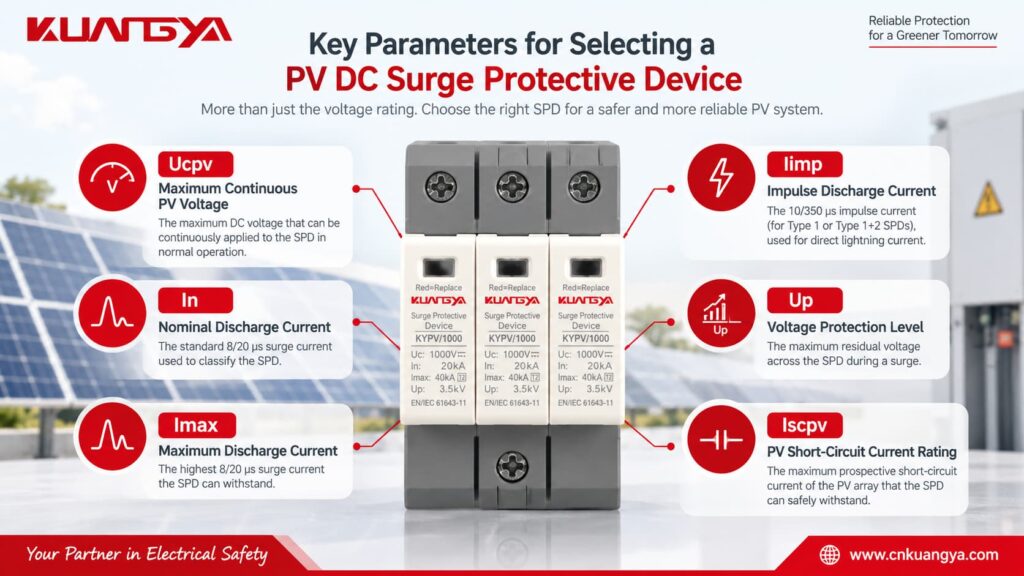
Ucpv is one of the most important parameters on a PV SPD.
It indicates the maximum DC voltage that may be continuously applied to the SPD under the specified conditions.
The selected Ucpv must be suitable for the highest voltage that can actually appear from the PV array.
Do not simply use the inverter’s nominal voltage.
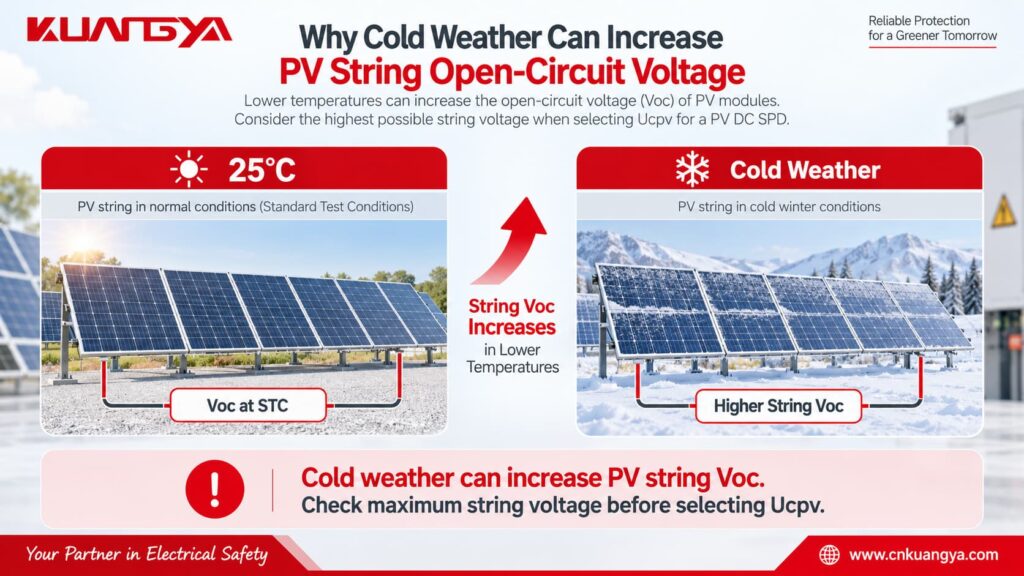
PV module open-circuit voltage increases when temperature decreases, so the maximum string voltage can be higher on a cold day than the value calculated from nominal operating voltage.
A simplified engineering calculation is:
Voc,max = Ns × Voc,STC × [1 + |βVoc| × (25°C − Tmin)]
Donde:
Voc,max = estimated maximum string open-circuit voltage
Ns = number of modules connected in series
Voc,STC = module open-circuit voltage at STC
βVoc = module Voc temperature coefficient expressed per °C
Tmin = minimum design temperature at the installation site
This simplified formula assumes the manufacturer’s temperature coefficient is applicable over the temperature range being considered.
For an actual project, always follow the PV module manufacturer’s calculation method and applicable electrical design requirements.
The important selection relationship is:
Ucpv ≥ maximum PV voltage that can continuously appear at the SPD
A safety margin or additional design factor may also be required by the applicable standard, manufacturer, or project specification.
In is the nominal discharge current that the SPD can withstand repeatedly under the specified test waveform.
For Type 2 SPDs, the commonly used test waveform is 8/20 μs.
A higher In generally indicates greater repetitive surge-current capability, but In should never be considered alone.
Imax is the maximum value of the 8/20 μs surge current that a Type 2 SPD can discharge under its specified test conditions.
It describes a maximum capability rather than normal repetitive operation.
Iimp is particularly important for Type 1 SPDs.
It is associated with the 10/350 μs lightning-current waveform and is used when the SPD may need to handle partial lightning current.
Up indicates the voltage protection level provided by the SPD during surge discharge.
A lower Up can provide better voltage limitation, but it still needs to be coordinated with the protected equipment and the rest of the surge protection system.
The SPD should limit the surge to a level compatible with the impulse withstand capability of the equipment being protected.
Iscpv is especially important for photovoltaic SPDs.
It represents the maximum prospective PV DC short-circuit current for which the SPD’s end-of-life and disconnection behavior has been evaluated.
The SPD must be suitable for the prospective short-circuit current available at the installation point.
This is another reason why choosing a PV SPD only by voltage is not enough.
Quick Check: Use the simple tool below to see whether the basic SPD application type and voltage marking appear compatible with your system.
Select the system type and the marking shown on the SPD. This quick check only evaluates basic AC/DC application compatibility and does not replace a full technical selection.
For PV systems, enter the maximum expected DC operating voltage rather than only the nominal inverter voltage.
Descargo de responsabilidad: This tool is for preliminary selection only. Always verify the SPD datasheet, system configuration, maximum operating voltage, short-circuit conditions, and applicable standards before installation.
This is one of the most common misunderstandings.
Suppose two SPDs are placed next to each other.
One says:
Uc: 1000V AC
The other says:
Ucpv: 1000V CC
Both contain the number “1000V,” but that does not make them interchangeable.
Their application ratings, test conditions, internal arrangement, insulation design, disconnection behavior, and applicable standards may be different.
Always read the complete marking.
Never remove “AC,” “DC,” or “PV” from the voltage specification when comparing products.
The differences are easier to understand when they are compared directly.
| Característica | AC SPD | PV DC SPD |
|---|---|---|
| Main application | AC power distribution | DC side of PV systems |
| Supply | CA | DC |
| Natural zero crossing | Sí | No |
| Typical voltage marking | Uc AC | Ucpv / Uc DC |
| DC fault interruption | Not assumed unless specified | Designed/tested for stated DC application |
| Common installation | Main distribution board, sub-panel | Combiner box, PV DC distribution, inverter DC side |
| Relevant IEC product standard | IEC 61643-11 | IEC 61643-31 |
| Tensión máxima del sistema | According to AC rating | According to specified PV DC rating |
| PV short-circuit consideration | Not a PV rating | Iscpv may be specified |
| Typical protection types | Type 1, Type 1+2, Type 2 | PV Type 1, Type 1+2, Type 2 |
The most important difference is not the appearance of the product.
It is what electrical system the SPD has actually been designed, rated, and tested for.
The same principle works in reverse.
Do not assume a DC SPD can be installed on AC simply because its DC voltage rating is higher than the AC system voltage.
Por ejemplo:
A 1000V DC PV SPD is not automatically suitable for a 230V or 400V AC distribution board.
The manufacturer must provide an appropriate AC rating for that application.
If the device has both AC and DC ratings, follow the relevant rating for the system being protected.
If it is marked only as a PV DC SPD, use it only for the application specified by the manufacturer.
Not unless the manufacturer specifically provides a DC rating that covers that DC circuit.
A label such as:
Uc = 275V AC
does not mean:
275V DC
and certainly does not mean the device can be used on a 600V, 1000V, or 1500V PV system.
This is particularly important because 275V AC Type 2 SPDs are very common in low-voltage AC distribution systems.
Their familiar appearance can lead to incorrect use in DC equipment.
Always check the complete specification.
A better selection process starts with the electrical system, not with the SPD catalogue.
First determine where the SPD will be installed.
Por ejemplo:
PV modules → DC combiner box → DC cables → inverter DC input → inverter AC output
The SPD installed before the inverter on the PV side is protecting a DC circuit.
The SPD installed on the inverter's AC output is protecting an AC circuit.
These two locations normally require different SPD specifications.
If your inverter already includes surge protection, see our guide on whether a solar inverter with a built-in SPD still needs an external SPD.
Check the number of modules in series, module Voc, temperature coefficient, and minimum expected module temperature.
Do not rely only on the inverter's nominal operating voltage.
Cold weather can increase the open-circuit voltage of a PV string.
The selected Ucpv must be suitable for the highest expected PV voltage.
The appropriate SPD type depends on the lightning protection concept and installation.
A Type 2 PV SPD is widely used for protection against induced and switching surges.
A Type 1 or Type 1+2 SPD may be required where partial lightning current has to be handled, depending on the installation and lightning protection design.
Do not choose Type 1, Type 1+2, or Type 2 based only on the kA number printed on the front.
After confirming the voltage and SPD type, compare the discharge-current parameters and voltage protection level.
For a Type 2 SPD, In and Imax are especially relevant.
For a Type 1 or Type 1+2 SPD, Iimp is also important.
Up should be coordinated with the impulse withstand level of the equipment being protected.
The prospective short-circuit current at the installation point also matters.
Check whether the SPD's Iscpv is suitable for the PV source.
Also confirm the system configuration and the required protection modes between positive, negative, and PE.
For dedicated photovoltaic DC SPDs, look for documentation relevant to PV DC applications, such as IEC 61643-31 compliance where applicable.
Do not rely solely on the product's external appearance.
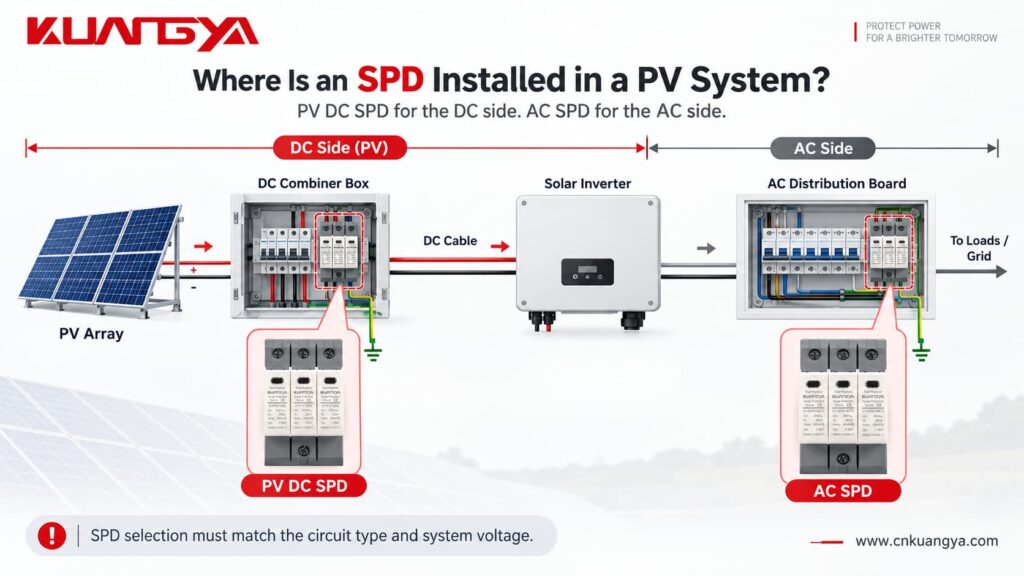
Common locations include the DC combiner box and the DC input side of the inverter.
In a larger PV system, protection may be required at more than one location depending on cable length, lightning protection design, equipment withstand level, and installation conditions.
The distance between the SPD and the protected inverter also matters.
Long connection conductors add inductive voltage during a surge, which can increase the effective voltage seen by the protected equipment.
Therefore, the SPD should not only be correctly selected — it should also be installed with short, direct connection conductors wherever possible.
If you want to understand this part in more detail, see:
¿Influye la distancia entre el SPD y el inversor?
No.
This is another common misunderstanding.
An incorrectly selected AC SPD installed on a DC system may not fail immediately.
Under normal conditions, the SPD is usually in a high-impedance standby state.
That means the installation can appear to operate normally even though the SPD is not correctly rated for the application.
The real problem may appear only when:
a strong surge occurs, the MOV ages, leakage current increases, the SPD experiences a temporary overvoltage, the device reaches end of life, or the thermal disconnector needs to operate.
Therefore:
“It has not failed yet” is not proof that an SPD is correctly selected.
Check its ratings instead.
A common mistake is using an AC SPD on a DC system simply because the voltage number printed on the device appears to match. Other common mistakes include ignoring the AC/DC marking, assuming a higher voltage rating automatically makes an SPD safer, ignoring the maximum PV open-circuit voltage in cold conditions, overlooking Iscpv, choosing an SPD only by Imax, and assuming a green status window proves that the SPD is correct for the application.
A green indicator normally tells you something about the current mechanical or electrical status of the protection module.
It does no prove that the model was correctly selected for the system.
Before installing an SPD, answer these questions:
| Consulte | Pregunta |
|---|---|
| Sistema | Is the circuit AC or DC? |
| Aplicación | Is it specifically a PV circuit? |
| Tensión | What is the maximum continuous system voltage? |
| SPD rating | Is Uc or Ucpv suitable for that voltage? |
| Tipo de SPD | Type 1, Type 1+2, or Type 2? |
| Surge current | Are In, Imax and/or Iimp appropriate? |
| Protection level | Is Up coordinated with the equipment? |
| Short-circuit capability | Is Iscpv suitable for the PV source? |
| Configuración | Does the connection arrangement match the PV system? |
| Estándar | Is the SPD designed and tested for the intended application? |
If any of these points are unclear, check the manufacturer's datasheet before energizing the circuit.
Only if the manufacturer specifically provides a DC rating for the device and that rating is suitable for the DC system. An SPD marked only for AC operation should not automatically be used on a DC circuit.
Not necessarily. It may initially appear to operate normally. However, an incorrectly rated SPD can overheat or fail to disconnect safely under abnormal conditions. Severe failure may result in arcing, burning, fire, or enclosure rupture.
No. A 275V AC rating does not make the device suitable for a 600V DC PV system. Use an SPD specifically rated for the required DC voltage and PV application.
Do not assume that you can. The identical voltage number does not mean the application ratings are equivalent. Check whether the manufacturer explicitly provides an appropriate 1000V DC rating.
Uc generally refers to maximum continuous operating voltage. For photovoltaic applications, Ucpv specifically identifies the maximum continuous DC voltage applicable to the PV SPD. The selected value must be suitable for the highest PV voltage that can occur at the installation.
The SPD may be subjected to excessive continuous electrical stress. This can increase leakage current, accelerate degradation, cause overheating, and eventually trigger or damage the disconnection mechanism.
No.
Ucpv must be high enough for the PV system, but SPD selection is a balance between continuous operating voltage and protection performance.
You should also consider Up, discharge-current ratings, equipment withstand voltage, system configuration, and manufacturer recommendations.
Check the product label and datasheet.
Look for clear markings such as:
275V AC
Uc 440V CA
Ucpv 1000V CC
Ucpv 1500V DC
Also check the applicable product standard and wiring configuration.
Never identify an AC or DC SPD only by its shape or number of poles.
An AC SPD and a DC SPD may look almost identical, but that does not mean they can be used interchangeably.
The biggest mistake is choosing an SPD only by the voltage number printed on the front.
A 1000V rating does not tell the whole story.
You also need to know whether the rating applies to AC or DC, whether the SPD is suitable for photovoltaic use, its maximum continuous operating voltage, discharge-current capability, voltage protection level, short-circuit capability, system configuration, and applicable standard.
Using an AC SPD on a DC system does not mean it will immediately explode, but the device must have a suitable DC rating for the application.
However, an SPD that is not designed for the DC application may experience excessive stress and may not disconnect safely at the end of its life. This can lead to overheating, sustained arcing, burning, fire, and in severe cases enclosure rupture.
For a photovoltaic DC system, use a surge protective device specifically designed and rated for the PV DC application.
KUANGYA provides DC surge protection solutions for different photovoltaic system voltages, including 600V DC, 1000V DC, and 1500V DC applications, with different SPD configurations available for solar PV protection.

