Zona industriale di WengYang Yueqing Wenzhou 325000
Orario di lavoro
Da lunedì a venerdì: dalle 7.00 alle 19.00
Fine settimana: 10.00 - 17.00
Zona industriale di WengYang Yueqing Wenzhou 325000
Orario di lavoro
Da lunedì a venerdì: dalle 7.00 alle 19.00
Fine settimana: 10.00 - 17.00

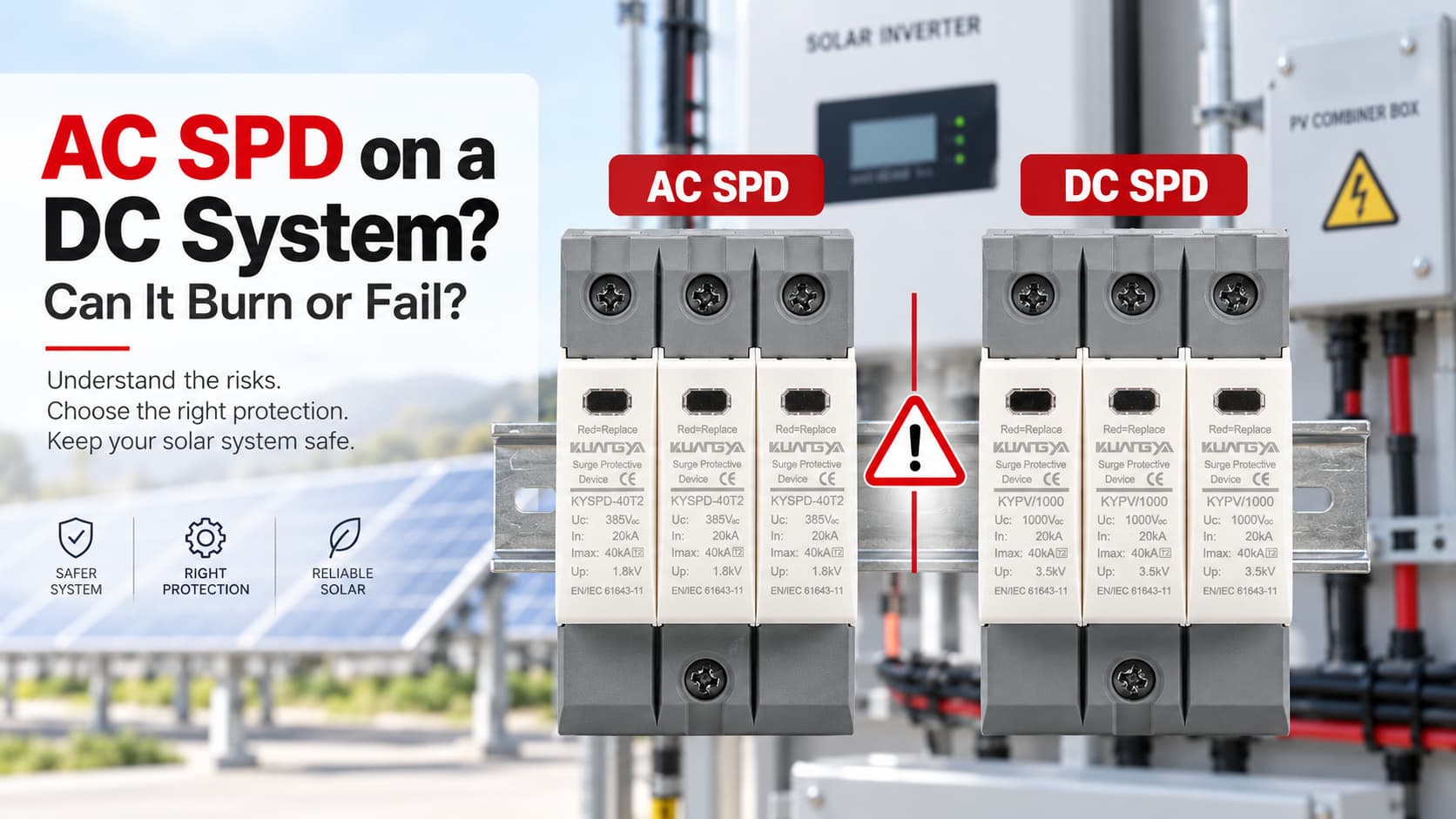
Utilizzare un SPD per CA su un sistema a CC può essere pericoloso se il dispositivo non è specificamente progettato per l'applicazione in corrente continua.
Un SPD per CA e un SPD per CC possono apparire molto simili esternamente, ma non sono automaticamente intercambiabili. Uno degli errori più comuni è confrontare solo la tensione riportata sull'etichetta. Ad esempio, qualcuno potrebbe vedere “1000V” su un SPD e presumere che possa essere installato in un impianto solare a 1000V CC.
Tale supposizione può essere pericolosa.
Un SPD deve essere installato su un sistema a CC solo quando il produttore lo ha specificamente certificato per tale applicazione e le sue caratteristiche elettriche corrispondono a quelle del sistema.
L'utilizzo di un SPD solo per CA su un circuito in CC può causare surriscaldamento, guasto del meccanismo di disconnessione interno, archi elettrici prolungati, bruciature o incendi. In caso di guasto grave, l'involucro dell'SPD potrebbe anche rompersi.
Quindi, un SPD per CA può esplodere se collegato alla CC?
Non necessariamente. Tuttavia, l'utilizzo di un SPD errato può creare un serio rischio di guasto e un grave guasto termico o elettrico può provocare la rottura dell'involucro.
Un SPD per CA non dovrebbe essere utilizzato su un sistema in CC semplicemente perché il valore di tensione sembra simile.
Un dispositivo contrassegnato solo per il funzionamento in CA è stato progettato e testato per le condizioni dei sistemi in CA. Un SPD per CC fotovoltaico è progettato per la tensione continua in CC, le condizioni di guasto, la configurazione del sistema e i requisiti di disconnessione presenti sul lato CC di un impianto fotovoltaico.
Per i sistemi fotovoltaici, verificare sempre la classificazione completa dell'SPD, in particolare Ucpv, In, Imax, Iimp ove applicabile, Up, Iscpv, tipo di SPD, configurazione di collegamento e standard applicabile.
Normalmente, non si dovrebbe utilizzare un SPD solo per CA su un sistema in CC.
La parola importante è “nominale”.”
Se un produttore specifica chiaramente che un determinato SPD è adatto sia per applicazioni in CA che in CC, esso può essere utilizzato entro i valori nominali e le condizioni di installazione dichiarati.
Tuttavia, un SPD contrassegnato solo per l'uso in CA non dovrebbe essere installato automaticamente su un circuito in CC.
Ad esempio:
| Marcatura SPD | Sistema | Idoneo? |
|---|---|---|
| Uc 275V CA | Sistema fotovoltaico 600V DC | No |
| Uc 440V AC | Sistema fotovoltaico 1000V DC | No |
| Ucpv 1000V DC | Sistema fotovoltaico idoneo entro i limiti di targa | Potenzialmente sì |
| SPD a doppia classificazione AC/DC | Sistema AC o DC corrispondente | Controllare le specifiche del produttore |
Ecco perché leggere solo il valore della tensione non è sufficiente.
1000V AC e 1000V DC non hanno la stessa classificazione di applicazione.
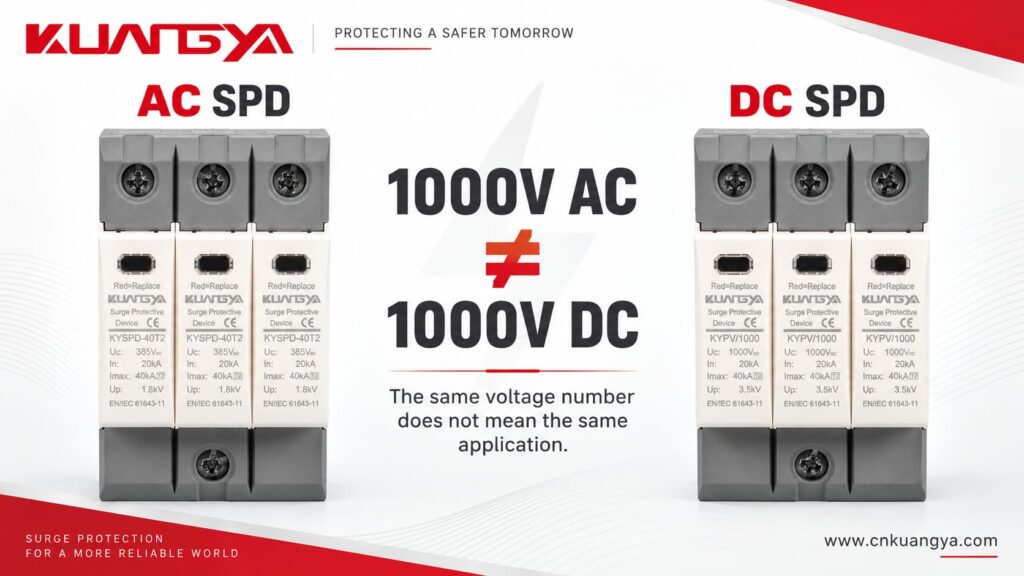
Le lettere dopo il numero sono importanti.
Entrambi gli SPD, sia per AC che per DC, svolgono la stessa funzione di base: aiutano a limitare le sovratensioni transitorie e a deviare la corrente di scarica lontano dalle apparecchiature sensibili.
Tuttavia, gli ambienti elettrici in cui operano sono differenti.
Tale differenza diventa particolarmente importante in condizioni anomale e al termine della vita utile dell'SPD.
In un normale sistema sinusoidale in corrente alternata, la tensione e la corrente istantanee passano periodicamente per lo zero.
A 50 Hz o 60 Hz, ciò accade ripetutamente ogni secondo.
I passaggi naturali per lo zero possono favorire l'estinzione dell'arco quando un dispositivo di commutazione o di sezionamento si apre.
Questo è uno dei motivi per cui non si può dare per scontato che le apparecchiature progettate per la commutazione e l'interruzione di guasti in corrente alternata funzionino in sicurezza in condizioni di corrente continua.
Una sorgente in corrente continua mantiene la stessa polarità e non passa naturalmente per lo zero nello stesso modo della corrente alternata.
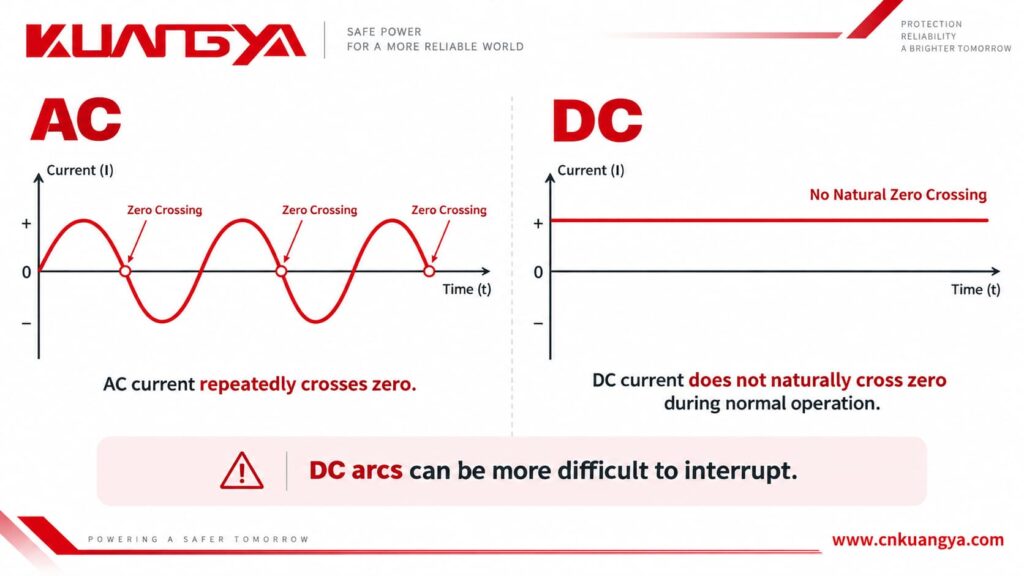
Se si forma un arco in corrente continua (DC), può quindi risultare più difficile da interrompere.
Questo è importante nei sistemi fotovoltaici perché il campo solare può continuare a fornire energia in corrente continua finché è disponibile la luce solare.
Se un SPD si sovraccarica e il suo sistema di disconnessione interno deve isolare il componente di protezione guasto, il dispositivo deve essere progettato per gestire le condizioni di corrente continua in sicurezza.
Questo è uno dei motivi per cui gli SPD dedicati per impianti fotovoltaici in corrente continua utilizzano design e configurazioni di disconnessione specifici per applicazioni in corrente continua.
Phoenix Contact spiega inoltre che i sistemi in corrente continua si comportano diversamente dai sistemi in corrente alternata e richiedono pertanto dispositivi di protezione contro le sovratensioni progettati per applicazioni in corrente continua.
L'installazione di un SPD per corrente alternata su un sistema in corrente continua potrebbe non causare un guasto visibile immediato e non esiste un'unica sequenza di guasto.
Il risultato dipende dal design dell'SPD, dalla tensione in corrente continua, dalla corrente disponibile, dalla configurazione del sistema, dalla temperatura, dallo storico delle sovratensioni e dalla modalità di guasto dell'SPD.
Un SPD selezionato in modo errato può apparire normale inizialmente.
È proprio questo che rende l'errore pericoloso.
| Condizione possibile | Cosa può accadere |
|---|---|
| Immediatamente dopo l'installazione | L'SPD può apparire completamente normale |
| Sollecitazione da sovratensione continua | Il MOV o altri componenti di protezione possono surriscaldarsi |
| Degrado dei componenti | La corrente di dispersione può aumentare |
| Sovraccarico termico | Il sezionatore termico interno potrebbe intervenire |
| Interruzione CC impropria | Un arco può persistere dopo l'inizio della separazione |
| Guasto grave | Possono verificarsi bruciature, fumo o incendio |
| Guasto estremo | L'involucro potrebbe incrinarsi o rompersi |
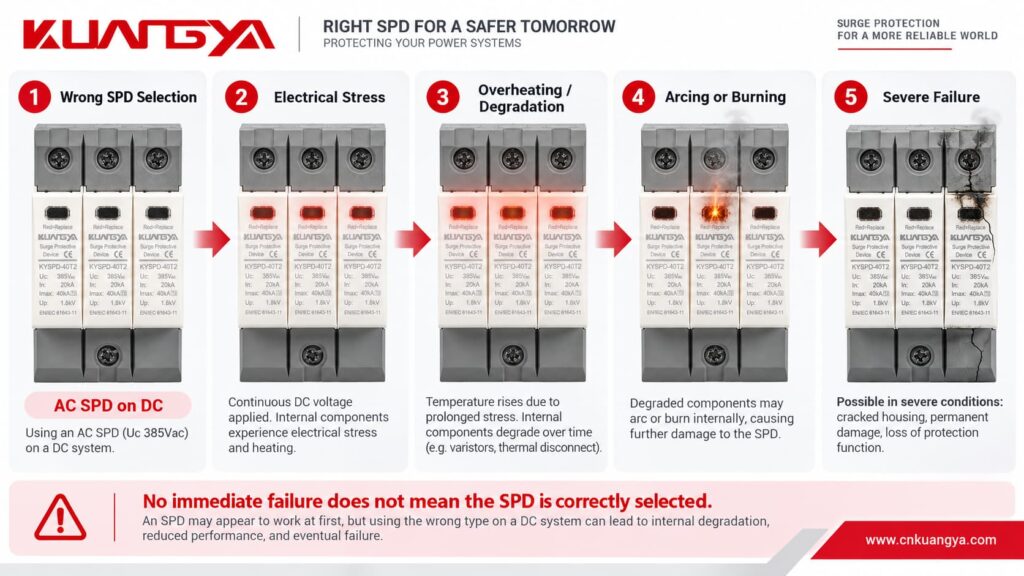
Il punto chiave è:
L'assenza di un guasto immediato non significa che l'SPD sia stato selezionato correttamente.
Un SPD applicato in modo errato può rimanere installato per settimane o mesi prima che una sovratensione, un cambiamento di temperatura, una condizione della rete, un problema di isolamento o il degrado dei componenti causino un guasto.
Guarda: cosa succede quando viene utilizzato l'SPD sbagliato in un sistema a corrente continua (DC)?
Questa domanda richiede una risposta attenta.
Collegare un SPD AC a un sistema DC non significa che esploderà istantaneamente.
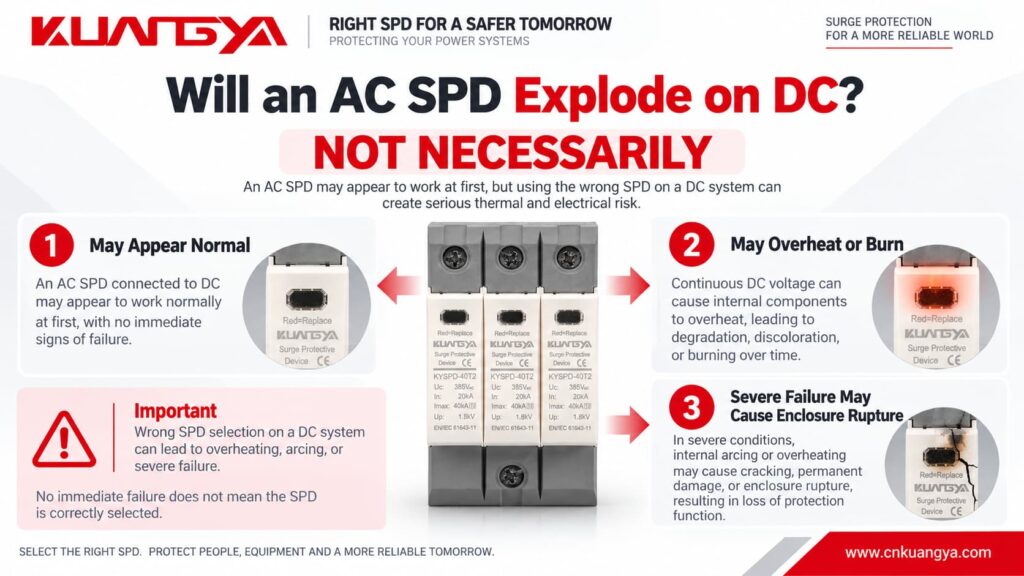
In molte installazioni errate, non accade nulla di drammatico nell'immediato.
La vera preoccupazione è cosa accade quando l'SPD subisce stress elettrico o termico.
Una sequenza di guasto semplificata può apparire così:
Selezione errata dell'SPD → eccessivo stress elettrico → riscaldamento o degrado → aumento della corrente di dispersione o di guasto → difficoltà di disconnessione → arco elettrico o combustione → possibile rottura dell'involucro
Pertanto, affermare che:
“Un SPD per corrente alternata (AC) esploderà se collegato alla corrente continua (DC).”
è troppo assoluto.
Un'affermazione tecnicamente più accurata è:
L'utilizzo di un SPD non classificato per l'applicazione in corrente continua (DC) può creare un grave rischio di surriscaldamento e incendio. In condizioni di guasto grave, l'SPD potrebbe bruciarsi o il suo involucro potrebbe rompersi.
“Esplosione” viene spesso usato in modo colloquiale per descrivere un SPD danneggiato o rotto, ma rottura violenta dell'involucro è una descrizione tecnica più precisa.
Se un SPD è già installato e temi che possa essere stato danneggiato, consulta la nostra guida su come capire se un SPD è guasto.
Molti SPD utilizzano varistori a ossido metallico, comunemente chiamati MOV.
During normal operation, a correctly selected MOV-based SPD has very low leakage current.
During a transient overvoltage, the MOV becomes conductive and diverts surge current.
After the surge disappears, it should return to its high-resistance state.
However, repeated surge events, temporary overvoltage, excessive continuous voltage, aging, or incorrect application can gradually degrade the MOV.
As degradation progresses, leakage current may increase.
More leakage current creates more heat.
More heat may cause additional degradation.
This process can eventually result in thermal runaway if the device is not safely disconnected.
Modern SPDs therefore commonly include a thermal disconnection mechanism designed to isolate an overloaded MOV.
In a DC application, that disconnection mechanism must also be capable of safely dealing with the DC conditions that appear when the device disconnects.
Imagine two contacts beginning to separate while current is flowing.
As the gap becomes larger, an electrical arc can form between them.
In AC, the current naturally passes through zero periodically. This can assist arc extinction.
In DC, there is no equivalent natural current zero during normal operation.
The arc can therefore continue unless the device has been designed with an appropriate method to interrupt it.
This principle is not limited to SPDs.
It is also one reason why DC circuit breakers, DC isolators, contactors, and fuses need appropriate DC ratings.
The same general rule applies:
Never assume an AC electrical device is suitable for DC only because the voltage appears similar.
If you also want to understand how a typical power SPD is connected in the circuit, see our guide on why an SPD is connected in parallel instead of series.
No.
Voltage is only one part of SPD selection.
For a photovoltaic DC SPD, several parameters need to be considered together.
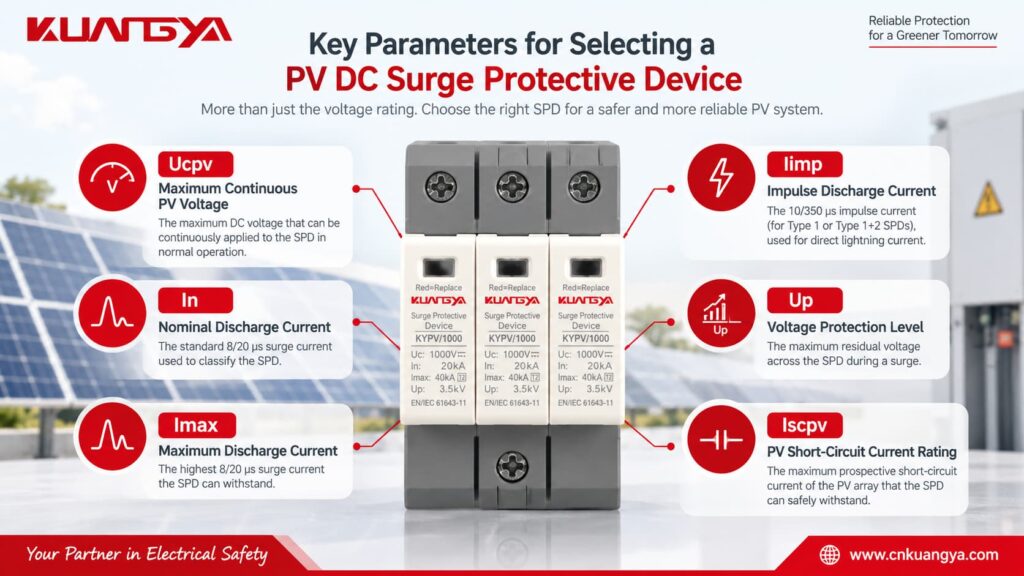
Ucpv is one of the most important parameters on a PV SPD.
It indicates the maximum DC voltage that may be continuously applied to the SPD under the specified conditions.
The selected Ucpv must be suitable for the highest voltage that can actually appear from the PV array.
Do not simply use the inverter’s nominal voltage.
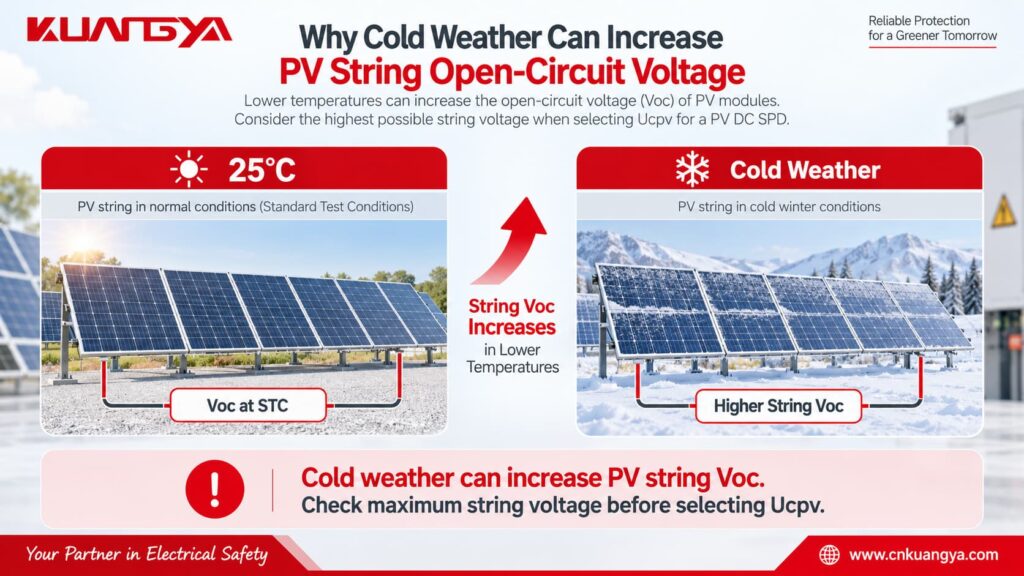
PV module open-circuit voltage increases when temperature decreases, so the maximum string voltage can be higher on a cold day than the value calculated from nominal operating voltage.
A simplified engineering calculation is:
Voc,max = Ns × Voc,STC × [1 + |βVoc| × (25°C − Tmin)]
Dove:
Voc,max = estimated maximum string open-circuit voltage
Ns = number of modules connected in series
Voc,STC = module open-circuit voltage at STC
βVoc = module Voc temperature coefficient expressed per °C
Tmin = minimum design temperature at the installation site
This simplified formula assumes the manufacturer’s temperature coefficient is applicable over the temperature range being considered.
For an actual project, always follow the PV module manufacturer’s calculation method and applicable electrical design requirements.
The important selection relationship is:
Ucpv ≥ maximum PV voltage that can continuously appear at the SPD
A safety margin or additional design factor may also be required by the applicable standard, manufacturer, or project specification.
In is the nominal discharge current that the SPD can withstand repeatedly under the specified test waveform.
For Type 2 SPDs, the commonly used test waveform is 8/20 μs.
A higher In generally indicates greater repetitive surge-current capability, but In should never be considered alone.
Imax is the maximum value of the 8/20 μs surge current that a Type 2 SPD can discharge under its specified test conditions.
It describes a maximum capability rather than normal repetitive operation.
Iimp is particularly important for Type 1 SPDs.
It is associated with the 10/350 μs lightning-current waveform and is used when the SPD may need to handle partial lightning current.
Up indicates the voltage protection level provided by the SPD during surge discharge.
A lower Up can provide better voltage limitation, but it still needs to be coordinated with the protected equipment and the rest of the surge protection system.
The SPD should limit the surge to a level compatible with the impulse withstand capability of the equipment being protected.
Iscpv is especially important for photovoltaic SPDs.
It represents the maximum prospective PV DC short-circuit current for which the SPD’s end-of-life and disconnection behavior has been evaluated.
The SPD must be suitable for the prospective short-circuit current available at the installation point.
This is another reason why choosing a PV SPD only by voltage is not enough.
Quick Check: Use the simple tool below to see whether the basic SPD application type and voltage marking appear compatible with your system.
Select the system type and the marking shown on the SPD. This quick check only evaluates basic AC/DC application compatibility and does not replace a full technical selection.
For PV systems, enter the maximum expected DC operating voltage rather than only the nominal inverter voltage.
Esclusione di responsabilità: This tool is for preliminary selection only. Always verify the SPD datasheet, system configuration, maximum operating voltage, short-circuit conditions, and applicable standards before installation.
This is one of the most common misunderstandings.
Suppose two SPDs are placed next to each other.
One says:
Uc: 1000V AC
The other says:
Ucpv: 1000V CC
Both contain the number “1000V,” but that does not make them interchangeable.
Their application ratings, test conditions, internal arrangement, insulation design, disconnection behavior, and applicable standards may be different.
Always read the complete marking.
Never remove “AC,” “DC,” or “PV” from the voltage specification when comparing products.
The differences are easier to understand when they are compared directly.
| Caratteristica | SPD CA | PV SPD DC |
|---|---|---|
| Main application | AC power distribution | DC side of PV systems |
| Supply | AC | DC |
| Natural zero crossing | Sì | No |
| Typical voltage marking | Uc AC | Ucpv / Uc DC |
| DC fault interruption | Not assumed unless specified | Designed/tested for stated DC application |
| Common installation | Main distribution board, sub-panel | Combiner box, PV DC distribution, inverter DC side |
| Relevant IEC product standard | IEC 61643-11 | IEC 61643-31 |
| Tensione massima di sistema | According to AC rating | According to specified PV DC rating |
| PV short-circuit consideration | Not a PV rating | Iscpv may be specified |
| Typical protection types | Type 1, Type 1+2, Type 2 | PV Type 1, Type 1+2, Type 2 |
The most important difference is not the appearance of the product.
It is what electrical system the SPD has actually been designed, rated, and tested for.
The same principle works in reverse.
Do not assume a DC SPD can be installed on AC simply because its DC voltage rating is higher than the AC system voltage.
Ad esempio:
A 1000V DC PV SPD is not automatically suitable for a 230V or 400V AC distribution board.
The manufacturer must provide an appropriate AC rating for that application.
If the device has both AC and DC ratings, follow the relevant rating for the system being protected.
If it is marked only as a PV DC SPD, use it only for the application specified by the manufacturer.
Not unless the manufacturer specifically provides a DC rating that covers that DC circuit.
A label such as:
Uc = 275V AC
does not mean:
275V DC
and certainly does not mean the device can be used on a 600V, 1000V, or 1500V PV system.
This is particularly important because 275V AC Type 2 SPDs are very common in low-voltage AC distribution systems.
Their familiar appearance can lead to incorrect use in DC equipment.
Always check the complete specification.
A better selection process starts with the electrical system, not with the SPD catalogue.
First determine where the SPD will be installed.
Ad esempio:
PV modules → DC combiner box → DC cables → inverter DC input → inverter AC output
The SPD installed before the inverter on the PV side is protecting a DC circuit.
The SPD installed on the inverter's AC output is protecting an AC circuit.
These two locations normally require different SPD specifications.
If your inverter already includes surge protection, see our guide on whether a solar inverter with a built-in SPD still needs an external SPD.
Check the number of modules in series, module Voc, temperature coefficient, and minimum expected module temperature.
Do not rely only on the inverter's nominal operating voltage.
Cold weather can increase the open-circuit voltage of a PV string.
The selected Ucpv must be suitable for the highest expected PV voltage.
The appropriate SPD type depends on the lightning protection concept and installation.
A Type 2 PV SPD is widely used for protection against induced and switching surges.
A Type 1 or Type 1+2 SPD may be required where partial lightning current has to be handled, depending on the installation and lightning protection design.
Do not choose Type 1, Type 1+2, or Type 2 based only on the kA number printed on the front.
After confirming the voltage and SPD type, compare the discharge-current parameters and voltage protection level.
For a Type 2 SPD, In and Imax are especially relevant.
For a Type 1 or Type 1+2 SPD, Iimp is also important.
Up should be coordinated with the impulse withstand level of the equipment being protected.
The prospective short-circuit current at the installation point also matters.
Check whether the SPD's Iscpv is suitable for the PV source.
Also confirm the system configuration and the required protection modes between positive, negative, and PE.
For dedicated photovoltaic DC SPDs, look for documentation relevant to PV DC applications, such as IEC 61643-31 compliance where applicable.
Do not rely solely on the product's external appearance.
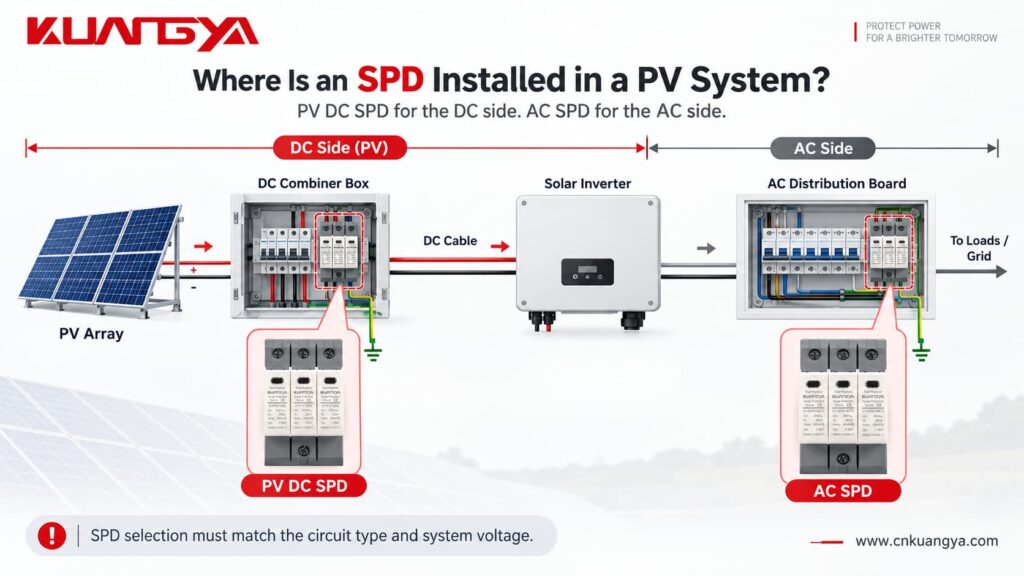
Common locations include the DC combiner box and the DC input side of the inverter.
In a larger PV system, protection may be required at more than one location depending on cable length, lightning protection design, equipment withstand level, and installation conditions.
The distance between the SPD and the protected inverter also matters.
Long connection conductors add inductive voltage during a surge, which can increase the effective voltage seen by the protected equipment.
Therefore, the SPD should not only be correctly selected — it should also be installed with short, direct connection conductors wherever possible.
If you want to understand this part in more detail, see:
La distanza tra l'SPD e l'inverter è rilevante?
No.
This is another common misunderstanding.
An incorrectly selected AC SPD installed on a DC system may not fail immediately.
Under normal conditions, the SPD is usually in a high-impedance standby state.
That means the installation can appear to operate normally even though the SPD is not correctly rated for the application.
The real problem may appear only when:
a strong surge occurs, the MOV ages, leakage current increases, the SPD experiences a temporary overvoltage, the device reaches end of life, or the thermal disconnector needs to operate.
Pertanto:
“It has not failed yet” is not proof that an SPD is correctly selected.
Check its ratings instead.
A common mistake is using an AC SPD on a DC system simply because the voltage number printed on the device appears to match. Other common mistakes include ignoring the AC/DC marking, assuming a higher voltage rating automatically makes an SPD safer, ignoring the maximum PV open-circuit voltage in cold conditions, overlooking Iscpv, choosing an SPD only by Imax, and assuming a green status window proves that the SPD is correct for the application.
A green indicator normally tells you something about the current mechanical or electrical status of the protection module.
It does non prove that the model was correctly selected for the system.
Before installing an SPD, answer these questions:
| Controllo | Domanda |
|---|---|
| Sistema | Is the circuit AC or DC? |
| Applicazione | Is it specifically a PV circuit? |
| Tensione | What is the maximum continuous system voltage? |
| SPD rating | Is Uc or Ucpv suitable for that voltage? |
| SPD type | Type 1, Type 1+2, or Type 2? |
| Surge current | Are In, Imax and/or Iimp appropriate? |
| Protection level | Is Up coordinated with the equipment? |
| Short-circuit capability | Is Iscpv suitable for the PV source? |
| Configurazione | Does the connection arrangement match the PV system? |
| Standard | Is the SPD designed and tested for the intended application? |
If any of these points are unclear, check the manufacturer's datasheet before energizing the circuit.
Only if the manufacturer specifically provides a DC rating for the device and that rating is suitable for the DC system. An SPD marked only for AC operation should not automatically be used on a DC circuit.
Not necessarily. It may initially appear to operate normally. However, an incorrectly rated SPD can overheat or fail to disconnect safely under abnormal conditions. Severe failure may result in arcing, burning, fire, or enclosure rupture.
No. A 275V AC rating does not make the device suitable for a 600V DC PV system. Use an SPD specifically rated for the required DC voltage and PV application.
Do not assume that you can. The identical voltage number does not mean the application ratings are equivalent. Check whether the manufacturer explicitly provides an appropriate 1000V DC rating.
Uc generally refers to maximum continuous operating voltage. For photovoltaic applications, Ucpv specifically identifies the maximum continuous DC voltage applicable to the PV SPD. The selected value must be suitable for the highest PV voltage that can occur at the installation.
The SPD may be subjected to excessive continuous electrical stress. This can increase leakage current, accelerate degradation, cause overheating, and eventually trigger or damage the disconnection mechanism.
No.
Ucpv must be high enough for the PV system, but SPD selection is a balance between continuous operating voltage and protection performance.
You should also consider Up, discharge-current ratings, equipment withstand voltage, system configuration, and manufacturer recommendations.
Check the product label and datasheet.
Look for clear markings such as:
275V AC
Uc 440V AC
Ucpv 1000V DC
Ucpv 1500V DC
Also check the applicable product standard and wiring configuration.
Never identify an AC or DC SPD only by its shape or number of poles.
An AC SPD and a DC SPD may look almost identical, but that does not mean they can be used interchangeably.
The biggest mistake is choosing an SPD only by the voltage number printed on the front.
A 1000V rating does not tell the whole story.
You also need to know whether the rating applies to AC or DC, whether the SPD is suitable for photovoltaic use, its maximum continuous operating voltage, discharge-current capability, voltage protection level, short-circuit capability, system configuration, and applicable standard.
Using an AC SPD on a DC system does not mean it will immediately explode, but the device must have a suitable DC rating for the application.
However, an SPD that is not designed for the DC application may experience excessive stress and may not disconnect safely at the end of its life. This can lead to overheating, sustained arcing, burning, fire, and in severe cases enclosure rupture.
For a photovoltaic DC system, use a surge protective device specifically designed and rated for the PV DC application.
KUANGYA provides DC surge protection solutions for different photovoltaic system voltages, including 600V DC, 1000V DC, and 1500V DC applications, with different SPD configurations available for solar PV protection.

