웽양 공업구 웨칭 원저우 325000
근무 시간
월요일~금요일: 오전 7시~오후 7시
주말: 주말: 오전 10시 - 오후 5시
웽양 공업구 웨칭 원저우 325000
근무 시간
월요일~금요일: 오전 7시~오후 7시
주말: 주말: 오전 10시 - 오후 5시

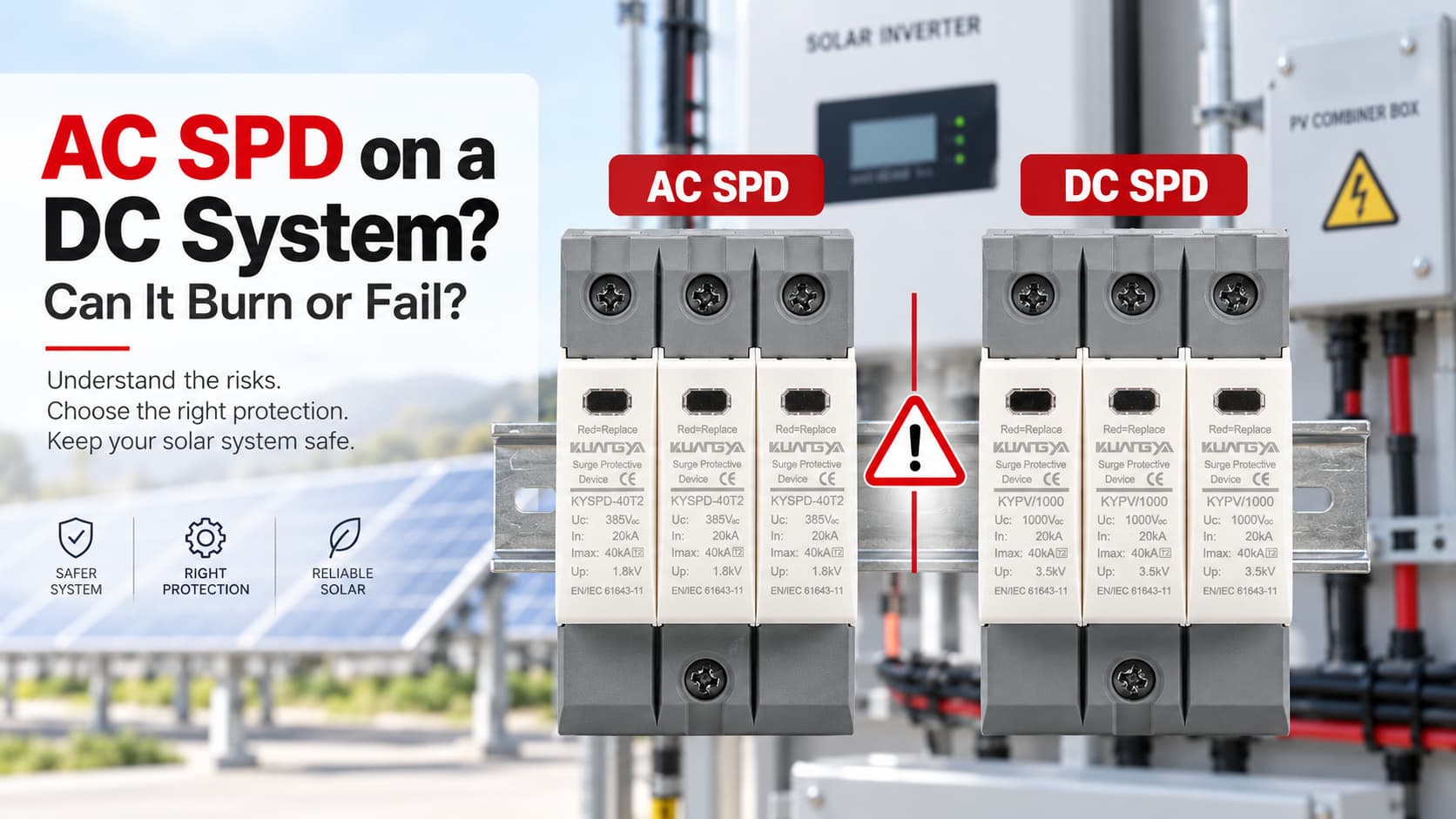
AC SPD를 DC 시스템에 사용하는 것은 해당 장치가 DC 애플리케이션용으로 특별히 정격되지 않은 경우 위험할 수 있습니다.
AC SPD와 DC SPD는 외부에서 보기에 매우 비슷할 수 있지만, 자동으로 상호 교체하여 사용할 수 없습니다. 가장 흔한 실수 중 하나는 라벨에 인쇄된 전압만 비교하는 것입니다. 예를 들어, 누군가 SPD에 적힌 “1000V”를 보고 1000V DC 태양광 시스템에 설치할 수 있다고 가정할 수 있습니다.
그러한 가정은 위험할 수 있습니다.
SPD는 제조업체가 해당 DC 애플리케이션에 대해 특별히 정격을 부여하고 전기적 특성이 시스템과 일치하는 경우에만 DC 시스템에 설치해야 합니다.
직류(DC) 회로에 교류(AC) 전용 서지 보호 장치(SPD)를 사용하면 과열, 내부 차단 메커니즘 고장, 지속적인 아크 발생, 연소 또는 화재가 발생할 수 있습니다. 심각한 고장의 경우 SPD 외함이 파손될 수도 있습니다.
그렇다면 AC SPD를 DC에 연결하면 폭발할 수 있습니까?
반드시 그렇지는 않습니다. 그러나 잘못된 SPD를 사용하면 심각한 고장 위험이 발생할 수 있으며, 심각한 열적 또는 전기적 고장으로 인해 외함이 파손될 수 있습니다.
전압 수치가 비슷해 보인다는 이유만으로 AC SPD를 DC 시스템에 사용해서는 안 됩니다.
AC 전용으로 표시된 장치는 AC 시스템 조건에 맞춰 설계 및 테스트되었습니다. 태양광(PV) DC SPD는 PV 설비의 DC 측에서 요구되는 연속 DC 전압, 고장 조건, 시스템 구성 및 차단 요구 사항에 맞춰 설계되었습니다.
PV 시스템의 경우, 항상 SPD의 전체 정격을 확인하십시오. 특히 다음 사항을 확인해야 합니다. Ucpv, In, Imax, 해당되는 경우 Iimp, Up, Iscpv, SPD 유형, 연결 구성 및 적용 표준.
일반적으로 AC 전용 SPD를 DC 시스템에 사용해서는 안 됩니다.
중요한 단어는 “정격(rated)”입니다.”
제조업체가 특정 SPD가 AC 및 DC 애플리케이션 모두에 적합하다고 명시한 경우, 명시된 정격 및 설치 조건 내에서 사용할 수 있습니다.
그러나 AC 전용으로 표시된 SPD를 DC 회로에 임의로 설치해서는 안 됩니다.
예를 들어
| SPD 표시 | 시스템 | 적합한가요? |
|---|---|---|
| Uc 275V AC | 600V DC 태양광 발전 시스템 | 아니요 |
| Uc 440V AC | 1000V DC 태양광 발전 시스템 | 아니요 |
| Ucpv 1000V DC | 정격 범위 내의 적합한 태양광 발전 시스템 | 잠재적으로 가능함 |
| AC/DC 겸용 SPD | 일치하는 AC 또는 DC 시스템 | 제조사 사양을 확인하십시오. |
이것이 전압 수치만 읽는 것으로는 충분하지 않은 이유입니다.
1000V AC와 1000V DC는 동일한 적용 정격이 아닙니다.
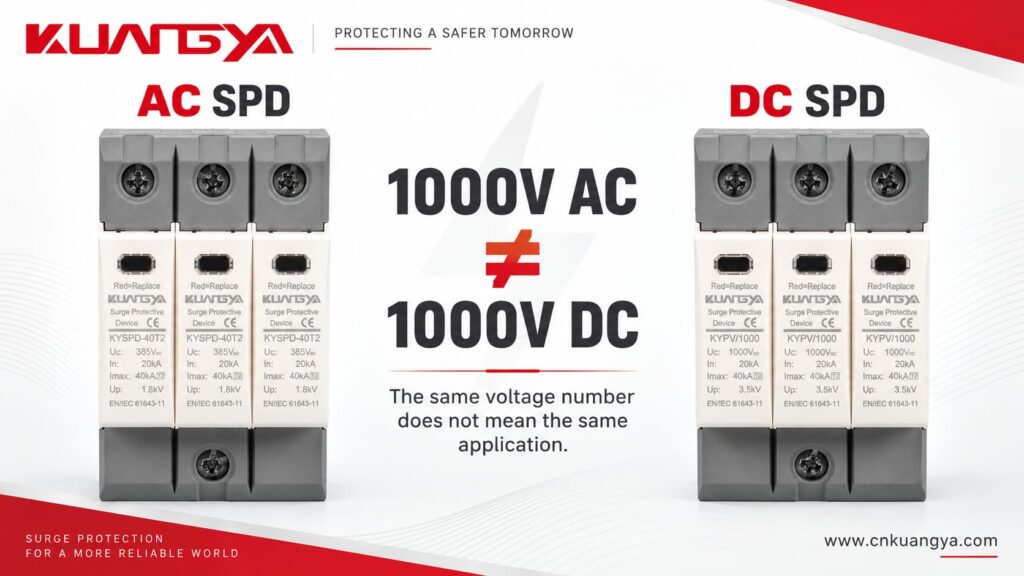
숫자 뒤에 오는 문자가 중요합니다.
AC 및 DC SPD 모두 동일한 기본 작업을 수행합니다. 즉, 과도 과전압을 제한하고 민감한 장비로부터 서지 전류를 우회시키는 역할을 합니다.
그러나 이들이 작동하는 전기적 환경은 서로 다릅니다.
이러한 차이는 비정상적인 상태와 SPD의 수명이 다했을 때 특히 중요해집니다.
정상적인 정현파 교류 시스템에서 순간 전압과 전류는 주기적으로 0을 통과합니다.
50Hz 또는 60Hz 주파수에서는 매초 이러한 현상이 반복적으로 발생합니다.
자연적인 영점 교차는 스위칭 또는 차단 장치가 열릴 때 아크를 소멸시키는 데 도움을 줄 수 있습니다.
이것이 바로 교류 스위칭 및 고장 차단용으로 설계된 장비가 직류(DC) 환경에서도 안전하게 작동할 것이라고 자동으로 가정할 수 없는 이유 중 하나입니다.
직류 전원은 동일한 극성을 유지하며 교류와 같은 방식으로 자연스럽게 0을 통과하지 않습니다.
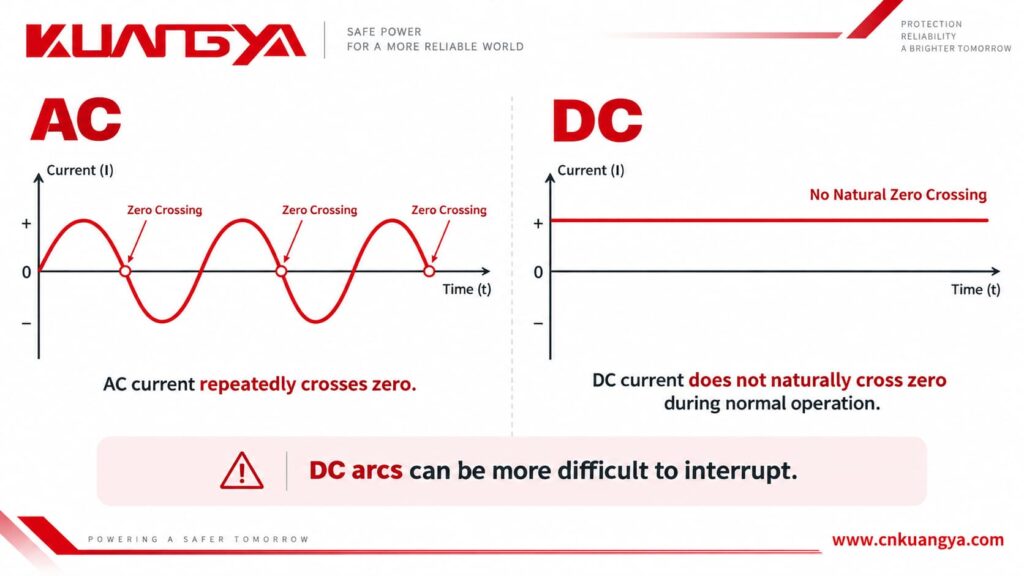
따라서 직류(DC) 아크가 발생하면 이를 차단하기가 더 어려울 수 있습니다.
태양광 발전 시스템에서는 햇빛이 있는 동안 태양광 어레이가 계속해서 직류(DC) 전력을 공급할 수 있기 때문에 이 점이 중요합니다.
서지 보호 장치(SPD)에 과부하가 걸려 내부 차단 시스템이 고장 난 보호 부품을 분리해야 하는 경우, 해당 장치는 DC 환경을 안전하게 처리할 수 있도록 설계되어야 합니다.
이것이 전용 태양광(PV) DC SPD가 DC 애플리케이션을 위해 의도된 설계 및 차단 방식을 사용하는 이유 중 하나입니다.
피닉스 컨택트(Phoenix Contact)는 또한 DC 시스템이 AC 시스템과 다르게 작동하므로 다음이 필요하다고 설명합니다. DC 애플리케이션용으로 설계된 서지 보호 장치.
DC 시스템에 AC SPD를 설치하면 즉각적인 가시적 고장이 발생하지 않을 수 있으며, 단일 고장 시퀀스가 존재하지 않습니다.
결과는 SPD 설계, DC 전압, 가용 전류, 시스템 구성, 온도, 서지 이력 및 SPD가 고장 나는 방식에 따라 달라집니다.
잘못 선정된 SPD는 처음에는 정상으로 보일 수 있습니다.
바로 그 점이 이 실수를 위험하게 만듭니다.
| 발생 가능한 상태 | 발생할 수 있는 현상 |
|---|---|
| 설치 직후 | SPD가 완전히 정상으로 보일 수 있음 |
| 지속적인 과전압 스트레스 | MOV 또는 기타 보호 부품이 발열할 수 있음 |
| 부품 열화 | 누설 전류가 증가할 수 있음 |
| 열 과부하 | 내부 열 차단기가 작동할 수 있음 |
| 부적절한 직류(DC) 차단 | 접점 분리 후에도 아크가 지속될 수 있음 |
| 심각한 고장 | 연소, 연기 또는 화재가 발생할 수 있음 |
| 치명적인 고장 | 하우징에 균열이 생기거나 파손될 수 있음 |
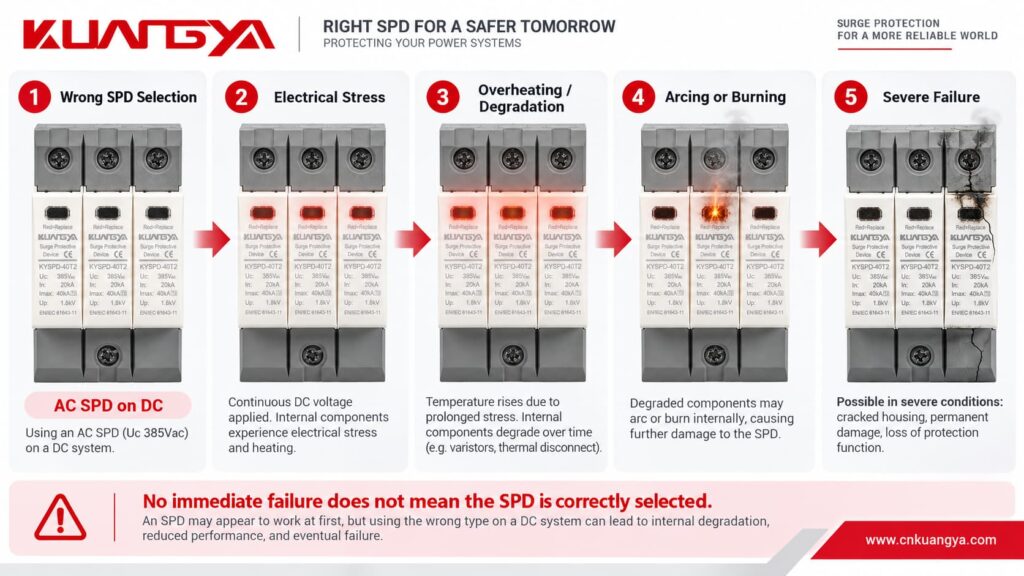
핵심 사항은 다음과 같음:
즉각적인 고장이 발생하지 않는다고 해서 SPD가 올바르게 선택된 것은 아님.
잘못 적용된 SPD는 서지, 온도 변화, 계통 상태, 절연 문제 또는 부품 열화로 인해 고장이 발생하기 전까지 수주 또는 수개월 동안 설치된 상태로 유지될 수 있음.
영상 시청: DC 시스템에 잘못된 SPD를 사용하면 어떤 일이 발생하는가?
이 질문에는 신중한 답변이 필요합니다.
AC SPD를 DC에 연결한다고 해서 즉시 폭발하는 것은 아닙니다.
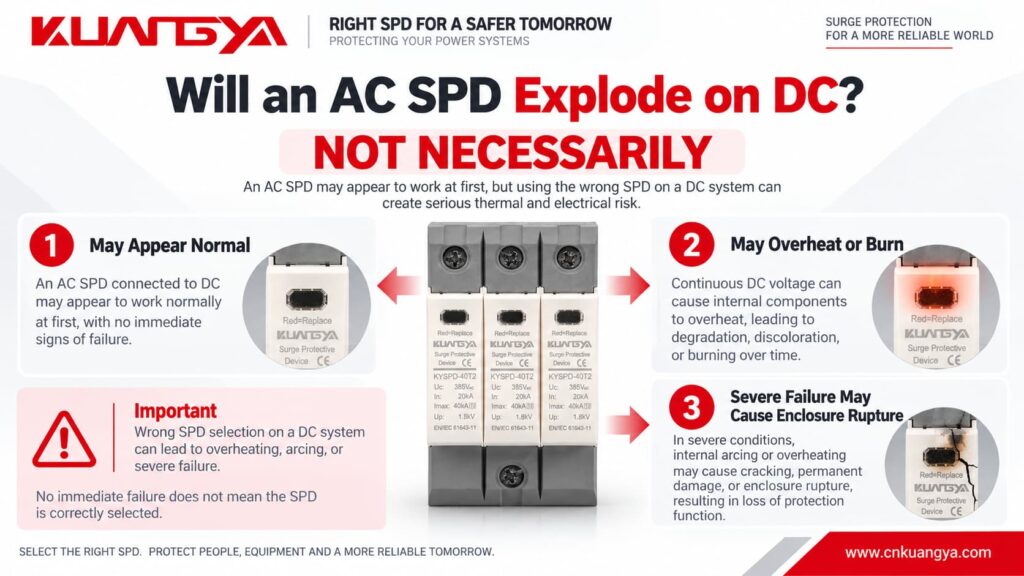
많은 잘못된 설치 사례에서 즉각적으로 극적인 현상이 발생하지는 않습니다.
진정한 우려는 SPD가 전기적 또는 열적 스트레스를 받을 때 발생하는 상황입니다.
단순화된 고장 순서는 다음과 같을 수 있습니다:
잘못된 SPD 선정 → 과도한 전기적 스트레스 → 발열 또는 열화 → 누설 전류 또는 고장 전류 증가 → 차단 어려움 → 아크 발생 또는 연소 → 외함 파손 가능성
따라서 다음과 같이 말할 수 있습니다:
“AC 서지 보호 장치(SPD)를 DC에 연결하면 폭발한다”는 표현은”
지나치게 단정적입니다.
더 기술적으로 정확한 설명은 다음과 같습니다:
DC 애플리케이션에 정격이 맞지 않는 SPD를 사용하면 심각한 과열 및 화재 위험이 발생할 수 있습니다. 심각한 결함 상태에서는 SPD가 타버리거나 외함이 파손될 수 있습니다.
“폭발”이라는 용어는 손상되거나 파손된 SPD를 설명할 때 흔히 사용되지만, 격렬한 외함 파손(violent enclosure rupture)이 더 정확한 기술적 표현입니다.
SPD가 이미 설치되어 있고 손상되었을까 우려된다면, 다음 가이드를 참조하십시오. SPD 불량 여부 확인 방법.
많은 SPD는 일반적으로 MOV라고 불리는 산화금속 바리스터를 사용합니다.
During normal operation, a correctly selected MOV-based SPD has very low leakage current.
During a transient overvoltage, the MOV becomes conductive and diverts surge current.
After the surge disappears, it should return to its high-resistance state.
However, repeated surge events, temporary overvoltage, excessive continuous voltage, aging, or incorrect application can gradually degrade the MOV.
As degradation progresses, leakage current may increase.
More leakage current creates more heat.
More heat may cause additional degradation.
This process can eventually result in thermal runaway if the device is not safely disconnected.
Modern SPDs therefore commonly include a thermal disconnection mechanism designed to isolate an overloaded MOV.
In a DC application, that disconnection mechanism must also be capable of safely dealing with the DC conditions that appear when the device disconnects.
Imagine two contacts beginning to separate while current is flowing.
As the gap becomes larger, an electrical arc can form between them.
In AC, the current naturally passes through zero periodically. This can assist arc extinction.
In DC, there is no equivalent natural current zero during normal operation.
The arc can therefore continue unless the device has been designed with an appropriate method to interrupt it.
This principle is not limited to SPDs.
It is also one reason why DC circuit breakers, DC isolators, contactors, and fuses need appropriate DC ratings.
The same general rule applies:
Never assume an AC electrical device is suitable for DC only because the voltage appears similar.
If you also want to understand how a typical power SPD is connected in the circuit, see our guide on why an SPD is connected in parallel instead of series.
아니요.
Voltage is only one part of SPD selection.
For a photovoltaic DC SPD, several parameters need to be considered together.
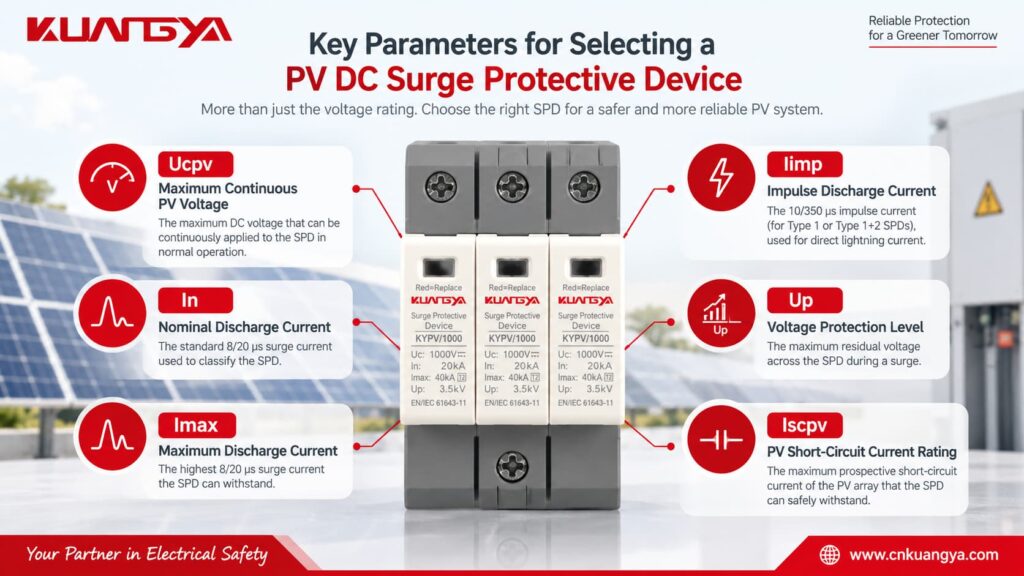
Ucpv is one of the most important parameters on a PV SPD.
It indicates the maximum DC voltage that may be continuously applied to the SPD under the specified conditions.
The selected Ucpv must be suitable for the highest voltage that can actually appear from the PV array.
Do not simply use the inverter’s nominal voltage.
PV module open-circuit voltage increases when temperature decreases, so the maximum string voltage can be higher on a cold day than the value calculated from nominal operating voltage.
A simplified engineering calculation is:
Voc,max = Ns × Voc,STC × [1 + |βVoc| × (25°C − Tmin)]
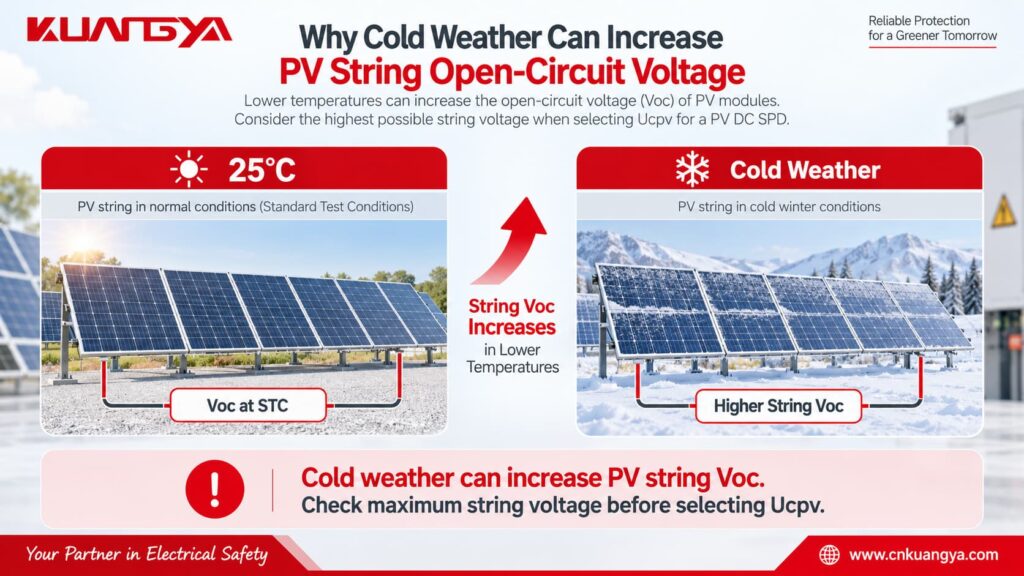
여기서:
Voc,max = estimated maximum string open-circuit voltage
Ns = number of modules connected in series
Voc,STC = module open-circuit voltage at STC
βVoc = module Voc temperature coefficient expressed per °C
Tmin = minimum design temperature at the installation site
This simplified formula assumes the manufacturer’s temperature coefficient is applicable over the temperature range being considered.
For an actual project, always follow the PV module manufacturer’s calculation method and applicable electrical design requirements.
The important selection relationship is:
Ucpv ≥ maximum PV voltage that can continuously appear at the SPD
A safety margin or additional design factor may also be required by the applicable standard, manufacturer, or project specification.
In is the nominal discharge current that the SPD can withstand repeatedly under the specified test waveform.
For Type 2 SPDs, the commonly used test waveform is 8/20 μs.
A higher In generally indicates greater repetitive surge-current capability, but In should never be considered alone.
Imax is the maximum value of the 8/20 μs surge current that a Type 2 SPD can discharge under its specified test conditions.
It describes a maximum capability rather than normal repetitive operation.
Iimp is particularly important for Type 1 SPDs.
It is associated with the 10/350 μs lightning-current waveform and is used when the SPD may need to handle partial lightning current.
Up indicates the voltage protection level provided by the SPD during surge discharge.
A lower Up can provide better voltage limitation, but it still needs to be coordinated with the protected equipment and the rest of the surge protection system.
The SPD should limit the surge to a level compatible with the impulse withstand capability of the equipment being protected.
Iscpv is especially important for photovoltaic SPDs.
It represents the maximum prospective PV DC short-circuit current for which the SPD’s end-of-life and disconnection behavior has been evaluated.
The SPD must be suitable for the prospective short-circuit current available at the installation point.
This is another reason why choosing a PV SPD only by voltage is not enough.
Quick Check: Use the simple tool below to see whether the basic SPD application type and voltage marking appear compatible with your system.
Select the system type and the marking shown on the SPD. This quick check only evaluates basic AC/DC application compatibility and does not replace a full technical selection.
For PV systems, enter the maximum expected DC operating voltage rather than only the nominal inverter voltage.
면책 조항: This tool is for preliminary selection only. Always verify the SPD datasheet, system configuration, maximum operating voltage, short-circuit conditions, and applicable standards before installation.
This is one of the most common misunderstandings.
Suppose two SPDs are placed next to each other.
One says:
Uc: 1000V AC
The other says:
Ucpv: 1000V DC
Both contain the number “1000V,” but that does not make them interchangeable.
Their application ratings, test conditions, internal arrangement, insulation design, disconnection behavior, and applicable standards may be different.
Always read the complete marking.
Never remove “AC,” “DC,” or “PV” from the voltage specification when comparing products.
The differences are easier to understand when they are compared directly.
| 기능 | AC SPD | PV DC SPD |
|---|---|---|
| Main application | AC power distribution | DC side of PV systems |
| Supply | AC | DC |
| Natural zero crossing | 예 | 아니요 |
| Typical voltage marking | Uc AC | Ucpv / Uc DC |
| DC fault interruption | Not assumed unless specified | Designed/tested for stated DC application |
| Common installation | Main distribution board, sub-panel | Combiner box, PV DC distribution, inverter DC side |
| Relevant IEC product standard | IEC 61643-11 | IEC 61643-31 |
| 최대 시스템 전압 | According to AC rating | According to specified PV DC rating |
| PV short-circuit consideration | Not a PV rating | Iscpv may be specified |
| Typical protection types | Type 1, Type 1+2, Type 2 | PV Type 1, Type 1+2, Type 2 |
The most important difference is not the appearance of the product.
It is what electrical system the SPD has actually been designed, rated, and tested for.
The same principle works in reverse.
Do not assume a DC SPD can be installed on AC simply because its DC voltage rating is higher than the AC system voltage.
예를 들어
A 1000V DC PV SPD is not automatically suitable for a 230V or 400V AC distribution board.
The manufacturer must provide an appropriate AC rating for that application.
If the device has both AC and DC ratings, follow the relevant rating for the system being protected.
If it is marked only as a PV DC SPD, use it only for the application specified by the manufacturer.
Not unless the manufacturer specifically provides a DC rating that covers that DC circuit.
A label such as:
Uc = 275V AC
does not mean:
275V DC
and certainly does not mean the device can be used on a 600V, 1000V, or 1500V PV system.
This is particularly important because 275V AC Type 2 SPDs are very common in low-voltage AC distribution systems.
Their familiar appearance can lead to incorrect use in DC equipment.
Always check the complete specification.
A better selection process starts with the electrical system, not with the SPD catalogue.
First determine where the SPD will be installed.
예를 들어
PV modules → DC combiner box → DC cables → inverter DC input → inverter AC output
The SPD installed before the inverter on the PV side is protecting a DC circuit.
The SPD installed on the inverter's AC output is protecting an AC circuit.
These two locations normally require different SPD specifications.
If your inverter already includes surge protection, see our guide on whether a solar inverter with a built-in SPD still needs an external SPD.
Check the number of modules in series, module Voc, temperature coefficient, and minimum expected module temperature.
Do not rely only on the inverter's nominal operating voltage.
Cold weather can increase the open-circuit voltage of a PV string.
The selected Ucpv must be suitable for the highest expected PV voltage.
The appropriate SPD type depends on the lightning protection concept and installation.
A Type 2 PV SPD is widely used for protection against induced and switching surges.
A Type 1 or Type 1+2 SPD may be required where partial lightning current has to be handled, depending on the installation and lightning protection design.
Do not choose Type 1, Type 1+2, or Type 2 based only on the kA number printed on the front.
After confirming the voltage and SPD type, compare the discharge-current parameters and voltage protection level.
For a Type 2 SPD, In and Imax are especially relevant.
For a Type 1 or Type 1+2 SPD, Iimp is also important.
Up should be coordinated with the impulse withstand level of the equipment being protected.
The prospective short-circuit current at the installation point also matters.
Check whether the SPD's Iscpv is suitable for the PV source.
Also confirm the system configuration and the required protection modes between positive, negative, and PE.
For dedicated photovoltaic DC SPDs, look for documentation relevant to PV DC applications, such as IEC 61643-31 compliance where applicable.
Do not rely solely on the product's external appearance.
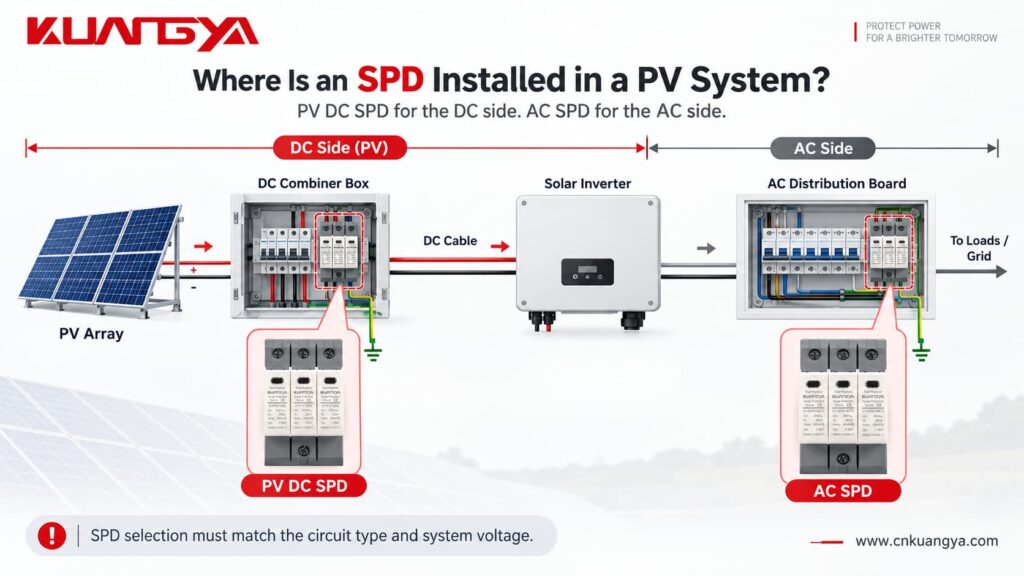
Common locations include the DC combiner box and the DC input side of the inverter.
In a larger PV system, protection may be required at more than one location depending on cable length, lightning protection design, equipment withstand level, and installation conditions.
The distance between the SPD and the protected inverter also matters.
Long connection conductors add inductive voltage during a surge, which can increase the effective voltage seen by the protected equipment.
Therefore, the SPD should not only be correctly selected — it should also be installed with short, direct connection conductors wherever possible.
If you want to understand this part in more detail, see:
아니요.
This is another common misunderstanding.
An incorrectly selected AC SPD installed on a DC system may not fail immediately.
Under normal conditions, the SPD is usually in a high-impedance standby state.
That means the installation can appear to operate normally even though the SPD is not correctly rated for the application.
The real problem may appear only when:
a strong surge occurs, the MOV ages, leakage current increases, the SPD experiences a temporary overvoltage, the device reaches end of life, or the thermal disconnector needs to operate.
따라서
“It has not failed yet” is not proof that an SPD is correctly selected.
Check its ratings instead.
A common mistake is using an AC SPD on a DC system simply because the voltage number printed on the device appears to match. Other common mistakes include ignoring the AC/DC marking, assuming a higher voltage rating automatically makes an SPD safer, ignoring the maximum PV open-circuit voltage in cold conditions, overlooking Iscpv, choosing an SPD only by Imax, and assuming a green status window proves that the SPD is correct for the application.
A green indicator normally tells you something about the current mechanical or electrical status of the protection module.
It does not prove that the model was correctly selected for the system.
Before installing an SPD, answer these questions:
| 확인 | 질문 |
|---|---|
| 시스템 | Is the circuit AC or DC? |
| 애플리케이션 | Is it specifically a PV circuit? |
| 전압 | What is the maximum continuous system voltage? |
| SPD rating | Is Uc or Ucpv suitable for that voltage? |
| 서지 보호 장치(SPD) 유형 | Type 1, Type 1+2, or Type 2? |
| Surge current | Are In, Imax and/or Iimp appropriate? |
| Protection level | Is Up coordinated with the equipment? |
| Short-circuit capability | Is Iscpv suitable for the PV source? |
| 구성 | Does the connection arrangement match the PV system? |
| 표준 | Is the SPD designed and tested for the intended application? |
If any of these points are unclear, check the manufacturer's datasheet before energizing the circuit.
Only if the manufacturer specifically provides a DC rating for the device and that rating is suitable for the DC system. An SPD marked only for AC operation should not automatically be used on a DC circuit.
Not necessarily. It may initially appear to operate normally. However, an incorrectly rated SPD can overheat or fail to disconnect safely under abnormal conditions. Severe failure may result in arcing, burning, fire, or enclosure rupture.
No. A 275V AC rating does not make the device suitable for a 600V DC PV system. Use an SPD specifically rated for the required DC voltage and PV application.
Do not assume that you can. The identical voltage number does not mean the application ratings are equivalent. Check whether the manufacturer explicitly provides an appropriate 1000V DC rating.
Uc generally refers to maximum continuous operating voltage. For photovoltaic applications, Ucpv specifically identifies the maximum continuous DC voltage applicable to the PV SPD. The selected value must be suitable for the highest PV voltage that can occur at the installation.
The SPD may be subjected to excessive continuous electrical stress. This can increase leakage current, accelerate degradation, cause overheating, and eventually trigger or damage the disconnection mechanism.
아니요.
Ucpv must be high enough for the PV system, but SPD selection is a balance between continuous operating voltage and protection performance.
You should also consider Up, discharge-current ratings, equipment withstand voltage, system configuration, and manufacturer recommendations.
Check the product label and datasheet.
Look for clear markings such as:
275V AC
Uc 440V AC
Ucpv 1000V DC
Ucpv 1500V DC
Also check the applicable product standard and wiring configuration.
Never identify an AC or DC SPD only by its shape or number of poles.
An AC SPD and a DC SPD may look almost identical, but that does not mean they can be used interchangeably.
The biggest mistake is choosing an SPD only by the voltage number printed on the front.
A 1000V rating does not tell the whole story.
You also need to know whether the rating applies to AC or DC, whether the SPD is suitable for photovoltaic use, its maximum continuous operating voltage, discharge-current capability, voltage protection level, short-circuit capability, system configuration, and applicable standard.
Using an AC SPD on a DC system does not mean it will immediately explode, but the device must have a suitable DC rating for the application.
However, an SPD that is not designed for the DC application may experience excessive stress and may not disconnect safely at the end of its life. This can lead to overheating, sustained arcing, burning, fire, and in severe cases enclosure rupture.
For a photovoltaic DC system, use a surge protective device specifically designed and rated for the PV DC application.
KUANGYA provides DC surge protection solutions for different photovoltaic system voltages, including 600V DC, 1000V DC, and 1500V DC applications, with different SPD configurations available for solar PV protection.

