WengYang Industriegebiet Yueqing Wenzhou 325000
Arbeitszeiten
Montag bis Freitag: 7AM - 7PM
Am Wochenende: 10AM - 5PM
WengYang Industriegebiet Yueqing Wenzhou 325000
Arbeitszeiten
Montag bis Freitag: 7AM - 7PM
Am Wochenende: 10AM - 5PM

Die Auswahl des DC-SPD ist einer der wichtigsten Schritte bei der Auslegung eines zuverlässigen Schutzsystems für Photovoltaik-(PV)-Anlagen. Die Wahl der korrekten Spannungsbemessung eines DC-Überspannungsschutzgeräts (DC-SPD) gewährleistet eine zuverlässige Schutzleistung und langfristige Systemstabilität.
Viele Anwender konzentrieren sich bei der Auswahl eines SPD hauptsächlich auf das Ableitvermögen (kA), doch die Spannungsbemessung ist ebenso entscheidend. Das gewählte DC-SPD muss in der Lage sein, der maximal möglichen Spannung standzuhalten, die von der PV-Anlage unter normalen Betriebsbedingungen erzeugt wird.
Ein SPD mit einer unzureichenden Spannungsbemessung kann vorzeitig degradieren oder ausfallen, während ein SPD mit einer unnötig hohen Spannungsbemessung möglicherweise nicht das optimalste Schutzniveau für die Anwendung bietet.
Bei Photovoltaikanlagen ist der entscheidende Spannungsparameter Ucpv (Maximale Dauerspannung für PV-Systeme). Die korrekte Auswahl erfordert das Verständnis der maximalen PV-Systemspannung, der Leerlaufspannung (Voc) der Module und der Temperatureinflüsse.
Dieser Leitfaden erläutert die Auswahl der korrekten DC-SPD-Spannungsbemessung für Solar-PV-Systeme, einschließlich gängiger 600V DC-, 1000V DC- und 1500V DC-Anwendungen.
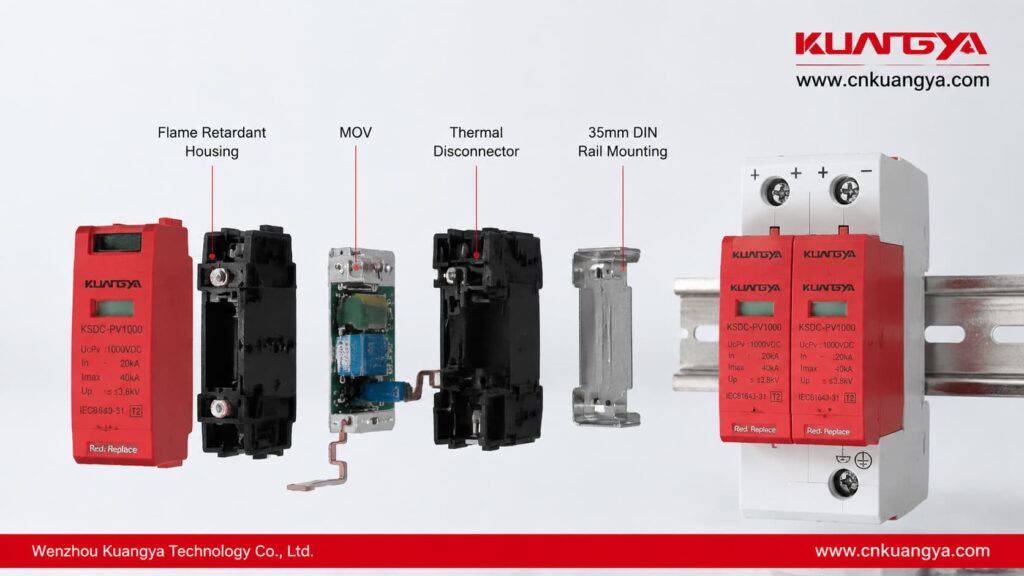
Die DC-SPD-Spannungsbemessung gibt die maximale Gleichspannung an, der das SPD dauerhaft standhalten kann, ohne seine Schutzfunktion zu aktivieren.
Um zu verstehen, wie DC-SPDs bei Überspannungsereignissen reagieren, lesen Sie unseren Leitfaden über die Funktionsweise eines DC-SPD.
Für Photovoltaikanwendungen ist der wichtigste Spannungsparameter:
Ucpv definiert die maximale Spannung, die während des normalen PV-Betriebs kontinuierlich am SPD anliegen darf.
Die gewählte Ucpv sollte wie folgt sein:
Zum Beispiel:
| DC-SPD-Bemessung | Typische Anwendung |
|---|---|
| 600V DC-SPD | Kleine PV-Anlagen |
| 1000V DC SPD | Kommerzielle und industrielle PV-Anlagen |
| 1500V DC SPD | Solarparks und Großprojekte |
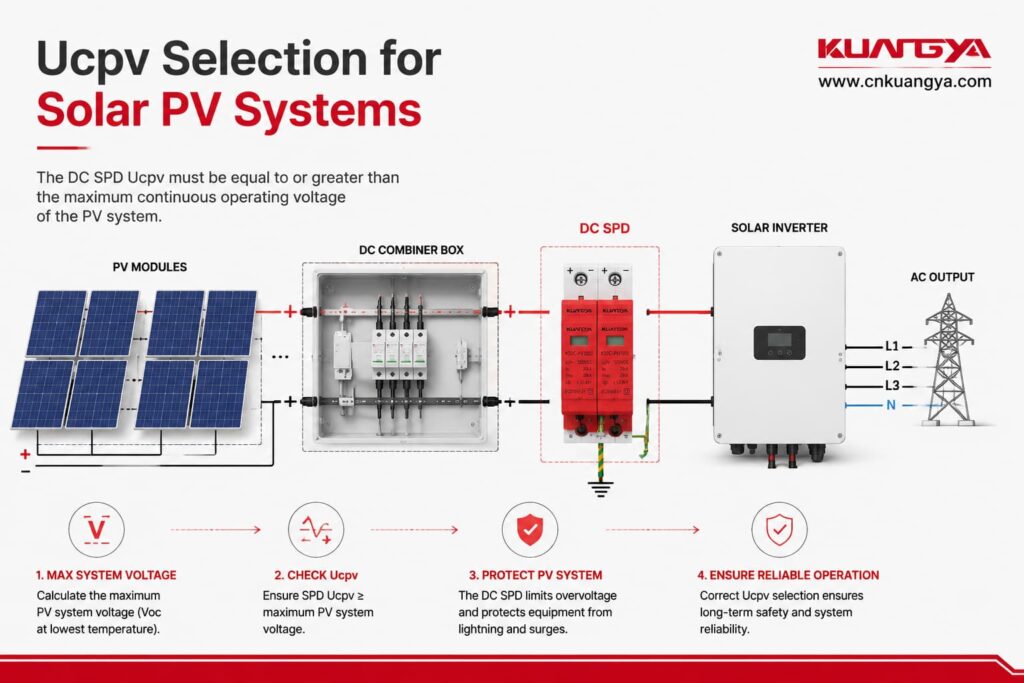
Die Auswahl des DC-SPD hängt von der maximalen PV-Systemspannung, den Moduleigenschaften, den Temperaturbedingungen und den Installationsanforderungen ab. Die Wahl der korrekten Spannungsbemessung ist der erste Schritt vor der Auswahl des endgültigen SPD-Modells.
Zu den Hauptfaktoren, die die Auswahl des DC-SPD beeinflussen, gehören:
Die Wahl einer falschen Bemessungsspannung kann die Systemzuverlässigkeit und die Schutzleistung beeinträchtigen.
Beispiel:
Eine PV-Anlage hat eine maximale Spannung von nahezu 1200 V DC, es ist jedoch ein 1000 V DC-Überspannungsschutzgerät installiert.
Potenzielle Probleme:
The SPD voltage rating should never be lower than the maximum calculated PV system voltage.
Beispiel:
A 600V PV system uses a 1500V DC SPD.
Although the SPD may withstand the voltage, it may not always provide the most optimized protection.
A higher voltage-rated SPD may have:
The goal is not to select the highest voltage rating, but the correct voltage rating.
When selecting a DC SPD, several voltage parameters are commonly used.
Ucpv is the most important parameter for photovoltaic DC SPD selection.
It represents the maximum voltage that the SPD can continuously withstand in a PV system.
The selected Ucpv must be higher than the maximum possible PV system voltage.
Uc is commonly used for general surge protective devices.
For PV-specific applications, Ucpv is normally the key parameter because photovoltaic systems have unique DC voltage characteristics.
Up represents the maximum voltage that can appear across the protected equipment during a surge event.
A lower Up generally means better protection performance.
When selecting an SPD, both Ucpv and Up should be considered.
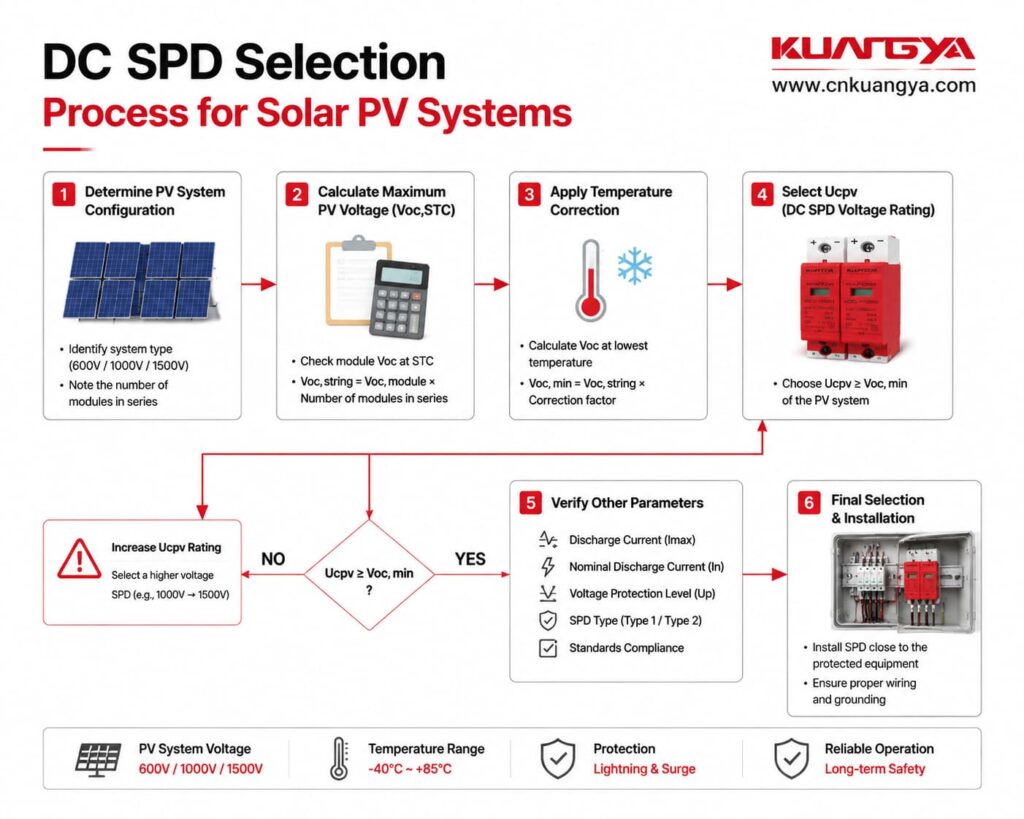
The maximum PV system voltage should be calculated based on:
The calculation formula is:
Wo:
| Parameter | Beschreibung |
|---|---|
| Number of Series Modules | Total PV modules connected in series in one string |
| Voc | Open-circuit voltage of one PV module |
| Temperatur-Korrekturfaktor | Voltage adjustment factor considering low-temperature conditions |
A PV string contains:
Kalkulation:
24 × 45V × 1.10 = 1188V
The maximum PV system voltage is:
1188V DC
Therefore, a 1500V DC SPD should be selected to provide sufficient voltage margin.
Voltage calculation is the first step in DC SPD selection. For a complete sizing approach including current ratings and protection requirements, refer to our guide on wie ein DC-Überspannungsschutz für eine Photovoltaikanlage zu dimensionieren ist.
The selected DC SPD voltage rating should not be lower than the calculated maximum PV system voltage.
For photovoltaic applications, the SPD parameter Ucpv should be equal to or higher than the maximum calculated PV voltage.
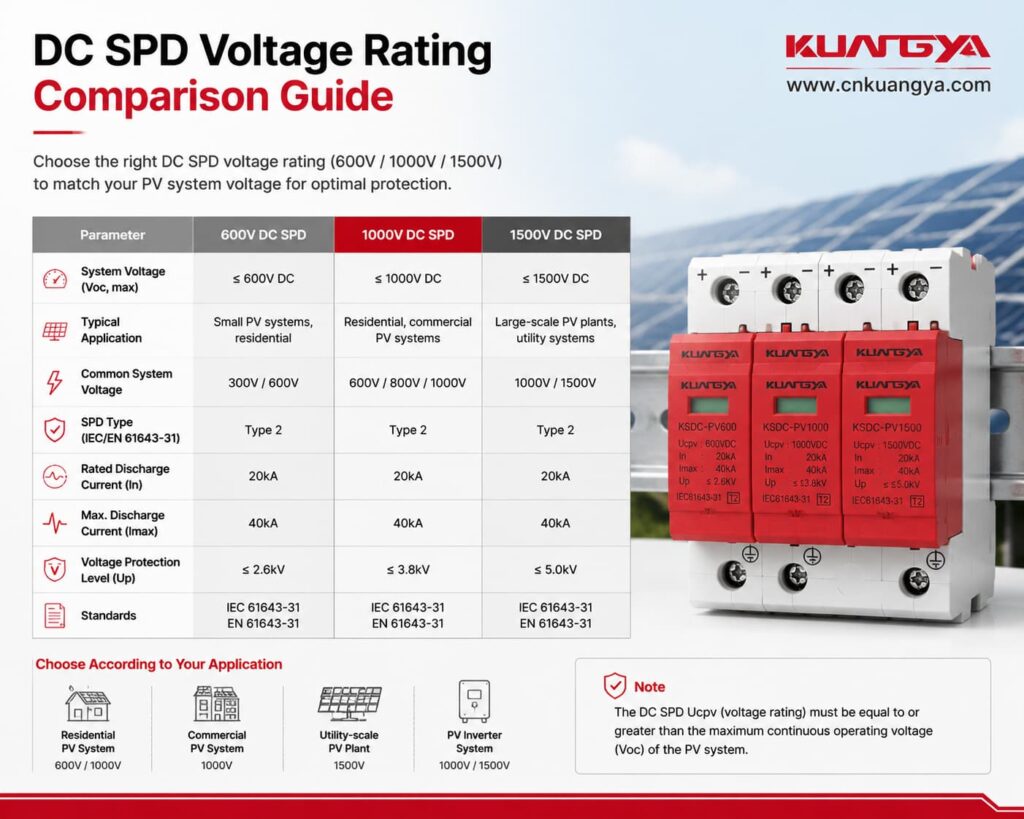
Calculate the recommended DC SPD voltage rating based on your PV system parameters.
Voltage rating is only one factor in DC SPD selection. The SPD type should also be selected according to the surge environment. Learn more about Type 1, Type 2 and Type 1+2 DC SPD selection.
Different PV system designs require different voltage-rated SPDs.
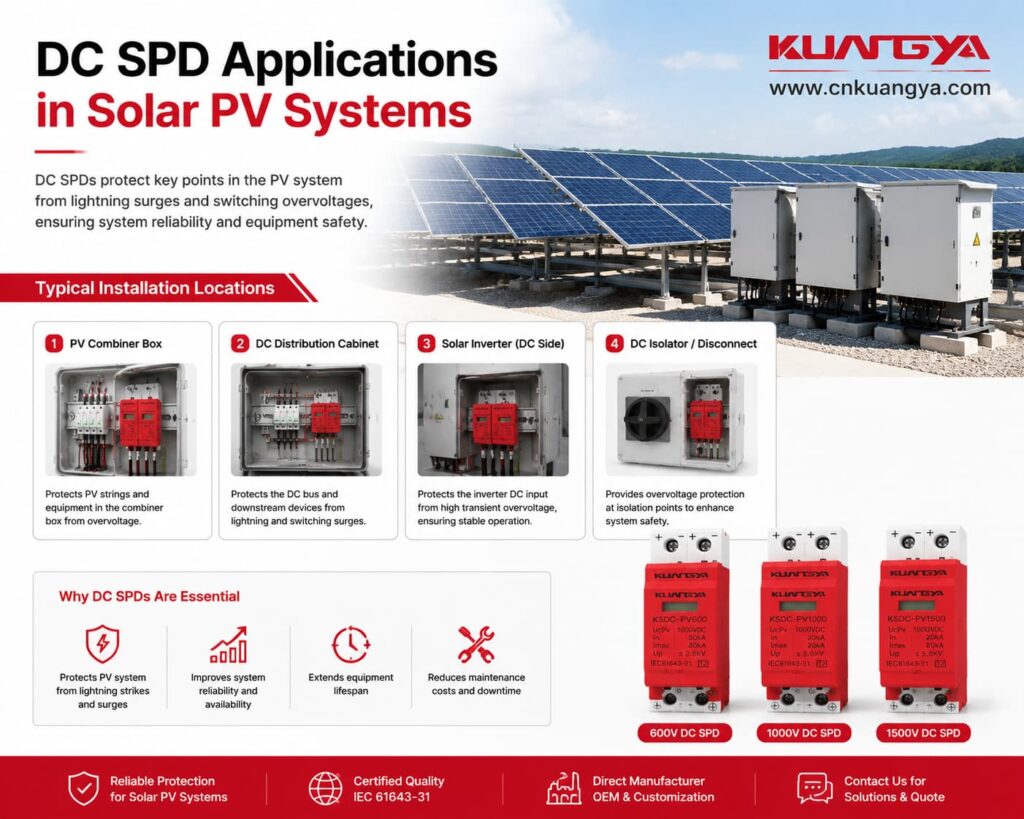
| SPD Voltage Rating | Gemeinsame Anwendungen | Typical Systems |
|---|---|---|
| 600V DC-SPD | Small PV installations | Residential rooftop systems |
| 1000V DC SPD | Medium and large PV systems | Commercial and industrial projects |
| 1500V DC SPD | Large-scale PV systems | Utility solar farms |
The correct selection depends on the calculated maximum PV voltage, not only the project size.
System information:
Kalkulation:
22 × 42V × 1.10
= 1016V DC
Recommended selection:
1500V DC SPD
Der Grund:
After temperature correction, the PV voltage exceeds 1000V.
System information:
Kalkulation:
18 × 45V × 1.10
= 891V DC
Recommended selection:
1000V DC SPD
Der Grund:
The calculated PV voltage is below 1000V.
The inverter input range does not always represent the maximum PV array voltage.
SPD selection should be based on PV string voltage.
Using Vmp instead of Voc may underestimate the maximum PV voltage.
A higher voltage-rated SPD may not always provide better equipment protection.
The Up value should meet the protection requirements of the system.
PV module voltage increases at low temperatures.
Temperature correction should be considered during system design.
A DC SPD with a suitable Ucpv rating should be selected based on the actual maximum PV system voltage. The calculated PV voltage should always remain below the SPD voltage rating.
A 1500V DC SPD may be used in some applications, but the protection level (Up), system requirements and cost should also be considered.
No. The SPD voltage rating should match the PV system requirements. A higher voltage rating does not automatically provide better protection.
Calculate the maximum PV voltage using:
Number of series modules × Module Voc × Temperature correction factor.
Ucpv is the maximum continuous operating voltage that a photovoltaic SPD can withstand during normal operation.
Photovoltaic surge protective devices are mainly covered by:
IEC 61643-31: Low-voltage surge protective devices – Requirements and test methods for SPDs for photovoltaic installations.
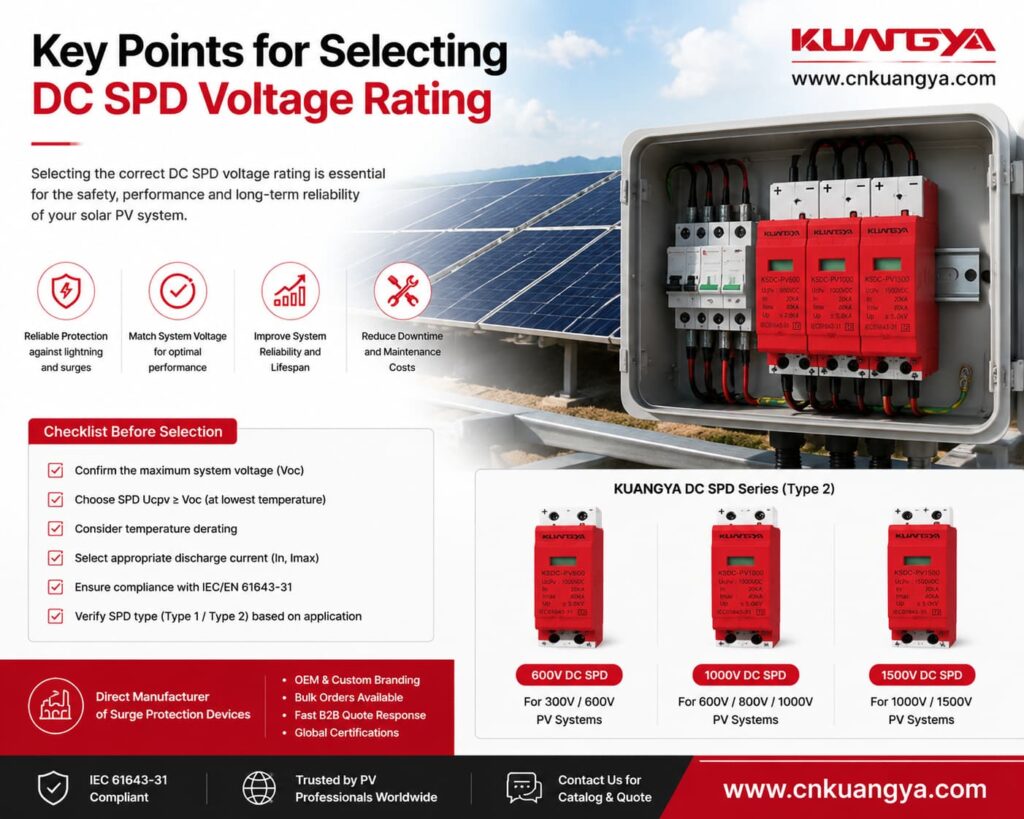
Selecting the correct DC SPD voltage rating is essential for reliable solar PV system protection.
Die richtige Wahl hängt ab von:
For common photovoltaic applications:
KUANGYA provides DC SPD solutions for solar photovoltaic applications, including 600V, 1000V and 1500V DC models with OEM customization support.

