WengYang Industrial Zone Yueqing Wenzhou 325000
Horas de trabalho
De segunda a sexta-feira: das 7h às 19h
Fim de semana: 10:00 - 17:00
WengYang Industrial Zone Yueqing Wenzhou 325000
Horas de trabalho
De segunda a sexta-feira: das 7h às 19h
Fim de semana: 10:00 - 17:00

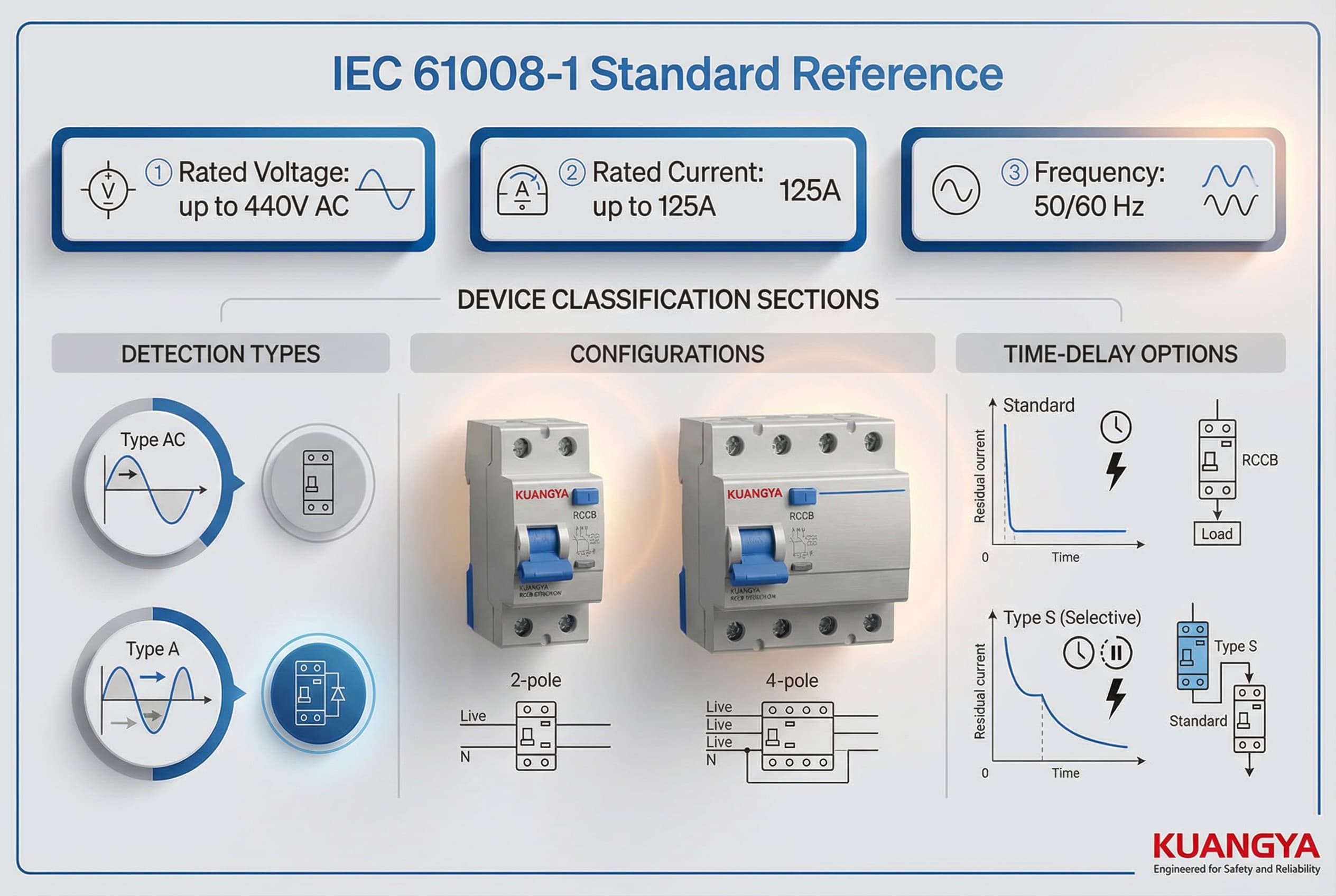
Você acabou de receber a folha de especificações finais de uma nova instalação comercial. Entre as anotações, há uma única linha crítica: “Todos os quadros de distribuição devem usar um equipamento compatível com a norma IEC 61008-1 RCCBs.” Para um engenheiro experiente, esse é um território familiar. Mas também é uma encruzilhada. Um caminho leva a uma seleção rápida, em conformidade com o papel, que pode ocultar riscos futuros. O outro caminho - o caminho da devida diligência - requer uma compreensão mais profunda do que esse padrão realmente exige.
A escolha do dispositivo errado não é apenas uma questão de não conformidade. Isso pode levar a disparos incômodos persistentes que interrompem as operações ou, o que é muito pior, a uma falha no disparo durante uma falha genuína, expondo as pessoas ao risco de choque elétrico grave ou criando um possível risco de incêndio. A diferença entre um sistema seguro e confiável e um desastre latente geralmente se resume à interpretação de normas como a IEC 61008-1.
Como engenheiro de aplicação com mais de 15 anos na área, vi em primeira mão como um entendimento adequado dos disjuntores de corrente residual (RCCBs) pode ser decisivo para o sucesso ou fracasso de um projeto. Este guia foi elaborado para traduzir a linguagem densa da IEC 61008-1 em conhecimento prático e acionável. Iremos além da simples listagem de requisitos e exploraremos por que são importantes, como interpretá-las para sua aplicação específica e como criar uma estrutura para selecionar o dispositivo certo, sempre. Este é o seu guia 2025 para dominar a especificação RCCB.
Antes de nos aprofundarmos nas especificações técnicas, precisamos primeiro definir nossos limites. A IEC 61008-1 é uma norma precisa e fundamental, mas entender o que ela abrange - e o que ela exclui deliberadamente - é o primeiro passo para evitar erros críticos de projeto.
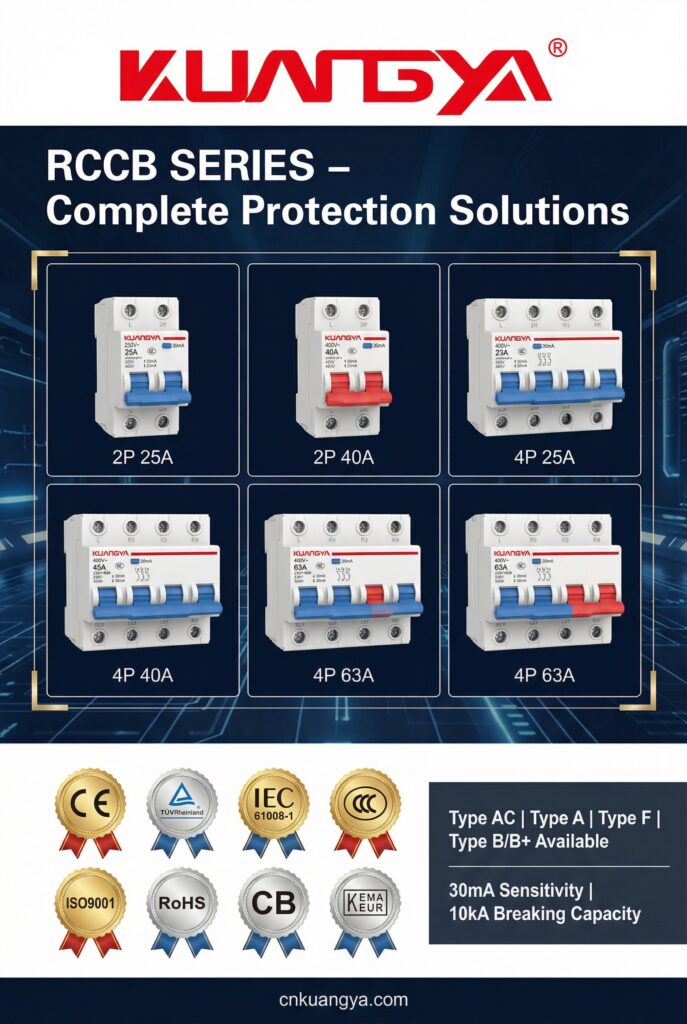
Em sua essência, a IEC 61008-1 se aplica a disjuntores operados por corrente residual sem proteção integral contra sobrecorrente para usos domésticos e similares. Essa é a distinção mais importante a ser entendida. Um RCCB é um dispositivo especializado. Sua única finalidade é detectar e responder a pequenas correntes de fuga (falhas de aterramento) que podem representar um risco de choque elétrico ou incêndio. Ele é fundamentalmente um dispositivo para salvar vidas.
O que ele faz não é proteger contra sobrecargas (consumir muita corrente) ou curtos-circuitos (uma conexão direta entre o vivo e o neutro). Essa tarefa é deixada para um dispositivo de proteção contra sobrecorrente (SCPD) a montante, como um disjuntor miniatura (MCB) ou um fusível.
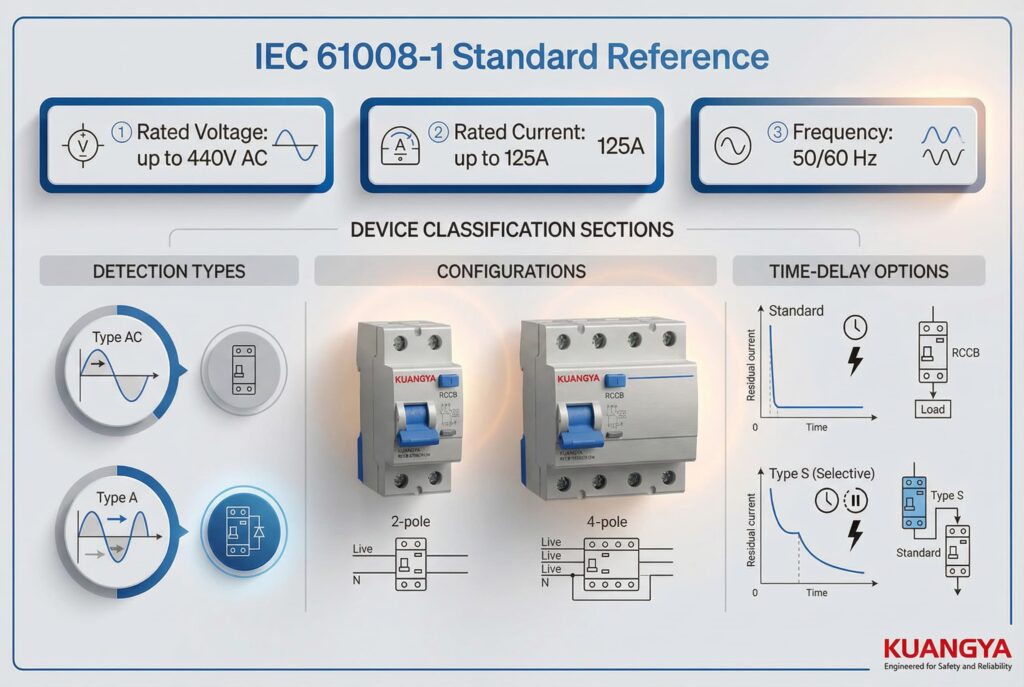
A norma define limites operacionais claros para os dispositivos que ela regula:
Se você precisar de um único dispositivo que forneça proteção contra falha de aterramento e proteção contra sobrecorrente, você está procurando um RCBO (Residual Current operated circuit-Breaker with integral Overcurrent protection), que é regido por um padrão diferente, o IEC 61009.
O mundo da segurança elétrica não é estático. Em 21 de novembro de 2024, a IEC publicou oficialmente a quarta edição da norma, retirando a versão anterior de 2010 e suas emendas. Para projetos que estão sendo especificados em 2025 e além, esse é um desenvolvimento crítico. As principais alterações introduzidas nessa última edição incluem novos requisitos para resistência à sobretensão temporária e melhor harmonização com as normas relacionadas. Ao adquirir dispositivos, agora você deve verificar qual edição a certificação do fornecedor faz referência para garantir a conformidade com o futuro.
Principais conclusões: A norma IEC 61008-1 é o padrão de segurança fundamental para a proteção autônoma contra falta à terra, mas é necessário emparelhar os RCCBs com um MCB ou fusível apropriado para obter uma proteção completa do circuito.
A placa de identificação de um RCCB é um contrato técnico. Trata-se de uma declaração do fabricante, validada por testes, sobre as capacidades de desempenho do dispositivo. Como engenheiro, seu trabalho é ler esse contrato e garantir que ele corresponda às demandas do seu circuito. Vamos detalhar os parâmetros críticos.
Essas são as especificações mais diretas. Tensão nominal (Un) é a tensão contínua máxima que o RCCB pode suportar, normalmente 230 V para sistemas monofásicos ou 400 V para sistemas trifásicos. Corrente nominal (In) é a corrente máxima de carga contínua que o dispositivo pode suportar sem superaquecimento. Os valores padrão incluem 16A, 25A, 40A, 63A e até 125A 1.
Analogia profissional: Pense neles como a capacidade estrutural básica do RCCB. Se o seu circuito for um cano, Em é o fluxo máximo de água que ele pode suportar 24 horas por dia, 7 dias por semana, sem que o próprio tubo fique quente, e Un é a pressão máxima que ele pode suportar. Isso não tem nada a ver com a função de disparo de segurança em si.
Esse é o coração da função de segurança do RCCB. IΔn é a quantidade específica de corrente de fuga que fará com que o dispositivo dispare. É a “sensibilidade do fio de disparo”.”
-sensitivity-levels-and-their-applications.webp)
As sensibilidades padrão são categorizadas por sua meta de proteção:
O padrão também define um Corrente residual nominal de não operação (IΔno), que, normalmente, é 0,5 x IΔn. Essa é a corrente de fuga máxima do dispositivo deve ignorar, evitando disparos incômodos causados por pequenos vazamentos de fundo cumulativos, comuns nos sistemas eletrônicos modernos.
É nesse ponto que ocorrem muitos erros de especificação. O “Tipo” do RCCB define o tipo de forma de onda de corrente de falha que ele pode detectar. O uso do tipo errado pode tornar o dispositivo cego para determinadas falhas.
Analogia profissional: Pense nos tipos de RCCB como tradutores de idiomas. Se suas cargas elétricas só “falam” CA puro, um tradutor básico funciona bem. Mas se elas falarem outros dialetos (como CC pulsante), você precisará de um tradutor mais avançado.
| Tipo de RCCB | Detecta CA senoidal | Detecta CC pulsante | Detecta DC suave | Aplicação típica |
|---|---|---|---|---|
| Tipo AC | ✔️ | ❌ | ❌ | Obsoleto; somente cargas resistivas simples. |
| Tipo A | ✔️ | ✔️ | ❌ | Padrão para circuitos residenciais e comerciais modernos. |
| Tipo B | ✔️ | ✔️ | ✔️ | Carregadores de veículos elétricos, inversores solares, VFDs, equipamentos médicos. |
Essas classificações definem a robustez do RCCB - sua capacidade de sobreviver a um evento de falha grave.

Principais conclusões: A correspondência do tipo de RCCB (A ou B) com a corrente de falha potencial da carga é tão importante quanto a seleção da sensibilidade correta (IΔn). Usar um tipo AC em um circuito com componentes eletrônicos é um erro comum e perigoso.
Com os parâmetros técnicos decodificados, vamos traduzir esse conhecimento em um processo de tomada de decisão repetível. Siga estas cinco etapas para garantir que sua seleção seja segura, compatível e confiável.
Comece perguntando: O que estou tentando proteger?
Com base em seu objetivo, selecione a classificação de sensibilidade. Essa é a etapa mais importante para a segurança.
| Sensibilidade (IΔn) | Uso primário | Nível de proteção | Aplicação típica |
|---|---|---|---|
| 10mA | Risco muito alto | Proteção humana extrema | Equipamentos médicos, áreas de piscina, saunas. |
| 30mA | Uso geral | Segurança humana | Residências, tomadas, espaços comerciais, cozinhas. |
| 100mA | Circuitos industriais | Equipamentos e proteção contra incêndio | Linhas de máquinas, quadros de distribuição com alto índice de vazamento. |
| 300mA / 500mA | Principal entrante | Proteção contra incêndios | Upstream em grandes quadros de distribuição para seletividade. |
Para qualquer tomada de uso geral onde uma pessoa possa conectar um aparelho, 30mA é a escolha obrigatória para a segurança humana.
Em seguida, analise o equipamento no circuito. Isso determina a “linguagem” da corrente de falha que seu RCCB precisa entender.
Escolha a corrente nominal (In) para ser igual ou superior à classificação do MCB a montante ou à corrente de carga máxima sustentada do circuito, o que for maior. Selecione a tensão nominal (Un) para corresponder à tensão do sistema (por exemplo, 230V ou 400V).
Por fim, verifique se a corrente de curto-circuito condicional (Inc) nominal do RCCB é adequada à corrente de falta prevista para a instalação e se está coordenada com o MCB a montante. Para a maioria das instalações comerciais, um dispositivo com classificação de 10kA é padrão. Essa coordenação garante que, no caso de um curto-circuito forte, o MCB disparará e protegerá o RCCB de uma falha catastrófica.
Conclusão principal: Um RCCB Tipo A de 30 mA é a escolha padrão para circuitos residenciais e comerciais modernos, mas você deve sempre analisar a carga para determinar se um Tipo B é necessário para segurança e conformidade.
Especificar e instalar um RCCB em conformidade é apenas metade do trabalho. Um RCCB é um dispositivo mecânico de segurança, e sua confiabilidade deve ser verificada ativamente. A norma IEC 61008-1 é construída sobre uma base de testes rigorosos.
Para obter a certificação, um RCCB deve passar por uma bateria de testes de tipo exigentes - mais de 21 deles, de acordo com algumas fontes - em um laboratório credenciado. Esses testes validam tudo, desde o aumento da temperatura e a resistência mecânica até as propriedades dielétricas e, o mais importante, suas características precisas de disparo em todas as condições de falha especificadas.
No entanto, quando o dispositivo sai da fábrica, a responsabilidade de garantir sua prontidão operacional passa para o instalador e o usuário final. Esse é o objetivo do “Botão ”T" (Teste) localizado na face de cada RCCB.
Pressionar esse botão cria um desequilíbrio pequeno e controlado, simulando uma falta real à terra. Um RCCB saudável disparará instantaneamente. Essa simples ação confirma que a ligação mecânica de disparo está livre e que o circuito de detecção está funcionando. Se o dispositivo não disparar, ele não está mais fornecendo proteção e deve ser substituído imediatamente por um eletricista licenciado.
Com que frequência esse teste deve ser realizado? As melhores práticas do setor e muitas regulamentações locais recomendam testes mensais. É um procedimento simples, de dois segundos, que proporciona a tranquilidade de saber que seu principal dispositivo de salvamento está pronto para agir quando necessário.
Principais conclusões: Um RCCB não testado é um RCCB não confiável. O teste mensal por meio do botão ‘T’ é uma prática de segurança inegociável que garante que o dispositivo funcionará quando você mais precisar dele.
P1: Qual é a diferença entre um RCCB, RCBO e MCB?
P2: Por que meu RCCB dispara quando não há nenhuma falha óbvia (disparo incômodo)?
Isso geralmente é causado por baixos níveis de corrente de fuga cumulativa de vários dispositivos eletrônicos em um único circuito. Também pode ser um sinal de isolamento deficiente na fiação ou de um aparelho com defeito. Embora às vezes seja um sinal de um RCCB excessivamente sensível, geralmente indica problemas subjacentes que precisam ser investigados.
P3: Posso usar um RCCB tipo AC para circuitos com eletrônicos modernos?
Não. Essa é uma prática perigosa. Os eletrônicos modernos produzem formas de onda CC pulsantes durante a operação. Um RCCB do tipo AC não foi projetado para detectar essas formas de onda e pode não disparar durante uma falha. Você deve usar o Tipo A como mínimo para qualquer circuito com cargas eletrônicas.
Q4: Com que frequência devo testar meu RCCB?
Você deve pressionar o botão “Test” uma vez por mês para garantir que o dispositivo esteja mecanicamente funcional.
Q5: Um RCCB oferece proteção contra sobrecarga?
Não. Um RCCB não oferece proteção contra sobrecorrentes. Um RCCB de 40 A permitirá que 100 A passem por ele se não houver falha de aterramento, o que pode levar a um sério risco de incêndio. Ele sempre deve ser precedido por um dispositivo de proteção contra sobrecorrente, como um MCB ou fusível.
Q6: Qual é o principal impacto da atualização de 2024 da IEC 61008-1?
A quarta edição apresenta requisitos mais rigorosos, principalmente para a resistência à sobretensão temporária (TOV). Isso torna os dispositivos mais robustos em ambientes com redes de energia instáveis ou altos transientes de comutação, melhorando a confiabilidade geral do sistema. Quando estiver adquirindo produtos para projetos de 2025, procure a certificação IEC 61008-1:2024.
A norma IEC 61008-1 é mais do que uma lista de requisitos técnicos; é um projeto para salvar vidas. Como engenheiros, nossa responsabilidade vai além da mera conformidade. Trata-se de compreender os princípios por trás das regras - a física das correntes de falha, a fisiologia do choque elétrico e as realidades práticas de uma instalação elétrica moderna.
Seguindo uma abordagem estruturada - definindo o objetivo, selecionando a sensibilidade e o tipo corretos, garantindo as classificações adequadas e verificando por meio de testes -, você transforma um desafio de especificação complexo em um processo claro para garantir a segurança e a confiabilidade. Um RCCB escolhido corretamente é um guardião silencioso, mas sua presença é uma prova da diligência e do cuidado do engenheiro que o colocou lá.

