Zona industrial de WengYang Yueqing Wenzhou 325000
Horas de trabajo
De lunes a viernes: de 7.00 a 19.00 horas
Fin de semana: 10.00 A 17.00 HORAS
Zona industrial de WengYang Yueqing Wenzhou 325000
Horas de trabajo
De lunes a viernes: de 7.00 a 19.00 horas
Fin de semana: 10.00 A 17.00 HORAS

Respuesta rápida: La norma IEC 61008-1 cubre los interruptores diferenciales (RCCB) sin protección contra sobreintensidades integrada para uso doméstico y aplicaciones similares. Un RCCB detecta fallos por corriente residual, pero no sustituye a un MCB o fusible para la protección contra sobrecargas y cortocircuitos. Antes de especificar uno, confirme la tensión del sistema, la corriente nominal, la sensibilidad, el tipo de corriente residual, la configuración de polos, la protección aguas arriba, las instrucciones del equipo y los requisitos locales de cableado.
Esta guía explica los requisitos prácticos y las comprobaciones de selección de los RCCB asociados a la norma IEC 61008-1. Es una visión general de ingeniería, no una reproducción de la norma ni una prueba de que un producto en particular esté certificado. Verifique siempre la edición oficial vigente, la documentación del fabricante, el alcance del certificado aplicable y las normas locales para su proyecto.
Antes de sumergirnos en las especificaciones técnicas, debemos definir nuestros límites. La norma IEC 61008-1 es precisa y fundamental, pero entender lo que cubre -y lo que excluye deliberadamente- es el primer paso para evitar errores de diseño críticos.
En esencia, la norma IEC 61008-1 se aplica a interruptores automáticos diferenciales sin protección integral contra sobreintensidades para usos domésticos y similares . Esta es la distinción más importante. En RCCB es un dispositivo especializado. Su único propósito es detectar y responder a corrientes residuales (fallos de fuga a tierra) que podrían suponer un riesgo de descarga eléctrica o incendio. Es un dispositivo de protección destinado a reducir los riesgos derivados de fallos por corriente residual cuando se selecciona, coordina, instala y mantiene correctamente.
Para qué sirve no es proteger contra sobrecargas (consumo excesivo de corriente) o cortocircuitos (una conexión directa entre el conductor y el neutro). Esta tarea se deja en manos de un dispositivo de protección contra sobrecorriente (SCPD), como un disyuntor en miniatura (MCB) o un fusible.
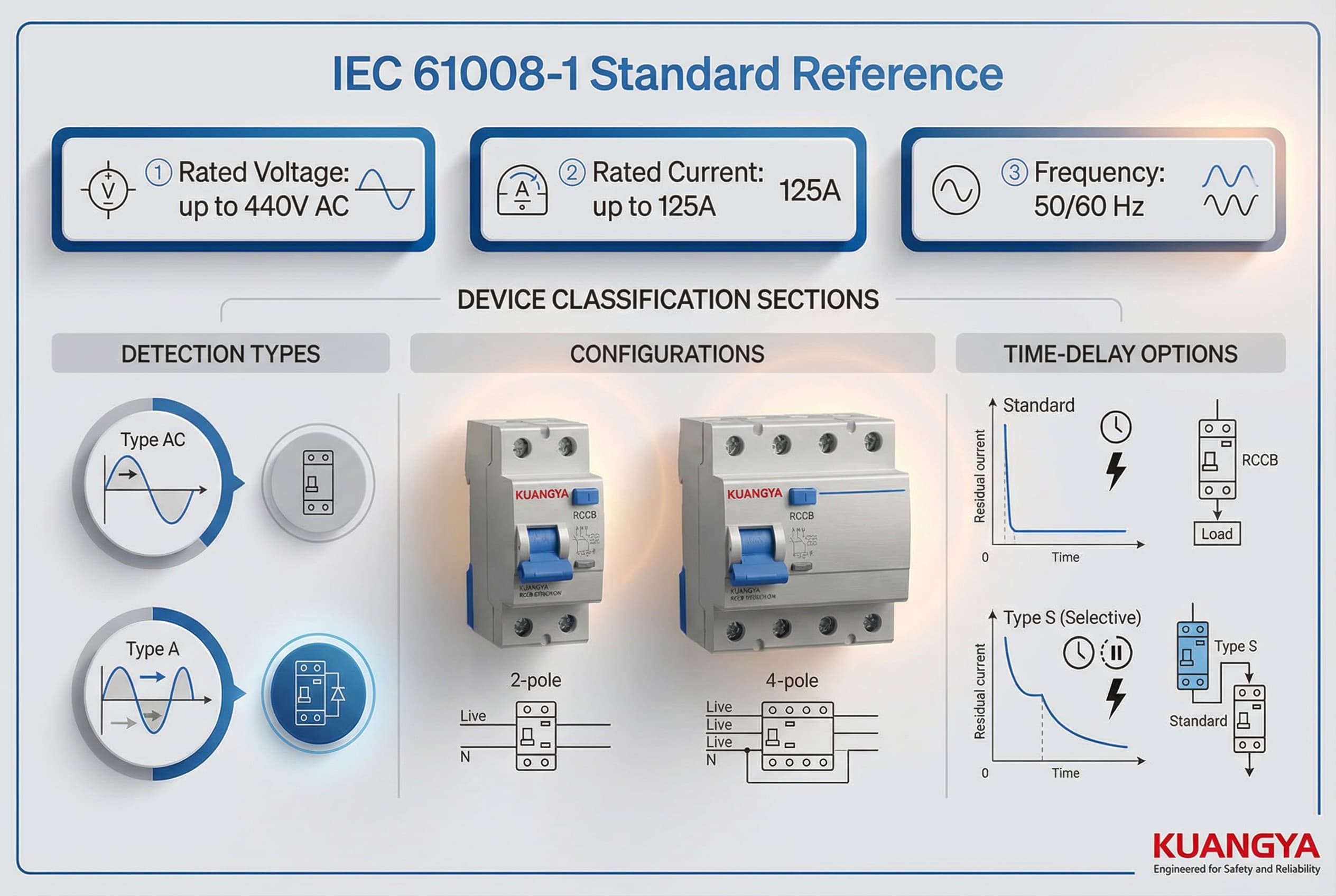
La norma establece límites operativos claros para los dispositivos que regula :
Si necesita un único dispositivo que proporcione protección contra corriente residual y protección de sobreintensidad, está buscando un RCBO (Residual Current operated circuit-Breaker with integral Overcurrent protection), que se rige por una norma diferente, la IEC 61009.
Utilice el verificador a continuación para organizar los parámetros principales del proyecto antes de solicitar un presupuesto. Su resultado es preliminar y no confirma la conformidad, certificación o idoneidad de la instalación.
Prepare una consulta preliminar de RCCB. El resultado no confirma la conformidad del producto, la certificación ni la idoneidad para la instalación.
Un RCCB requiere protección coordinada contra sobrecargas y cortocircuitos. Verifique siempre el diseño del circuito, las instrucciones del equipo, los documentos del producto y las normas locales.
El mundo de la seguridad eléctrica no es estático. La norma IEC 61008-1 ha sido revisada a lo largo del tiempo. Para un proyecto actual, verifique la edición requerida por el contrato o la autoridad local y compruebe que cualquier documentación del proveedor haga referencia al mismo producto, capacidad nominal y edición. No infiera la certificación únicamente a partir de una declaración en el catálogo; revise el organismo emisor, el alcance del certificado y su validez.
Conclusión clave: La norma IEC 61008-1 trata sobre los RCCB sin protección contra sobrecorriente integrada. Coordine el RCCB con un MCB o fusible adecuado y verifique la instalación completa conforme a las normas vigentes aplicables.
La placa de características de un RCCB es un contrato técnico. Es una declaración del fabricante, validada mediante pruebas, sobre las prestaciones del dispositivo. Como ingeniero, su trabajo consiste en leer ese contrato y asegurarse de que se ajusta a las exigencias de su circuito. Desglosemos los parámetros críticos.
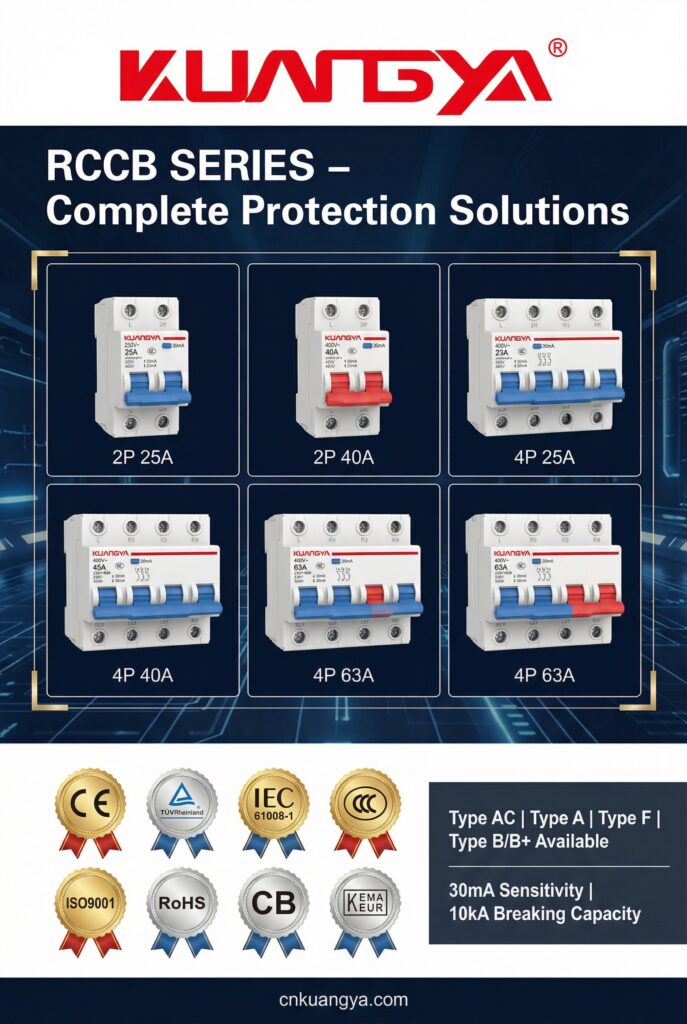
Estas son las especificaciones más sencillas. Tensión nominal (Un) es la tensión continua máxima que puede soportar el RCCB, normalmente 230 V para sistemas monofásicos o 400 V para sistemas trifásicos. Corriente nominal (In) es la corriente de carga continua máxima que el dispositivo puede transportar sin sobrecalentarse. Las capacidades nominales comunes incluyen 16A, 25A, 40A y 63A, aunque existen capacidades mayores en algunas gamas de productos. Confirme la corriente nominal, la capacidad de los terminales y el alcance del certificado en la documentación actual del fabricante.
Analogía profesional: Piense en ellos como la capacidad estructural básica del RCCB. Si su circuito es una tubería, En es el caudal máximo de agua que puede soportar 24/7 sin que la propia tubería se caliente, y Un es la presión máxima que puede soportar. No tiene nada que ver con la función de disparo de seguridad en sí.
Este es el corazón de la función de seguridad del RCCB. IΔn es la cantidad específica de corriente de fuga que provocará el disparo del dispositivo. Es la “sensibilidad de disparo”.”
-sensitivity-levels-and-their-applications.webp)
Las sensibilidades estándar se clasifican por su objetivo de protección :
La norma también define un corriente residual de no funcionamiento nominal (IΔno). Bajo las condiciones de prueba especificadas, el RCCB no debe dispararse a este nivel de corriente de prueba. En una instalación real, el riesgo de disparo no deseado también debe evaluarse a partir de la fuga acumulada normal, los transitorios y la coordinación con los dispositivos aguas arriba y aguas abajo.
Aquí es donde se producen muchos errores de especificación. El “tipo” de RCCB define qué tipo de forma de onda de corriente de fallo puede detectar. El uso de un tipo incorrecto puede hacer que el dispositivo no detecte determinados fallos.
Analogía profesional: Piense en los tipos RCCB como traductores de idiomas. Si sus cargas eléctricas sólo “hablan” CA pura, un traductor básico funciona bien. Pero si hablan otros dialectos (como CC pulsante), necesita un traductor más avanzado.
| Tipo RCCB | Detecta CA sinusoidal | Detecta CC pulsante | Detecta CC suave | Aplicación típica |
|---|---|---|---|---|
| Tipo AC | ✔️ | ❌ | ❌ | Cargas de CA sinusoidal, solo donde esté permitido. |
| Tipo A | ✔️ | ✔️ | ❌ | Muchas cargas electrónicas monofásicas; verifique los requisitos. |
| Tipo B | ✔️ | ✔️ | ✔️ | Cargas que pueden producir CC suave; verifique las instrucciones del equipo. |
Estas clasificaciones definen la robustez del RCCB, es decir, su capacidad para sobrevivir a un fallo grave.

Conclusión clave: Adecuar el tipo de RCCB (A o B) a la corriente de defecto potencial de la carga es tan crítico como seleccionar la sensibilidad correcta (IΔn). Utilizar un tipo AC en un circuito con componentes electrónicos es un error común y peligroso.
Una vez descodificados los parámetros técnicos, traduzcamos estos conocimientos en un proceso repetible de toma de decisiones. Siga estos cinco pasos para asegurarse de que su selección es segura, conforme y fiable.
Empiece por preguntarse: ¿Qué intento proteger?
En función de su objetivo, seleccione el grado de sensibilidad. Este es el paso más crítico para la seguridad.
| Sensibilidad (IΔn) | Uso principal | Nivel de protección | Aplicación típica |
|---|---|---|---|
| 10 mA | Riesgo muy alto | Protección humana extrema | Equipamiento médico, zonas de piscina, saunas. |
| 30 mA | Uso general | Seguridad humana | Hogares, tomas de corriente, espacios comerciales, cocinas. |
| 100 mA | Circuitos industriales | Equipamiento y protección contra incendios | Líneas de maquinaria, cuadros de distribución con altas fugas. |
| 300 mA / 500 mA | Entrada principal | Protección contra incendios | Aguas arriba en grandes cuadros de distribución para selectividad. |
Para cualquier toma de corriente de uso general en la que una persona pueda enchufar un aparato, 30mA es la opción obligatoria para la seguridad humana.
A continuación, analice los equipos del circuito. Esto determinará el “lenguaje” de la corriente de defecto que debe comprender su RCCB.
Seleccione la tensión nominal para el sistema real y seleccione la corriente nominal utilizando la carga de diseño, la capacidad del conductor, las condiciones de instalación y el dispositivo de protección aguas arriba coordinado. La corriente nominal del RCCB no es un ajuste de disparo por sobrecarga.
Verifique la corriente de cortocircuito prospectiva en el punto de instalación y la capacidad de cortocircuito condicional del RCCB para el dispositivo de protección asociado especificado. El valor requerido no puede seleccionarse a partir de una cifra “estándar” universal; utilice los datos de coordinación del fabricante y el estudio de fallas del proyecto.
Conclusión clave: La sensibilidad y el tipo de corriente residual dependen de la aplicación. Confirme el objetivo de protección, la forma de onda esperada, las instrucciones del equipo, la coordinación y los requisitos locales.
Especificar e instalar un RCCB conforme es sólo la mitad del trabajo. Un RCCB es un dispositivo de seguridad mecánico, y su fiabilidad debe verificarse activamente. La norma IEC 61008-1 se basa en ensayos rigurosos.
La evaluación de la conformidad se basa en las pruebas y la documentación aplicables a la norma declarada y al alcance del producto. Los compradores deben verificar el organismo emisor, la referencia del informe o certificado, el modelo y las características nominales cubiertos, la edición, la validez y cualquier condición, en lugar de confiar en un número de pruebas no especificado.
Sin embargo, una vez que el aparato sale de fábrica, la responsabilidad de garantizar su operatividad pasa al instalador y al usuario final. Este es el objetivo del “Botón ”T" (Test) situado en la cara de cada RCCB.
Al presionar el botón de prueba se genera una corriente de prueba interna destinada a accionar el dispositivo. El comportamiento esperado y el tiempo de funcionamiento permitido dependen de las instrucciones del producto. Si no funciona según lo especificado, aísle el problema y haga que la instalación sea evaluada por una persona cualificada; el botón de prueba no verifica todos los aspectos de la protección del circuito.
¿Con qué frecuencia debe realizarse esta prueba? Los intervalos de prueba varían según las instrucciones del fabricante y las normas locales. Accionar el botón de prueba verifica la función de prueba interna y el mecanismo de disparo, pero no sustituye la verificación eléctrica requerida para la puesta en servicio o la inspección periódica.
Conclusión clave: Siga el intervalo del botón de prueba del fabricante y los requisitos de inspección y prueba aplicables a la instalación.
P1: ¿Cuál es la diferencia entre un RCCB, un RCBO y un MCB?
P2: ¿Por qué se dispara mi RCCB cuando no hay ningún fallo evidente? (Disparos molestos)
Suele deberse a niveles bajos de corriente de fuga acumulada de varios dispositivos electrónicos en un mismo circuito. También puede ser señal de un aislamiento deficiente en el cableado o de un aparato averiado. Aunque a veces es un signo de un RCCB demasiado sensible, a menudo indica problemas subyacentes que deben investigarse.
P3: ¿Puedo utilizar un interruptor diferencial de tipo CA para circuitos con electrónica moderna?
No elija basándose únicamente en las palabras “electrónica moderna”. Identifique la forma de onda de corriente residual indicada por el fabricante del equipo y aplique los requisitos locales. Dependiendo de la carga, puede ser necesario el tipo A, F o B —u otro arreglo de protección coordinado—; el tipo AC solo debe utilizarse cuando su capacidad de detección sea adecuada y esté permitida.
P4: ¿Con qué frecuencia debo comprobar mi RCCB?
Accione el botón de prueba en el intervalo indicado por el fabricante y las normas locales aplicables. Una operación exitosa del botón de prueba es útil, pero no sustituye la verificación eléctrica de instalación y periódica requerida.
P5: ¿Proporciona un RCCB protección contra sobrecargas?
No. La corriente nominal del RCCB es una capacidad de carga, no un ajuste de disparo por sobrecarga. Coordine el RCCB con un MCB, fusible u otro dispositivo de protección contra sobrecorriente para que la instalación permanezca dentro de los límites nominales del RCCB y de los conductores bajo condiciones de sobrecarga y cortocircuito.
P6: ¿Cuál es la principal repercusión de la actualización de 2024 de la norma IEC 61008-1?
La cuarta edición introduce requisitos más estrictos, especialmente para la resistencia a sobretensiones temporales (TOV). Esto hace que los dispositivos sean más robustos en entornos con redes eléctricas inestables o altos transitorios de conmutación, mejorando la fiabilidad general del sistema. Para la adquisición, verifique la edición requerida para el proyecto y obtenga evidencia cuyo producto, capacidad nominal y alcance del certificado coincidan con el dispositivo ofrecido.
La norma IEC 61008-1 es más que una lista de requisitos técnicos; proporciona un marco para los requisitos específicos de seguridad y rendimiento de los RCCB. Como ingenieros, nuestra responsabilidad va más allá del simple cumplimiento. Se trata de comprender los principios detrás de las reglas: la física de las corrientes de falla, la fisiología de la descarga eléctrica y las realidades prácticas de una instalación eléctrica moderna.
Siguiendo un enfoque estructurado (definiendo el objetivo, seleccionando la sensibilidad y el tipo correctos, asegurando las capacidades nominales adecuadas y verificando mediante pruebas), usted transforma un desafío de especificación complejo en un proceso claro para garantizar la seguridad y la fiabilidad. Un RCCB seleccionado correctamente es una parte de un sistema de protección coordinado y debe estar respaldado por una protección contra sobrecorriente, prácticas de instalación y verificación adecuadas.

