WengYang Industrial Zone Yueqing Wenzhou 325000
Work Hours
Monday to Friday: 7AM - 7PM
Weekend: 10AM - 5PM
WengYang Industrial Zone Yueqing Wenzhou 325000
Work Hours
Monday to Friday: 7AM - 7PM
Weekend: 10AM - 5PM

Quick answer: IEC 61008-1 covers residual current operated circuit-breakers without integral overcurrent protection (RCCBs) for household and similar applications. An RCCB detects qualifying residual-current faults, but it does not replace an MCB or fuse for overload and short-circuit protection. Before specifying one, confirm the system voltage, rated current, sensitivity, residual-current type, pole arrangement, upstream protection, equipment instructions and local wiring requirements.
This guide explains the practical RCCB requirements and selection checks associated with IEC 61008-1. It is an engineering overview, not a reproduction of the standard or proof that any particular product is certified. Always verify the current official edition, the manufacturer’s documentation, the applicable certificate scope and local rules for your project.
Before we dive into technical specifications, we must first define our boundaries. IEC 61008-1 is a precise and foundational standard, but understanding what it covers—and what it deliberately excludes—is the first step to avoiding critical design errors.
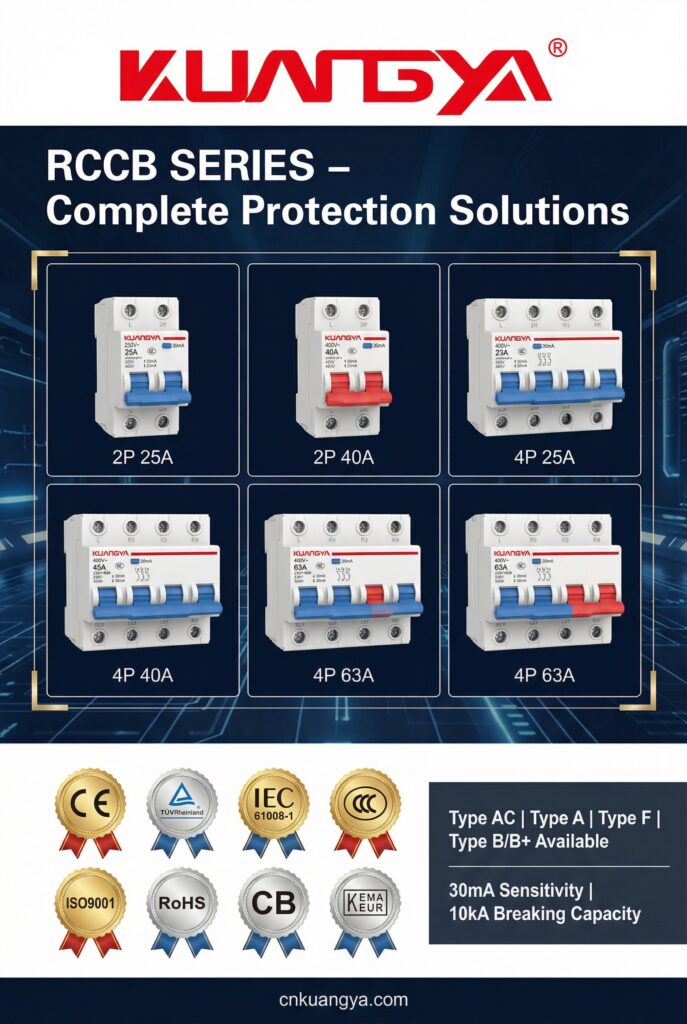
At its core, IEC 61008-1 applies to residual current operated circuit-breakers without integral overcurrent protection for household and similar uses . This is the most important distinction to grasp. An RCCB is a specialist device. Its sole purpose is to detect and respond to qualifying residual currents (earth-leakage faults) that could pose a risk of electric shock or fire. It is a protective device intended to reduce risks from qualifying residual-current faults when correctly selected, coordinated, installed and maintained.
What it does not do is protect against overloads (drawing too much current) or short circuits (a direct connection between live and neutral). That job is left to an upstream overcurrent protective device (SCPD), such as a Miniature Circuit Breaker (MCB) or a fuse.
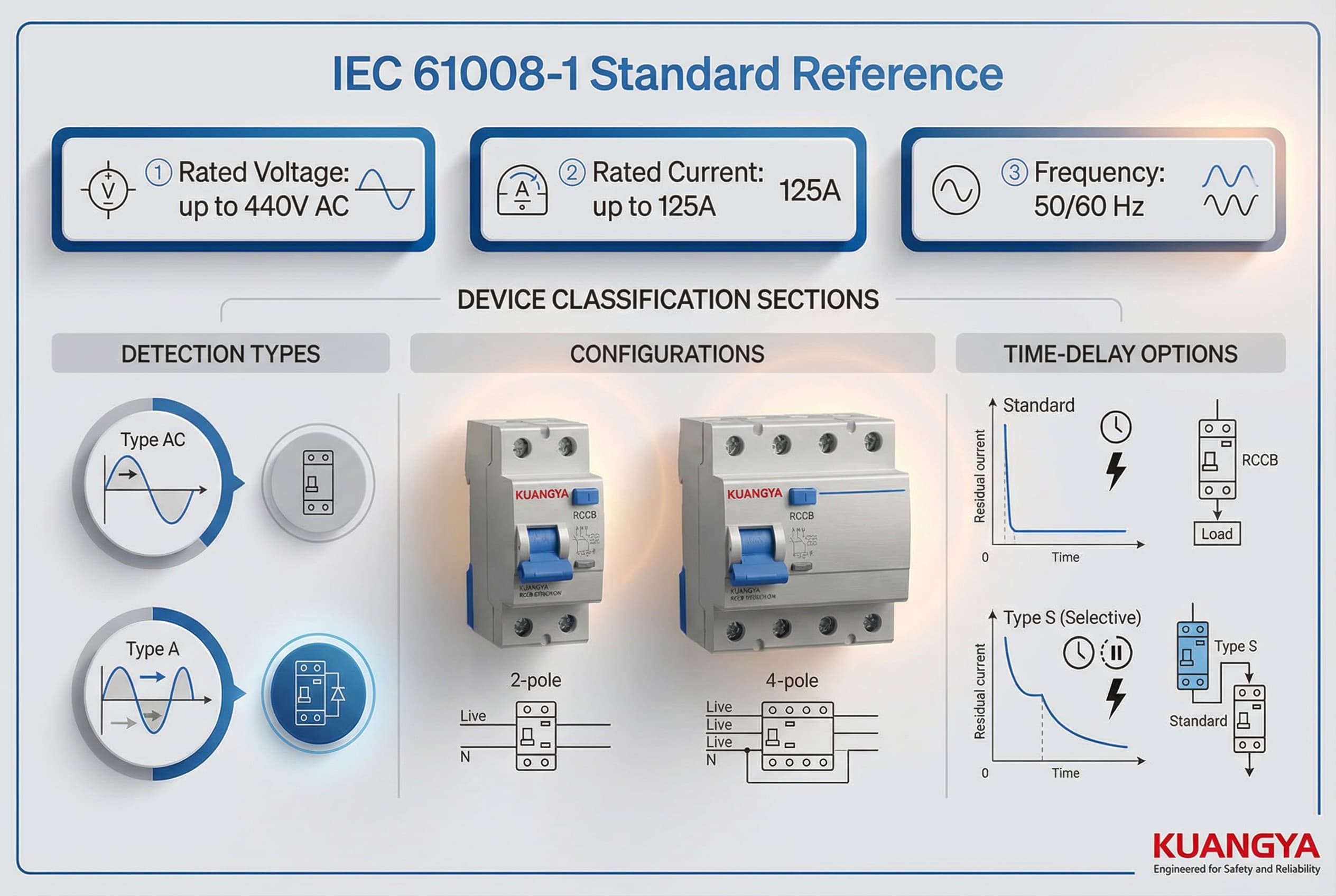
The standard sets clear operational limits for the devices it governs :
If you need a single device that provides both residual-current protection and overcurrent protection, you are looking for an RCBO (Residual Current operated circuit-Breaker with integral Overcurrent protection), which is governed by a different standard, IEC 61009.
Use the checker below to organize the main project parameters before requesting a quotation. Its result is preliminary and does not confirm conformity, certification or installation suitability.
Prepare a preliminary RCCB enquiry. The result does not confirm product conformity, certification or suitability for installation.
An RCCB requires coordinated overload and short-circuit protection. Always verify the circuit design, equipment instructions, product documents and local rules.
The world of electrical safety is not static. IEC 61008-1 has been revised over time. For a current project, verify the edition required by the contract or local authority and check that any supplier documentation refers to the same product, rating and edition. Do not infer certification from a catalogue statement alone; review the issuing body, certificate scope and validity.
Key takeaway: IEC 61008-1 addresses RCCBs without integral overcurrent protection. Coordinate the RCCB with an appropriate MCB or fuse and verify the complete installation against the current applicable rules.
The nameplate of an RCCB is a technical contract. It’s a declaration by the manufacturer, validated by testing, of the device’s performance capabilities. As an engineer, your job is to read that contract and ensure it matches the demands of your circuit. Let’s break down the critical parameters.
These are the most straightforward specifications. Rated Voltage (Un) is the maximum continuous voltage the RCCB can handle, typically 230V for single-phase or 400V for three-phase systems. Rated Current (In) is the maximum continuous load current the device can carry without overheating. Common product ratings include 16A, 25A, 40A and 63A, while higher ratings are available in some product ranges. Confirm the rated current, terminal capacity and certificate scope in the manufacturer’s current documentation.
Professional Analogy: Think of these as the RCCB’s basic structural capacity. If your circuit is a pipe, In is the maximum water flow it can handle 24/7 without the pipe itself getting hot, and Un is the maximum pressure it can withstand. It has nothing to do with the safety trip function itself.
This is the heart of the RCCB’s safety function. IΔn is the specific amount of leakage current that will cause the device to trip. It is the “tripwire sensitivity.”
-sensitivity-levels-and-their-applications.webp)
Standard sensitivities are categorized by their protection goal :
The standard also defines a rated residual non-operating current (IΔno). Under the specified test conditions, the RCCB must not trip at this test-current level. In a real installation, unwanted-tripping risk must also be assessed from normal cumulative leakage, transients and coordination with upstream and downstream devices.
This is where many specification errors occur. The RCCB “Type” defines which kind of fault current waveform it can detect. Using the wrong type can render the device blind to certain faults.
Professional Analogy: Think of RCCB types as language translators. If your electrical loads only “speak” pure AC, a basic translator works fine. But if they speak other dialects (like pulsating DC), you need a more advanced translator.
| RCCB Type | Detects Sinusoidal AC | Detects Pulsating DC | Detects Smooth DC | Typical Application |
|---|---|---|---|---|
| Type AC | ✔️ | ❌ | ❌ | Sinusoidal AC loads, only where permitted. |
| Type A | ✔️ | ✔️ | ❌ | Many single-phase electronic loads; verify requirements. |
| Type B | ✔️ | ✔️ | ✔️ | Loads that may produce smooth DC; verify equipment instructions. |
These ratings define the RCCB’s ruggedness—its ability to survive a major fault event.

Key Takeaway: Matching RCCB Type (A or B) to the load’s potential fault current is as critical as selecting the correct sensitivity (IΔn). Using a Type AC on a circuit with electronics is a common and dangerous mistake.
With the technical parameters decoded, let’s translate this knowledge into a repeatable decision-making process. Follow these five steps to ensure your selection is safe, compliant, and reliable.
Start by asking: What am I trying to protect?
Based on your goal, select the sensitivity rating. This is the most critical step for safety.
| Sensitivity (IΔn) | Primary Use | Protection Level | Typical Application |
|---|---|---|---|
| 10mA | Very High Risk | Extreme Human Protection | Medical equipment, swimming pool areas, saunas. |
| 30mA | General Use | Human Safety | Homes, socket outlets, commercial spaces, kitchens. |
| 100mA | Industrial Circuits | Equipment & Fire Protection | Machinery lines, distribution boards with high leakage. |
| 300mA / 500mA | Main Incomer | Fire Protection | Upstream on large distribution boards for selectivity. |
For any general-purpose socket outlet where a person might plug in an appliance, 30mA is the mandatory choice for human safety.
Next, analyze the equipment on the circuit. This determines the “language” of fault current your RCCB needs to understand.
Select rated voltage for the actual system and select rated current using the design load, conductor capacity, installation conditions and the coordinated upstream protective device. The RCCB current rating is not an overload-trip setting.
Verify the prospective short-circuit current at the installation point and the RCCB conditional short-circuit rating for the specified associated protective device. The required value cannot be selected from a universal “standard” figure; use the manufacturer’s coordination data and the project fault study.
Key takeaway: Sensitivity and residual-current type are application-dependent. Confirm the protection objective, expected waveform, equipment instructions, coordination and local requirements.
Specifying and installing a compliant RCCB is only half the job. An RCCB is a mechanical safety device, and its reliability must be actively verified. The IEC 61008-1 standard is built on a foundation of rigorous testing.
Conformity assessment relies on the tests and documentation applicable to the claimed standard and product scope. Buyers should verify the issuing body, report or certificate reference, covered model and ratings, edition, validity and any conditions rather than relying on an unspecified test count.
However, once the device leaves the factory, the responsibility for ensuring its operational readiness shifts to the installer and the end-user. This is the purpose of the “T” (Test) button located on the face of every RCCB.
Pressing the test button creates an internal test current intended to operate the device. The expected behavior and permitted operating time depend on the product instructions. If it does not operate as specified, isolate the issue and have the installation assessed by a qualified person; the test button does not prove every aspect of circuit protection.
How often should this test be performed? Test intervals vary by manufacturer instructions and local rules. Operating the test button checks the internal test function and trip mechanism, but it does not replace the electrical verification required for commissioning or periodic inspection.
Key takeaway: Follow the manufacturer’s test-button interval and the inspection and testing requirements applicable to the installation.
Q1: What’s the difference between an RCCB, RCBO, and MCB?
Q2: Why does my RCCB trip when there’s no obvious fault? (Nuisance Tripping)
This is often caused by low levels of cumulative leakage current from multiple electronic devices on a single circuit. It can also be a sign of poor insulation in wiring or a failing appliance. While sometimes a sign of an oversensitive RCCB, it often indicates underlying issues that need investigation.
Q3: Can I use a Type AC RCCB for circuits with modern electronics?
Do not choose solely from the words “modern electronics.” Identify the residual-current waveform stated by the equipment manufacturer and apply local requirements. Depending on the load, Type A, F or B—or another coordinated protective arrangement—may be required; Type AC should only be used where its detection capability is suitable and permitted.
Q4: How often must I test my RCCB?
Operate the test button at the interval stated by the manufacturer and applicable local rules. A successful test-button operation is useful, but it does not replace the required installation and periodic electrical verification.
Q5: Does an RCCB provide overload protection?
No. The RCCB rated current is a carrying rating, not an overload-trip setting. Coordinate the RCCB with an MCB, fuse or other overcurrent protective device so the installation remains within the RCCB and conductor ratings under overload and short-circuit conditions.
Q6: What is the main impact of the 2024 update to IEC 61008-1?
The fourth edition introduces stricter requirements, notably for temporary overvoltage (TOV) resistance. This makes the devices more robust in environments with unstable power grids or high switching transients, improving overall system reliability. For procurement, verify the edition required for the project and obtain evidence whose product, rating and certificate scope match the offered device.
The IEC 61008-1 standard is more than a list of technical requirements; it provides a framework for specified RCCB safety and performance requirements. As engineers, our responsibility extends beyond mere compliance. It’s about understanding the principles behind the rules—the physics of fault currents, the physiology of electric shock, and the practical realities of a modern electrical installation.
By following a structured approach—defining the goal, selecting the right sensitivity and type, ensuring proper ratings, and verifying through testing—you transform a complex specification challenge into a clear process for ensuring safety and reliability. A correctly selected RCCB is one part of a coordinated protection system and must be supported by suitable overcurrent protection, installation practices and verification.

