IEC 61008-1 STANDARD: RCCB REQUIREMENTS EXPLAINED (2025 GUIDE)

The Engineer’s Crossroads: A Familiar Challenge

You’ve just received the final spec sheet for a new commercial installation. Buried in the notes is a single, critical line: “All distribution boards must use IEC 61008-1 compliant RCCB.” For an experienced engineer, this is familiar territory. But it’s also a crossroads. One path leads to a quick, compliant-on-paper selection that might hide future risks. The other path—the path of due diligence—requires a deeper understanding of what that standard truly demands.

Choosing the wrong device isn’t just a matter of non-compliance. It can lead to persistent nuisance tripping that disrupts operations, or far worse, a failure to trip during a genuine fault, exposing people to the risk of severe electric shock or creating a potential fire hazard. The difference between a safe, reliable system and a latent disaster often comes down to how well you interpret standards like IEC 61008-1.

As an application engineer with over 15 years in the field, I’ve seen firsthand how a proper understanding of Residual Current Circuit Breakers (RCCB) can make or break a project. This guide is designed to translate the dense language of IEC 61008-1 into practical, actionable knowledge. We will move beyond simply listing requirements and explore why they matter, how to interpret them for your specific application, and how to build a framework for selecting the right device, every time. This is your 2025 guide to mastering RCCB specification.

Part 1: Understanding the Foundation – Scope of IEC 61008-1

Before we dive into technical specifications, we must first define our boundaries. IEC 61008-1 is a precise and foundational standard, but understanding what it covers—and what it deliberately excludes—is the first step to avoiding critical design errors.

At its core, IEC 61008-1 applies to residual current operated circuit-breakers without integral overcurrent protection for household and similar uses . This is the most important distinction to grasp. An RCCB is a specialist device. Its sole purpose is to detect and respond to small leakage currents (ground faults) that could pose a risk of electric shock or fire. It is fundamentally a life-saving device.

What it does not do is protect against overloads (drawing too much current) or short circuits (a direct connection between live and neutral). That job is left to an upstream overcurrent protective device (SCPD), such as a Miniature Circuit Breaker (MCB) or a fuse.

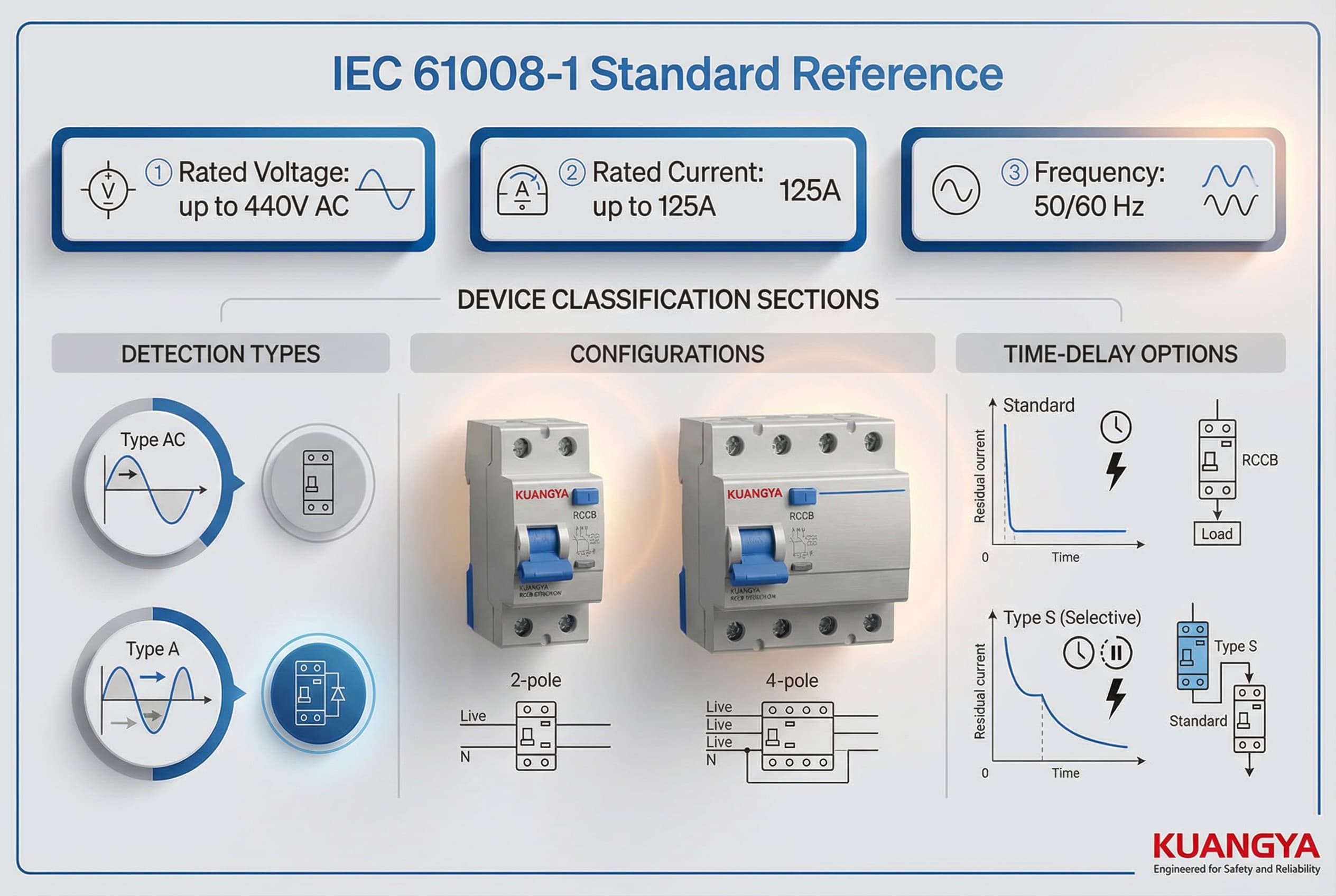
The standard sets clear operational limits for the devices it governs :

  • Rated Voltages (Un): Up to 440V AC.
  • Rated Currents (In): Up to 125A.
  • Rated Frequencies: 50 Hz, 60 Hz, or 50/60 Hz.

If you need a single device that provides both ground fault protection  overcurrent protection, you are looking for an RCBO (Residual Current operated circuit-Breaker with integral Overcurrent protection), which is governed by a different standard, IEC 61009.

The 2024/2025 Transition

The world of electrical safety is not static. On November 21, 2024, the IEC officially published the fourth edition of the standard, withdrawing the previous 2010 version and its amendments. For projects being specified in 2025 and beyond, this is a critical development. Key changes introduced in this latest edition include new requirements for temporary overvoltage resistance and better harmonization with related standards. When procuring devices, you must now verify which edition a supplier’s certification references to ensure future-proof compliance.

Key Takeaway: IEC 61008-1 is the foundational safety standard for standalone ground fault protection, but you must pair RCCBs with an appropriate MCB or fuse for complete circuit protection.

Part 2: Decoding the Specs – Key RCCB Requirements Explained

The nameplate of an RCCB is a technical contract. It’s a declaration by the manufacturer, validated by testing, of the device’s performance capabilities. As an engineer, your job is to read that contract and ensure it matches the demands of your circuit. Let’s break down the critical parameters.

Rated Voltage (Un) and Rated Current (In)

These are the most straightforward specifications. Rated Voltage (Un) is the maximum continuous voltage the RCCB can handle, typically 230V for single-phase or 400V for three-phase systems. 정격 전류(In) is the maximum continuous load current the device can carry without overheating. Standard values include 16A, 25A, 40A, 63A, and up to 125A 1.

Professional Analogy: Think of these as the RCCB’s basic structural capacity. If your circuit is a pipe, In is the maximum water flow it can handle 24/7 without the pipe itself getting hot, and Un is the maximum pressure it can withstand. It has nothing to do with the safety trip function itself.

Rated Residual Operating Current (IΔn)

This is the heart of the RCCB’s safety function. IΔn is the specific amount of leakage current that will cause the device to trip. It is the “tripwire sensitivity.”

RCCB Residual Operating Current Sensitivity Levels

Standard sensitivities are categorized by their protection goal :

  • High Sensitivity (10mA, 30mA): For additional protection against direct contact (human safety). A current of 30mA is considered the threshold for preventing severe physiological harm like ventricular fibrillation.
  • Medium Sensitivity (100mA): Provides a balance of equipment protection and fire prevention, often used in industrial settings.
  • Low Sensitivity (300mA, 500mA): Primarily for fire protection from persistent ground faults in large installations or as upstream breakers for selectivity.

The standard also defines a Rated Residual Non-Operating Current (IΔno), which is typically 0.5 x IΔn. This is the maximum leakage current the device must ignore, preventing nuisance trips from the small, cumulative background leakage common in modern electronic systems.

RCCB Types (AC, A, F, B) – The Fault Current “Translator”

This is where many specification errors occur. The RCCB “Type” defines which kind of fault current waveform it can detect. Using the wrong type can render the device blind to certain faults.

Professional Analogy: Think of RCCB types as language translators. If your electrical loads only “speak” pure AC, a basic translator works fine. But if they speak other dialects (like pulsating DC), you need a more advanced translator.

  • Type AC: The original standard. It is designed to detect sinusoidal AC leakage currents only, typical of simple resistive loads like incandescent lighting or heating elements. It is largely obsolete for modern installations.
  • Type A: The modern standard for most residential and commercial applications. It detects sinusoidal AC currents  pulsating DC residual currents. These are common in single-phase electronics with rectified power supplies (e.g., LED drivers, appliance controls, IT equipment).
  • Type F: A specialist type that builds on Type A, adding detection for mixed-frequency fault currents that can be generated by some single-phase variable speed drives (e.g., in modern washing machines).
  • Type B: The “universal translator.” It detects AC, pulsating DC,  smooth DC leakage currents. This type is essential for three-phase VFDs (Variable Frequency Drives), solar PV inverters, EV charging stations, and medical equipment, all of which can produce DC faults that make Type A RCCBs blind.
RCCB TypeDetects Sinusoidal ACDetects Pulsating DCDetects Smooth DCTypical Application
AC 유형✔️Obsolete; simple resistive loads only.
유형 A✔️✔️Standard for modern residential & commercial circuits.
유형 B✔️✔️✔️EV chargers, solar inverters, VFDs, medical equipment.

Time-Delay (General vs. Type S)

  • General Use (Instantaneous): These RCCBs trip without any intentional delay as soon as IΔn is reached (typically within 40ms).
  • Type S (Selective): These devices have a built-in time delay. They are used upstream in a tiered system to provide selectivity. If a fault occurs on a final circuit, the downstream instantaneous RCCB trips first, leaving the rest of the installation powered. The upstream Type S will only trip if the fault is larger or persists, acting as a back-up.

Short-Circuit Ratings (Inc, IΔm)

These ratings define the RCCB’s ruggedness—its ability to survive a major fault event.

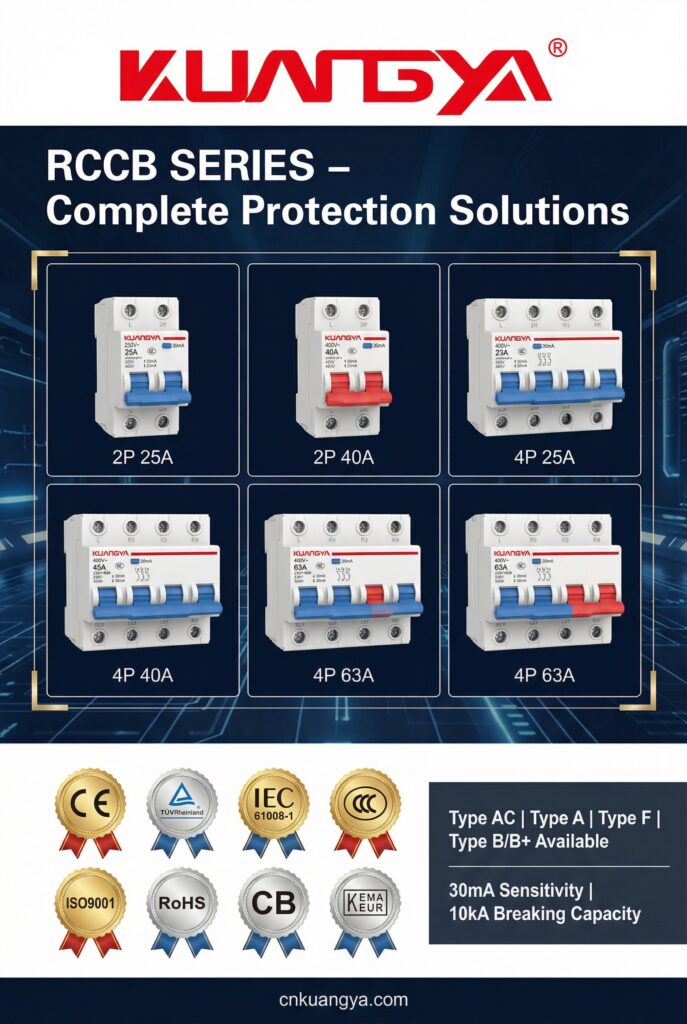
  • Rated conditional short-circuit current (Inc): This is the crucial “crash safety rating.” It specifies the maximum short-circuit current the RCCB can withstand when protected by a specific SCPD (MCB or fuse). The coordination between the MCB and RCCB ensures the MCB clears the high fault current before the RCCB is destroyed. Common values are 6kA or 10kA.

Key Takeaway: Matching RCCB Type (A or B) to the load’s potential fault current is as critical as selecting the correct sensitivity (IΔn). Using a Type AC on a circuit with electronics is a common and dangerous mistake.

Part 3: The Practical Guide – A 5-Step RCCB Selection Framework

With the technical parameters decoded, let’s translate this knowledge into a repeatable decision-making process. Follow these five steps to ensure your selection is safe, compliant, and reliable.

Step 1: Define the Primary Protection Goal

Start by asking: What am I trying to protect?

  • Human Safety (Additional Protection): If the primary goal is to protect people from electric shock in areas they might come into contact with equipment (e.g., socket outlets, bathrooms, outdoor tools), you need high sensitivity.
  • Fire & Equipment Protection: If the goal is to protect a large installation or specific machinery from fire caused by ground fault currents, a lower sensitivity may be more appropriate to avoid nuisance tripping.

Step 2: Select the Sensitivity (IΔn)

Based on your goal, select the sensitivity rating. This is the most critical step for safety.

감도(IΔn)Primary UseProtection LevelTypical Application
10mAVery High RiskExtreme Human ProtectionMedical equipment, swimming pool areas, saunas.
30mAGeneral UseHuman SafetyHomes, socket outlets, commercial spaces, kitchens.
100mAIndustrial CircuitsEquipment & Fire ProtectionMachinery lines, distribution boards with high leakage.
300mA / 500mAMain IncomerFire ProtectionUpstream on large distribution boards for selectivity.

For any general-purpose socket outlet where a person might plug in an appliance, 30mA is the mandatory choice for human safety.

Step 3: Determine the Required RCCB Type (A or B)

Next, analyze the equipment on the circuit. This determines the “language” of fault current your RCCB needs to understand.

  • Are there only simple resistive or capacitive loads? (Rare today). Type AC might suffice, but Type A is the recommended minimum.
  • Are there single-phase electronics, LED lighting, or Class 1 IT equipment? You need 유형 A.
  • Is there an EV charger, a solar PV inverter, a three-phase Variable Frequency Drive (VFD), or medical imaging equipment? You absolutely must use 유형 B. A Type A device will likely be blinded by the potential for smooth DC fault current and fail to operate.

Step 4: Specify Ratings (In, Un)

Choose the Rated Current (In) to be equal to or greater than the rating of the upstream MCB or the maximum sustained load current of the circuit, whichever is higher. Select the Rated Voltage (Un) to match your system voltage (e.g., 230V or 400V).

Step 5: Ensure Short-Circuit Coordination (Inc)

Finally, verify that the RCCB’s rated conditional short-circuit current (Inc) is appropriate for the installation’s prospective fault current and is coordinated with the upstream MCB. For most commercial installations, a 10kA rated device is standard. This coordination ensures that in the event of a powerful short-circuit, the MCB will trip and protect the RCCB from catastrophic failure.

Key Takeaway: A 30mA, Type A RCCB is the default choice for modern residential and general commercial circuits, but you must always analyze the load to determine if a Type B is required for safety and compliance.

Part 4: Ensuring Reliability – Testing & Verification

Specifying and installing a compliant RCCB is only half the job. An RCCB is a mechanical safety device, and its reliability must be actively verified. The IEC 61008-1 standard is built on a foundation of rigorous testing.

To earn certification, an RCCB must pass a battery of demanding type tests—over 21 of them according to some sources —at an accredited lab. These tests validate everything from temperature rise and mechanical strength to dielectric properties and, most importantly, its precise tripping characteristics under all specified fault conditions.

However, once the device leaves the factory, the responsibility for ensuring its operational readiness shifts to the installer and the end-user. This is the purpose of the “T” (Test) button located on the face of every RCCB.

Pressing this button creates a small, controlled imbalance, simulating a real ground fault. A healthy RCCB will trip instantly. This simple action confirms that the mechanical trip linkage is free and the sensing circuitry is functional. If the device does not trip, it is no longer providing protection and must be replaced immediately by a licensed electrician.

How often should this test be performed? Industry best practice and many local regulations recommend testing every month. It’s a simple, two-second procedure that provides peace of mind that your primary life-saving device is ready to act when needed.

Key Takeaway: An untested RCCB is an unreliable RCCB. Monthly testing via the ‘T’ button is a non-negotiable safety practice that ensures the device will work when you need it most.

Part 5: Frequently Asked Questions (FAQ)

Q1: What’s the difference between an RCCB, RCBO, and MCB?

  • MCB (Miniature Circuit Breaker): Protects equipment and wiring from overloads and short circuits. It does not protect people from small ground faults.
  • RCCB (Residual Current Circuit Breaker): Protects people from electric shock (ground faults). It does notprovide overload or short-circuit protection and must be used with an MCB.
  • RCBO (Residual Current Breaker with Overcurrent): An all-in-one device that combines the functions of both an MCB and an RCCB.

Q2: Why does my RCCB trip when there’s no obvious fault? (Nuisance Tripping)
This is often caused by low levels of cumulative leakage current from multiple electronic devices on a single circuit. It can also be a sign of poor insulation in wiring or a failing appliance. While sometimes a sign of an oversensitive RCCB, it often indicates underlying issues that need investigation.

Q3: Can I use a Type AC RCCB for circuits with modern electronics?
No. This is a dangerous practice. Modern electronics produce pulsating DC waveforms during operation. A Type AC RCCB is not designed to detect these and may fail to trip during a fault. You must use Type A as a minimum for any circuit with electronic loads .

Q4: How often must I test my RCCB?
You should press the “Test” button once a month to ensure the device is mechanically functional.

Q5: Does an RCCB provide overload protection?
No. An RCCB provides no protection against overcurrents. A 40A RCCB will happily allow 100A to pass through it if there is no ground fault, leading to a serious fire risk. It must always be preceded by an overcurrent protective device like an MCB or fuse.

Q6: What is the main impact of the 2024 update to IEC 61008-1?
The fourth edition introduces stricter requirements, notably for temporary overvoltage (TOV) resistance. This makes the devices more robust in environments with unstable power grids or high switching transients, improving overall system reliability. When sourcing for 2025 projects, look for certification to IEC 61008-1:2024.

Conclusion

The IEC 61008-1 standard is more than a list of technical requirements; it’s a blueprint for saving lives. As engineers, our responsibility extends beyond mere compliance. It’s about understanding the principles behind the rules—the physics of fault currents, the physiology of electric shock, and the practical realities of a modern electrical installation.

By following a structured approach—defining the goal, selecting the right sensitivity and type, ensuring proper ratings, and verifying through testing—you transform a complex specification challenge into a clear process for ensuring safety and reliability. A correctly chosen RCCB is a silent guardian, but its presence is a testament to the diligence and care of the engineer who put it there.