Zona industrial de WengYang Yueqing Wenzhou 325000
Horas de trabajo
De lunes a viernes: de 7.00 a 19.00 horas
Fin de semana: 10.00 A 17.00 HORAS
Zona industrial de WengYang Yueqing Wenzhou 325000
Horas de trabajo
De lunes a viernes: de 7.00 a 19.00 horas
Fin de semana: 10.00 A 17.00 HORAS

Selección de SPD de CC es uno de los pasos más importantes en el diseño de un sistema de protección solar fotovoltaica (FV) fiable. Seleccionar la tensión nominal correcta de un dispositivo de protección contra sobretensiones de CC (SPD de CC) garantiza un rendimiento de protección fiable y la estabilidad del sistema a largo plazo.
Muchos usuarios se centran principalmente en la corriente de descarga nominal (kA) al elegir un SPD, pero la tensión nominal es igual de crítica. El SPD de CC seleccionado debe ser capaz de soportar la máxima tensión posible generada por el sistema fotovoltaico en condiciones normales de funcionamiento.
Un SPD con una tensión nominal insuficiente puede sufrir una degradación o fallo prematuro, mientras que un SPD con una tensión nominal innecesariamente alta puede no proporcionar el nivel de protección más optimizado para la aplicación.
Para los sistemas fotovoltaicos, el parámetro de tensión clave es Ucpv (Tensión máxima de funcionamiento continuo para sistemas fotovoltaicos). La selección correcta requiere comprender la tensión máxima del sistema fotovoltaico, la tensión de circuito abierto del módulo (Voc) y los efectos de la temperatura.
Esta guía explica cómo seleccionar la tensión nominal correcta del SPD de CC para sistemas solares fotovoltaicos, incluyendo aplicaciones comunes de 600V CC, 1000V CC y 1500V CC.
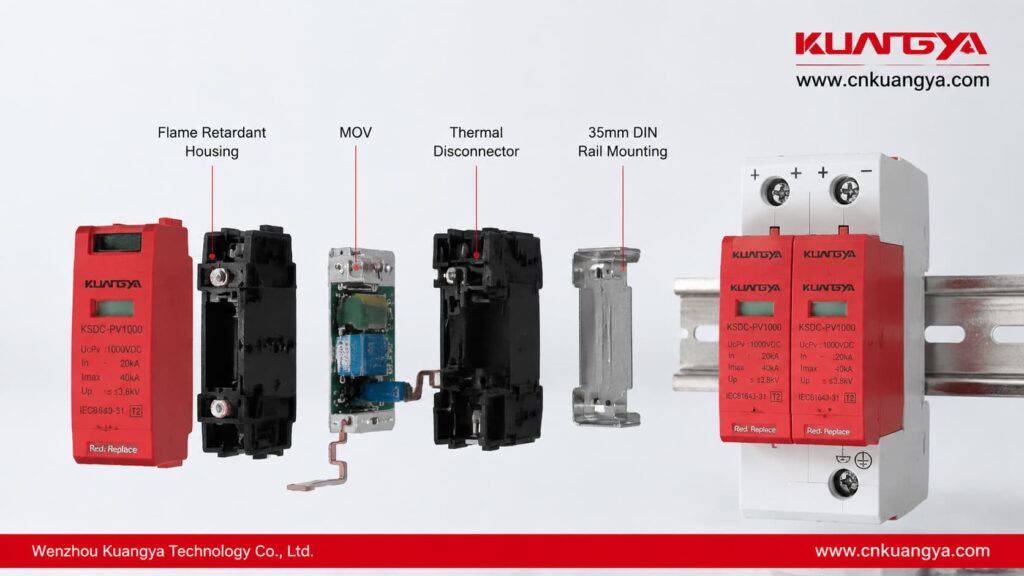
La tensión nominal de un SPD de CC indica la tensión de CC máxima que el SPD puede soportar de forma continua sin activar su función de protección.
Para comprender cómo responden los SPD de CC durante eventos de sobretensión, consulte nuestra guía sobre cómo funciona un SPD de CC.
Para aplicaciones fotovoltaicas, el parámetro de tensión más importante es:
Ucpv define la tensión máxima que puede aplicarse continuamente al SPD durante el funcionamiento normal de la instalación fotovoltaica.
El Ucpv seleccionado debe ser:
Por ejemplo:
| Clasificación del SPD de CC | Aplicación común |
|---|---|
| SPD de 600V CC | Sistemas fotovoltaicos de pequeña escala |
| SPD de 1000V CC | Sistemas fotovoltaicos comerciales e industriales |
| SPD de 1500V CC | Proyectos solares a gran escala y de servicios públicos |
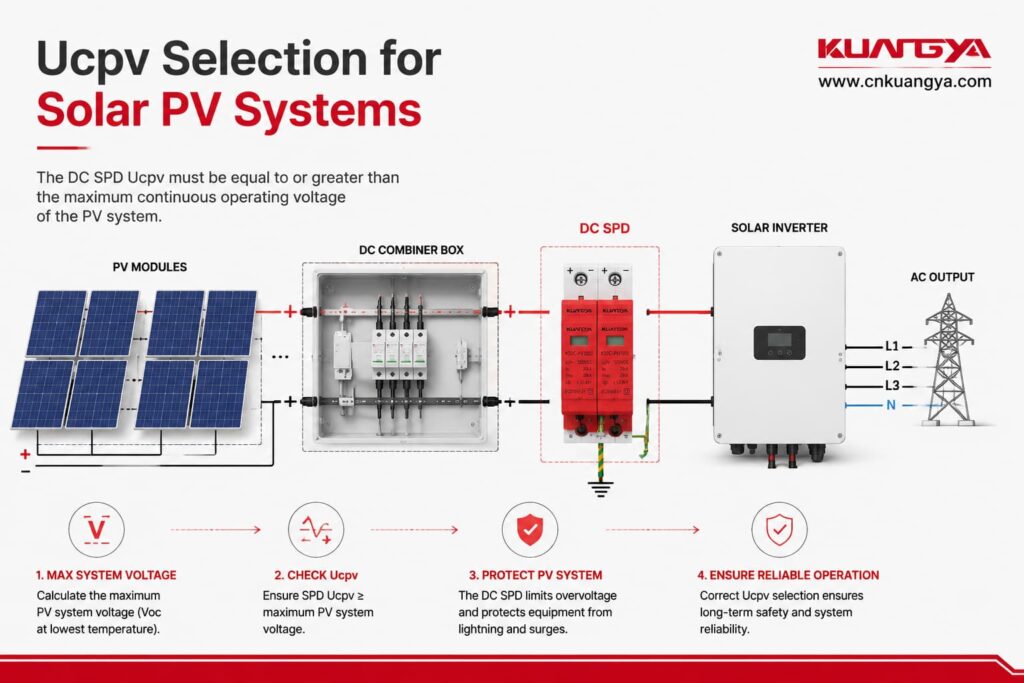
La selección del SPD de CC depende de la tensión máxima del sistema fotovoltaico, las características de los módulos, las condiciones de temperatura y los requisitos de instalación. Seleccionar la tensión nominal correcta es el primer paso antes de elegir el modelo final de SPD.
Los principales factores que afectan la selección del SPD de CC incluyen:
Elegir una tensión nominal incorrecta puede afectar la fiabilidad del sistema y el rendimiento de la protección.
Ejemplo:
Un sistema fotovoltaico tiene una tensión máxima cercana a 1200V CC, pero se ha instalado un SPD de 1000V CC.
Potential problems:
The SPD voltage rating should never be lower than the maximum calculated PV system voltage.
Ejemplo:
A 600V PV system uses a 1500V DC SPD.
Although the SPD may withstand the voltage, it may not always provide the most optimized protection.
A higher voltage-rated SPD may have:
The goal is not to select the highest voltage rating, but the correct voltage rating.
When selecting a DC SPD, several voltage parameters are commonly used.
Ucpv is the most important parameter for photovoltaic DC SPD selection.
It represents the maximum voltage that the SPD can continuously withstand in a PV system.
The selected Ucpv must be higher than the maximum possible PV system voltage.
Uc is commonly used for general surge protective devices.
For PV-specific applications, Ucpv is normally the key parameter because photovoltaic systems have unique DC voltage characteristics.
Up represents the maximum voltage that can appear across the protected equipment during a surge event.
A lower Up generally means better protection performance.
When selecting an SPD, both Ucpv and Up should be considered.
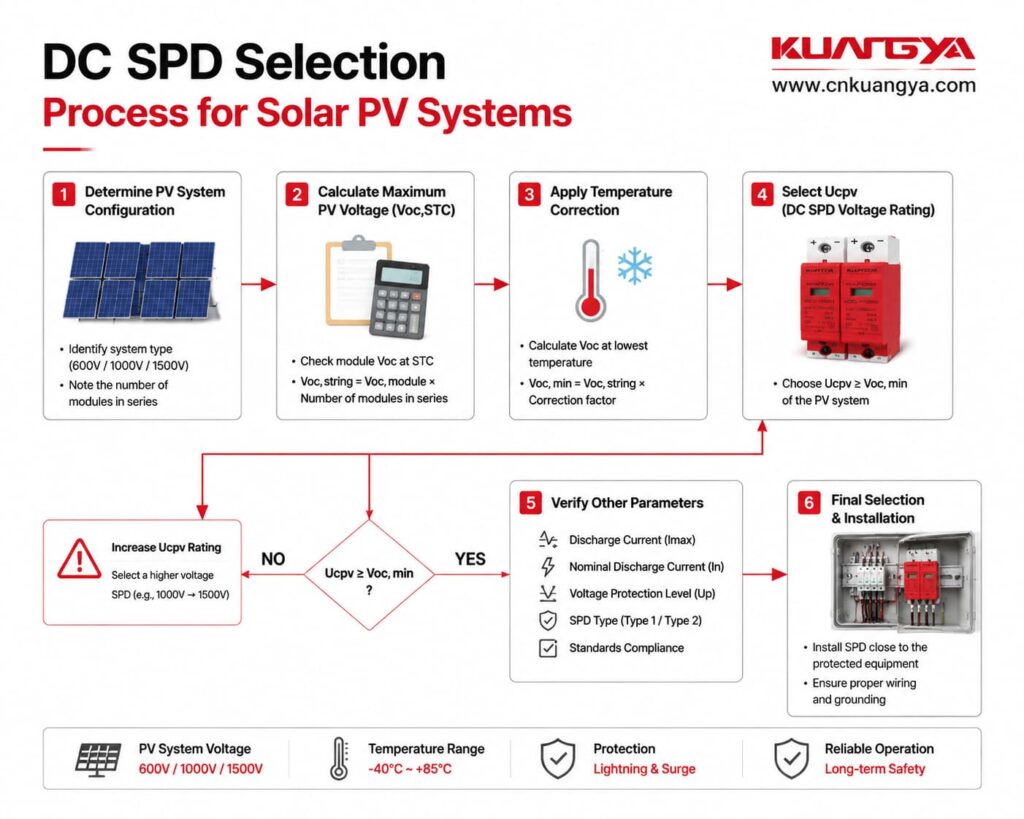
The maximum PV system voltage should be calculated based on:
The calculation formula is:
Donde:
| Parámetro | Descripción |
|---|---|
| Number of Series Modules | Total PV modules connected in series in one string |
| Voc | Open-circuit voltage of one PV module |
| Temperature Correction Factor | Voltage adjustment factor considering low-temperature conditions |
A PV string contains:
Cálculo:
24 × 45V × 1.10 = 1188V
The maximum PV system voltage is:
1188V DC
Therefore, a SPD de 1500V CC should be selected to provide sufficient voltage margin.
Voltage calculation is the first step in DC SPD selection. For a complete sizing approach including current ratings and protection requirements, refer to our guide on cómo dimensionar un SPD de CC para una matriz fotovoltaica solar.
The selected DC SPD voltage rating should not be lower than the calculated maximum PV system voltage.
For photovoltaic applications, the SPD parameter Ucpv should be equal to or higher than the maximum calculated PV voltage.
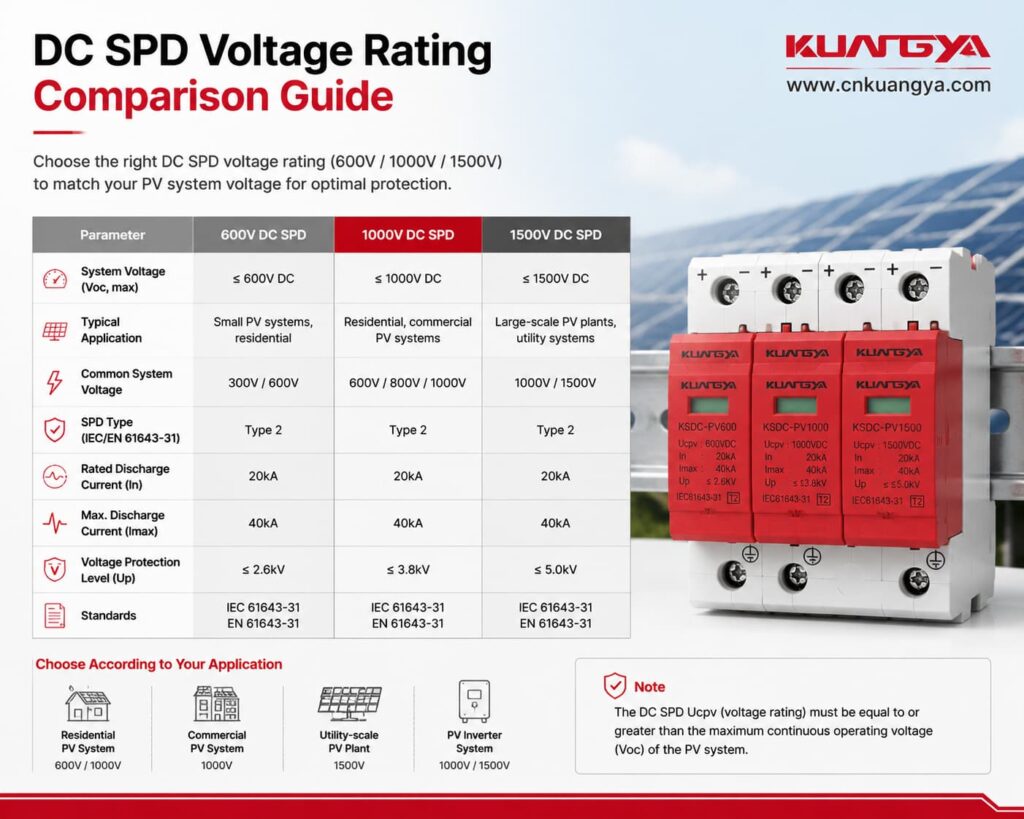
Calculate the recommended DC SPD voltage rating based on your PV system parameters.
Voltage rating is only one factor in DC SPD selection. The SPD type should also be selected according to the surge environment. Learn more about Type 1, Type 2 and Type 1+2 DC SPD selection.
Different PV system designs require different voltage-rated SPDs.
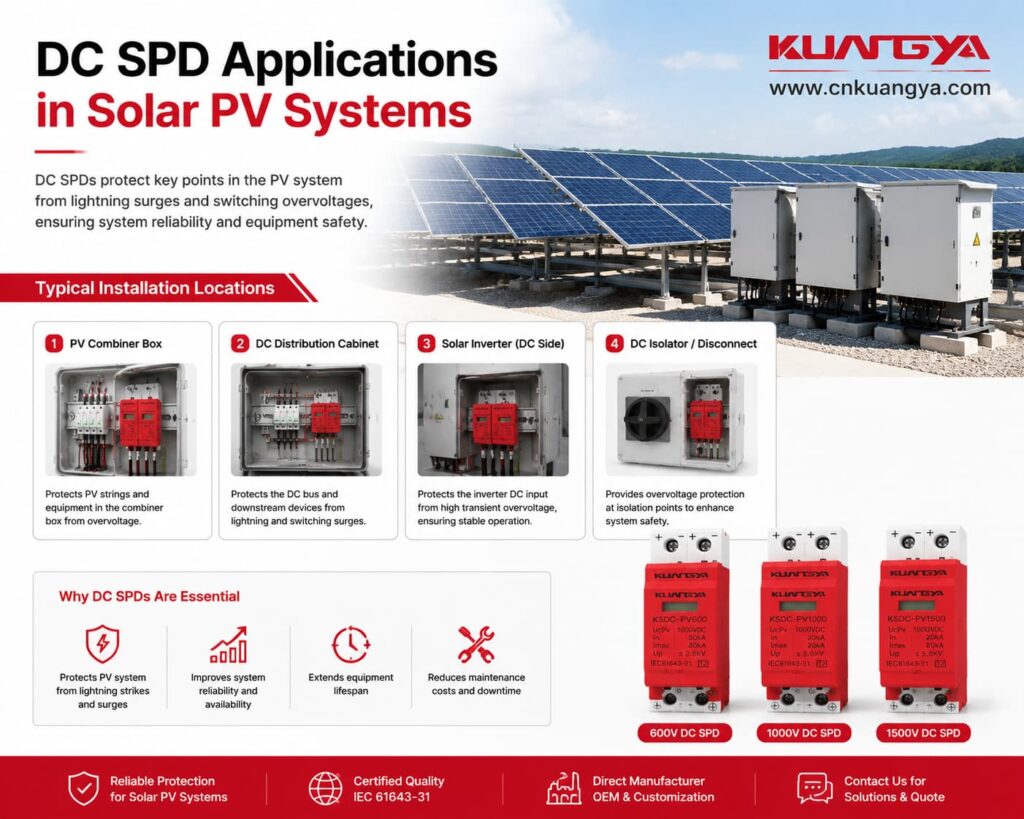
| SPD Voltage Rating | Aplicaciones comunes | Typical Systems |
|---|---|---|
| SPD de 600V CC | Small PV installations | Residential rooftop systems |
| SPD de 1000V CC | Medium and large PV systems | Commercial and industrial projects |
| SPD de 1500V CC | Large-scale PV systems | Utility solar farms |
The correct selection depends on the calculated maximum PV voltage, not only the project size.
System information:
Cálculo:
22 × 42V × 1.10
= 1016V DC
Recommended selection:
SPD de 1500V CC
Razón:
After temperature correction, the PV voltage exceeds 1000V.
System information:
Cálculo:
18 × 45V × 1.10
= 891V DC
Recommended selection:
SPD de 1000V CC
Razón:
The calculated PV voltage is below 1000V.
The inverter input range does not always represent the maximum PV array voltage.
SPD selection should be based on PV string voltage.
Using Vmp instead of Voc may underestimate the maximum PV voltage.
A higher voltage-rated SPD may not always provide better equipment protection.
The Up value should meet the protection requirements of the system.
PV module voltage increases at low temperatures.
Temperature correction should be considered during system design.
A DC SPD with a suitable Ucpv rating should be selected based on the actual maximum PV system voltage. The calculated PV voltage should always remain below the SPD voltage rating.
A 1500V DC SPD may be used in some applications, but the protection level (Up), system requirements and cost should also be considered.
No. The SPD voltage rating should match the PV system requirements. A higher voltage rating does not automatically provide better protection.
Calculate the maximum PV voltage using:
Number of series modules × Module Voc × Temperature correction factor.
Ucpv is the maximum continuous operating voltage that a photovoltaic SPD can withstand during normal operation.
Photovoltaic surge protective devices are mainly covered by:
IEC 61643-31: Low-voltage surge protective devices – Requirements and test methods for SPDs for photovoltaic installations.
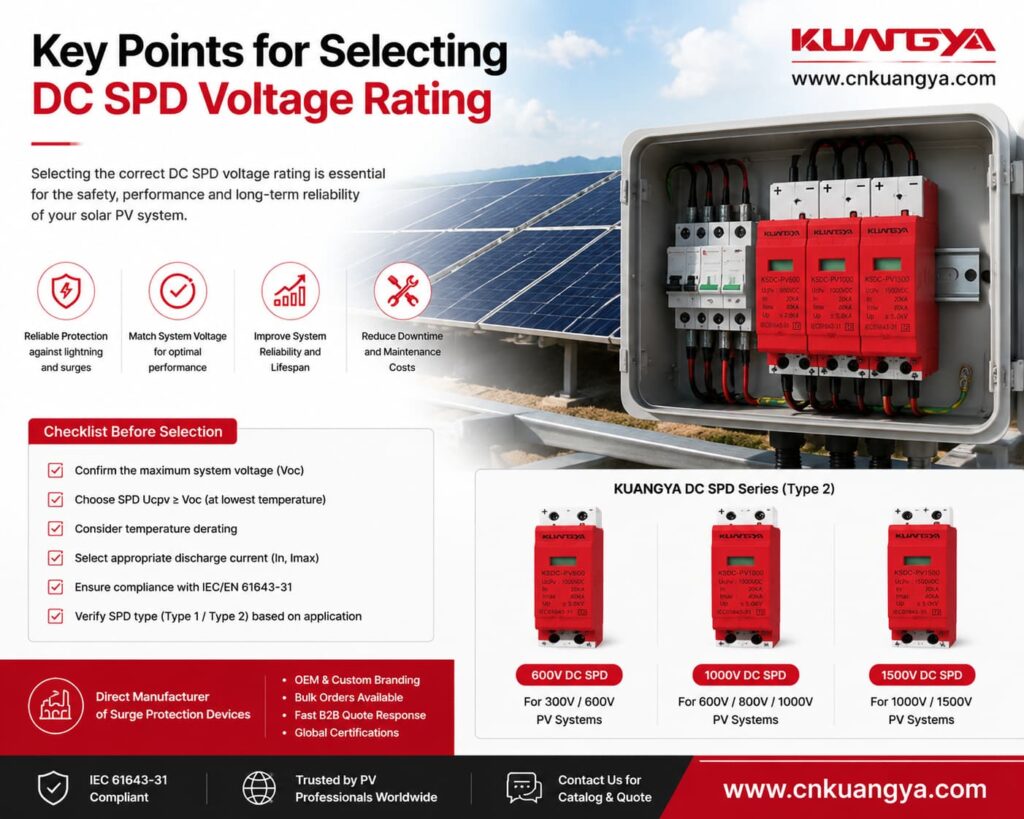
Selecting the correct DC SPD voltage rating is essential for reliable solar PV system protection.
La elección correcta depende de:
For common photovoltaic applications:
KUANGYA provides DC SPD solutions for solar photovoltaic applications, including 600V, 1000V and 1500V DC models with OEM customization support.

