WengYang Industrial Zone Yueqing Wenzhou 325000
Horas de trabalho
De segunda a sexta-feira: das 7h às 19h
Fim de semana: 10:00 - 17:00
WengYang Industrial Zone Yueqing Wenzhou 325000
Horas de trabalho
De segunda a sexta-feira: das 7h às 19h
Fim de semana: 10:00 - 17:00

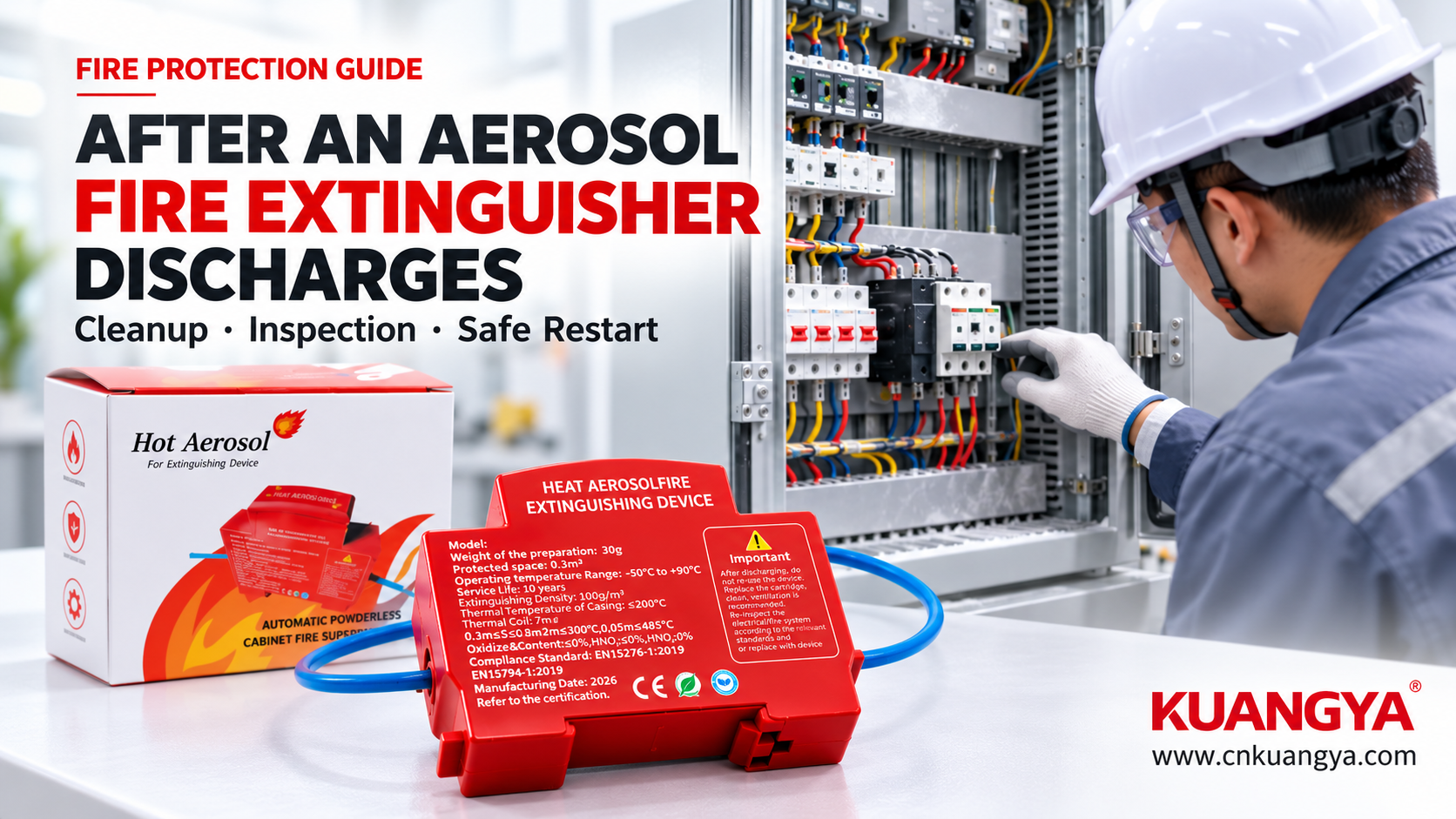
Um extintor de incêndio por aerossol ou dispositivo automático de supressão de incêndio por aerossol condensado pode ajudar a controlar um incêndio dentro de um armário elétrico, painel de controle ou outro espaço fechado. No entanto, o trabalho não termina quando o incêndio é extinto.
Após a descarga de um sistema de supressão de incêndio por aerossol, os gerentes de instalações e engenheiros de manutenção devem avaliar os danos causados pelo incêndio, remover resíduos usando um método de limpeza apropriado, inspecionar componentes elétricos, verificar a condição do sistema de supressão e determinar se o equipamento pode retornar com segurança ao serviço.
Um erro comum é assumir que, como um sistema de aerossol não usa água da mesma forma que um sistema convencional à base de água, o equipamento protegido pode ser reiniciado imediatamente. Na realidade, o resultado depende do agente extintor, das condições de descarga, do próprio incêndio e da condição do equipamento elétrico.
Este guia explica o que fazer após a descarga de um sistema de supressão de incêndio por aerossol condensado, como abordar a remoção de resíduos, quais componentes requerem inspeção e o que os engenheiros devem confirmar antes de reiniciar equipamentos elétricos.
Sistemas de supressão de incêndio por aerossol condensado geram partículas finas e gases que ajudam a suprimir a combustão. Dependendo do projeto do sistema, o agente extintor pode se espalhar por todo o invólucro protegido e alcançar áreas que podem ser difíceis de proteger com equipamentos convencionais.
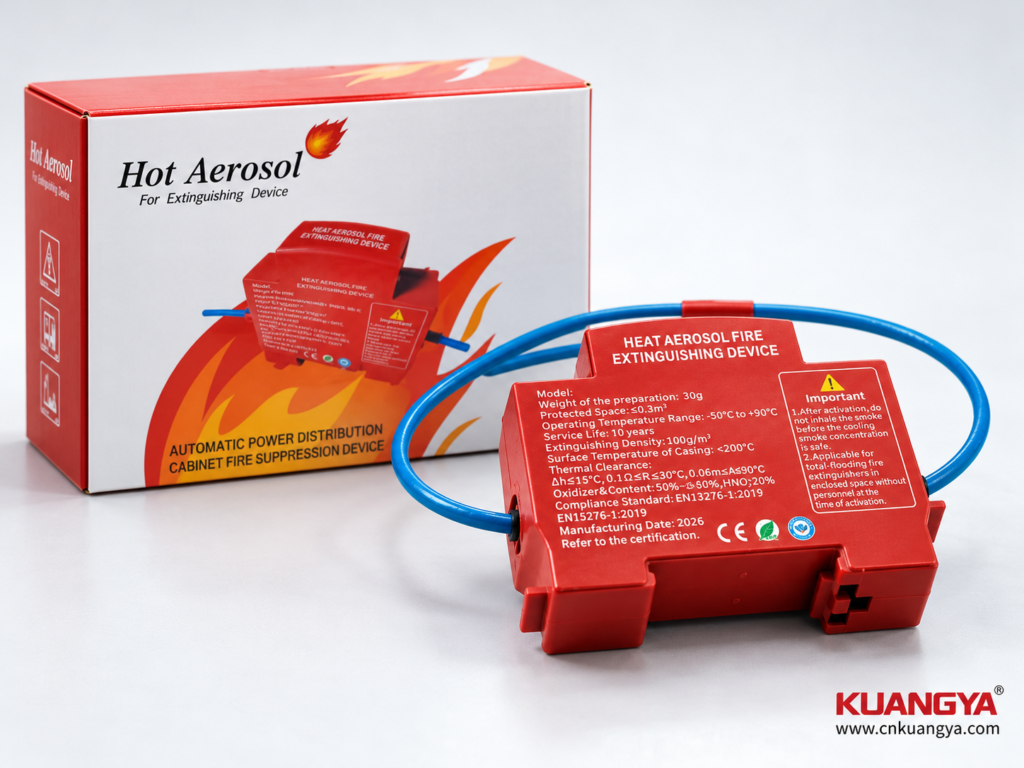
Após a descarga, várias condições podem exigir atenção.
Primeiro, finas partículas de aerossol podem depositar-se em superfícies dentro do invólucro. Segundo, o incêndio pode ter produzido os seus próprios depósitos de fumo, fuligem e subprodutos da combustão. Terceiro, o calor pode ter danificado o isolamento, a fiação, as placas de circuito, os terminais ou outros componentes, mesmo que as chamas visíveis tenham sido extintas.
A descarga de aerossol também pode deixar o próprio gerador esgotado ou, de outra forma, inadequado para uso posterior, dependendo do projeto do fabricante.
| Condição | Impacto possível | Resposta recomendada |
|---|---|---|
| Resíduo de aerossol fino | Depósitos nas superfícies e componentes do invólucro | Identifique o agente e siga as instruções de limpeza do fabricante |
| Fumo e fuligem | Contaminação de contatos, isolamento e componentes eletrónicos | Avalie a contaminação e selecione um método de limpeza adequado |
| Exposição ao calor | Isolamento, terminais, cabos e peças eletrónicas danificados | Providencie uma inspeção elétrica qualificada |
| Humidade elevada | Pode aumentar o risco de corrosão quando certos resíduos permanecem nas superfícies | Controle a umidade e limpe prontamente conforme instruído |
| Gerador descarregado | O sistema pode não fornecer mais sua proteção pretendida | Inspecione e substitua ou faça a manutenção conforme especificado pelo fabricante |
| Circuito de alarme ou controle ativado | O sistema de supressão pode exigir redefinição e comissionamento | Verifique o painel de controle e as funções de intertravamento |
Estas condições devem ser avaliadas separadamente. Um gabinete com aparência limpa não é prova de que seus componentes elétricos são seguros, e resíduos visíveis não significam automaticamente que todos os componentes devam ser substituídos.
Para obter informações sobre a seleção de proteção para gabinetes elétricos, consulte nosso guia para proteção contra incêndio de gabinetes elétricos.
A resposta depende da formulação do aerossol, dos resultados dos testes do fabricante, do ambiente circundante e dos materiais expostos à descarga.
Alguns sistemas de aerossol condensado produzem um resíduo de partículas finas, predominantemente secas. Certos fabricantes descrevem seus agentes específicos como não condutores e não corrosivos sob as condições cobertas por sua documentação. Essas características específicas do produto não devem ser generalizadas para todos os sistemas de supressão de incêndio por aerossol.
Por exemplo, o Manual de Instalação e Operação FirePro Xtinguish explica que os resíduos do seu sistema particular de aerossol condensado devem ser removidos prontamente. O manual também discute a possibilidade de absorção de umidade e oxidação de superfícies metálicas suscetíveis quando os resíduos permanecem por um longo período.
Essa distinção é importante: as propriedades de um agente extintor não eliminam a necessidade de avaliar os danos do incêndio ou seguir os procedimentos de limpeza pós-descarga.
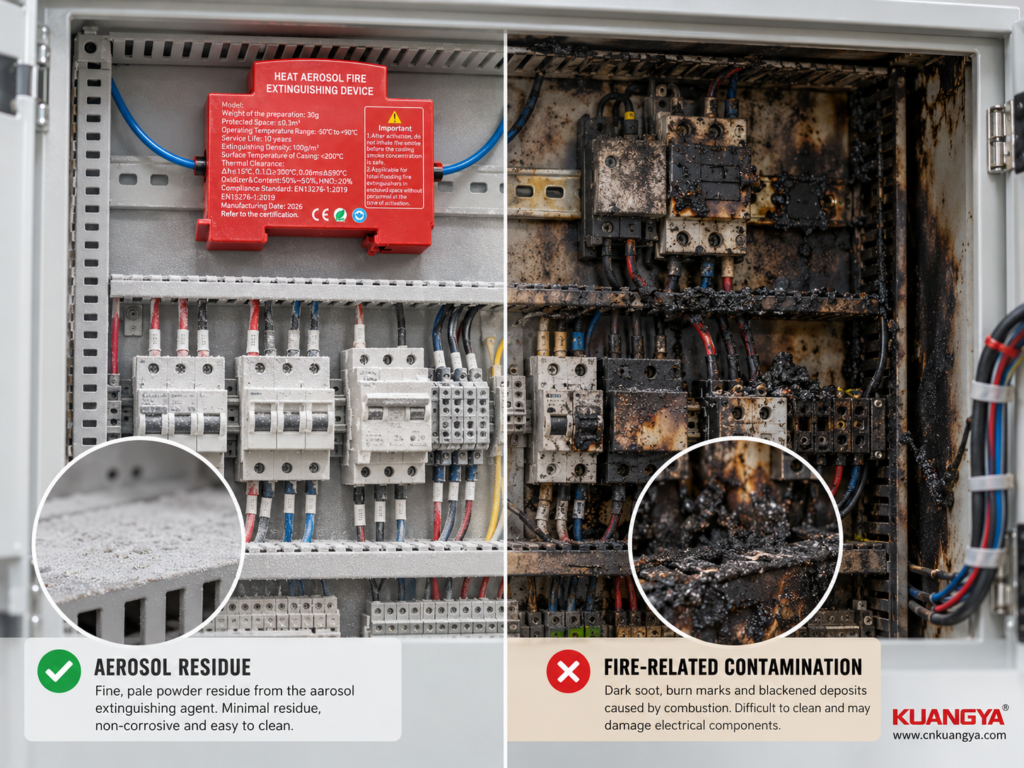
| Comparação | Resíduo de aerossol | Contaminação relacionada a incêndio |
|---|---|---|
| Fonte | Agente extintor descarregado pelo sistema | Fumo, fuligem, calor e subprodutos da combustão |
| Aparência | May appear as a fine, light-colored or gray deposit, depending on the agent | May appear as black soot, oily deposits, or other discoloration |
| Distribuição | May settle across surfaces reached by the discharge | Depends on the fire location, airflow, and materials burned |
| Potential concern | Residue compatibility, moisture absorption, and surface contamination | Corrosion, insulation damage, conductive deposits, and chemical contamination |
| Cleaning approach | Follow the aerosol system manufacturer’s instructions | Assess the contamination and use a method appropriate for the affected equipment |
In practice, both types of contamination may be present simultaneously. Engineers should not assume that every deposit is extinguishing-agent residue or that removing visible aerosol particles resolves all fire-related damage.
Circuit boards, relays, connectors, sensors, and exposed contacts require particular care.
Before cleaning them, identify the component manufacturer’s recommendations and the extinguishing system’s post-discharge instructions. Some components may tolerate a particular residue under specified conditions, while others may require specialist cleaning or replacement after exposure to heat, smoke, or chemical contamination.
Do not apply water, solvents, compressed air, or electronic cleaning sprays indiscriminately. The correct method depends on the component, the residue, and the manufacturer’s instructions.
For more information about the differences between aerosol and conventional fire suppression approaches, see our article on aerosol versus traditional fire suppression systems.
The first priority is personnel safety, followed by fire assessment and protection of the affected equipment.
Do not open an enclosure or enter a protected room simply because the discharge has stopped. Depending on the system and incident, there may still be hazards from hot surfaces, smoke, combustion gases, reduced visibility, electrical energy, or the discharge itself.
The required waiting period and re-entry procedure must follow the system manufacturer’s instructions and the site’s emergency procedures.
Keep personnel away from the affected area until the responsible emergency or safety personnel determine that it is safe to enter.
Consider the following:
If there is any indication of continuing fire, evacuate as appropriate and contact the relevant emergency response personnel.
Electrical equipment should not be assumed safe merely because a fire has been extinguished.
A qualified electrical professional should determine how to isolate the affected equipment, including any connected supplies, stored electrical energy, and possible backfeed sources.
Do not touch damaged conductors, terminals, or circuit boards before their electrical condition has been assessed.
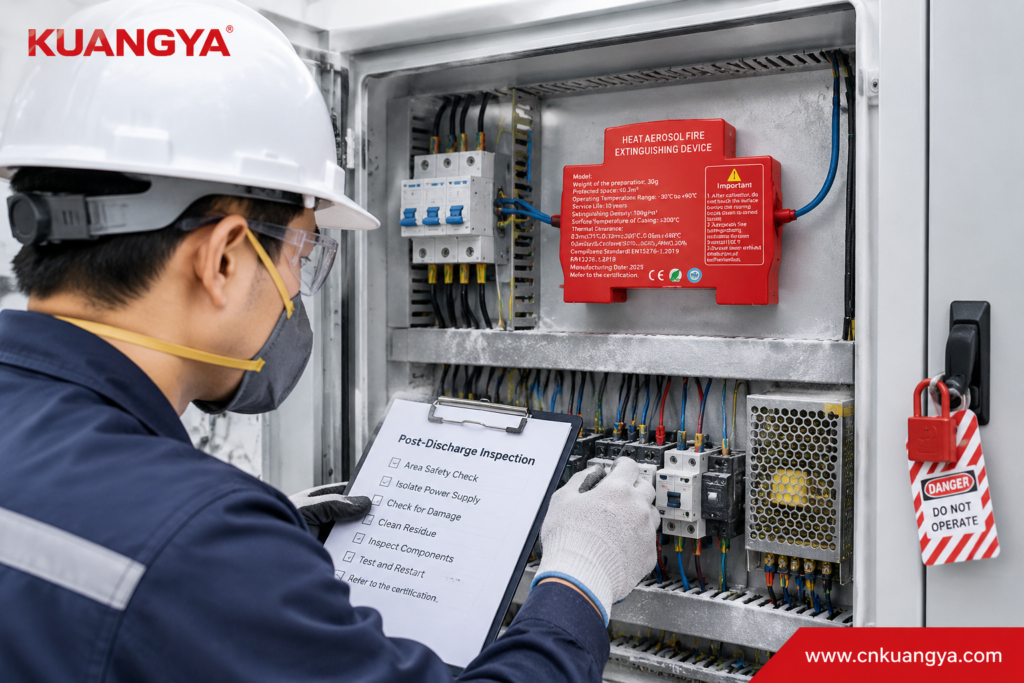
Before cleaning begins, record the condition of the enclosure and the suppression system.
Useful records include:
This information can help the maintenance team, equipment manufacturer, insurer, and fire protection service provider determine what needs to be repaired or replaced.
Identify the extinguishing agent and consult the applicable installation and operation manual. Determine whether the work can be carried out by trained in-house personnel or requires a specialist recovery or electrical service company.
Avoid beginning with a general-purpose cleaning method before the residue and equipment requirements are understood.
Cleaning should begin as soon as it is safe and practical, following the specific system manufacturer’s instructions.
Prompt removal matters because certain condensed aerosol residues may absorb moisture over time. At the same time, cleaning methods that are suitable for enclosure walls may not be appropriate for delicate electronic assemblies.
O FirePro Xtinguish manual provides product-specific post-discharge guidance, including the use of suitable methods for dry residues and specialized cleaning products for electronic components.
| Area | Initial assessment | Cleaning approach |
|---|---|---|
| Cabinet floor and internal panels | Check for loose residue, soot, and heat damage | Remove deposits using the method specified by the system manufacturer |
| Painted metal surfaces | Check for discoloration and residue buildup | Use a compatible cleaning method and inspect for coating damage |
| Uncoated metal surfaces | Check for deposits, oxidation, and moisture exposure | Clean promptly as instructed and assess susceptible surfaces |
| Circuit boards | Check for residue, soot, and heat exposure | Use an approved electronics-cleaning procedure or specialist service |
| Terminals and connectors | Check for deposits, corrosion, looseness, or thermal damage | Inspect and clean or replace according to component requirements |
| Ventilation paths and filters | Check for deposits and blocked airflow | Clean or replace affected parts according to equipment instructions |
| Suppression generator and mounting area | Check for physical damage and discharge-related changes | Have the system inspected and serviced as required |
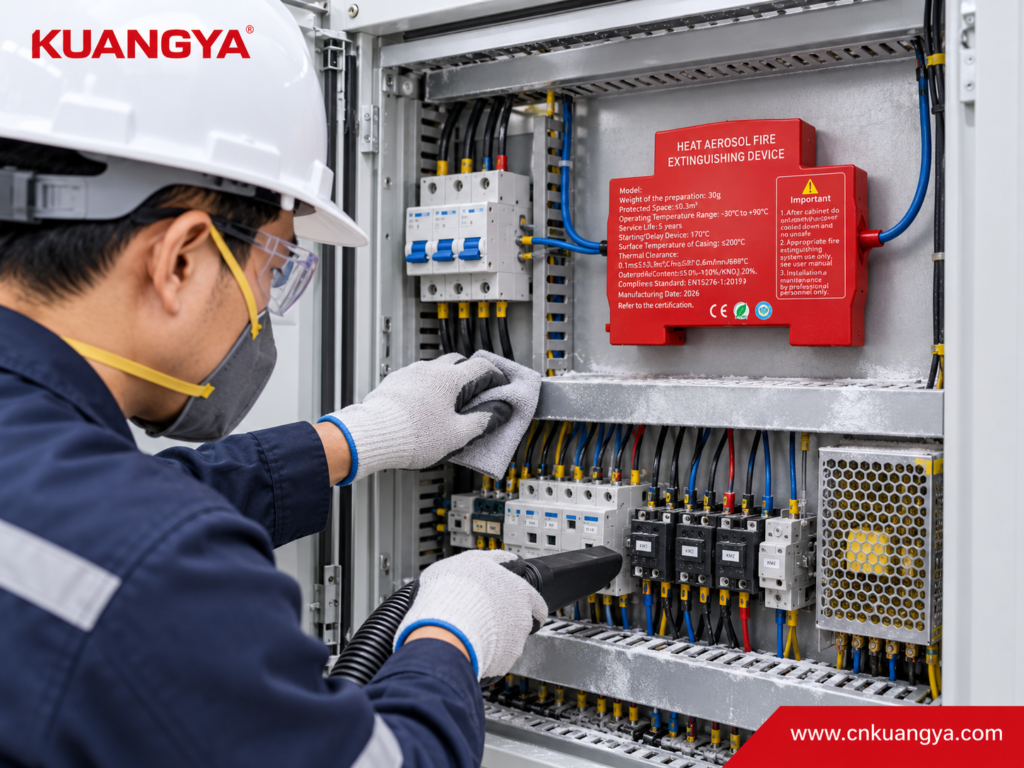
1. Identify the residue.
Confirm the agent type and consult its safety data sheet and operation manual. Where fire damage and aerosol deposits are mixed together, obtain specialist advice if necessary.
2. Protect personnel and sensitive equipment.
Use the personal protective equipment and handling procedures specified for the residue and incident conditions. Confirm that electrical equipment is safely isolated before any work begins.
3. Remove loose deposits using an approved method.
Depending on the specific product instructions, this may involve suitable wiping, brushing, vacuuming, or other controlled removal methods. Do not assume that compressed air or an ordinary vacuum is appropriate for every component or residue.
4. Clean electronic components separately.
Use only a method approved for the component and the particular contamination. A cleaning product that is safe for one circuit board or connector may be unsuitable for another.
5. Inspect after cleaning.
Check for remaining deposits, signs of corrosion, damaged insulation, discoloration, and other defects. Cleaning cannot reverse damage caused by excessive temperature or electrical arcing.
6. Record the work.
Document the cleaning method, products used, parts replaced, inspection results, and any outstanding issues.
The following practices can create additional problems when used without an approved procedure:
The objective is not simply to make the cabinet look clean. It is to remove the relevant contamination without introducing new electrical, chemical, or mechanical risks.
Once the immediate hazards have been addressed and the appropriate cleaning has been completed, the affected electrical equipment should undergo a systematic inspection.
The depth of inspection depends on the fire severity, equipment design, contamination, and operational importance of the installation.
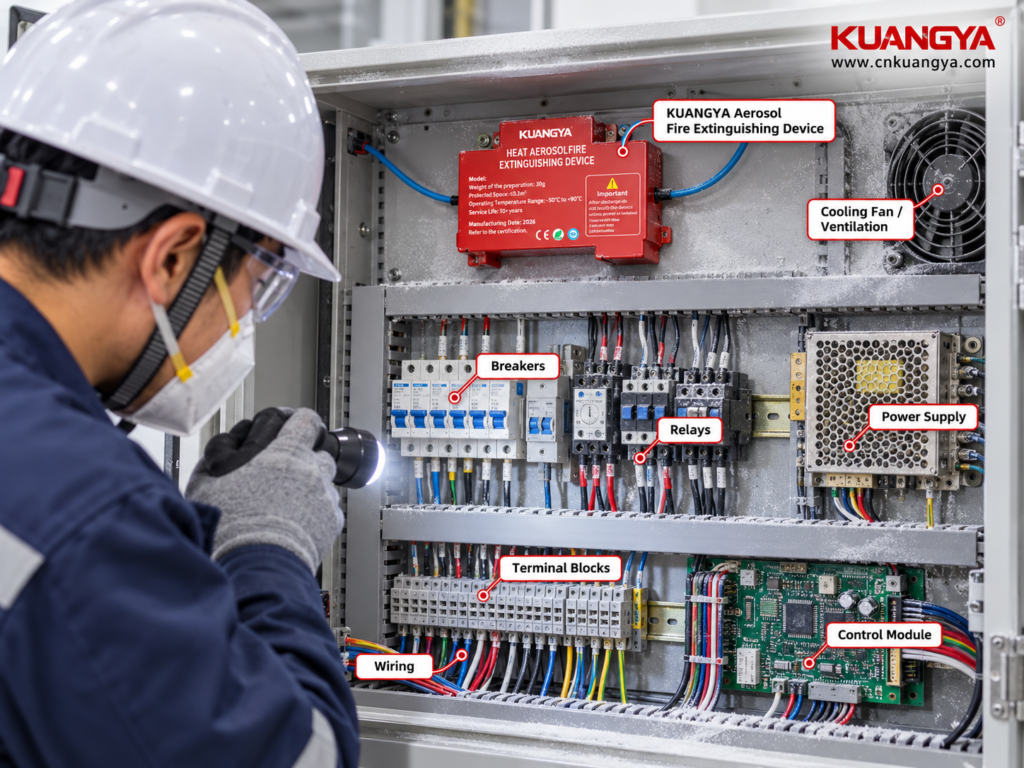
| Componente | What to check | Possible action |
|---|---|---|
| Cables and insulation | Cracking, melting, discoloration, brittleness, or deformation | Replace damaged cable sections |
| Blocos de terminais | Loose connections, heat marks, residue, or corrosion | Clean, retorque, or replace according to manufacturer specifications |
| Circuit breakers and contactors | Heat damage, abnormal operation, damaged housings, or contaminated contacts | Arrange inspection and replacement where required |
| Printed circuit boards | Soot, residue, damaged components, lifted tracks, or discoloration | Specialist cleaning, testing, repair, or replacement |
| Sensors and detectors | Physical damage, contamination, or incorrect status indications | Clean, test, or replace as specified |
| Fans and ventilation components | Blocked airflow, damaged blades, or contaminated filters | Clean or replace affected parts |
| Enclosure and seals | Warping, damaged seals, openings, or compromised environmental protection | Repair or replace as appropriate |
| Protective earthing | Damaged conductors, loose connections, or compromised bonding | Verify electrical continuity and repair defects |
| Control and alarm circuits | Fault indications, damaged wiring, or failed interlocks | Test and recommission the affected circuits |
Visual inspection is important, but it may not be sufficient. Depending on the equipment and incident, qualified personnel may also need to perform insulation-resistance measurements, continuity checks, functional testing, or other electrical tests.
Test methods and acceptance criteria must be suitable for the equipment. Some electronic components can be damaged by inappropriate testing voltages, so the manufacturer’s instructions should be followed.
There is no universal waiting time that makes electrical equipment safe to restart after an aerosol fire suppression event.
The decision should be based on the condition of the equipment, the nature of the incident, the cleaning results, and the required inspection and testing.
A cabinet that experienced a nuisance discharge without a fire may need a different recovery process from one exposed to sustained flames, high temperatures, smoke, and electrical arcing.
| Finding | Is immediate restart appropriate? | Required next step |
|---|---|---|
| No visible fire damage, but the system discharged | Não automaticamente | Verify isolation, residue removal, system condition, and equipment requirements |
| Fine residue is present on electrical components | No, not before assessment | Complete the approved cleaning and inspection process |
| Smoke or soot has entered the cabinet | No, not before assessment | Evaluate contamination and component condition |
| Insulation is melted or cables are visibly damaged | Não | Replace or repair affected components and perform the required tests |
| A circuit breaker or contactor shows heat damage | Não | Have the component evaluated and replace it if required |
| Cleaning is complete, but electrical testing is outstanding | Não | Complete the required inspection and tests |
| Inspection and required tests are satisfactory | Potentially | Obtain the required authorization and follow the equipment’s return-to-service procedure |
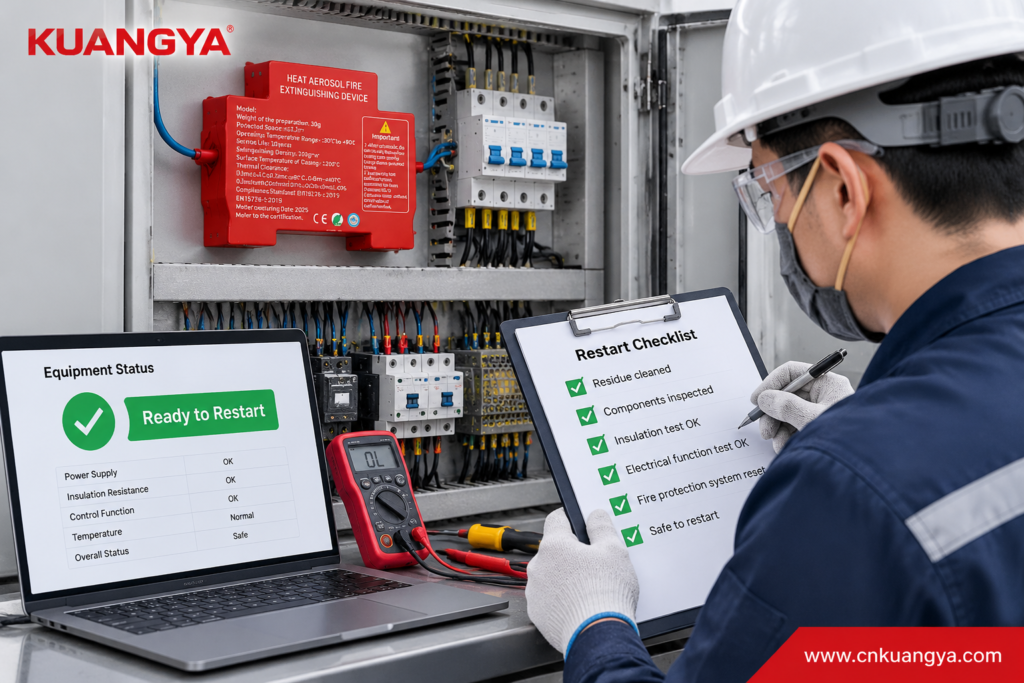
A responsible restart process typically includes:
Not every installation requires the same tests or approval process. The responsible engineer should determine the appropriate requirements based on the equipment manufacturer’s documentation, local regulations, and the incident findings.
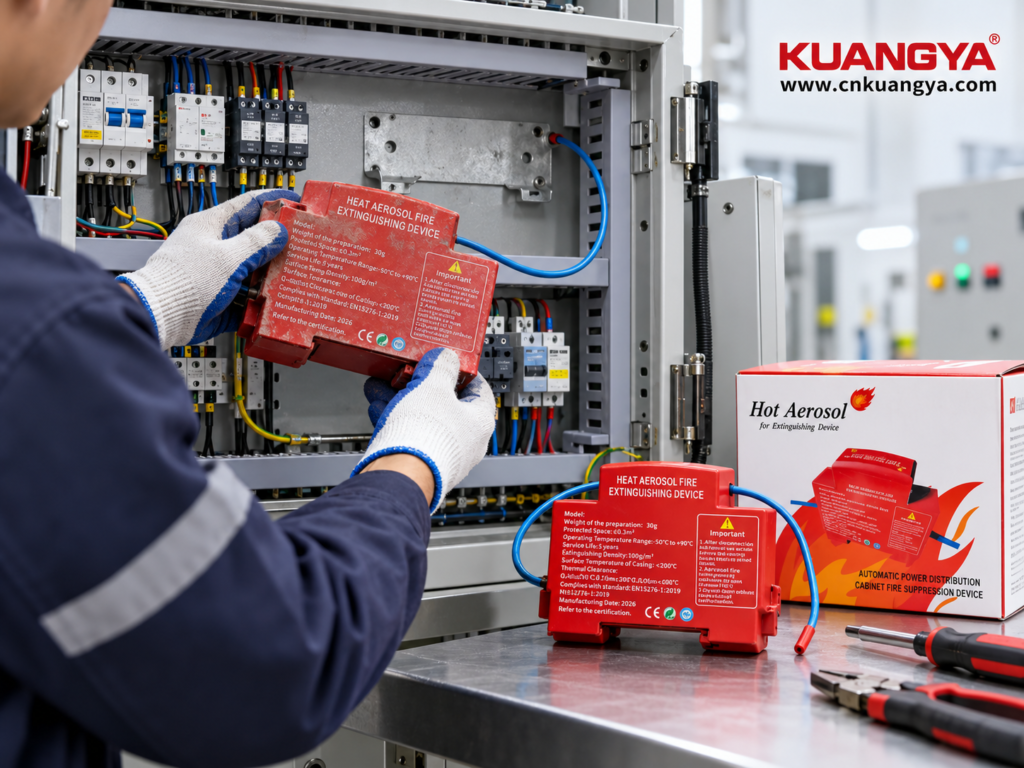
In many condensed aerosol systems, the generator is designed for a single discharge and must be replaced after activation. However, the exact requirement depends on the product design.
Do not assume that a generator can be reused simply because its housing appears intact. The internal extinguishing compound or activation mechanism may have been consumed, and the unit may no longer provide its intended protection.
| Item | Inspection question | Possible action |
|---|---|---|
| Aerosol generator | Has it discharged, activated, or sustained physical damage? | Replace or service according to the product manual |
| Activation wiring | Is the wiring intact and correctly connected? | Repair and test as specified |
| Detection devices | Are they damaged, contaminated, or still reporting a fault? | Inspect, clean, test, or replace |
| Control panel | Are alarms, faults, or activation indicators still present? | Investigate and reset only after the cause has been addressed |
| Backup power supply | Is the power supply functional and available? | Test and replace defective components |
| Mounting brackets | Are the generator and brackets secure and undamaged? | Repair or replace as required |
| System coverage | Have enclosure volume, openings, or protected equipment changed? | Have the design and coverage reviewed by a qualified specialist |
Replacement should restore the protection intended by the original design. Simply installing another generator of a similar size may not be sufficient if the protected enclosure or hazard has changed.
For more information about selecting a suitable device, see how to choose an aerosol fire extinguisher.
Post-discharge recovery is easier when the system has been correctly designed, installed, documented, and maintained before an incident occurs.
The following measures can help reduce downtime and make future maintenance more predictable.
Maintain the installation and operation manual, safety data sheet, wiring diagram, generator model information, inspection records, and supplier contact details.
Maintenance personnel should know which cleaning products and methods are permitted for the installed system.
Check the cabinet for unauthorized modifications, damaged seals, blocked discharge paths, changes in internal volume, and alterations to the protected equipment.
Changes to the enclosure can affect the effectiveness of a suppression system. Significant modifications should be reviewed by a qualified designer or service provider.
Where the aerosol system operates with detectors, alarm panels, electrical interlocks, or remote signals, verify that these associated systems are maintained according to their applicable requirements.
An aerosol generator alone does not establish that the entire fire protection system is functional.
Personnel should understand the difference between ordinary cleaning, post-fire recovery, electrical inspection, and suppression-system recommissioning.
They should also know when to stop work and contact a specialist rather than attempting an unfamiliar cleaning or repair procedure.
For critical electrical cabinets, establish a recovery plan that identifies replacement generators, spare electrical components, qualified service providers, and the authorization needed before equipment returns to operation.
This preparation can reduce delays without compromising personnel safety or equipment reliability.
The following is an illustrative engineering scenario, not a report of a verified customer incident. It demonstrates how a maintenance team might organize a post-discharge assessment.
An industrial control cabinet experiences an electrical fault, and its installed condensed aerosol fire suppression system activates. The flames are no longer visible after the incident, but fine deposits remain on internal surfaces. Several components show signs of heat exposure.
The maintenance team must determine whether the cabinet can be returned to service.
The team isolates the affected equipment under an approved electrical safety procedure and confirms that the area is safe for inspection.
Photographs are taken of the enclosure, the generator, the affected wiring, and the suspected fault location. The team records the control-panel indications and identifies the installed aerosol system.
The team consults the generator manufacturer’s documentation before selecting a residue-removal method.
Loose deposits are removed using an approved procedure. Electronic assemblies are assessed separately, and components exposed to heat or smoke are inspected for damage.
During the electrical inspection, the team identifies a cable section with visible heat damage. That section is replaced rather than being accepted merely because the surrounding cabinet has been cleaned.
The suppression generator is evaluated according to the manufacturer’s instructions and replaced because the installed unit is designed for single discharge.
The team completes the required electrical checks, verifies the detection and control circuits, and confirms that the suppression system has been restored to its required operational condition.
The cabinet returns to service only after the responsible personnel authorize the restart.
| Lesson | Por que é importante |
|---|---|
| Extinguishing the fire is only the first step | Electrical damage may remain after visible flames disappear |
| Cleaning must match the actual agent | Different formulations and components can require different procedures |
| Fire residue and aerosol residue are not the same | Both may need to be addressed |
| Damaged components should not be accepted solely on visual appearance | Appropriate electrical testing and engineering assessment may be necessary |
| The suppression system must also be restored | Cleaning the cabinet does not automatically restore fire protection |
The main lesson is that a successful recovery requires both fire-related assessment and electrical-system verification.
Not automatically. The equipment must be assessed for fire damage, contamination, and electrical safety. Follow the installed system’s instructions and the equipment manufacturer’s requirements before restarting.
Some condensed aerosol systems leave fine particulate residue after discharge. The amount and characteristics depend on the formulation, installation, and discharge conditions. Consult the specific product documentation.
The answer depends on the particular agent and the conditions of use. Some manufacturers document their own agents as nonconductive under specified conditions, but this should not be generalized to every aerosol product or to mixed deposits containing soot and combustion by-products.
Certain residues may absorb moisture and contribute to oxidation or other surface problems under particular conditions. Prompt cleaning in accordance with the manufacturer’s instructions helps manage this risk.
Only if the applicable instructions permit it and the method is suitable for the equipment. Uncontrolled compressed air can spread contamination or drive particles into sensitive components.
Many condensed aerosol generators are single-use devices. Check the specific model’s documentation and replace or service the unit as instructed.
A qualified electrical professional should assess electrical safety and damage. Depending on the installation, a fire suppression service provider and the equipment manufacturer may also need to participate in the recovery process.
As soon as it is safe and practical, in accordance with the manufacturer’s instructions. Do not delay cleaning unnecessarily, but never enter an unsafe area or begin maintenance before the required safety conditions have been met.
No. Cleaning removes contamination but does not repair damaged insulation, burned components, failed terminals, or a defective suppression system. The equipment must pass the required inspection and return-to-service checks.
The system should be inspected and restored according to the manufacturer’s recommissioning procedures and applicable requirements. Any required functional tests must be performed by appropriately qualified personnel using the approved procedure.
After a condensed aerosol fire suppression system discharges, safe recovery requires more than removing visible residue. The affected area must first be declared safe, the electrical equipment must be isolated and assessed, and cleaning must follow the specific agent and equipment requirements.
Engineers should then inspect electrical components, replace damaged parts, evaluate the discharged generator, and verify that the fire suppression system is ready for service before authorizing a restart.
The most reliable approach is to combine prompt, appropriate cleaning with a documented electrical inspection and a controlled return-to-service process.
For facilities planning protection for electrical cabinets and distribution equipment, selecting a suitable suppression device is only one part of the overall strategy. Correct installation, maintenance, incident procedures, and post-discharge recovery planning are equally important.
Saiba mais sobre proteção contra incêndio de gabinetes elétricos e aerosol fire suppression for PV distribution boxes to explore related protection considerations for electrical installations.

