웽양 공업구 웨칭 원저우 325000
근무 시간
월요일~금요일: 오전 7시~오후 7시
주말: 주말: 오전 10시 - 오후 5시
웽양 공업구 웨칭 원저우 325000
근무 시간
월요일~금요일: 오전 7시~오후 7시
주말: 주말: 오전 10시 - 오후 5시

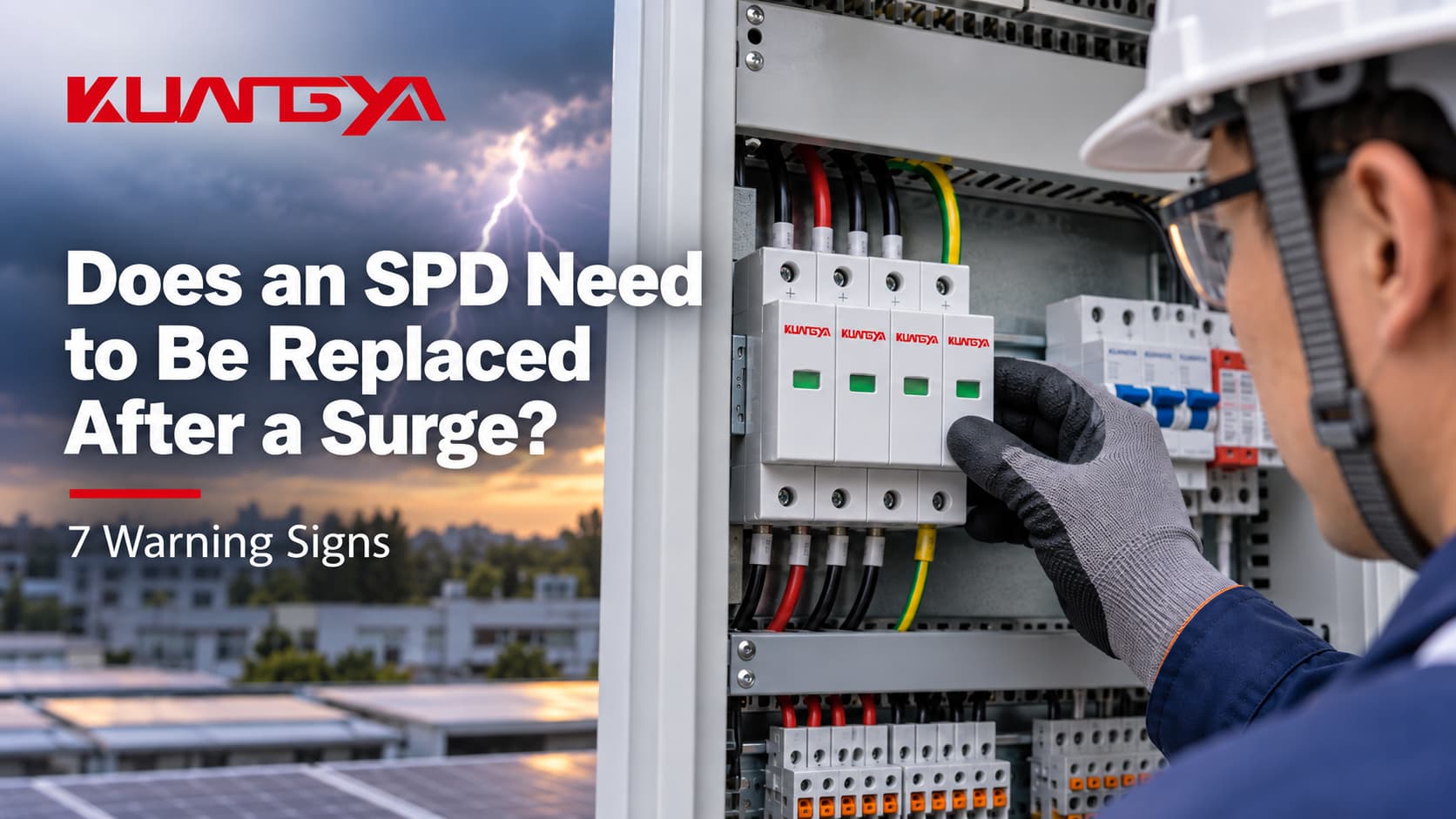
낙뢰, 스위칭 이벤트 또는 예기치 않은 전압 서지가 발생한 후 흔히 하는 질문은 다음과 같습니다. 서지 발생 후 SPD를 교체해야 합니까?
간단히 답하자면 아니요, 자동으로 교체할 필요는 없습니다..
서지 보호 장치는 과도 과전압을 제한하고 서지 전류를 분산시키도록 설계되었습니다. 서지가 SPD의 허용 범위 내에 있고 장치가 수명 종료 상태에 도달하지 않았다면, 이벤트 발생 후에도 시스템을 계속 보호할 수 있습니다.
그러나 심각한 서지, 반복적인 전기적 스트레스, 일시적 과전압, 과열 또는 장기적인 성능 저하는 SPD 내부의 보호 부품을 손상시킬 수 있습니다. 이러한 경우 보호 모듈이 내부적으로 차단될 수 있으며, 이때는 SPD를 교체해야 할 수도 있습니다.
따라서 올바른 질문은 단순히 다음과 같은 것이 아닙니다.
“SPD가 서지를 경험했습니까?”
올바른 질문은 다음과 같습니다.
“서지 발생 후 SPD의 상태는 어떻습니까?”
이 가이드는 서지 발생 시 SPD에 일어나는 현상, 손상 징후를 식별하는 방법, 녹색 또는 적색 상태 표시등의 실제 의미, 그리고 보호 모듈이나 SPD 전체를 교체해야 하는 시기에 대해 설명합니다.
SPD의 교체 여부는 서지 발생 후의 상태에 따라 결정됩니다.
| 서지 발생 후 SPD 상태 | 교체해야 합니까? | 권장 조치 |
|---|---|---|
| 정상 상태 표시 및 육안상 손상 없음 | 자동 아님 | 제조사의 지침에 따라 점검을 계속하십시오 |
| 적색 또는 수명 종료 표시 | 일반적으로 그렇습니다 | 제조사가 지정한 대로 해당 모듈 또는 SPD를 교체하십시오 |
| 원격 신호가 결함을 보고함 | 즉시 조사하십시오 | SPD 상태 및 원격 접점 회로를 확인하십시오 |
| 탄 자국, 녹은 흔적 또는 심각한 변색 | 예 | 필요에 따라 회로를 차단하고 손상된 SPD를 교체한 후 원인을 조사하십시오 |
| 하우징의 균열 또는 변형 | 예 | 손상된 SPD를 계속 사용하지 마십시오 |
| 교체 가능한 카트리지 하나가 수명에 도달함 | 일반적으로 카트리지 | 베이스를 점검하고 올바른 교체용 모듈을 사용하십시오 |
| 대규모 낙뢰 사고가 있었으나 표시기가 정상 상태를 유지함 | 자동 아님 | 더 상세한 점검을 수행하십시오. |
| 교체한 SPD가 반복적으로 조기 고장납니다. | 단순히 계속 교체만 하지 마십시오. | 시스템 전압, TOV, SPD 선정, 배선 및 설치 조건을 조사하십시오. |
중요한 점은 다음과 같습니다. 서지 이벤트 발생 자체가 곧 수명 종료를 의미하는 것은 아닙니다..
실제 SPD 상태와 제조사의 유지보수 지침에 따라 다음 단계를 결정해야 합니다.
서지 발생 후 SPD 교체 여부를 결정하기 전에 이 짧은 설명을 시청하십시오.
모든 서지 발생 후 SPD를 반드시 교체할 필요가 없는 이유를 이해하려면, 해당 장치가 실제로 어떤 역할을 하는지 파악하는 것이 도움이 된다.
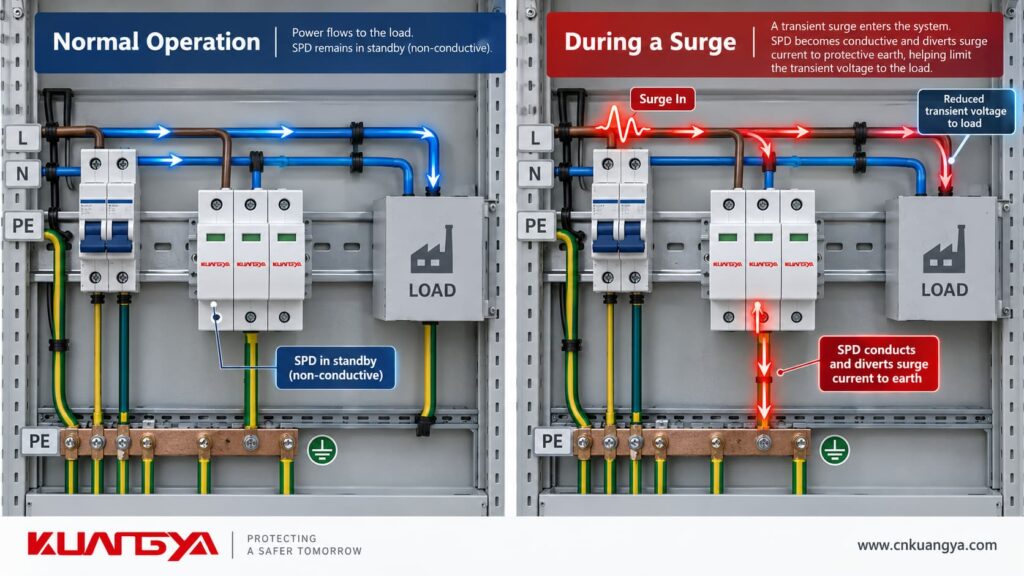
많은 전원 SPD는 보호 대상 회로와 병렬로 연결됩니다.
정상 작동 전압 상태에서 SPD 내부의 전압 제한 부품은 고임피던스 상태를 유지합니다. 따라서 정상 부하 전류는 SPD 보호 소자를 통과할 필요가 없습니다.
이것이 바로 SPD가 일반적으로 병렬로 설치되는 이유이며 부하와 단순히 직렬로 배치되지 않는 이유입니다.
과도 과전압이 SPD에 도달하면 보호 부품이 반응합니다.
MOV 기반 SPD에서 금속 산화물 배리스터는 전압이 동작 범위를 초과함에 따라 고임피던스 상태에서 도통 상태로 변화합니다.
SPD는 다음 기능을 수행합니다:
과도 전압 제한
및
민감한 장비로부터 서지 전류를 우회.
과도 현상이 종료되면 보호 소자는 일반적으로 고임피던스 상태로 복귀합니다.
이 동작 원리는 서지 보호 장치의 핵심입니다. 즉, 서지 전압을 제한하고 서지 전류를 우회하도록 설계된 비선형 소자를 포함합니다. 현행 IEC 요구 사항도 동일한 기본 정의를 사용합니다.
따라서 SPD가 서지 중에 동작했다는 사실 자체가 곧 고장을 의미하는 것은 아닙니다.
꼭 그렇지는 않습니다.
결과는 다음과 같은 요소에 따라 달라집니다:
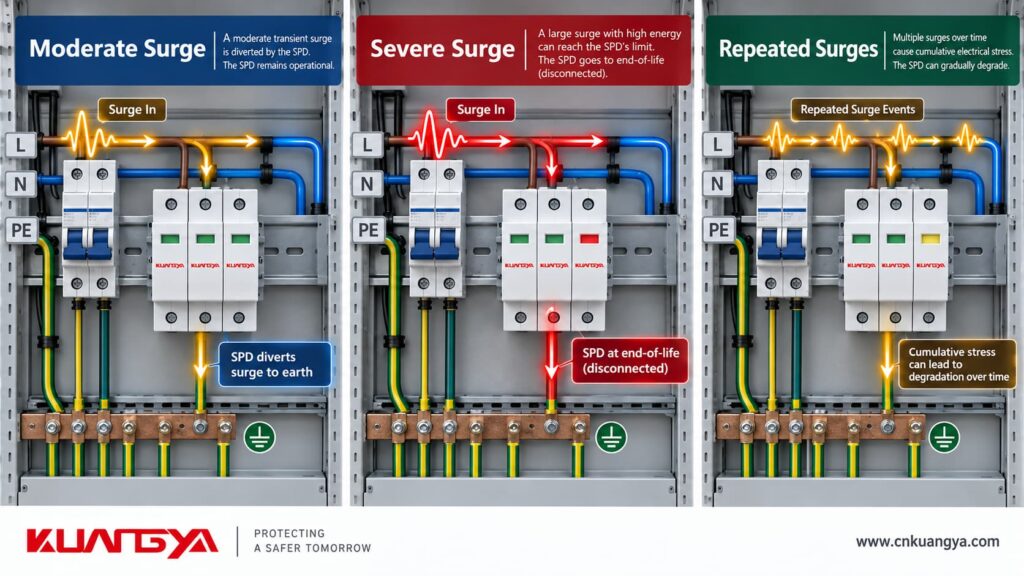
SPD의 성능 범위 내에 있는 서지는 장치의 수명 종료를 초래하지 않고 처리될 수 있습니다.
훨씬 더 심각한 이벤트는 단 한 번의 발생으로도 상당한 손상을 일으킬 수 있습니다.
SPD는 과도 과전압에 대응하도록 설계되었습니다.
이벤트가 제품의 의도된 작동 및 서지 처리 능력 범위 내에 있다면, SPD는 그 이후에도 계속 작동할 수 있습니다.
이것이 다음과 같은 규칙을 적용하는 것이 옳지 않은 이유입니다:
“한 번의 서지 발생 = 한 번의 교체.”
장치는 실제 상태에 따라 평가되어야 합니다.
충분히 심각한 이벤트는 단 한 번의 발생으로 보호 소자의 수명을 다하게 할 수 있습니다.
SPD 설계에 따라 다음과 같은 결과가 나타날 수 있습니다:
정확한 고장 동작은 제품 설계에 따라 다릅니다.
SPD 성능 저하는 단 한 번의 강력한 낙뢰 이벤트에만 국한되지 않습니다.
반복적인 전기적 스트레스는 MOV의 전기적 특성에 점진적인 영향을 줄 수 있습니다.
그러나 이를 모든 서지가 동일한 양의 잔여 수명을 감소시키는 단순한 고정 에너지 카운트다운 방식으로 설명해서는 안 됩니다.
MOV의 열화는 부품에 가해지는 서지의 크기, 지속 시간, 반복 횟수, 동작 전압, 온도 및 기타 스트레스 요인에 따라 달라집니다. IEC TR 61643-333:2026은 산화아연(ZnO) MOV의 특성 방정식과 수명 평가를 구체적으로 다루고 있으며, MOV의 수명이 단순한 고정적 “줄(joule) 평형”보다 훨씬 복잡하다는 점을 설명합니다.”
Many Type 2 SPDs use metal oxide varistors as their primary voltage-limiting elements.
Under normal voltage, an MOV has high resistance.
When the applied voltage rises sharply during a transient event, the MOV becomes conductive and helps limit the voltage.
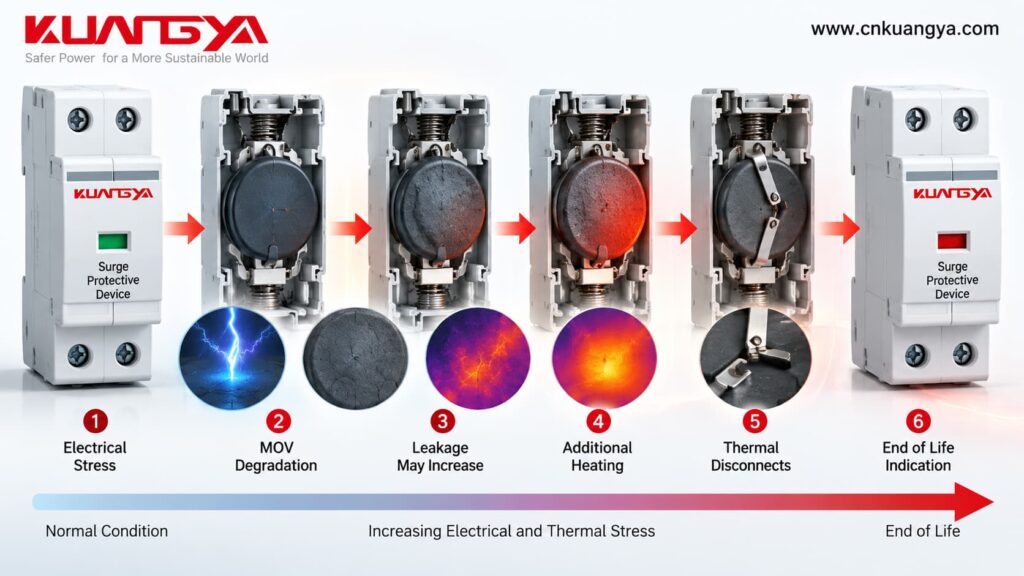
Over time, electrical and thermal stress can change the MOV’s characteristics.
A simplified aging path may look like this:
Repeated electrical stress
↓
Change in MOV characteristics
↓
Possible increase in leakage current
↓
Additional heating
↓
Thermal protection operates if necessary
↓
Protection element disconnects
↓
SPD indicates an end-of-life or fault condition
The precise sequence depends on the SPD design.
Modern MOV-based SPDs commonly include thermal protection because an MOV that becomes unstable or overheated must be safely disconnected from the power system.
For example, Schneider Electric describes some of its SPDs as using thermally protected MOVs and instructs replacement of the module when the corresponding indication shows loss of protection.
This internal disconnection is one reason a failed SPD can sometimes leave the protected equipment powered while surge protection for that mode is no longer available.
There is no single inspection method that applies identically to every SPD.
If you are not sure whether an SPD has failed, see our guide on SPD 불량 여부 확인 방법.
However, the following signs usually justify replacement or further investigation.
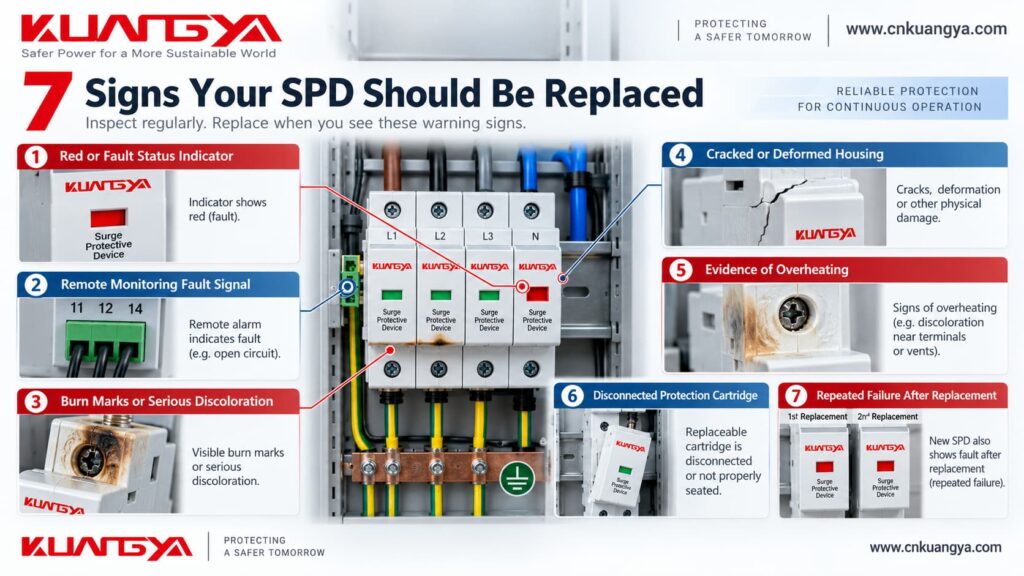
For many pluggable DIN-rail SPDs, the front status window provides the fastest visual indication of the protection module’s condition.
일반적인 구성은 다음과 같습니다:
Normal indication → protection element has not reported end of life
Red/fault indication → affected module requires replacement
예를 들어, ABB describes mechanical SPD indicators that change from green to red at end of life and states that once this occurs, the SPD should be changed because protection is no longer guaranteed.
However, indicator colors and meanings are product-specific.
Always check the markings, datasheet, or instructions for the exact SPD you are inspecting.
Do not assume that every SPD from every manufacturer uses the same color logic.
Some SPDs include remote signaling terminals, often using a changeover dry contact with terminals such as:
COM
아니요
NC
These contacts allow the SPD’s status to be reported remotely to equipment such as:
When the monitored SPD reaches the state defined by the manufacturer, the remote contact changes state.
But a remote alarm should still be verified.
Check:
The remote contact tells you about the monitored SPD state. It does not directly measure the SPD’s actual surge-clamping performance.
Visible heat damage is not a normal service condition.
Warning signs include:
If these conditions are present, the SPD should not simply be returned to service because its indicator still appears normal.
The circuit should be made safe according to the applicable electrical procedure, and both the SPD and surrounding installation should be inspected.
The cause also matters.
Replacing the SPD without identifying a wiring problem, abnormal system voltage, short-circuit condition, or other fault can result in another failure.
A cracked housing may result from:
Even if the internal condition cannot be seen, physical enclosure damage is a reason to treat the SPD as suspect.
An electrical protection device depends not only on its MOV or other internal component but also on proper insulation, spacing, mechanical connections, and safe containment.
If these have been compromised, replacement is normally the safer maintenance decision.
Not every internal problem immediately produces an obvious red indicator.
If you notice:
disconnect and investigate the equipment using the required safe electrical procedure.
Do not continue using an SPD simply because power is still reaching the protected equipment.
A parallel-connected SPD can lose its protective function while the main circuit continues supplying the load.
Many modular SPDs use plug-in cartridges.
If an internal disconnector has operated and the cartridge indicates end of life, the affected cartridge normally needs replacement.
That does not necessarily mean the complete SPD base must always be replaced.
If:
the manufacturer may allow replacement of the cartridge only.
Schneider Electric, for example, provides model-specific replacement modules for certain modular SPD families rather than requiring replacement of every part of the assembly.
But never assume that a pluggable SPD cartridge is automatically safe to remove while energized.
Pluggable does not mean hot-swappable.
Follow the manufacturer’s instructions and the required electrical isolation procedure before servicing the SPD.
One of the most important warning signs is not the first failure.
그것은 repeated early failure after replacement.
If a newly installed SPD quickly reaches its fault or end-of-life condition again, simply installing another identical device may not solve the problem.
Investigate possible causes such as:
For PV applications, correct voltage selection is especially important. See how to select the correct DC SPD voltage rating for a solar PV system.
Current IEC SPD requirements specifically consider system and fault conditions such as expected short-circuit current and temporary-overvoltage stresses when evaluating SPD applications.
Repeated failure should therefore be treated as a system-level troubleshooting problem, not merely a replacement problem.
Usually, a manufacturer-defined normal indication means the SPD has not reported its end-of-life condition through that indicator mechanism.
For a deeper explanation, see what an SPD green indicator can and cannot tell you about the protection condition.
But there is an important distinction:
Normal indicator ≠ exact measurement of remaining SPD life.
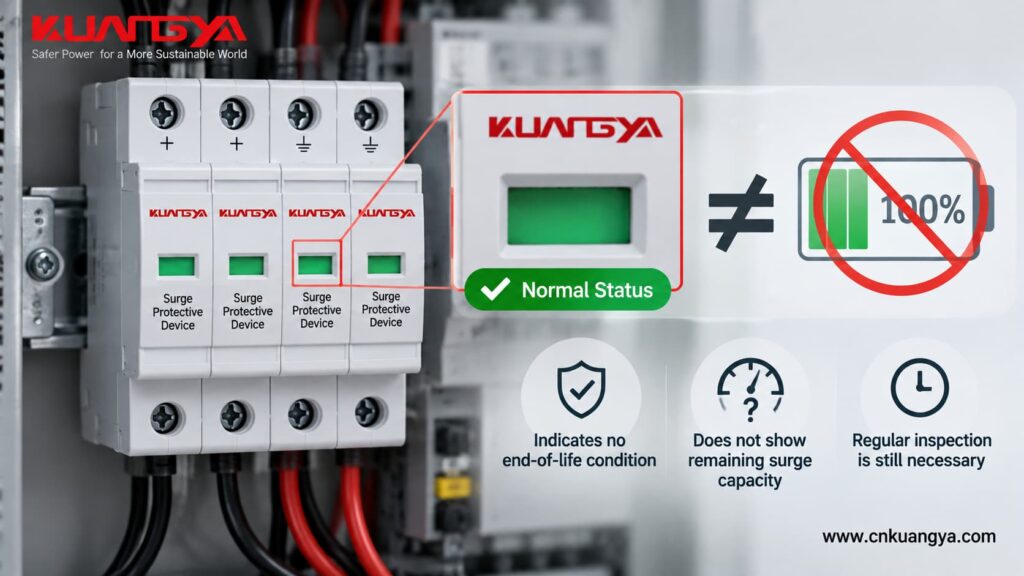
A basic mechanical indicator normally does not tell you:
So avoid statements such as:
“Green means the SPD is 100% healthy.”
또는
“Green means the SPD has full surge capacity remaining.”
A more technically accurate interpretation is:
The SPD’s normal status indication shows that its internal monitoring or disconnection mechanism has not indicated end of life according to the product design.
That is useful information—but it is not the same as a complete electrical performance test.
ABB’s guidance illustrates this distinction well: the mechanical indicator is specifically an end-of-life indicator, changing state when the device reaches the defined replacement condition.
Not automatically—but the inspection should be more thorough.
The words “lightning event” can describe very different electrical stresses.
A distant lightning event that induces a relatively small transient is not the same as a severe nearby or direct lightning-current event.
The correct SPD type and coordinated protection system also matter.
For example, a Type 2 SPD is primarily tested for surge-current conditions different from those associated with the lightning-current testing of a Type 1 SPD.
So after a known major event, check more than just the color window.
Inspect:
If nearby electrical equipment has also been damaged, or the lightning event was unusually severe, a more detailed electrical inspection is justified even when the status window has not changed.
For critical installations, follow the site’s maintenance plan, lightning-protection procedure, and manufacturer-specific recommendations.
For modular SPDs, a failed cartridge does not always require replacing the complete assembly.
Use the physical condition of the base and the manufacturer’s instructions to make the decision.
| 조건 | Replace cartridge only | Replace complete SPD |
|---|---|---|
| One plug-in module reaches end of life | Usually | Not normally necessary if base is sound |
| Base contacts remain clean and undamaged | Usually | 아니요 |
| Base contacts are burned or damaged | 아니요 | 예 |
| Base or housing has melted | 아니요 | 예 |
| Severe corrosion is present | 아니요 | Usually |
| Mechanical locking system is damaged | 아니요 | 예 |
| Correct compatible cartridge is unavailable | 아니요 | 예 |
| Extent of damage cannot be confidently determined after a serious failure | Not preferred | Consider complete replacement |
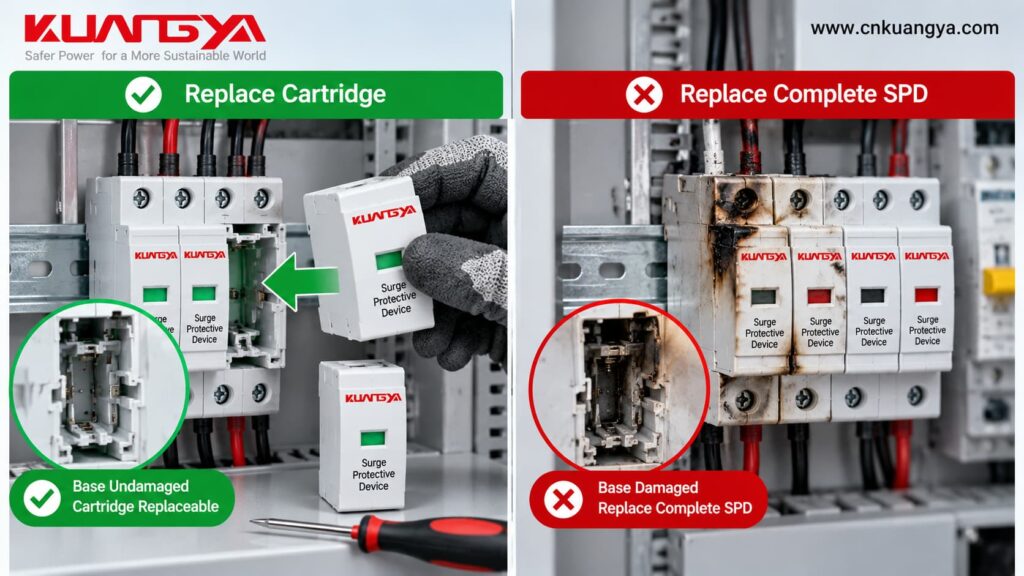
가장 중요한 규칙은 다음과 같습니다:
Replace only what the manufacturer allows you to replace.
A cartridge from a different series may physically look similar while having a different Uc, discharge rating, protection level, internal circuit, or coding system.
Always use the specified replacement module.
A practical post-surge inspection can follow seven basic steps.
Start with the front status window.
Look for the manufacturer-defined normal, fault, or end-of-life condition.
If the SPD includes remote contacts, verify whether the monitoring system has received a fault signal.
Compare the result with the manufacturer’s COM/NO/NC diagram.
확인:
For a modular SPD, inspect both the plug-in cartridge and the base.
A new cartridge should not be installed into a heat-damaged or mechanically damaged base.
Loose or heat-damaged conductors can affect both safety and surge protection.
Also check the SPD connection conductors and protective-earth connection according to the installation instructions.
In solar PV systems, the distance between the SPD and inverter and the connection lead length can also affect practical surge protection performance.
Ask what happened before the SPD changed state.
Was there:
This information can help distinguish normal end-of-life behavior from a broader installation problem.
If the SPD has reached its defined end-of-life state or shows physical damage, replace the affected component according to the manufacturer’s instructions.
If the condition is uncertain and the application justifies deeper verification, use the appropriate professional SPD testing method or manufacturer-approved test equipment.
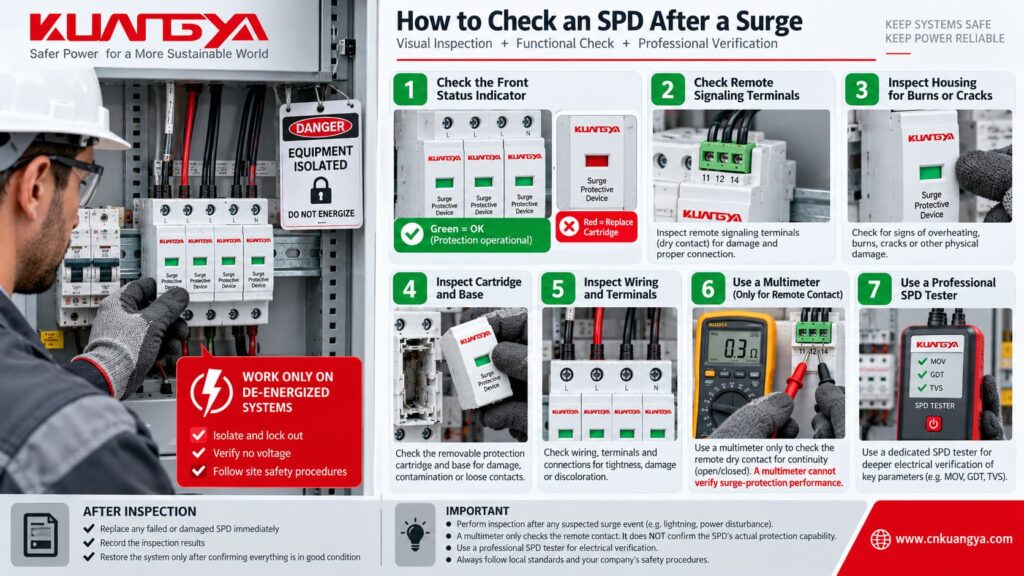
A multimeter can be useful around an SPD, but it cannot fully prove that the SPD still has its original surge-protection performance.
For example, a multimeter may help with:
But an ordinary multimeter does not reproduce the electrical conditions used to determine major SPD parameters such as:
If these ratings are unfamiliar, our DC SPD 사양 가이드를 참조하십시오. explains Ucpv, In, Imax, Up and other common SPD markings in more detail.
따라서
A successful multimeter continuity or resistance check is not proof that the SPD still meets its original surge-protection specification.
Professional SPD verification may require dedicated equipment capable of testing the relevant electrical characteristics.
Phoenix Contact, for example, provides dedicated CHECKMASTER equipment for electrical testing of compatible pluggable SPDs and notes that visual inspection alone may not reliably determine an SPD’s functional capability.
Also remember that some electrical tests performed elsewhere in an installation can interact with an SPD.
ABB installation guidance, for example, specifies that the SPD should be disconnected before certain insulation testing because the SPD can respond to the test voltage as though it were an overvoltage.
Always follow the SPD and test-equipment manufacturer’s instructions.
For a more complete inspection procedure, see our guide on how to test an SPD.
There is no universal fixed service life that applies to every SPD.
It would therefore be misleading to say:
“Every SPD must be replaced after three years.”
또는:
“An SPD always lasts ten years.”
Actual service life depends on many variables, including:
A severe event may cause end of life much earlier than expected.
Another SPD in a relatively quiet installation may remain serviceable for many years.
For that reason, condition-based inspection and manufacturer-defined status indications are generally more useful than assigning one universal expiration date.
Use this quick decision guide after a surge event.
Answer these 5 quick questions to check whether your SPD shows an obvious replacement condition or needs further inspection.
아니요.
SPDs are designed to respond to transient overvoltages. Experiencing a surge does not automatically mean the SPD has reached end of life.
Replace or service it when the manufacturer’s status indication, inspection results, electrical testing, or physical condition shows that it is no longer serviceable.
예.
Many SPDs are designed to withstand multiple surge events within their specified capability.
However, the number and severity of events an SPD can withstand cannot be reduced to one universal number because different surge stresses and product designs produce different effects.
예.
A sufficiently severe lightning-related event can cause an SPD to reach end of life in one occurrence.
Whether this happens depends on the actual current and voltage stress reaching the SPD, the SPD type and ratings, installation, and the overall lightning and surge protection system.
It normally means the SPD has not indicated its manufacturer-defined end-of-life state through that indicator.
It should not normally be interpreted as an exact measurement of remaining surge capacity.
Always check the product instructions for the specific meaning of its status window.
For SPDs where red is defined as the end-of-life or replacement indication, yes—the affected module or device should be serviced or replaced according to the manufacturer’s instructions.
ABB, for example, states that when its standard SPD indicator changes from green to red at end of life, the SPD must be changed because protection is no longer guaranteed.
If the SPD uses manufacturer-approved replaceable modules and the base remains undamaged, replacing only the affected cartridge may be permitted.
Check that the replacement module has the correct model, voltage rating, and compatibility.
If the base, terminals, housing, or contacts have been damaged, replace the complete affected assembly as required.
Do not assume that you can.
A pluggable design makes maintenance easier, but it does not automatically mean the module is approved for energized replacement.
Follow the manufacturer’s instructions and the required electrical isolation and safety procedure before removing or installing an SPD module.
Not completely.
A multimeter may help test remote contacts or perform limited circuit checks, but it cannot reproduce the surge test conditions needed to verify the SPD’s full protection performance.
Dedicated test equipment or manufacturer-defined electrical testing may be required for more detailed verification.
Do not replace an SPD simply because a surge occurred.
An SPD is specifically designed to respond to transient overvoltage events, and one surge does not automatically mean the device has reached end of life.
Instead, base the decision on the actual condition of the SPD.
Replacement is normally justified when:
A normal status indication and the absence of physical damage generally mean there is no obvious end-of-life indication, but they do not provide an exact measurement of remaining surge capacity.
And if an SPD repeatedly fails shortly after replacement, do not simply install another one.
Investigate the system voltage, Uc or MCOV selection, temporary overvoltage conditions, electrical configuration, wiring, backup protection, and the severity of the surge environment.
The best replacement decision is therefore based not on:
“Did a surge happen?”
but on:
“What does the SPD condition tell us after the surge?”
KUANGYA provides AC and DC surge protective devices for electrical distribution and solar PV applications, including modular designs with visual status indication and optional remote signaling functions for easier inspection and maintenance.
For photovoltaic DC applications, SPD selection should consider factors such as maximum PV system voltage, Ucpv, SPD type, discharge-current ratings, voltage protection level, system configuration, and installation position.
PV-side SPDs are specifically addressed by IEC 61643-31 for photovoltaic installations up to 1500 V DC.
If you need help selecting a replacement SPD, send us your:
AC or DC application + system voltage + required SPD type + quantity
and KUANGYA can help you check a suitable model.

