WengYang Industriegebiet Yueqing Wenzhou 325000
Arbeitszeiten
Montag bis Freitag: 7AM - 7PM
Am Wochenende: 10AM - 5PM
WengYang Industriegebiet Yueqing Wenzhou 325000
Arbeitszeiten
Montag bis Freitag: 7AM - 7PM
Am Wochenende: 10AM - 5PM

Eine häufige Frage nach einem Gewitter, einem Schaltvorgang oder einer unerwarteten Spannungsspitze lautet: Muss ein SPD nach einer Überspannung ausgetauscht werden?
Die kurze Antwort lautet: Nein – nicht automatisch..
Ein Überspannungsschutzgerät ist darauf ausgelegt, transiente Überspannungen zu begrenzen und Stoßströme abzuleiten. Wenn die Überspannung innerhalb der Leistungsfähigkeit des SPD liegt und das Gerät sein Lebensende noch nicht erreicht hat, kann es das System nach dem Ereignis weiterhin schützen.
Eine schwere Überspannung, wiederholte elektrische Belastung, temporäre Überspannungen, Überhitzung oder langfristige Alterung können jedoch die Schutzkomponenten im Inneren eines SPD beschädigen. In diesen Fällen kann sich das Schutzmodul intern trennen und das SPD muss möglicherweise ausgetauscht werden.
Die richtige Frage lautet also nicht einfach:
“Hat der Überspannungsschutz (SPD) einen Stoßstrom erfahren?”
Sie lautet:
“In welchem Zustand befindet sich der SPD nach dem Stoßstrom?”
Dieser Leitfaden erklärt, was während eines Stoßstroms mit einem SPD geschieht, wie man Anzeichen von Schäden erkennt, was eine grüne oder rote Statusanzeige tatsächlich bedeutet und wann Sie das Schutzmodul oder den gesamten SPD austauschen sollten.
Ob ein SPD ausgetauscht werden sollte, hängt von seinem Zustand nach dem Ereignis ab.
| Zustand des SPD nach der Überspannung | Austauschen? | Empfohlene Maßnahme |
|---|---|---|
| Normaler Statusanzeige und keine sichtbaren Schäden | Nicht automatisch | Inspektion gemäß den Anweisungen des Herstellers fortsetzen |
| Rot- oder Lebensdaueranzeige | Normalerweise ja | Das betroffene Modul oder den SPD gemäß den Herstellerangaben austauschen |
| Fernmeldung signalisiert einen Fehler | Sofort untersuchen | Den Status des SPD und den Fernmeldekontaktkreis überprüfen |
| Brandspuren, Schmelzstellen oder starke Verfärbungen | Ja | Stromkreis wie erforderlich trennen, beschädigten SPD austauschen und Ursache untersuchen |
| Rissiges oder verformtes Gehäuse | Ja | Verlassen Sie sich nicht weiter auf den beschädigten SPD |
| Ein austauschbarer Einsatz hat das Ende seiner Lebensdauer erreicht | Normalerweise der Einsatz | Basis prüfen und das korrekte Ersatzmodul verwenden |
| Schweres Blitzereignis, aber die Anzeige bleibt normal | Nicht automatisch | Führen Sie eine detailliertere Inspektion durch |
| Das Ersatz-SPD fällt wiederholt vorzeitig aus | Tauschen Sie es nicht einfach immer wieder aus | Untersuchen Sie Systemspannung, TOV, SPD-Auswahl, Verkabelung und Installationsbedingungen |
Der wichtige Punkt ist, dass ein Überspannungsereignis allein kein Anzeichen für das Ende der Lebensdauer ist.
Der tatsächliche Zustand des SPD und die Wartungsanweisungen des Herstellers sollten den nächsten Schritt bestimmen.
Sehen Sie sich diese kurze Erklärung an, bevor Sie entscheiden, ob ein SPD nach einer Überspannung ausgetauscht werden muss.
Um zu verstehen, warum ein SPD nicht nach jedem Stoßstrom zwingend ausgetauscht werden muss, ist es hilfreich zu wissen, was das Gerät tatsächlich bewirkt.
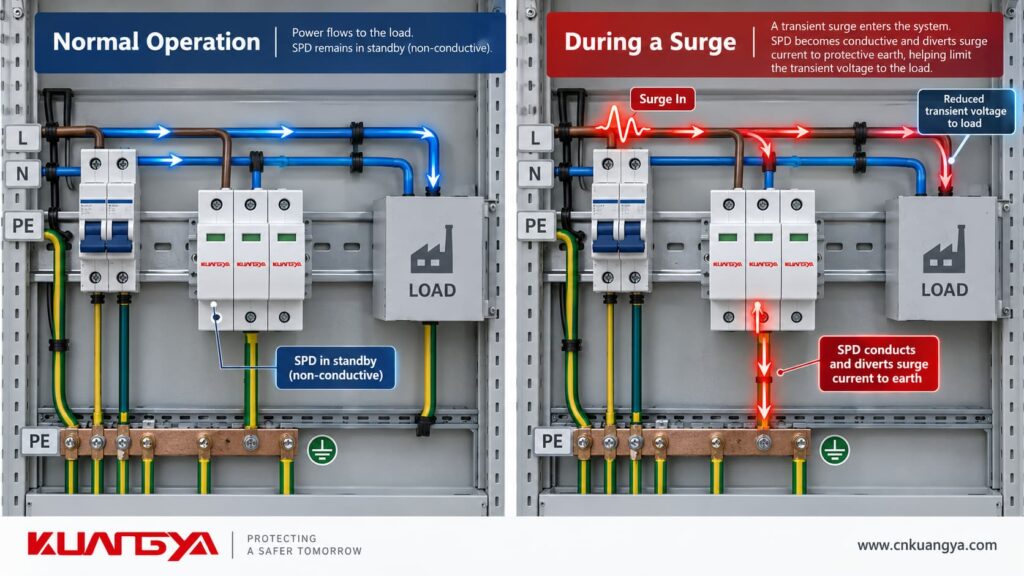
Viele Überspannungsschutzgeräte (SPDs) sind parallel zu dem Stromkreis geschaltet, den sie schützen.
Bei normaler Betriebsspannung befinden sich die spannungsbegrenzenden Komponenten innerhalb des SPD in einem hochohmigen Zustand. Der normale Laststrom muss daher nicht durch das Schutzelement des SPD fließen.
Dies ist auch der Grund, warum SPDs normalerweise parallel installiert werden anstatt einfach in Reihe mit der Last geschaltet zu werden.
Wenn eine transiente Überspannung das SPD erreicht, reagieren dessen Schutzkomponenten.
Bei einem auf MOV basierenden SPD wechselt der Metalloxid-Varistor von einem hochohmigen Zustand in einen leitfähigen Zustand, sobald die Spannung über seinen Betriebsbereich ansteigt.
Das SPD hilft dann:
die transiente Spannung zu begrenzen
und
Stoßströme von empfindlichen Geräten abzuleiten.
Wenn das transiente Ereignis endet, kehrt das Schutzelement normalerweise in seinen hochohmigen Zustand zurück.
Dieses Funktionsprinzip ist grundlegend für Überspannungsschutzgeräte: Sie enthalten nichtlineare Komponenten, die dazu ausgelegt sind, Stoßspannungen zu begrenzen und Stoßströme abzuleiten. Aktuelle IEC-Anforderungen verwenden dieselbe grundlegende Definition.
Daher bedeutet die Tatsache, dass ein SPD während eines Stoßereignisses angesprochen hat, nicht automatisch, dass es defekt ist.
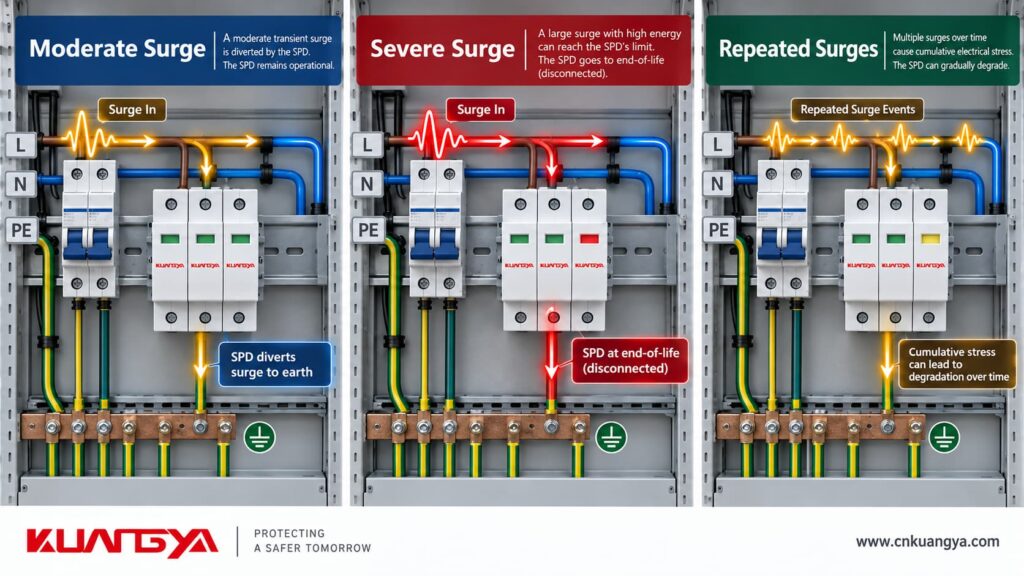
Nicht unbedingt.
Das Ergebnis hängt von Faktoren ab wie:
Ein Stoßstrom, der innerhalb der Leistungsfähigkeit des SPD bleibt, kann bewältigt werden, ohne dass das Gerät das Ende seiner Lebensdauer erreicht.
Ein wesentlich schwerwiegenderes Ereignis kann bereits bei einem einzigen Auftreten zu erheblichen Schäden führen.
Ein SPD ist dafür ausgelegt, auf transiente Überspannungen zu reagieren.
Wenn ein Ereignis innerhalb der vorgesehenen Betriebs- und Stoßstrombelastbarkeit des Produkts bleibt, kann das SPD danach weiterarbeiten.
Deshalb wäre es nicht korrekt, eine Regel wie die folgende anzuwenden:
“Ein Überspannungsereignis = ein Austausch.”
Das Gerät muss gemäß seinem tatsächlichen Zustand bewertet werden.
Ein ausreichend schweres Ereignis kann dazu führen, dass das Schutzelement bereits bei einem einzigen Vorfall das Ende seiner Lebensdauer erreicht.
Abhängig von der Bauart des SPD kann dies zu Folgendem führen:
Das genaue Ausfallverhalten variiert je nach Produktdesign.
Die Degradation eines SPD ist nicht auf ein einzelnes schwerwiegendes Blitzeinschlagereignis beschränkt.
Wiederholte elektrische Belastungen können die elektrischen Eigenschaften eines MOV allmählich beeinträchtigen.
Dies sollte jedoch nicht als einfacher Countdown mit fester Energie beschrieben werden, bei dem jeder Stoßstrom eine identische Menge an verbleibender Lebensdauer verbraucht.
Die Degradation von MOV hängt von der Stärke, Dauer, Wiederholung, Betriebsspannung, Temperatur und anderen Belastungen ab, denen das Bauteil ausgesetzt ist. Die IEC TR 61643-333:2026 befasst sich spezifisch mit charakteristischen Gleichungen und der Lebensdauerbewertung von Zinkoxid-MOVs und verdeutlicht, dass die Lebensdauer eines MOV komplexer ist als eine einfache, feste “Joule-Bilanz”.”
Many Type 2 SPDs use metal oxide varistors as their primary voltage-limiting elements.
Under normal voltage, an MOV has high resistance.
When the applied voltage rises sharply during a transient event, the MOV becomes conductive and helps limit the voltage.
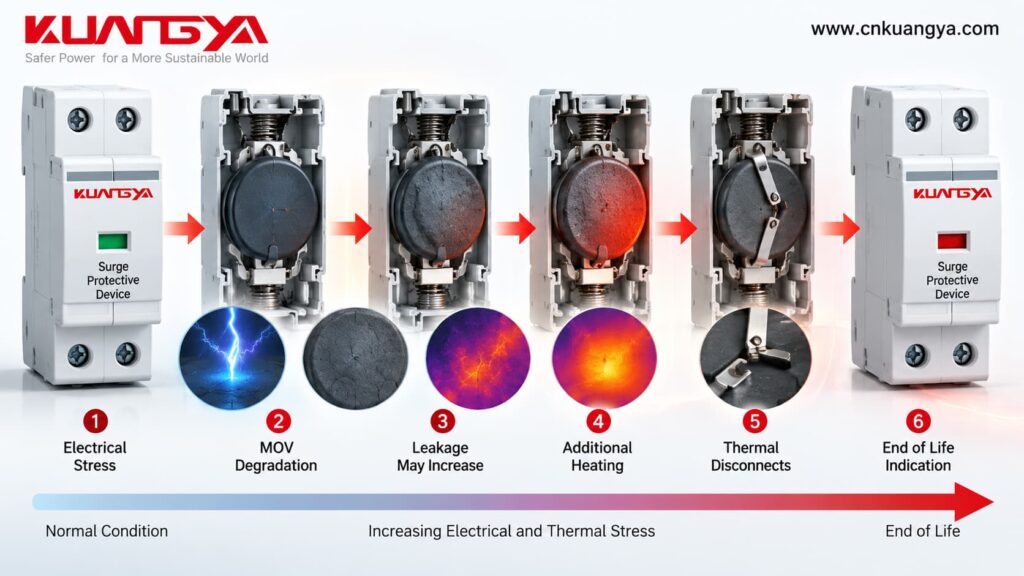
Over time, electrical and thermal stress can change the MOV’s characteristics.
A simplified aging path may look like this:
Repeated electrical stress
↓
Change in MOV characteristics
↓
Possible increase in leakage current
↓
Additional heating
↓
Thermal protection operates if necessary
↓
Protection element disconnects
↓
SPD indicates an end-of-life or fault condition
The precise sequence depends on the SPD design.
Modern MOV-based SPDs commonly include thermal protection because an MOV that becomes unstable or overheated must be safely disconnected from the power system.
For example, Schneider Electric describes some of its SPDs as using thermally protected MOVs and instructs replacement of the module when the corresponding indication shows loss of protection.
This internal disconnection is one reason a failed SPD can sometimes leave the protected equipment powered while surge protection for that mode is no longer available.
There is no single inspection method that applies identically to every SPD.
If you are not sure whether an SPD has failed, see our guide on wie man erkennt, ob ein SPD defekt ist.
However, the following signs usually justify replacement or further investigation.
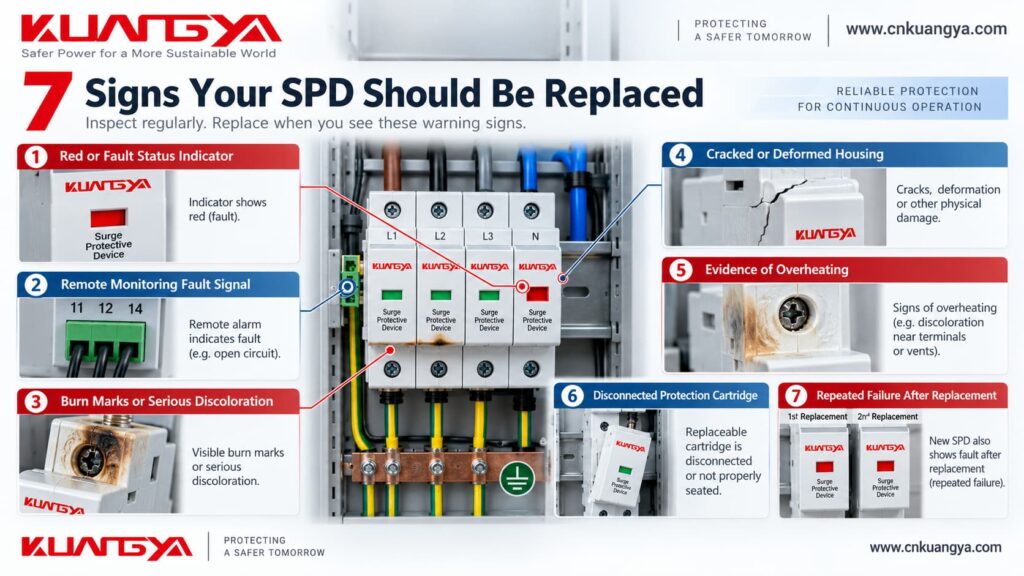
For many pluggable DIN-rail SPDs, the front status window provides the fastest visual indication of the protection module’s condition.
Eine übliche Anordnung ist:
Normal indication → protection element has not reported end of life
Red/fault indication → affected module requires replacement
Zum Beispiel, ABB describes mechanical SPD indicators that change from green to red at end of life and states that once this occurs, the SPD should be changed because protection is no longer guaranteed.
However, indicator colors and meanings are product-specific.
Always check the markings, datasheet, or instructions for the exact SPD you are inspecting.
Do not assume that every SPD from every manufacturer uses the same color logic.
Some SPDs include remote signaling terminals, often using a changeover dry contact with terminals such as:
COM
NO
NC
These contacts allow the SPD’s status to be reported remotely to equipment such as:
When the monitored SPD reaches the state defined by the manufacturer, the remote contact changes state.
But a remote alarm should still be verified.
Check:
The remote contact tells you about the monitored SPD state. It does not directly measure the SPD’s actual surge-clamping performance.
Visible heat damage is not a normal service condition.
Warning signs include:
If these conditions are present, the SPD should not simply be returned to service because its indicator still appears normal.
The circuit should be made safe according to the applicable electrical procedure, and both the SPD and surrounding installation should be inspected.
The cause also matters.
Replacing the SPD without identifying a wiring problem, abnormal system voltage, short-circuit condition, or other fault can result in another failure.
A cracked housing may result from:
Even if the internal condition cannot be seen, physical enclosure damage is a reason to treat the SPD as suspect.
An electrical protection device depends not only on its MOV or other internal component but also on proper insulation, spacing, mechanical connections, and safe containment.
If these have been compromised, replacement is normally the safer maintenance decision.
Not every internal problem immediately produces an obvious red indicator.
If you notice:
disconnect and investigate the equipment using the required safe electrical procedure.
Do not continue using an SPD simply because power is still reaching the protected equipment.
A parallel-connected SPD can lose its protective function while the main circuit continues supplying the load.
Many modular SPDs use plug-in cartridges.
If an internal disconnector has operated and the cartridge indicates end of life, the affected cartridge normally needs replacement.
That does not necessarily mean the complete SPD base must always be replaced.
If:
the manufacturer may allow replacement of the cartridge only.
Schneider Electric, for example, provides model-specific replacement modules for certain modular SPD families rather than requiring replacement of every part of the assembly.
But never assume that a pluggable SPD cartridge is automatically safe to remove while energized.
Pluggable does not mean hot-swappable.
Follow the manufacturer’s instructions and the required electrical isolation procedure before servicing the SPD.
One of the most important warning signs is not the first failure.
Er liegt darin, repeated early failure after replacement.
If a newly installed SPD quickly reaches its fault or end-of-life condition again, simply installing another identical device may not solve the problem.
Investigate possible causes such as:
For PV applications, correct voltage selection is especially important. See how to select the correct DC SPD voltage rating for a solar PV system.
Current IEC SPD requirements specifically consider system and fault conditions such as expected short-circuit current and temporary-overvoltage stresses when evaluating SPD applications.
Repeated failure should therefore be treated as a system-level troubleshooting problem, not merely a replacement problem.
Usually, a manufacturer-defined normal indication means the SPD has not reported its end-of-life condition through that indicator mechanism.
For a deeper explanation, see what an SPD green indicator can and cannot tell you about the protection condition.
But there is an important distinction:
Normal indicator ≠ exact measurement of remaining SPD life.
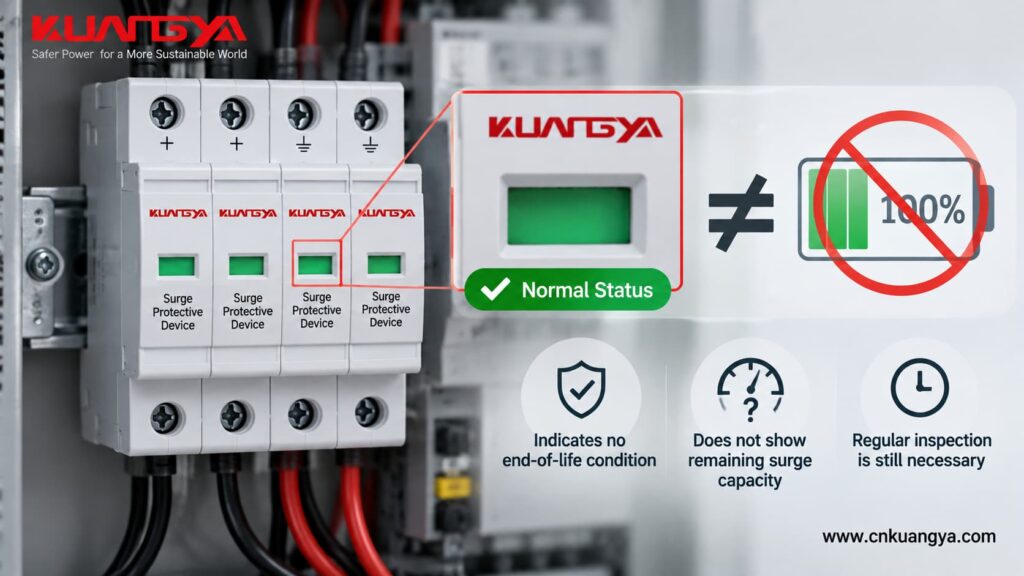
A basic mechanical indicator normally does not tell you:
So avoid statements such as:
“Green means the SPD is 100% healthy.”
oder
“Green means the SPD has full surge capacity remaining.”
A more technically accurate interpretation is:
The SPD’s normal status indication shows that its internal monitoring or disconnection mechanism has not indicated end of life according to the product design.
That is useful information—but it is not the same as a complete electrical performance test.
ABB’s guidance illustrates this distinction well: the mechanical indicator is specifically an end-of-life indicator, changing state when the device reaches the defined replacement condition.
Not automatically—but the inspection should be more thorough.
The words “lightning event” can describe very different electrical stresses.
A distant lightning event that induces a relatively small transient is not the same as a severe nearby or direct lightning-current event.
The correct SPD type and coordinated protection system also matter.
For example, a Type 2 SPD is primarily tested for surge-current conditions different from those associated with the lightning-current testing of a Type 1 SPD.
So after a known major event, check more than just the color window.
Inspect:
If nearby electrical equipment has also been damaged, or the lightning event was unusually severe, a more detailed electrical inspection is justified even when the status window has not changed.
For critical installations, follow the site’s maintenance plan, lightning-protection procedure, and manufacturer-specific recommendations.
For modular SPDs, a failed cartridge does not always require replacing the complete assembly.
Use the physical condition of the base and the manufacturer’s instructions to make the decision.
| Zustand | Replace cartridge only | Replace complete SPD |
|---|---|---|
| One plug-in module reaches end of life | Usually | Not normally necessary if base is sound |
| Base contacts remain clean and undamaged | Usually | Nein |
| Base contacts are burned or damaged | Nein | Ja |
| Base or housing has melted | Nein | Ja |
| Severe corrosion is present | Nein | Usually |
| Mechanical locking system is damaged | Nein | Ja |
| Correct compatible cartridge is unavailable | Nein | Ja |
| Extent of damage cannot be confidently determined after a serious failure | Not preferred | Consider complete replacement |
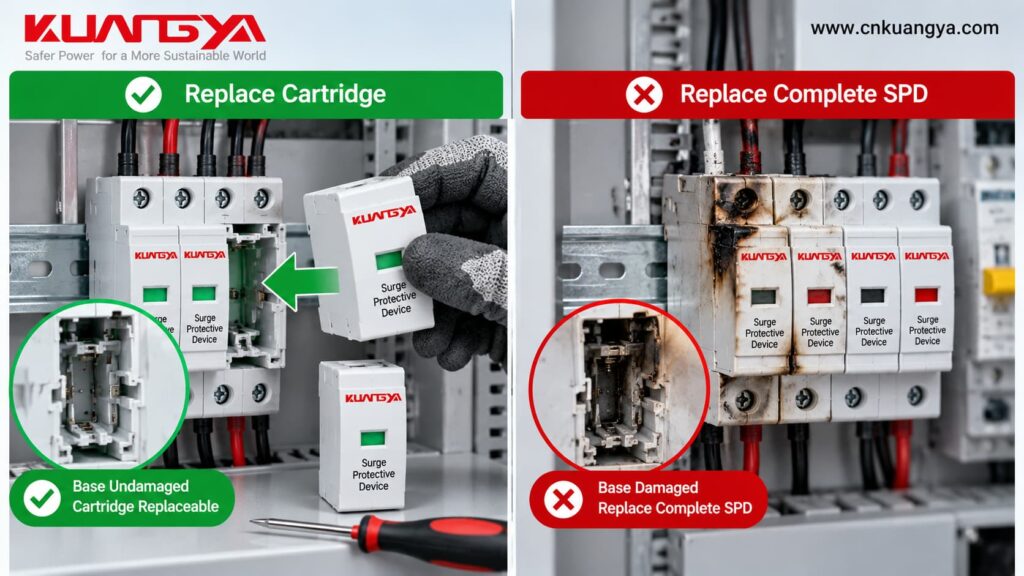
Die wichtigste Regel lautet:
Replace only what the manufacturer allows you to replace.
A cartridge from a different series may physically look similar while having a different Uc, discharge rating, protection level, internal circuit, or coding system.
Always use the specified replacement module.
A practical post-surge inspection can follow seven basic steps.
Start with the front status window.
Look for the manufacturer-defined normal, fault, or end-of-life condition.
If the SPD includes remote contacts, verify whether the monitoring system has received a fault signal.
Compare the result with the manufacturer’s COM/NO/NC diagram.
Prüfen Sie auf:
For a modular SPD, inspect both the plug-in cartridge and the base.
A new cartridge should not be installed into a heat-damaged or mechanically damaged base.
Loose or heat-damaged conductors can affect both safety and surge protection.
Also check the SPD connection conductors and protective-earth connection according to the installation instructions.
In solar PV systems, the distance between the SPD and inverter and the connection lead length can also affect practical surge protection performance.
Ask what happened before the SPD changed state.
Was there:
This information can help distinguish normal end-of-life behavior from a broader installation problem.
If the SPD has reached its defined end-of-life state or shows physical damage, replace the affected component according to the manufacturer’s instructions.
If the condition is uncertain and the application justifies deeper verification, use the appropriate professional SPD testing method or manufacturer-approved test equipment.
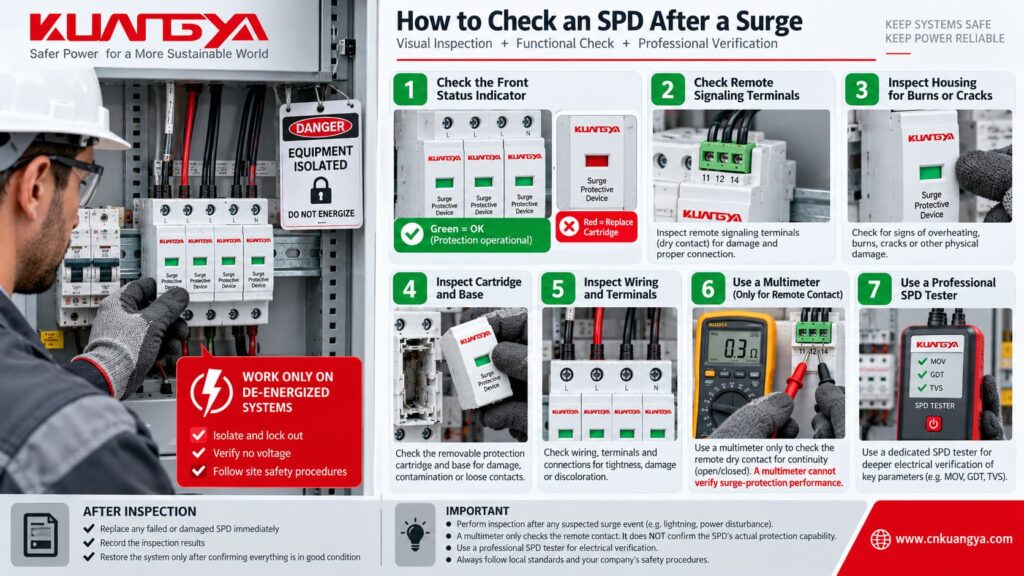
A multimeter can be useful around an SPD, but it cannot fully prove that the SPD still has its original surge-protection performance.
For example, a multimeter may help with:
But an ordinary multimeter does not reproduce the electrical conditions used to determine major SPD parameters such as:
If these ratings are unfamiliar, our Leitfaden für DC-SPD-Spezifikationen explains Ucpv, In, Imax, Up and other common SPD markings in more detail.
Daher:
A successful multimeter continuity or resistance check is not proof that the SPD still meets its original surge-protection specification.
Professional SPD verification may require dedicated equipment capable of testing the relevant electrical characteristics.
Phoenix Contact, for example, provides dedicated CHECKMASTER equipment for electrical testing of compatible pluggable SPDs and notes that visual inspection alone may not reliably determine an SPD’s functional capability.
Also remember that some electrical tests performed elsewhere in an installation can interact with an SPD.
ABB installation guidance, for example, specifies that the SPD should be disconnected before certain insulation testing because the SPD can respond to the test voltage as though it were an overvoltage.
Always follow the SPD and test-equipment manufacturer’s instructions.
For a more complete inspection procedure, see our guide on wie man ein SPD prüft,.
There is no universal fixed service life that applies to every SPD.
It would therefore be misleading to say:
“Every SPD must be replaced after three years.”
oder:
“An SPD always lasts ten years.”
Actual service life depends on many variables, including:
A severe event may cause end of life much earlier than expected.
Another SPD in a relatively quiet installation may remain serviceable for many years.
For that reason, condition-based inspection and manufacturer-defined status indications are generally more useful than assigning one universal expiration date.
Use this quick decision guide after a surge event.
Answer these 5 quick questions to check whether your SPD shows an obvious replacement condition or needs further inspection.
Nein.
SPDs are designed to respond to transient overvoltages. Experiencing a surge does not automatically mean the SPD has reached end of life.
Replace or service it when the manufacturer’s status indication, inspection results, electrical testing, or physical condition shows that it is no longer serviceable.
Ja.
Many SPDs are designed to withstand multiple surge events within their specified capability.
However, the number and severity of events an SPD can withstand cannot be reduced to one universal number because different surge stresses and product designs produce different effects.
Ja.
A sufficiently severe lightning-related event can cause an SPD to reach end of life in one occurrence.
Whether this happens depends on the actual current and voltage stress reaching the SPD, the SPD type and ratings, installation, and the overall lightning and surge protection system.
It normally means the SPD has not indicated its manufacturer-defined end-of-life state through that indicator.
It should not normally be interpreted as an exact measurement of remaining surge capacity.
Always check the product instructions for the specific meaning of its status window.
For SPDs where red is defined as the end-of-life or replacement indication, yes—the affected module or device should be serviced or replaced according to the manufacturer’s instructions.
ABB, for example, states that when its standard SPD indicator changes from green to red at end of life, the SPD must be changed because protection is no longer guaranteed.
If the SPD uses manufacturer-approved replaceable modules and the base remains undamaged, replacing only the affected cartridge may be permitted.
Check that the replacement module has the correct model, voltage rating, and compatibility.
If the base, terminals, housing, or contacts have been damaged, replace the complete affected assembly as required.
Do not assume that you can.
A pluggable design makes maintenance easier, but it does not automatically mean the module is approved for energized replacement.
Follow the manufacturer’s instructions and the required electrical isolation and safety procedure before removing or installing an SPD module.
Not completely.
A multimeter may help test remote contacts or perform limited circuit checks, but it cannot reproduce the surge test conditions needed to verify the SPD’s full protection performance.
Dedicated test equipment or manufacturer-defined electrical testing may be required for more detailed verification.
Do not replace an SPD simply because a surge occurred.
An SPD is specifically designed to respond to transient overvoltage events, and one surge does not automatically mean the device has reached end of life.
Instead, base the decision on the actual condition of the SPD.
Replacement is normally justified when:
A normal status indication and the absence of physical damage generally mean there is no obvious end-of-life indication, but they do not provide an exact measurement of remaining surge capacity.
And if an SPD repeatedly fails shortly after replacement, do not simply install another one.
Investigate the system voltage, Uc or MCOV selection, temporary overvoltage conditions, electrical configuration, wiring, backup protection, and the severity of the surge environment.
The best replacement decision is therefore based not on:
“Did a surge happen?”
but on:
“What does the SPD condition tell us after the surge?”
KUANGYA provides AC and DC surge protective devices for electrical distribution and solar PV applications, including modular designs with visual status indication and optional remote signaling functions for easier inspection and maintenance.
For photovoltaic DC applications, SPD selection should consider factors such as maximum PV system voltage, Ucpv, SPD type, discharge-current ratings, voltage protection level, system configuration, and installation position.
PV-side SPDs are specifically addressed by IEC 61643-31 for photovoltaic installations up to 1500 V DC.
If you need help selecting a replacement SPD, send us your:
AC or DC application + system voltage + required SPD type + quantity
and KUANGYA can help you check a suitable model.

