Zona industrial de WengYang Yueqing Wenzhou 325000
Horas de trabajo
De lunes a viernes: de 7.00 a 19.00 horas
Fin de semana: 10.00 A 17.00 HORAS
Zona industrial de WengYang Yueqing Wenzhou 325000
Horas de trabajo
De lunes a viernes: de 7.00 a 19.00 horas
Fin de semana: 10.00 A 17.00 HORAS

Una pregunta común después de una tormenta eléctrica, un evento de conmutación o una sobretensión inesperada es: ¿es necesario reemplazar un SPD después de una sobretensión?
La respuesta corta es no, no automáticamente.
Un dispositivo de protección contra sobretensiones (SPD) está diseñado para limitar las sobretensiones transitorias y desviar la corriente de sobretensión. Si la sobretensión está dentro de la capacidad del SPD y el dispositivo no ha llegado al final de su vida útil, puede seguir protegiendo el sistema después del evento.
Sin embargo, una sobretensión severa, el estrés eléctrico repetido, una sobretensión temporal, el sobrecalentamiento o la degradación a largo plazo pueden dañar los componentes de protección dentro de un SPD. En estos casos, el módulo de protección puede desconectarse internamente y es posible que el SPD deba ser reemplazado.
Por lo tanto, la pregunta correcta no es simplemente:
“¿Ha experimentado el SPD una sobretensión?”
Es:
“¿En qué estado se encuentra el SPD después de la sobretensión?”
Esta guía explica qué le sucede a un SPD durante una sobretensión, cómo reconocer los signos de daño, qué significa realmente un indicador de estado verde o rojo, y cuándo debe reemplazar el módulo de protección o el SPD completo.
Si un SPD debe ser reemplazado depende de su estado después del evento.
| Estado del SPD después de la sobretensión | ¿Reemplazarlo? | Acción recomendada |
|---|---|---|
| Indicación de estado normal y sin daños visibles | No automáticamente | Continuar la inspección de acuerdo con las instrucciones del fabricante |
| Indicación de color rojo o de fin de vida útil | Generalmente sí | Reemplazar el módulo afectado o el SPD según lo especificado por el fabricante |
| La señalización remota informa de un fallo | Investigar inmediatamente | Verificar el estado del SPD y el circuito de contacto remoto |
| Marcas de quemaduras, derretimiento o decoloración grave | Sí | Aísle el circuito según sea necesario, reemplace el SPD dañado e investigue la causa |
| Carcasa agrietada o deformada | Sí | No siga confiando en el SPD dañado |
| Un cartucho reemplazable ha llegado al final de su vida útil | Generalmente el cartucho | Inspeccione la base y utilice el módulo de repuesto correcto |
| Evento de rayo importante pero el indicador permanece normal | No automáticamente | Realizar una inspección más detallada |
| El SPD de reemplazo falla prematuramente de forma repetida | No se limite a seguir reemplazándolo | Investigar la tensión del sistema, las sobretensiones temporales (TOV), la selección del SPD, el cableado y las condiciones de instalación |
El punto importante es que un evento de sobretensión por sí solo no es una indicación de fin de vida útil.
El estado real del SPD y las instrucciones de mantenimiento del fabricante deben determinar el siguiente paso.
Vea esta breve explicación antes de decidir si reemplazar un SPD después de una sobretensión.
Para entender por qué un SPD no necesita ser reemplazado necesariamente después de cada sobretensión, es útil comprender qué hace realmente el dispositivo.
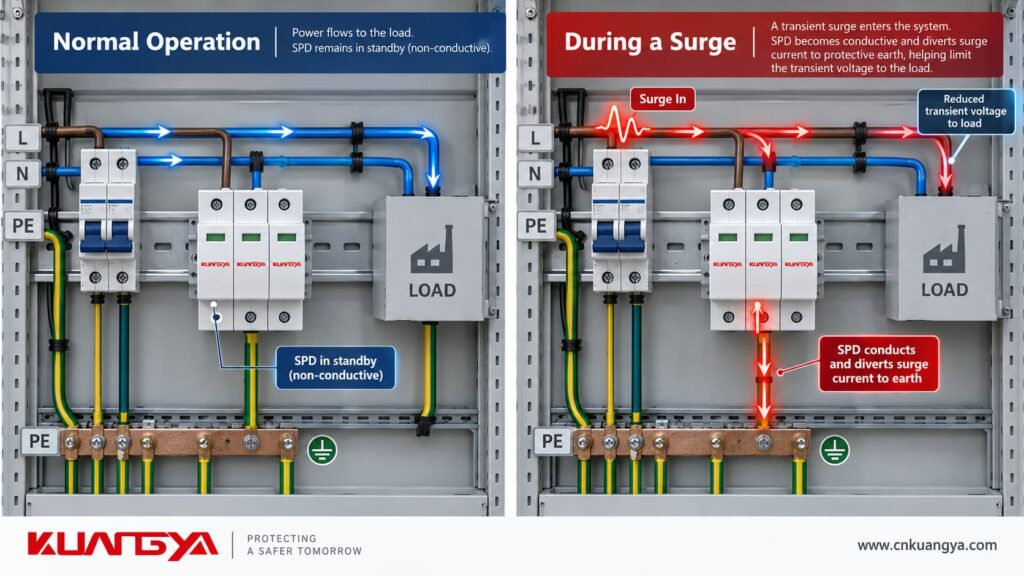
Muchos SPD de potencia se conectan en paralelo con el circuito que protegen.
Durante la tensión de funcionamiento normal, los componentes limitadores de tensión dentro del SPD permanecen en un estado de alta impedancia. Por lo tanto, la corriente de carga normal no necesita fluir a través del elemento de protección del SPD.
Esta es también la razón por la cual los SPD se instalan normalmente en paralelo en lugar de simplemente colocarse en serie con la carga.
Cuando una sobretensión transitoria llega al SPD, sus componentes de protección responden.
En un SPD basado en MOV, el varistor de óxido metálico cambia de un estado de alta impedancia a un estado conductor a medida que el voltaje supera su región de operación.
El SPD entonces ayuda a:
limitar el voltaje transitorio
y
desviar la corriente de sobretensión lejos de los equipos sensibles.
Cuando el evento transitorio termina, el elemento de protección normalmente regresa a su estado de alta impedancia.
Este principio de funcionamiento es fundamental para los dispositivos de protección contra sobretensiones: contienen componentes no lineales diseñados para limitar el voltaje de sobretensión y desviar la corriente de sobretensión. Los requisitos actuales de la IEC utilizan la misma definición básica.
Por lo tanto, el hecho de que un SPD haya operado durante una sobretensión no significa por sí mismo que haya fallado.
No necesariamente.
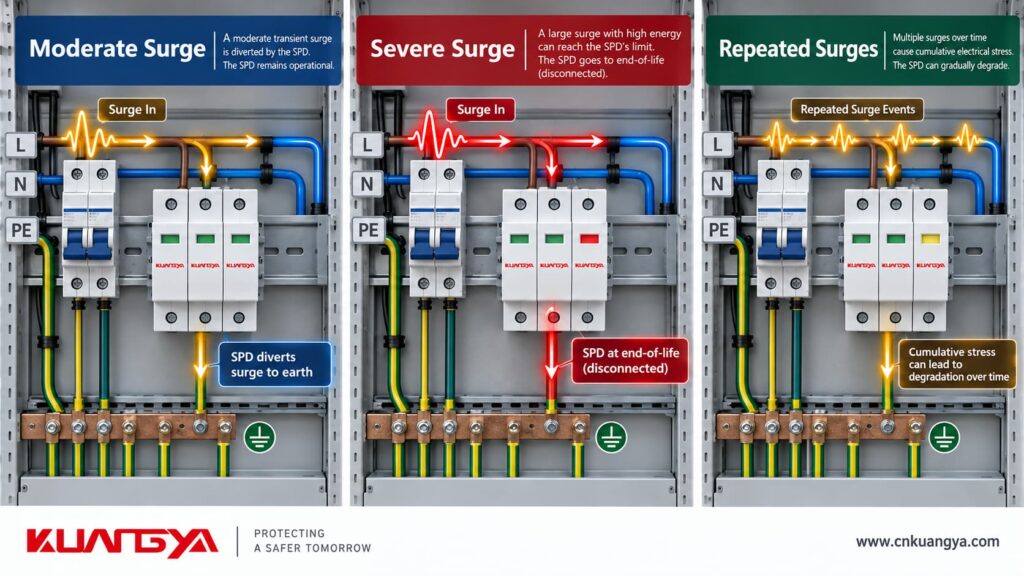
El resultado depende de factores tales como:
Una sobretensión que se mantiene dentro de la capacidad del SPD puede ser gestionada sin causar que el dispositivo llegue al final de su vida útil.
Un evento mucho más severo puede causar daños significativos en una sola ocurrencia.
Un SPD está diseñado para responder a sobretensiones transitorias.
Si un evento se mantiene dentro de la capacidad operativa y de manejo de sobretensiones prevista para el producto, el SPD puede seguir funcionando después.
Por esta razón, sería incorrecto aplicar una regla como:
“Una sobretensión = un reemplazo”.”
El dispositivo debe evaluarse de acuerdo con su condición real.
Un evento lo suficientemente severo puede hacer que el elemento de protección alcance su fin de vida útil en un solo suceso.
Dependiendo del diseño del SPD, esto puede resultar en:
El comportamiento exacto ante fallos varía según el diseño del producto.
La degradación del SPD tampoco se limita a un único evento de rayo importante.
Las tensiones eléctricas repetidas pueden afectar gradualmente las características eléctricas de un MOV.
Sin embargo, esto no debe describirse como una simple cuenta regresiva de energía fija donde cada sobretensión elimina una cantidad idéntica de vida útil restante.
La degradación de los MOV depende de la magnitud, duración, repetición, tensión de funcionamiento, temperatura y otros esfuerzos aplicados al componente. La norma IEC TR 61643-333:2026 aborda específicamente las ecuaciones características y la evaluación de la vida útil de los MOV de óxido de zinc, ilustrando que la vida útil de un MOV es más compleja que un simple “balance de julios” fijo.”
Many Type 2 SPDs use metal oxide varistors as their primary voltage-limiting elements.
Under normal voltage, an MOV has high resistance.
When the applied voltage rises sharply during a transient event, the MOV becomes conductive and helps limit the voltage.
Over time, electrical and thermal stress can change the MOV’s characteristics.
A simplified aging path may look like this:
Repeated electrical stress
↓
Change in MOV characteristics
↓
Possible increase in leakage current
↓
Additional heating
↓
Thermal protection operates if necessary
↓
Protection element disconnects
↓
SPD indicates an end-of-life or fault condition
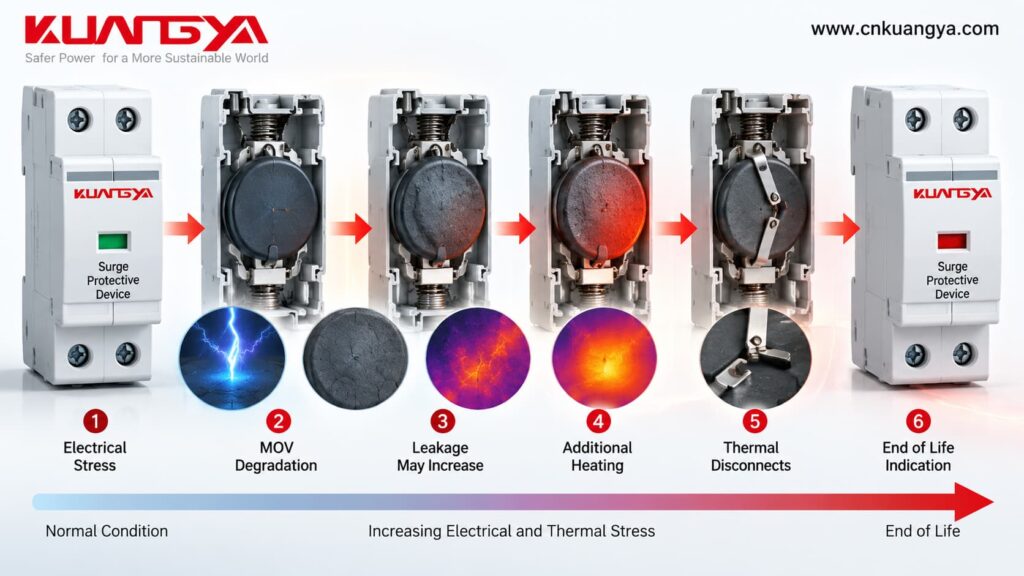
The precise sequence depends on the SPD design.
Modern MOV-based SPDs commonly include thermal protection because an MOV that becomes unstable or overheated must be safely disconnected from the power system.
For example, Schneider Electric describes some of its SPDs as using thermally protected MOVs and instructs replacement of the module when the corresponding indication shows loss of protection.
This internal disconnection is one reason a failed SPD can sometimes leave the protected equipment powered while surge protection for that mode is no longer available.
There is no single inspection method that applies identically to every SPD.
If you are not sure whether an SPD has failed, see our guide on cómo saber si un SPD está defectuoso.
However, the following signs usually justify replacement or further investigation.
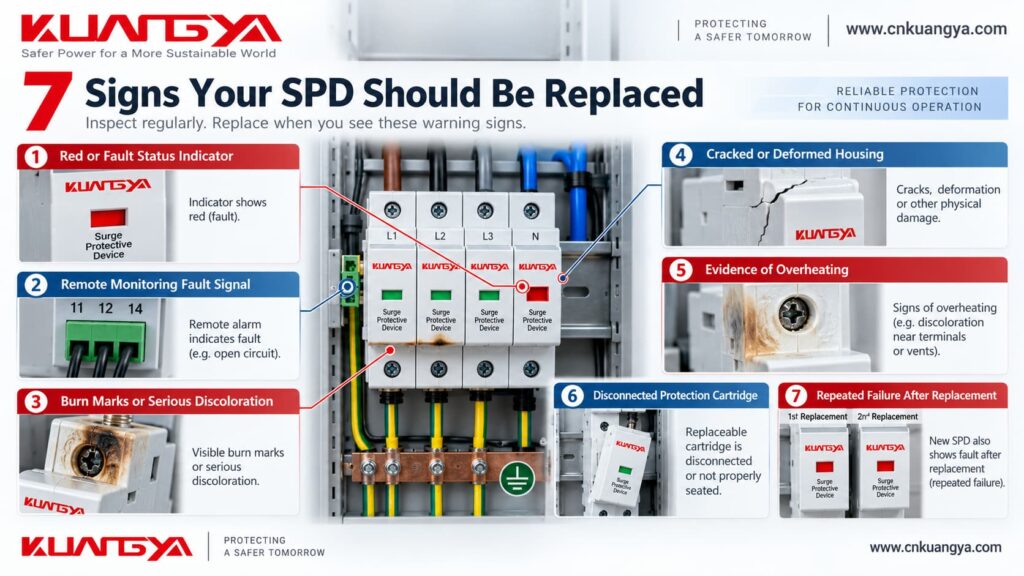
For many pluggable DIN-rail SPDs, the front status window provides the fastest visual indication of the protection module’s condition.
Una disposición común es:
Normal indication → protection element has not reported end of life
Red/fault indication → affected module requires replacement
Por ejemplo, ABB describes mechanical SPD indicators that change from green to red at end of life and states that once this occurs, the SPD should be changed because protection is no longer guaranteed.
However, indicator colors and meanings are product-specific.
Always check the markings, datasheet, or instructions for the exact SPD you are inspecting.
Do not assume that every SPD from every manufacturer uses the same color logic.
Some SPDs include remote signaling terminals, often using a changeover dry contact with terminals such as:
COM
NO
NC
These contacts allow the SPD’s status to be reported remotely to equipment such as:
When the monitored SPD reaches the state defined by the manufacturer, the remote contact changes state.
But a remote alarm should still be verified.
Check:
The remote contact tells you about the monitored SPD state. It does not directly measure the SPD’s actual surge-clamping performance.
Visible heat damage is not a normal service condition.
Warning signs include:
If these conditions are present, the SPD should not simply be returned to service because its indicator still appears normal.
The circuit should be made safe according to the applicable electrical procedure, and both the SPD and surrounding installation should be inspected.
The cause also matters.
Replacing the SPD without identifying a wiring problem, abnormal system voltage, short-circuit condition, or other fault can result in another failure.
A cracked housing may result from:
Even if the internal condition cannot be seen, physical enclosure damage is a reason to treat the SPD as suspect.
An electrical protection device depends not only on its MOV or other internal component but also on proper insulation, spacing, mechanical connections, and safe containment.
If these have been compromised, replacement is normally the safer maintenance decision.
Not every internal problem immediately produces an obvious red indicator.
If you notice:
disconnect and investigate the equipment using the required safe electrical procedure.
Do not continue using an SPD simply because power is still reaching the protected equipment.
A parallel-connected SPD can lose its protective function while the main circuit continues supplying the load.
Many modular SPDs use plug-in cartridges.
If an internal disconnector has operated and the cartridge indicates end of life, the affected cartridge normally needs replacement.
That does not necessarily mean the complete SPD base must always be replaced.
If:
the manufacturer may allow replacement of the cartridge only.
Schneider Electric, for example, provides model-specific replacement modules for certain modular SPD families rather than requiring replacement of every part of the assembly.
But never assume that a pluggable SPD cartridge is automatically safe to remove while energized.
Pluggable does not mean hot-swappable.
Follow the manufacturer’s instructions and the required electrical isolation procedure before servicing the SPD.
One of the most important warning signs is not the first failure.
Es repeated early failure after replacement.
If a newly installed SPD quickly reaches its fault or end-of-life condition again, simply installing another identical device may not solve the problem.
Investigate possible causes such as:
For PV applications, correct voltage selection is especially important. See how to select the correct DC SPD voltage rating for a solar PV system.
Current IEC SPD requirements specifically consider system and fault conditions such as expected short-circuit current and temporary-overvoltage stresses when evaluating SPD applications.
Repeated failure should therefore be treated as a system-level troubleshooting problem, not merely a replacement problem.
Usually, a manufacturer-defined normal indication means the SPD has not reported its end-of-life condition through that indicator mechanism.
For a deeper explanation, see what an SPD green indicator can and cannot tell you about the protection condition.
But there is an important distinction:
Normal indicator ≠ exact measurement of remaining SPD life.
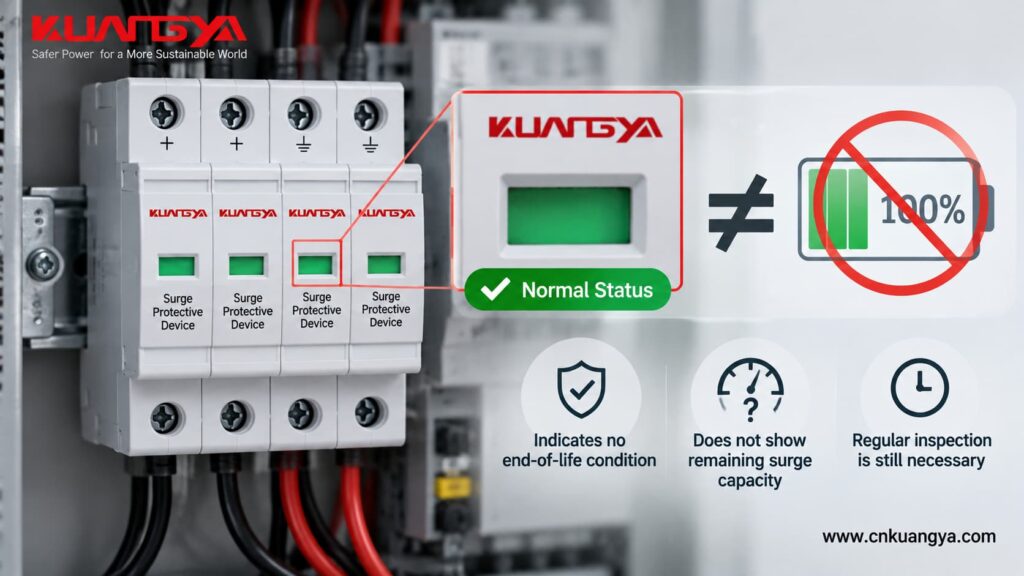
A basic mechanical indicator normally does not tell you:
So avoid statements such as:
“Green means the SPD is 100% healthy.”
o
“Green means the SPD has full surge capacity remaining.”
A more technically accurate interpretation is:
The SPD’s normal status indication shows that its internal monitoring or disconnection mechanism has not indicated end of life according to the product design.
That is useful information—but it is not the same as a complete electrical performance test.
ABB’s guidance illustrates this distinction well: the mechanical indicator is specifically an end-of-life indicator, changing state when the device reaches the defined replacement condition.
Not automatically—but the inspection should be more thorough.
The words “lightning event” can describe very different electrical stresses.
A distant lightning event that induces a relatively small transient is not the same as a severe nearby or direct lightning-current event.
The correct SPD type and coordinated protection system also matter.
For example, a Type 2 SPD is primarily tested for surge-current conditions different from those associated with the lightning-current testing of a Type 1 SPD.
So after a known major event, check more than just the color window.
Inspect:
If nearby electrical equipment has also been damaged, or the lightning event was unusually severe, a more detailed electrical inspection is justified even when the status window has not changed.
For critical installations, follow the site’s maintenance plan, lightning-protection procedure, and manufacturer-specific recommendations.
For modular SPDs, a failed cartridge does not always require replacing the complete assembly.
Use the physical condition of the base and the manufacturer’s instructions to make the decision.
| Condición | Replace cartridge only | Replace complete SPD |
|---|---|---|
| One plug-in module reaches end of life | Usually | Not normally necessary if base is sound |
| Base contacts remain clean and undamaged | Usually | No |
| Base contacts are burned or damaged | No | Sí |
| Base or housing has melted | No | Sí |
| Severe corrosion is present | No | Usually |
| Mechanical locking system is damaged | No | Sí |
| Correct compatible cartridge is unavailable | No | Sí |
| Extent of damage cannot be confidently determined after a serious failure | Not preferred | Consider complete replacement |
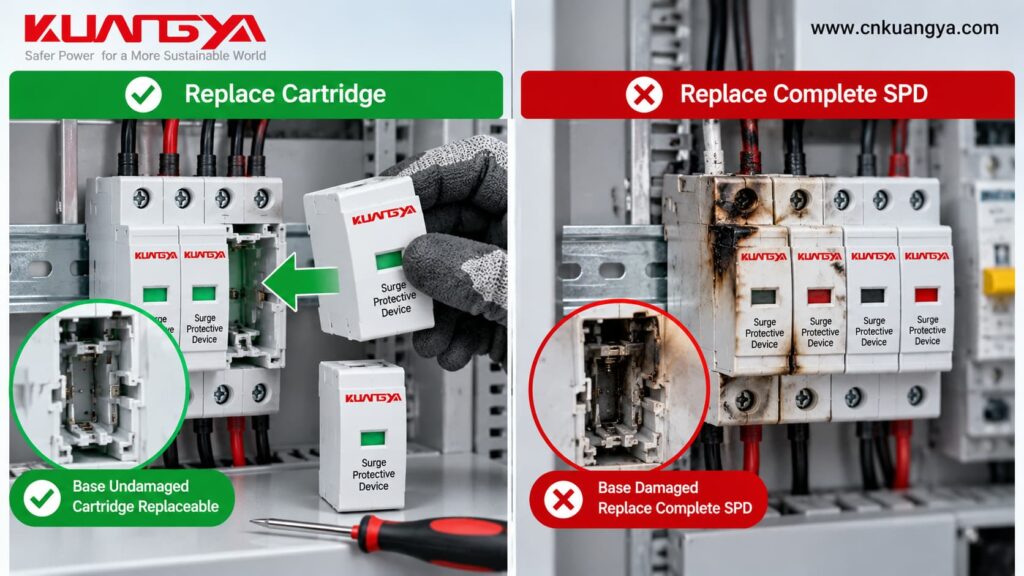
La regla más importante es:
Replace only what the manufacturer allows you to replace.
A cartridge from a different series may physically look similar while having a different Uc, discharge rating, protection level, internal circuit, or coding system.
Always use the specified replacement module.
A practical post-surge inspection can follow seven basic steps.
Start with the front status window.
Look for the manufacturer-defined normal, fault, or end-of-life condition.
If the SPD includes remote contacts, verify whether the monitoring system has received a fault signal.
Compare the result with the manufacturer’s COM/NO/NC diagram.
Compruébalo:
For a modular SPD, inspect both the plug-in cartridge and the base.
A new cartridge should not be installed into a heat-damaged or mechanically damaged base.
Loose or heat-damaged conductors can affect both safety and surge protection.
Also check the SPD connection conductors and protective-earth connection according to the installation instructions.
In solar PV systems, the distance between the SPD and inverter and the connection lead length can also affect practical surge protection performance.
Ask what happened before the SPD changed state.
Was there:
This information can help distinguish normal end-of-life behavior from a broader installation problem.
If the SPD has reached its defined end-of-life state or shows physical damage, replace the affected component according to the manufacturer’s instructions.
If the condition is uncertain and the application justifies deeper verification, use the appropriate professional SPD testing method or manufacturer-approved test equipment.
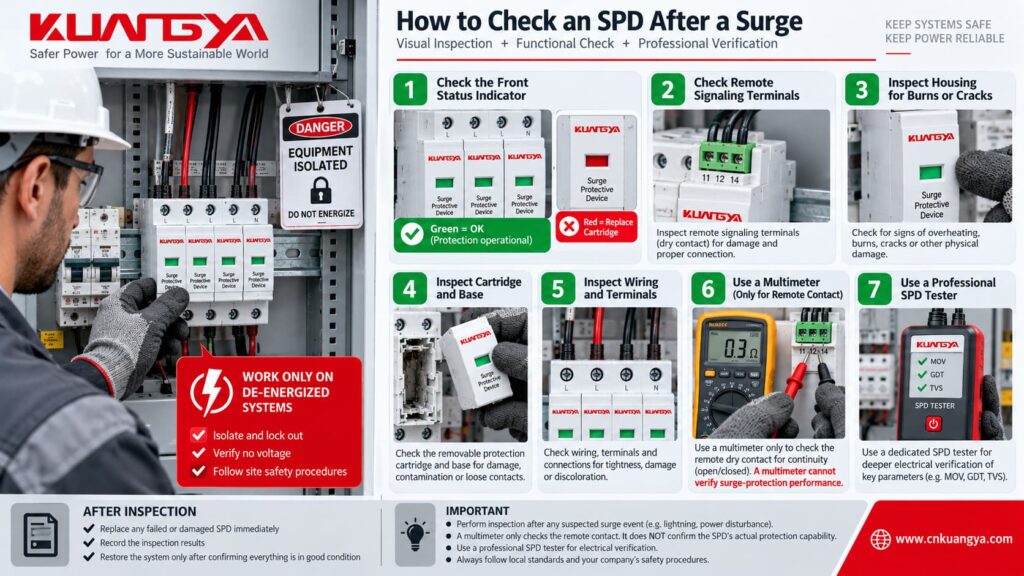
A multimeter can be useful around an SPD, but it cannot fully prove that the SPD still has its original surge-protection performance.
For example, a multimeter may help with:
But an ordinary multimeter does not reproduce the electrical conditions used to determine major SPD parameters such as:
If these ratings are unfamiliar, our Guía de especificaciones de SPD de CC explains Ucpv, In, Imax, Up and other common SPD markings in more detail.
Por lo tanto:
A successful multimeter continuity or resistance check is not proof that the SPD still meets its original surge-protection specification.
Professional SPD verification may require dedicated equipment capable of testing the relevant electrical characteristics.
Phoenix Contact, for example, provides dedicated CHECKMASTER equipment for electrical testing of compatible pluggable SPDs and notes that visual inspection alone may not reliably determine an SPD’s functional capability.
Also remember that some electrical tests performed elsewhere in an installation can interact with an SPD.
ABB installation guidance, for example, specifies that the SPD should be disconnected before certain insulation testing because the SPD can respond to the test voltage as though it were an overvoltage.
Always follow the SPD and test-equipment manufacturer’s instructions.
For a more complete inspection procedure, see our guide on cómo probar un SPD.
There is no universal fixed service life that applies to every SPD.
It would therefore be misleading to say:
“Every SPD must be replaced after three years.”
o:
“An SPD always lasts ten years.”
Actual service life depends on many variables, including:
A severe event may cause end of life much earlier than expected.
Another SPD in a relatively quiet installation may remain serviceable for many years.
For that reason, condition-based inspection and manufacturer-defined status indications are generally more useful than assigning one universal expiration date.
Use this quick decision guide after a surge event.
Answer these 5 quick questions to check whether your SPD shows an obvious replacement condition or needs further inspection.
No.
SPDs are designed to respond to transient overvoltages. Experiencing a surge does not automatically mean the SPD has reached end of life.
Replace or service it when the manufacturer’s status indication, inspection results, electrical testing, or physical condition shows that it is no longer serviceable.
Sí.
Many SPDs are designed to withstand multiple surge events within their specified capability.
However, the number and severity of events an SPD can withstand cannot be reduced to one universal number because different surge stresses and product designs produce different effects.
Sí.
A sufficiently severe lightning-related event can cause an SPD to reach end of life in one occurrence.
Whether this happens depends on the actual current and voltage stress reaching the SPD, the SPD type and ratings, installation, and the overall lightning and surge protection system.
It normally means the SPD has not indicated its manufacturer-defined end-of-life state through that indicator.
It should not normally be interpreted as an exact measurement of remaining surge capacity.
Always check the product instructions for the specific meaning of its status window.
For SPDs where red is defined as the end-of-life or replacement indication, yes—the affected module or device should be serviced or replaced according to the manufacturer’s instructions.
ABB, for example, states that when its standard SPD indicator changes from green to red at end of life, the SPD must be changed because protection is no longer guaranteed.
If the SPD uses manufacturer-approved replaceable modules and the base remains undamaged, replacing only the affected cartridge may be permitted.
Check that the replacement module has the correct model, voltage rating, and compatibility.
If the base, terminals, housing, or contacts have been damaged, replace the complete affected assembly as required.
Do not assume that you can.
A pluggable design makes maintenance easier, but it does not automatically mean the module is approved for energized replacement.
Follow the manufacturer’s instructions and the required electrical isolation and safety procedure before removing or installing an SPD module.
Not completely.
A multimeter may help test remote contacts or perform limited circuit checks, but it cannot reproduce the surge test conditions needed to verify the SPD’s full protection performance.
Dedicated test equipment or manufacturer-defined electrical testing may be required for more detailed verification.
Do not replace an SPD simply because a surge occurred.
An SPD is specifically designed to respond to transient overvoltage events, and one surge does not automatically mean the device has reached end of life.
Instead, base the decision on the actual condition of the SPD.
Replacement is normally justified when:
A normal status indication and the absence of physical damage generally mean there is no obvious end-of-life indication, but they do not provide an exact measurement of remaining surge capacity.
And if an SPD repeatedly fails shortly after replacement, do not simply install another one.
Investigate the system voltage, Uc or MCOV selection, temporary overvoltage conditions, electrical configuration, wiring, backup protection, and the severity of the surge environment.
The best replacement decision is therefore based not on:
“Did a surge happen?”
but on:
“What does the SPD condition tell us after the surge?”
KUANGYA provides AC and DC surge protective devices for electrical distribution and solar PV applications, including modular designs with visual status indication and optional remote signaling functions for easier inspection and maintenance.
For photovoltaic DC applications, SPD selection should consider factors such as maximum PV system voltage, Ucpv, SPD type, discharge-current ratings, voltage protection level, system configuration, and installation position.
PV-side SPDs are specifically addressed by IEC 61643-31 for photovoltaic installations up to 1500 V DC.
If you need help selecting a replacement SPD, send us your:
AC or DC application + system voltage + required SPD type + quantity
and KUANGYA can help you check a suitable model.

