温州市岳陽工業区 325000
勤務時間
月曜日~金曜日:午前7時~午後7時
週末午前10時~午後5時
温州市岳陽工業区 325000
勤務時間
月曜日~金曜日:午前7時~午後7時
週末午前10時~午後5時

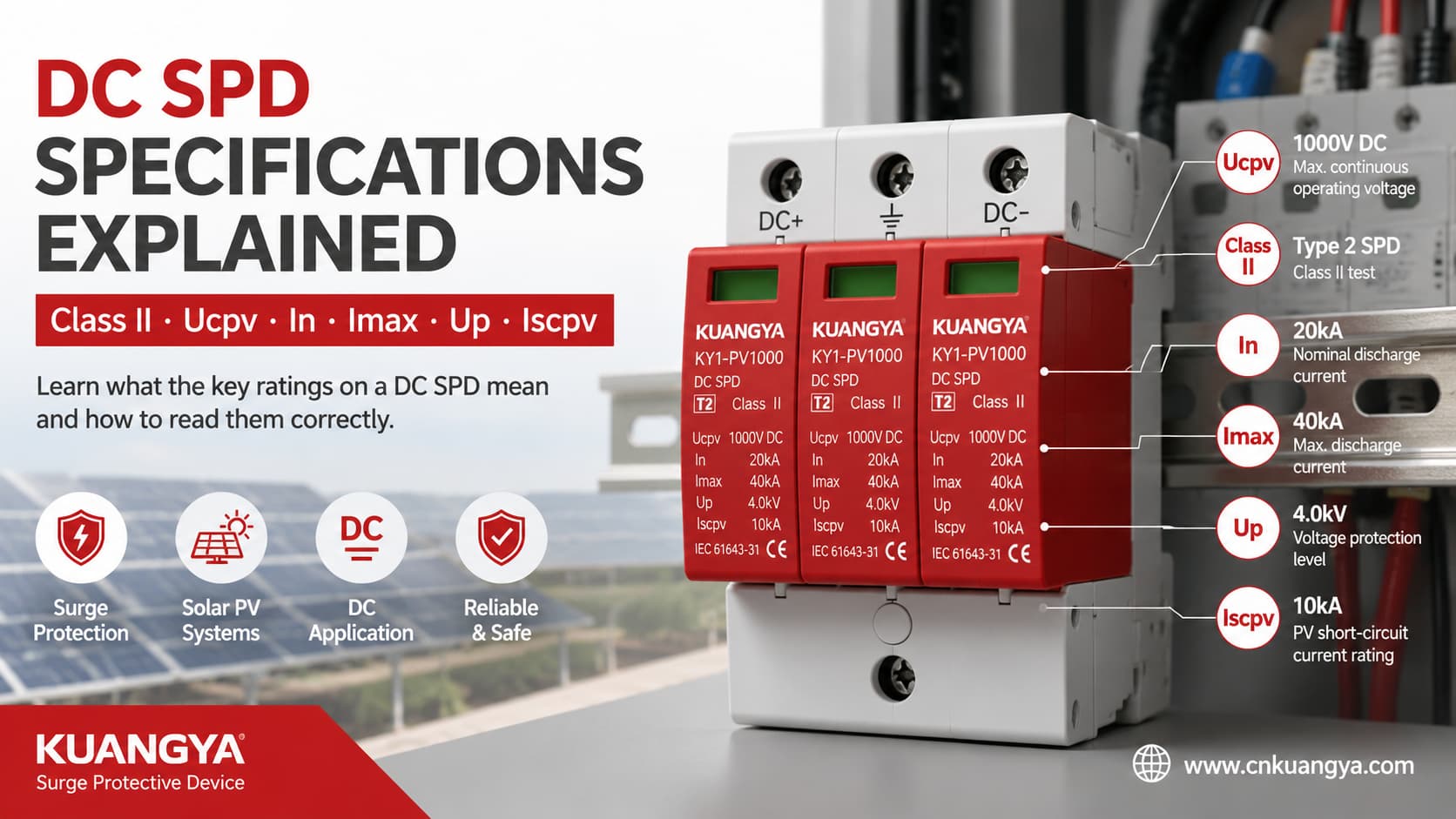
DCサージ保護デバイス(SPD)は外見上は単純に見えるかもしれませんが、ラベルに記載された表示には、そのSPDがどこで使用可能か、どのような性能を持つかという重要な情報が含まれています。.
1000V DC太陽光発電用SPDの以下の例を検討してください:
Ucpv: 1000V DC
クラスII
In: 20kA
Imax: 40kA
Up: 4.0kV
Iscpv: 10kA
-40°C ~ +85°C
屋内用、IP20
経験豊富な電気エンジニアにとって、これらの略語は馴染み深いものです。.
しかし、バイヤー、販売代理店、太陽光発電設備業者、あるいはプロジェクトの購買担当者にとっては、混乱を招きやすいものです。.
Does クラスII は、クラスIIのSPDを意味しますか?
Is 40kA Imax 20kAよりも自動的に優れているということですか?
なぜ同じSPDに両方が表示されているのですか? 1000V そして 4.0kV?
Does Iscpv 10kA SPDが10kAの雷サージを放電できるという意味ですか?
結論から言うと: 単一の数値だけでSPDのすべてを説明することはできません。.
DC SPDは、電気的特性の完全なセットとして読み解く必要があります。サージ保護が初めての場合は、まず以下を理解してください。 太陽光発電システムにおけるDC SPDの仕組み これらの仕様をより理解しやすくすることができます。.
本ガイドでは、それらの表記を正しく読み解く方法を解説します。 クラスII 1000V DC SPD を実例として使用します。.
DC SPD銘板の主要な表示内容の読み方について、このクイックガイドをご覧ください。.
技術的な詳細に入る前に、以下の表で概要を簡潔に説明します。.
| マーキング | 例 | 単純な意味 |
|---|---|---|
| Ucpv | DC1000V | PVアプリケーションにおける最大連続動作電圧 |
| クラスII | クラスII | クラスII試験済みSPD、タイプ2サージ保護に関連 |
| で | 20kA | 公称放電電流 |
| アイマックス | 40kA | 最大放電電流 |
| 上へ | 4.0kV | 規定電圧保護レベル |
| Iscpv | 10kA | SPDのPV短絡電流定格 |
| 温度 | -40°C ~ +85°C | 規定動作温度範囲 |
| 湿度 | 5%–95% | 規定湿度範囲 |
| 屋内用 | 屋内用 | 保護された設置環境向け |
| IP20 | IP20 | SPD筐体の保護等級 |
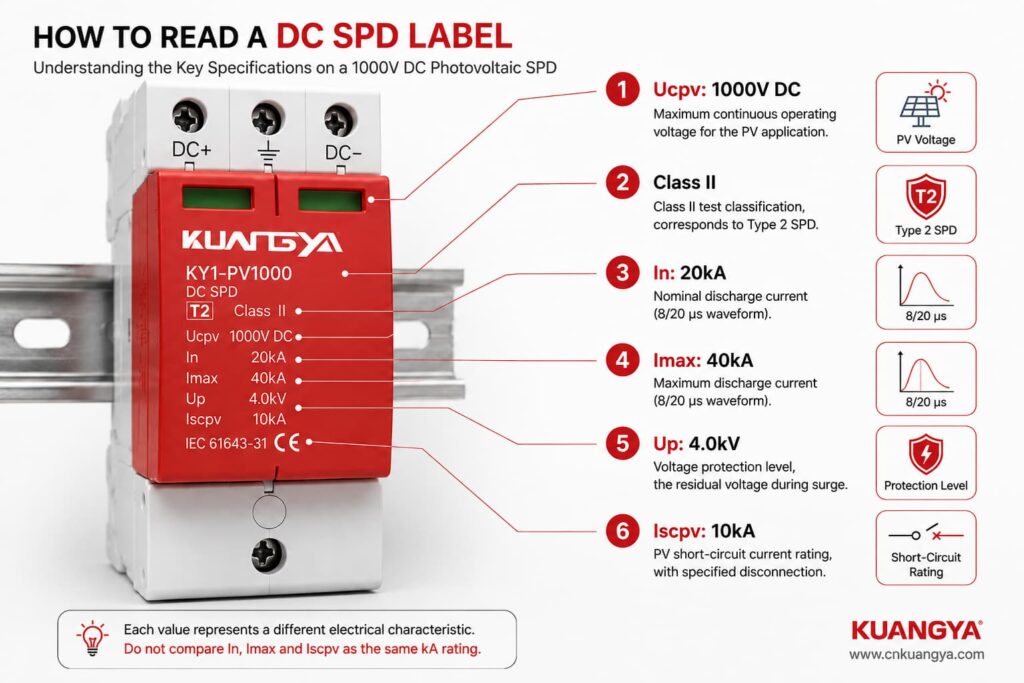
最も重要な点は以下の通りです。
DC SPDをラベルに記載された最大のkA数値のみで比較しないでください。.
例えば、, Imax 40kA, In 20kA そして Iscpv 10kA これらはすべてkAという単位を使用していますが、全く異なる特性を示しています。.
SPDのデータシートを初めて見る際、購入者は多くの場合、最も大きな数値から確認しがちです。.
それは通常、誤ったアプローチです。.
より適切な読み取り順序は以下の通りです。
この順序により、見出しのサージ電流値を比較する前に、不適切な製品を排除することができます。.
VIOXは、データシートガイドにおいて同様の「不適合な仕様を先に排除する」アプローチを採用しています。PVアプリケーションの場合、UcpvおよびPV短絡時の挙動に特別な注意が必要となるため、この論理はさらに重要になります。.
サンプルラベルにある最初の表示の一つは以下の通りです:
クラスII
これは~を行います ない 第2種品質を意味する。.
クラスI、クラスII、クラスIIIは、製品の品質等級ではなく、SPDの標準化された試験分類を指す。.
太陽光発電用サージ防護デバイス(SPD)において、タイプ2 SPDは以下に関連付けられる。 クラスII試験.
これが、メーカーやデータシートによって以下のような表記が使われる理由である。
それらは密接に関連した分類および試験の概念を指しているが、技術的には “「タイプ」と「試験クラス」は、単に同じ用語の異なる綴りというわけではない。.
ほとんどの購入者にとって、実用的な関係性は以下のように理解できる。
| SPDの分類 | 試験クラス | 主な電流パラメータ | 一般的な試験波形 |
|---|---|---|---|
| タイプ1 | クラスI | インプ | 10/350 μs |
| タイプ2 | クラスII | イン / アイマックス | 8/20 μs |
| タイプ3 | クラスIII | その他の協調試験パラメータ | 複合波試験 |
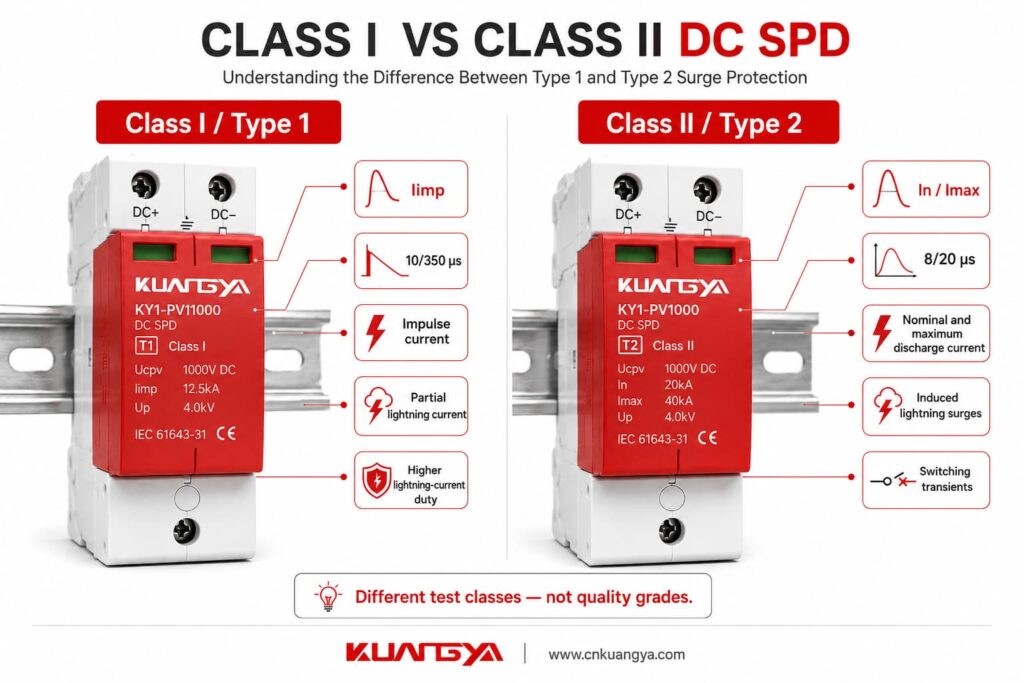
本記事の例については:
クラスII → タイプ2の適用方向
したがって、示されている最も重要な電流パラメータは以下の通りです:
In = 20kA
Imax = 40kA
そうだ。.
これはSPDを比較する際によくある誤解の一つです。.
クラスIおよびクラスIIという言葉は、順位付けのように聞こえる場合があります:
クラスI = より優れている
クラスII = より安価または性能が低い
SPDの分類はそのような仕組みではありません。.
それらは~を目的としています 異なるサージ条件.
タイプ1 / クラスI SPDは、設置場所で雷電流の一部を処理する必要がある場合を想定し、雷インパルス電流耐量について評価されています。.
タイプ2 / クラスII SPDは、誘導雷や開閉サージによって引き起こされる過渡過電圧を抑制するために一般的に使用されます。.
したがって、正しい問いは以下ではありません。
どちらのクラスが優れているか?
正しくは次の通りです。
この設置箇所にはどのタイプのSPDが必要ですか?
タイプ1のSPDがすべての太陽光発電設備に自動的に適しているわけではなく、タイプ1が存在するからといってタイプ2のSPDが不十分であるとは限りません。.
この選定に関する詳細な説明が必要な場合は、当社のガイドをご覧ください:
太陽光発電用DC SPDのタイプ1、タイプ2、タイプ1+2の比較
既存の記事では、雷への曝露、設置場所、およびタイプ1の性能を評価すべきタイミングについて詳しく解説しています。.
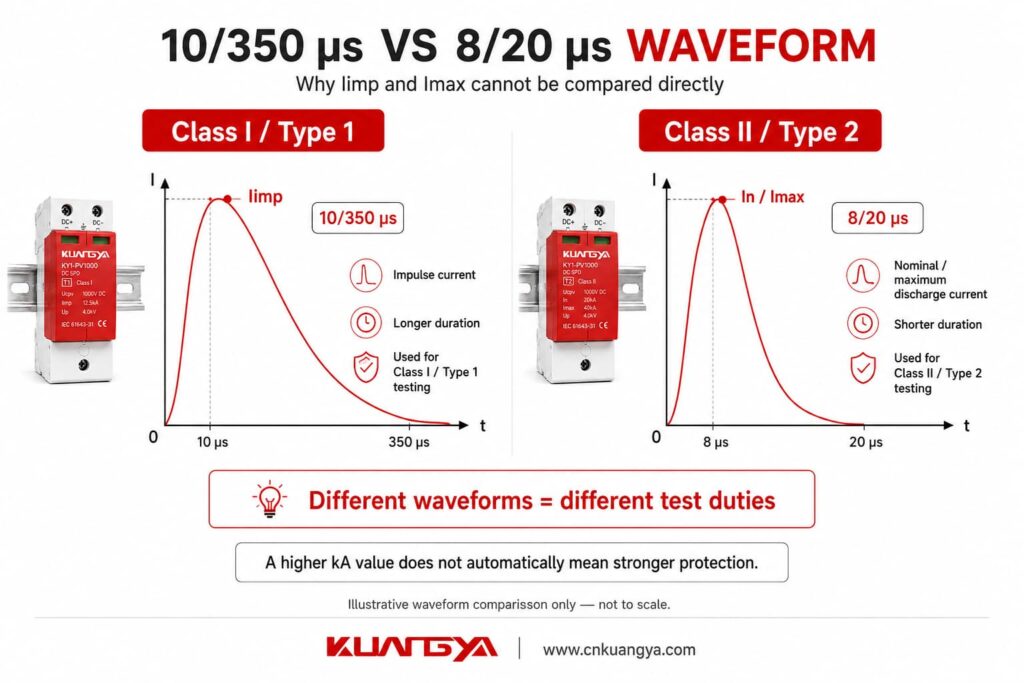
試験電流に注目すると、技術的な最大の違いがより明確になります。.
タイプ1 SPDはインパルス電流定格に関連しています:
インプ
および 10/350 μs 電流波形は一般的にクラスI試験に関連付けられています。.
10/350 μs波形は、タイプ2評価に使用される8/20 μs波形とは大きく異なる電流エネルギー負荷を表します。.
ということだ:
IimpとImaxは、どちらもkAで表示されているという理由だけで直接比較することはできません。.
例えば、こうだ:
Iimp = 12.5kA
そして
Imax = 40kA
40kAのタイプ2製品が「より強力」であることを意味するわけではありません。“
これらは異なる試験波形と異なる性能特性を指しています。.
タイプ2 SPDは主に以下を使用して特徴付けられます:
8/20μsの電流波形は、クラスII放電電流試験に関連するものである。.
タイプ2 DC SPDは、一般的に以下のような場所での使用を想定して評価される。
ただし、最終的なSPDのタイプは、実際の雷保護設計および設置条件に基づいて決定されなければならない。.
クラスIIIは一般的なSPD分類の中に存在するが、一般的なPV用DC SPDの選定を議論する際に主要な対象とすべきではない。.
クラスIII保護は、一般的に敏感な機器の近くで行われる協調的な精密保護に関連しています。.
太陽光発電(PV)のDC保護において、購入者がより一般的に目にするのは以下の通りです。
これが、本記事が主に以下に焦点を当てている理由です。 クラスIIとタイプ2 DC SPDとの関係, 、クラスI、II、IIIを同等に一般的なPV製品カテゴリとして扱うのではなく。.
ラベルの例は以下を示しています:
Ucpv: 1000V DC
Ucpvとは:
太陽光発電(PV)用途における最大連続使用電圧
簡単に言うと:
Ucpvは、SPDの保護モードに対して連続的に印加可能な最大直流電圧を示します。.
IEC 61643-32ではUcpvを本質的にこのように定義しており、設置条件における最大PV開放電圧以上でなければならないと規定しています。.
このため、太陽光発電用DC SPDを選定する際、Ucpvは最初に確認すべき仕様の一つとなります。.
必ずしもそうではない。.
これは重要な点です。.
PVシステムは、以下のような便宜的な公称ラベルのみを使用して評価すべきではありません。
1000Vソーラーシステム
PVストリングの実際の最大DC電圧は、以下の要因に依存します。
PVモジュールの開放電圧は、通常、温度が低下すると上昇します。.
PVアレイの電圧、ストリング設計、および関連するシステム要件に関する詳細な説明については、以下を参照してください。 IEC 62548 PVアレイ設計ガイド.
Therefore, the selection process should be based on the maximum calculated PV open-circuit voltage, rather than simply copying the nominal inverter or system voltage.
A simplified workflow is:
Module Voc
→ 直列モジュール数
→ Low-temperature correction
→ Maximum PV open-circuit voltage
→ Select suitable Ucpv
We have already covered this subject separately in our DC SPD Voltage Selection Guide, including 600V, 1000V and 1500V DC applications.
So in this article, the important point is simply:
Ucpv is a continuous-voltage compatibility rating, not a surge-current rating.
This is another common source of confusion.
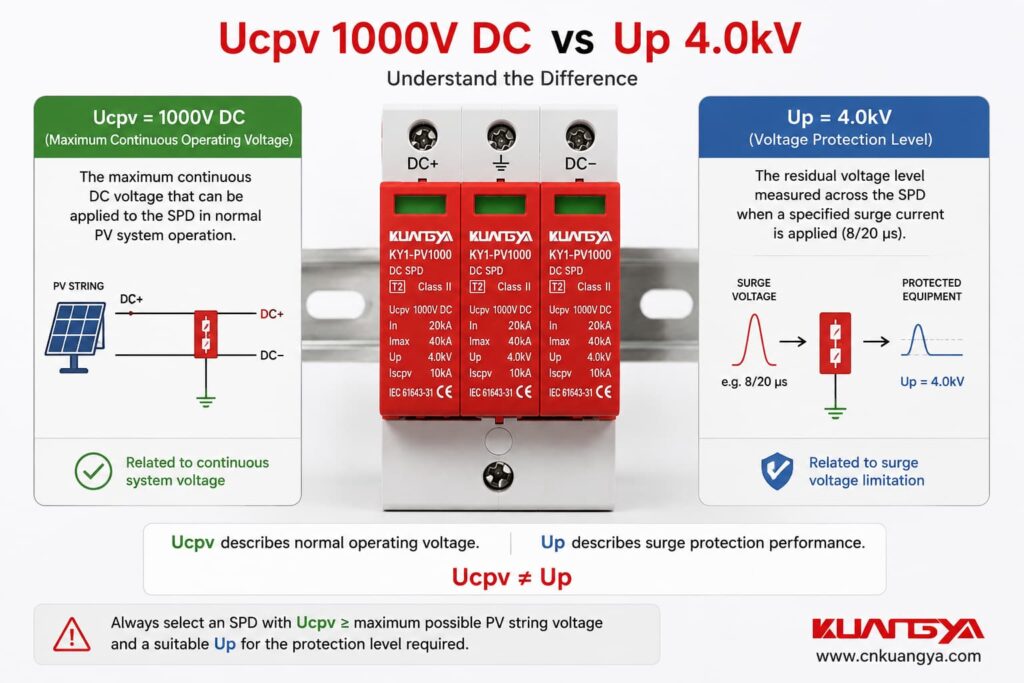
Our example SPD shows:
Ucpv = 1000V DC
そして
Up = 4.0kV
A buyer may reasonably ask:
Why does a 1000V SPD also have a 4kV voltage rating?
Because these two values describe different things.
| パラメータ | 例 | 何を説明しているか |
|---|---|---|
| Ucpv | DC1000V | Continuous PV operating voltage |
| 上へ | 4.0kV | Voltage protection level during surge testing |
したがって:
Ucpv is about surviving normal system operation.
Up is about limiting transient surge voltage.
They should never be treated as interchangeable voltage ratings.
The label shows:
In: 20kA
In means:
公称放電電流
For a Type 2 / Class II SPD, In is associated with an 8/20 μs電流波形.
In technical terms, it represents the crest value of the current through the SPD having the specified 8/20 μs waveshape under the relevant standardized test conditions.
That definition is accurate, but for a buyer it can be simplified:
In is one of the main ratings used to describe the tested surge-discharge performance of a Type 2 SPD.
For this product:
In = 20kA
The important word here is nominal.
It should not be confused with Imax.
The same SPD also shows:
Imax: 40kA
Imax means:
最大放電電流
For a Type 2 SPD, Imax is also normally associated with the 8/20 μs電流波形.
It represents the manufacturer’s declared maximum discharge-current capability under the applicable test conditions.
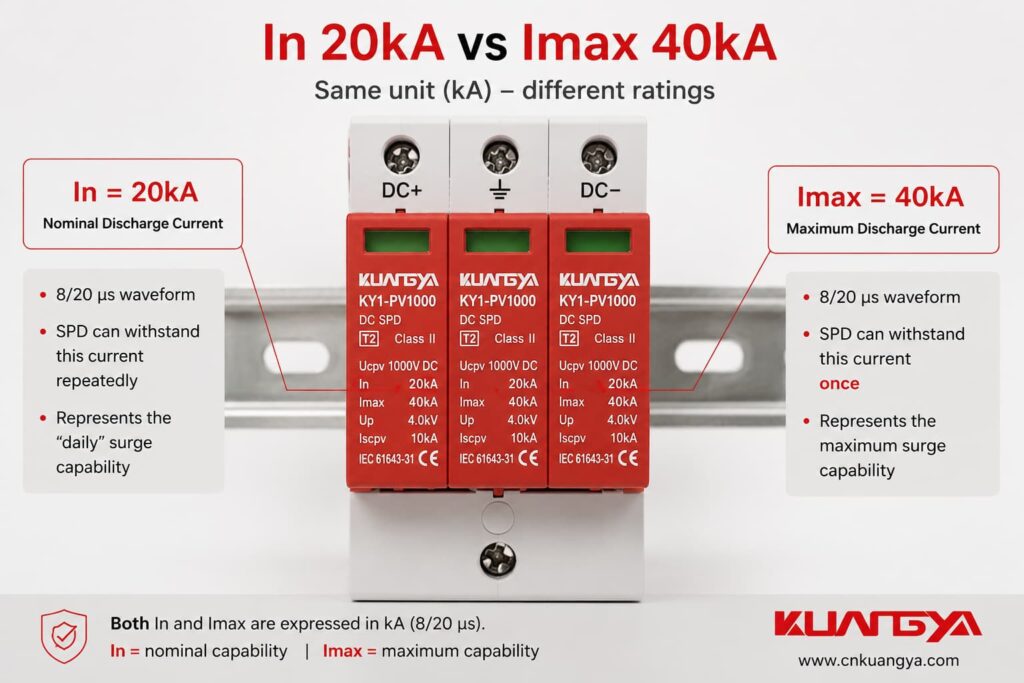
したがって:
In 20kA and Imax 40kA are not duplicate specifications.
They represent different test-duty levels.
This is one of the most important parts of the entire datasheet.
Consider the example:
| パラメータ | 価値 |
|---|---|
| で | 20kA |
| アイマックス | 40kA |
| 波形 | 8/20 μs |
A simple way to understand them is:
で = nominal discharge-current rating.
アイマックス = maximum declared discharge-current rating.
One common purchasing mistake is to look only at Imax because it is the larger number.
例えば、こうだ:
SPD A: In 20kA / Imax 40kA
SPD B: In 10kA / Imax 40kA
A buyer may see “40kA” on both products and assume that their surge performance is equivalent.
That conclusion is incomplete.
The full declared performance needs to be checked.
VIOX makes the same useful procurement distinction in its SPD datasheet guide: In and Imax should be read separately, and Imax should not be interpreted as the SPD’s normal repeated discharge capacity.
そうだ。.
This is probably the most useful purchasing rule in this article:
The highest kA value does not automatically identify the best SPD.
Suppose two products are advertised as:
It would be incorrect to select SPD B immediately just because:
60kA > 40kA.
Other questions still matter:
A larger number may be useful when the complete design calls for it.
But:
More kA is not a substitute for correct coordination.
Not simply because it says 40kA.
This is another very common mistake.
A Type 2 product may show:
Imax = 40kA, 8/20 μs
while a Type 1 product may show:
Iimp = 12.5kA, 10/350 μs
Looking only at the peak current numbers:
40 > 12.5
may make the Type 2 SPD appear stronger.
But that comparison is technically incorrect.
The two values are based on different test waveforms and different protection duties.
したがって:
Imax cannot be used as a substitute for a specified Iimp requirement.
If the project requires Type 1 lightning-current capability, a large Type 2 Imax value alone does not satisfy that requirement.
ラベルの例は以下を示しています:
Up: 4.0kV
Up means:
電圧保護レベル
It describes the SPD’s declared voltage-limiting performance under specified standardized test conditions.
In practical terms, Up helps answer the question:
How effectively does the SPD limit the transient voltage during the relevant test?
Generally, a lower Up can provide a lower level of surge voltage at the SPD terminals.
However, this needs an important qualification.
The printed Up value should ない be treated as the exact maximum voltage that every connected inverter or device will experience in a real installation.
なぜですか?
Because the actual voltage seen by the protected equipment can also be affected by:
VIOX correctly makes the same distinction: the declared Up is established at the SPD under standardized conditions, while installation conductors can increase the voltage presented to the protected equipment.
Not by itself.
It is reasonable to prefer effective voltage limitation, but the selection must remain compatible with the complete electrical system.
A low Up does not compensate for:
So instead of saying:
“Always buy the SPD with the lowest Up.”
A more technically correct rule is:
Select an SPD with a suitable Up while also verifying Ucpv, SPD Type, protected equipment withstand level and installation coordination.
Now we come to one of the most misunderstood PV-specific parameters:
Iscpv: 10kA
This is particularly important because it also uses the unit kA.
It is easy to look at:
In 20kA
Imax 40kA
Iscpv 10kA
and assume they are three levels of surge current.
そうではない。.
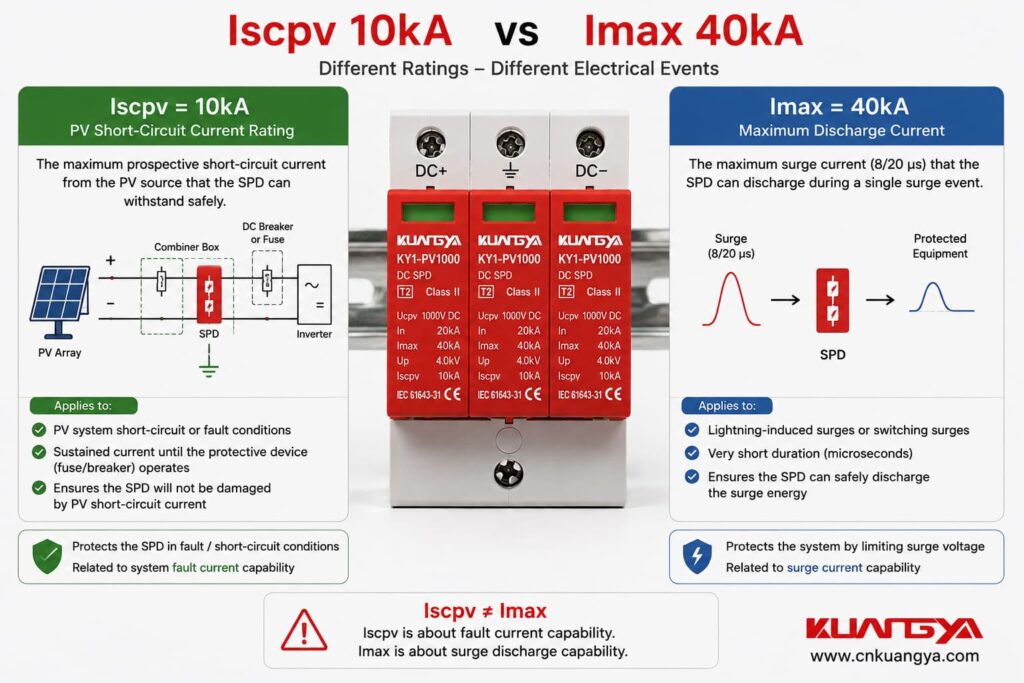
Iscpv means:
Short-Circuit Current Rating of the SPD for the PV application.
IEC terminology defines Iscpv as the maximum prospective short-circuit current from the power system for which the SPD, together with the specified disconnector, is rated.
A simpler explanation is:
Iscpv tells you whether the SPD and its specified disconnection arrangement are suitable for the prospective PV short-circuit current at the installation point.
これは fault-current / short-circuit characteristic.
It is not a lightning-surge rating.
This distinction deserves to be stated clearly:
Iscpv ≠ Imax
Even though both can be expressed in kA.
例えば、こうだ:
Describes surge discharge-current performance.
Describes the SPD’s PV short-circuit-current rating in conjunction with the specified disconnection arrangement.
So on our example product:
Imax = 40kA
does not mean:
PV short-circuit rating = 40kA.
And:
Iscpv = 10kA
does not mean:
The SPD can only discharge a 10kA surge.
These numbers belong to different electrical events.
PV DC circuits behave differently from ordinary AC circuits.
One important difference is that DC current does not naturally pass through zero every half-cycle as AC current does.
For protection devices, switching equipment and disconnecting arrangements, this makes DC fault interruption an important design consideration.
That is one reason PV-specific SPDs have characteristics and test requirements beyond simply printing:
“DC 1000V”
on an AC-style product.
IEC 61643-31 is specifically intended for SPDs connected to the DC side of photovoltaic installations and establishes PV-specific requirements, ratings and test methods.
Therefore, when buying a PV SPD, do not ask only:
“Is this 1000V DC?”
Also ask:
What is the declared Iscpv and required disconnection arrangement?
The easiest way to remember these parameters is with this table:
| 評価 | Main Meaning | Typical Context |
|---|---|---|
| で | 公称放電電流 | Type 2 / Class II surge performance |
| アイマックス | 最大放電電流 | Type 2 maximum declared surge-current performance |
| インプ | Impulse current | Type 1 / Class I lightning-current capability |
| Iscpv | PV short-circuit current rating | PV fault-current compatibility |
Notice something important:
Three or four specifications can all contain:
kA
but this does not mean they can be compared directly.
Before comparing any two kA ratings, first ask:
This prevents a large number of purchasing errors.
The label also declares:
-40°C ~ +85°C
This is the manufacturer’s declared temperature range for the product.
Environmental ratings should not be ignored simply because electrical parameters look correct.
PV equipment may be installed in:
The internal temperature of an enclosure can be very different from the normal outdoor air temperature.
Therefore, project engineers should confirm that the SPD’s declared environmental conditions are suitable for the actual enclosure and installation environment.
Where the datasheet declares:
5%–95%
this normally represents the manufacturer’s declared relative humidity operating range.
However, humidity specifications should always be read together with conditions such as:
The percentage alone does not mean that an exposed SPD can be installed directly in rain or other outdoor environments.
The label states:
屋内用
This does not necessarily mean that the SPD can never form part of an outdoor PV installation.
It means the SPD itself is intended for a protected environment according to its declared construction and installation conditions.
For example, an indoor-rated SPD may be installed inside:
The important distinction is:
The SPD can be inside outdoor equipment without the SPD itself being directly exposed to outdoor conditions.
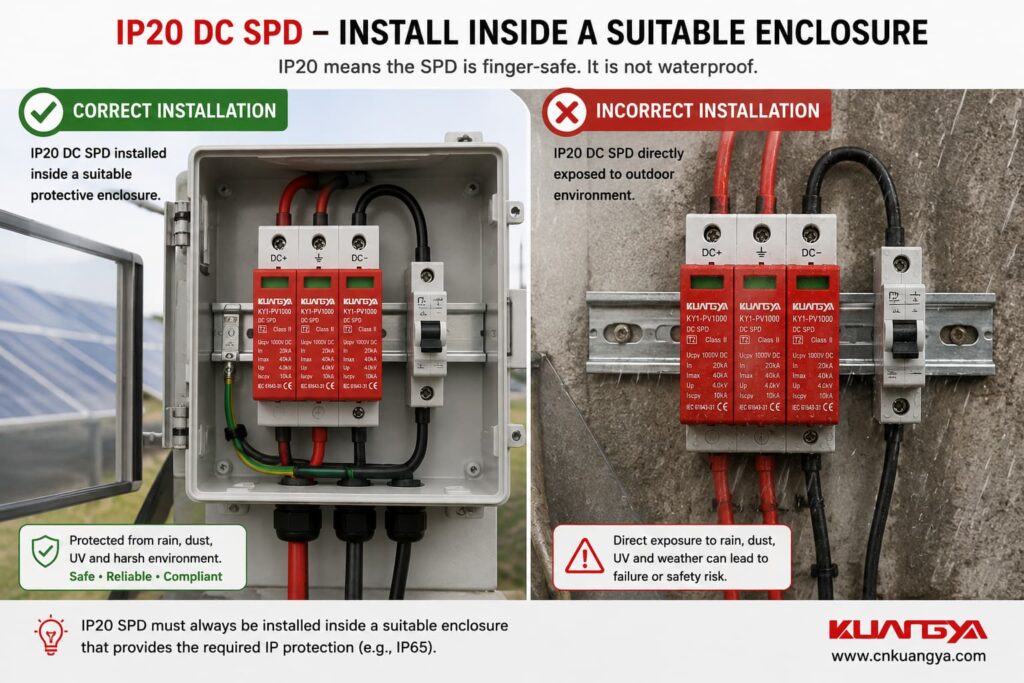
IP20 is the enclosure protection rating shown for the SPD itself.
It should not be interpreted as a weatherproof rating.
A DIN-rail SPD with IP20 is normally installed inside another suitable enclosure or cabinet.
For an outdoor PV installation, the final environmental protection depends on the complete enclosure, not only the bare SPD module.
したがって:
IP20 SPD inside a suitable outdoor enclosure
can be a normal arrangement.
But:
IP20 SPD directly exposed to rain, dust and outdoor weather
should not be assumed to be acceptable.
Now we can return to the original example.
Ucpv: 1000V DC
クラスII
In: 20kA
Imax: 40kA
Up: 4.0kV
Iscpv: 10kA
Instead of reading each number independently, read it as one technical description.
This tells us the declared maximum continuous PV operating voltage of the SPD.
This indicates Class II testing / Type 2 application direction.
This is the nominal discharge-current rating associated with the relevant Type 2 surge test.
This is the declared maximum discharge-current rating.
This is the declared voltage protection level.
This is the PV short-circuit-current rating and must be understood together with the applicable disconnector/protection arrangement.
Now the label makes much more sense.
It is not saying:
“1000V, 20kA, 40kA, 10kA — bigger numbers are better.”
It is describing different electrical functions and limits of the same SPD.
Incorrect:
Class I is premium and Class II is lower quality.
Correct:
Class I and Class II represent different test/protection classifications.
Incorrect:
This one says 60kA, so it is automatically better than the 40kA model.
Correct:
Check:
before making the comparison.
Incorrect:
Imax 40kA is higher than Iimp 12.5kA, so Type 2 is stronger.
Correct:
Iimp and Imax refer to different test waveforms and different surge duties.
Incorrect:
The SPD is rated 1000V but Up is 4kV, so the specifications conflict.
Correct:
Ucpv and Up describe different voltage characteristics.
Incorrect:
Iscpv 10kA means the SPD can discharge 10kA of lightning current.
Correct:
Iscpv is a PV short-circuit-current rating.
Even a correctly selected SPD can provide poor protection if installation is poor.
Important details include:
A datasheet tells you what the device is capable of under defined conditions.
Installation determines how effectively that capability is used in the real system.
The SPD should also be considered together with other solar PV electrical protection devices, including DC fuses, isolators, circuit breakers and the overall protection arrangement.
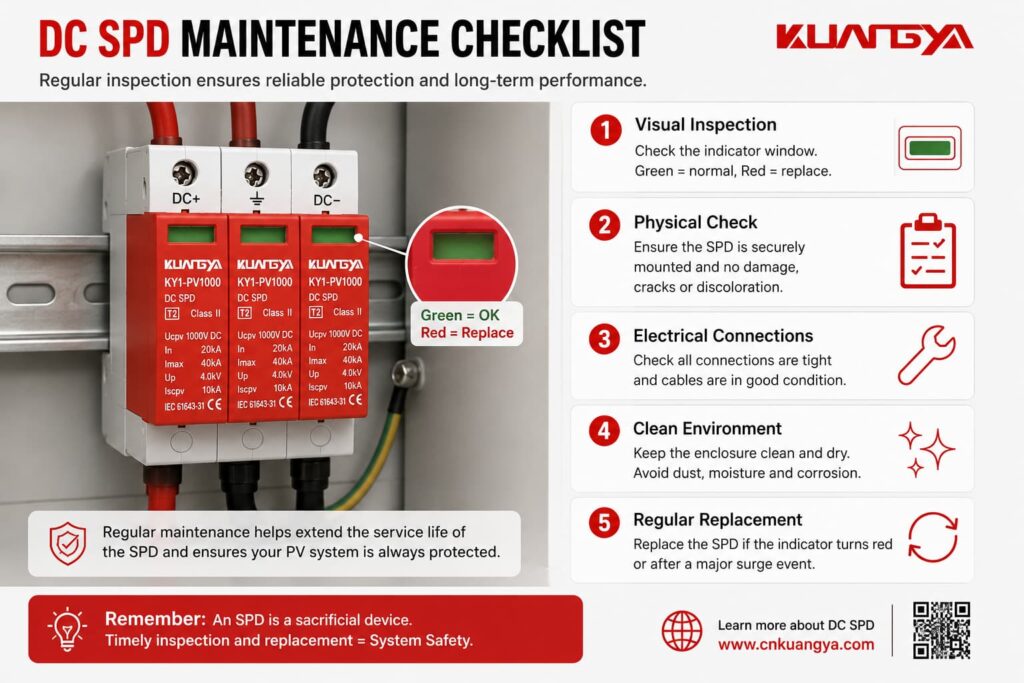
For buyers, distributors and EPC procurement teams, the following sequence is more useful than simply asking for:
“1000V 40kA SPD price.”
Is the product specifically intended for:
PV DC surge protection?
Do not assume an AC SPD with a similar voltage or current marking is interchangeable.
Determine the maximum possible PV open-circuit voltage.
Then confirm that the selected Ucpv is suitable.
For the full calculation method, refer to the DC SPD Voltage Selection Guide mentioned earlier.
Determine whether the installation requires:
Do not make this decision simply from product price or kA rating.
Our detailed Type 1 vs Type 2 vs Type 1+2 DC SPD guide explains this separately.
For a Type 2 / Class II SPD, confirm both values.
Do not check only Imax.
Verify the declared voltage protection level and whether it is appropriate for the protected equipment and protection concept.
Confirm that the SPD and specified disconnection/protection arrangement are compatible with the prospective short-circuit current of the PV system.
Confirm:
検証する:
For PV DC SPDs, IEC 61643-31 is an important product standard to check.
IEC 61643-31:2018 covers SPDs intended for the DC side of photovoltaic installations up to 1500V DC, while IEC 61643-32:2017 addresses their selection, installation and coordination.
Depending on the project and market, buyers may also need:
Do not assume that a logo printed on a product is sufficient evidence.
Match the documentation to the exact model being purchased.
Before approving a PV SPD, use the following checklist.
| チェック | 質問 |
|---|---|
| 申し込み | Is it specifically suitable for PV DC? |
| Ucpv | Is it suitable for maximum PV open-circuit voltage? |
| SPDタイプ | Does Type 1 / Type 2 / Type 1+2 match the installation design? |
| 試験クラス | Is the declared classification clear? |
| で | Is the nominal discharge-current rating specified? |
| アイマックス | Is the maximum discharge-current rating specified? |
| インプ | If Type 1 is required, is Iimp declared? |
| 上へ | Is the protection level suitable? |
| Iscpv | Is the PV short-circuit rating adequate? |
| 配線 | Is the correct DC connection diagram available? |
| 保護 | Is required backup protection identified? |
| 環境 | Are temperature, IP and enclosure conditions suitable? |
| スタンダード | Is the applicable PV SPD standard stated? |
| ドキュメンテーション | Do certificates/test reports match the exact model? |
A weak RFQ might say:
Please quote 1000V 40kA solar SPD.
This leaves many important questions unanswered.
A better RFQ is:
Please quote a Type 2 / Class II PV DC SPD for a 1000V DC application. Please confirm Ucpv, In, Imax, Up, Iscpv, pole configuration, required backup protection, IEC 61643-31 documentation and wiring diagram.
If known, also include:
This allows the manufacturer to evaluate the complete requirement instead of matching only the words:
“1000V” and “40kA.”
They are closely related but technically describe classification/testing from slightly different perspectives.
For practical PV product selection, a Type 2 SPD is associated with クラスII試験, which is why labels and datasheets may show Type 2, T2 or Class II terminology.
そうだ。.
Class I and Class II are not quality levels.
They are intended for different surge-protection duties and test conditions.
In is the nominal discharge current.
Imax is the maximum discharge current.
For Type 2 SPDs, both are normally associated with the 8/20 μs waveform, but they represent different test-duty levels.
Not enough information is available to answer that from Imax alone.
A proper comparison also requires Ucpv, Type, In, Up, Iscpv, standard, protection configuration and installation conditions.
Not simply because its peak current number is larger.
Type 1 is characterized by lightning impulse-current capability such as Iimp and the associated Class I test conditions.
Imax and Iimp should not be directly compared.
Ucpv is the maximum continuous operating voltage for the PV application.
上へ is the declared voltage protection level under specified surge test conditions.
They perform completely different functions in the datasheet.
Iscpv is the short-circuit current rating of the PV SPD.
More precisely, it describes the maximum prospective short-circuit current for which the SPD, together with its specified disconnector arrangement, is rated.
そうだ。.
Imax is a surge discharge-current rating.
Iscpv is a short-circuit-current rating.
The fact that both use kA does not make them interchangeable.
Not automatically.
Maximum PV open-circuit voltage should be calculated under the project’s design conditions before selecting Ucpv.
For more detail, see our DC SPD選定ガイド:適切な電圧定格の選び方.
It may be installed inside a suitable outdoor enclosure, provided the complete installation satisfies the required environmental protection.
IP20 on the SPD itself should not be treated as a weatherproof outdoor rating.
IEC 61643-31 covers requirements and test methods for SPDs intended for the DC side of photovoltaic installations up to 1500V DC.
IEC 61643-32 provides selection and application principles for PV SPDs.
Reading a DC SPD datasheet becomes much easier once each parameter is treated according to its actual purpose.
For the example:
クラスII
Ucpv 1000V DC
In 20kA
Imax 40kA
Up 4.0kV
Iscpv 10kA
the correct interpretation is not simply:
“This is a 1000V, 40kA SPD.”
A more complete interpretation is:
Each specification answers a different engineering question.
That leads to one simple purchasing principle:
Never select a DC SPD from one voltage number, one kA number or one Type label alone.
The correct SPD is the one whose complete set of ratings matches the PV system voltage, surge environment, equipment protection requirements, short-circuit conditions and installation design.
For solar PV projects requiring 600V, 1000V or 1500V surge protection, explore KUANGYA DC surge protective devices to compare available Type 2 and Type 1+2 models by voltage rating, discharge-current capability and application.

