Zona industriale di WengYang Yueqing Wenzhou 325000
Orario di lavoro
Da lunedì a venerdì: dalle 7.00 alle 19.00
Fine settimana: 10.00 - 17.00
Zona industriale di WengYang Yueqing Wenzhou 325000
Orario di lavoro
Da lunedì a venerdì: dalle 7.00 alle 19.00
Fine settimana: 10.00 - 17.00

La selezione dell'SPD CC è uno dei passaggi più importanti nella progettazione di un sistema di protezione affidabile per impianti solari fotovoltaici (PV). La scelta della corretta tensione nominale di un dispositivo di protezione contro le sovratensioni CC (SPD CC) garantisce prestazioni di protezione affidabili e la stabilità del sistema a lungo termine.
Molti utenti si concentrano principalmente sulla corrente di scarica nominale (kA) quando scelgono un SPD, ma la tensione nominale è altrettanto critica. L'SPD CC selezionato deve essere in grado di resistere alla massima tensione possibile generata dall'impianto fotovoltaico in condizioni operative normali.
Un SPD con una tensione nominale insufficiente può subire un degrado prematuro o un guasto, mentre un SPD con una tensione nominale inutilmente elevata potrebbe non fornire il livello di protezione ottimizzato per l'applicazione.
Per gli impianti fotovoltaici, il parametro di tensione chiave è Ucpv (Tensione massima di esercizio continuo per sistemi fotovoltaici). Una selezione corretta richiede la comprensione della tensione massima del sistema fotovoltaico, della tensione a circuito aperto del modulo (Voc) e degli effetti della temperatura.
Questa guida spiega come selezionare la corretta tensione nominale dell'SPD CC per sistemi solari fotovoltaici, incluse le comuni applicazioni a 600V CC, 1000V CC e 1500V CC.
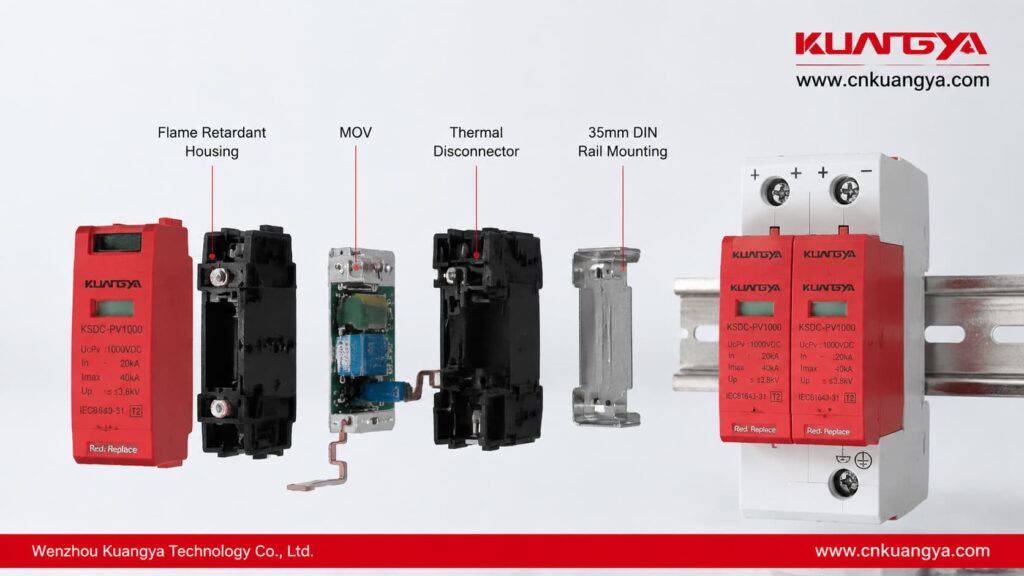
La tensione nominale di un SPD DC indica la tensione continua massima che l'SPD può sopportare in modo permanente senza attivare la sua funzione di protezione.
Per capire come rispondono gli SPD DC durante gli eventi di sovratensione, consulta la nostra guida su come funziona un SPD DC.
Per le applicazioni fotovoltaiche, il parametro di tensione più importante è:
Ucpv definisce la tensione massima che può essere applicata continuamente all'SPD durante il normale funzionamento dell'impianto FV.
L'Ucpv selezionato deve essere:
Ad esempio:
| Valore nominale SPD CC | Applicazione comune |
|---|---|
| SPD CC 600V | Sistemi fotovoltaici su piccola scala |
| SPD 1000V DC | Sistemi fotovoltaici commerciali e industriali |
| SPD 1500V DC | Progetti solari su larga scala e utility-scale |
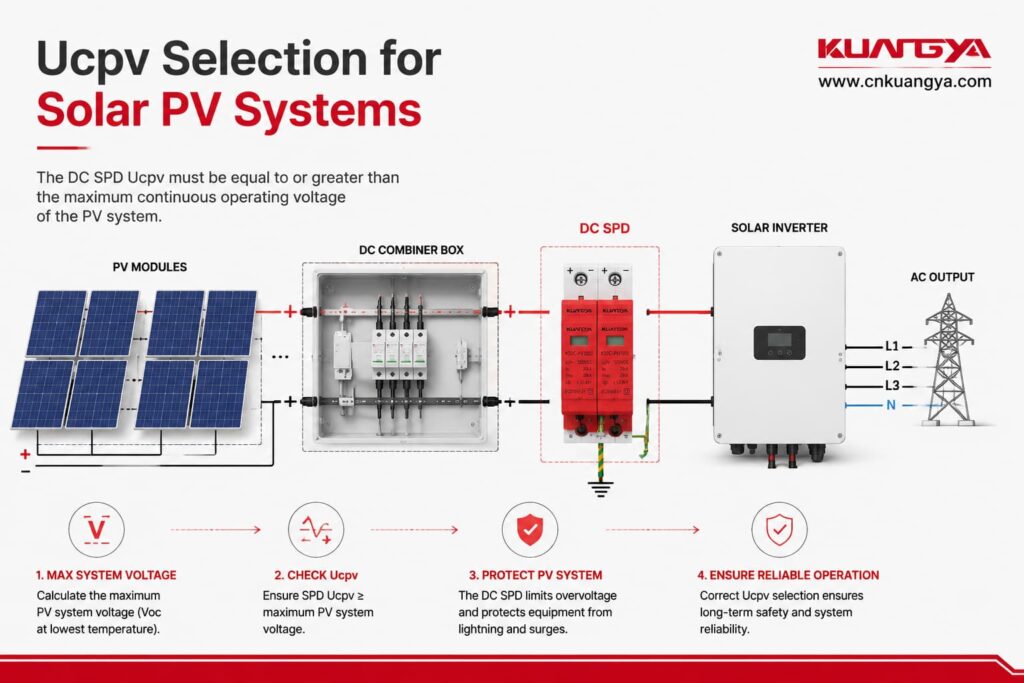
La selezione dell'SPD DC dipende dalla tensione massima del sistema fotovoltaico, dalle caratteristiche dei moduli, dalle condizioni di temperatura e dai requisiti di installazione. La selezione della tensione nominale corretta è il primo passo prima di scegliere il modello finale di SPD.
I principali fattori che influenzano la selezione dell'SPD DC includono:
Scegliere una tensione nominale errata può compromettere l'affidabilità del sistema e le prestazioni di protezione.
Esempio:
Un impianto fotovoltaico ha una tensione massima vicina a 1200V DC, ma è stato installato un SPD da 1000V DC.
Potential problems:
The SPD voltage rating should never be lower than the maximum calculated PV system voltage.
Esempio:
A 600V PV system uses a 1500V DC SPD.
Although the SPD may withstand the voltage, it may not always provide the most optimized protection.
A higher voltage-rated SPD may have:
The goal is not to select the highest voltage rating, but the correct voltage rating.
When selecting a DC SPD, several voltage parameters are commonly used.
Ucpv is the most important parameter for photovoltaic DC SPD selection.
It represents the maximum voltage that the SPD can continuously withstand in a PV system.
The selected Ucpv must be higher than the maximum possible PV system voltage.
Uc is commonly used for general surge protective devices.
For PV-specific applications, Ucpv is normally the key parameter because photovoltaic systems have unique DC voltage characteristics.
Up represents the maximum voltage that can appear across the protected equipment during a surge event.
A lower Up generally means better protection performance.
When selecting an SPD, both Ucpv and Up should be considered.
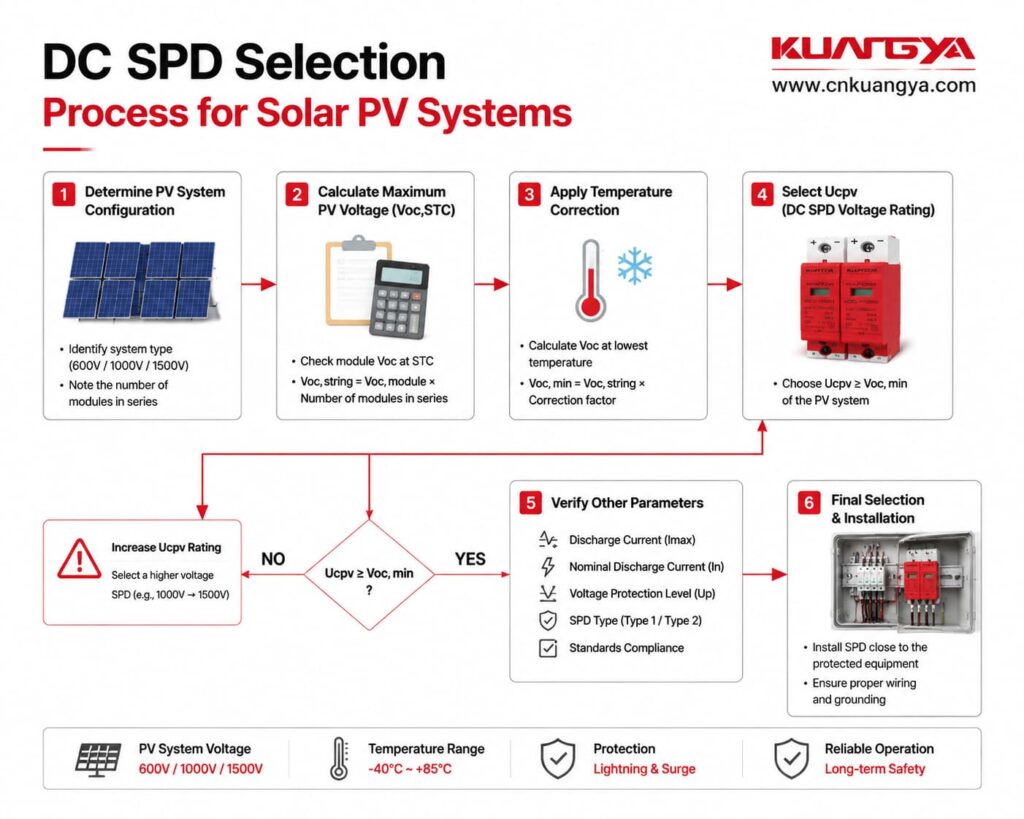
The maximum PV system voltage should be calculated based on:
The calculation formula is:
Dove:
| Parametro | Descrizione |
|---|---|
| Number of Series Modules | Total PV modules connected in series in one string |
| Voc | Open-circuit voltage of one PV module |
| Fattore di correzione della temperatura | Voltage adjustment factor considering low-temperature conditions |
A PV string contains:
Calcolo:
24 × 45V × 1.10 = 1188V
The maximum PV system voltage is:
1188V DC
Therefore, a SPD 1500V DC should be selected to provide sufficient voltage margin.
Voltage calculation is the first step in DC SPD selection. For a complete sizing approach including current ratings and protection requirements, refer to our guide on come dimensionare un SPD CC per un impianto fotovoltaico.
The selected DC SPD voltage rating should not be lower than the calculated maximum PV system voltage.
For photovoltaic applications, the SPD parameter Ucpv should be equal to or higher than the maximum calculated PV voltage.
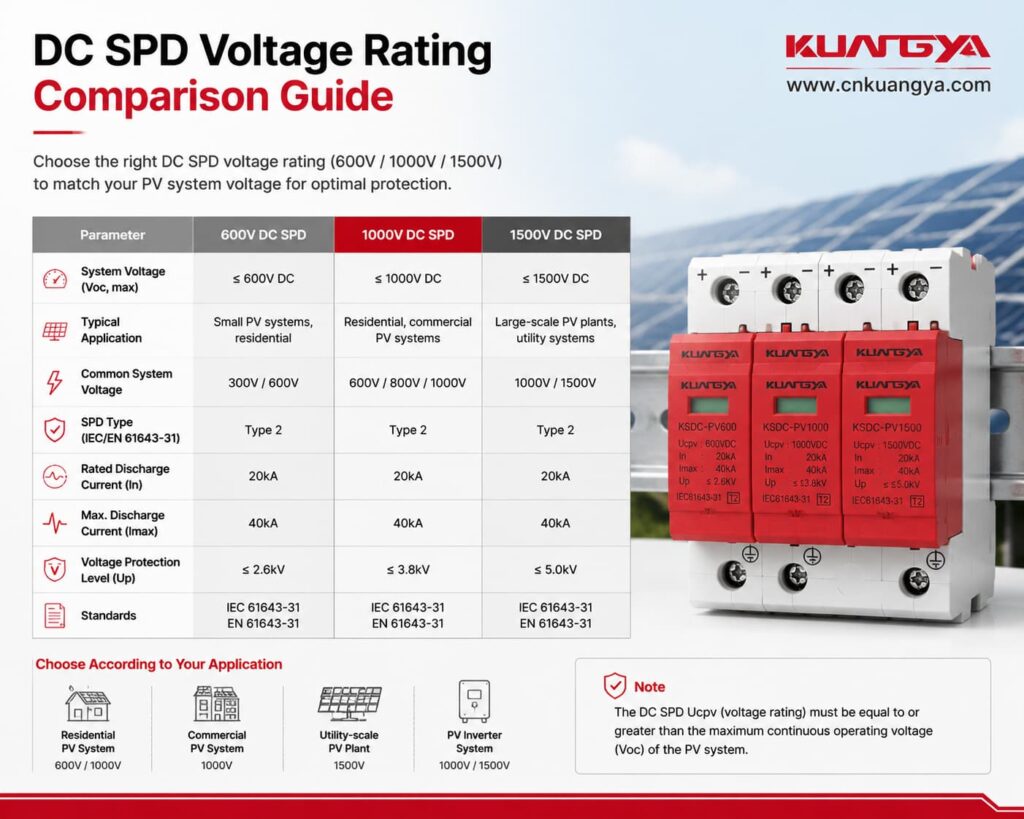
Calculate the recommended DC SPD voltage rating based on your PV system parameters.
Voltage rating is only one factor in DC SPD selection. The SPD type should also be selected according to the surge environment. Learn more about Type 1, Type 2 and Type 1+2 DC SPD selection.
Different PV system designs require different voltage-rated SPDs.
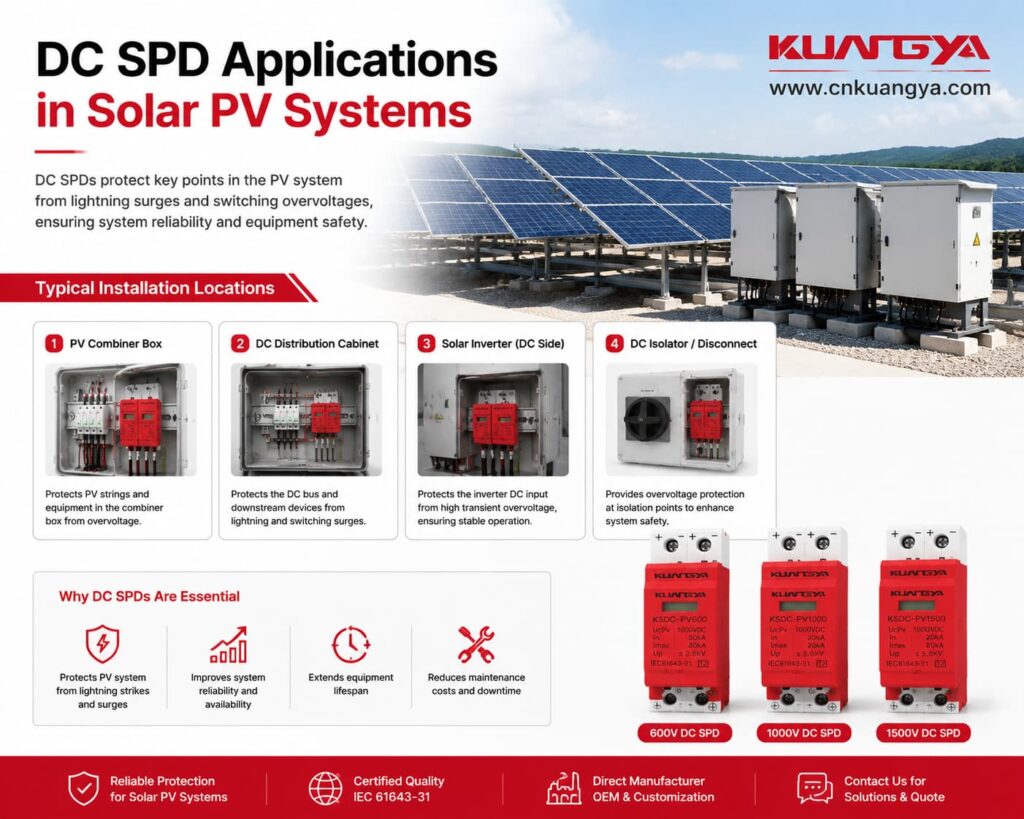
| SPD Voltage Rating | Applicazioni comuni | Typical Systems |
|---|---|---|
| SPD CC 600V | Small PV installations | Residential rooftop systems |
| SPD 1000V DC | Medium and large PV systems | Commercial and industrial projects |
| SPD 1500V DC | Large-scale PV systems | Utility solar farms |
The correct selection depends on the calculated maximum PV voltage, not only the project size.
System information:
Calcolo:
22 × 42V × 1.10
= 1016V DC
Recommended selection:
SPD 1500V DC
Motivo:
After temperature correction, the PV voltage exceeds 1000V.
System information:
Calcolo:
18 × 45V × 1.10
= 891V DC
Recommended selection:
SPD 1000V DC
Motivo:
The calculated PV voltage is below 1000V.
The inverter input range does not always represent the maximum PV array voltage.
SPD selection should be based on PV string voltage.
Using Vmp instead of Voc may underestimate the maximum PV voltage.
A higher voltage-rated SPD may not always provide better equipment protection.
The Up value should meet the protection requirements of the system.
PV module voltage increases at low temperatures.
Temperature correction should be considered during system design.
A DC SPD with a suitable Ucpv rating should be selected based on the actual maximum PV system voltage. The calculated PV voltage should always remain below the SPD voltage rating.
A 1500V DC SPD may be used in some applications, but the protection level (Up), system requirements and cost should also be considered.
No. The SPD voltage rating should match the PV system requirements. A higher voltage rating does not automatically provide better protection.
Calculate the maximum PV voltage using:
Number of series modules × Module Voc × Temperature correction factor.
Ucpv is the maximum continuous operating voltage that a photovoltaic SPD can withstand during normal operation.
Photovoltaic surge protective devices are mainly covered by:
IEC 61643-31: Low-voltage surge protective devices – Requirements and test methods for SPDs for photovoltaic installations.
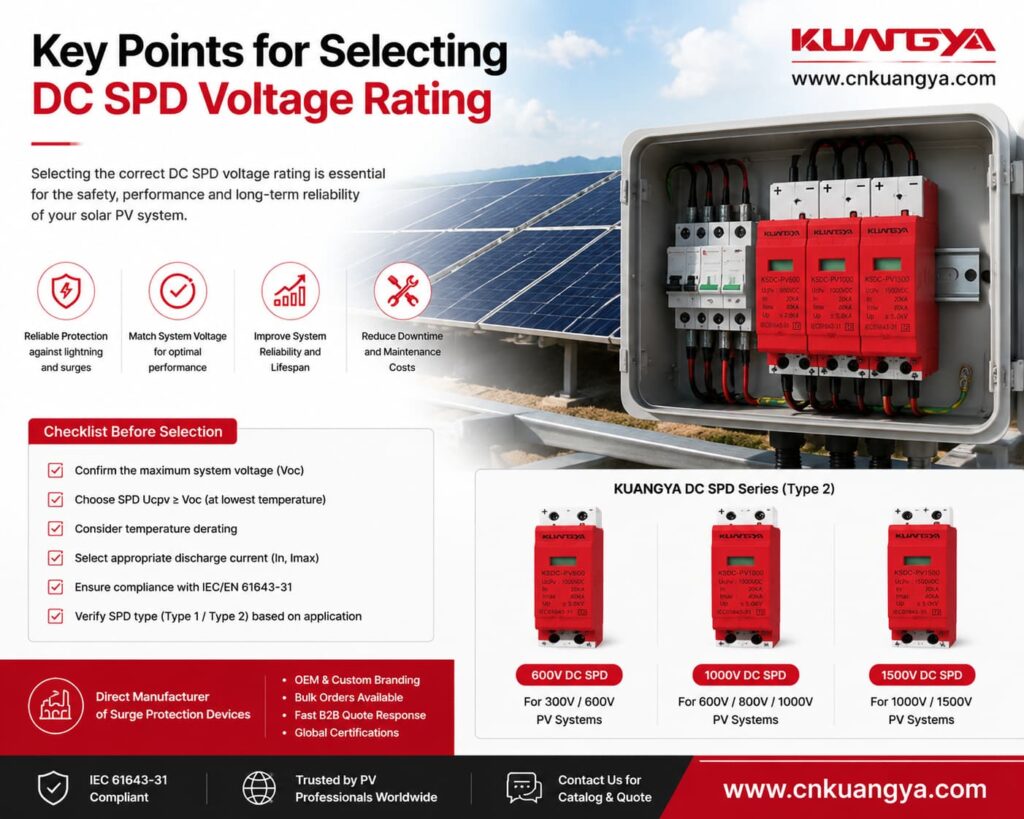
Selecting the correct DC SPD voltage rating is essential for reliable solar PV system protection.
La scelta corretta dipende da:
For common photovoltaic applications:
KUANGYA provides DC SPD solutions for solar photovoltaic applications, including 600V, 1000V and 1500V DC models with OEM customization support.

