Zone industrielle WengYang Yueqing Wenzhou 325000
Heures de travail
Du lundi au vendredi : de 7h00 à 19h00
Le week-end : 10H00 - 17H00
Zone industrielle WengYang Yueqing Wenzhou 325000
Heures de travail
Du lundi au vendredi : de 7h00 à 19h00
Le week-end : 10H00 - 17H00

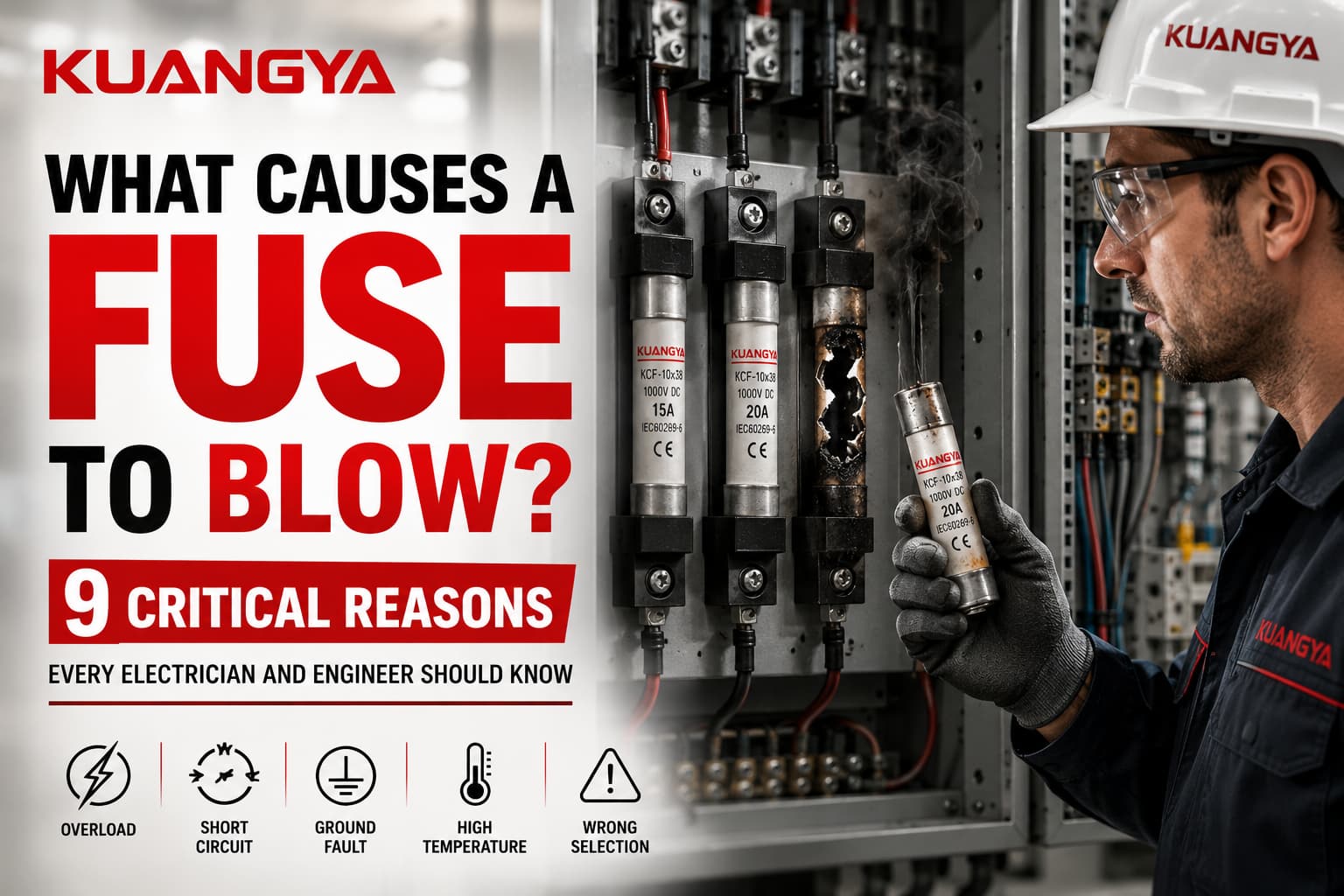
Tous les électriciens y ont été confrontés.
Une machine s'arrête soudainement.
Un onduleur solaire tombe en panne.
Un système de batterie perd de l'énergie.
Après avoir ouvert le panneau, le diagnostic semble simple : le fusible est grillé.
Mais les ingénieurs expérimentés savent qu'un fusible grillé est rarement le véritable problème.
Un fusible est conçu pour se sacrifier afin de protéger les câbles, les équipements et les personnes contre les surintensités dangereuses. Lorsqu'un fusible saute, c'est souvent le signe d'un problème plus profond, quelque part dans le système électrique.
Malheureusement, de nombreux techniciens se contentent de remplacer le fusible et de rétablir le courant sans chercher à savoir pourquoi le fusible est tombé en panne. Cette approche peut entraîner des défaillances répétées, des dommages aux équipements, des arrêts de production et même des risques d'incendie.
Ce guide fournit une analyse professionnelle des incidents de fusibles grillés, aidant les électriciens, les ingénieurs de maintenance, les installateurs solaires et les opérateurs industriels à identifier les causes profondes et à prévenir les défaillances futures.
Un fusible est considéré comme grillé lorsque son fusion de l'élément fusible interne et ouvre définitivement le circuit.
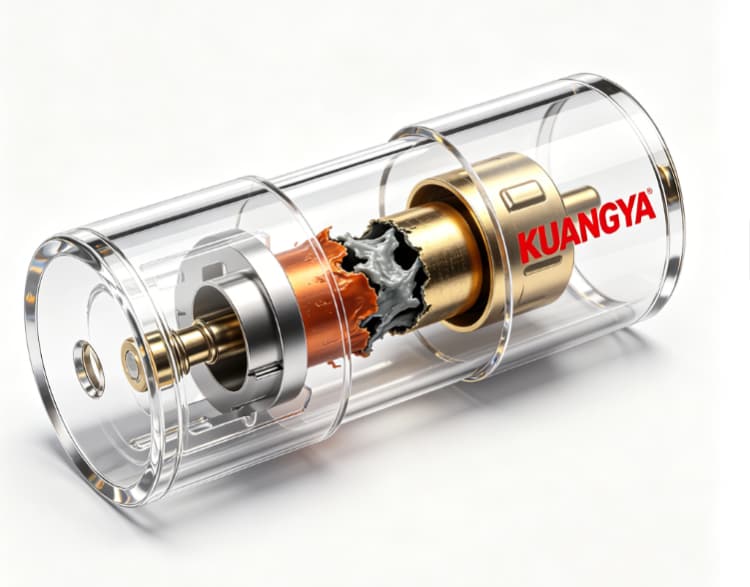
Le processus de fusion se produit parce que le courant électrique génère de la chaleur.
Lorsque le courant dépasse la limite de fonctionnement prévue pour le fusible pendant une période suffisante, l'élément fusible atteint sa température de fusion et se rompt.
| Stade | Description |
|---|---|
| Fonctionnement normal | Le courant reste dans les limites de l'évaluation |
| La surcharge commence | Le courant dépasse la valeur nominale |
| Augmentation de la température | L'élément fusible chauffe |
| Point de fusion atteint | L'élément fusible fond |
| Circuit ouvert | Le flux de courant s'arrête |
| Système protégé | Le défaut est isolé |
Le fusible lui-même fonctionne généralement correctement.
La vraie question est la suivante :
Pourquoi la surintensité s'est-elle produite ?
La surcharge est la raison la plus fréquente d'un fusible grillé.
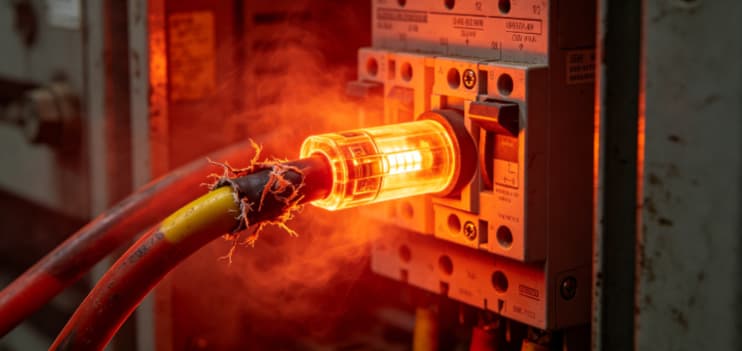
Cela se produit lorsque l'équipement tire plus de courant que le circuit n'a été conçu pour le supporter.
| Symptôme | Observation |
| Défaillance du fusible | Retardé |
| Température du câble | Chaud |
| Fonctionnement de l'équipement | Se poursuit généralement avant l'échec |
| Soufflage répété | Communs |
Contrairement aux courts-circuits, les surcharges se développent généralement de manière progressive.
Un court-circuit est l'une des pannes électriques les plus graves.
Il se produit lorsque des conducteurs ayant des potentiels différents entrent en contact direct.
En voici quelques exemples :
| Puissance du circuit | Courant de court-circuit possible |
| Circuit 20A | 1 000A-10 000A |
| Circuit 100A | 5 000A-50 000A |
| Barre collectrice industrielle | Plus de 100 kA |
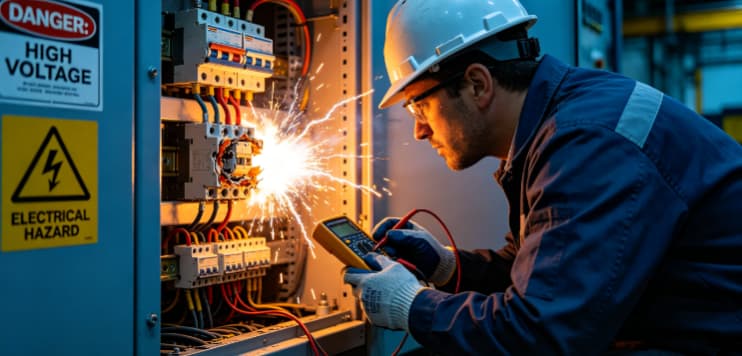
Un fusible correctement choisi devrait interrompre le défaut en quelques millisecondes.
Défauts de mise à la terre se produisent lorsque le courant passe involontairement à la terre.
Les causes les plus fréquentes sont les suivantes :
| Environnement | Niveau de risque |
| Sites solaires extérieurs | Haut |
| Câblage souterrain | Haut |
| Salles des batteries | Moyen |
| Panneaux intérieurs | Faible |
Les défauts à la terre se développent souvent avant que des défaillances catastrophiques ne se produisent.
Nombreux incidents fusible grillé sont dues à la sélection d'un mauvais fusible.
| Erreur | Résultat |
| Fusible trop petit | Souffles nuisibles fréquents |
| Tension nominale incorrecte | Défaillance de l'interruption de l'arc électrique |
| Fusible AC utilisé dans un système DC | Élimination des défauts dangereux |
| Capacité de rupture insuffisante | Destruction du fusible |
C'est pourquoi il est essentiel de bien dimensionner les fusibles.
Les moteurs électriques créent un courant d'appel temporaire lors du démarrage.
| Type de moteur | Courant de démarrage |
| Petit moteur | 3-5 × courant nominal |
| Moteur industriel | 6-8 × courant nominal |
| Grand moteur | 8-12 × le courant nominal |
Si le fusible est sélectionné trop près du courant de fonctionnement, le démarrage peut entraîner des défaillances inutiles du fusible.
Les transformateurs génèrent des courants magnétiques extrêmement élevés lors de leur mise sous tension.
| Taille du transformateur | Inrush Multiple |
| Petit transformateur | 8 × le courant nominal |
| Transformateur moyen | 10 × le courant nominal |
| Grand transformateur | 15 × le courant nominal |
Les ingénieurs confondent souvent ces surtensions temporaires avec des défauts réels.
La défaillance d'un fusible n'est pas toujours due à une surintensité.
Au fil du temps, les cycles répétés de chauffage et de refroidissement affaiblissent l'élément fusible.
| Symptôme | Cause possible |
| Décoloration | Vieillissement thermique |
| Oxydation | Exposition à l'humidité |
| Réduction de l'espérance de vie | Chauffage continu |
Les installations industrielles négligent souvent ce facteur.
Des bornes mal serrées créent une résistance.
La résistance crée de la chaleur.
La chaleur peut provoquer des points chauds locaux qui finissent par endommager le fusible.
| Objet | Vérifier |
| Couple terminal | Correct |
| État du titulaire | Intact |
| Corrosion | Aucun |
| Pression de contact | Adéquat |
De nombreuses “pannes de fusibles” sont en fait des pannes de connexion.
Les systèmes électriques ne fonctionnent pas dans des conditions de laboratoire. Les facteurs environnementaux affectent de manière significative la performance des fusibles, en particulier effets de la température ambiante sur les fusibles
Les facteurs environnementaux affectent de manière significative la performance des fusibles.
| Condition | Effet |
| Haute température | Capacité actuelle réduite |
| Poussière | Augmentation du chauffage |
| Humidité | Risque de corrosion |
| Altitude | Efficacité réduite du refroidissement |
Ces facteurs sont particulièrement importants pour les installations solaires photovoltaïques et les systèmes de stockage d'énergie par batterie.
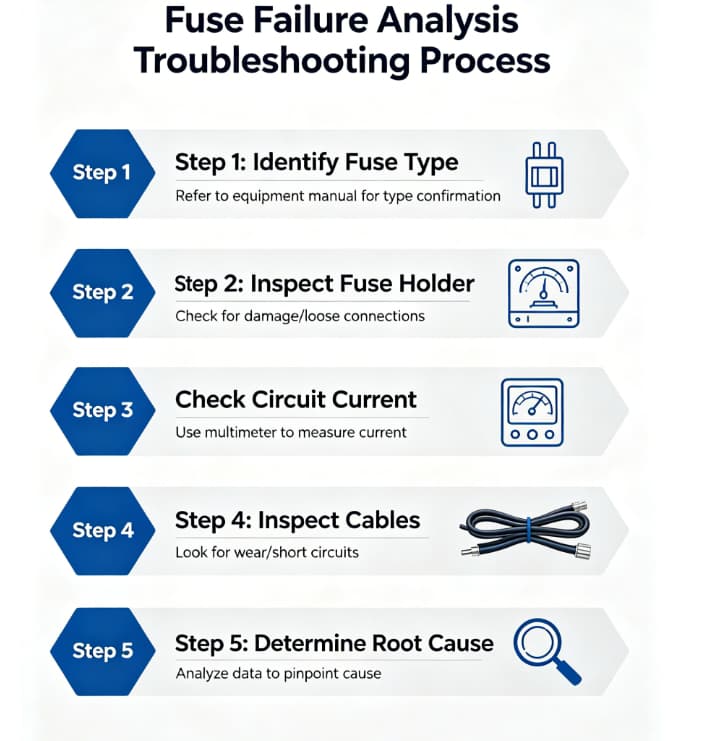
Le remplacement du fusible ne doit jamais être la première étape.
Le dépannage professionnel suit un processus systématique.
Identifier le type et le calibre du fusible.
Inspecter le porte-fusible.
Vérifier qu'il n'y a pas de dommages visibles.
Mesurer la résistance d'isolement.
Mesurer le courant de fonctionnement.
Inspecter les câbles et les bornes.
Étudier les changements récents apportés au système.
Vérifier les calculs de charge.
L'apparence d'un fusible grillé fournit souvent des informations précieuses pour le diagnostic.
| Apparence | Cause probable |
| Rupture nette | Surcharge modérée |
| Intérieur noirci | Court-circuit |
| Support fondu | Connexion desserrée |
| Corps fissuré | L'énergie des failles extrêmes |
| Marques de brûlure aux bornes | Résistance de contact |
Les électriciens expérimentés diagnostiquent souvent les pannes avant d'utiliser un équipement de test.
Les systèmes solaires photovoltaïques présentent des défis uniques.
| Cause | Fréquence |
| Courant inverse | Haut |
| Inadéquation de la chaîne de caractères | Moyen |
| Défaut à la terre | Moyen |
| Surtensions dues à la foudre | Faible |
| Erreurs d'installation | Haut |
Les systèmes photovoltaïques fonctionnant en courant continu, les arcs électriques sont plus difficiles à éteindre.

C'est pourquoi des fusibles gPV spécialisés sont nécessaires.
Les systèmes de batteries peuvent produire des courants de défaut extrêmement élevés.
| Exigence | Importance |
| Puissance en courant continu | Critique |
| Capacité de rupture élevée | Critique |
| Réponse rapide | Haut |
| Résistance à la température | Haut |
Avant de remplacer un fusible, répondez aux questions suivantes.
| Question | Oui/Non |
| Le fusible est-il correctement calibré ? | |
| La tension nominale est-elle correcte ? | |
| Toutes les bornes sont-elles bien serrées ? | |
| L'isolation du câble est-elle intacte ? | |
| L'équipement a-t-il été modifié récemment ? | |
| Les températures ambiantes sont-elles élevées ? | |
| Un courant de démarrage est-il envisagé ? | |
| Y a-t-il des signes de court-circuit ? |
Cette liste de contrôle permet d'éviter de nombreux échecs récurrents.
Les défaillances répétées des fusibles indiquent généralement une surcharge non résolue, un court-circuit, une connexion desserrée ou un dimensionnement incorrect des fusibles.
Oui.
Les surcharges, le vieillissement, les courants d'appel et les contraintes thermiques peuvent tous faire sauter un fusible.
Non.
Le surdimensionnement d'un fusible peut entraîner des niveaux de courant dangereux qui endommagent l'équipement et créent des risques d'incendie.
Absolument.
Les températures ambiantes élevées réduisent la capacité de transport de courant de la plupart des fusibles.
Seulement après avoir identifié et corrigé la cause sous-jacente.
Sinon, le fusible de remplacement risque de tomber à nouveau en panne.
Les systèmes électriques modernes deviennent de plus en plus intelligents.
Les technologies émergentes comprennent :
Ces technologies permettent de réduire les défaillances inattendues des fusibles et d'améliorer la fiabilité des systèmes.
Un fusible grillé ne doit jamais être considéré comme le problème lui-même.
Il s'agit plutôt d'un signe d'alerte indiquant que quelque chose d'anormal s'est produit dans le système électrique.
Les surcharges, les courts-circuits, les défauts de mise à la terre, les courants d'appel, les mauvaises connexions, le vieillissement, les conditions environnementales et la sélection incorrecte des fusibles figurent parmi les causes les plus courantes.
En appliquant un processus structuré d'analyse des défaillances, les électriciens et les ingénieurs peuvent identifier la véritable cause première, améliorer la fiabilité du système, réduire les temps d'arrêt et prévenir les défaillances futures.
La prochaine fois qu'un le fusible saute, Il ne suffit pas de le remplacer.
Enquêtez.
Le fusible peut protéger votre équipement d'un problème beaucoup plus important.

