منطقة ونغ يانغ الصناعية يويتشينغ ونتشو 325000
ساعات العمل
من الاثنين إلى الجمعة: 7 صباحاً - 7 مساءً
عطلة نهاية الأسبوع 10 صباحاً - 5 مساءً
منطقة ونغ يانغ الصناعية يويتشينغ ونتشو 325000
ساعات العمل
من الاثنين إلى الجمعة: 7 صباحاً - 7 مساءً
عطلة نهاية الأسبوع 10 صباحاً - 5 مساءً

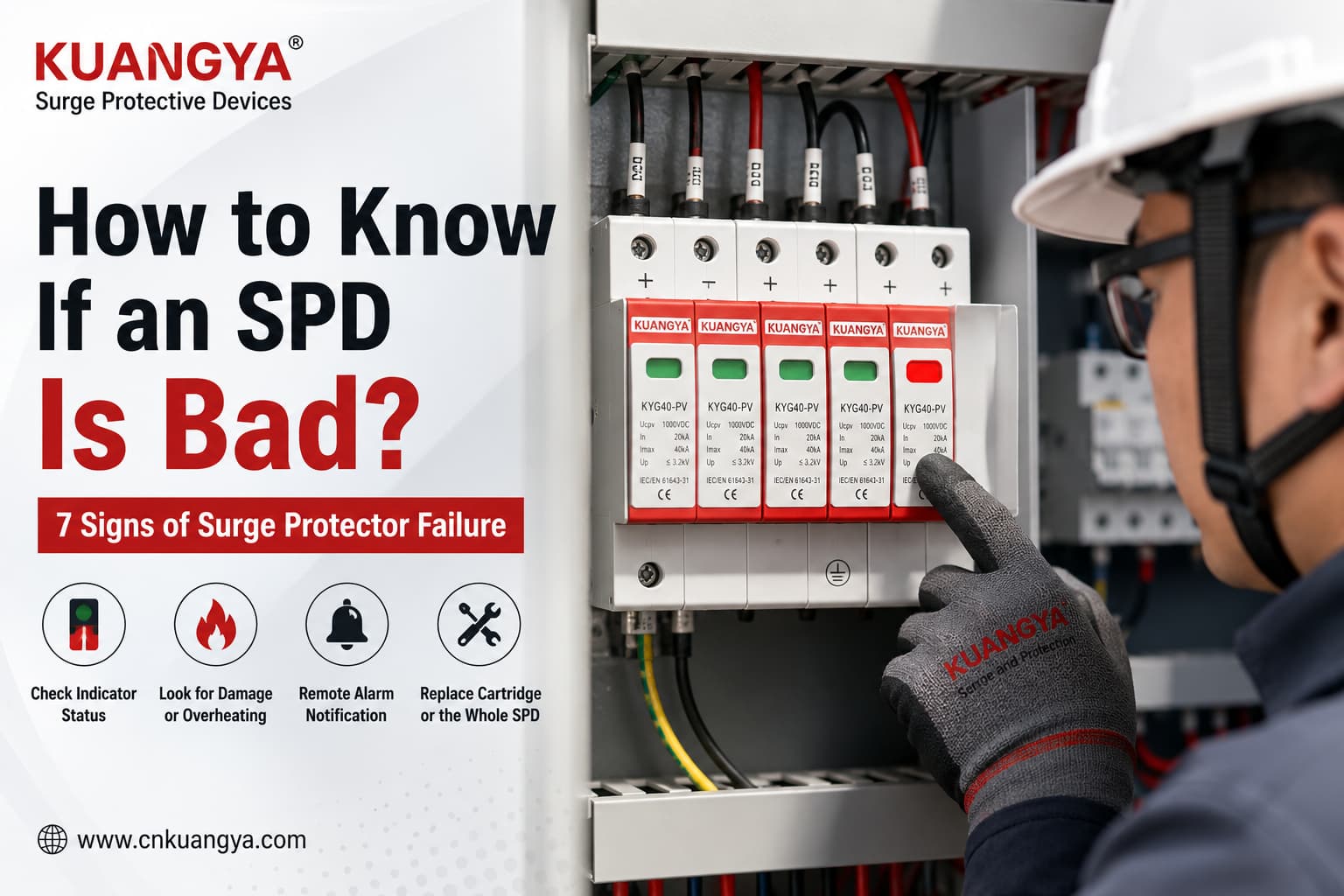
هل تتساءل كيف تعرف ما إذا كان جهاز الحماية من اندفاع التيار (SPD) تالفاً؟ عادة ما يكون مؤشر الحالة هو المكان الأول للتحقق، لكنه لا يمكنه إخبارك بكل شيء عن حالة جهاز الحماية من اندفاع التيار.
يمكن أن يظل جهاز الحماية من اندفاع التيار (SPD) يبدو طبيعياً تماماً من الخارج حتى بعد فقدان جزء من وظيفة الحماية الخاصة به.
وهذا يخلق مشكلة شائعة للقائمين بالتركيب ومالكي الأنظمة:
كيف تعرف ما إذا كان جهاز الحماية من اندفاع التيار (SPD) تالفاً؟
أسرع مكان للبدء هو مؤشر الحالة. في العديد من أجهزة الحماية من زيادة التيار (SPD) النمطية، يشير اللون الأخضر العادي إلى أن وحدة الحماية المراقبة لا تزال في حالتها الطبيعية المتاحة، بينما يشير اللون الأحمر أو مؤشر العطل إلى ضرورة فحص الوحدة المتأثرة أو استبدالها.
ومع ذلك، فإن المؤشر هو جزء واحد فقط من عملية التشخيص.
قد يحتاج جهاز الحماية من زيادة التيار (SPD) أيضاً إلى الاهتمام بسبب ارتفاع درجة الحرارة، أو وجود تلف مرئي، أو إنذار عن بُعد، أو تشغيل جهاز حماية احتياطي، أو التعرض لحدث كهربائي شديد غير عادي.
والأهم من ذلك:
لا يثبت المؤشر الأخضر أن نظام الحماية من زيادة التيار بالكامل يعمل بشكل مثالي.
الطريقة الصحيحة للحكم على حالة جهاز الحماية من زيادة التيار (SPD) هي الجمع بين مؤشر المنتج، والفحص البصري، وحالة التركيب، وسجل الأحداث، وتعليمات الشركة المصنعة.
قد يكون جهاز الحماية من زيادة التيار (SPD) تالفاً إذا أظهر مؤشر الحالة الخاص به حالة عطل، أو تحولت وحدة واحدة أو أكثر إلى اللون الأحمر، أو ظهرت علامات حرق أو تشوه على الغلاف، أو ارتفعت درجة حرارة الوحدة، أو ظهر إنذار عن بُعد، أو تعرض الجهاز لحدث كهربائي غير طبيعي. تأكد دائماً من معنى المؤشر من خلال تعليمات الشركة المصنعة.
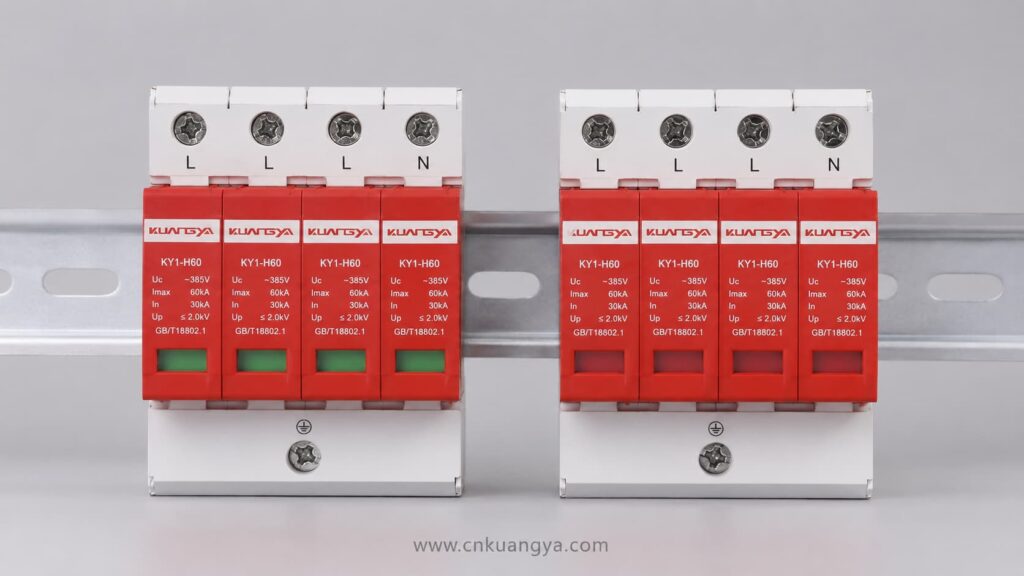
يشرح هذا الدليل 7 علامات عملية تدل على أن جهاز الحماية من زيادة التيار (SPD) قد يكون تالفاً, ، وما تعنيه كل علامة في الواقع، ومتى يجب استبدال الوحدة أو جهاز الحماية من زيادة التيار (SPD) بالكامل.
تم تصميم جهاز الحماية من زيادة التيار (SPD) للحد من الجهد الزائد العابر وتوجيه تيار الاندفاع بعيداً عن المعدات الكهربائية الحساسة.
تحتوي أجهزة الحماية من زيادة التيار (SPD) ذات الجهد المنخفض الحديثة عادةً على مكون حماية غير خطي واحد أو أكثر. وتُستخدم مقاومات أكسيد المعدن (MOVs) بشكل شائع في العديد من تصميمات أجهزة الحماية من النوع 2 والأجهزة المدمجة.
تصف معايير اللجنة الكهروتقنية الدولية (IEC) أجهزة الحماية من زيادة التيار بأنها أجهزة تحتوي على مكون غير خطي واحد على الأقل يعمل على الحد من جهد الاندفاع وتوجيه تيار الاندفاع. وتميز متطلبات اللجنة الكهروتقنية الدولية الحالية بين تطبيقات التيار المتردد (AC)، وتطبيقات التيار المستمر (DC) العامة، وتطبيقات التيار المستمر الكهروضوئية.
أثناء جهد النظام الطبيعي، يظل عنصر الحماية من زيادة التيار غير موصل للكهرباء إلى حد كبير.
عند حدوث جهد زائد عابر، يوفر جهاز الحماية من زيادة التيار مساراً منخفض المعاوقة لتيار الاندفاع ويساعد في الحد من الجهد الذي يصل إلى المعدات الموجودة في اتجاه التيار.
لكن هذه العملية تخلق إجهاداً كهربائياً وحرارياً.
بعد تكرار أحداث الاندفاع، أو حدوث اندفاع شديد، أو جهد نظام غير طبيعي، أو ظروف مجهدة أخرى، قد يتدهور أداء مكون الحماية.
لذلك، تتضمن العديد من أجهزة الحماية من زيادة التيار النمطية القائمة على مقاومات أكسيد المعدن (MOV) ما يلي: فاصل حراري.
إذا وصل المكون الوقائي إلى حالة غير آمنة، يمكن للفاصل فصله عن الدائرة الكهربائية. تربط العديد من المنتجات هذه الحالة ميكانيكياً بنافذة حالة باللونين الأحمر/الأخضر.
على سبيل المثال، توثق شركة فينيكس كونتاكت (Phoenix Contact) مقابس الحماية من زيادة التيار التي تجمع بين مقاوم متغير (varistor)، وجهاز فصل حراري، ومؤشر حالة محلي باللونين الأخضر/الأحمر.
توثق شركة فينيكس كونتاكت (Phoenix Contact)، على سبيل المثال، وحدات المقاوم المتغير القابلة للتوصيل التي تدمج جهاز فصل حراري ومؤشر محلي باللونين الأخضر/الأحمر.
يساعد هذا جهاز الحماية من زيادة التيار (SPD) على التعطل بشكل أكثر أماناً.
ولكن بمجرد فصل مسار الحماية المتأثر، قد لا يعود النظام يتمتع بمستوى الحماية المطلوب من زيادة التيار.
عادة ما يكون هذا هو أول شيء يجب التحقق منه.
تحتوي العديد من أجهزة الحماية من زيادة التيار (SPD) القابلة للتوصيل على نافذة حالة ميكانيكية صغيرة في المقدمة.
اعتماداً على المنتج، قد تظهر الحالة الطبيعية كالتالي:
قد تظهر حالة التلف أو الحاجة إلى الاستبدال كالتالي:
بالنسبة للعديد من المنتجات النمطية القائمة على MOV:
أخضر ← وحدة الحماية المراقبة تظل فعالة
أحمر ← حدث فصل داخلي وعادة ما تتطلب الوحدة المتأثرة الاستبدال
ومع ذلك، فإن هذا ليس قاعدة ألوان عالمية لكل أجهزة الحماية من زيادة التيار (SPD).
يستخدم المصنعون المختلفون مؤشرات مختلفة. تستخدم بعض أجهزة الحماية من زيادة التيار (SPD) مصابيح LED بدلاً من النوافذ الميكانيكية. ويستخدم البعض الآخر شاشات عرض، أو نقاط تلامس للإنذار، أو رموزاً، أو إنذارات صوتية، أو مجموعات من هذه الوظائف.
على سبيل المثال، توثق شركة شنايدر إلكتريك عائلات من أجهزة الحماية من زيادة التيار (SPD) حيث تُستخدم حالات مصابيح LED للإشارة إلى ما إذا كانت خاصية الحماية من زيادة التيار لا تزال متاحة على كل طور.
لذلك، تحقق دائماً من العلامات والتعليمات الخاصة بطراز جهاز الحماية من زيادة التيار (SPD) بدقة.
عادة لا.
يتم تركيب العديد من أجهزة الحماية من زيادة التيار (SPD) المثبتة على اللوحات على التوازي مع دائرة الطاقة.
وبالتالي، لا يعتمد الحمل الكهربائي عادةً على التيار المار عبر جهاز الحماية من زيادة التيار (SPD).
إذا انفتح فاصل جهاز الحماية من زيادة التيار (SPD) الداخلي، فقد تستمر المعدات المحمية في العمل بشكل طبيعي بينما تكون الحماية من زيادة التيار على ذلك المسار قد فُقدت.
ولهذا السبب يمكن لجهاز الحماية من زيادة التيار التالف أن يظل دون ملاحظة بسهولة.
تظل الأضواء مضاءة.
يستمر العاكس (Inverter) في العمل.
تستمر الآلة في التشغيل.
ولكن قد لا يتم تحديد الجهد العابر التالي بنفس الطريقة.
لا ينبغي الحكم على جهاز الحماية من زيادة التيار متعدد الأقطاب من خلال النظر إلى خرطوشة واحدة فقط.
على سبيل المثال، قد يظهر في التركيبات متعددة الوحدات ما يلي:
| حالة الوحدة | المعنى المحتمل | الإجراء الموصى به |
|---|---|---|
| جميع الوحدات المطلوبة تعمل بشكل طبيعي | لا يوجد عطل مشار إليه بواسطة المراقبة المحلية | متابعة الفحص الدوري |
| تعطل وحدة واحدة | قد لا يكون مسار الحماية الواحد متاحاً بعد الآن | افحص واستبدل حسب المواصفات |
| فشل وحدات متعددة | قد يكون حدث تدهور كبير في جهاز الحماية من اندفاع التيار (SPD) أو وقعت حادثة معينة | افحص جهاز الحماية من اندفاع التيار (SPD) والتركيب بالكامل |
| المؤشر غير واضح | لا يمكن تحديد الحالة بثقة | راجع ورقة البيانات أو تعليمات الشركة المصنعة |
افترض أن جهاز الحماية من اندفاع التيار (SPD) ثلاثي الأطوار يحتوي على ثلاث أو أربع وحدات قابلة للتوصيل.
إذا ظلت ثلاثة مؤشرات باللون الأخضر بينما تغير أحدها إلى حالة العطل المحددة من قبل الشركة المصنعة، فيجب عليك عدم وصف جهاز الحماية من زيادة التيار (SPD) بأنه يعمل بكامل كفاءته.
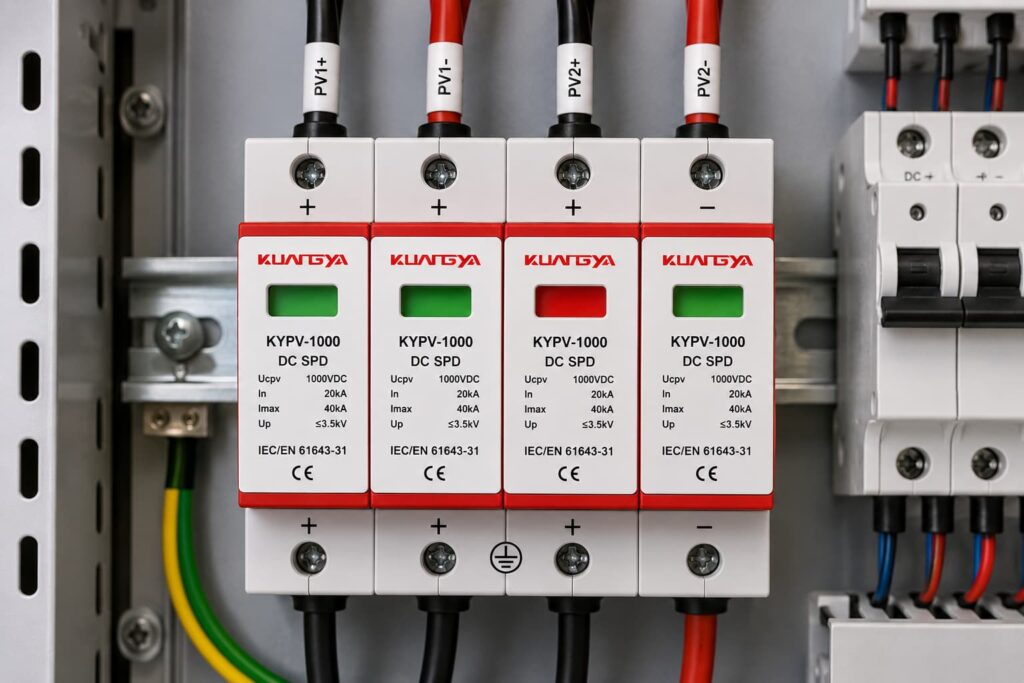
At least one intended protection path is no longer confirmed.
Not automatically.
Some modular SPDs are specifically designed so individual cartridges can be replaced.
If:
then replacing the affected cartridge may be sufficient.
However, if there is:
the complete SPD and surrounding installation should be investigated.
The status indicator is not the only thing that matters.
Always inspect the physical condition of the SPD.
Warning signs include:
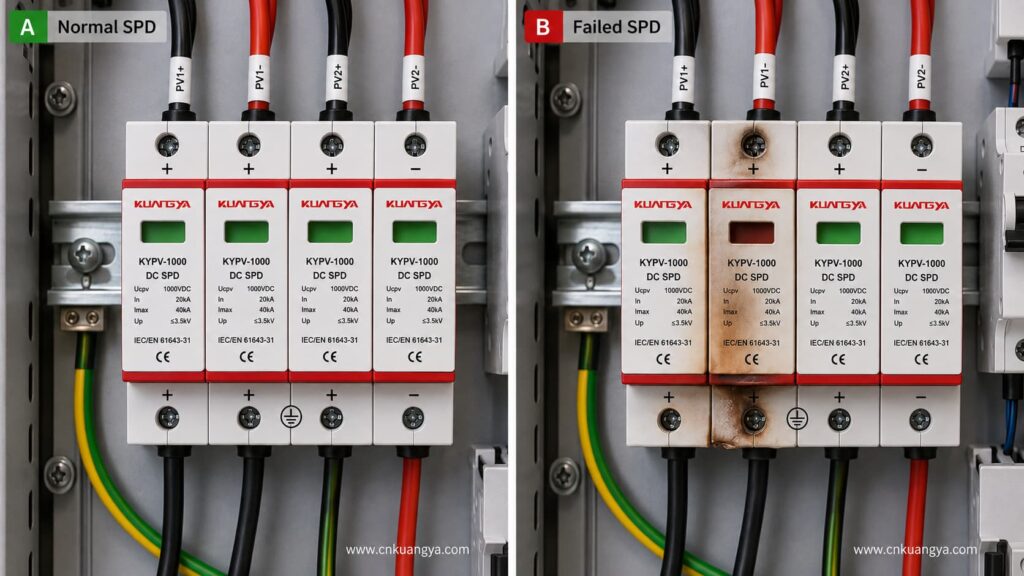
An SPD showing obvious thermal or mechanical damage should not simply be left in service because its indicator still appears green.
Physical damage can be caused by several different conditions, including:
The cause therefore matters.
Simply changing the cartridge without understanding why it was damaged can allow the same problem to happen again.
There is an important difference between:
A clean module that has reached its manufacturer-defined replacement condition
و
An SPD showing burning, melting, arcing, or mechanical damage.
In the second situation, inspection should extend beyond the replaceable cartridge.
Check the:
Severe physical damage is a reason to investigate the entire installation rather than simply installing a new plug.
Electrical equipment naturally operates at different temperatures.
But an SPD that becomes unusually hot, produces a burnt smell, or shows progressive discoloration deserves immediate attention.
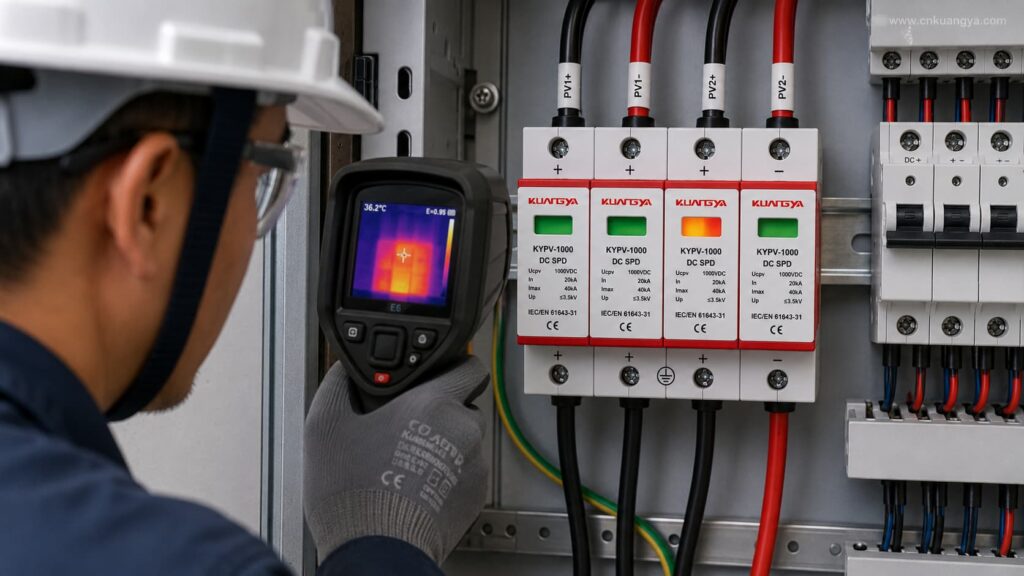
MOV-based protective components can experience increasing leakage and thermal stress as they degrade.
Proper SPD designs therefore use internal disconnecting or protective mechanisms to reduce the risk of an unsafe end-of-life condition.
Do not diagnose an energized SPD by repeatedly touching it.
If abnormal heating is suspected, inspection should be carried out by qualified personnel using appropriate procedures and instruments.
تشمل الأسباب المحتملة ما يلي:
A hot SPD does not automatically prove that the MOV itself has failed.
For example, a poorly tightened terminal can create local resistance and heating even if the surge component has not reached its end of life.
That is why the location of the heat and the overall installation condition should be investigated.
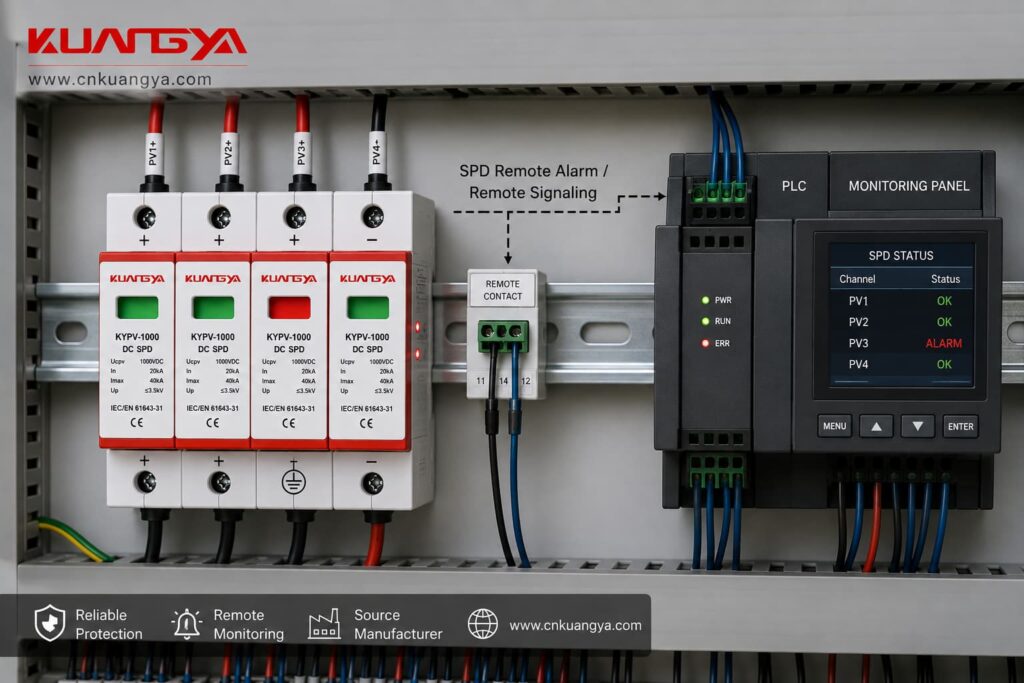
Industrial SPDs frequently offer an optional remote signaling contact.
Instead of requiring someone to open the electrical cabinet and visually check the SPD, the remote contact can communicate the SPD’s model-defined condition to equipment such as:
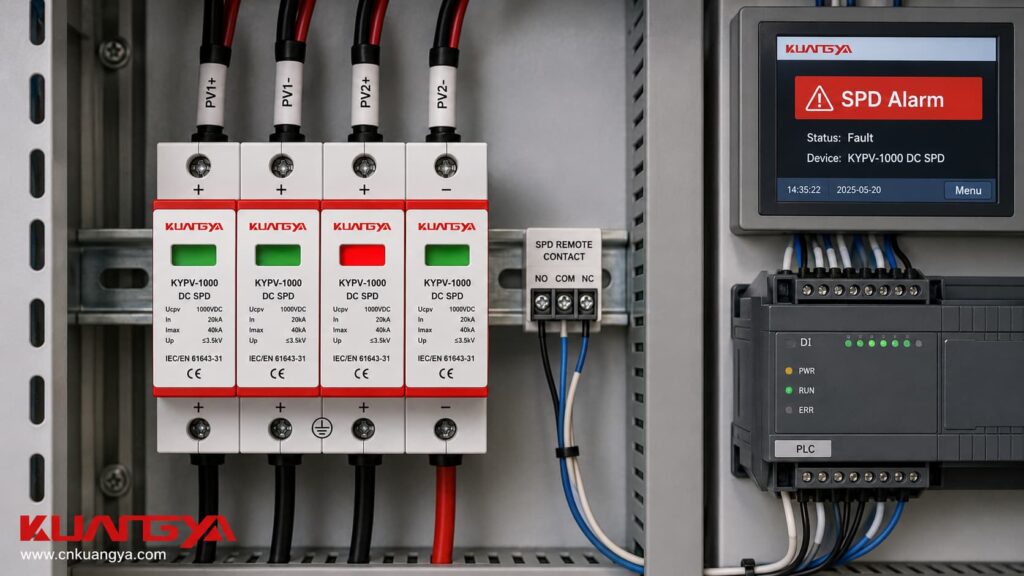
Phoenix Contact, for example, offers SPD assemblies combining local green/red indication with remote signaling.
This is useful in:
Usually, it tells you that the SPD’s monitored mechanism has changed state.
It does not automatically tell you:
Remote signaling is therefore a maintenance tool, not a complete SPD diagnostic system.
If a remote alarm appears, confirm the local SPD status and inspect the device according to the manufacturer’s instructions.
SPDs can be installed with upstream or dedicated overcurrent protection depending on the SPD design and system requirements.
If the associated fuse or circuit breaker operates unexpectedly, do not immediately assume that the breaker itself is faulty.
قد تشمل الأسباب المحتملة ما يلي:
The backup protective device and the internal SPD disconnector do different jobs.
The internal thermal disconnector may operate because a surge protection element has reached an unsafe thermal condition without necessarily creating the type of sustained overcurrent required to trip a conventional breaker.
So this situation is possible:
SPD = failed
Breaker = still ON
This does not automatically mean the breaker has failed.
Likewise, repeatedly fitting a larger breaker is not a correct solution to repeated SPD disconnection.
The cause of the SPD failure must be investigated first.
A major lightning or switching event is an important reason to inspect an SPD.
But it is important to use careful wording here.
SPDs are specifically designed to handle transient surge currents within their declared performance capabilities.
بناءً على ذلك:
Lightning nearby ≠ SPD automatically destroyed
However, after a known severe event, especially at a critical facility, it is good maintenance practice to inspect:
If a module has entered the manufacturer’s failed state, replace it.
If there is visible damage, investigate further.
If everything remains normal, follow the manufacturer’s maintenance and post-event instructions rather than replacing the SPD without evidence.
Select the conditions you can observe and get a quick indication of whether the SPD may need further inspection or replacement.
لا يوجد.
This is one of the most important distinctions when inspecting an SPD.
If the manufacturer defines green as the normal state, a green indicator usually means something like:
The monitored disconnect mechanism has not indicated failure and the protection module remains in its normal available state.
That is useful information.
But it is not the same as proving every aspect of SPD performance.
A green indicator normally cannot prove:
Think of the indicator as a condition signal, not a laboratory test.
If your SPD is still green, see our detailed guide to what an SPD green indicator can — and cannot — confirm about the protection system.
This is also why normal indication should be combined with periodic inspection.
نعم.
This surprises many people.
A typical shunt-connected SPD is installed parallel to the circuit being protected.
A simplified arrangement looks like this:
Power Supply → Load
with the SPD connected from the live conductors toward the relevant protection path, such as PE.
The load does not normally receive its operating current through the SPD.
Therefore, when the SPD’s internal protective element is disconnected at end of life:
Load power may remain ON
while
surge protection may be reduced or lost.
This is exactly why local indicators and remote alarms are important.
Without inspection, a failed SPD can remain installed for months while everything downstream appears to operate normally.
When learning how to know if an SPD is bad, it is important to understand that a normal digital multimeter cannot fully verify surge protection performance.
هذا السؤال يحتاج إلى إجابة دقيقة.
A digital multimeter cannot reproduce the standardized surge conditions used to determine major SPD ratings.
It cannot verify:
These characteristics require controlled test equipment and defined test procedures.
IEC SPD requirements use standardized testing to establish performance and safety characteristics; ordinary low-voltage resistance measurements are not substitutes for those tests.
Depending on the SPD and the manufacturer’s instructions, a multimeter may help with:
But there is no universal resistance reading that means “SPD good.”
For MOV-based products, the small test voltage produced by a normal multimeter may be far below the voltage at which the varistor significantly conducts.
A healthy MOV can therefore appear as very high resistance or open circuit.
A degraded MOV may also appear open under the same low test voltage.
إذن:
Open circuit on a multimeter does not prove the SPD is healthy.
Likewise:
A continuity beep is not a universal SPD pass/fail test.
Dedicated SPD or MOV test equipment can provide more useful diagnostic information for some products, but results must still be compared with manufacturer-defined values for that specific SPD.
Generally, do not apply an insulation resistance tester directly across an SPD unless the manufacturer specifically provides a procedure allowing it.
Megohmmeters use test voltages much higher than an ordinary multimeter.
Because an SPD is intentionally designed to conduct when voltage rises above certain conditions, insulation testing can:
For system insulation testing, SPDs may need to be disconnected or removed according to the manufacturer’s instructions and applicable installation procedures.
Never assume an SPD should behave like ordinary insulation.
Understanding the reason is important because simply installing another SPD may not solve the underlying problem.
Every surge does not necessarily destroy an SPD.
However, repeated surge activity can progressively stress protective components.
The actual service life depends on factors such as:
There is therefore no reliable rule such as:
“An SPD always lasts exactly five years.”
Calendar age alone does not determine SPD condition.
SPDs have declared surge-current capabilities.
A sufficiently severe electrical event can exceed the capability of a particular protection system.
This is one reason correct Type selection and coordinated surge protection are important.
Type 1, Type 2, and combined Type 1+2 SPDs are not simply different quality levels.
If you are unsure which classification applies, see our guide to Type 1 vs Type 2 vs Type 1+2 SPD for a more detailed comparison.
A transient surge and a temporary overvoltage are not the same thing.
A surge is generally very short.
A temporary overvoltage, or TOV, can remain for much longer.
An SPD designed to conduct short transient energy should not be expected to clamp an abnormal power-frequency overvoltage indefinitely.
Improper TOV conditions can therefore create serious stress on an SPD.
Current IEC requirements specifically consider TOV and fault conditions as part of SPD application and testing.
Selecting an SPD with an unsuitable maximum continuous operating voltage can cause problems.
For AC systems, the relevant value is commonly expressed as Uc.
For photovoltaic applications, Ucpv is particularly important.
For photovoltaic DC applications, IEC 61643-31 specifies requirements and test methods for SPDs intended for the DC side of PV installations.
If you are not familiar with these ratings, our guide to DC SPD specifications explains Ucpv, In, Imax, Up and Iscpv separately.
If the SPD’s voltage rating is too low for the maximum voltage that can continuously appear in the system, the protection component can be stressed during normal or abnormal operating conditions.
For PV systems, remember that array voltage changes with temperature.
Maximum PV open-circuit voltage under expected low-temperature conditions therefore needs to be considered when selecting the DC SPD.
For the full selection process, see how to select the correct DC SPD voltage rating for a solar PV system.
Even a good SPD can perform poorly if it is installed incorrectly.
Important installation factors include:
Long connection leads are particularly important because the inductive voltage developed along the conductors during a rapidly changing surge current can add to the voltage seen by the protected equipment.
SPD location and lead length are two different installation issues. See why SPD distance from the inverter matters for a detailed explanation of the 10 m system-distance rule and the approximately 0.5 m connection-lead recommendation.
This means SPD performance depends not only on the number printed next to لأعلى, but also on how the SPD is actually installed.
Environmental stress can also shorten SPD service life.
وتشمل الأمثلة على ذلك:
These conditions can affect terminals, insulation, contacts, and surrounding installation components even before the internal surge element reaches normal end of life.
A simple field inspection can follow this order.
Check:
Do not install a cartridge just because it physically fits the base.
Confirm what the indicator means for that exact product.
Do not automatically assume every green window means normal and every red window means failure without checking the manufacturer’s markings.
For multi-pole SPDs, inspect all cartridges.
One failed module can mean the complete intended protection arrangement is no longer available.
Check for:
If remote signaling is installed, compare the remote alarm state with the local status.
A mismatch should be investigated.
Ask whether the installation recently experienced:
| الحالة | Typical Action |
|---|---|
| Manufacturer-defined normal indicator, no other problems | Continue normal monitoring |
| Failed/red module | Replace according to manufacturer instructions |
| One cartridge failed | Inspect assembly and replace affected cartridge if permitted |
| Multiple cartridges failed | Inspect complete SPD and system |
| Burnt or melted base | Investigate and normally replace complete damaged assembly |
| Remote fault alarm | Confirm local status and investigate |
| Severe event but normal indication | Inspect according to maintenance instructions |
| Repeated replacement failures | Investigate system voltage, wiring, TOV and coordination |
| Condition uncertain | Treat protection as unconfirmed until properly assessed |
Many DIN-rail SPDs are modular.
They consist of:
Base + replaceable protection cartridge
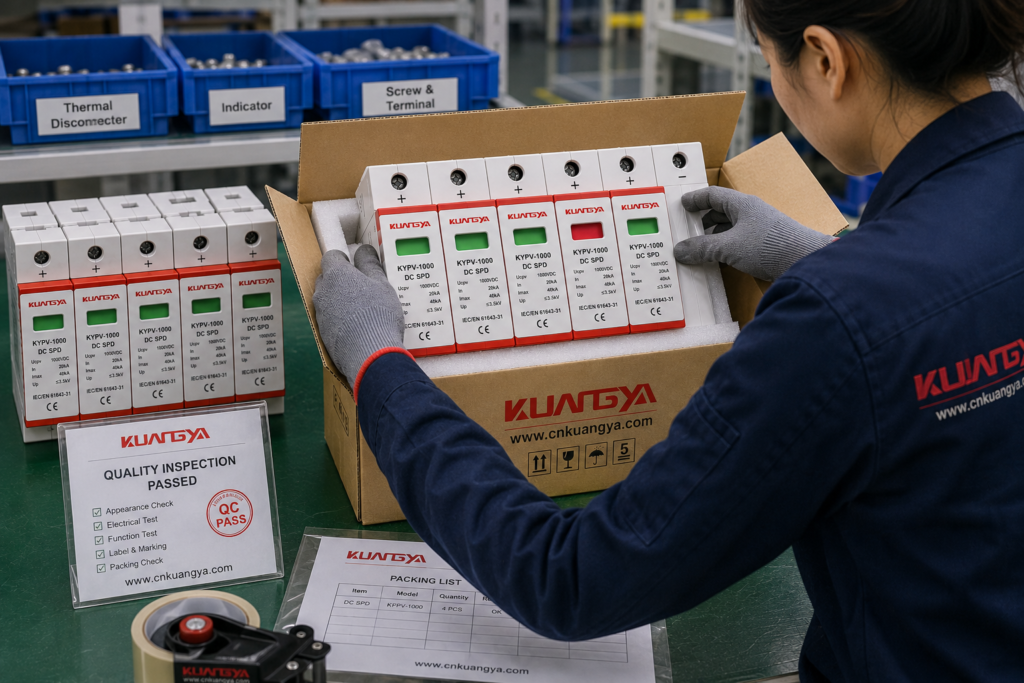
For reference, you can also view our DC surge protective device range, including modular Type 2 and Type 1+2 models with replaceable cartridges.
This allows easier maintenance.
Never bypass the SPD’s internal thermal disconnector or attempt to reset a sealed failed cartridge.
A cartridge that has entered its defined end-of-life condition is normally intended to be replaced rather than repaired.
If the manufacturer-defined indication shows that the intended surge protection path is no longer available, replacement should not be unnecessarily delayed.
The electrical system may continue running without it.
But that does not mean continued operation without surge protection is desirable.
هذا الأمر مهم بشكل خاص لـ
The longer the failed SPD remains in place, the longer the equipment may remain exposed to the next transient event.
There is no single inspection interval suitable for every installation.
Inspection frequency should consider:
Inspection is particularly useful:
For unattended or critical installations, remote signaling can make it easier to detect a failed SPD quickly.
Seeing a failed SPD sometimes leads to the assumption:
“The SPD failed, so it must be defective.”
That conclusion is not always correct.
An SPD is a protective device exposed directly to electrical stress.
A failure indication may mean that it experienced the kind of abnormal condition its protective and disconnecting mechanisms were designed to handle safely.
The more useful question is:
Why did the SPD reach this condition?
Investigate:
If the same SPD position fails repeatedly, replacing cartridges without investigating the system is not enough.
The easiest sign of SPD failure is a manufacturer-defined failure or replacement indication, commonly red on many modular SPDs.
But that should not be the only check.
An SPD should also be investigated if you find:
At the same time, do not assume that a green indicator proves the entire surge protection system is perfect.
It usually confirms only the condition monitored by that particular SPD.
And do not rely on a normal multimeter resistance test to prove surge performance.
Correct SPD assessment combines:
product status + visual inspection + installation condition + event history + manufacturer instructions.
If a modular SPD has reached its defined end-of-life state, replace the affected cartridge or assembly as specified.
More importantly, if failure is repeated or accompanied by physical damage, investigate the underlying electrical system before simply installing another SPD.
Ultimately, how to know if an SPD is bad comes down to combining the status indication, physical inspection, event history, installation condition and manufacturer guidance rather than relying on a single test.
Start with the manufacturer’s status indicator. If the product defines the displayed condition as normal and there is no physical damage or alarm, the monitored module remains in its normal indicated state. However, the status indicator does not prove complete surge performance or remaining lifetime.
On many modular SPDs, green means that the monitored protection module has not entered its failure or disconnection state.
But always confirm the manufacturer’s markings because indicator systems vary between products.
Green should not be interpreted as proof that the complete installation is perfectly protected.
On many plug-in MOV-based SPDs, a red indicator means the protection module has reached a manufacturer-defined failed or replacement condition, often associated with an internal disconnector.
The affected cartridge normally needs to be replaced.
Check the exact product instructions before taking action.
نعم.
Most panel-mounted SPDs are connected in parallel with the protected circuit.
The load can therefore remain energized even if the SPD protection element has been disconnected.
Only to a limited extent.
A multimeter may help check remote dry contacts or investigate certain basic electrical conditions when permitted by the manufacturer.
It cannot verify surge ratings such as Up, In, Imax, or Iimp, and there is no universal resistance value that proves an SPD is healthy.
Not automatically.
Inspect the SPD after a significant event and follow the manufacturer’s maintenance instructions.
Replace it if it shows a failure indication, physical damage, abnormal condition, or if the manufacturer specifically requires replacement after the event.
Replaceable cartridges are common in modular SPDs. For example, Schneider Electric explains that when the SPD end-of-life indicator turns red, the cartridge should be replaced.
Often yes, if the SPD is designed with replaceable plug-in modules and the base is undamaged.
Use only the correct compatible replacement cartridge specified for that SPD.
If the base, terminals, or surrounding components show heat or arc damage, the complete assembly should be investigated.
Repeated failure can indicate more than ordinary surge aging.
تشمل الأسباب المحتملة ما يلي:
If cartridges repeatedly fail at the same location, investigate the system instead of continuing to replace modules without identifying the cause.
No reliable fixed lifetime can be determined from indicator color alone.
SPD life depends on the electrical stress it experiences, environmental conditions, product design, and installation.
The indicator should be treated as one part of a wider inspection and maintenance process.

