温州市岳陽工業区 325000
勤務時間
月曜日~金曜日:午前7時~午後7時
週末午前10時~午後5時
温州市岳陽工業区 325000
勤務時間
月曜日~金曜日:午前7時~午後7時
週末午前10時~午後5時

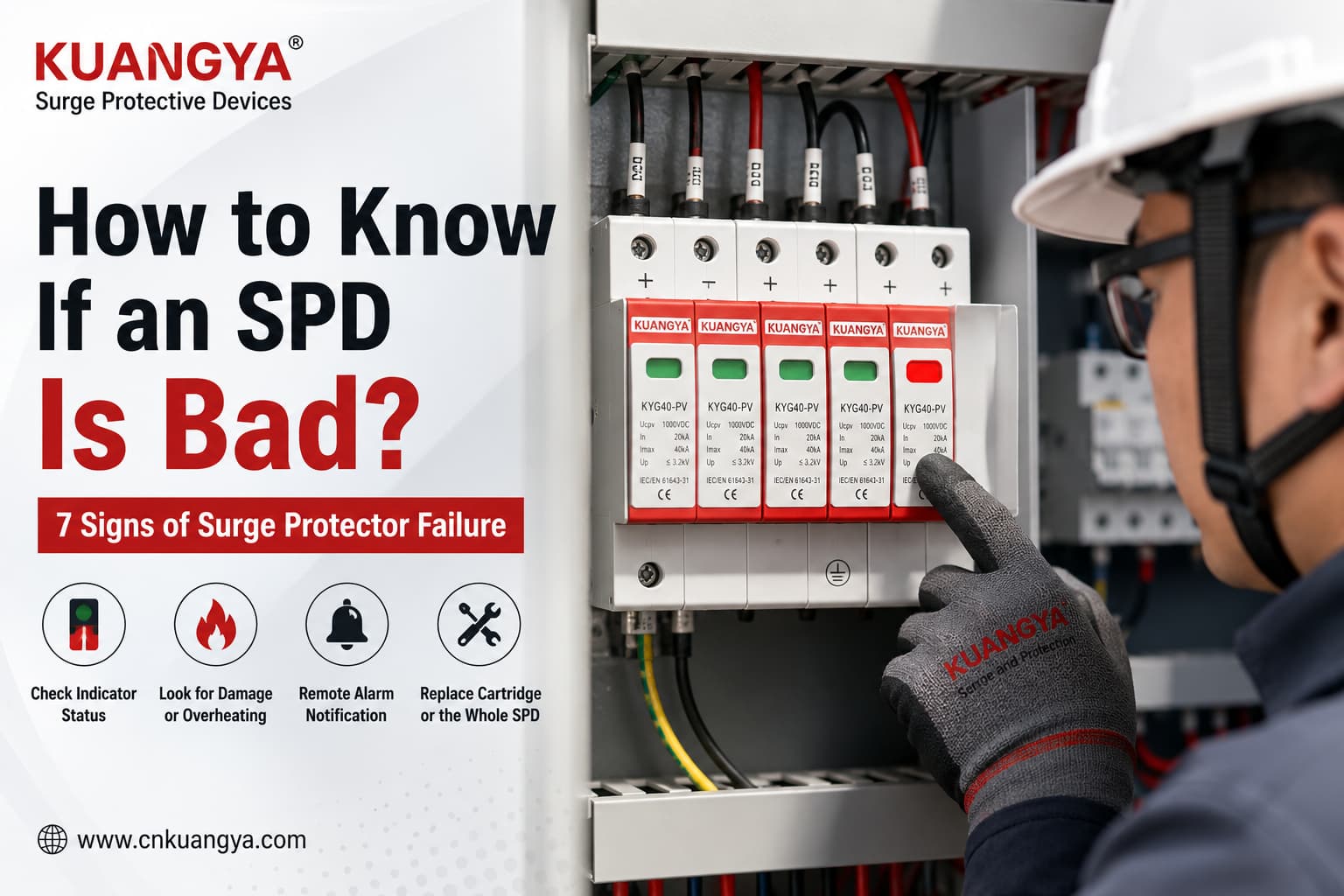
SPDが故障しているかどうかを判断する方法について疑問をお持ちですか?ステータスインジケーターは通常、最初に確認すべき箇所ですが、それだけでサージ保護デバイスの状態のすべてを把握できるわけではありません。.
サージ保護デバイス(SPD)は、保護機能の一部が失われた後でも、外観上は完全に正常に見えることがあります。.
これにより、設置業者やシステム所有者にとって共通の課題が生じます。
SPDが故障しているかどうかをどのように判断すればよいのでしょうか?
最も迅速に確認できるのは、 ステータスインジケーターです。. 多くのモジュール式SPDにおいて、緑色の表示は監視対象の保護モジュールが正常な待機状態であることを示し、赤色または故障の表示は該当モジュールの点検または交換が必要であることを示します。.
ただし、インジケーターは診断の一部に過ぎません。.
SPDは、過熱、目視による損傷、リモートアラームの作動、バックアップ保護装置の動作、または異常に過酷な電気的イベントへの曝露によっても、点検が必要となる場合があります。.
そして重要な点として:
緑色のインジケーターは、サージ保護システム全体が完璧であることを証明するものではありません。.
SPDの状態を判断する正しい方法は、製品のインジケーター、目視点検、設置状況、イベント履歴、およびメーカーの指示を組み合わせて確認することです。.
ステータスインジケーターが故障状態を示している、1つ以上のモジュールが赤色になっている、筐体に焦げ跡や変形がある、ユニットが過熱している、リモートアラームが作動している、またはSPDが異常な電気的イベントを経験した場合、そのSPDは故障している可能性があります。インジケーターの意味については、必ずメーカーの指示書で確認してください。.
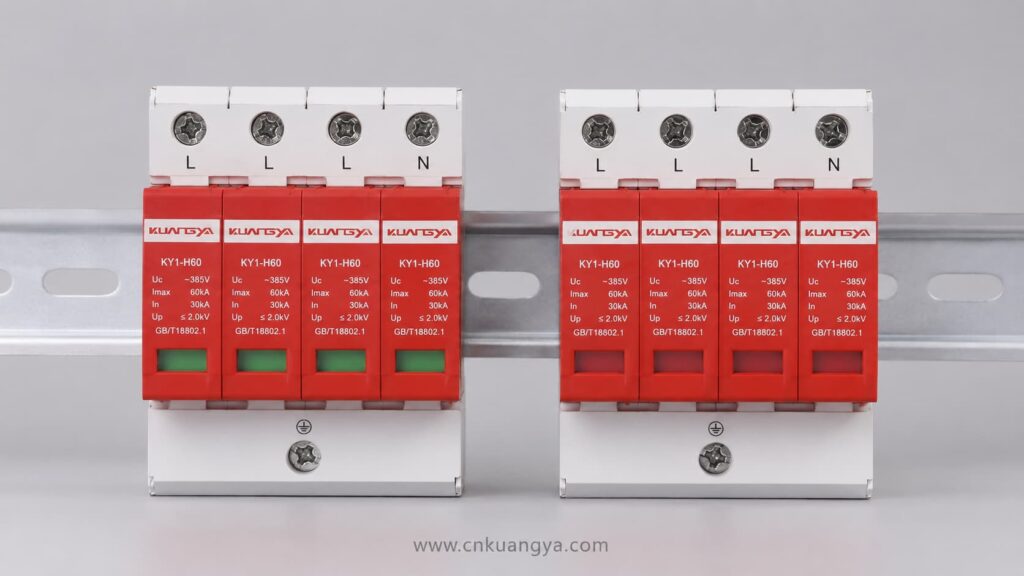
本ガイドでは以下について説明します。 SPDが故障している可能性を示す7つの実用的な兆候, 各兆候が実際に何を意味するのか、またモジュールやSPD全体をいつ交換すべきかについて。.
SPDは、過渡過電圧を制限し、サージ電流を敏感な電気機器から逸らして保護するように設計されています。.
現代の低圧用SPDには、通常1つ以上の非線形保護素子が組み込まれています。MOV(金属酸化物バリスタ)は、多くのタイプ2および複合型SPD設計で一般的に使用されています。.
IEC規格では、SPDを「サージ電圧を制限し、サージ電流を逸らすための少なくとも1つの非線形素子を含むデバイス」と定義しています。現在のIEC要件では、AC用、汎用DC用、および太陽光発電DC用の各アプリケーションが区別されています。.
通常のシステム電圧下では、サージ保護素子はほとんど導通しない状態を維持します。.
過渡過電圧が発生すると、SPDはサージ電流に対して低インピーダンスの経路を提供し、下流の機器に到達する電圧を制限する役割を果たします。.
しかし、このプロセスは電気的および熱的なストレスを生じさせます。.
繰り返されるサージイベント、深刻なサージ、異常なシステム電圧、またはその他の過酷な条件下では、保護素子が劣化する可能性があります。.
そのため、多くのMOVベースのモジュール式SPDには、以下が含まれています。 熱動遮断器.
保護コンポーネントが危険な状態に達した場合、遮断器はそれを回路から切り離すことができます。多くの製品では、この状態が機械的に赤/緑のステータスウィンドウと連動しています。.
例えば、フエニックス・コンタクトの資料では、サージ保護プラグが以下を組み合わせていると説明されています。 バリスタ、熱動遮断装置、およびローカルの緑/赤ステータスインジケーター.
例えば、フエニックス・コンタクトの資料では、熱動遮断装置とローカルの緑/赤表示を組み込んだプラグイン式バリスタモジュールについて説明されています。.
これにより、SPDはより安全に故障(フェイルセーフ)することができます。.
しかし、影響を受けた保護経路が遮断されると、システムは意図したレベルのサージ保護を維持できなくなる可能性があります。.
通常、これが最初に確認すべき項目です。.
多くのプラグイン式SPDの前面には、小さな機械式ステータスウィンドウが備わっています。.
製品によっては、正常状態が以下のように表示される場合があります:
故障または交換が必要な状態は、以下のように表示される場合があります:
多くのモジュール式MOVベース製品において:
緑色 → 監視対象の保護モジュールが有効であることを示します
赤色 → 内部で切り離しが発生しており、通常は該当モジュールの交換が必要です
ただし、これは すべてのSPDに共通する色のルールではありません.
メーカーによってインジケーターの仕様は異なります。一部のSPDでは機械式ウィンドウの代わりにLEDが使用されます。また、ディスプレイ、警報接点、シンボル、警報音、あるいはこれらの機能を組み合わせたものを使用する製品もあります。.
例えばシュナイダーエレクトリック社では、各相のサージ抑制機能が有効かどうかをLEDの状態によって示すSPDシリーズの仕様を定めています。.
したがって、正確なSPDモデルについては、常にマーキングと取扱説明書を確認してください。.
通常はそうではありません。.
多くのパネル取り付け型SPDは、 並列に 電源回路と共に設置されます。.
そのため、電気負荷は通常、SPDを通過する電流に依存しません。.
SPD内部の断路器が作動した場合、その経路のサージ保護機能は失われますが、保護対象の機器は正常に動作し続ける可能性があります。.
これが、故障したSPDが見過ごされやすい理由です。.
照明は点灯したままです。.
インバータは動作を継続します。.
機械は運転を継続します。.
しかし、次の過渡現象は同じように制限されない可能性があります。.
多極SPDは、1つのカートリッジだけを見て判断すべきではありません。.
例えば、マルチモジュール設置では以下のように表示されることがあります:
| モジュールの状態 | 考えられる意味 | 推奨される措置 |
|---|---|---|
| すべての必須モジュールは正常 | ローカル監視による異常検知なし | 通常点検を継続 |
| 1つのモジュールが故障 | 1つの保護経路が使用不可の可能性あり | 指定に従って調査および交換を実施 |
| 複数のモジュールが故障 | SPDの著しい劣化またはイベントが発生した可能性がある | SPDおよび設置状況全体を点検すること |
| 表示が不明瞭 | 状態を確実に判断できない | データシートまたはメーカーの取扱説明書を確認すること |
三相SPDに3つまたは4つのプラグインモジュールがある場合を想定する.
3つが緑色のままで1つがメーカーの故障状態に変化している場合、 SPD全体が完全に動作していると判断してはならない.
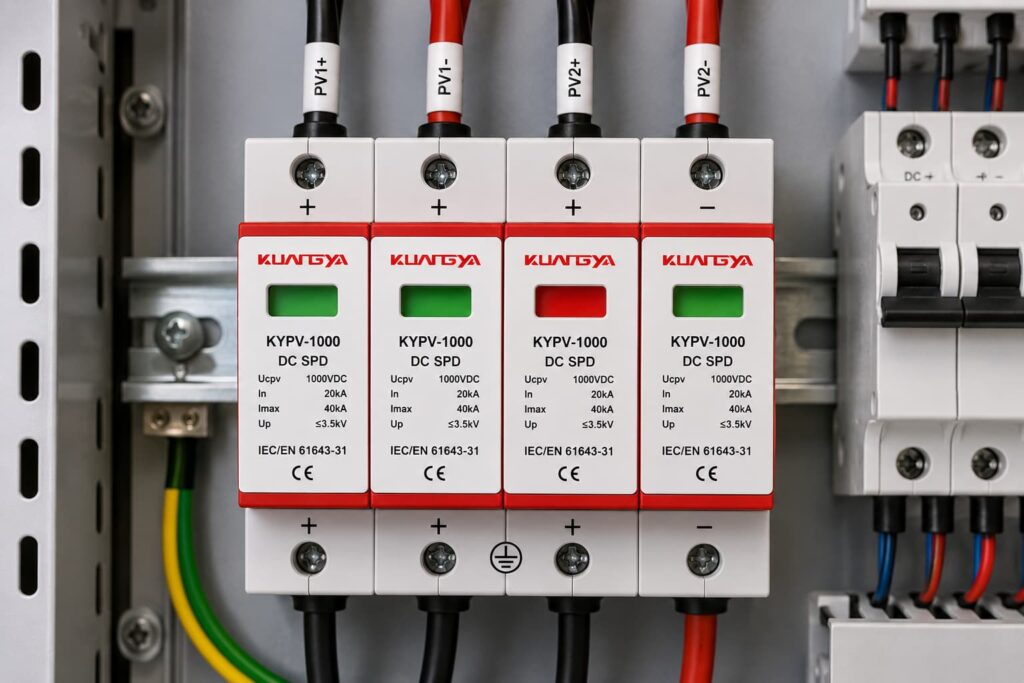
少なくとも1つの意図された保護経路が確保されていない状態です。.
Not automatically.
Some modular SPDs are specifically designed so individual cartridges can be replaced.
If:
then replacing the affected cartridge may be sufficient.
However, if there is:
the complete SPD and surrounding installation should be investigated.
The status indicator is not the only thing that matters.
Always inspect the physical condition of the SPD.
Warning signs include:
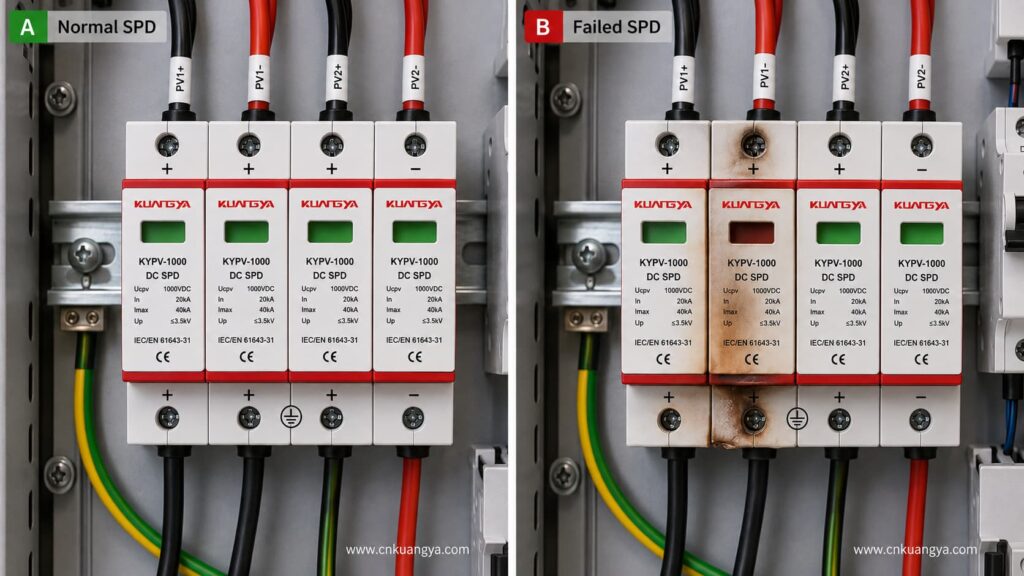
An SPD showing obvious thermal or mechanical damage should not simply be left in service because its indicator still appears green.
Physical damage can be caused by several different conditions, including:
The cause therefore matters.
Simply changing the cartridge without understanding why it was damaged can allow the same problem to happen again.
There is an important difference between:
A clean module that has reached its manufacturer-defined replacement condition
そして
An SPD showing burning, melting, arcing, or mechanical damage.
In the second situation, inspection should extend beyond the replaceable cartridge.
Check the:
Severe physical damage is a reason to investigate the entire installation rather than simply installing a new plug.
Electrical equipment naturally operates at different temperatures.
But an SPD that becomes unusually hot, produces a burnt smell, or shows progressive discoloration deserves immediate attention.
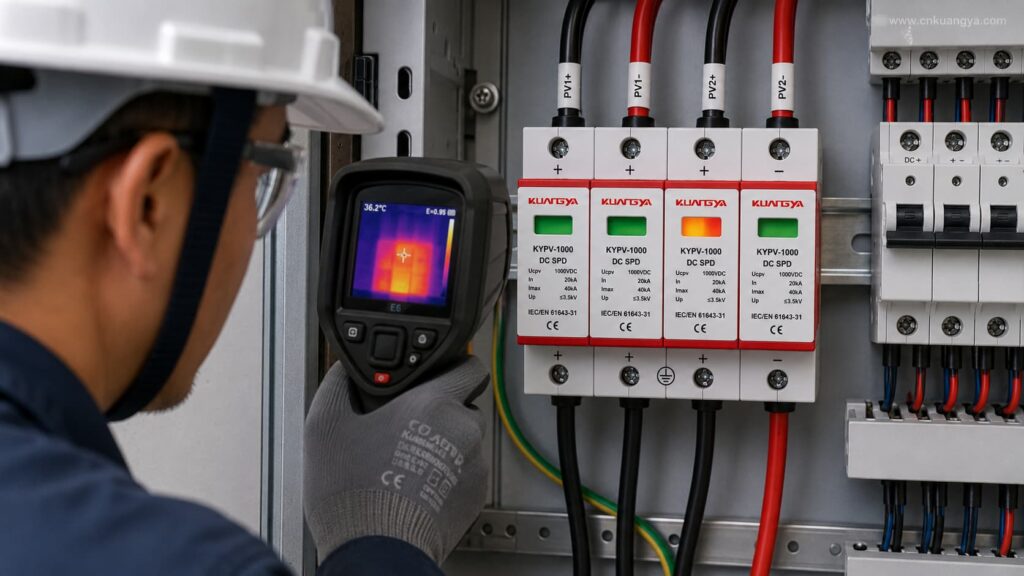
MOV-based protective components can experience increasing leakage and thermal stress as they degrade.
Proper SPD designs therefore use internal disconnecting or protective mechanisms to reduce the risk of an unsafe end-of-life condition.
Do not diagnose an energized SPD by repeatedly touching it.
If abnormal heating is suspected, inspection should be carried out by qualified personnel using appropriate procedures and instruments.
考えられる原因は以下の通り:
A hot SPD does not automatically prove that the MOV itself has failed.
For example, a poorly tightened terminal can create local resistance and heating even if the surge component has not reached its end of life.
That is why the location of the heat and the overall installation condition should be investigated.
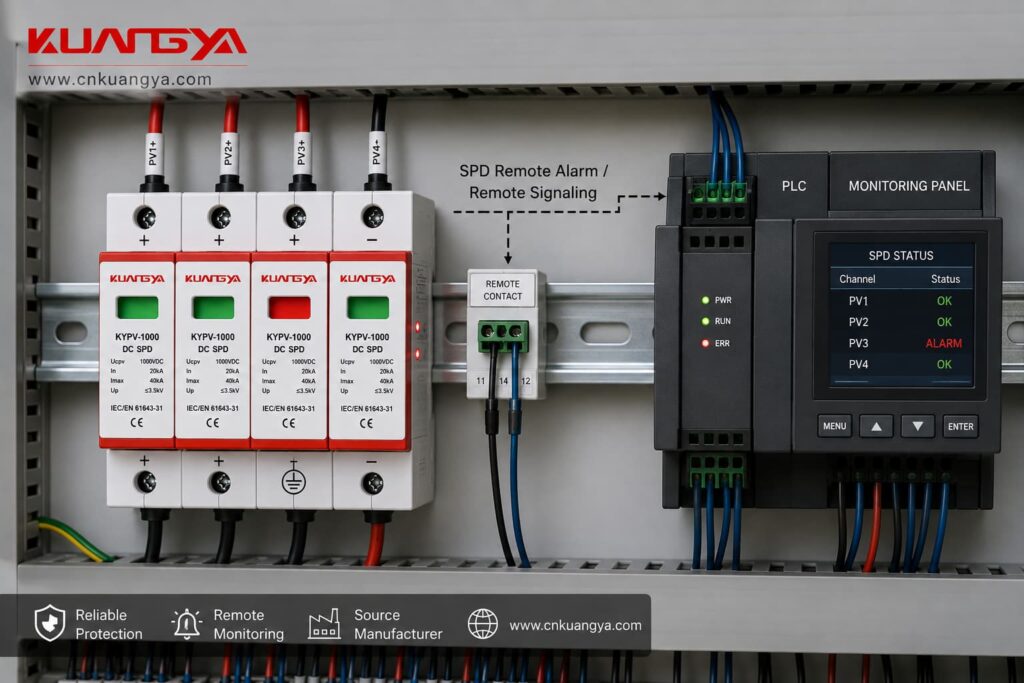
Industrial SPDs frequently offer an optional remote signaling contact.
Instead of requiring someone to open the electrical cabinet and visually check the SPD, the remote contact can communicate the SPD’s model-defined condition to equipment such as:
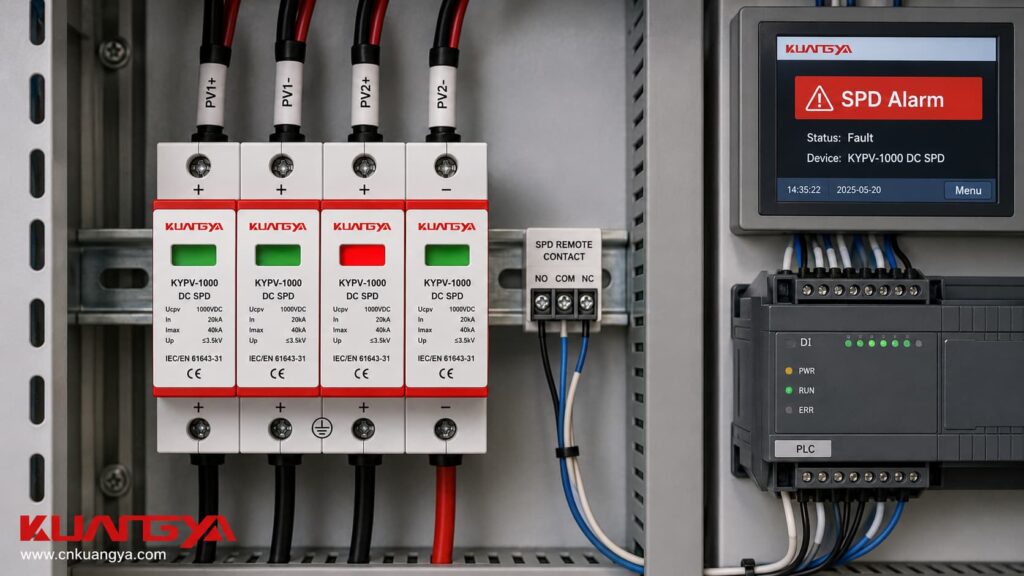
Phoenix Contact, for example, offers SPD assemblies combining local green/red indication with remote signaling.
This is useful in:
Usually, it tells you that the SPD’s monitored mechanism has changed state.
It does not automatically tell you:
Remote signaling is therefore a maintenance tool, not a complete SPD diagnostic system.
If a remote alarm appears, confirm the local SPD status and inspect the device according to the manufacturer’s instructions.
SPDs can be installed with upstream or dedicated overcurrent protection depending on the SPD design and system requirements.
If the associated fuse or circuit breaker operates unexpectedly, do not immediately assume that the breaker itself is faulty.
考えられる原因は以下の通りです:
The backup protective device and the internal SPD disconnector do different jobs.
The internal thermal disconnector may operate because a surge protection element has reached an unsafe thermal condition without necessarily creating the type of sustained overcurrent required to trip a conventional breaker.
So this situation is possible:
SPD = failed
Breaker = still ON
This does not automatically mean the breaker has failed.
Likewise, repeatedly fitting a larger breaker is not a correct solution to repeated SPD disconnection.
The cause of the SPD failure must be investigated first.
A major lightning or switching event is an important reason to inspect an SPD.
But it is important to use careful wording here.
SPDs are specifically designed to handle transient surge currents within their declared performance capabilities.
したがって:
Lightning nearby ≠ SPD automatically destroyed
However, after a known severe event, especially at a critical facility, it is good maintenance practice to inspect:
If a module has entered the manufacturer’s failed state, replace it.
If there is visible damage, investigate further.
If everything remains normal, follow the manufacturer’s maintenance and post-event instructions rather than replacing the SPD without evidence.
Select the conditions you can observe and get a quick indication of whether the SPD may need further inspection or replacement.
そうだ。.
This is one of the most important distinctions when inspecting an SPD.
If the manufacturer defines green as the normal state, a green indicator usually means something like:
The monitored disconnect mechanism has not indicated failure and the protection module remains in its normal available state.
That is useful information.
But it is not the same as proving every aspect of SPD performance.
A green indicator normally cannot prove:
Think of the indicator as a condition signal, not a laboratory test.
If your SPD is still green, see our detailed guide to what an SPD green indicator can — and cannot — confirm about the protection system.
This is also why normal indication should be combined with periodic inspection.
そうだ。.
This surprises many people.
A typical shunt-connected SPD is installed parallel to the circuit being protected.
A simplified arrangement looks like this:
Power Supply → Load
with the SPD connected from the live conductors toward the relevant protection path, such as PE.
The load does not normally receive its operating current through the SPD.
Therefore, when the SPD’s internal protective element is disconnected at end of life:
Load power may remain ON
while
surge protection may be reduced or lost.
This is exactly why local indicators and remote alarms are important.
Without inspection, a failed SPD can remain installed for months while everything downstream appears to operate normally.
When learning how to know if an SPD is bad, it is important to understand that a normal digital multimeter cannot fully verify surge protection performance.
この質問には慎重な回答が必要です。.
A digital multimeter cannot reproduce the standardized surge conditions used to determine major SPD ratings.
It cannot verify:
These characteristics require controlled test equipment and defined test procedures.
IEC SPD requirements use standardized testing to establish performance and safety characteristics; ordinary low-voltage resistance measurements are not substitutes for those tests.
Depending on the SPD and the manufacturer’s instructions, a multimeter may help with:
But there is no universal resistance reading that means “SPD good.”
For MOV-based products, the small test voltage produced by a normal multimeter may be far below the voltage at which the varistor significantly conducts.
A healthy MOV can therefore appear as very high resistance or open circuit.
A degraded MOV may also appear open under the same low test voltage.
したがって:
Open circuit on a multimeter does not prove the SPD is healthy.
Likewise:
A continuity beep is not a universal SPD pass/fail test.
Dedicated SPD or MOV test equipment can provide more useful diagnostic information for some products, but results must still be compared with manufacturer-defined values for that specific SPD.
Generally, do not apply an insulation resistance tester directly across an SPD unless the manufacturer specifically provides a procedure allowing it.
Megohmmeters use test voltages much higher than an ordinary multimeter.
Because an SPD is intentionally designed to conduct when voltage rises above certain conditions, insulation testing can:
For system insulation testing, SPDs may need to be disconnected or removed according to the manufacturer’s instructions and applicable installation procedures.
Never assume an SPD should behave like ordinary insulation.
Understanding the reason is important because simply installing another SPD may not solve the underlying problem.
Every surge does not necessarily destroy an SPD.
However, repeated surge activity can progressively stress protective components.
The actual service life depends on factors such as:
There is therefore no reliable rule such as:
“An SPD always lasts exactly five years.”
Calendar age alone does not determine SPD condition.
SPDs have declared surge-current capabilities.
A sufficiently severe electrical event can exceed the capability of a particular protection system.
This is one reason correct Type selection and coordinated surge protection are important.
Type 1, Type 2, and combined Type 1+2 SPDs are not simply different quality levels.
If you are unsure which classification applies, see our guide to Type 1 vs Type 2 vs Type 1+2 SPD for a more detailed comparison.
A transient surge and a temporary overvoltage are not the same thing.
A surge is generally very short.
A temporary overvoltage, or TOV, can remain for much longer.
An SPD designed to conduct short transient energy should not be expected to clamp an abnormal power-frequency overvoltage indefinitely.
Improper TOV conditions can therefore create serious stress on an SPD.
Current IEC requirements specifically consider TOV and fault conditions as part of SPD application and testing.
Selecting an SPD with an unsuitable maximum continuous operating voltage can cause problems.
For AC systems, the relevant value is commonly expressed as ウク.
For photovoltaic applications, Ucpv is particularly important.
For photovoltaic DC applications, IEC 61643-31 specifies requirements and test methods for SPDs intended for the DC side of PV installations.
If you are not familiar with these ratings, our guide to DC SPD specifications explains Ucpv, In, Imax, Up and Iscpv separately.
If the SPD’s voltage rating is too low for the maximum voltage that can continuously appear in the system, the protection component can be stressed during normal or abnormal operating conditions.
For PV systems, remember that array voltage changes with temperature.
Maximum PV open-circuit voltage under expected low-temperature conditions therefore needs to be considered when selecting the DC SPD.
For the full selection process, see how to select the correct DC SPD voltage rating for a solar PV system.
Even a good SPD can perform poorly if it is installed incorrectly.
Important installation factors include:
Long connection leads are particularly important because the inductive voltage developed along the conductors during a rapidly changing surge current can add to the voltage seen by the protected equipment.
SPD location and lead length are two different installation issues. See why SPD distance from the inverter matters for a detailed explanation of the 10 m system-distance rule and the approximately 0.5 m connection-lead recommendation.
This means SPD performance depends not only on the number printed next to 上へ, but also on how the SPD is actually installed.
Environmental stress can also shorten SPD service life.
例を挙げよう:
These conditions can affect terminals, insulation, contacts, and surrounding installation components even before the internal surge element reaches normal end of life.
A simple field inspection can follow this order.
Check:
Do not install a cartridge just because it physically fits the base.
Confirm what the indicator means for that exact product.
Do not automatically assume every green window means normal and every red window means failure without checking the manufacturer’s markings.
For multi-pole SPDs, inspect all cartridges.
One failed module can mean the complete intended protection arrangement is no longer available.
をチェックする:
If remote signaling is installed, compare the remote alarm state with the local status.
A mismatch should be investigated.
Ask whether the installation recently experienced:
| コンディション | Typical Action |
|---|---|
| Manufacturer-defined normal indicator, no other problems | Continue normal monitoring |
| Failed/red module | Replace according to manufacturer instructions |
| One cartridge failed | Inspect assembly and replace affected cartridge if permitted |
| Multiple cartridges failed | Inspect complete SPD and system |
| Burnt or melted base | Investigate and normally replace complete damaged assembly |
| Remote fault alarm | Confirm local status and investigate |
| Severe event but normal indication | Inspect according to maintenance instructions |
| Repeated replacement failures | Investigate system voltage, wiring, TOV and coordination |
| Condition uncertain | Treat protection as unconfirmed until properly assessed |
Many DIN-rail SPDs are modular.
They consist of:
Base + replaceable protection cartridge
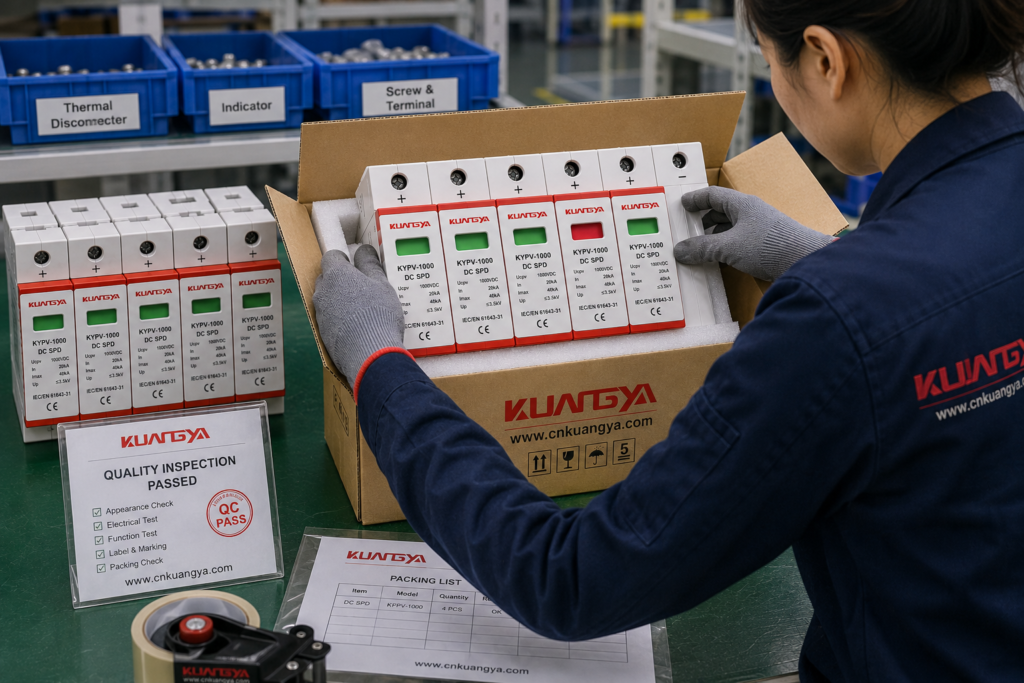
For reference, you can also view our DC surge protective device range, including modular Type 2 and Type 1+2 models with replaceable cartridges.
This allows easier maintenance.
Never bypass the SPD’s internal thermal disconnector or attempt to reset a sealed failed cartridge.
A cartridge that has entered its defined end-of-life condition is normally intended to be replaced rather than repaired.
If the manufacturer-defined indication shows that the intended surge protection path is no longer available, replacement should not be unnecessarily delayed.
The electrical system may continue running without it.
But that does not mean continued operation without surge protection is desirable.
This is especially important for:
The longer the failed SPD remains in place, the longer the equipment may remain exposed to the next transient event.
There is no single inspection interval suitable for every installation.
Inspection frequency should consider:
Inspection is particularly useful:
For unattended or critical installations, remote signaling can make it easier to detect a failed SPD quickly.
Seeing a failed SPD sometimes leads to the assumption:
“The SPD failed, so it must be defective.”
That conclusion is not always correct.
An SPD is a protective device exposed directly to electrical stress.
A failure indication may mean that it experienced the kind of abnormal condition its protective and disconnecting mechanisms were designed to handle safely.
The more useful question is:
Why did the SPD reach this condition?
Investigate:
If the same SPD position fails repeatedly, replacing cartridges without investigating the system is not enough.
The easiest sign of SPD failure is a manufacturer-defined failure or replacement indication, commonly red on many modular SPDs.
But that should not be the only check.
An SPD should also be investigated if you find:
At the same time, do not assume that a green indicator proves the entire surge protection system is perfect.
It usually confirms only the condition monitored by that particular SPD.
And do not rely on a normal multimeter resistance test to prove surge performance.
Correct SPD assessment combines:
product status + visual inspection + installation condition + event history + manufacturer instructions.
If a modular SPD has reached its defined end-of-life state, replace the affected cartridge or assembly as specified.
More importantly, if failure is repeated or accompanied by physical damage, investigate the underlying electrical system before simply installing another SPD.
Ultimately, how to know if an SPD is bad comes down to combining the status indication, physical inspection, event history, installation condition and manufacturer guidance rather than relying on a single test.
Start with the manufacturer’s status indicator. If the product defines the displayed condition as normal and there is no physical damage or alarm, the monitored module remains in its normal indicated state. However, the status indicator does not prove complete surge performance or remaining lifetime.
On many modular SPDs, green means that the monitored protection module has not entered its failure or disconnection state.
But always confirm the manufacturer’s markings because indicator systems vary between products.
Green should not be interpreted as proof that the complete installation is perfectly protected.
On many plug-in MOV-based SPDs, a red indicator means the protection module has reached a manufacturer-defined failed or replacement condition, often associated with an internal disconnector.
The affected cartridge normally needs to be replaced.
Check the exact product instructions before taking action.
そうだ。.
Most panel-mounted SPDs are connected in parallel with the protected circuit.
The load can therefore remain energized even if the SPD protection element has been disconnected.
Only to a limited extent.
A multimeter may help check remote dry contacts or investigate certain basic electrical conditions when permitted by the manufacturer.
It cannot verify surge ratings such as Up, In, Imax, or Iimp, and there is no universal resistance value that proves an SPD is healthy.
Not automatically.
Inspect the SPD after a significant event and follow the manufacturer’s maintenance instructions.
Replace it if it shows a failure indication, physical damage, abnormal condition, or if the manufacturer specifically requires replacement after the event.
Replaceable cartridges are common in modular SPDs. For example, Schneider Electric explains that when the SPD end-of-life indicator turns red, the cartridge should be replaced.
Often yes, if the SPD is designed with replaceable plug-in modules and the base is undamaged.
Use only the correct compatible replacement cartridge specified for that SPD.
If the base, terminals, or surrounding components show heat or arc damage, the complete assembly should be investigated.
Repeated failure can indicate more than ordinary surge aging.
考えられる原因は以下の通り:
If cartridges repeatedly fail at the same location, investigate the system instead of continuing to replace modules without identifying the cause.
No reliable fixed lifetime can be determined from indicator color alone.
SPD life depends on the electrical stress it experiences, environmental conditions, product design, and installation.
The indicator should be treated as one part of a wider inspection and maintenance process.

