温州市岳陽工業区 325000
勤務時間
月曜日~金曜日:午前7時~午後7時
週末午前10時~午後5時
温州市岳陽工業区 325000
勤務時間
月曜日~金曜日:午前7時~午後7時
週末午前10時~午後5時

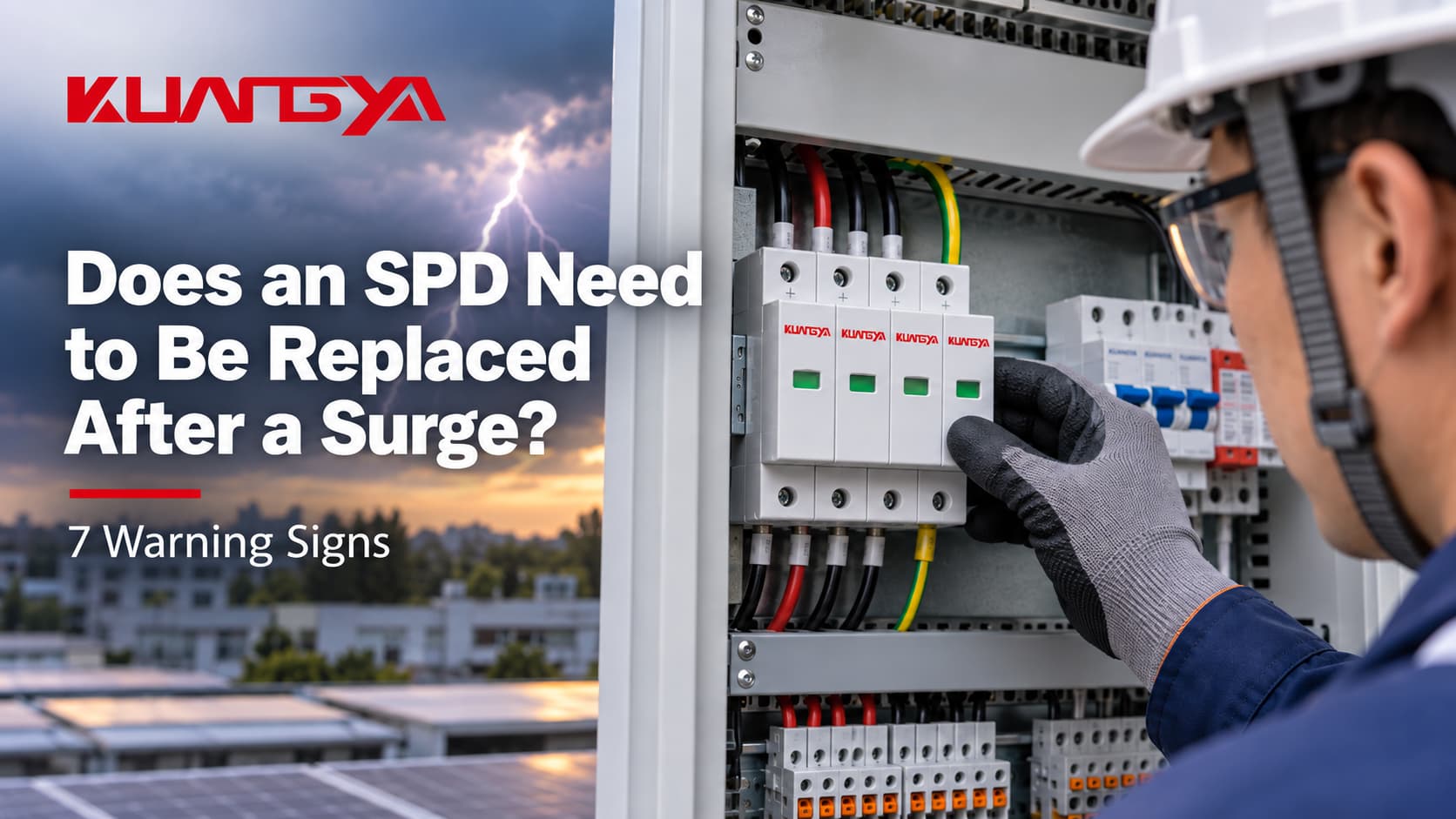
雷雨、開閉サージ、または予期せぬ電圧サージが発生した後に頻繁に寄せられる質問は以下の通りです。 サージ発生後にSPDを交換する必要がありますか?
結論から言うと いいえ、自動的に交換する必要はありません。.
サージ防護デバイス(SPD)は、過渡過電圧を制限し、サージ電流を逃がすように設計されています。サージがSPDの許容範囲内であり、デバイスが寿命に達していない場合は、イベント後もシステムを保護し続けることができます。.
しかし、激しいサージ、繰り返される電気的ストレス、一時的な過電圧、過熱、または長期的な劣化は、SPD内部の保護素子を損傷させる可能性があります。このような場合、保護モジュールが内部的に切り離され、SPDの交換が必要になることがあります。.
したがって、正しい問いは単に次のようなものではありません。
“SPDはサージを経験しましたか?”
正しくは次の通りです。
“サージ後のSPDの状態はどうなっていますか?”
本ガイドでは、サージ発生時にSPD内部で何が起こるのか、損傷の兆候をどのように見分けるか、緑色または赤色のステータス表示が何を意味するのか、そして保護モジュールまたはSPD全体をいつ交換すべきかについて説明します。.
SPDを交換すべきかどうかは、サージ発生後の状態に依存します。.
| サージ発生後のSPDの状態 | 交換が必要か? | 推奨される処置 |
|---|---|---|
| 正常な状態表示であり、目視による損傷がない場合 | 自動的ではありません | メーカーの指示に従って点検を継続してください |
| 赤色または寿命表示 | 通常ははい | メーカーの指定に従い、該当するモジュールまたはSPDを交換してください |
| 遠隔信号が故障を報告します | 直ちに調査してください | SPDの状態および遠隔接点回路を確認してください |
| 焦げ跡、溶融、または深刻な変色 | はい | 必要に応じて回路を遮断し、損傷したSPDを交換した上で、原因を調査すること |
| ハウジングのひび割れまたは変形 | はい | 損傷したSPDを継続して使用しないこと |
| 交換可能なカートリッジの1つが寿命に達している | 通常はカートリッジ | ベースを点検し、適切な交換用モジュールを使用すること |
| 落雷等の大きなサージが発生したが、表示器が正常なままの場合 | 自動的ではありません | より詳細な点検を実施してください |
| 交換したSPDが早期に繰り返し故障する | 単に交換を繰り返さないでください | システム電圧、一時的過電圧(TOV)、SPDの選定、配線、および設置条件を調査してください |
重要な点は サージイベントの発生のみが寿命の指標ではないということです.
SPDの実際の状態とメーカーの保守指示に基づいて、次のステップを決定すべきです.
サージ発生後にSPDを交換するかどうかを判断する前に、この簡単な解説動画をご覧ください.
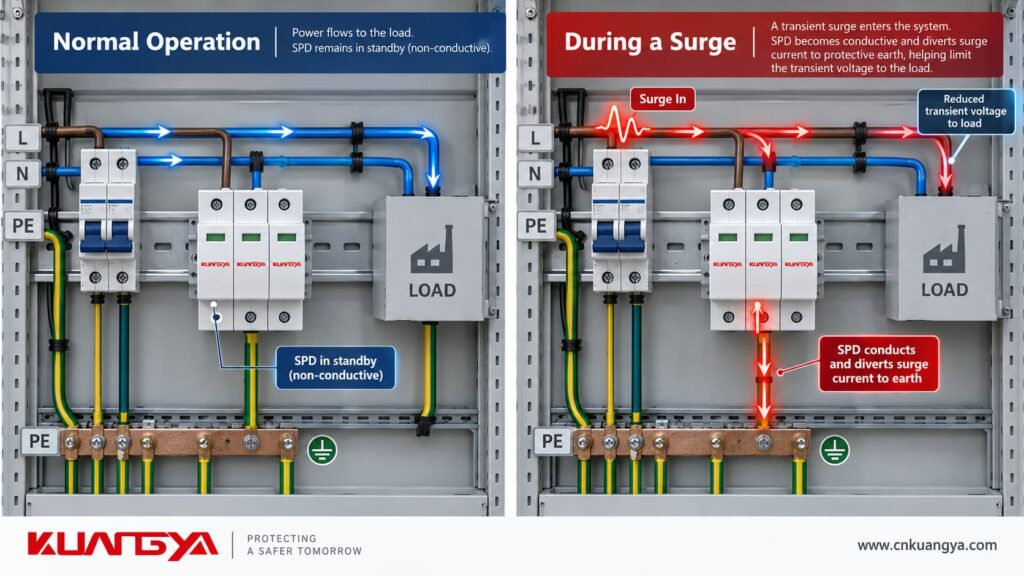
サージが発生するたびにSPDを交換する必要がない理由を理解するには、そのデバイスが実際にどのような動作をしているのかを知ることが重要です。.
多くの電源用SPDは、保護対象の回路に対して並列に接続されます。.
通常の動作電圧下では、SPD内部の電圧制限素子は高インピーダンス状態を維持します。そのため、通常の負荷電流がSPDの保護素子を流れる必要はありません。.
これが、 SPDが通常並列に設置される理由であり、 負荷に対して単に直列に配置されるわけではない理由です。.
過渡過電圧がSPDに到達すると、その保護素子が応答します。.
MOVベースのSPDでは、電圧が動作領域を超えて上昇すると、酸化亜鉛バリスタは高インピーダンス状態から導通状態へと変化します。.
その後、SPDは以下の役割を果たします。
過渡電圧を制限する。
そして
サージ電流を敏感な機器から逸らして逃がす。.
過渡現象が終了すると、保護素子は通常、高インピーダンス状態に戻ります。.
この動作原理はサージ防護デバイスの基本であり、サージ電圧を制限しサージ電流を逸らすように設計された非線形コンポーネントが含まれています。現在のIEC規格でも、この基本的な定義が採用されています。.
したがって、サージ発生時にSPDが動作したという事実だけでは、SPDが故障したことを意味するわけではありません。.
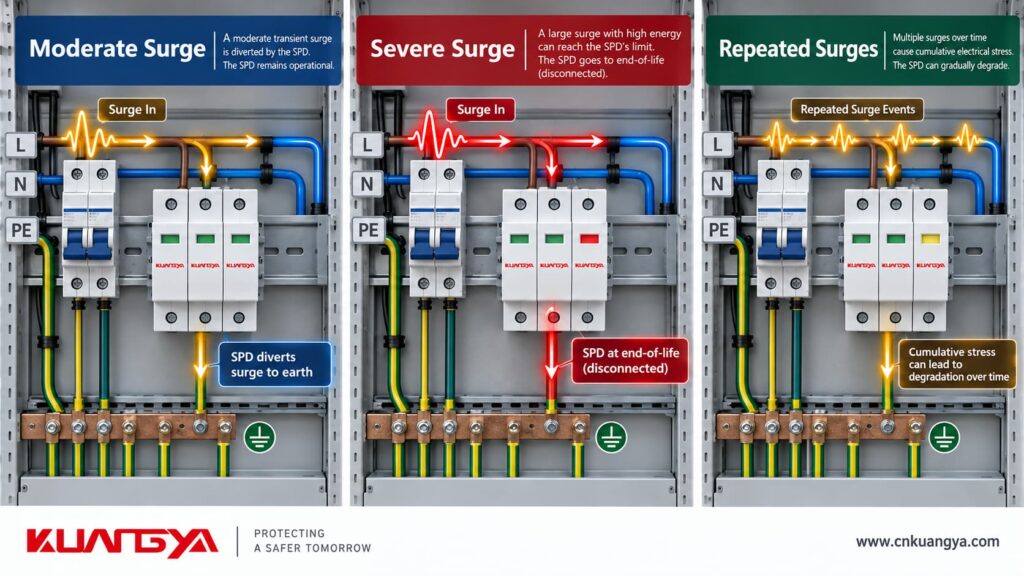
必ずしもそうではない。.
結果は以下の要因に依存します:
SPDの許容範囲内のサージであれば、デバイスの寿命を縮めることなく処理できる場合がある。.
はるかに深刻な事象が発生した場合、一度の発生で重大な損傷を引き起こす可能性がある。.
SPDは過渡過電圧に応答するように設計されている。.
事象が製品の意図された動作およびサージ処理能力の範囲内であれば、SPDはその後も動作を継続できる可能性がある。.
このため、以下のようなルールを適用することは不適切です。
“「サージ1回につき交換1回」”
デバイスは、その実際の状態に基づいて評価されなければなりません。.
十分に重大なイベントが発生した場合、1回の発生で保護素子が寿命に達することがあります。.
SPDの設計によっては、以下の結果を招く可能性があります。
正確な故障挙動は製品設計によって異なります。.
SPDの劣化は、一度の激しい落雷事象に限定されるものではありません。.
繰り返される電気的ストレスは、MOVの電気的特性に徐々に影響を与える可能性があります。.
しかし、これはすべてのサージが同量の残存寿命を奪うような、単純な固定エネルギーのカウントダウンとして説明されるべきではありません。.
MOVの劣化は、コンポーネントに印加される大きさ、持続時間、繰り返し回数、動作電圧、温度、およびその他のストレスに依存します。IEC TR 61643-333:2026は、酸化亜鉛MOVの特性方程式と寿命評価について具体的に言及しており、MOVの寿命が単純な固定の「ジュールバランス」よりも複雑であることを示しています。“
Many Type 2 SPDs use metal oxide varistors as their primary voltage-limiting elements.
Under normal voltage, an MOV has high resistance.
When the applied voltage rises sharply during a transient event, the MOV becomes conductive and helps limit the voltage.
Over time, electrical and thermal stress can change the MOV’s characteristics.
A simplified aging path may look like this:
Repeated electrical stress
↓
Change in MOV characteristics
↓
Possible increase in leakage current
↓
Additional heating
↓
Thermal protection operates if necessary
↓
Protection element disconnects
↓
SPD indicates an end-of-life or fault condition
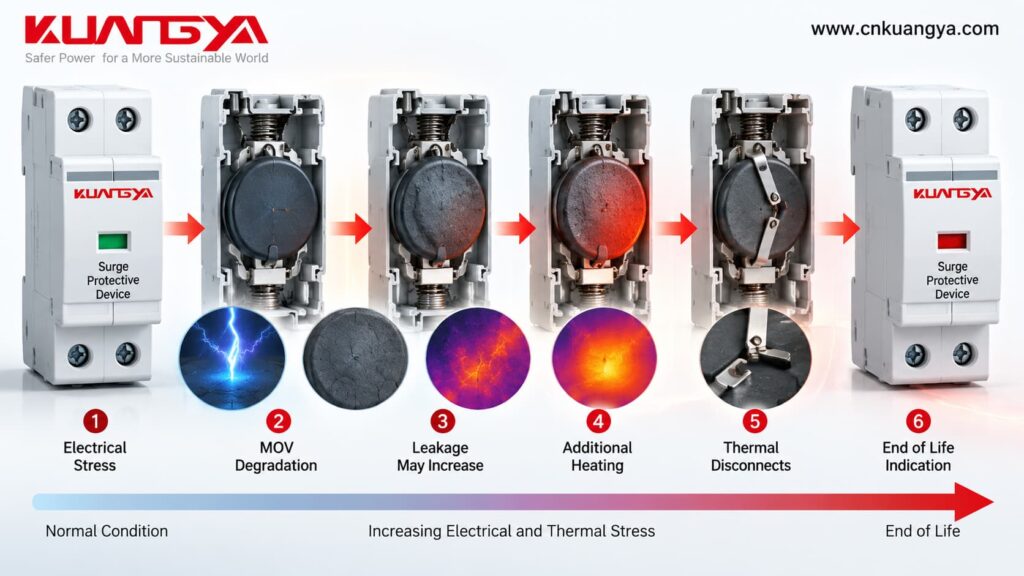
The precise sequence depends on the SPD design.
Modern MOV-based SPDs commonly include thermal protection because an MOV that becomes unstable or overheated must be safely disconnected from the power system.
For example, Schneider Electric describes some of its SPDs as using thermally protected MOVs and instructs replacement of the module when the corresponding indication shows loss of protection.
This internal disconnection is one reason a failed SPD can sometimes leave the protected equipment powered while surge protection for that mode is no longer available.
There is no single inspection method that applies identically to every SPD.
If you are not sure whether an SPD has failed, see our guide on SPDの故障を見分ける方法.
However, the following signs usually justify replacement or further investigation.
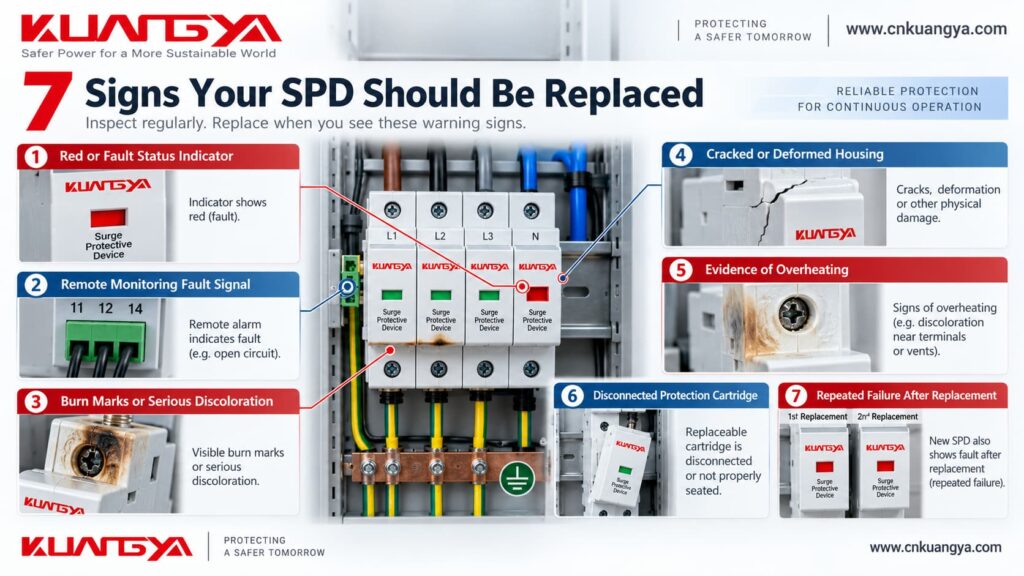
For many pluggable DIN-rail SPDs, the front status window provides the fastest visual indication of the protection module’s condition.
一般的な構成は以下の通りです:
Normal indication → protection element has not reported end of life
Red/fault indication → affected module requires replacement
例えば、, ABB describes mechanical SPD indicators that change from green to red at end of life and states that once this occurs, the SPD should be changed because protection is no longer guaranteed.
However, indicator colors and meanings are product-specific.
Always check the markings, datasheet, or instructions for the exact SPD you are inspecting.
Do not assume that every SPD from every manufacturer uses the same color logic.
Some SPDs include remote signaling terminals, often using a changeover dry contact with terminals such as:
COM
ノー
NC
These contacts allow the SPD’s status to be reported remotely to equipment such as:
When the monitored SPD reaches the state defined by the manufacturer, the remote contact changes state.
But a remote alarm should still be verified.
Check:
The remote contact tells you about the monitored SPD state. It does not directly measure the SPD’s actual surge-clamping performance.
Visible heat damage is not a normal service condition.
Warning signs include:
If these conditions are present, the SPD should not simply be returned to service because its indicator still appears normal.
The circuit should be made safe according to the applicable electrical procedure, and both the SPD and surrounding installation should be inspected.
The cause also matters.
Replacing the SPD without identifying a wiring problem, abnormal system voltage, short-circuit condition, or other fault can result in another failure.
A cracked housing may result from:
Even if the internal condition cannot be seen, physical enclosure damage is a reason to treat the SPD as suspect.
An electrical protection device depends not only on its MOV or other internal component but also on proper insulation, spacing, mechanical connections, and safe containment.
If these have been compromised, replacement is normally the safer maintenance decision.
Not every internal problem immediately produces an obvious red indicator.
If you notice:
disconnect and investigate the equipment using the required safe electrical procedure.
Do not continue using an SPD simply because power is still reaching the protected equipment.
A parallel-connected SPD can lose its protective function while the main circuit continues supplying the load.
Many modular SPDs use plug-in cartridges.
If an internal disconnector has operated and the cartridge indicates end of life, the affected cartridge normally needs replacement.
That does not necessarily mean the complete SPD base must always be replaced.
If:
the manufacturer may allow replacement of the cartridge only.
Schneider Electric, for example, provides model-specific replacement modules for certain modular SPD families rather than requiring replacement of every part of the assembly.
But never assume that a pluggable SPD cartridge is automatically safe to remove while energized.
Pluggable does not mean hot-swappable.
Follow the manufacturer’s instructions and the required electrical isolation procedure before servicing the SPD.
One of the most important warning signs is not the first failure.
それは repeated early failure after replacement.
If a newly installed SPD quickly reaches its fault or end-of-life condition again, simply installing another identical device may not solve the problem.
Investigate possible causes such as:
For PV applications, correct voltage selection is especially important. See how to select the correct DC SPD voltage rating for a solar PV system.
Current IEC SPD requirements specifically consider system and fault conditions such as expected short-circuit current and temporary-overvoltage stresses when evaluating SPD applications.
Repeated failure should therefore be treated as a system-level troubleshooting problem, not merely a replacement problem.
Usually, a manufacturer-defined normal indication means the SPD has not reported its end-of-life condition through that indicator mechanism.
For a deeper explanation, see what an SPD green indicator can and cannot tell you about the protection condition.
But there is an important distinction:
Normal indicator ≠ exact measurement of remaining SPD life.
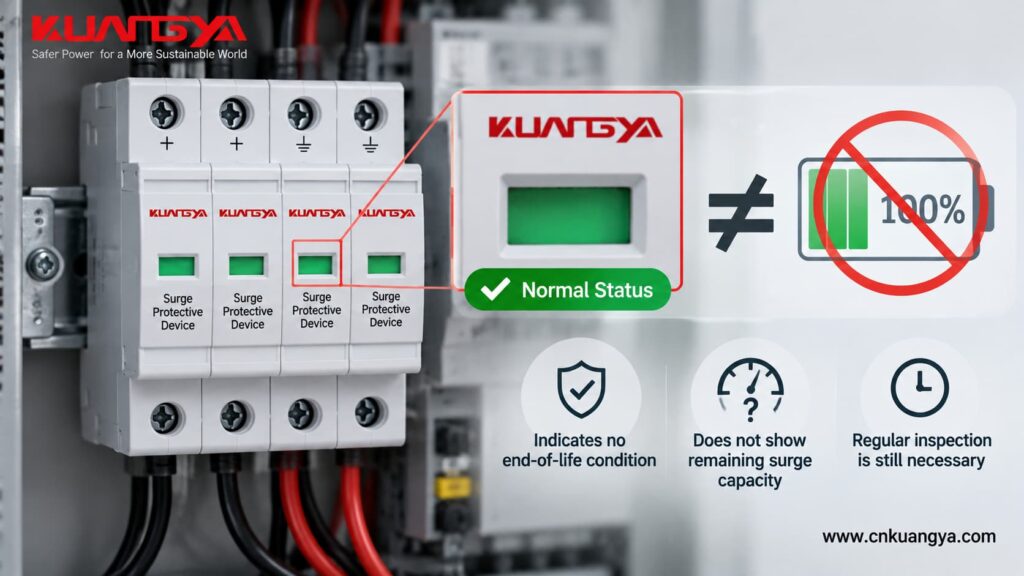
A basic mechanical indicator normally does not tell you:
So avoid statements such as:
“Green means the SPD is 100% healthy.”
または
“Green means the SPD has full surge capacity remaining.”
A more technically accurate interpretation is:
The SPD’s normal status indication shows that its internal monitoring or disconnection mechanism has not indicated end of life according to the product design.
That is useful information—but it is not the same as a complete electrical performance test.
ABB’s guidance illustrates this distinction well: the mechanical indicator is specifically an end-of-life indicator, changing state when the device reaches the defined replacement condition.
Not automatically—but the inspection should be more thorough.
The words “lightning event” can describe very different electrical stresses.
A distant lightning event that induces a relatively small transient is not the same as a severe nearby or direct lightning-current event.
The correct SPD type and coordinated protection system also matter.
For example, a Type 2 SPD is primarily tested for surge-current conditions different from those associated with the lightning-current testing of a Type 1 SPD.
So after a known major event, check more than just the color window.
Inspect:
If nearby electrical equipment has also been damaged, or the lightning event was unusually severe, a more detailed electrical inspection is justified even when the status window has not changed.
For critical installations, follow the site’s maintenance plan, lightning-protection procedure, and manufacturer-specific recommendations.
For modular SPDs, a failed cartridge does not always require replacing the complete assembly.
Use the physical condition of the base and the manufacturer’s instructions to make the decision.
| コンディション | Replace cartridge only | Replace complete SPD |
|---|---|---|
| One plug-in module reaches end of life | Usually | Not normally necessary if base is sound |
| Base contacts remain clean and undamaged | Usually | いいえ |
| Base contacts are burned or damaged | いいえ | はい |
| Base or housing has melted | いいえ | はい |
| Severe corrosion is present | いいえ | Usually |
| Mechanical locking system is damaged | いいえ | はい |
| Correct compatible cartridge is unavailable | いいえ | はい |
| Extent of damage cannot be confidently determined after a serious failure | Not preferred | Consider complete replacement |
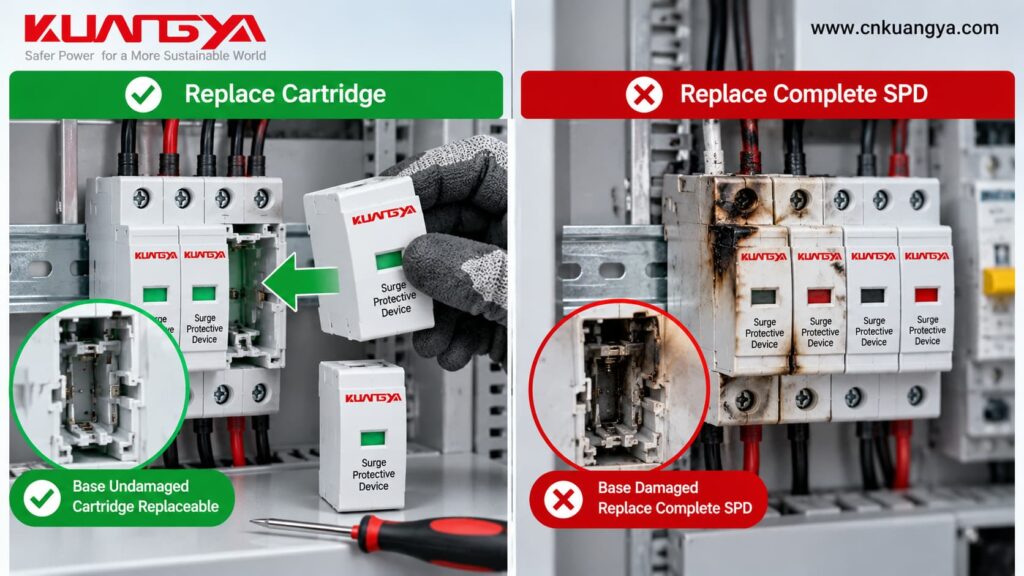
最も重要なルールは以下の通りです:
Replace only what the manufacturer allows you to replace.
A cartridge from a different series may physically look similar while having a different Uc, discharge rating, protection level, internal circuit, or coding system.
Always use the specified replacement module.
A practical post-surge inspection can follow seven basic steps.
Start with the front status window.
Look for the manufacturer-defined normal, fault, or end-of-life condition.
If the SPD includes remote contacts, verify whether the monitoring system has received a fault signal.
Compare the result with the manufacturer’s COM/NO/NC diagram.
をチェックする:
For a modular SPD, inspect both the plug-in cartridge and the base.
A new cartridge should not be installed into a heat-damaged or mechanically damaged base.
Loose or heat-damaged conductors can affect both safety and surge protection.
Also check the SPD connection conductors and protective-earth connection according to the installation instructions.
In solar PV systems, the distance between the SPD and inverter and the connection lead length can also affect practical surge protection performance.
Ask what happened before the SPD changed state.
Was there:
This information can help distinguish normal end-of-life behavior from a broader installation problem.
If the SPD has reached its defined end-of-life state or shows physical damage, replace the affected component according to the manufacturer’s instructions.
If the condition is uncertain and the application justifies deeper verification, use the appropriate professional SPD testing method or manufacturer-approved test equipment.
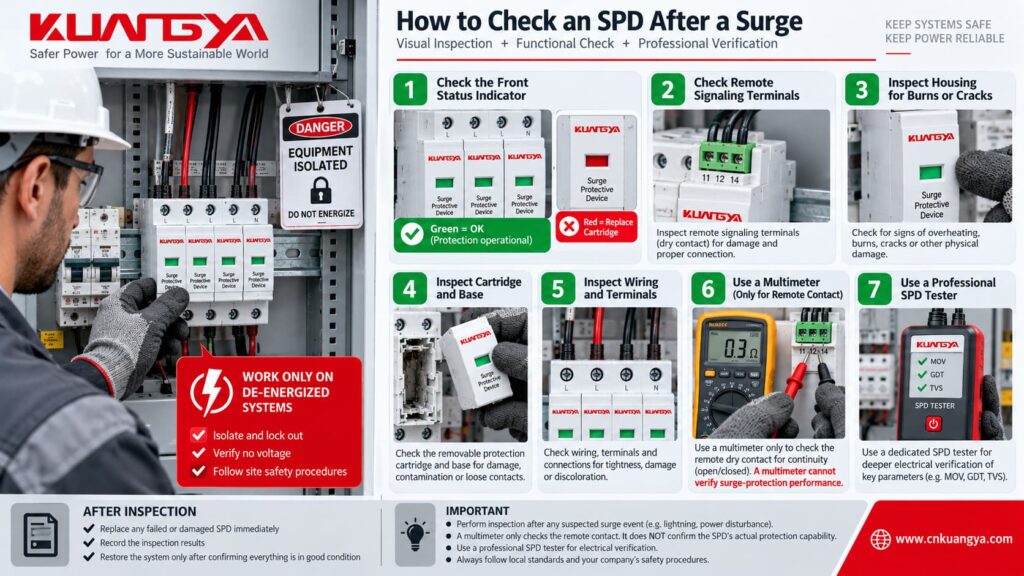
A multimeter can be useful around an SPD, but it cannot fully prove that the SPD still has its original surge-protection performance.
For example, a multimeter may help with:
But an ordinary multimeter does not reproduce the electrical conditions used to determine major SPD parameters such as:
If these ratings are unfamiliar, our DC SPD仕様ガイドをご参照ください explains Ucpv, In, Imax, Up and other common SPD markings in more detail.
したがって:
A successful multimeter continuity or resistance check is not proof that the SPD still meets its original surge-protection specification.
Professional SPD verification may require dedicated equipment capable of testing the relevant electrical characteristics.
Phoenix Contact, for example, provides dedicated CHECKMASTER equipment for electrical testing of compatible pluggable SPDs and notes that visual inspection alone may not reliably determine an SPD’s functional capability.
Also remember that some electrical tests performed elsewhere in an installation can interact with an SPD.
ABB installation guidance, for example, specifies that the SPD should be disconnected before certain insulation testing because the SPD can respond to the test voltage as though it were an overvoltage.
Always follow the SPD and test-equipment manufacturer’s instructions.
For a more complete inspection procedure, see our guide on how to test an SPD.
There is no universal fixed service life that applies to every SPD.
It would therefore be misleading to say:
“Every SPD must be replaced after three years.”
または:
“An SPD always lasts ten years.”
Actual service life depends on many variables, including:
A severe event may cause end of life much earlier than expected.
Another SPD in a relatively quiet installation may remain serviceable for many years.
For that reason, condition-based inspection and manufacturer-defined status indications are generally more useful than assigning one universal expiration date.
Use this quick decision guide after a surge event.
Answer these 5 quick questions to check whether your SPD shows an obvious replacement condition or needs further inspection.
そうだ。.
SPDs are designed to respond to transient overvoltages. Experiencing a surge does not automatically mean the SPD has reached end of life.
Replace or service it when the manufacturer’s status indication, inspection results, electrical testing, or physical condition shows that it is no longer serviceable.
そうだ。.
Many SPDs are designed to withstand multiple surge events within their specified capability.
However, the number and severity of events an SPD can withstand cannot be reduced to one universal number because different surge stresses and product designs produce different effects.
そうだ。.
A sufficiently severe lightning-related event can cause an SPD to reach end of life in one occurrence.
Whether this happens depends on the actual current and voltage stress reaching the SPD, the SPD type and ratings, installation, and the overall lightning and surge protection system.
It normally means the SPD has not indicated its manufacturer-defined end-of-life state through that indicator.
It should not normally be interpreted as an exact measurement of remaining surge capacity.
Always check the product instructions for the specific meaning of its status window.
For SPDs where red is defined as the end-of-life or replacement indication, yes—the affected module or device should be serviced or replaced according to the manufacturer’s instructions.
ABB, for example, states that when its standard SPD indicator changes from green to red at end of life, the SPD must be changed because protection is no longer guaranteed.
If the SPD uses manufacturer-approved replaceable modules and the base remains undamaged, replacing only the affected cartridge may be permitted.
Check that the replacement module has the correct model, voltage rating, and compatibility.
If the base, terminals, housing, or contacts have been damaged, replace the complete affected assembly as required.
Do not assume that you can.
A pluggable design makes maintenance easier, but it does not automatically mean the module is approved for energized replacement.
Follow the manufacturer’s instructions and the required electrical isolation and safety procedure before removing or installing an SPD module.
Not completely.
A multimeter may help test remote contacts or perform limited circuit checks, but it cannot reproduce the surge test conditions needed to verify the SPD’s full protection performance.
Dedicated test equipment or manufacturer-defined electrical testing may be required for more detailed verification.
Do not replace an SPD simply because a surge occurred.
An SPD is specifically designed to respond to transient overvoltage events, and one surge does not automatically mean the device has reached end of life.
Instead, base the decision on the actual condition of the SPD.
Replacement is normally justified when:
A normal status indication and the absence of physical damage generally mean there is no obvious end-of-life indication, but they do not provide an exact measurement of remaining surge capacity.
And if an SPD repeatedly fails shortly after replacement, do not simply install another one.
Investigate the system voltage, Uc or MCOV selection, temporary overvoltage conditions, electrical configuration, wiring, backup protection, and the severity of the surge environment.
The best replacement decision is therefore based not on:
“Did a surge happen?”
but on:
“What does the SPD condition tell us after the surge?”
KUANGYA provides AC and DC surge protective devices for electrical distribution and solar PV applications, including modular designs with visual status indication and optional remote signaling functions for easier inspection and maintenance.
For photovoltaic DC applications, SPD selection should consider factors such as maximum PV system voltage, Ucpv, SPD type, discharge-current ratings, voltage protection level, system configuration, and installation position.
PV-side SPDs are specifically addressed by IEC 61643-31 for photovoltaic installations up to 1500 V DC.
If you need help selecting a replacement SPD, send us your:
AC or DC application + system voltage + required SPD type + quantity
and KUANGYA can help you check a suitable model.

