WengYang Industriegebiet Yueqing Wenzhou 325000
Arbeitszeiten
Montag bis Freitag: 7AM - 7PM
Am Wochenende: 10AM - 5PM
WengYang Industriegebiet Yueqing Wenzhou 325000
Arbeitszeiten
Montag bis Freitag: 7AM - 7PM
Am Wochenende: 10AM - 5PM

Ein Überspannungsschutzgerät schützt elektrische Anlagen vor transienten Überspannungen, aber was schützt das SPD, wenn ein interner Fehler oder Kurzschluss auftritt?
Hier kommt die SPD-Vorsicherung oder der Leitungsschutzschalter ins Spiel.
Es gibt jedoch keine allgemeingültige Regel wie:
“Jeder Typ-2-Ableiter benötigt eine 125-A-Sicherung.”
oder:
“Ein 40-kA-Überspannungsschutzgerät (SPD) sollte mit einem 40-A-Leitungsschutzschalter abgesichert werden.”
Beide Aussagen können falsch sein.
Richtig Vorsicherung für Überspannungsschutzgeräte (SPD) Die Auswahl hängt vom genauen SPD-Modell, dem vorgeschalteten Überstromschutz, dem prospektiven Kurzschlussstrom, dem Leiterquerschnitt, der Systemkonfiguration und den Herstellerangaben ab.
Einige SPDs können über die vorhandene vorgeschaltete Sicherung oder den Leitungsschutzschalter abgesichert werden. Andere erfordern einen separaten Vorsicherungsschutz. Manche Produkte haben den Vorsicherungsschutz sogar bereits im SPD integriert.
Die wichtigste Regel ist daher einfach:
Wählen Sie eine SPD-Vorsicherung nicht allein anhand des In-, Imax- oder Typ-Klassifizierung des SPD aus. Überprüfen Sie immer den vom Hersteller angegebenen Vorsicherungsschutz und die tatsächlichen Installationsbedingungen.
Ein SPD benötigt möglicherweise eine Vorsicherung oder einen Leitungsschutzschalter, aber nicht jede Installation erfordert eine separate Absicherung.
Wenn das vorhandene vorgeschaltete Überstromschutzorgan bereits die vom SPD-Hersteller zugelassene Schutzanordnung erfüllt, ist eine zusätzliche Vorsicherung möglicherweise nicht erforderlich.
Wenn das vorgeschaltete Schutzorgan den vom Hersteller zulässigen Wert überschreitet oder wenn die SPD-Anleitung einen dedizierten Abzweigschutz vorschreibt, kann eine zusätzliche SPD-Vorsicherung oder der Leitungsschutzschalter Absicherung erforderlich sein.
Das bedeutet, die richtige Frage lautet nicht einfach:
“Welche Sicherungsgröße sollte ich installieren?”
Fragen Sie stattdessen:
“Erfüllt der vorhandene vorgeschaltete Schutz bereits die Anforderungen für diesen spezifischen SPD?”
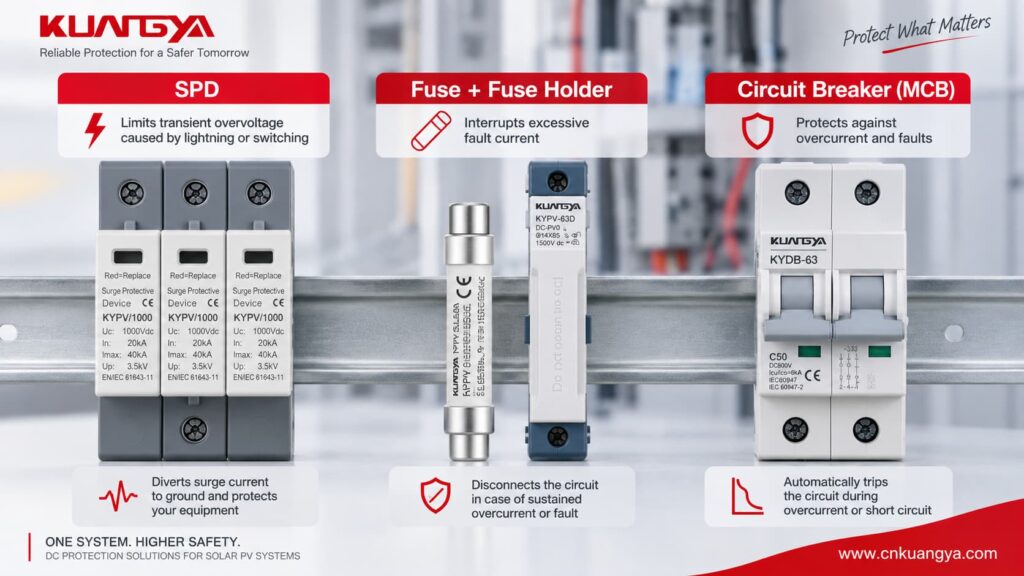
Ein SPD und eine Überstromschutzeinrichtung lösen unterschiedliche elektrische Probleme.
Ein typisches Netz-SPD wird parallel zum Stromkreis geschaltet.
Im Normalbetrieb führt es wenig oder keinen Laststrom. Bei einer transienten Überspannung wird das SPD leitfähig und leitet den Stoßstrom über seinen vorgesehenen Schutzpfad ab.
Eine Sicherung oder ein Leitungsschutzschalter hat einen anderen Zweck.
Seine Aufgabe ist primär die Unterbrechung von anhaltenden Überströmen oder Fehlerströmen.
| Gerät | Hauptfunktion | Hauptsächlich ausgelegt für |
|---|---|---|
| SPD | Begrenzt transiente Überspannungen und leitet Stoßströme ab | Blitz- und Schaltüberspannungen |
| Sicherung | Unterbricht übermäßige Ströme | Überstrom und Kurzschluss |
| Leitungsschutzschalter | Unterbricht übermäßige Ströme und ermöglicht Trennung/Schaltung | Überlast und Kurzschluss |
| Interner SPD-Trennschalter | Trennt ein defektes oder überhitztes Schutzelement | Ende der Lebensdauer oder anomaler interner Zustand des SPD |
Daher:
SPD ≠ Sicherung
und:
Sicherung ≠ SPD
Sie bieten einen komplementären Schutz.
Viele spannungsbegrenzende SPDs verwenden nichtlineare Komponenten wie Metalloxid-Varistoren.
Bei normaler Systemspannung verbleibt das Schutzelement in einem hochohmigen Zustand.
Bei einem Stoßstrom ändert sich sein elektrisches Verhalten schlagartig und es leitet den Stoßstrom ab.
Überspannungsschutzkomponenten können jedoch aufgrund folgender Faktoren das Ende ihrer Lebensdauer erreichen oder beschädigt werden:
Wenn ein Schutzelement einen niederohmigen Fehler aufweist, muss die Installation in der Lage sein, den resultierenden netzfrequenten oder Gleichstrom-Fehlerstrom sicher abzuschalten.
Deshalb können Datenblätter von Überspannungsschutzgeräten (SPD) Parameter enthalten wie:
Für AC-Niederspannungs-Überspannungsschutzgeräte (SPD) ist die aktuelle internationale Produktnorm IEC 61643-11:2025, welche Anforderungen und Prüfverfahren für SPDs zum Anschluss an Wechselstromkreise bis 1.000 V Effektivwert abdeckt.
IEC 61643-11:2025 — offizielle IEC-Seite
Eine häufige Frage lautet:
“Wenn mein SPD bereits über einen internen Trennschalter verfügt, warum wird dann noch eine weitere Sicherung benötigt?”
Da sie nicht notwendigerweise die gleiche Funktion erfüllen.
Der interne Trennschalter ist im Allgemeinen mit der Überspannungsschutzkomponente innerhalb des SPD verbunden.
Wenn beispielsweise ein MOV einen unsicheren thermischen Zustand erreicht, kann der interne Mechanismus das defekte Element trennen.
Bei vielen modularen SPDs ist dieser Zustand mechanisch mit einer Statusanzeige gekoppelt.
Das Sichtfenster kann je nach Design des Herstellers von Grün auf Rot wechseln.
Die externe Sicherung oder der Leitungsschutzschalter ist Teil des Fehlerschutzes und der Koordination der Installation.
Je nach SPD kann dies dazu beitragen:
Daher:
Ein interner thermischer Trennschalter sollte nicht automatisch als Ersatz für eine externe SPD-Vorsicherung betrachtet werden.
Die Produktdokumentation muss dennoch geprüft werden.
Nein.
Es gibt drei häufige Situationen.
| Installationsbedingung | Separater Vorsicherungsschutz |
|---|---|
| Vorhandenes vorgeschaltetes Gerät liegt innerhalb der vom SPD-Hersteller zulässigen Bedingungen | Oft nicht erforderlich |
| Vorhandenes vorgeschaltetes Gerät überschreitet den vom Hersteller zulässigen Grenzwert | Ein dedizierter Schutz kann erforderlich sein |
| SPD verfügt über einen geprüften integrierten Vorsicherungsschutz | Zusätzliches Vorsicherungsgerät ist unter den spezifizierten Bedingungen möglicherweise nicht erforderlich |
Dies ist einer der wichtigsten Punkte bei SPD-Vorsicherung.
Sie können die Entscheidung nicht allein auf Basis folgender Punkte treffen:
Zwei Typ-2-Überspannungsschutzgeräte (SPD) mit ähnlichen Spannungs- und Imax-Werten können unterschiedliche Anforderungen an den Vorsicherungsschutz haben.
Installationspläne für SPDs verwenden häufig zwei Bezeichnungen:
F1 = vorgeschaltete Schutzeinrichtung des Systems
F2 = dedizierte SPD-Vorsicherung
Eine vereinfachte Anordnung kann wie folgt aussehen:
Einspeisung → F1 → Verteilungssystem
wobei das SPD parallel geschaltet ist über F2 wo ein dedizierter F2-Schutz erforderlich ist.
Bei der Auswahl einer Vorsicherung für Überspannungsschutzgeräte (SPD), sollte die erste Frage daher nicht lauten:
“Welche Sicherungsgröße sollte ich kaufen?”
Fragen Sie stattdessen:
“Kann die vorhandene F1 bereits den für diesen SPD erforderlichen Schutz bieten?”
Wenn F1 die Bedingungen des Herstellers erfüllt, ist F2 möglicherweise nicht erforderlich.
Wenn F1 größer als der zulässige Wert ist, kann eine dedizierte F2 erforderlich sein.
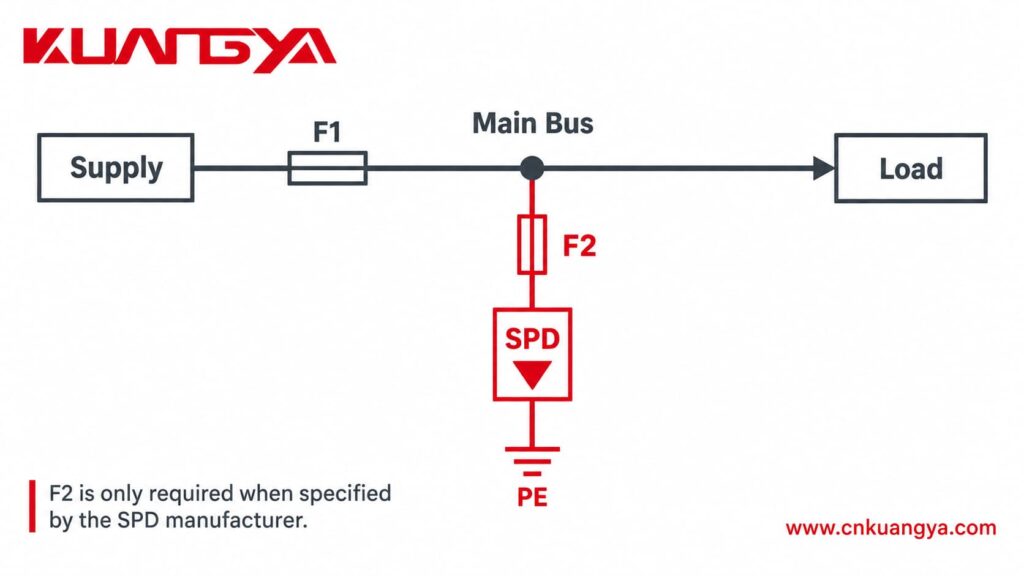
Dieses Prinzip wird in den veröffentlichten Installationsanleitungen mehrerer Hersteller deutlich dargelegt, die wir später untersuchen werden.
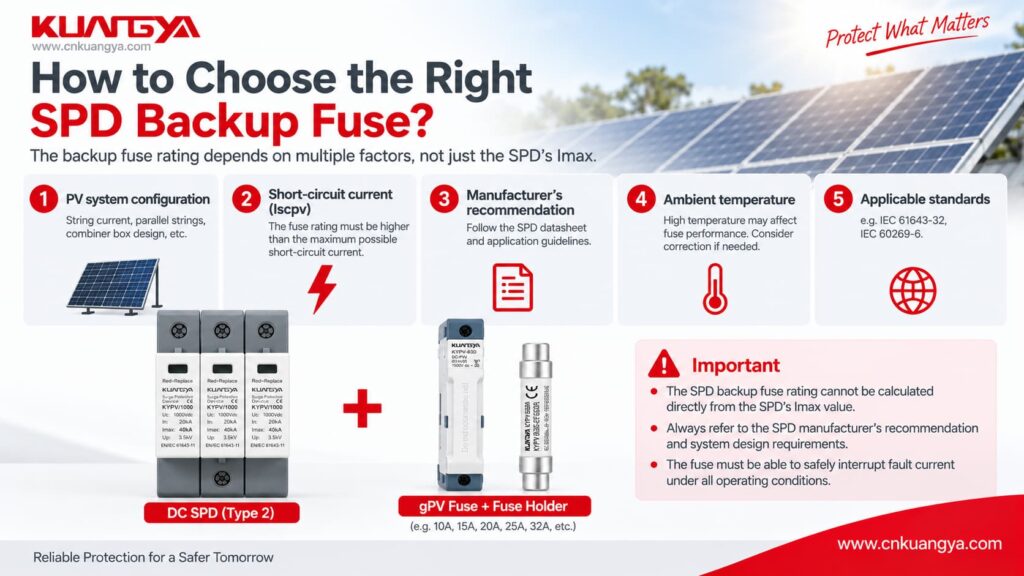
Es gibt keine universelle Vorsicherung für Überspannungsschutzgeräte (SPD) Größe.
Beginnen Sie immer mit dem exakten Datenblatt oder der Installationsanleitung des Herstellers.
Achten Sie auf Formulierungen wie:
Übernehmen Sie keinen Sicherungswert von einem anderen SPD, nur weil beide Geräte vom Typ 2 sind oder beide einen Imax-Wert von 40 kA aufweisen.
Produktaufbau und geprüfte Koordination können unterschiedlich sein.
Angenommen, ein SPD-Hersteller erlaubt:
Maximaler Vorsicherungsschutz = 125 A gG
und das System verfügt bereits über:
F1 = 63 A gG
Wenn alle anderen Anforderungen des Herstellers erfüllt sind, bietet die vorhandene Vorsicherung möglicherweise bereits den erforderlichen Schutz.
Die Installation einer weiteren 125-A-Sicherung macht die Anlage nicht automatisch sicherer.
Betrachten Sie nun:
F1 = 250 A gG
Wenn der SPD nur für eine maximale Vorsicherung von 125 A gG zugelassen ist, erfüllt der vorhandene 250-A-Schutz möglicherweise nicht mehr die Anforderungen des SPD.
Eine dedizierte Vorsicherung für Überspannungsschutzgeräte (SPD) Absicherung kann dann erforderlich sein.
Deshalb muss F1 überprüft werden, bevor F2 hinzugefügt wird.
Die Amperezahl der Sicherung allein reicht nicht aus.
Sie müssen auch den verfügbaren Fehlerstrom am Installationsort berücksichtigen.
Derselbe SPD kann je nach Installationsort mit sehr unterschiedlichen Fehlerbedingungen konfrontiert sein.
Zum Beispiel:
Ein kleiner nachgeschalteter Verteiler kann einen relativ niedrigen prospektiven Kurzschlussstrom aufweisen.
Ein industrieller Hauptverteiler in der Nähe eines Transformators kann einen deutlich höheren verfügbaren Fehlerstrom aufweisen.
Bewerten Sie daher immer die Kombination aus:
SPD + Vorsicherung + verfügbarer Kurzschlussstrom
Dies ist besonders wichtig bei:
Betrachten Sie einen Typ-2-Überspannungsschutz mit folgender Kennzeichnung:
In = 20 kA
Imax = 40 kA
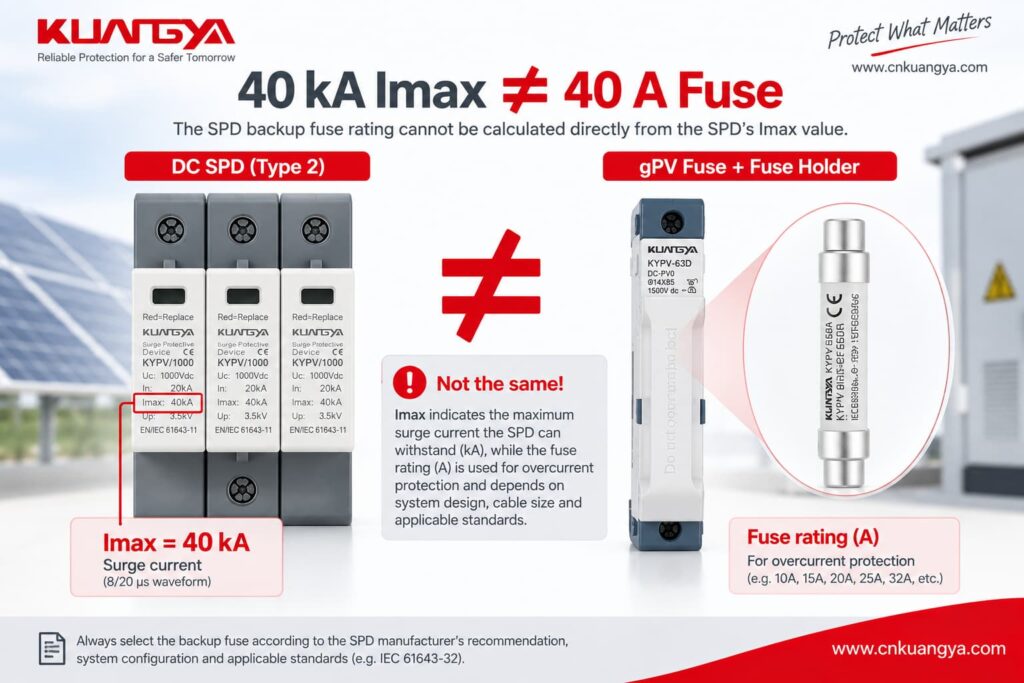
Ein sehr häufiger Fehler ist:
“Der SPD hat 40 kA, daher sollte er mit einer 40-A-Sicherung abgesichert werden.”
Das ist nicht korrekt.
Imax = 40 kA beschreibt eine Stoßstromcharakteristik in Verbindung mit der relevanten Impulsstromform.
A 40-A-Sicherung ist ein Bemessungswert für eine Überstromschutzeinrichtung.
Diese Werte beschreiben unterschiedliche elektrische Phänomene.
Daher:
Die Bemessung der SPD-Vorsicherung kann nicht direkt aus dem Imax-Wert des SPD berechnet werden.
Wenn Sie sich über den Unterschied zwischen In, Imax, Up und Iscpv unsicher sind, lesen Sie unsere Leitfaden für DC-SPD-Spezifikationen.
Das Verständnis dieser Parameter verhindert einen der häufigsten Fehler bei der Auswahl von Überspannungsschutzgeräten (SPD).
Der vom Hersteller angegebene maximale Vorsicherungswert bedeutet nicht, dass immer die größtmögliche Sicherung installiert werden sollte.
Die Schutzeinrichtung muss zudem auf Folgendes abgestimmt sein:
For example, if an SPD permits a maximum backup fuse of 125 A, that does not automatically mean every installation should use a 125 A fuse.
Maximum is a limit, not always a recommendation.
A fuse and a circuit breaker can both provide overcurrent protection, but their operating characteristics are different.
| Faktor | Sicherung | Stromkreisunterbrecher |
|---|---|---|
| Replacement after operation | Must normally be replaced | Can normally be reset after investigation |
| Time-current behavior | Depends on fuse class and rating | Depends on breaker type and trip curve |
| Short-circuit capability | Can be very high | Depends on breaker breaking capacity |
| Surge impulse behavior | Depends on fuse characteristics | Depends on breaker characteristics |
| Trennung | Requires suitable holder/switching arrangement | Often convenient |
| Koordinierung | Must match SPD data | Must match SPD data |
Daher:
Do not assume that a 125 A gG fuse can automatically be replaced by a 125 A circuit breaker.
Manufacturers can specify different protective-device combinations.
For example, Schneider Electric publishes coordination tables pairing particular SPD models with specific protective-device ratings rather than applying one universal breaker value.
Do not copy an AC SPD backup-protection rule directly into a photovoltaic DC system.
PV systems have different:
SPDs designed specifically for the DC side of photovoltaic installations are covered by IEC 61643-31:2018, which applies to PV DC SPDs up to 1,500 V DC.
IEC 61643-31:2018 — official IEC page
This is why an AC SPD backup-fuse example should never automatically be applied to a 1,000 V or 1,500 V PV system.
The following SPD backup fuse examples come from published manufacturer technical information.
They are useful because they demonstrate that backup-protection requirements vary significantly between products.
Do not copy these values to another SPD without checking its own datasheet.
| Manufacturer Example | Published Information | What It Demonstrates |
|---|---|---|
| Schneider Electric Resi MAX | Backup fuse only required if not already provided in mains; published table shows no F2 required in one F1 ≤125 A / Isc <50 kA arrangement | Existing upstream protection may sometimes provide the required backup protection |
| Phoenix Contact VAL-SEC | Published guidance allows installation without additional F2 up to specified upstream conditions; if dedicated F2 is used, 125 A gG is recommended in the example | F2 is not automatically required |
| DEHNguard SE CI | Integrated backup fuse; manufacturer states no additional backup fuse required up to its specified 25 kArms short-circuit condition | Backup protection can be integrated into the SPD |
Let’s look at these examples more closely.
Schneider Electric’s Resi MAX installation instructions provide an especially useful example.
For the documented SPD arrangement, Schneider states that the backup fuse is:
required only if suitable protection is not already provided in the mains.
The document lists ≤125 A gL/gG backup protection and shows a case where:
F1 ≤125 A
und:
Isc <50 kA
can result in:
No need for F2
under the manufacturer’s stated conditions.
Schneider Electric Resi MAX SPD installation instructions
This is an excellent example of why installing an additional fuse automatically is not always correct.
Phoenix Contact provides a useful Type 2 SPD backup-fuse example for its VAL-SEC range.
Its published technical guidance explains that the device can be installed in the branch line without an additional F2 under specified upstream protection conditions.
Where a dedicated F2 is nevertheless required or desired, the document gives:
125 A gG
as an appropriate value for the example.
More importantly, Phoenix Contact also warns against selecting certain smaller backup fuses below 80 A gG in that specific arrangement because their impulse withstand may result in unwanted operation during surge events.
Phoenix Contact — The Right Backup Fuse for Surge Protective Devices
Dies bedeutet nicht mean that every Type 2 SPD needs an 80 A or 125 A fuse.
It demonstrates something more important:
An SPD backup fuse must be coordinated with the specific SPD. Choosing the smallest possible fuse is not automatically the safest option.
Not every SPD requires an external backup fuse.
DEHN’s DEHNguard SE CI Type 2 SPD includes an integrated backup fuse.
DEHN states that no additional backup fuse is required for installations within the product’s specified maximum short-circuit current of 25 kArms.
DEHNguard SE CI with integrated backup fuse
This example shows why the statement:
“Every SPD must have a separate external fuse.”
is incorrect.
The correct arrangement depends on the tested product design.
Ja.
A smaller fuse is not automatically safer.
The protective device must be capable of remaining intact during the surge conditions that the SPD is intended to handle while still interrupting a sustained fault when required.
If an undersized fuse operates unnecessarily during a surge, the SPD can become disconnected.
The electrical installation may then continue operating normally while surge protection has been lost.
This can be particularly difficult to notice in a parallel-connected SPD.
Phoenix Contact’s published example illustrates this issue by warning against certain undersized gG backup fuses in the specific Type 2 SPD arrangement described above.
Again:
This is a product-specific example, not a universal minimum fuse value.
Ja.
If the external protective device exceeds the maximum value permitted by the SPD manufacturer, the SPD may no longer be operating within the tested fault-protection arrangement.
For example, if a product states:
Maximum backup fuse: 125 A gG
this should not be interpreted as:
“125 A must always be installed.”
Instead it means that the protection arrangement should not exceed the manufacturer’s stated limit unless another approved configuration is provided.
The actual selection must still consider:
Consider a Type 2 SPD in a small commercial distribution board.
Assume:
Main upstream fuse F1 = 63 A gG
and the selected SPD permits:
Maximaler Vorsicherungsschutz = 125 A gG
If:
then the existing 63 A upstream device may already provide the required backup protection.
Adding a second 125 A fuse would not automatically improve the system.
Now consider a larger industrial panel.
Assume:
F1 = 400 A
while the SPD permits:
Maximum backup protection = 125 A gG
The upstream protection now exceeds the manufacturer’s stated limit.
A dedicated F2 may therefore be required.
The simplified arrangement may become:
400 A upstream protection → SPD branch → approved F2 → SPD
However, the designer must still verify:
This is why a backup-protection arrangement that works in a small distribution board cannot simply be copied into an industrial main panel.
Photovoltaic DC systems require additional care.
A PV DC SPD must be suitable for:
The exact Vorsicherung für Überspannungsschutzgeräte (SPD) arrangement can depend on:
Before choosing backup protection, the SPD voltage itself must also be correct.
For more detail, see our DC SPD voltage selection guide for solar PV systems.
Nein.
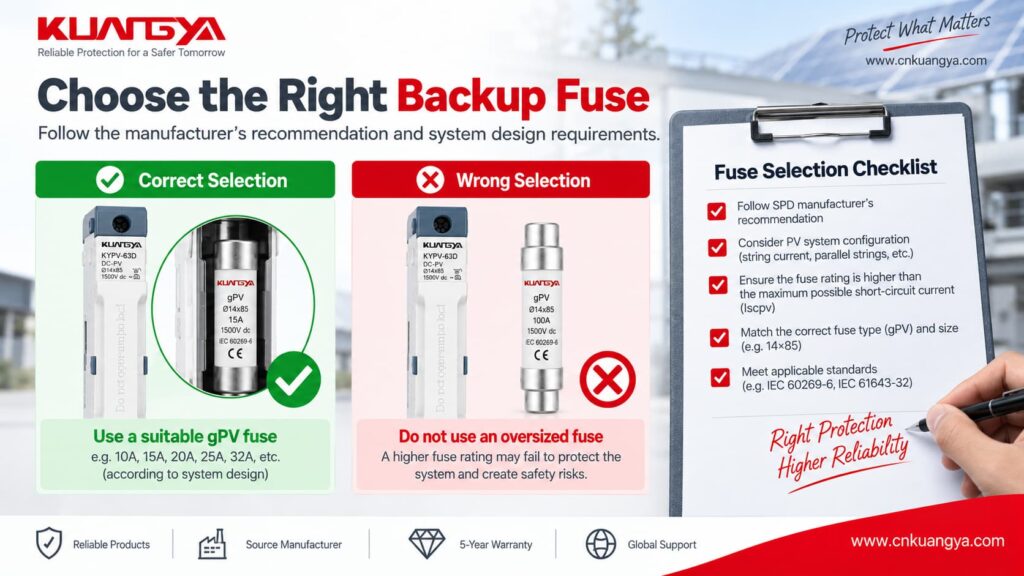
A gPV fuse is specifically designed for photovoltaic applications, but this does nicht mean every PV SPD requires a separate gPV backup fuse.
The manufacturer’s instructions must be checked first.
Depending on the system design, existing PV overcurrent protection may already form part of the approved protection arrangement.
If a gPV fuse is required, it must also be suitable for:
For examples of PV-rated fuse links and holders, see KUANGYA’s DC gPV fuse range.
The product page is useful for understanding available PV fuse formats, but final SPD coordination must still follow the SPD manufacturer’s technical data.
Where dedicated backup protection is required, it is normally positioned in the SPD branch so that fault current flowing to the SPD can be interrupted.
A simplified concept is:
Busbar / Supply → F2 → SPD → required protection path
However, the exact wiring depends on:
Always follow the wiring diagram for the exact SPD.
Adding a fuse or breaker should not result in unnecessarily long SPD connections.
SPD connection conductors have inductance.
During a fast-rising surge current, additional lead length can increase the voltage appearing across the protected equipment.
This means backup protection should be coordinated while keeping the SPD connection path short and direct.
For PV systems, there is also another distance issue: the distance between the SPD location and the inverter.
These two distances should not be confused.
For a detailed explanation, see our guide to SPD distance from inverter and SPD connection lead length.
Sometimes.
The existing protective device may be acceptable if:
However, a dedicated SPD breaker can also provide practical advantages such as easier isolation and maintenance.
Der wichtige Punkt ist:
Dedicated protection does not automatically mean correctly coordinated protection.
The device must still match the SPD manufacturer’s requirements.
Because many power SPDs are connected in parallel, the main electrical load can continue operating even after the SPD branch is disconnected.
That means:
Power ON does not necessarily mean surge protection ON.
If the backup fuse opens, the cause should be investigated rather than simply replacing the fuse and re-energizing the system.
Mögliche Ursachen sind:
If you suspect the SPD itself has failed, see our guide on wie man erkennt, ob ein SPD defekt ist.
| Irrtum | Why It Is Wrong |
|---|---|
| 40 kA SPD = 40 A fuse | Imax and fuse current rating describe completely different electrical quantities |
| Every Type 2 SPD needs 125 A | Backup protection is manufacturer-specific |
| Smaller fuse is always safer | It may disconnect unnecessarily during surge events |
| Internal SPD disconnector means no external protection is ever required | Internal and external protective functions are not necessarily identical |
| 125 A fuse = 125 A breaker | Fuse and breaker operating characteristics differ |
| F2 must always be installed | Existing F1 may already meet the SPD requirement |
| Ignore prospective short-circuit current | SPD protection must be coordinated with available fault current |
| Use AC examples for PV DC SPD | AC and PV DC systems have different requirements |
| Choose only by Imax | Imax does not determine backup-fuse rating |
| Use maximum permitted fuse automatically | “Maximum” is a limit, not necessarily the ideal rating |
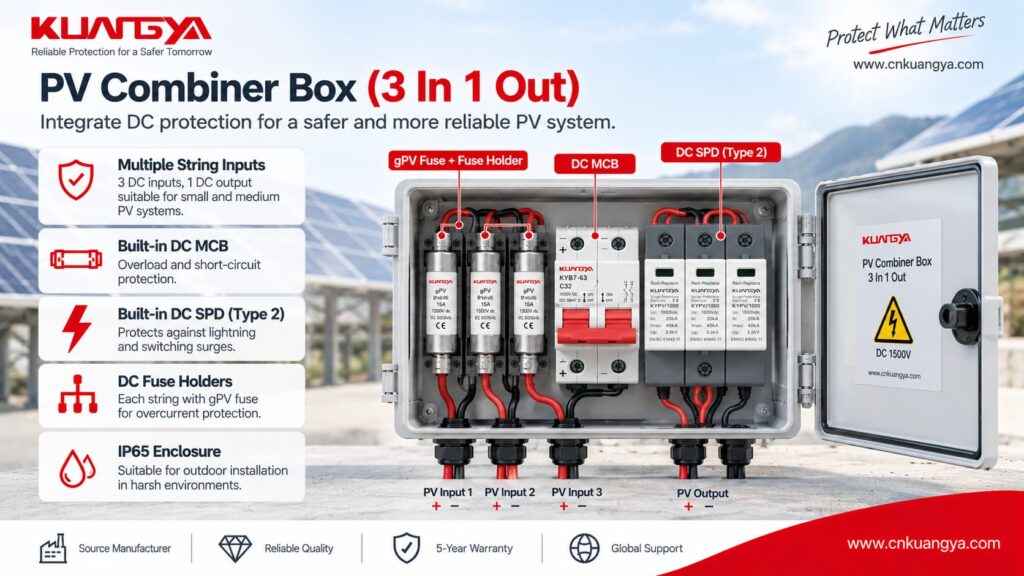
Before selecting an SPD-Vorsicherung oder der Leitungsschutzschalter, check the following:
| Siehe | Frage |
|---|---|
| Exact SPD | What manufacturer and model is installed? |
| Anmeldung | AC or photovoltaic DC? |
| SPD-Typ | Type 1, Type 1+2 or Type 2? |
| Spannung | Are Uc/Ucpv suitable for the system? |
| Upstream device | What is F1? |
| Manufacturer limit | What maximum backup protection is specified? |
| Dedicated F2 | Is it actually required? |
| Fault current | What is the prospective short-circuit current? |
| Fuse class | gG, gPV or another specified type? |
| Leitungsschutzschalter | What curve and breaking capacity are required? |
| Conductors | Is the conductor cross-section suitable? |
| Terminals | Can the SPD terminals accept the selected conductors? |
| Lead length | Are SPD connection leads short and direct? |
| Earthing | Is the protection path correctly connected? |
| Indication | Can failure or disconnection be detected? |
If several of these answers are unknown, selecting a backup fuse by guesswork is not appropriate.
IEC 61643-11 covers SPDs intended for connection to AC low-voltage power circuits and specifies performance and safety requirements, tests and ratings.
IEC 61643-31 applies specifically to SPDs intended for the DC side of photovoltaic installations up to 1.500 V DC.
IEC 60364-5-53 covers the selection and erection of electrical equipment for protection, isolation, switching, control and monitoring.
The current IEC consolidated version includes the 2019 base publication plus amendments from 2020 and 2024.
IEC 60364-5-53:2019+A1:2020+A2:2024
Applicable national standards, installation rules and manufacturer instructions must also be followed.
Nein.
A separate Vorsicherung für Überspannungsschutzgeräte (SPD) is not always necessary.
If the existing upstream protective device already satisfies the manufacturer’s permitted backup-protection conditions, another fuse may not be required.
Some SPDs also include integrated backup protection.
There is no universal fuse size for an SPD.
Use the exact SPD datasheet and check:
Do not calculate the fuse size from Imax alone.
Nein.
125 A appears in several manufacturer examples, but it is not a universal Type 2 SPD value.
Published examples show SPDs with different arrangements, including:
Sometimes.
But the circuit breaker’s:
must be suitable.
Do not replace a specified fuse with a breaker simply because both devices have the same ampere rating.
Nicht unbedingt.
A red status indicator commonly relates to the condition of the SPD’s internal protection module or disconnection mechanism.
An external backup fuse is a separate protective device.
Therefore, both the SPD status and the upstream or branch protection should be inspected.
Ja.
Because many power SPDs are connected in parallel, the protected load may remain energized even if the SPD has been disconnected.
This means surge protection can be lost while the equipment appears to operate normally.
Nein.
The requirement depends on:
Never assume every PV SPD needs the same gPV fuse.
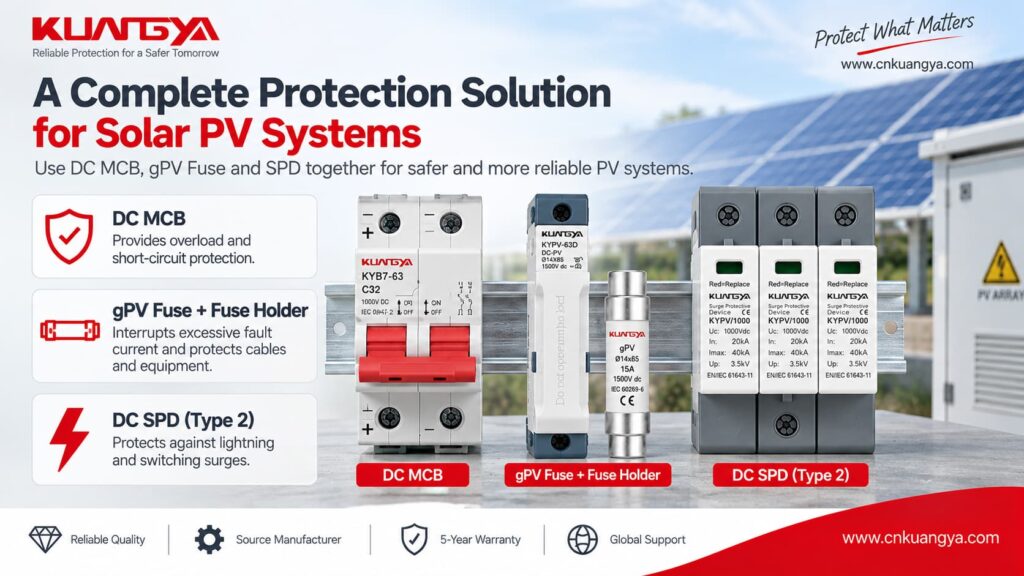
Not directly.
Imax represents a surge-discharge current characteristic.
Fuse current rating relates to overcurrent protection.
A 40 kA Imax rating does not mean a 40 A backup fuse is required.
So, does an SPD need a backup fuse or circuit breaker?
Sometimes yes—but not always as a separate device.
Richtig SPD backup fuse selection starts with the manufacturer’s technical data rather than a universal ampere rating.
The correct decision depends on the relationship between:
SPD → F1 → F2 → available fault current → conductors → electrical system
Before installing additional backup protection, first check whether the existing upstream device already satisfies the SPD manufacturer’s requirements.
If dedicated protection is required, verify:
Most importantly:
Never select an SPD backup fuse only from Type 1 / Type 2, In or Imax. Use the exact manufacturer’s backup-protection requirements and the actual system conditions.
For photovoltaic applications, you can also review KUANGYA’s DC surge protective devices for solar PV systems when comparing Type 2 and Type 1+2 DC SPD options.

