منطقة ونغ يانغ الصناعية يويتشينغ ونتشو 325000
ساعات العمل
من الاثنين إلى الجمعة: 7 صباحاً - 7 مساءً
عطلة نهاية الأسبوع 10 صباحاً - 5 مساءً
منطقة ونغ يانغ الصناعية يويتشينغ ونتشو 325000
ساعات العمل
من الاثنين إلى الجمعة: 7 صباحاً - 7 مساءً
عطلة نهاية الأسبوع 10 صباحاً - 5 مساءً

What do Inc and IΔc mean on an RCCB? Learn why a 10 kA conditional marking depends on specified backup protection and which documents to check before selection.
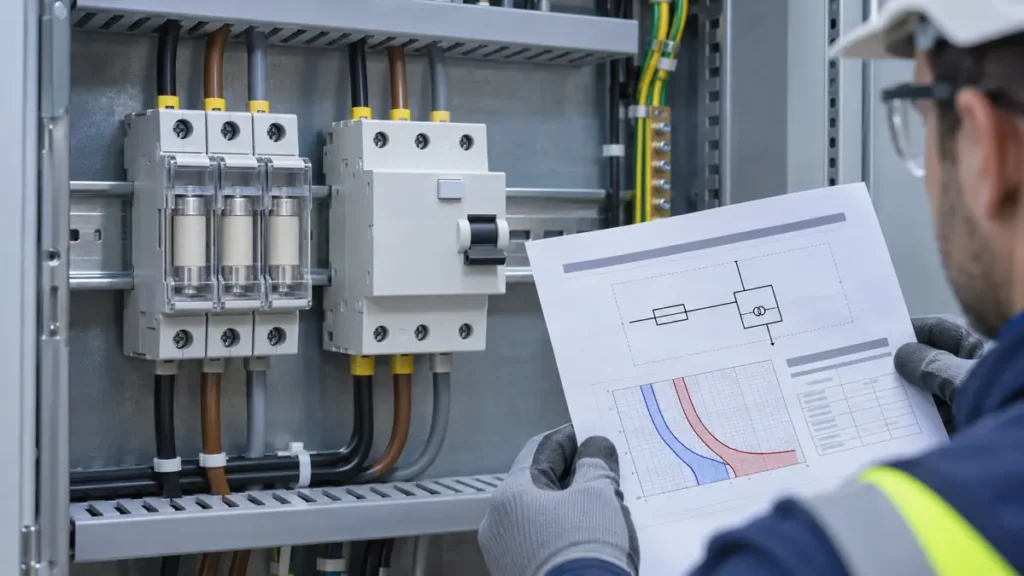
إجابة سريعة: The conditional short-circuit rating printed on an RCCB is not a promise that the RCCB can interrupt that fault current by itself. An RCCB has no integral overcurrent protection. Its stated conditional capability depends on an appropriate associated short-circuit protective device (SCPD), the tested combination, and the prospective fault current at the installation point. Check the exact product documentation before selecting a fuse or circuit breaker.
Inc is the rated conditional short-circuit current. IΔc is the rated conditional residual short-circuit current. These markings describe different specified fault conditions for an RCCB used with associated protection. They are not interchangeable with the RCCB’s rated current In or residual operating current IΔn.
Schneider Electric defines conditional short-circuit current as prospective current a device without integral short-circuit protection can withstand when protected in series by a suitable SCPD under specified test conditions. See its technical definition. The IEC’s IEC 61008-1:2024 scope identifies RCCBs as residual-current circuit breakers without integral overcurrent protection.
If a label or catalog shows 10 kA conditional capability, the missing question is: with which protective device? A supplier datasheet may specify a particular fuse class and rating or a tested circuit-breaker arrangement. The prospective short-circuit current at the RCCB must also be within the verified combination’s limit. A 10 kA conditional marking alone does not make the RCCB a standalone 10 kA MCB.
على سبيل المثال، Schneider Electric RCCB datasheet lists a conditional rating together with a specified gG fuse. That is an example of how a manufacturer states a tested condition; it is لا a fuse recommendation for a different brand or model. For Kuangya equipment, request the exact series datasheet and associated SCPD information rather than copying another manufacturer’s pairing.
| وضع العلامات | Question it answers |
|---|---|
| في | What current is the RCCB rated to carry under its specified conditions? |
| 𞸍 | What is its rated residual operating current? |
| Inc / IΔc | What conditional short-circuit performance is stated with associated protection? |
| MCB breaking capacity | What fault current can that overcurrent device interrupt under its own rated conditions? |
أن RCCB is one type of RCD. If a final circuit needs both residual-current and overcurrent protection in one device, consider an RCBO whose complete ratings suit the circuit. The selection still requires the local installation rules and the equipment manufacturer’s instructions.
Ask for the exact RCCB datasheet, its conditional short-circuit test conditions, the permitted associated fuse or circuit-breaker details, and evidence applicable to the destination market. Send the supply voltage, earthing arrangement, prospective fault current and required residual-current characteristics. تواصل مع Kuangya with those details for a model-specific review.
Do not assume so. A conditional rating depends on the specified associated protective device and test conditions. Confirm the exact documentation.
No automatic substitution is justified. A breaker and fuse with the same ampere rating can behave differently during a short circuit. Use a manufacturer-approved combination or obtain documented engineering confirmation.
No. The 30 mA figure is a residual-current rating, not an overcurrent or short-circuit interrupting rating.
Electrical design, installation and testing must be performed by qualified personnel to the applicable local rules. Do not change protection devices in an energized panel.

