منطقة ونغ يانغ الصناعية يويتشينغ ونتشو 325000
ساعات العمل
من الاثنين إلى الجمعة: 7 صباحاً - 7 مساءً
عطلة نهاية الأسبوع 10 صباحاً - 5 مساءً
منطقة ونغ يانغ الصناعية يويتشينغ ونتشو 325000
ساعات العمل
من الاثنين إلى الجمعة: 7 صباحاً - 7 مساءً
عطلة نهاية الأسبوع 10 صباحاً - 5 مساءً

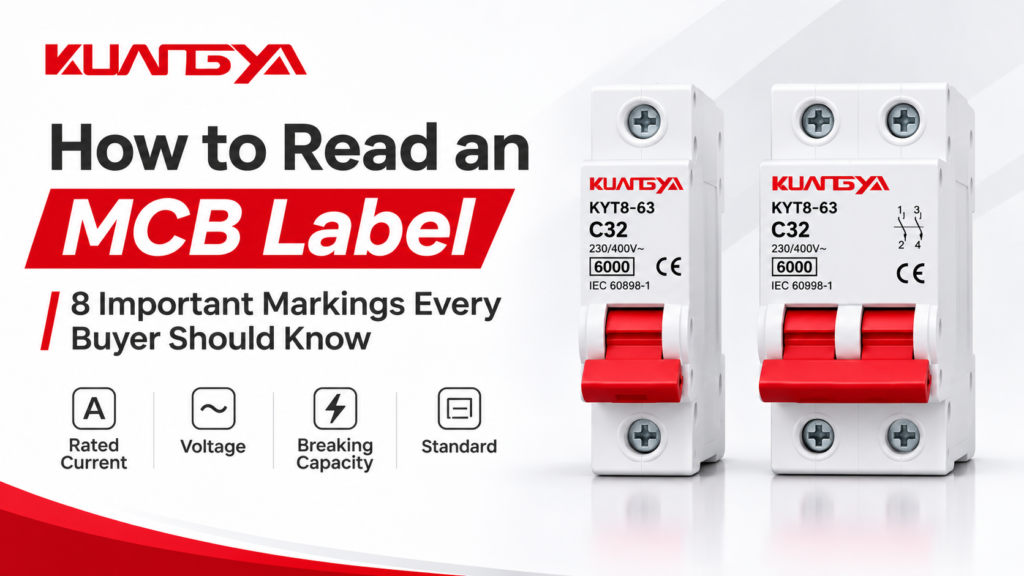
أن MCB label provides essential information about a miniature circuit breaker’s electrical ratings, protection characteristics, and applicable standards. Understanding how to read an MCB label helps electrical distributors, panel builders, contractors, and procurement teams select the right circuit breaker for their applications.
From rated current and voltage to tripping curves and breaking capacity, each marking provides important technical information that buyers should check before placing an order.
In this guide, we explain eight important MCB label markings and show you what to look for when selecting an MCB.
The manufacturer name or brand is usually printed near the top of the MCB.
This marking identifies the product’s brand and helps buyers distinguish between different manufacturers and product ranges.
For distributors and OEM buyers, brand identification is particularly important when purchasing products for resale or private-label projects.
When evaluating an MCB manufacturer, buyers should also check:
على سبيل المثال،, KUANGYA AC MCB products are designed for residential, commercial, and light-industrial distribution applications, with different current ratings, tripping curves, and breaking capacity options depending on the model.
The model number identifies a particular MCB product or product series.
Different models may have different dimensions, electrical ratings, breaking capacities, and installation characteristics.
A model number can help buyers identify:
However, model numbering systems vary between manufacturers. There is no universal rule that every manufacturer must follow the same naming format.
When requesting a quotation, buyers should provide the complete model number whenever possible.
This helps the supplier identify the correct product and avoid confusion between similar-looking models.
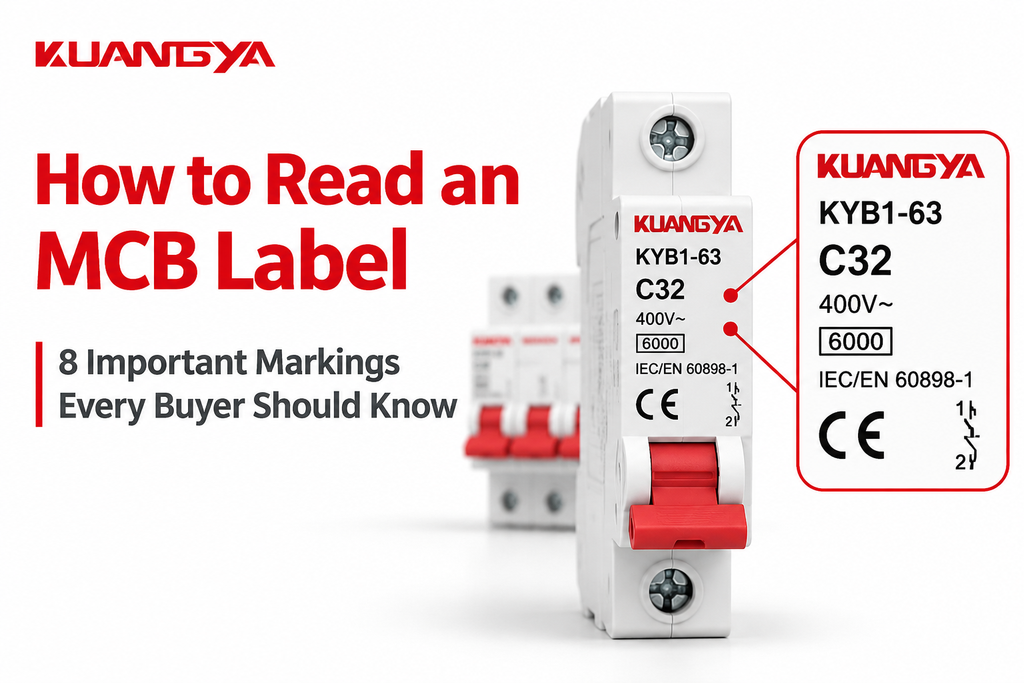
Rated current is one of the most important electrical parameters on an MCB label.
It is commonly expressed in amperes (A).
Typical MCB current ratings include:
For example, a marking of C32 means that the MCB has a rated current of 32A and a Type C tripping characteristic.
Rated current indicates the current rating under specified reference conditions. It does not mean that the breaker will trip immediately whenever the current exceeds 32A by even a small amount.
The actual tripping behavior depends on the breaker’s time-current characteristics and operating conditions.
When selecting the rated current, engineers must consider:
Choosing an MCB with an unsuitable rated current may result in unwanted tripping or inadequate circuit protection.
Rated operational voltage indicates the voltage at which the MCB is designed to operate under its specified conditions.
It is commonly marked in volts (V).
على سبيل المثال:
| وضع العلامات | المعنى |
|---|---|
| 230 فولت تيار متردد | Rated voltage for a specified AC application |
| 400 فولت تيار متردد | Rated voltage for a specified AC application |
| 230/400V AC | Voltage ratings for different system configurations |
The actual voltage suitability depends on the manufacturer’s declared ratings, pole configuration, and wiring arrangement.
For example, in a typical three-phase 230/400V system:
Buyers should always check the voltage rating for the intended circuit rather than relying only on the appearance or pole count of the breaker.
هام: AC and DC circuit breakers are not automatically interchangeable. DC applications require a breaker specifically rated and tested for the relevant DC voltage and current.
For photovoltaic and other DC distribution systems, refer to KUANGYA DC MCB products and check the approved voltage and pole configuration for the specific model.
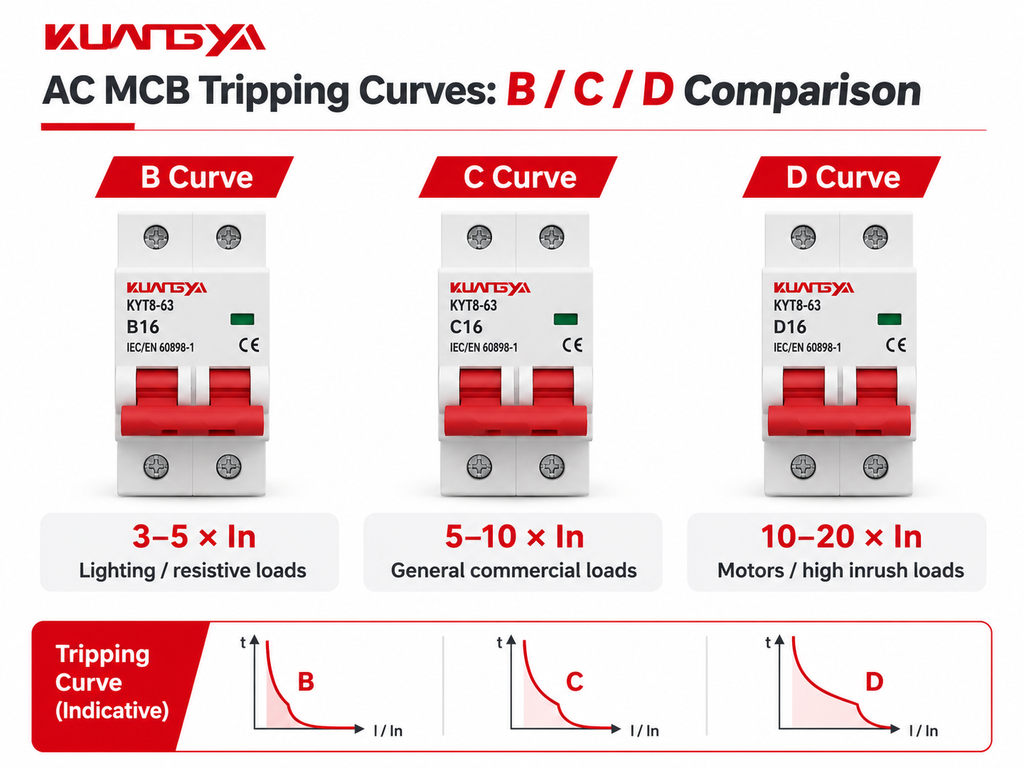
The letters B, C, and D indicate the MCB’s instantaneous magnetic tripping characteristics.
They describe how the breaker responds to high current surges, particularly during short-circuit conditions.
Under IEC 60898-1, the conventional instantaneous tripping ranges are:
| Curve | Magnetic tripping range | التطبيق النموذجي |
|---|---|---|
| B | 3–5 × In | Resistive loads and general lighting |
| C | 5–10 × In | General commercial and industrial loads |
| D | 10–20 × In | Loads with high starting currents |
For example, a C32 MCB has a rated current of 32A and a Type C tripping characteristic.
Its conventional instantaneous magnetic operating range is approximately 160–320A.
The appropriate curve depends on the load characteristics, starting current, and fault-loop conditions.
A higher tripping curve is not automatically better. The selected curve must provide suitable protection while avoiding unnecessary trips during normal equipment startup.
For a more detailed comparison, read our related guide:
B, C and D MCB Tripping Curves: Understanding the Differences
[Insert the link to your existing B/C/D MCB article here.]
Breaking capacity indicates the circuit breaker’s ability to interrupt a short-circuit current under specified test conditions.
It is commonly expressed in kiloamperes (kA).
Typical markings include:
على سبيل المثال:
A marking of 6000 indicates a declared short-circuit capacity of 6,000A under the applicable product standard and rated conditions.
Under IEC 60898-1, the relevant rated short-circuit capacity is designated Icn.
A higher breaking capacity allows the breaker to interrupt a higher prospective short-circuit current, provided the rating applies at the required voltage and operating conditions.
When selecting an MCB, buyers and engineers should check:
The breaking capacity must be suitable for the installation’s fault conditions.
Do not assume that a 10kA MCB is always necessary or that a 6kA MCB is suitable for every installation.
The standard number printed on an MCB provides information about the technical requirements and test framework used for the product.
Two important standards for low-voltage circuit breakers are:
IEC 60898-1
This standard covers AC circuit breakers for overcurrent protection in household and similar installations.
It applies to specified AC circuit breakers with rated voltages not exceeding 440V between phases and rated currents not exceeding 125A.
Official reference:
IEC 60898-1:2015 + Amendment 1:2019 — IEC Webstore
IEC 60947-2
This standard covers low-voltage circuit breakers intended for applications involving instructed or skilled persons.
The 2024 edition applies to circuit breakers for circuits with rated voltages up to 1,000V AC or 1,500V DC, within its scope.
Official reference:
IEC 60947-2:2024 — IEC Webstore
These standards have different scopes. Buyers should check which standard applies to the specific product and intended application.
A standard number printed on the product should not, by itself, be treated as proof of independent certification or conformity.
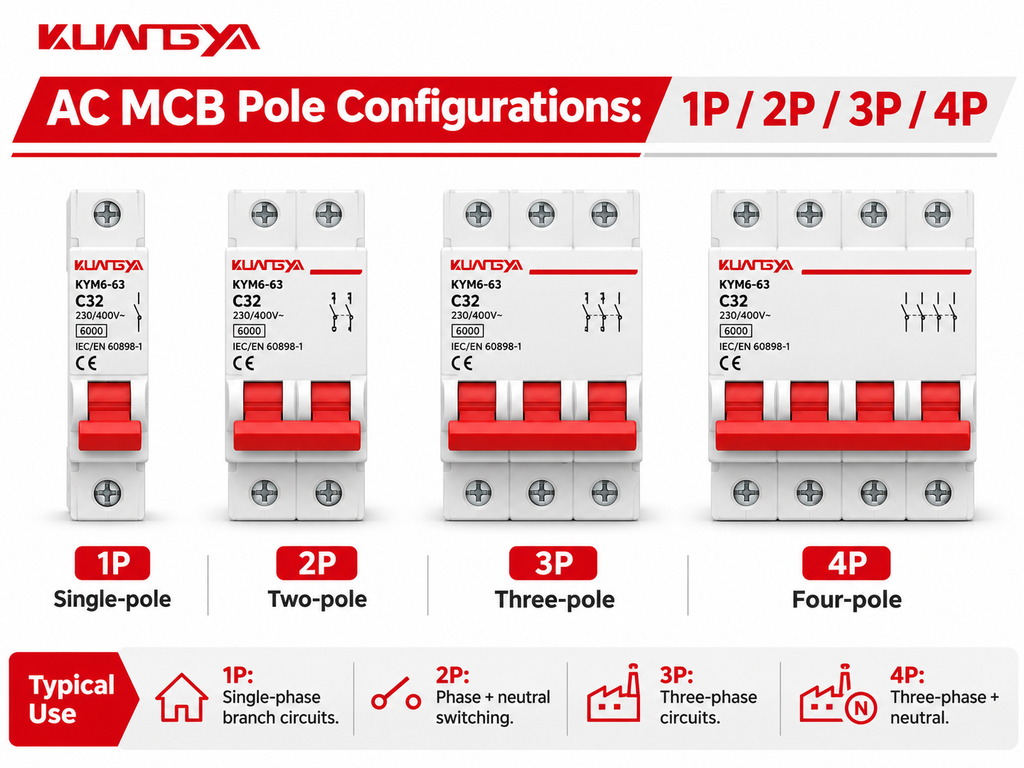
The number of poles determines the circuit configuration that the MCB is designed to protect and switch.
Common configurations include:
| التكوين | Typical description |
|---|---|
| 1P | Single-pole circuit breaker |
| 2P | Two-pole circuit breaker |
| 3P | Three-pole circuit breaker |
| 4P | Four-pole circuit breaker |
Different pole configurations are used in different electrical distribution systems.
على سبيل المثال:
Buyers should also check the terminal markings and wiring diagram, where provided.
These markings help identify the correct connection points and installation arrangement.
The number of poles alone does not determine the breaker’s complete protection capability. The rated voltage, switching arrangement, and manufacturer’s wiring instructions must also be considered.
Let’s put the markings together.
Imagine an MCB with the following information printed on its front:
| وضع العلامات | الشرح |
|---|---|
| C32 | Type C tripping curve, 32A rated current |
| 230/400V AC | Declared operational voltage |
| 6000 | 6kA rated short-circuit capacity, subject to applicable standard |
| IEC 60898-1 | Applicable product standard |
| 2P | Two-pole configuration |
| 50/60 هرتز | Rated operating frequency, if marked |
| Brand logo | Manufacturer or product brand |
| Model number | Product identification |
By understanding these markings, buyers can quickly identify the basic electrical characteristics of an MCB.
However, the front label is only the starting point. Full technical verification should also include the product datasheet, dimensions, terminal capacity, temperature conditions, and applicable test documentation.
Before placing an MCB order, procurement teams should confirm the following information with the manufacturer or supplier.
| البند | Information to confirm |
|---|---|
| Product type | AC MCB or DC MCB |
| التيار المقنن | 6A, 10A, 16A, 32A, etc. |
| Tripping curve | B, C or D |
| الجهد المقنن | Required AC or DC voltage |
| القدرة الاستيعابية | 4.5kA, 6kA, 10kA, etc. |
| عدد الأعمدة | 1P, 2P, 3P or 4P |
| Applicable standard | IEC 60898-1 or IEC 60947-2, as applicable |
| Product dimensions | Required panel and DIN rail compatibility |
| التوثيق | Datasheet, test reports and relevant conformity documents |
| Branding | Standard brand or OEM/private label |
For bulk orders, confirming the label artwork and product specifications before mass production is also important.
This helps reduce marking errors, packaging inconsistencies, and unnecessary communication during order processing.
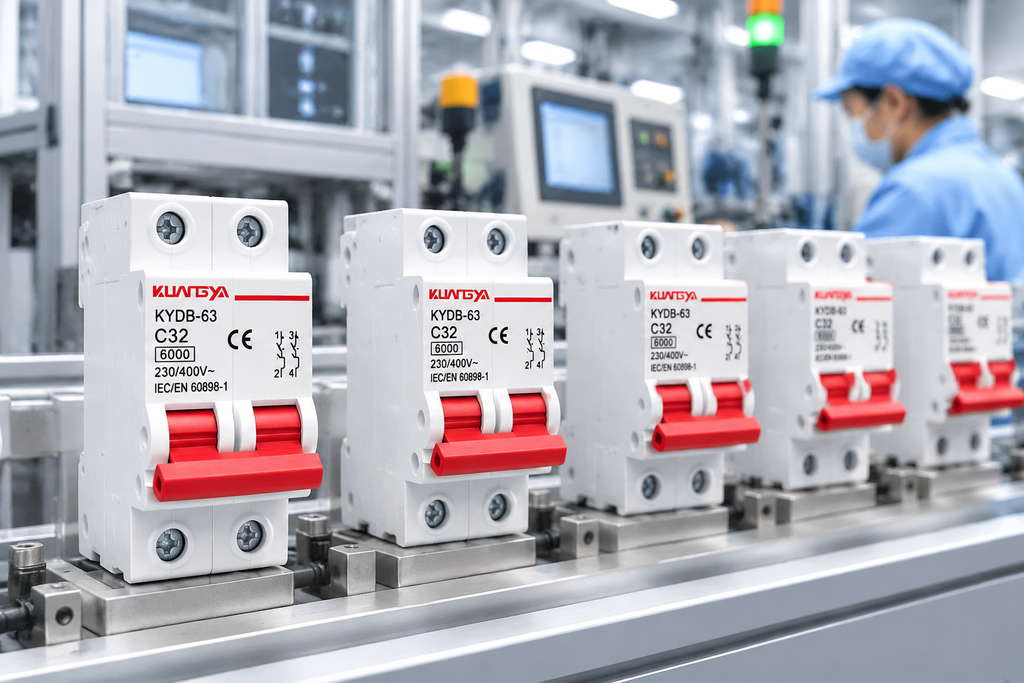
Understanding MCB markings helps buyers compare products, but the manufacturer’s production capability and quality control are equally important.
For distributors, wholesalers, and panel builders, a reliable supplier should be able to provide:
KUANGYA manufactures low-voltage circuit protection products, including AC MCBs and DC MCBs, for international distributors, contractors, and OEM customers.
Our AC MCB range includes different rated currents, tripping curves, pole configurations, and breaking capacity options depending on the model.
Explore our products:
For product specifications, OEM requirements, or bulk purchasing inquiries, contact our team to discuss your application.
C32 means the MCB has a rated current of 32A and a Type C tripping characteristic. Under IEC 60898-1, the conventional instantaneous magnetic tripping range for Type C is 5–10 times the rated current.
6000 generally indicates a rated short-circuit capacity of 6,000A (6kA). The exact designation and conditions depend on the applicable product standard and rated voltage.
The main difference is their rated short-circuit breaking capacity. A 10kA MCB has a higher declared capacity than a 6kA MCB under the applicable specified conditions.
It indicates the declared voltage ratings for the relevant electrical system configurations. The exact suitability must be checked against the manufacturer’s voltage and pole configuration specifications.
Not automatically. AC and DC circuits have different arc-extinguishing requirements. Always select a circuit breaker specifically rated for the intended DC voltage and current.
IEC 60898-1 covers AC circuit breakers for household and similar installations, while IEC 60947-2 covers low-voltage circuit breakers within its industrial and professional application scope. Their requirements and rating designations should not be assumed to be interchangeable.
No. The rated current must match the load, cable capacity, and installation conditions. Selecting an unnecessarily high current rating may compromise proper circuit protection.
Provide the required AC or DC type, rated current, rated voltage, tripping curve, breaking capacity, pole configuration, applicable standard, and estimated order quantity. If OEM branding is required, include your label and packaging requirements.
Reading an MCB label correctly is an essential step in selecting the right circuit breaker.
From rated current and voltage to tripping curves, breaking capacity, and applicable standards, each marking provides important information about the product’s intended operation.
For distributors, contractors, and procurement teams, understanding these specifications makes it easier to compare products, communicate technical requirements, and purchase the correct MCB for each application.
If you are looking for an MCB manufacturer offering different specifications and OEM options, contact KUANGYA to discuss your requirements.

