منطقة ونغ يانغ الصناعية يويتشينغ ونتشو 325000
ساعات العمل
من الاثنين إلى الجمعة: 7 صباحاً - 7 مساءً
عطلة نهاية الأسبوع 10 صباحاً - 5 مساءً
منطقة ونغ يانغ الصناعية يويتشينغ ونتشو 325000
ساعات العمل
من الاثنين إلى الجمعة: 7 صباحاً - 7 مساءً
عطلة نهاية الأسبوع 10 صباحاً - 5 مساءً

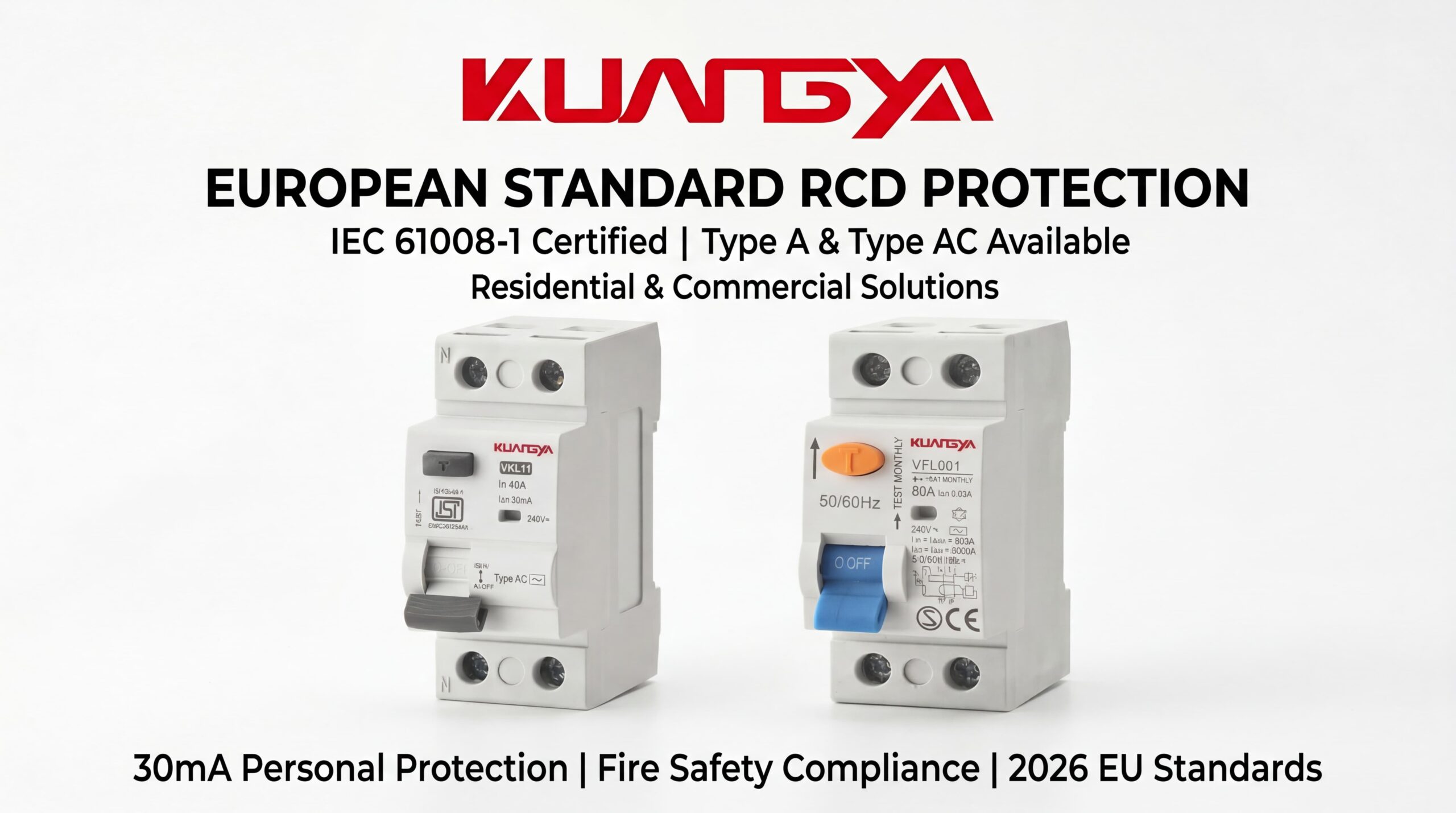
The consequences of selecting or installing an unsuitable residual current device can go beyond nuisance tripping. Residual current devices (RCDs), RCCBs and RCBOs must be selected according to the expected residual-current waveform, circuit requirements, connected equipment and applicable installation rules.
One of the most important functions of an RCD is additional protection against electric shock. A 30mA RCD is widely used for this purpose in residential and similar installations. However, reliable protection depends not only on the rated residual operating current (IΔn), but also on the RCD type, operating characteristics, installation conditions and whether the device is suitable for the residual-current waveform produced by the connected equipment.
Modern electrical equipment can contain rectifiers, inverters, electronic power supplies and variable-speed controls. These loads may produce residual-current waveforms that differ from simple sinusoidal AC. For this reason, Type AC, Type A, Type F and Type B RCDs should not be treated as interchangeable. The correct type must be selected according to the application and applicable installation requirements.
Residual current protection can also form part of an electrical installation’s protection strategy against earth faults that may contribute to overheating or fire. Insulation deterioration, damaged wiring and earth-leakage faults can create abnormal current paths that require effective protection and proper coordination.
An RCD that is incorrectly specified, poorly manufactured or unable to operate according to its declared characteristics may not provide the expected protection. Product compliance, correct selection and coordination with other protective devices are therefore all important parts of electrical system design.
Another common problem is unwanted loss of supply. When one RCD protects a large group of unrelated circuits, a residual-current fault on one circuit can disconnect every circuit connected downstream of that device.
Modern distribution boards can reduce this problem by dividing circuits between several RCDs or by using individual RCBOs. The number of circuits that may be connected to one RCD depends on the applicable national installation rules. For example, French NF C 15-100 guidance limits one residual-current device to a maximum of eight circuits. This should not be treated as a universal rule for every European country.
RCD requirements are not identical across Europe. Product standards such as IEC 61008-1 and IEC 61009-1 define requirements for RCCBs and RCBOs, while national wiring regulations determine how and where these protective devices should be installed.
Installers, distributors and property owners should therefore avoid relying on one general “European rule.” Product conformity, manufacturer instructions, local wiring regulations and the characteristics of the installation all need to be considered.
Selecting the appropriate RCD, RCCB or RCBO requires more than choosing an ampere rating. A practical selection process should consider four main points: RCD type, residual-current sensitivity, rated current and the connected equipment.
Choose the application below to get a practical starting point for RCD type and residual-current selection.
The fundamental classification of RCDs is based on the residual-current waveforms they are designed to detect. This is particularly important as modern homes increasingly use electronic appliances, variable-speed equipment, EV chargers and renewable-energy systems.
Type AC RCDs detect sinusoidal alternating residual currents. They are still permitted for certain applications under some national installation rules. However, they should not automatically be treated as suitable for every modern circuit, particularly where electronic equipment can produce residual-current waveforms other than sinusoidal AC.
أجهزة RCDs من النوع A detect sinusoidal AC and pulsating DC residual currents. They are widely used with modern household appliances and electronic loads containing rectifiers, electronic controls and switched-mode power supplies. Type A is a common choice for many residential circuits, although equipment capable of producing smooth DC or more complex residual currents may require another RCD type.
Type F RCDs build on the capabilities of Type A and are designed to respond to certain composite residual currents that may occur with single-phase frequency-controlled equipment. Typical applications can include some heat pumps, air-conditioning systems, pumps and other equipment using single-phase frequency converters. Type F does not provide the same smooth DC residual-current detection capability as Type B.
Type B RCDs can detect sinusoidal AC, pulsating DC and smooth DC residual currents, together with additional residual-current components within their specified operating range. They are used in applications where smooth DC residual current may occur, including certain PV systems, EV charging equipment, UPS systems and variable-frequency drives.
However, Type B is not automatically required for every EV charger, solar inverter or heat pump. The equipment design, built-in protection, residual-current characteristics and manufacturer instructions must be checked first.
The rated residual operating current (𞸍) indicates the residual-current sensitivity of the RCD. Common ratings include 10mA, 30mA, 100mA and 300mA, but these values serve different protection objectives and should not be treated as interchangeable.
حساسية 30 مللي أمبير is widely used for additional protection against electric shock in residential and similar installations. It is commonly specified for final circuits where additional protection is required by the applicable installation rules.
100mA sensitivity may be used in upstream, selective or other application-specific protection arrangements. A 100mA RCD should not be treated as a substitute for 30mA additional protection where 30mA protection is specifically required.
300mA sensitivity may be used in certain upstream, earth-fault or fire-risk-related protection arrangements depending on the installation design and applicable rules. A 300mA device does not provide the same level of additional shock protection as a 30mA RCD.
Two values printed on an RCCB or RCBO are often confused. For example, on a device marked 63A / 30mA:
A 63A/30mA RCD therefore does لا trip because the normal load current reaches 30mA. The two numbers describe different characteristics and must be selected separately.
The rated current (In) must be selected so that the RCCB or RCBO is not overloaded during normal operation. Available ratings depend on the product series, application and applicable product standard.
The correct RCCB current rating should not simply be determined by adding every downstream circuit-breaker rating together. National installation rules can use different sizing methods. For example, French NF C 15-100 practice allows selection using an upstream method or a downstream calculation that applies specified diversity factors.
Making and breaking capacities are separate product characteristics and must also be checked against the installation and applicable product requirements. The normal rated current, residual-current sensitivity and short-circuit characteristics should not be confused.
Proper RCD coordination helps ensure that a residual-current fault disconnects only the necessary part of the installation rather than unnecessarily removing power from unaffected circuits.
Selective or time-delayed RCDs can be used in suitable upstream arrangements to improve coordination with downstream devices. However, selectivity should not be determined from sensitivity ratings alone. The designer must also consider time-delay characteristics, RCD type, manufacturer coordination data and the installation arrangement.
RCBO versus RCCB + MCB: an RCBO combines residual-current and overcurrent protection for an individual circuit. An RCCB normally provides residual-current protection for one or more downstream circuits and therefore requires suitable overcurrent protection. RCBOs can improve circuit separation because a fault on one circuit does not necessarily disconnect unrelated circuits.
| المعلمة | نوع التكييف | النوع أ | النوع F | النوع ب |
|---|---|---|---|---|
| Sinusoidal AC Residual Current | ✓ | ✓ | ✓ | ✓ |
| التيار المتبقي النابض للتيار المستمر النابض | ✗ | ✓ | ✓ | ✓ |
| Certain Composite Residual Currents | ✗ | محدودة | ✓ | ✓ |
| Smooth DC Residual Current Detection | ✗ | ✗ | ✗ | ✓ |
| Typical Starting Point | Simple AC loads where permitted | Modern household and electronic loads | Certain single-phase frequency-controlled loads | Applications where smooth DC residual current may occur |
Note: Type A and Type F RCDs are designed to operate under specified conditions involving DC components, but they should not be confused with Type B RCDs, which are designed to detect smooth DC residual current. This table is a simplified comparison only.
| الحساسية (IΔn) | Common Role | Important Consideration |
|---|---|---|
| 10 مللي أمبير | Higher-sensitivity protection for specific applications | Application-specific and more sensitive to accumulated leakage current |
| 30 مللي أمبير | Additional protection against electric shock | Widely used for final circuits where required |
| 100 مللي أمبير | Upstream, selective or application-specific protection | Not a substitute for required 30mA additional protection |
| 300 مللي أمبير | Certain upstream / earth-fault / fire-risk-related applications | Does not provide the same additional shock protection as 30mA |
| Selection Item | ماذا يعني ذلك | ما الذي يجب التحقق منه |
|---|---|---|
| التيار المقدر (في) | Normal current-carrying rating of the device | Load, upstream protection and applicable sizing method |
| Residual Rating (IΔn) | حساسية التيار المتبقي | Protection objective and installation rules |
| RCD Type | Residual-current waveform detection capability | Connected equipment and manufacturer instructions |
| RCBO or RCCB | Individual combined protection or grouped residual protection | Distribution-board design and continuity requirements |
| التطبيق | Practical Starting Point | What Must Be Confirmed |
|---|---|---|
| Lighting / standard sockets | Type A is widely used; Type AC may still be permitted for certain applications | National installation requirements and connected loads |
| Household electronic appliances | Type A commonly used | Manufacturer instructions and equipment characteristics |
| Heat pump / air conditioner | Type F may suit certain single-phase frequency-controlled equipment | Frequency-converter design and possible DC residual current |
| EV charger | Type A/F with suitable DC protection or Type B depending on EVSE design | Compliant DC residual-current protection and manufacturer requirements |
| Solar PV inverter | No universal RCD type | Inverter topology, residual-current characteristics and manufacturer instructions |
| Industrial VFD | Type B may be required where smooth DC or broader-frequency residual currents can occur | Drive design, normal leakage and manufacturer requirements |
| قياسي | Main Scope |
|---|---|
| IEC 61008-1:2024 | RCCBs without integral overcurrent protection for household and similar uses |
| IEC 61009-1:2024 | RCBOs with integral overcurrent protection for household and similar uses |
| IEC 62423:2009 | Additional requirements for Type F and Type B RCDs |
| IEC / HD 60364 Series | Low-voltage electrical installation requirements |
| BS 7671 | Requirements for electrical installations in the United Kingdom |
| NF C 15-100 | Low-voltage electrical installation requirements used in France |
Product standards and installation standards serve different purposes. Compliance with an RCCB or RCBO product standard does not automatically mean that the same RCD type is appropriate for every application.
RCD (Residual Current Device) is a general term for residual-current protective devices. An RCCB provides residual-current protection but normally requires separate overcurrent protection. An RCBO combines residual-current, overload and short-circuit protection in one device. GFCI is terminology commonly used in North America for ground-fault protection, although product construction, ratings and applicable standards differ from European RCD arrangements.
63A is the rated current (In), while 30mA is the rated residual operating current (IΔn). The first value relates to normal current-carrying capacity, while the second describes residual-current sensitivity.
The correct type depends primarily on the residual-current waveform that the connected equipment can produce. Type A is widely used for modern electronic loads, Type F adds protection for certain composite residual currents associated with single-phase frequency-controlled equipment, while Type B can also detect smooth DC residual current. Always check the equipment manufacturer’s instructions before final selection.
No. EV charging equipment can produce DC residual current, but the correct solution depends on the DC protection provided by the EVSE. For example, under BS 7671, Type A or Type F may be used together with appropriate DC residual-current protection such as an RDC-DD where applicable. Where suitable DC fault-current protection is not provided, Type B may be required. Manufacturer instructions and applicable local rules must always be followed.
No. PV inverter topology, internal monitoring and residual-current characteristics vary between products. Some applications may require Type B, while others may permit another RCD type. The inverter manufacturer’s installation instructions should be checked before selection.
There is no single number that applies to every country. For example, French NF C 15-100 guidance limits one residual-current device to a maximum of eight circuits. Other national installation rules can use different arrangements, so the local requirements should always be checked.
The most important point is simple: do not select an RCD from only one number on the product label. A correct selection requires the appropriate rated current, residual-current sensitivity, RCD type and installation arrangement.
نبذة عن كوانجيا: KUANGYA manufactures electrical protection products including RCCBs, RCBOs, circuit breakers and surge protection devices for residential, commercial and industrial applications. For model-specific specifications, available certifications, OEM options or product-selection support, please اتصل بنا.