Zona industrial de WengYang Yueqing Wenzhou 325000
Horas de trabajo
De lunes a viernes: de 7.00 a 19.00 horas
Fin de semana: 10.00 A 17.00 HORAS
Zona industrial de WengYang Yueqing Wenzhou 325000
Horas de trabajo
De lunes a viernes: de 7.00 a 19.00 horas
Fin de semana: 10.00 A 17.00 HORAS

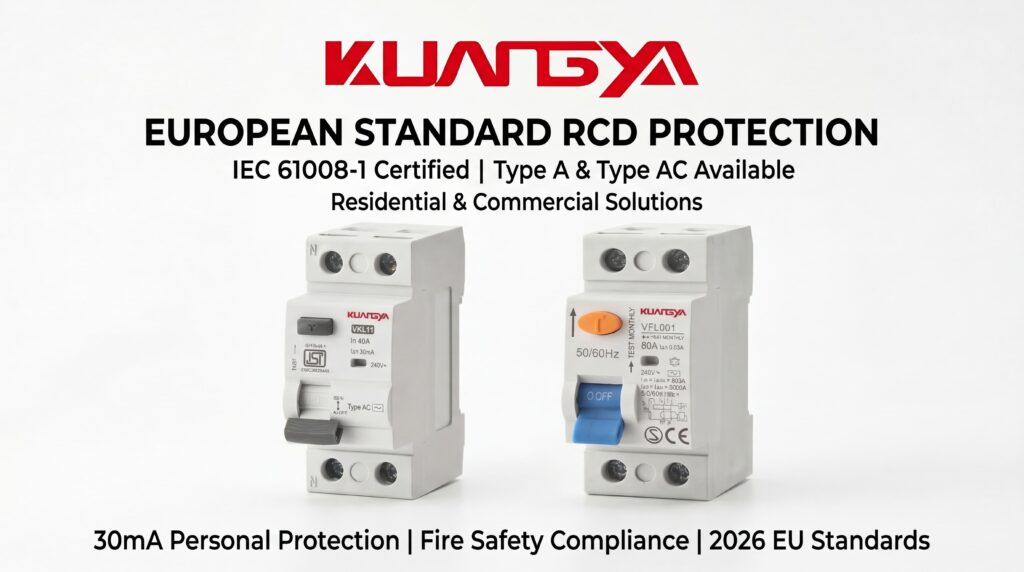
RCD coordination is the process of arranging upstream and downstream residual current devices so that the device closest to an earth fault disconnects first. In a well-coordinated residential panel, a fault on one final circuit should not unnecessarily remove power from every other circuit.
The usual design combines circuit subdivision, a suitable difference in rated residual operating current (IΔn), and a verified time delay at the upstream device. A common example is an upstream selective Type S RCD coordinated with downstream instantaneous 30 mA devices. The exact combination must still be checked against manufacturer coordination data, the earthing arrangement and the national wiring rules that apply to the installation.
| Cuestión de diseño | Practical check |
|---|---|
| Which device should trip first? | The downstream RCD or RCBO immediately upstream of the faulty circuit. |
| How is total selectivity normally achieved? | Use a higher IΔn upstream and ensure its minimum non-tripping time is longer than the downstream device’s maximum operating time. |
| Is a 3:1 sensitivity ratio enough by itself? | No. It is a widely used coordination rule, but time-current characteristics and manufacturer data must also confirm selectivity. |
| Where does Type S belong? | Normally upstream of instantaneous downstream RCDs; it should not replace 30 mA additional protection on final circuits where that protection is required. |
| How can unwanted whole-panel trips be reduced? | Divide circuits between several RCCBs or use an individual RCBO for each final circuit. |
A 30 mA RCD is widely used as additional protection against electric shock in residential installations. Its effectiveness depends on the correct RCD type, operating characteristics, installation conditions and suitability for the residual-current waveform produced by connected equipment.
If one instantaneous RCD protects many unrelated circuits, leakage or a fault on one circuit can disconnect the whole group. Circuit subdivision or individual RCBOs improve fault localisation and reduce disruption to lighting, refrigeration, heating and other unaffected loads.
Product standards such as IEC 61008-1 and IEC 61009-1 define requirements for RCCBs and RCBOs, while national wiring regulations determine where and how they are installed. There is no single residential arrangement that automatically complies in every European country. Always check local rules, equipment instructions and the selected manufacturer’s coordination tables.
Selecting the appropriate RCD, RCCB or RCBO requires more than choosing an ampere rating. A practical selection process should consider four main points: RCD type, residual-current sensitivity, rated current and the connected equipment.
Choose the application below to get a practical starting point for RCD type and residual-current selection.
The fundamental classification of RCDs is based on the residual-current waveforms they are designed to detect. This is particularly important as modern homes increasingly use electronic appliances, variable-speed equipment, EV chargers and renewable-energy systems.
Tipo AC RCDs detect sinusoidal alternating residual currents. They are still permitted for certain applications under some national installation rules. However, they should not automatically be treated as suitable for every modern circuit, particularly where electronic equipment can produce residual-current waveforms other than sinusoidal AC.
Dispositivos de corriente residual de tipo A detect sinusoidal AC and pulsating DC residual currents. They are widely used with modern household appliances and electronic loads containing rectifiers, electronic controls and switched-mode power supplies. Type A is a common choice for many residential circuits, although equipment capable of producing smooth DC or more complex residual currents may require another RCD type.
Dispositivos de corriente residual de tipo F build on the capabilities of Type A and are designed to respond to certain composite residual currents that may occur with single-phase frequency-controlled equipment. Typical applications can include some heat pumps, air-conditioning systems, pumps and other equipment using single-phase frequency converters. Type F does not provide the same smooth DC residual-current detection capability as Type B.
Dispositivos de corriente residual de tipo B can detect sinusoidal AC, pulsating DC and smooth DC residual currents, together with additional residual-current components within their specified operating range. They are used in applications where smooth DC residual current may occur, including certain PV systems, EV charging equipment, UPS systems and variable-frequency drives.
However, Type B is not automatically required for every EV charger, solar inverter or heat pump. The equipment design, built-in protection, residual-current characteristics and manufacturer instructions must be checked first.
The rated residual operating current (En) indicates the residual-current sensitivity of the RCD. Common ratings include 10mA, 30mA, 100mA and 300mA, but these values serve different protection objectives and should not be treated as interchangeable.
30 mA de sensibilidad is widely used for additional protection against electric shock in residential and similar installations. It is commonly specified for final circuits where additional protection is required by the applicable installation rules.
Sensibilidad de 100 mA may be used in upstream, selective or other application-specific protection arrangements. A 100mA RCD should not be treated as a substitute for 30mA additional protection where 30mA protection is specifically required.
300 mA de sensibilidad may be used in certain upstream, earth-fault or fire-risk-related protection arrangements depending on the installation design and applicable rules. A 300mA device does not provide the same level of additional shock protection as a 30mA RCD.
Two values printed on an RCCB or RCBO are often confused. For example, on a device marked 63A / 30mA:
A 63A/30mA RCD therefore does no trip because the normal load current reaches 30mA. The two numbers describe different characteristics and must be selected separately.
The rated current (In) must be selected so that the RCCB or RCBO is not overloaded during normal operation. Available ratings depend on the product series, application and applicable product standard.
The correct RCCB current rating should not simply be determined by adding every downstream circuit-breaker rating together. National installation rules can use different sizing methods. For example, French NF C 15-100 practice allows selection using an upstream method or a downstream calculation that applies specified diversity factors.
Making and breaking capacities are separate product characteristics and must also be checked against the installation and applicable product requirements. The normal rated current, residual-current sensitivity and short-circuit characteristics should not be confused.
RCD selectivity means that a downstream device clears a residual-current fault while the upstream device remains closed. Designers normally combine current selectivity with time selectivity and verify the result for every protective level.
The downstream device protecting the final circuit is normally instantaneous. Where additional protection is required, this is commonly a 30 mA RCD or RCBO. The upstream device must not introduce a delay that compromises a required disconnection time.
A commonly applied IEC-based coordination rule is for the upstream IΔn to be at least three times the downstream IΔn. For example, a 100 mA or 300 mA upstream device may be considered above a 30 mA downstream device, depending on the installation. This ratio is a starting condition rather than proof of total selectivity: actual device tolerances and trip curves still matter.
For total selectivity, the upstream device’s minimum non-tripping time must remain longer than the downstream device’s maximum operating time over the relevant fault-current range. A selective Type S RCD is commonly used upstream of an instantaneous RCD for this purpose. Confirm the exact pairing in the manufacturer’s selectivity tables.
Electronic loads, filters, appliances, EV equipment and inverters can contribute normal protective-conductor current. The upstream RCD sees the combined leakage of its downstream circuits. Subdivision helps prevent cumulative leakage from causing unwanted operation and makes fault finding easier.
En RCCB provides residual-current protection and normally needs suitable overcurrent protection. It can protect a group of circuits but may disconnect the entire group after one residual-current fault. An RCBO combines residual-current, overload and short-circuit protection for one circuit. Individual RCBOs usually provide better circuit separation, although board space, cost, local rules and project requirements also influence the design.
| Arrangement | Ventajas | Points to check |
|---|---|---|
| One RCCB + several MCBs | Simple grouped protection and fewer residual-current devices | One earth fault can disconnect the whole group; combined leakage must be considered |
| Several RCCB groups | Better subdivision than one whole-panel RCCB | Circuits must be distributed logically; shared neutrals can cause problems |
| One RCBO per final circuit | Best fault localisation and continuity for unaffected circuits | More devices and potentially higher cost; correct type and rating are still required |
| Parámetro | Tipo AC | Tipo A | Tipo F | Tipo B |
|---|---|---|---|---|
| Sinusoidal AC Residual Current | ✓ | ✓ | ✓ | ✓ |
| Corriente continua residual pulsante | ✗ | ✓ | ✓ | ✓ |
| Certain Composite Residual Currents | ✗ | Limitado | ✓ | ✓ |
| Smooth DC Residual Current Detection | ✗ | ✗ | ✗ | ✓ |
| Typical Starting Point | Simple AC loads where permitted | Modern household and electronic loads | Certain single-phase frequency-controlled loads | Applications where smooth DC residual current may occur |
Note: Type A and Type F RCDs are designed to operate under specified conditions involving DC components, but they should not be confused with Type B RCDs, which are designed to detect smooth DC residual current. This table is a simplified comparison only.
| Sensibilidad (IΔn) | Common Role | Important Consideration |
|---|---|---|
| 10 mA | Higher-sensitivity protection for specific applications | Application-specific and more sensitive to accumulated leakage current |
| 30 mA | Additional protection against electric shock | Widely used for final circuits where required |
| 100 mA | Upstream, selective or application-specific protection | Not a substitute for required 30mA additional protection |
| 300 mA | Certain upstream / earth-fault / fire-risk-related applications | Does not provide the same additional shock protection as 30mA |
| Selection Item | Qué significa | Qué comprobar |
|---|---|---|
| Corriente nominal (In) | Normal current-carrying rating of the device | Load, upstream protection and applicable sizing method |
| Residual Rating (IΔn) | Sensibilidad de corriente residual | Protection objective and installation rules |
| Tipo RCD | Residual-current waveform detection capability | Connected equipment and manufacturer instructions |
| RCBO or RCCB | Individual combined protection or grouped residual protection | Distribution-board design and continuity requirements |
| Aplicación | Practical Starting Point | What Must Be Confirmed |
|---|---|---|
| Lighting / standard sockets | Type A is widely used; Type AC may still be permitted for certain applications | National installation requirements and connected loads |
| Household electronic appliances | Type A commonly used | Manufacturer instructions and equipment characteristics |
| Heat pump / air conditioner | Type F may suit certain single-phase frequency-controlled equipment | Frequency-converter design and possible DC residual current |
| EV charger | Type A/F with suitable DC protection or Type B depending on EVSE design | Compliant DC residual-current protection and manufacturer requirements |
| Solar PV inverter | No universal RCD type | Inverter topology, residual-current characteristics and manufacturer instructions |
| Industrial VFD | Type B may be required where smooth DC or broader-frequency residual currents can occur | Drive design, normal leakage and manufacturer requirements |
| Estándar | Main Scope |
|---|---|
| IEC 61008-1:2024 | RCCBs without integral overcurrent protection for household and similar uses |
| IEC 61009-1:2024 | RCBOs with integral overcurrent protection for household and similar uses |
| IEC 62423:2009 | Additional requirements for Type F and Type B RCDs |
| IEC / HD 60364 Series | Low-voltage electrical installation requirements |
| BS 7671 | Requirements for electrical installations in the United Kingdom |
| NF C 15-100 | Low-voltage electrical installation requirements used in France |
Product standards and installation standards serve different purposes. Compliance with an RCCB or RCBO product standard does not automatically mean that the same RCD type is appropriate for every application.
Coordination is the broader process of checking how protective devices work together. Selectivity is the desired result in which only the RCD closest to the fault trips. A design can include sensitivity grading without achieving total selectivity if the devices’ operating times are not also coordinated.
RCD (dispositivo de corriente residual) is a general term for residual-current protective devices. An RCCB provides residual-current protection but normally requires separate overcurrent protection. An RCBO combines residual-current, overload and short-circuit protection in one device. GFCI is terminology commonly used in North America for ground-fault protection, although product construction, ratings and applicable standards differ from European RCD arrangements.
63A is the rated current (In), while 30mA is the rated residual operating current (IΔn). The first value relates to normal current-carrying capacity, while the second describes residual-current sensitivity.
The correct type depends primarily on the residual-current waveform that the connected equipment can produce. Type A is widely used for modern electronic loads, Type F adds protection for certain composite residual currents associated with single-phase frequency-controlled equipment, while Type B can also detect smooth DC residual current. Always check the equipment manufacturer’s instructions before final selection.
No. EV charging equipment can produce DC residual current, but the correct solution depends on the DC protection provided by the EVSE. For example, under BS 7671, Type A or Type F may be used together with appropriate DC residual-current protection such as an RDC-DD where applicable. Where suitable DC fault-current protection is not provided, Type B may be required. Manufacturer instructions and applicable local rules must always be followed.
No. PV inverter topology, internal monitoring and residual-current characteristics vary between products. Some applications may require Type B, while others may permit another RCD type. The inverter manufacturer’s installation instructions should be checked before selection.
There is no single number that applies to every country. For example, French NF C 15-100 guidance limits one residual-current device to a maximum of eight circuits. Other national installation rules can use different arrangements, so the local requirements should always be checked.
The most important point is simple: do not select an RCD from only one number on the product label. A correct selection requires the appropriate rated current, residual-current sensitivity, RCD type and installation arrangement.
Acerca de KUANGYA: KUANGYA manufactures electrical protection products including RCCBs, RCBOs, circuit breakers and surge protection devices for residential, commercial and industrial applications. For model-specific specifications, available certifications, OEM options or product-selection support, please Contacto.