Промышленная зона Вэньян Юэцин Вэньчжоу 325000
Рабочие часы
Понедельник - пятница: 7AM - 7PM
Выходные: 10AM - 5PM
Промышленная зона Вэньян Юэцин Вэньчжоу 325000
Рабочие часы
Понедельник - пятница: 7AM - 7PM
Выходные: 10AM - 5PM

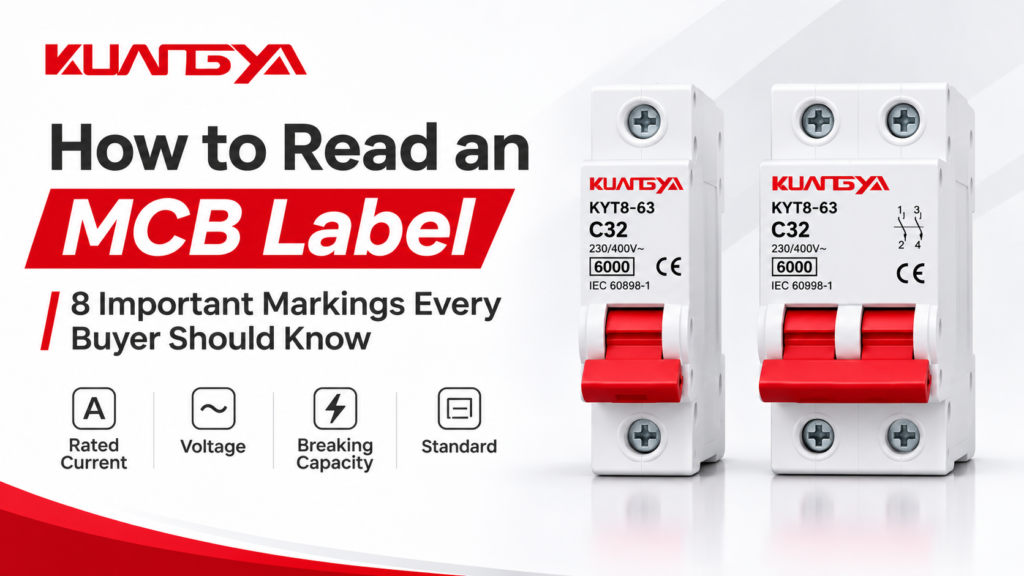
An Маркировка автоматического выключателя содержит важную информацию о номинальных электрических параметрах миниатюрного автоматического выключателя, характеристиках защиты и применимых стандартах. Умение читать маркировку помогает дистрибьюторам электрооборудования, производителям щитов, подрядчикам и специалистам по закупкам выбирать подходящий автоматический выключатель для конкретных задач.
Каждая маркировка — от номинального тока и напряжения до время-токовой характеристики и отключающей способности — содержит важную техническую информацию, которую покупателям следует проверить перед оформлением заказа.
В этом руководстве мы рассмотрим восемь важных обозначений на маркировке автоматического выключателя и расскажем, на что обращать внимание при его выборе.
Название или товарный знак производителя обычно указывается в верхней части автоматического выключателя.
Эта маркировка указывает бренд изделия и помогает покупателям отличать продукцию разных производителей и товарных линеек.
Для дистрибьюторов и покупателей OEM-продукции идентификация бренда особенно важна при закупке изделий для перепродажи или проектов под собственной торговой маркой.
При оценке производителя автоматических выключателей покупателям также следует проверить:
Например, Продукты KUANGYA AC MCB предназначены для распределительных приложений в жилых, коммерческих и легких промышленных условиях, с различными номинальными токами, кривыми срабатывания и вариантами отключающей способности в зависимости от модели.
Номер модели идентифицирует конкретный продукт MCB или серию продуктов.
Разные модели могут иметь разные размеры, электрические характеристики, отключающие способности и характеристики установки.
Номер модели может помочь покупателям определить:
Однако системы нумерации моделей различаются у разных производителей. Не существует универсального правила, которому должны следовать все производители при выборе формата обозначений.
При запросе коммерческого предложения покупателям по возможности следует указывать полный номер модели.
Это поможет поставщику определить нужное изделие и избежать путаницы между похожими моделями.
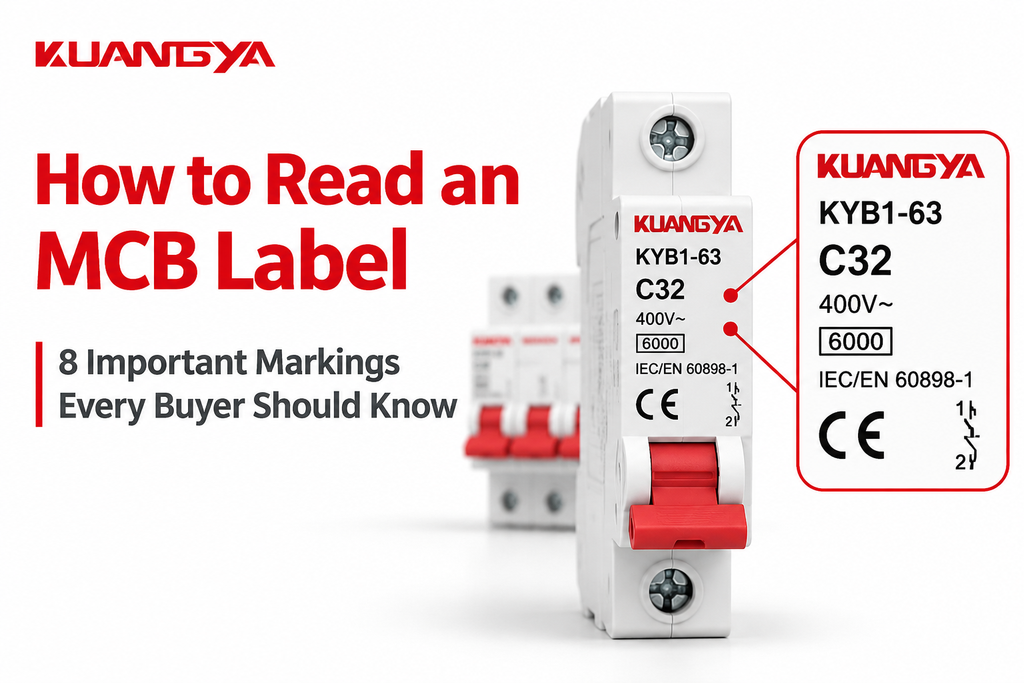
Номинальный ток — один из важнейших электрических параметров, указанных на маркировке модульного автоматического выключателя.
Обычно он указывается в амперах (А).
Типичные значения номинального тока автоматических выключателей:
Например, маркировка C32 означает, что номинальный ток автоматического выключателя составляет 32 А, а его времятоковая характеристика соответствует типу C.
Номинальный ток указывает значение тока при заданных эталонных условиях. Это не означает, что автоматический выключатель немедленно сработает при любом, даже незначительном, превышении тока 32 А.
Фактическое срабатывание зависит от времятоковой характеристики выключателя и условий эксплуатации.
При выборе номинального тока инженеры должны учитывать:
Выбор автоматического выключателя с неподходящим номинальным током может привести к нежелательному срабатыванию или недостаточной защите цепи.
Номинальное рабочее напряжение указывает напряжение, при котором автоматический выключатель предназначен для работы в заданных условиях.
Обычно оно указывается в вольтах (В).
Например:
| Маркировка | Значение |
|---|---|
| 230 В ПЕРЕМЕННОГО ТОКА | Номинальное напряжение для указанного применения переменного тока |
| 400 В ПЕРЕМЕННОГО ТОКА | Номинальное напряжение для указанного применения переменного тока |
| 230/400 В переменного тока | Voltage ratings for different system configurations |
The actual voltage suitability depends on the manufacturer’s declared ratings, pole configuration, and wiring arrangement.
For example, in a typical three-phase 230/400V system:
Buyers should always check the voltage rating for the intended circuit rather than relying only on the appearance or pole count of the breaker.
Важно: AC and DC circuit breakers are not automatically interchangeable. DC applications require a breaker specifically rated and tested for the relevant DC voltage and current.
For photovoltaic and other DC distribution systems, refer to KUANGYA DC MCB products and check the approved voltage and pole configuration for the specific model.
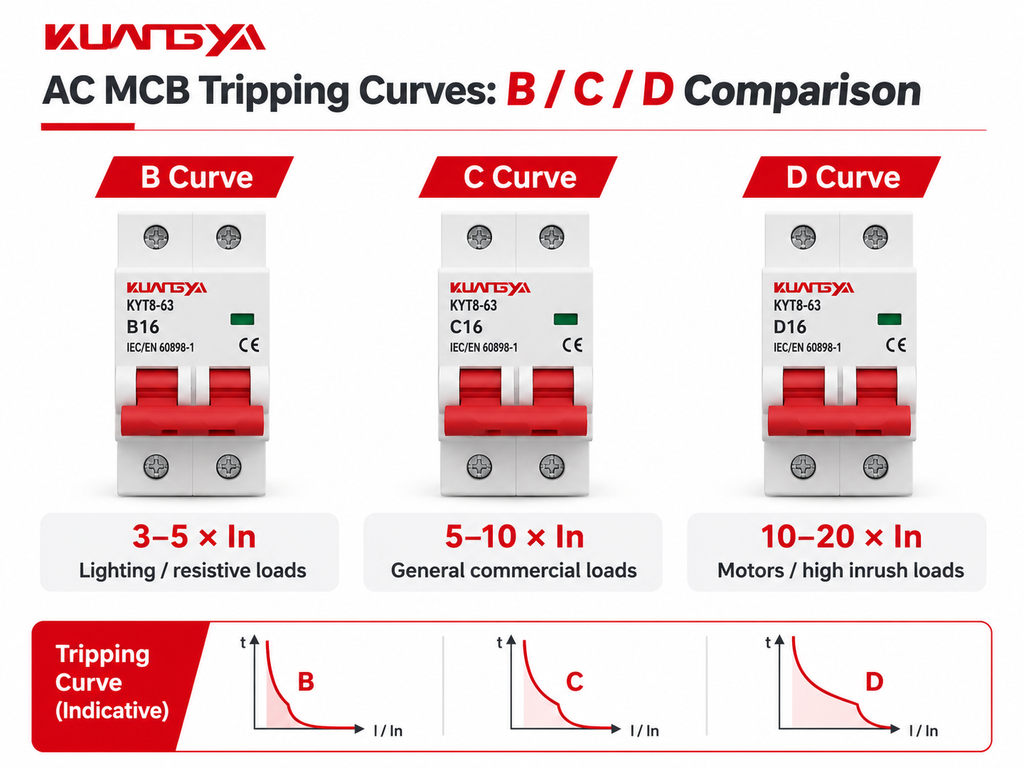
The letters B, C, and D indicate the MCB’s instantaneous magnetic tripping characteristics.
They describe how the breaker responds to high current surges, particularly during short-circuit conditions.
Under IEC 60898-1, the conventional instantaneous tripping ranges are:
| Curve | Magnetic tripping range | Типичное применение |
|---|---|---|
| B | 3–5 × In | Resistive loads and general lighting |
| C | 5–10 × In | General commercial and industrial loads |
| D | 10–20 × In | Loads with high starting currents |
For example, a C32 MCB has a rated current of 32A and a Type C tripping characteristic.
Its conventional instantaneous magnetic operating range is approximately 160–320A.
The appropriate curve depends on the load characteristics, starting current, and fault-loop conditions.
A higher tripping curve is not automatically better. The selected curve must provide suitable protection while avoiding unnecessary trips during normal equipment startup.
For a more detailed comparison, read our related guide:
B, C and D MCB Tripping Curves: Understanding the Differences
[Insert the link to your existing B/C/D MCB article here.]
Breaking capacity indicates the circuit breaker’s ability to interrupt a short-circuit current under specified test conditions.
It is commonly expressed in kiloamperes (kA).
Typical markings include:
Например:
A marking of 6000 indicates a declared short-circuit capacity of 6,000A under the applicable product standard and rated conditions.
Under IEC 60898-1, the relevant rated short-circuit capacity is designated Icn.
A higher breaking capacity allows the breaker to interrupt a higher prospective short-circuit current, provided the rating applies at the required voltage and operating conditions.
When selecting an MCB, buyers and engineers should check:
The breaking capacity must be suitable for the installation’s fault conditions.
Do not assume that a 10kA MCB is always necessary or that a 6kA MCB is suitable for every installation.
The standard number printed on an MCB provides information about the technical requirements and test framework used for the product.
Two important standards for low-voltage circuit breakers are:
IEC 60898-1
This standard covers AC circuit breakers for overcurrent protection in household and similar installations.
It applies to specified AC circuit breakers with rated voltages not exceeding 440V between phases and rated currents not exceeding 125A.
Official reference:
IEC 60898-1:2015 + Amendment 1:2019 — IEC Webstore
IEC 60947-2
This standard covers low-voltage circuit breakers intended for applications involving instructed or skilled persons.
The 2024 edition applies to circuit breakers for circuits with rated voltages up to 1,000V AC or 1,500V DC, within its scope.
Official reference:
IEC 60947-2:2024 — IEC Webstore
These standards have different scopes. Buyers should check which standard applies to the specific product and intended application.
A standard number printed on the product should not, by itself, be treated as proof of independent certification or conformity.
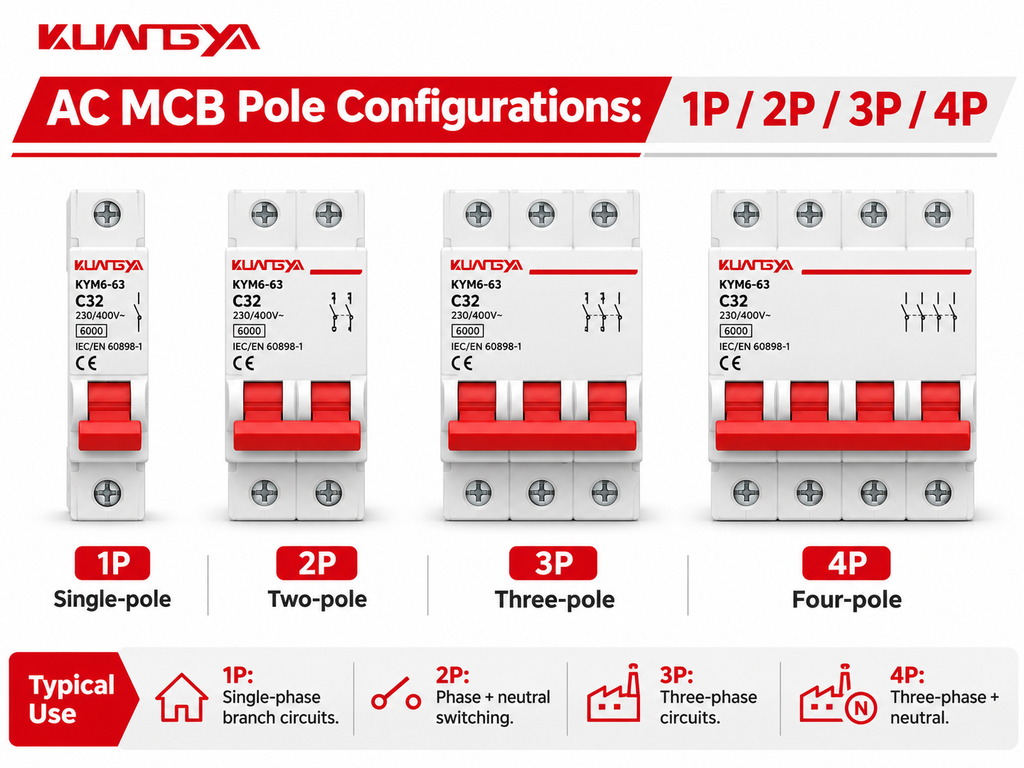
The number of poles determines the circuit configuration that the MCB is designed to protect and switch.
Common configurations include:
| Конфигурация | Typical description |
|---|---|
| 1P | Single-pole circuit breaker |
| 2P | Two-pole circuit breaker |
| 3P | Three-pole circuit breaker |
| 4P | Four-pole circuit breaker |
Different pole configurations are used in different electrical distribution systems.
Например:
Buyers should also check the terminal markings and wiring diagram, where provided.
These markings help identify the correct connection points and installation arrangement.
The number of poles alone does not determine the breaker’s complete protection capability. The rated voltage, switching arrangement, and manufacturer’s wiring instructions must also be considered.
Let’s put the markings together.
Imagine an MCB with the following information printed on its front:
| Маркировка | Пояснение |
|---|---|
| C32 | Type C tripping curve, 32A rated current |
| 230/400 В переменного тока | Declared operational voltage |
| 6000 | 6kA rated short-circuit capacity, subject to applicable standard |
| IEC 60898-1 | Applicable product standard |
| 2P | Two-pole configuration |
| 50/60 Гц | Rated operating frequency, if marked |
| Brand logo | Manufacturer or product brand |
| Model number | Product identification |
By understanding these markings, buyers can quickly identify the basic electrical characteristics of an MCB.
However, the front label is only the starting point. Full technical verification should also include the product datasheet, dimensions, terminal capacity, temperature conditions, and applicable test documentation.
Before placing an MCB order, procurement teams should confirm the following information with the manufacturer or supplier.
| Артикул | Information to confirm |
|---|---|
| Product type | AC MCB or DC MCB |
| Номинальный ток | 6A, 10A, 16A, 32A, etc. |
| Tripping curve | B, C or D |
| Номинальное напряжение | Required AC or DC voltage |
| Разрывная способность | 4.5kA, 6kA, 10kA, etc. |
| Количество столбов | 1P, 2P, 3P or 4P |
| Applicable standard | IEC 60898-1 or IEC 60947-2, as applicable |
| Product dimensions | Required panel and DIN rail compatibility |
| Документация | Datasheet, test reports and relevant conformity documents |
| Branding | Standard brand or OEM/private label |
For bulk orders, confirming the label artwork and product specifications before mass production is also important.
This helps reduce marking errors, packaging inconsistencies, and unnecessary communication during order processing.
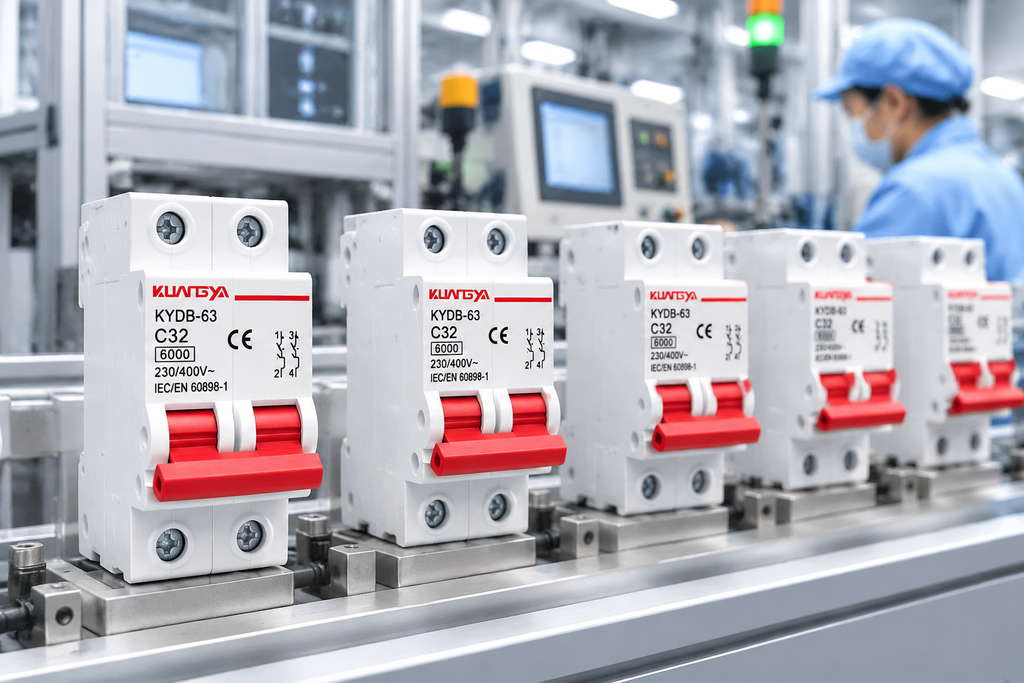
Understanding MCB markings helps buyers compare products, but the manufacturer’s production capability and quality control are equally important.
For distributors, wholesalers, and panel builders, a reliable supplier should be able to provide:
KUANGYA manufactures low-voltage circuit protection products, including AC MCBs and DC MCBs, for international distributors, contractors, and OEM customers.
Our AC MCB range includes different rated currents, tripping curves, pole configurations, and breaking capacity options depending on the model.
Explore our products:
For product specifications, OEM requirements, or bulk purchasing inquiries, contact our team to discuss your application.
C32 means the MCB has a rated current of 32A and a Type C tripping characteristic. Under IEC 60898-1, the conventional instantaneous magnetic tripping range for Type C is 5–10 times the rated current.
6000 generally indicates a rated short-circuit capacity of 6,000A (6kA). The exact designation and conditions depend on the applicable product standard and rated voltage.
The main difference is their rated short-circuit breaking capacity. A 10kA MCB has a higher declared capacity than a 6kA MCB under the applicable specified conditions.
It indicates the declared voltage ratings for the relevant electrical system configurations. The exact suitability must be checked against the manufacturer’s voltage and pole configuration specifications.
Not automatically. AC and DC circuits have different arc-extinguishing requirements. Always select a circuit breaker specifically rated for the intended DC voltage and current.
IEC 60898-1 covers AC circuit breakers for household and similar installations, while IEC 60947-2 covers low-voltage circuit breakers within its industrial and professional application scope. Their requirements and rating designations should not be assumed to be interchangeable.
No. The rated current must match the load, cable capacity, and installation conditions. Selecting an unnecessarily high current rating may compromise proper circuit protection.
Provide the required AC or DC type, rated current, rated voltage, tripping curve, breaking capacity, pole configuration, applicable standard, and estimated order quantity. If OEM branding is required, include your label and packaging requirements.
Reading an MCB label correctly is an essential step in selecting the right circuit breaker.
From rated current and voltage to tripping curves, breaking capacity, and applicable standards, each marking provides important information about the product’s intended operation.
For distributors, contractors, and procurement teams, understanding these specifications makes it easier to compare products, communicate technical requirements, and purchase the correct MCB for each application.
If you are looking for an MCB manufacturer offering different specifications and OEM options, contact KUANGYA to discuss your requirements.

