Промышленная зона Вэньян Юэцин Вэньчжоу 325000
Рабочие часы
Понедельник - пятница: 7AM - 7PM
Выходные: 10AM - 5PM
Промышленная зона Вэньян Юэцин Вэньчжоу 325000
Рабочие часы
Понедельник - пятница: 7AM - 7PM
Выходные: 10AM - 5PM

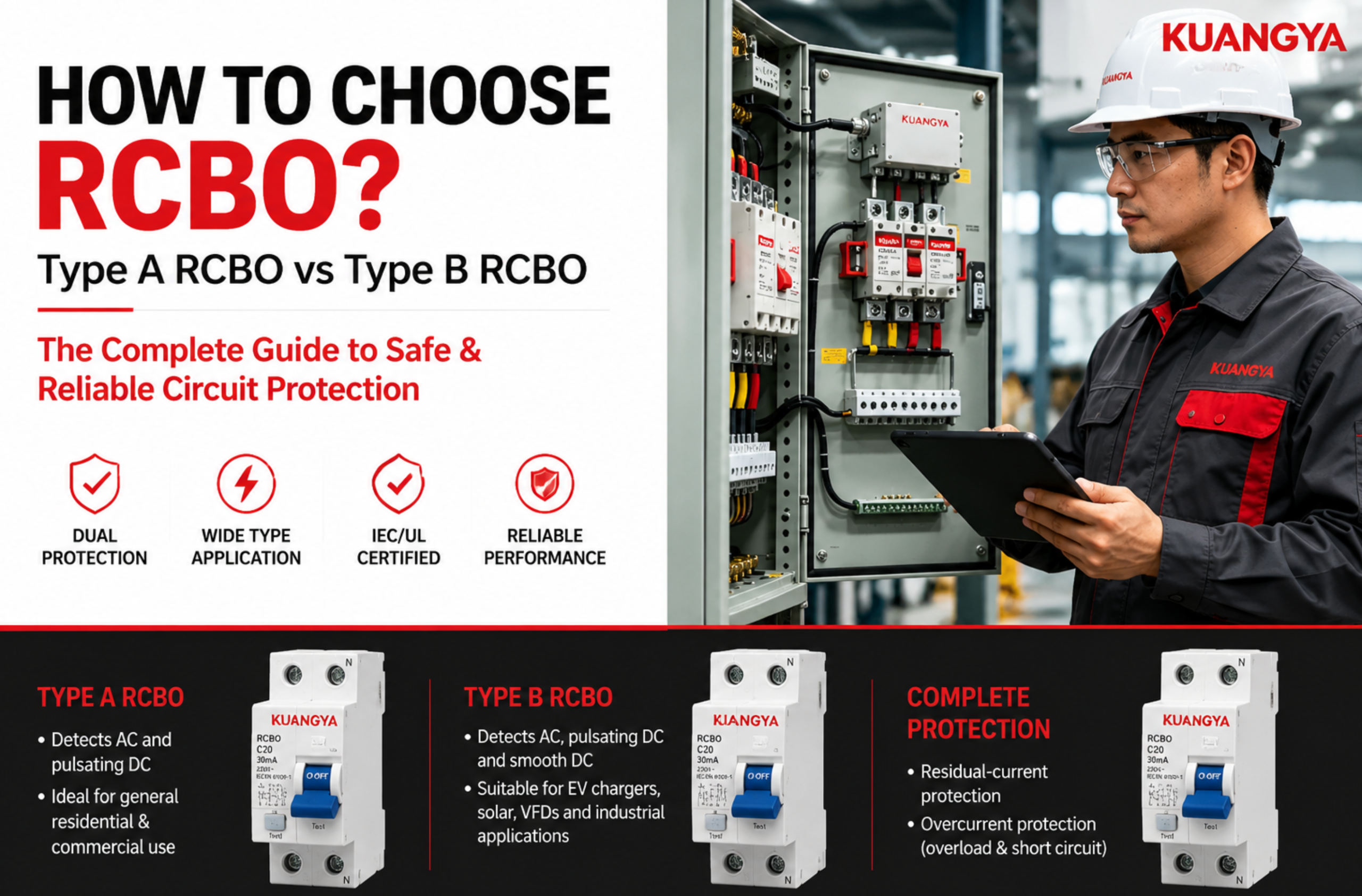
Type A vs Type B RCBO—quick answer: Type A RCBOs detect sinusoidal AC and pulsating DC residual currents. Type B RCBOs additionally cover smooth DC and mixed-frequency residual currents within the device’s specified range. Type B is not a universal upgrade: select the RCBO type according to the connected equipment, DC monitoring arrangement, manufacturer instructions, circuit design and local requirements.
This guide compares RCBO types, explains Type A or Type B selection, and covers poles, current rating, sensitivity, breaking capacity and application-specific checks for EV chargers, PV inverters and motor drives.
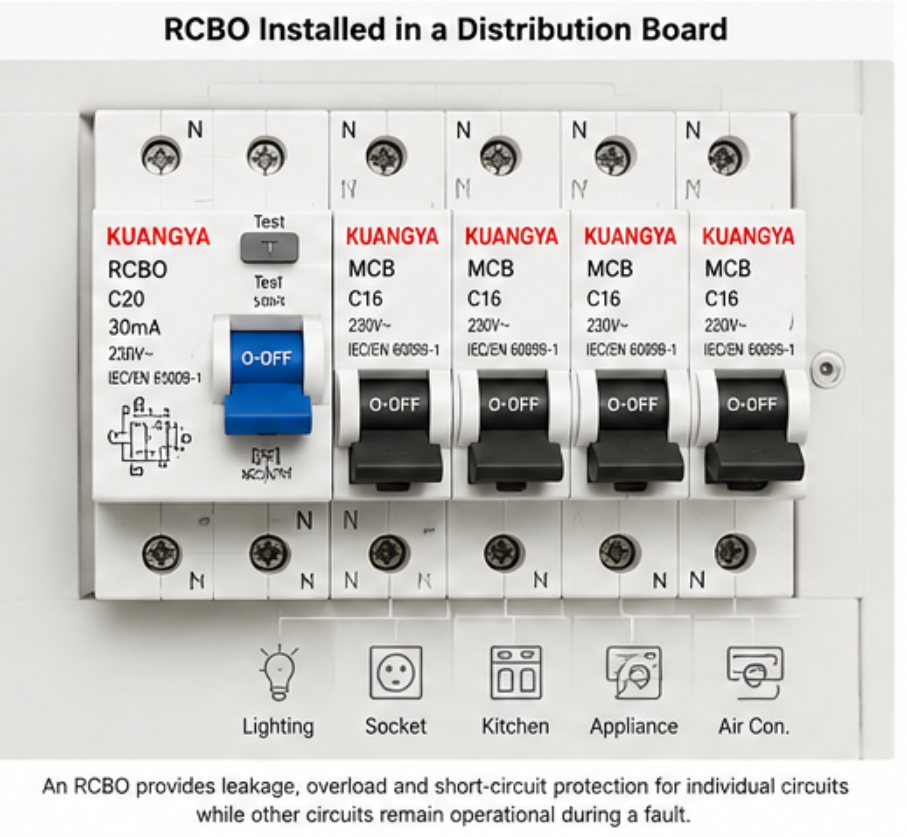
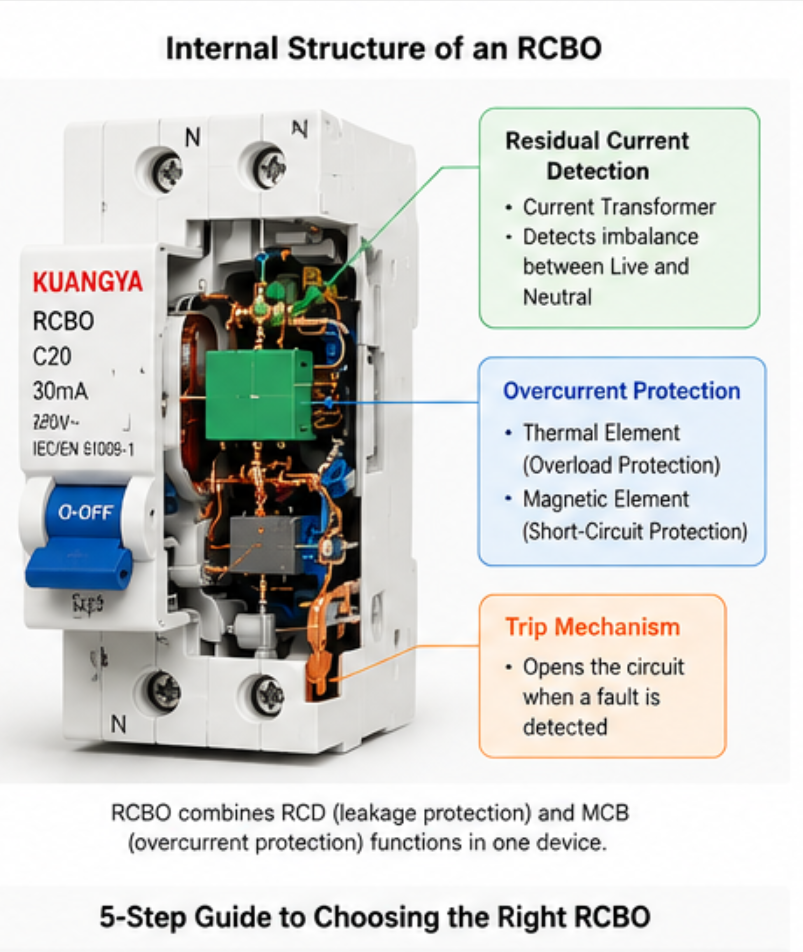
RCBO обеспечивает как защиту от остаточного тока, так и защиту от сверхтоков в одном устройстве. Однако неправильный выбор типа RCBO может снизить эффективность защиты и привести к нежелательным срабатываниям или невозможности обнаружения определенных условий повреждения.
Именно поэтому понимание разницы между RCBO типа A и RCBO типа B очень важно при проектировании или модернизации электрических систем.
Многие инсталляторы уделяют особое внимание:
Несмотря на важность этих характеристик, тип остаточного тока имеет не меньшее значение.
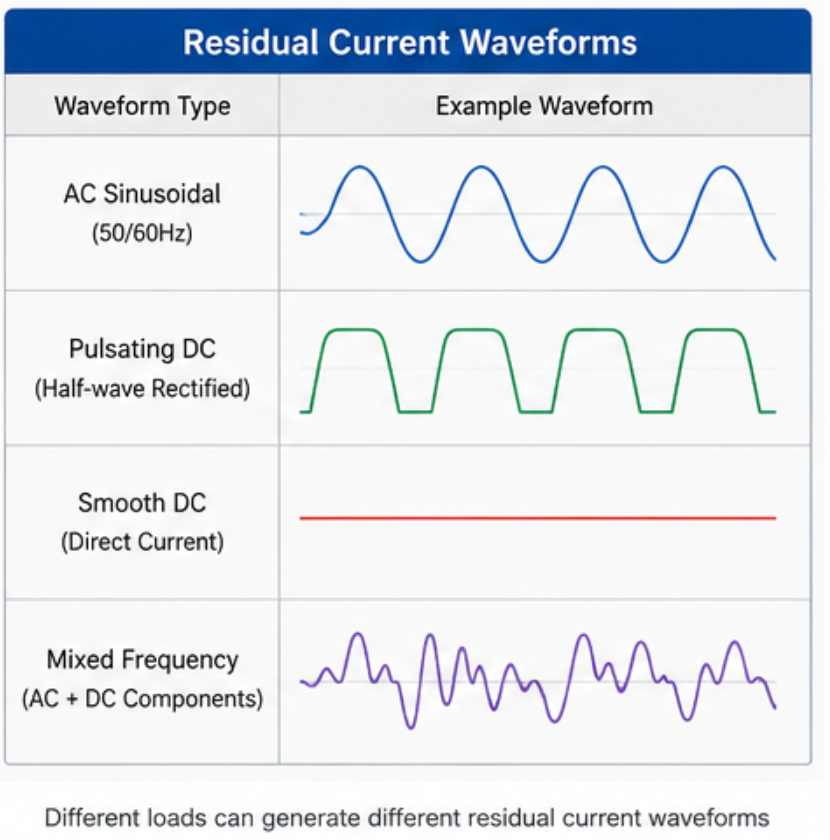
Различные электрические нагрузки могут создавать различные формы тока утечки. Не каждый RCBO предназначен для обнаружения всех из них.
Если выбран неправильный тип RCBO, опасные токи замыкания на землю могут быть обнаружены неправильно.
RCBO типа A предназначен для обнаружения:
Благодаря этому устройства типа A подходят для большинства современных жилых и коммерческих объектов, где присутствует электронное оборудование.
RCBO типа A обычно используются для:
Поскольку многие современные приборы содержат электронные компоненты и выпрямители, RCBO типа A становятся все более предпочтительными по сравнению со старыми устройствами типа AC.
| Тип остаточного тока | Обнаружено с помощью RCBO типа A |
|---|---|
| Синусоидальный переменный ток | Да |
| Пульсирующий постоянный ток | Да |
| Плавный постоянный ток | Нет |
| Высокочастотные компоненты постоянного тока | Ограниченный |
Type A is commonly used for many residential and commercial electronic loads, but suitability still depends on the connected equipment and applicable requirements.
РЦБО типа B предназначен для обнаружения:
Устройства типа B обеспечивают наиболее широкие возможности обнаружения остаточного тока среди распространенных типов RCBO.
Это позволяет использовать их в установках, где могут возникать постоянные токи короткого замыкания.
RCBO типа B обычно используются в:
В этих приложениях могут генерироваться плавные постоянные остаточные токи, которые могут ослепить или насытить обычные устройства типа A.
| Тип остаточного тока | Обнаружено с помощью RCBO типа B |
|---|---|
| Синусоидальный переменный ток | Да |
| Пульсирующий постоянный ток | Да |
| Плавный постоянный ток | Да |
| Смешанная частота | Да |
| Высокочастотные компоненты | Да |
Благодаря более широкому диапазону обнаружения, RCBO типа B часто используется в современных электрических системах.
Это самое важное сравнение при выборе RCBO.
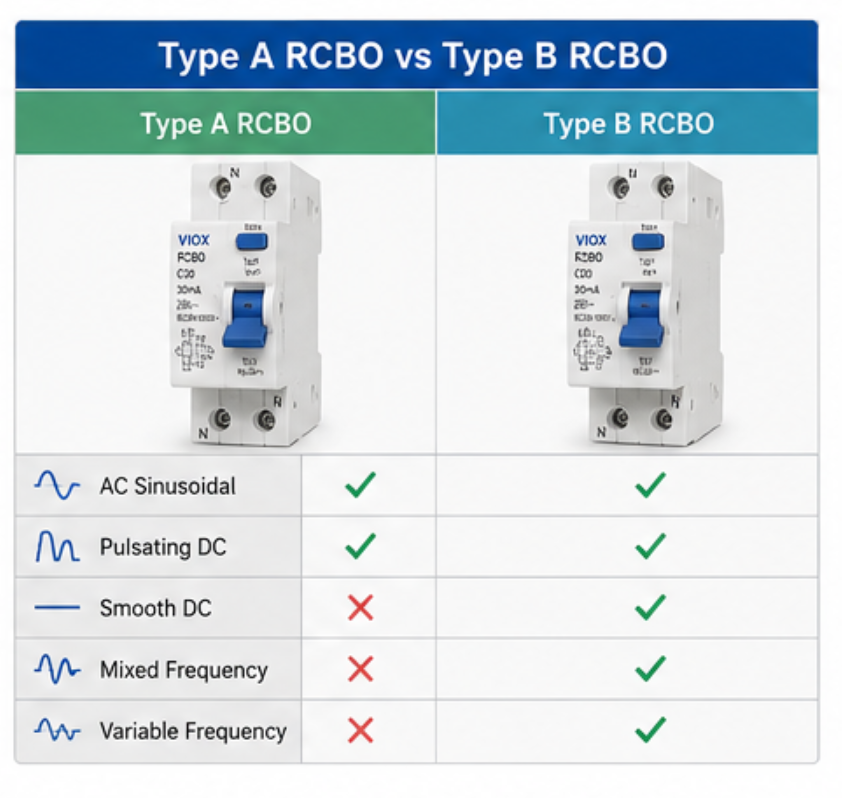
| Характеристика | Тип A RCBO | Тип B RCBO |
|---|---|---|
| Обнаружение остаточного тока переменного тока | Да | Да |
| Обнаружение пульсирующего постоянного тока | Да | Да |
| Плавное обнаружение постоянного тока | Нет | Да |
| Mixed-Frequency Residual Currents | Verify waveform and device specification | Covered only within the device’s specified frequency range |
| Применение зарядных устройств для электромобилей | Possible with verified DC protection where permitted | Use when required by the charger manual or applicable rules |
| Солнечные фотоэлектрические системы | Verify inverter manual and DC monitoring | Use when required by the inverter manual or applicable rules |
| Промышленные приводы | Ограниченный | Verify equipment manual and applicable rules |
| Стоимость | Нижний | Выше |
The key difference is residual-current waveform coverage. Type A detects sinusoidal AC and pulsating DC residual currents, while Type B additionally detects smooth DC and mixed-frequency components within the manufacturer’s specified range.
Do not treat Type B as automatically better. For EV chargers, PV inverters and variable-speed drives, follow the equipment manual and applicable rules to determine whether Type A with verified DC detection, Type F or Type B is required.
Use the tool below to organize a preliminary RCBO specification. It highlights missing parameters and unsafe combinations, but it does not replace engineering verification or local requirements.
How to use this RCBO selector: choose the known circuit and equipment conditions. The result organizes a preliminary specification and highlights information that still requires verification.
Preliminary selection only. This tool does not approve a circuit or replace the equipment manual, product datasheet, coordination study, qualified designer, or local rules.
Выбор правильного RCBO начинается с понимания подключенной нагрузки.
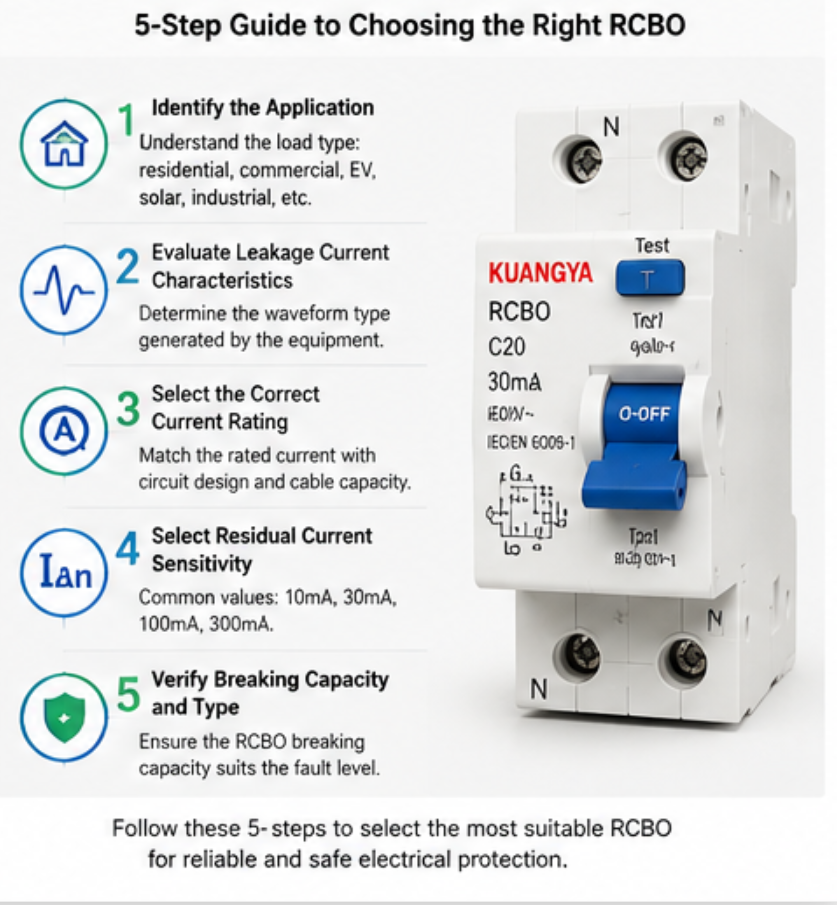
Спрашивайте:
Ответы помогут выбрать тип RCBO.
Различное оборудование создает различные формы остаточных токов.
| Тип оборудования | Рекомендуемый тип RCBO |
|---|---|
| Схемы освещения | Тип A |
| Розетки | Тип A |
| Бытовая техника | Тип A |
| Офисное оборудование | Тип A |
| Зарядные устройства для электромобилей | Follow the EVSE manual: Type A with verified DC monitoring or Type B, as required |
| Солнечные инверторы | Follow the inverter manual and applicable rules |
| Моторные приводы VFD | Verify leakage waveform, frequency behavior and drive manual |
| Системы хранения аккумуляторных батарей | Follow the converter/BESS manual and applicable rules |
Номинальный ток должен совпадать:
Общие рейтинги включают:
Обычные рейтинги чувствительности включают:
| Чувствительность | Типовое применение |
|---|---|
| 10 мА | Усиленная индивидуальная защита |
| 30 мА | Стандартная защита персонала |
| 100 мА | Защита оборудования |
| 300 мА | Применение в противопожарной защите |
30 мА остается наиболее распространенным выбором для конечных схем.
RCBO должен быть способен прерывать имеющийся ток повреждения.
Типичные показатели включают:
Необходимое значение зависит от уровня неисправности в точке установки.
Многие ошибки в спецификациях и закупках происходят из-за неправильного понимания типов RCBO.
К распространенным ошибкам относятся:
Тип RCBO всегда следует выбирать в зависимости от фактической нагрузки, а не только от цены.
| Параметр | What to confirm | Почему это важно |
|---|---|---|
| Система | Single/three phase, voltage, frequency and neutral | Determines pole arrangement and operating voltage |
| Load | Electronic, motor/VFD, EVSE, PV inverter, UPS or resistive | Influences waveform type and trip curve |
| Номинальный ток | Design current, cable capacity and derating | A higher ampere rating is not automatically safer |
| RCBO type | AC, A, F or B required by the equipment manual | Determines detectable residual-current waveforms |
| Чувствительность | 10/30/100/300 mA as permitted | Must match protection objective and selectivity |
| Trip curve | B, C or D after inrush and loop checks | Controls magnetic response to overcurrent |
| Разрывная способность | Prospective short-circuit current at installation point | Catalogue values cannot replace a fault-level calculation |
| Рынок | Required standard edition and certificate scope | IEC reference does not prove approval in every country |
Stop condition: If breaking capacity, leakage characteristics, pole arrangement or local requirements are unknown, do not finalize the RCBO selection.
| Результат | When to use it | Next action |
|---|---|---|
| Preliminary match | Every parameter is known and no obvious conflict exists | Compare exact datasheets and certificates; obtain engineering approval |
| Требуется проверка | Breaking capacity, waveform, curve, poles or certification is unknown | Collect the missing data before ordering |
| Пока не выбирать | Phase/poles conflict, EV/PV uses unverified Type AC, or the equipment manual contradicts the choice | Stop and review the circuit and equipment requirements |
System phase and voltage:
Load or equipment:
Rated current:
Poles and neutral requirement:
Residual-current type (AC/A/F/B):
Sensitivity (mA):
Trip curve (B/C/D):
Required breaking capacity (kA):
Frequency:
Target market and certification:
Quantity and purchase stage:
OEM/ODM requirement:
Required delivery date:
Also compare RCCB product families and read the RCCB vs RCBO guide. Final selection must use the exact product documentation and applicable local rules.
Выбор правильного RCBO включает в себя не только выбор правильного номинального тока. Тип остаточного тока является критическим фактором, который непосредственно влияет на эффективность защиты.
Для большинства жилых и коммерческих цепей RCBO типа A обеспечивает эффективную защиту от переменного и пульсирующего постоянного остаточного тока.
For EV chargers, solar installations, battery storage systems and inverter-driven equipment, follow the exact equipment manual. Some designs allow Type A with verified DC monitoring; others require Type F or Type B.
Понимание разницы между RCBO типа A и RCBO типа B помогает обеспечить соответствие требованиям, повысить безопасность и обеспечить надежную защиту современных электрических систем.
RCBO (выключатель остаточного тока с перегрузкой по току)| Безопасный и надежный Kuangya
IEC 61009-1:2024 gives general requirements and tests for RCBOs for household and similar uses within its stated scope. Always verify the applicable national adoption, installation rules, equipment manual and certificate scope of the exact product model.
Type A is common for many residential and commercial electronic circuits. EV, PV, storage and variable-frequency applications require verification against the equipment manual and local rules; do not assume one residual-current type fits every design.
RCBO типа A может обнаружить пульсирующие остаточные токи постоянного тока, но не может надежно обнаружить плавные остаточные токи постоянного тока.
RCBO типа B содержит более совершенную технологию считывания, способную обнаруживать более широкий диапазон форм сигнала остаточного тока, включая плавные замыкания постоянного тока.
Многие зарядные устройства EV требуют либо защиты типа B, либо эквивалентных мер обнаружения неисправностей постоянного тока, в зависимости от местных стандартов и конструкции зарядного устройства.
Do not treat Type B as a universal upgrade. The selected type must match the residual-current waveform, equipment instructions, coordination requirements and certification scope of the exact device.

