WengYang Industrial Zone Yueqing Wenzhou 325000
Work Hours
Monday to Friday: 7AM - 7PM
Weekend: 10AM - 5PM
WengYang Industrial Zone Yueqing Wenzhou 325000
Work Hours
Monday to Friday: 7AM - 7PM
Weekend: 10AM - 5PM

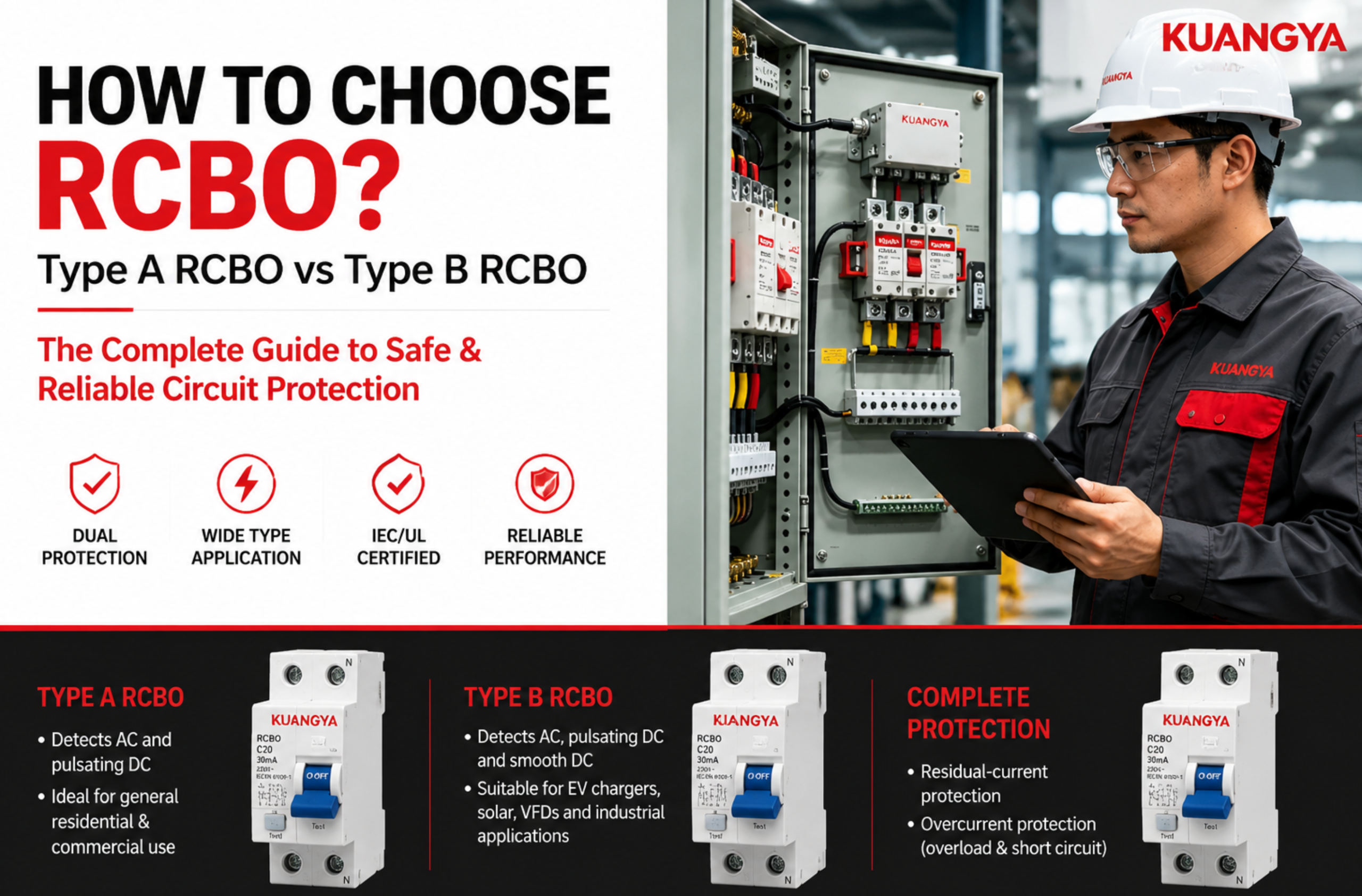
Type A vs Type B RCBO—quick answer: Type A RCBOs detect sinusoidal AC and pulsating DC residual currents. Type B RCBOs additionally cover smooth DC and mixed-frequency residual currents within the device’s specified range. Type B is not a universal upgrade: select the RCBO type according to the connected equipment, DC monitoring arrangement, manufacturer instructions, circuit design and local requirements.
This guide compares RCBO types, explains Type A or Type B selection, and covers poles, current rating, sensitivity, breaking capacity and application-specific checks for EV chargers, PV inverters and motor drives.
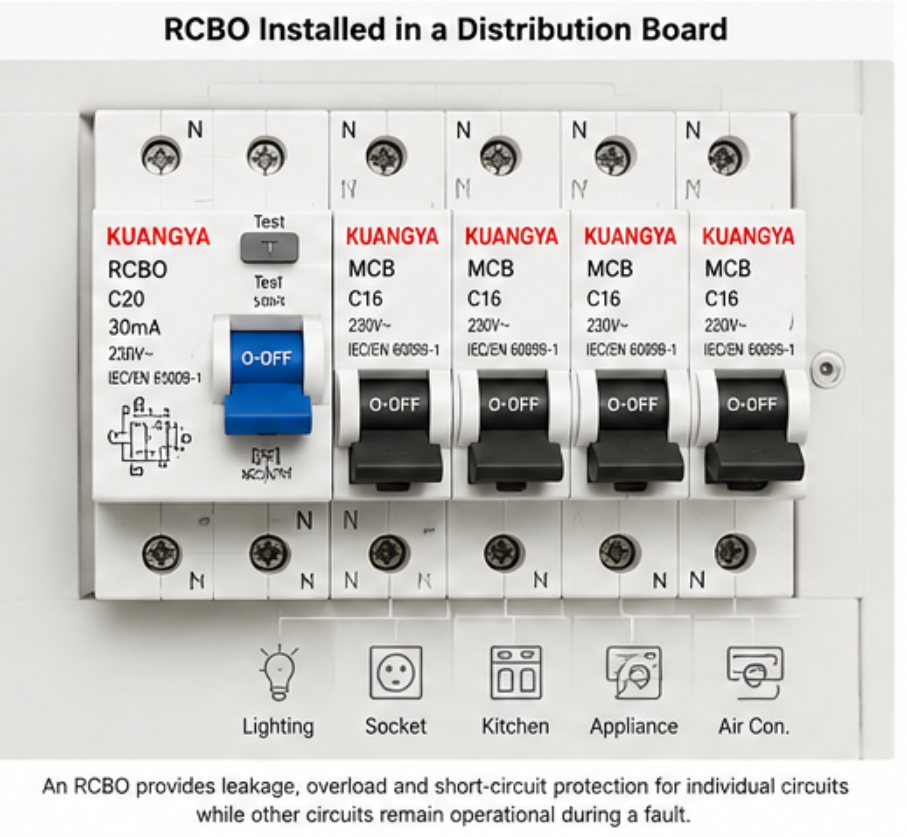
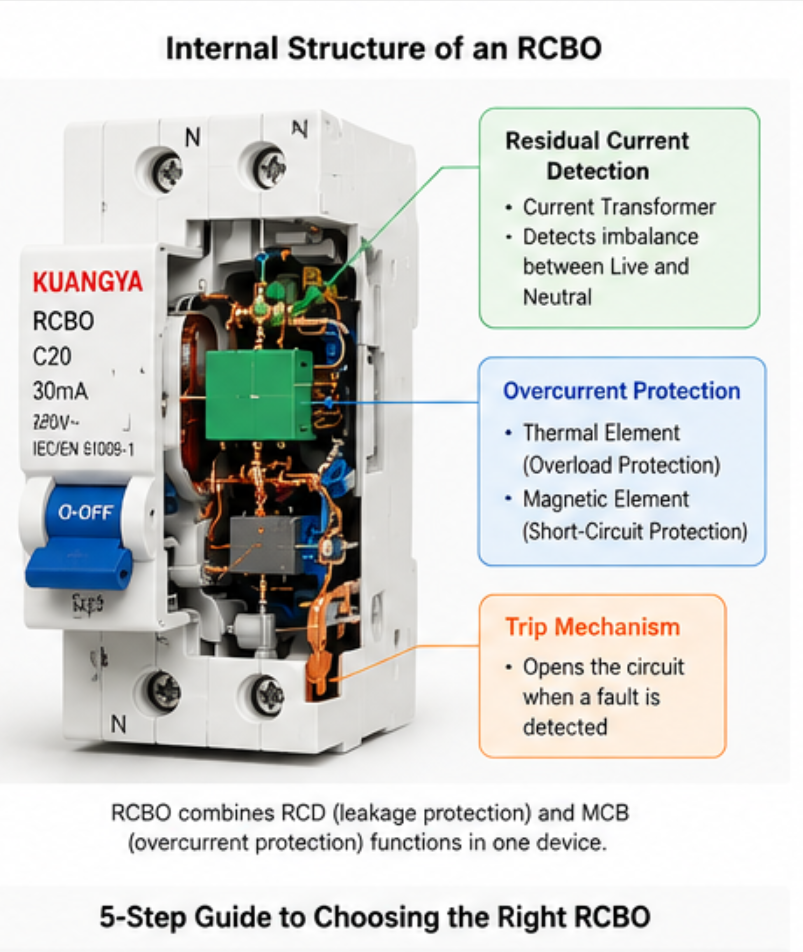
An RCBO provides both residual-current protection and overcurrent protection in a single device. However, choosing the wrong RCBO type may reduce protection effectiveness and lead to nuisance tripping or failure to detect certain fault conditions.
That is why understanding the difference between Type A RCBO and Type B RCBO is essential when designing or upgrading electrical systems.
Many installers focus on:
While these specifications are important, the residual-current type is equally critical.
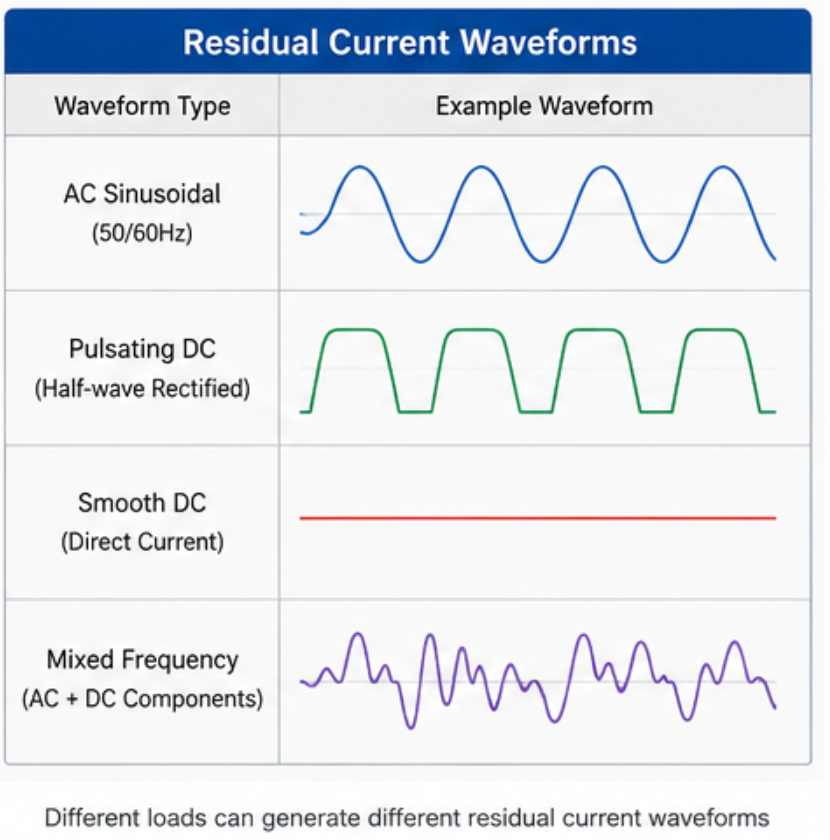
Different electrical loads can produce different leakage-current waveforms. Not every RCBO is designed to detect all of them.
If the wrong RCBO type is selected, dangerous earth-fault currents may not be detected correctly.
A Type A RCBO is designed to detect:
This makes Type A devices suitable for most modern residential and commercial installations where electronic equipment is present.
Type A RCBOs are commonly used for:
Because many modern appliances contain electronic components and rectifiers, Type A RCBOs are increasingly preferred over older Type AC devices.
| Residual Current Type | Detected by Type A RCBO |
|---|---|
| AC Sinusoidal | Yes |
| Pulsating DC | Yes |
| Smooth DC | No |
| High-Frequency DC Components | Limited |
Type A is commonly used for many residential and commercial electronic loads, but suitability still depends on the connected equipment and applicable requirements.
A Type B RCBO is designed to detect:
Type B devices provide the broadest residual-current detection capability among common RCBO types.
This makes them suitable for installations where DC fault currents may be generated.
Type B RCBOs are commonly used in:
These applications can generate smooth DC residual currents that may blind or saturate conventional Type A devices.
| Residual Current Type | Detected by Type B RCBO |
|---|---|
| AC Sinusoidal | Yes |
| Pulsating DC | Yes |
| Smooth DC | Yes |
| Mixed Frequency | Yes |
| High-Frequency Components | Yes |
Because of its broader detection range, Type B RCBO is often specified for advanced electrical systems.
This is the most important comparison when selecting an RCBO.
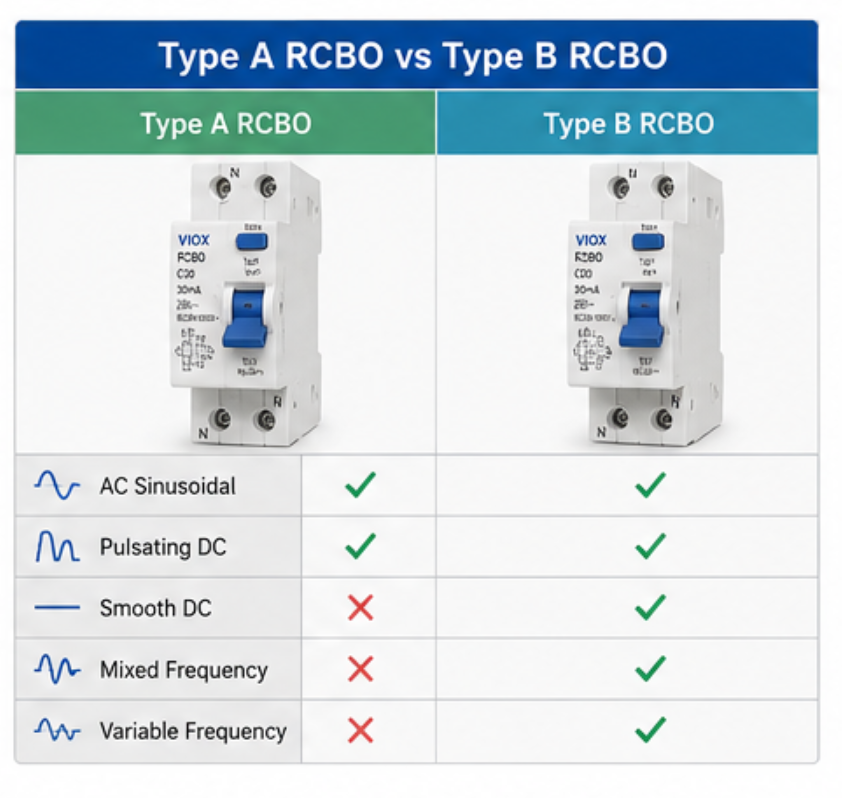
| Feature | Type A RCBO | Type B RCBO |
|---|---|---|
| AC Residual Current Detection | Yes | Yes |
| Pulsating DC Detection | Yes | Yes |
| Smooth DC Detection | No | Yes |
| Mixed-Frequency Residual Currents | Verify waveform and device specification | Covered only within the device’s specified frequency range |
| EV Charger Applications | Possible with verified DC protection where permitted | Use when required by the charger manual or applicable rules |
| Solar PV Systems | Verify inverter manual and DC monitoring | Use when required by the inverter manual or applicable rules |
| Industrial Drives | Limited | Verify equipment manual and applicable rules |
| Cost | Lower | Higher |
The key difference is residual-current waveform coverage. Type A detects sinusoidal AC and pulsating DC residual currents, while Type B additionally detects smooth DC and mixed-frequency components within the manufacturer’s specified range.
Do not treat Type B as automatically better. For EV chargers, PV inverters and variable-speed drives, follow the equipment manual and applicable rules to determine whether Type A with verified DC detection, Type F or Type B is required.
Use the tool below to organize a preliminary RCBO specification. It highlights missing parameters and unsafe combinations, but it does not replace engineering verification or local requirements.
How to use this RCBO selector: choose the known circuit and equipment conditions. The result organizes a preliminary specification and highlights information that still requires verification.
Preliminary selection only. This tool does not approve a circuit or replace the equipment manual, product datasheet, coordination study, qualified designer, or local rules.
Choosing the correct RCBO starts with understanding the connected load.
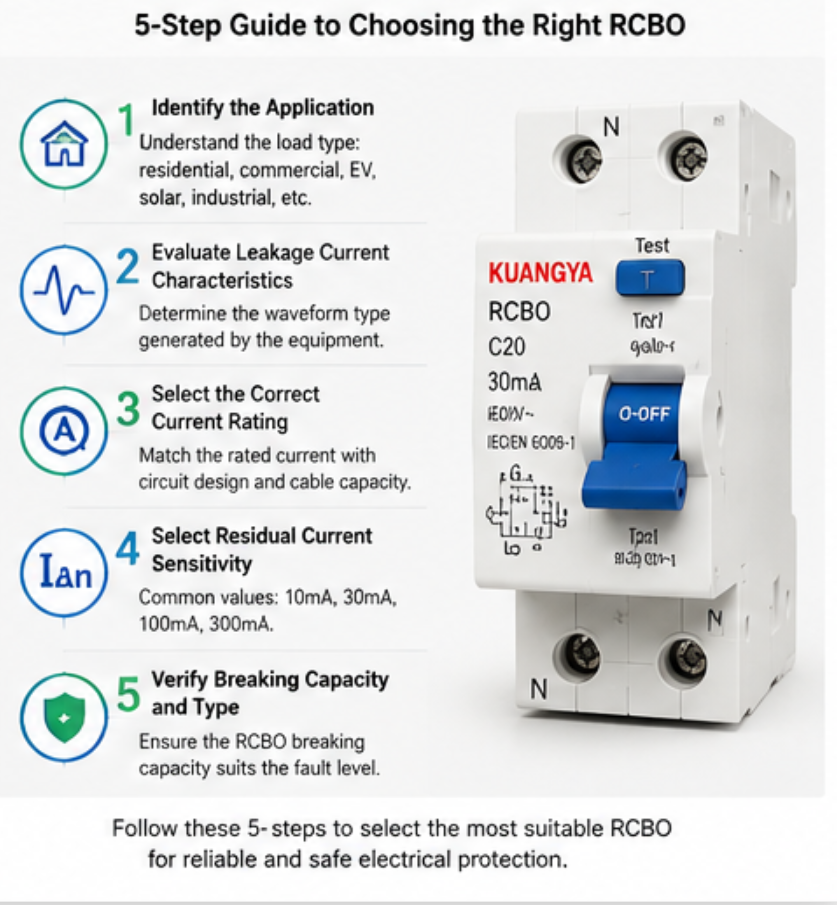
Ask:
The answers will guide RCBO type selection.
Different equipment creates different residual-current waveforms.
| Equipment Type | Recommended RCBO Type |
|---|---|
| Lighting Circuits | Type A |
| Socket Outlets | Type A |
| Household Appliances | Type A |
| Office Equipment | Type A |
| EV Chargers | Follow the EVSE manual: Type A with verified DC monitoring or Type B, as required |
| Solar Inverters | Follow the inverter manual and applicable rules |
| VFD Motor Drives | Verify leakage waveform, frequency behavior and drive manual |
| Battery Storage Systems | Follow the converter/BESS manual and applicable rules |
The rated current should match:
Common ratings include:
Common sensitivity ratings include:
| Sensitivity | Typical Application |
|---|---|
| 10mA | Enhanced personal protection |
| 30mA | Standard personnel protection |
| 100mA | Equipment protection |
| 300mA | Fire protection applications |
30mA remains the most common choice for final circuits.
The RCBO must be able to interrupt the available fault current.
Typical ratings include:
The required value depends on the fault level at the installation point.
Many specification and purchasing errors come from misunderstanding RCBO types.
Common mistakes include:
The RCBO type should always be selected according to actual load behavior rather than price alone.
| Parameter | What to confirm | Why it matters |
|---|---|---|
| System | Single/three phase, voltage, frequency and neutral | Determines pole arrangement and operating voltage |
| Load | Electronic, motor/VFD, EVSE, PV inverter, UPS or resistive | Influences waveform type and trip curve |
| Rated current | Design current, cable capacity and derating | A higher ampere rating is not automatically safer |
| RCBO type | AC, A, F or B required by the equipment manual | Determines detectable residual-current waveforms |
| Sensitivity | 10/30/100/300 mA as permitted | Must match protection objective and selectivity |
| Trip curve | B, C or D after inrush and loop checks | Controls magnetic response to overcurrent |
| Breaking capacity | Prospective short-circuit current at installation point | Catalogue values cannot replace a fault-level calculation |
| Market | Required standard edition and certificate scope | IEC reference does not prove approval in every country |
Stop condition: If breaking capacity, leakage characteristics, pole arrangement or local requirements are unknown, do not finalize the RCBO selection.
| Result | When to use it | Next action |
|---|---|---|
| Preliminary match | Every parameter is known and no obvious conflict exists | Compare exact datasheets and certificates; obtain engineering approval |
| Needs verification | Breaking capacity, waveform, curve, poles or certification is unknown | Collect the missing data before ordering |
| Do not select yet | Phase/poles conflict, EV/PV uses unverified Type AC, or the equipment manual contradicts the choice | Stop and review the circuit and equipment requirements |
System phase and voltage:
Load or equipment:
Rated current:
Poles and neutral requirement:
Residual-current type (AC/A/F/B):
Sensitivity (mA):
Trip curve (B/C/D):
Required breaking capacity (kA):
Frequency:
Target market and certification:
Quantity and purchase stage:
OEM/ODM requirement:
Required delivery date:
Also compare RCCB product families and read the RCCB vs RCBO guide. Final selection must use the exact product documentation and applicable local rules.
Choosing the correct RCBO involves more than selecting the right current rating. The residual-current type is a critical factor that directly affects protection performance.
For most residential and commercial circuits, a Type A RCBO provides effective protection against AC and pulsating DC residual currents.
For EV chargers, solar installations, battery storage systems and inverter-driven equipment, follow the exact equipment manual. Some designs allow Type A with verified DC monitoring; others require Type F or Type B.
Understanding the difference between Type A RCBO and Type B RCBO helps ensure compliance, improve safety, and provide reliable protection for modern electrical systems.
RCBO (Residual Current Breaker with Overcurrent) | Safe & Reliable Kuangya
IEC 61009-1:2024 gives general requirements and tests for RCBOs for household and similar uses within its stated scope. Always verify the applicable national adoption, installation rules, equipment manual and certificate scope of the exact product model.
Type A is common for many residential and commercial electronic circuits. EV, PV, storage and variable-frequency applications require verification against the equipment manual and local rules; do not assume one residual-current type fits every design.
Type A RCBO can detect pulsating DC residual currents but cannot reliably detect smooth DC residual currents.
Type B RCBO contains more advanced sensing technology capable of detecting a wider range of residual-current waveforms, including smooth DC faults.
Many EV charging applications either require Type B protection or equivalent DC fault detection measures, depending on local standards and charger design.
Do not treat Type B as a universal upgrade. The selected type must match the residual-current waveform, equipment instructions, coordination requirements and certification scope of the exact device.

