Промышленная зона Вэньян Юэцин Вэньчжоу 325000
Рабочие часы
Понедельник - пятница: 7AM - 7PM
Выходные: 10AM - 5PM
Промышленная зона Вэньян Юэцин Вэньчжоу 325000
Рабочие часы
Понедельник - пятница: 7AM - 7PM
Выходные: 10AM - 5PM

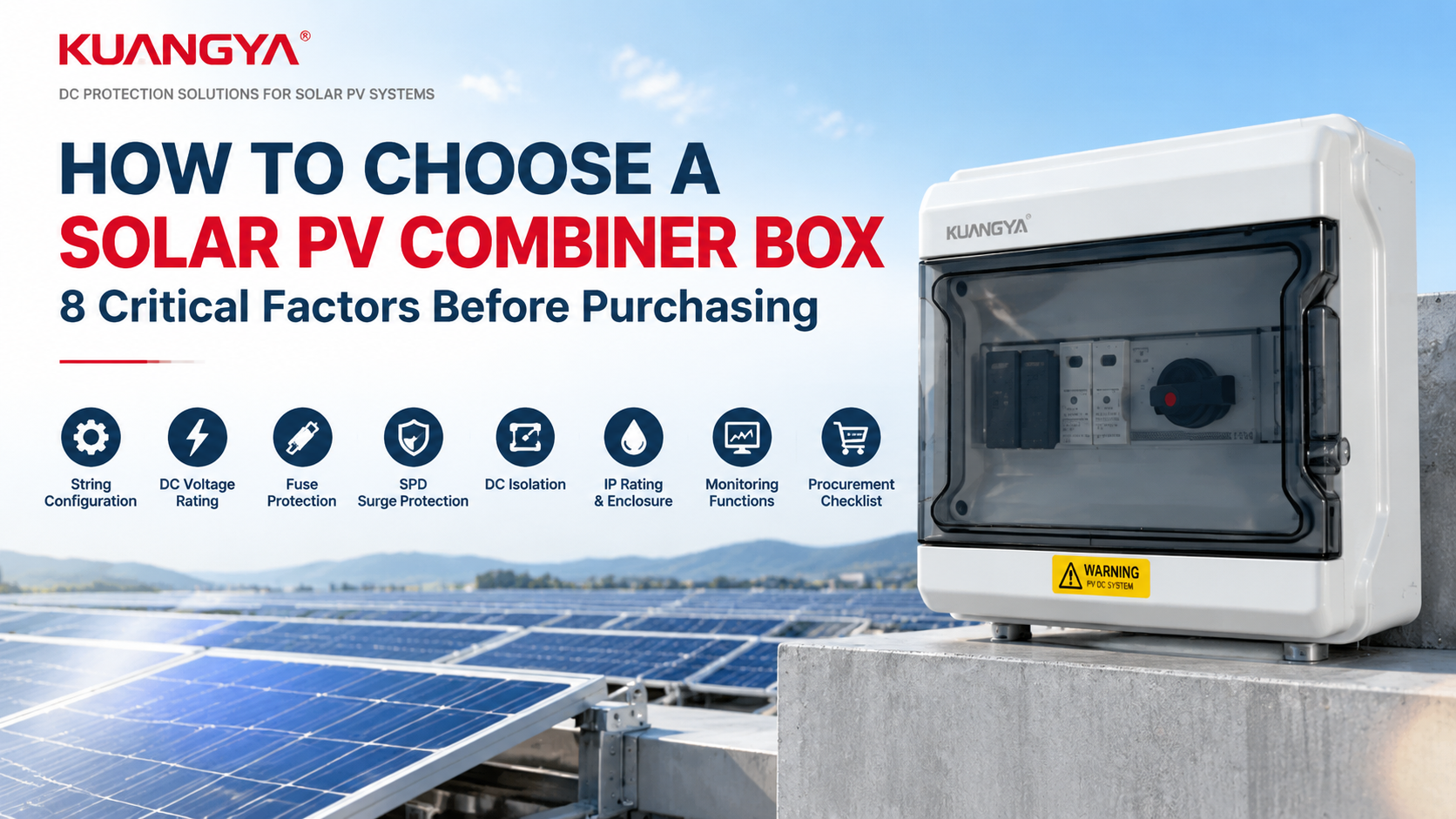
Выбор фотоэлектрической сумматорной коробки — важное решение при проектировании или закупке оборудования для фотоэлектрической системы. Правильно подобранная сумматорная коробка обеспечивает надлежащую электрическую защиту, надежные соединения стрингов, а также совместимость с инвертором и всей солнечной установкой в целом.
Для монтажников солнечных электростанций, EPC-подрядчиков, дистрибьюторов и отделов закупок выбор сумматорной коробки подразумевает нечто большее, чем просто подсчет количества фотоэлектрических стрингов или выбор между моделями на 1000 В и 1500 В постоянного тока.
Необходимо учитывать конфигурацию инвертора, максимальное напряжение постоянного тока, ток стринга, плавкие предохранители, защиту от перенапряжения, изоляцию цепей постоянного тока, требования к корпусу и функции мониторинга.
В этом руководстве объясняется, как выбрать фотоэлектрическую сумматорную коробку, рассматривая 8 критических факторов, что поможет вам оценить технические характеристики, наладить взаимодействие с производителями и подготовить более точный запрос на коммерческое предложение.
Если вы новичок в вопросах фотоэлектрических сумматорных коробок, вы также можете ознакомиться с нашим полным руководством по фотоэлектрическим сумматорным коробкам чтобы понять их структуру, компоненты и принципы работы.
Перед выбором модели определите, требуется ли вашей фотоэлектрической системе отдельный блок сумматоров.
Блок сумматоров для солнечных фотоэлектрических систем собирает несколько цепей постоянного тока от фотоэлектрических стрингов и объединяет их в одну или несколько исходящих цепей перед тем, как они поступят на инвертор или другое оборудование.
Однако не каждая солнечная установка требует внешнего блока сумматоров.
Рассмотрите следующие ситуации:
| Конфигурация фотоэлектрической системы | Нужен ли блок сумматоров? | Основные соображения |
|---|---|---|
| Одна фотоэлектрическая цепочка | Часто не требуется | Проверьте встроенную защиту и входные требования инвертора |
| Две независимые цепочки | Зависит от конструкции инвертора | Уточните, подключаются ли цепочки к отдельным входам MPPT |
| Несколько параллельных цепочек | Часто целесообразно | Проверьте защиту от обратного тока и выходную мощность |
| Коммерческая крышная фотоэлектрическая система | Часто полезно | Централизованная защита и прокладка кабелей |
| Крупный наземный солнечный проект | Зависит от архитектуры системы | Сбор стрингов, мониторинг и требования к техническому обслуживанию |
Решение должно основываться на архитектуре электрической системы, а не просто на количестве установленных солнечных панелей.
Например, если инвертор уже обеспечивает достаточное количество независимых входов и необходимые функции защиты, дополнительный внешний сумматор (комбайнер) может не потребоваться.
Однако, когда необходимо объединить несколько стрингов в одной точке, специализированный фотоэлектрический сумматор может упростить прокладку кабелей, защиту и техническое обслуживание.
Основной вывод: Перед выбором сумматора уточните конфигурацию входа постоянного тока инвертора и однолинейную схему проекта.
Одной из первых характеристик, которую необходимо подтвердить, является количество подключаемых фотоэлектрических стрингов.
Сумматор обычно описывается с использованием конфигурации входов/выходов, например:
Первое число обозначает количество входящих цепочек, а второе — количество исходящих цепей.
Например, сумматорная коробка 6 входов / 1 выход принимает шесть цепочек фотоэлектрических модулей и объединяет их в одну исходящую цепь постоянного тока.
Конфигурация 4 входа / 2 выхода, в свою очередь, обеспечивает две отдельные исходящие цепи.
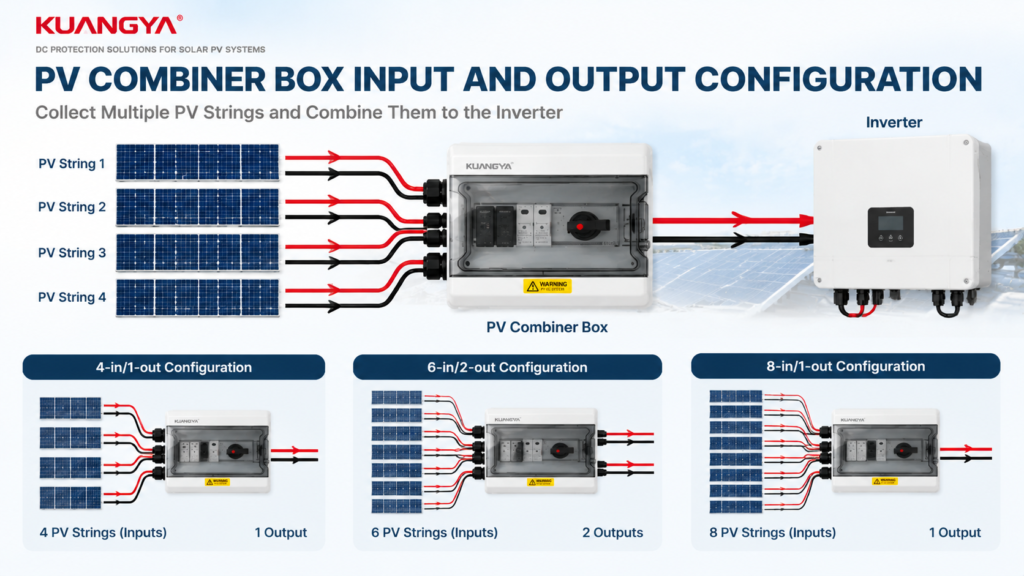
Перед выбором количества входов и выходов проверьте:
An important point is that the number of inputs does not automatically determine the number of strings that can safely be connected together.
Different MPPT groups, module configurations, and inverter input limits must be considered.
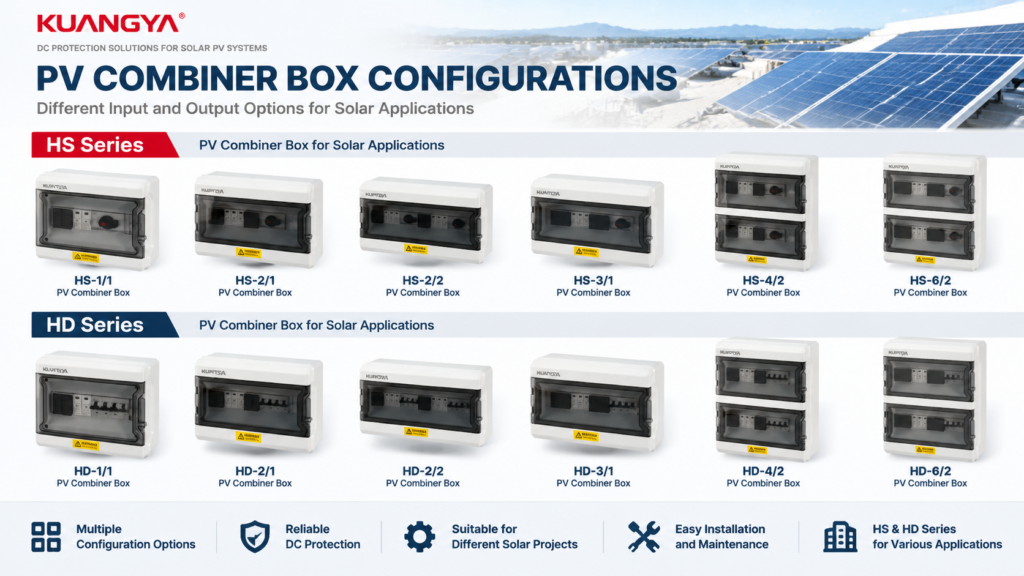
For larger installations, a customized combiner box may be required.
For example, KUANGYA has worked on a customized 16-string PV combiner box project integrating string protection, DC surge protection, and remote monitoring.
Read more about the actual configuration in our 16-String PV Combiner Box Project.
The voltage rating is one of the most important specifications when purchasing a PV combiner box.
Common PV system voltage classes include:
| DC voltage class | Типичное применение | Selection considerations |
|---|---|---|
| 600 В ПОСТОЯННОГО ТОКА | Certain residential and smaller PV architectures | Verify actual maximum array voltage |
| 1000 В ПОСТОЯННОГО ТОКА | Коммерческие и промышленные фотоэлектрические системы | Check cold-temperature open-circuit voltage |
| 1500 В ПОСТОЯННОГО ТОКА | Large-scale and utility PV projects | Verify every component’s voltage rating and insulation requirements |
However, choosing a combiner box based only on the nominal system voltage is not sufficient.
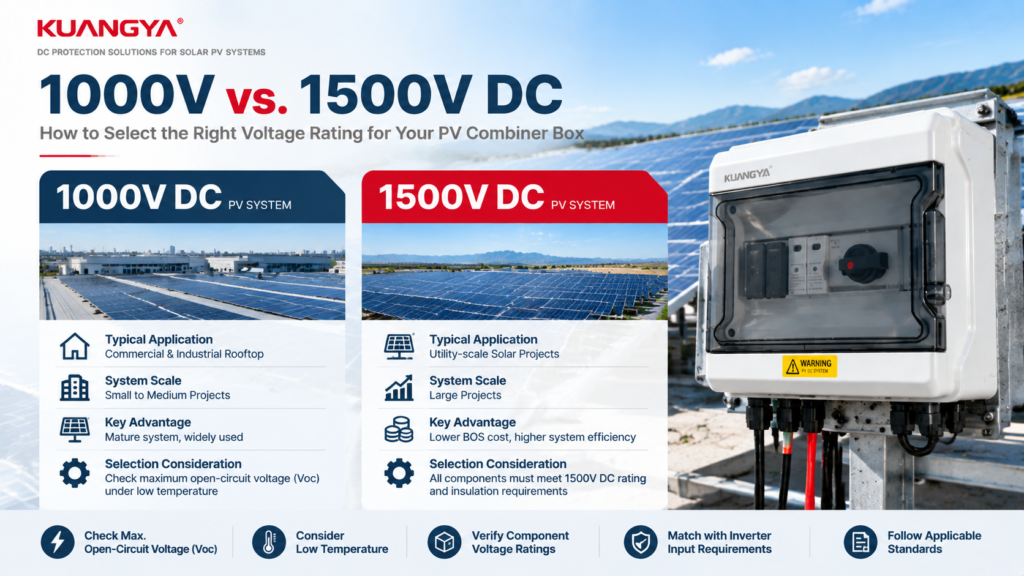
The open-circuit voltage of a solar module increases as its temperature decreases.
Therefore, the maximum PV string voltage must be calculated using the module’s electrical specifications and the project’s minimum design temperature.
The calculation should consider:
The selected combiner box and all internal components must be suitable for the resulting maximum DC voltage.
Do not verify only the enclosure’s voltage label.
The following components also need appropriate DC ratings:
A 1000V DC enclosure does not automatically mean every installed component is suitable for a 1000V DC application.
For further information, refer to the official IEC 62548-1 photovoltaic array design requirements.
Voltage is only one part of the selection process. Current capacity and overcurrent protection are equally important.
A properly specified combiner box must accommodate the operating current of the connected PV strings and the combined output circuit.
The following information should be collected from the solar module datasheet:
The project engineer must then calculate the required design current according to the applicable standards and installation conditions.
Do not select fuse ratings using a universal multiplier without checking the actual module specifications and local design requirements.
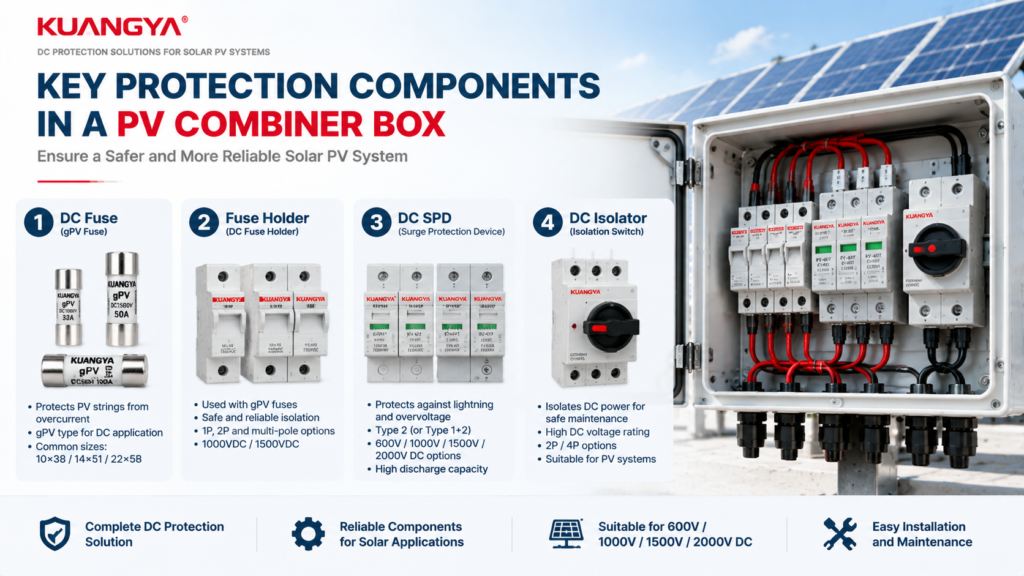
PV string protection commonly uses dedicated gPV fuse links.
When selecting a fuse, verify:
| Технические характеристики | Что необходимо проверить |
|---|---|
| Fuse category | Suitable gPV photovoltaic fuse |
| Номинальное напряжение | Compatible with maximum PV DC voltage |
| Номинальный ток | Coordinated with module and circuit requirements |
| Разрывная способность | Suitable for the prospective fault current |
| Fuse holder | Compatible with the selected fuse and DC rating |
| Температура | Consider actual operating and enclosure conditions |
The fuse link and holder must be evaluated as a compatible protection assembly.
An oversized fuse may fail to provide the intended protection, while an undersized fuse may cause unwanted operation.
For more information, see the official IEC 60269-6 photovoltaic fuse standard.
You can also explore KUANGYA’s DC Fuse and Fuse Holder product range for photovoltaic protection applications.
Surge protection is another important consideration when purchasing a solar PV combiner box.
PV systems may be exposed to transient overvoltages caused by lightning activity and switching events.
A suitable DC Surge Protective Device (SPD) helps limit transient overvoltages and protect connected equipment.
However, not every project requires the same SPD configuration.
Before confirming the SPD specification, consider:
1. SPD type
Depending on the lightning protection design and installation conditions, the project may require Type 1, Type 2, or a combined Type 1+2 SPD.
2. Maximum continuous operating voltage (Ucpv)
The SPD’s operating voltage must be compatible with the maximum PV system voltage and grounding arrangement.
3. Discharge current
Check the required nominal discharge current (In), maximum discharge current (Imax), or impulse current (Iimp), as applicable.
4. Voltage protection level (Up)
The selected SPD must provide a suitable protection level for the equipment being protected.
5. Backup protection
Confirm the manufacturer’s requirements for backup overcurrent protection and short-circuit coordination.
6. Status indication
A visual status window helps maintenance personnel identify the operating condition of the SPD.
For projects requiring remote fault indication, an SPD with a remote signaling contact may also be considered.
For additional technical information, refer to IEC 61643-31: Requirements and test methods for SPDs for photovoltaic installations.
A PV combiner box may also incorporate a DC isolator or switch-disconnector to provide a means of disconnecting the DC circuit for maintenance and servicing.
However, isolation and overcurrent protection are not the same function.
A DC isolator is designed for the specified isolation and switching duty. It should not automatically be treated as a replacement for a properly selected fuse or circuit breaker.
Before purchasing, confirm:
The selected device must be suitable for the actual DC circuit and installation conditions.
Also check whether the inverter or another downstream device already provides the required switching function. This helps avoid unnecessary duplication.
For projects with different electrical architectures, the isolator configuration should be confirmed before manufacturing.
The enclosure protects the internal electrical components from environmental exposure and mechanical damage.
Choosing the wrong enclosure can affect long-term reliability, especially in outdoor PV installations.
Common enclosure protection levels include:
| Степень защиты IP | General protection description |
|---|---|
| IP54 | Limited dust protection and protection against water splashes |
| IP65 | Dust-tight and protected against water jets |
| IP66 | Dust-tight and protected against powerful water jets |
| IP67 | Dust-tight and protected against temporary immersion under specified test conditions |
The required rating depends on the actual installation environment and project specifications.
Например:
Commercial rooftop installations
Consider direct sunlight, temperature changes, rain exposure, and cable-entry sealing.
Coastal installations
Pay attention to corrosion resistance, material selection, and the effects of salt exposure.
Industrial environments
Evaluate dust, moisture, vibration, chemical exposure, and maintenance accessibility.
Ground-mounted solar farms
Consider UV exposure, enclosure durability, mounting arrangements, and long-term outdoor operation.
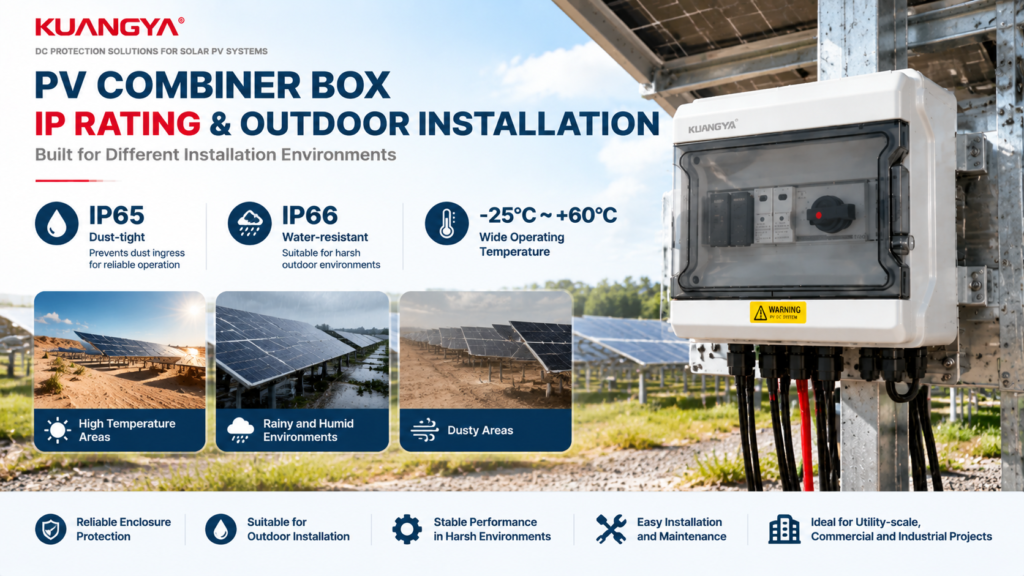
When evaluating a supplier’s enclosure, also check:
Remember that the enclosure’s effective protection depends on the complete installed assembly, including cable glands, unused openings, seals, and installation workmanship.
For larger commercial and industrial PV projects, monitoring functions can provide additional visibility into system operation.
A conventional combiner box mainly provides electrical connection and protection functions.
An intelligent PV combiner box can integrate additional monitoring and communication components.
| Monitoring function | Назначение |
|---|---|
| String current monitoring | Identify abnormal current differences between strings |
| DC voltage monitoring | Monitor DC operating conditions |
| Fuse status monitoring | Provide fault indication |
| Мониторинг состояния УЗИП | Identify SPD failure conditions |
| Контроль температуры | Monitor internal enclosure temperature |
| Remote alarm | Send fault signals to a monitoring system |
| Communication interface | Transfer operating data to an external controller |
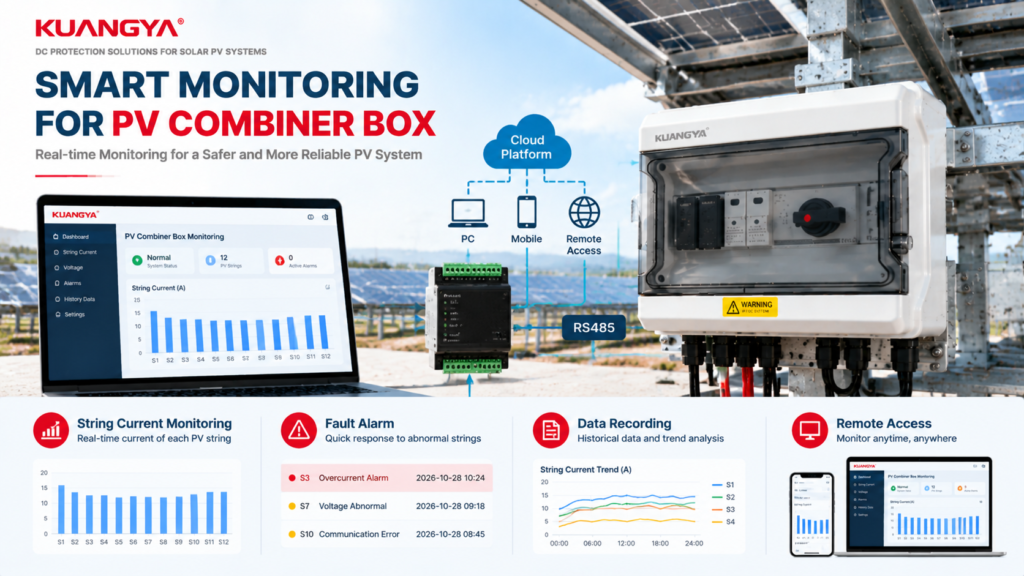
Depending on the project, communication may use RS485 and protocols such as Modbus RTU.
However, not every PV project needs all these functions.
Before purchasing, confirm:
For projects involving many PV strings, remote monitoring can help maintenance teams identify abnormal operating conditions without inspecting every string individually.
You can see how these functions can be integrated into a customized solution in our 16-String PV Combiner Box Project.
After confirming the eight factors above, the next step is to prepare a clear Request for Quotation (RFQ).
Providing complete project information helps manufacturers evaluate the required configuration and prepare a more accurate quotation.
Here is a practical checklist you can use.
| Information | Details to provide |
|---|---|
| Приложение | Residential, commercial, industrial, or utility-scale PV |
| Напряжения системы | 600V, 1000V, 1500V DC, or project-specific |
| Количество стрингов | Total number of PV string inputs |
| Input/output configuration | 4-in/1-out, 8-in/1-out, 16-in/1-out, etc. |
| Ток в цепочке | Module Isc, Imp, and calculated design current |
| Предохранительная защита | Required fuse type, rating, and configuration |
| СПД | Type, Ucpv, In, Imax/Iimp, Up, and protection arrangement |
| DC isolation | Required isolator or switch-disconnector specifications |
| Шкаф | Material, IP rating, and installation environment |
| Мониторинг | Required measurement and communication functions |
| Количество | Estimated purchasing quantity |
| Destination market | Country and applicable project requirements |
| Документация | Drawings, BOM, datasheets, certificates, and test records |
Suppose you are purchasing a customized PV combiner box for a commercial solar project.
Your initial inquiry could include:
This information provides a starting point for the manufacturer to review the configuration.
However, it is not a complete engineering specification. The module datasheets, inverter input limits, current calculations, grounding arrangement, and project-specific protection requirements must also be checked before the design is approved.
Even when the basic specifications appear correct, several purchasing mistakes can create problems during installation.
Mistake 1: Selecting a model based only on voltage
A 1000V label does not guarantee that every internal component is correctly rated.
Mistake 2: Ignoring inverter MPPT configuration
Not all PV strings can be combined into one output. Check the inverter architecture first.
Mistake 3: Choosing fuses based only on current
Fuse selection requires coordination with module limits, conductor capacity, fault conditions, and the applicable design requirements.
Mistake 4: Assuming every outdoor project needs the same IP rating
Environmental conditions differ. Specify the enclosure based on the actual installation location.
Mistake 5: Requesting monitoring without defining its functions
Simply asking for an intelligent combiner box is not enough. Specify the channels, measured parameters, communication protocol, and remote alarm requirements.
Mistake 6: Confirming production before reviewing the drawings
Always review the wiring diagram, component list, terminal arrangement, and enclosure layout before mass production.
Choosing a solar PV combiner box requires careful consideration of electrical ratings, protection devices, enclosure specifications, and monitoring requirements. Before placing an order, compare the manufacturer’s technical proposal with your project’s actual requirements to ensure that the selected configuration is suitable for your solar installation.
The number of strings depends on the model and customized design. Common configurations include 2, 4, 6, 8, and 16 inputs.
The final selection must also consider inverter architecture, MPPT grouping, current capacity, and protection requirements.
No. A 1000V-rated assembly should not be used in a 1500V DC application unless the complete assembly has been specifically designed and verified for the required voltage. All internal components must have suitable ratings.
The requirement depends on the project’s surge protection design, lightning risk assessment, installation arrangement, and applicable standards.
Where an SPD is required, its type, operating voltage, protection modes, and discharge ratings must be properly specified.
A standard combiner box primarily provides string collection and electrical protection.
An intelligent combiner box can additionally integrate monitoring sensors, communication modules, remote alarms, and other monitoring functions.
Yes. Depending on the manufacturer’s capabilities, the input/output configuration, voltage class, protection devices, enclosure, monitoring functions, and labeling can be customized to meet project requirements.
Depending on the project, request:
Make sure the documentation corresponds to the actual model, component configuration, and ratings being supplied.
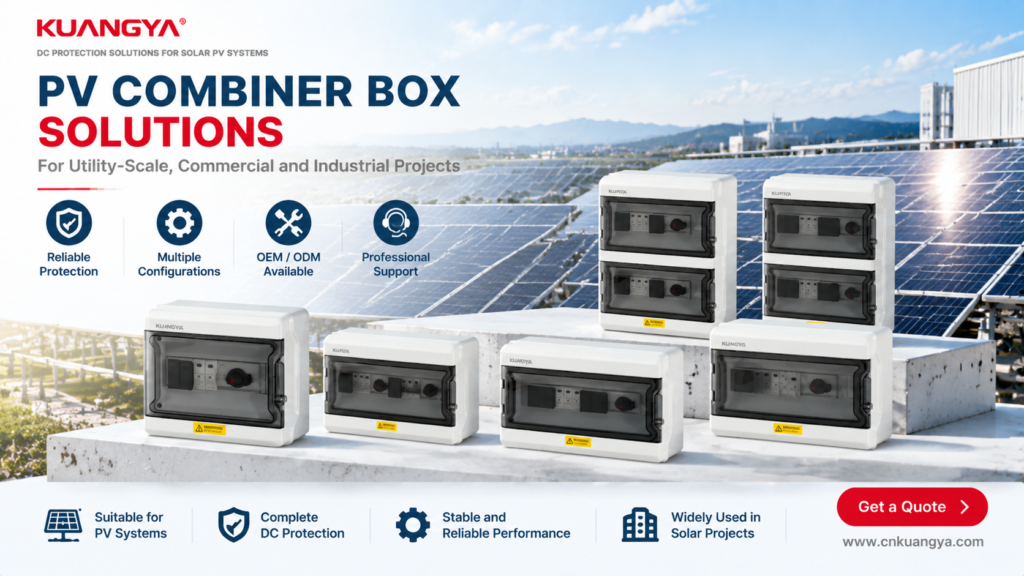
Choosing the right solar PV combiner box is not simply about finding a product with the correct number of inputs.
It requires a complete evaluation of electrical ratings, protection coordination, enclosure requirements, inverter compatibility, and project-specific monitoring functions.
На сайте КУАНЬЯ, we provide PV combiner box solutions for different solar applications, including commercial and industrial photovoltaic systems.
Our product and customization capabilities cover:
We can also discuss OEM/ODM requirements for distributors, panel builders, and project contractors.
Explore our PV Combiner Box product range to learn more about available configurations.
Need a quotation for your project?
Send us your system voltage, number of PV strings, input/output configuration, protection requirements, monitoring needs, and estimated quantity.
Our team can help review your requirements and discuss a suitable PV combiner box solution.
Веб-сайт: https://www.cnkuangya.com/
Contact: sales@cnkuangya.com
KUANGYA – Reliable DC Protection Solutions for Solar PV Systems.

