Zona industriale di WengYang Yueqing Wenzhou 325000
Orario di lavoro
Da lunedì a venerdì: dalle 7.00 alle 19.00
Fine settimana: 10.00 - 17.00
Zona industriale di WengYang Yueqing Wenzhou 325000
Orario di lavoro
Da lunedì a venerdì: dalle 7.00 alle 19.00
Fine settimana: 10.00 - 17.00

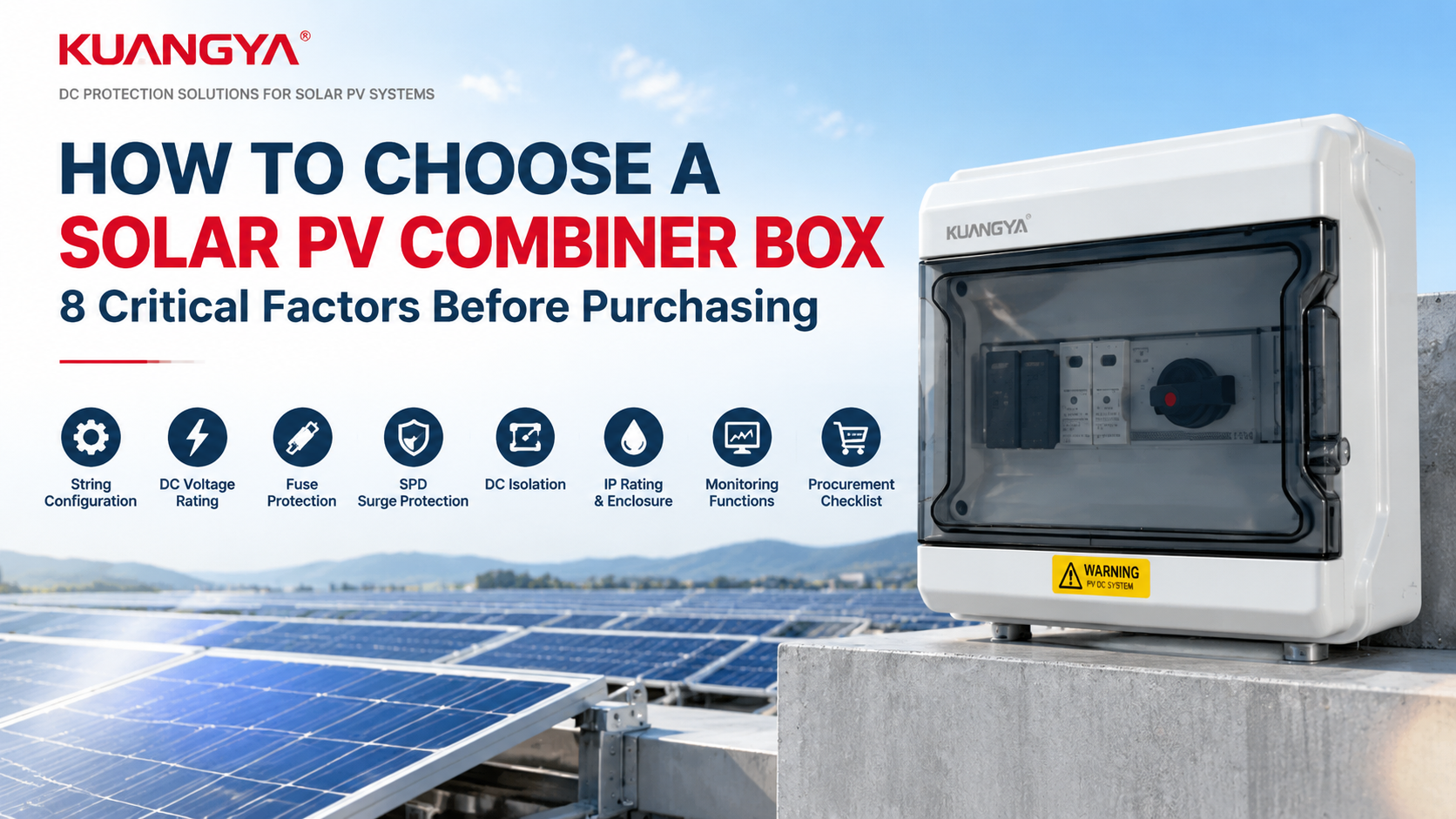
Scegliere un quadro di parallelo fotovoltaico è una decisione importante durante la progettazione o l'acquisto di apparecchiature per un impianto fotovoltaico. Il giusto quadro di parallelo aiuta a garantire una protezione elettrica adeguata, connessioni affidabili delle stringhe e la compatibilità con l'inverter e l'intero impianto solare.
Per installatori solari, appaltatori EPC, distributori e team di approvvigionamento di progetti, la selezione di un quadro di parallelo comporta molto più del semplice conteggio del numero di stringhe FV o della scelta tra modelli a 1000V e 1500V DC.
È necessario considerare la configurazione dell'inverter, la tensione massima in corrente continua, la corrente di stringa, la protezione tramite fusibili, la protezione contro le sovratensioni, l'isolamento DC, i requisiti dell'involucro e le funzioni di monitoraggio.
Questa guida spiega come scegliere un quadro di parallelo fotovoltaico esaminando 8 fattori critici, aiutandoti a valutare le specifiche tecniche, a comunicare con i produttori e a preparare una richiesta di preventivo più accurata.
Se non hai familiarità con i quadri di parallelo fotovoltaici, puoi anche leggere la nostra guida completa ai quadri di parallelo fotovoltaici per comprenderne la struttura, i componenti e i principi di funzionamento.
Prima di selezionare un modello, determina se il tuo impianto fotovoltaico richiede una scatola di giunzione separata.
Una scatola di giunzione solare fotovoltaica raccoglie molteplici circuiti in corrente continua (DC) provenienti dalle stringhe fotovoltaiche e li combina in uno o più circuiti in uscita prima che raggiungano l'inverter o altre apparecchiature a valle.
Tuttavia, non ogni installazione solare richiede una scatola di giunzione esterna.
Considera le seguenti situazioni:
| Configurazione dell'impianto fotovoltaico | È necessaria una scatola di giunzione? | Considerazione principale |
|---|---|---|
| Stringa FV singola | Spesso non necessario | Verificare la protezione integrata e i requisiti di ingresso dell'inverter |
| Due stringhe indipendenti | Dipende dal design dell'inverter | Verificare se le stringhe sono collegate a ingressi MPPT separati |
| Stringhe multiple in parallelo | Spesso appropriato | Verificare la protezione contro la corrente inversa e la capacità di uscita |
| Impianto fotovoltaico commerciale su tetto | Spesso utile | Protezione centralizzata e gestione dei cavi |
| Grande impianto solare a terra | Dipende dall'architettura del sistema | Requisiti di raccolta stringhe, monitoraggio e manutenzione |
La decisione dovrebbe basarsi sull'architettura elettrica piuttosto che semplicemente sul numero di pannelli solari installati.
Ad esempio, se un inverter fornisce già ingressi indipendenti sufficienti e le funzioni di protezione richieste, un quadro di parallelo esterno aggiuntivo potrebbe non essere necessario.
Tuttavia, quando è necessario raggruppare più stringhe in un punto comune, un quadro di parallelo FV dedicato può semplificare il cablaggio, la protezione e la manutenzione.
Concetto chiave: Verificare la configurazione dell'ingresso CC dell'inverter e lo schema unifilare del progetto prima di scegliere un quadro di parallelo.
Una delle prime specifiche da confermare è il numero di stringhe FV che devono essere collegate.
Un quadro di parallelo viene comunemente descritto utilizzando una configurazione di ingresso/uscita, come ad esempio:
Il primo numero rappresenta il numero di stringhe in ingresso, mentre il secondo rappresenta il numero di circuiti in uscita.
Ad esempio, una scatola di giunzione 6 ingressi/1 uscita riceve sei stringhe fotovoltaiche e le combina in un unico circuito CC in uscita.
Una configurazione 4 ingressi/2 uscite, invece, fornisce due circuiti in uscita separati.
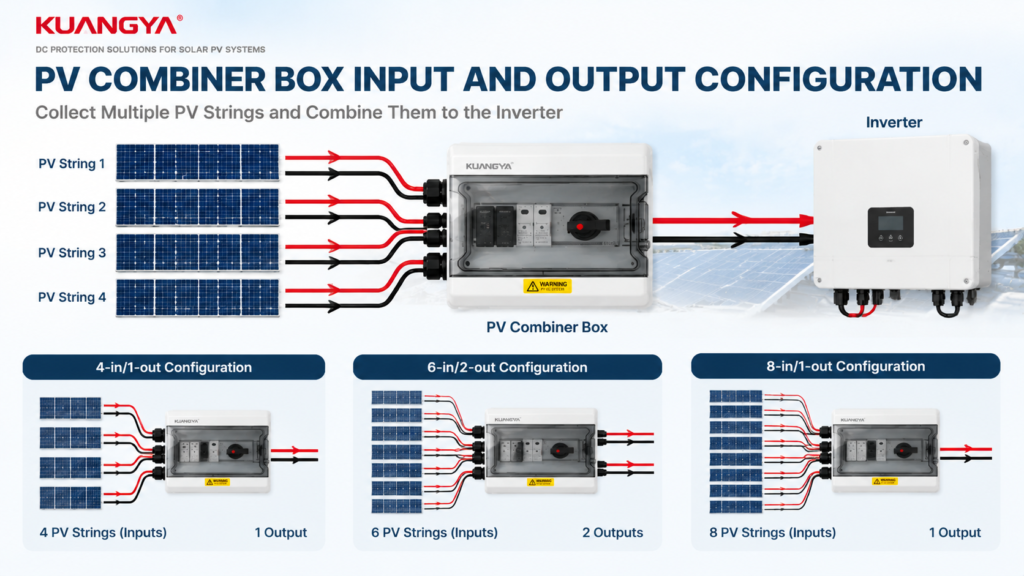
Prima di selezionare il numero di ingressi e uscite, verificare:
Un punto importante è che il numero di ingressi non determina automaticamente il numero di stringhe che possono essere collegate insieme in sicurezza.
È necessario considerare diversi gruppi MPPT, configurazioni dei moduli e limiti di ingresso dell'inverter.
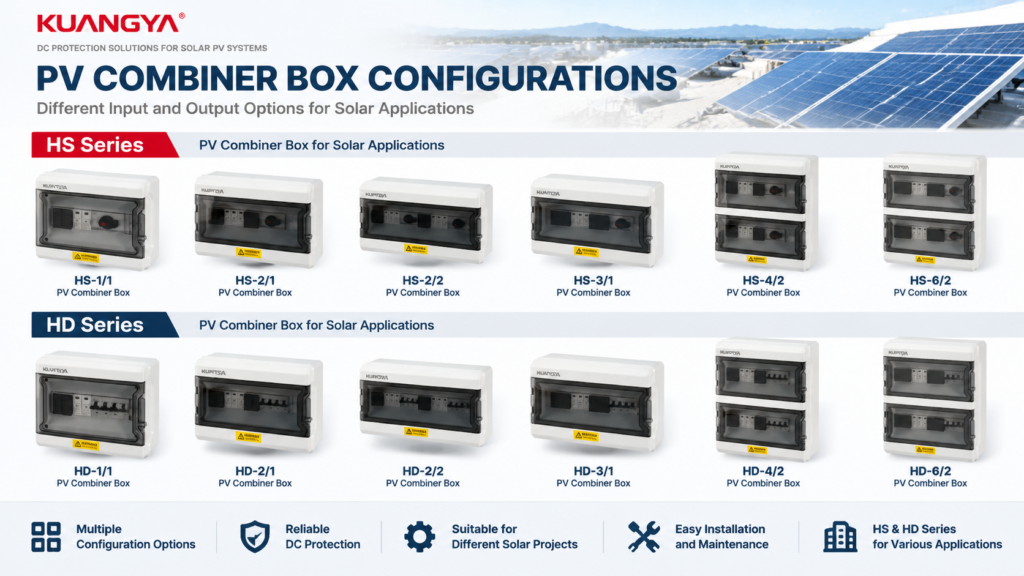
Per installazioni di maggiori dimensioni, potrebbe essere necessario un quadro di parallelo personalizzato.
Ad esempio, KUANGYA ha lavorato a un progetto di quadro di parallelo fotovoltaico personalizzato a 16 stringhe, integrando protezione delle stringhe, protezione contro le sovratensioni CC e monitoraggio remoto.
Leggi di più sulla configurazione effettiva nel nostro Progetto di quadro di parallelo fotovoltaico a 16 stringhe.
La tensione nominale è una delle specifiche più importanti quando si acquista un quadro di parallelo fotovoltaico.
Le classi di tensione comuni per i sistemi fotovoltaici includono:
| Classe di tensione CC | Applicazione tipica | Considerazioni sulla selezione |
|---|---|---|
| 600 V CC | Alcune architetture residenziali e fotovoltaiche di piccole dimensioni | Verificare la tensione massima effettiva dell'array |
| 1000V CC | Sistemi fotovoltaici commerciali e industriali | Controllare la tensione a circuito aperto a bassa temperatura |
| 1500V DC | Progetti fotovoltaici su larga scala e di pubblica utilità | Verificare la tensione nominale e i requisiti di isolamento di ogni componente |
Tuttavia, scegliere una string box basandosi solo sulla tensione nominale del sistema non è sufficiente.
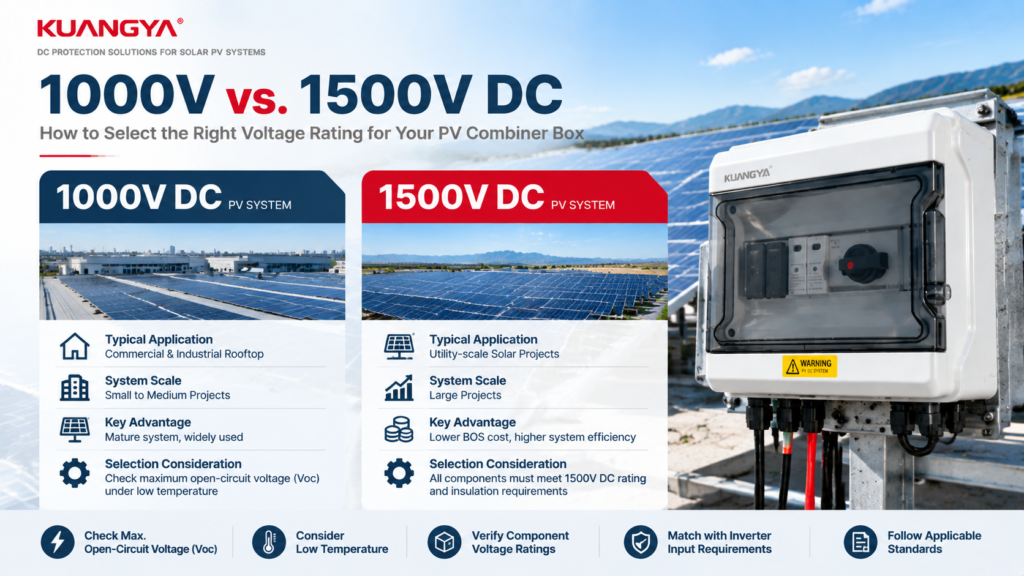
La tensione a circuito aperto di un modulo solare aumenta al diminuire della sua temperatura.
Pertanto, la tensione massima della stringa FV deve essere calcolata utilizzando le specifiche elettriche del modulo e la temperatura minima di progetto del progetto.
Il calcolo deve considerare:
Il quadro di parallelo (combiner box) selezionato e tutti i componenti interni devono essere idonei per la tensione CC massima risultante.
Non limitarsi a verificare l'etichetta di tensione dell'involucro.
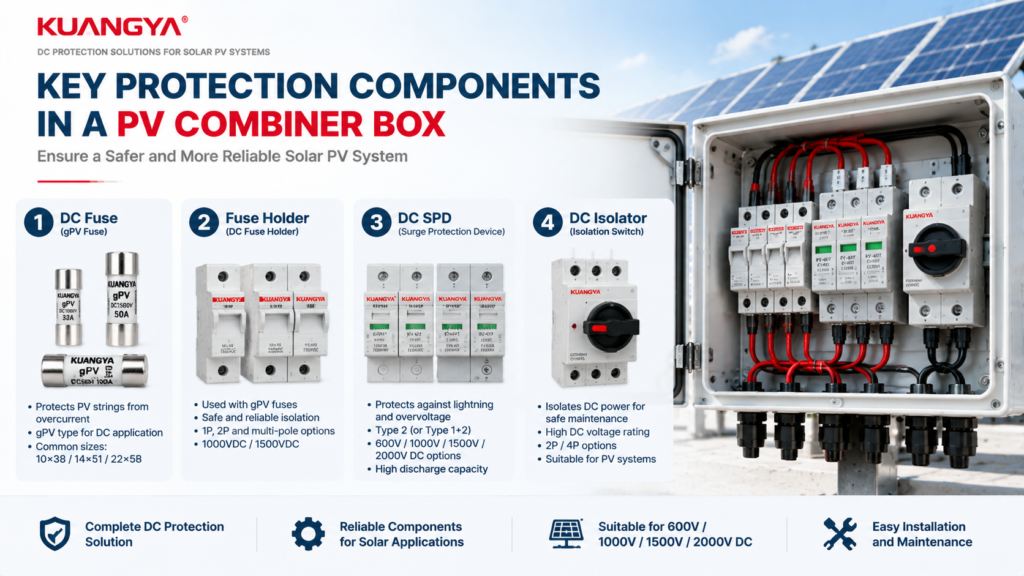
Anche i seguenti componenti necessitano di valori nominali in CC appropriati:
Un involucro da 1000V CC non implica automaticamente che ogni componente installato sia idoneo per un'applicazione a 1000V CC.
Per ulteriori informazioni, fare riferimento al documento ufficiale Requisiti di progettazione degli impianti fotovoltaici secondo la norma IEC 62548-1.
La tensione è solo una parte del processo di selezione. La capacità di corrente e la protezione da sovracorrente sono altrettanto importanti.
Un quadro di parallelo (combiner box) correttamente specificato deve essere in grado di gestire la corrente operativa delle stringhe fotovoltaiche collegate e del circuito di uscita combinato.
Le seguenti informazioni devono essere raccolte dalla scheda tecnica del modulo solare:
L'ingegnere di progetto deve quindi calcolare la corrente di progetto richiesta in conformità con le norme applicabili e le condizioni di installazione.
Do not select fuse ratings using a universal multiplier without checking the actual module specifications and local design requirements.
PV string protection commonly uses dedicated gPV fuse links.
When selecting a fuse, verify:
| Specifiche | Cosa controllare |
|---|---|
| Fuse category | Suitable gPV photovoltaic fuse |
| Tensione nominale | Compatible with maximum PV DC voltage |
| Corrente nominale | Coordinated with module and circuit requirements |
| Capacità di rottura | Suitable for the prospective fault current |
| Fuse holder | Compatible with the selected fuse and DC rating |
| Temperatura | Consider actual operating and enclosure conditions |
The fuse link and holder must be evaluated as a compatible protection assembly.
An oversized fuse may fail to provide the intended protection, while an undersized fuse may cause unwanted operation.
For more information, see the official IEC 60269-6 photovoltaic fuse standard.
You can also explore KUANGYA’s DC Fuse and Fuse Holder product range for photovoltaic protection applications.
Surge protection is another important consideration when purchasing a solar PV combiner box.
PV systems may be exposed to transient overvoltages caused by lightning activity and switching events.
A suitable DC Surge Protective Device (SPD) helps limit transient overvoltages and protect connected equipment.
However, not every project requires the same SPD configuration.
Before confirming the SPD specification, consider:
1. SPD type
Depending on the lightning protection design and installation conditions, the project may require Type 1, Type 2, or a combined Type 1+2 SPD.
2. Maximum continuous operating voltage (Ucpv)
The SPD’s operating voltage must be compatible with the maximum PV system voltage and grounding arrangement.
3. Discharge current
Check the required nominal discharge current (In), maximum discharge current (Imax), or impulse current (Iimp), as applicable.
4. Voltage protection level (Up)
The selected SPD must provide a suitable protection level for the equipment being protected.
5. Backup protection
Confirm the manufacturer’s requirements for backup overcurrent protection and short-circuit coordination.
6. Status indication
A visual status window helps maintenance personnel identify the operating condition of the SPD.
For projects requiring remote fault indication, an SPD with a remote signaling contact may also be considered.
For additional technical information, refer to IEC 61643-31: Requirements and test methods for SPDs for photovoltaic installations.
A PV combiner box may also incorporate a DC isolator or switch-disconnector to provide a means of disconnecting the DC circuit for maintenance and servicing.
However, isolation and overcurrent protection are not the same function.
A DC isolator is designed for the specified isolation and switching duty. It should not automatically be treated as a replacement for a properly selected fuse or circuit breaker.
Before purchasing, confirm:
The selected device must be suitable for the actual DC circuit and installation conditions.
Also check whether the inverter or another downstream device already provides the required switching function. This helps avoid unnecessary duplication.
For projects with different electrical architectures, the isolator configuration should be confirmed before manufacturing.
The enclosure protects the internal electrical components from environmental exposure and mechanical damage.
Choosing the wrong enclosure can affect long-term reliability, especially in outdoor PV installations.
Common enclosure protection levels include:
| Grado di protezione IP | General protection description |
|---|---|
| IP54 | Limited dust protection and protection against water splashes |
| IP65 | Dust-tight and protected against water jets |
| IP66 | Dust-tight and protected against powerful water jets |
| IP67 | Dust-tight and protected against temporary immersion under specified test conditions |
The required rating depends on the actual installation environment and project specifications.
Ad esempio:
Commercial rooftop installations
Consider direct sunlight, temperature changes, rain exposure, and cable-entry sealing.
Coastal installations
Pay attention to corrosion resistance, material selection, and the effects of salt exposure.
Industrial environments
Evaluate dust, moisture, vibration, chemical exposure, and maintenance accessibility.
Ground-mounted solar farms
Consider UV exposure, enclosure durability, mounting arrangements, and long-term outdoor operation.
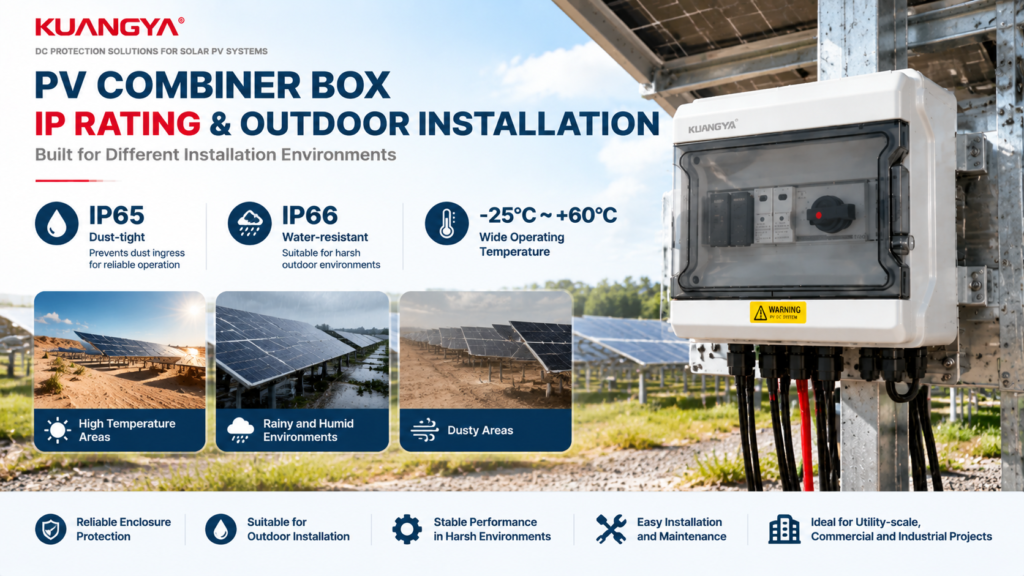
When evaluating a supplier’s enclosure, also check:
Remember that the enclosure’s effective protection depends on the complete installed assembly, including cable glands, unused openings, seals, and installation workmanship.
For larger commercial and industrial PV projects, monitoring functions can provide additional visibility into system operation.
A conventional combiner box mainly provides electrical connection and protection functions.
An intelligent PV combiner box can integrate additional monitoring and communication components.
| Monitoring function | Scopo |
|---|---|
| String current monitoring | Identify abnormal current differences between strings |
| DC voltage monitoring | Monitor DC operating conditions |
| Fuse status monitoring | Provide fault indication |
| Monitoraggio dello stato degli SPD | Identify SPD failure conditions |
| Monitoraggio della temperatura | Monitor internal enclosure temperature |
| Remote alarm | Send fault signals to a monitoring system |
| Communication interface | Transfer operating data to an external controller |
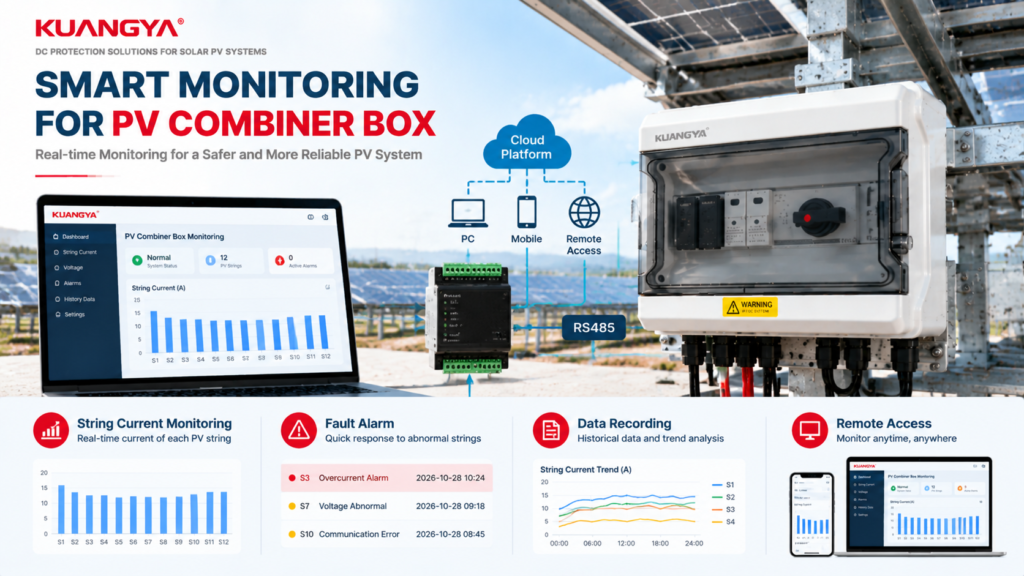
Depending on the project, communication may use RS485 and protocols such as Modbus RTU.
However, not every PV project needs all these functions.
Before purchasing, confirm:
For projects involving many PV strings, remote monitoring can help maintenance teams identify abnormal operating conditions without inspecting every string individually.
You can see how these functions can be integrated into a customized solution in our Progetto di quadro di parallelo fotovoltaico a 16 stringhe.
After confirming the eight factors above, the next step is to prepare a clear Request for Quotation (RFQ).
Providing complete project information helps manufacturers evaluate the required configuration and prepare a more accurate quotation.
Here is a practical checklist you can use.
| Information | Details to provide |
|---|---|
| Applicazione | Residential, commercial, industrial, or utility-scale PV |
| Tensione di sistema | 600V, 1000V, 1500V DC, or project-specific |
| Numero di stringhe | Total number of PV string inputs |
| Input/output configuration | 4-in/1-out, 8-in/1-out, 16-in/1-out, etc. |
| Corrente di stringa | Module Isc, Imp, and calculated design current |
| Fuse protection | Required fuse type, rating, and configuration |
| SPD | Type, Ucpv, In, Imax/Iimp, Up, and protection arrangement |
| DC isolation | Required isolator or switch-disconnector specifications |
| Involucro | Material, IP rating, and installation environment |
| Monitoraggio | Required measurement and communication functions |
| Quantità | Estimated purchasing quantity |
| Destination market | Country and applicable project requirements |
| Documentazione | Drawings, BOM, datasheets, certificates, and test records |
Suppose you are purchasing a customized PV combiner box for a commercial solar project.
Your initial inquiry could include:
This information provides a starting point for the manufacturer to review the configuration.
However, it is not a complete engineering specification. The module datasheets, inverter input limits, current calculations, grounding arrangement, and project-specific protection requirements must also be checked before the design is approved.
Even when the basic specifications appear correct, several purchasing mistakes can create problems during installation.
Mistake 1: Selecting a model based only on voltage
A 1000V label does not guarantee that every internal component is correctly rated.
Mistake 2: Ignoring inverter MPPT configuration
Not all PV strings can be combined into one output. Check the inverter architecture first.
Mistake 3: Choosing fuses based only on current
Fuse selection requires coordination with module limits, conductor capacity, fault conditions, and the applicable design requirements.
Mistake 4: Assuming every outdoor project needs the same IP rating
Environmental conditions differ. Specify the enclosure based on the actual installation location.
Mistake 5: Requesting monitoring without defining its functions
Simply asking for an intelligent combiner box is not enough. Specify the channels, measured parameters, communication protocol, and remote alarm requirements.
Mistake 6: Confirming production before reviewing the drawings
Always review the wiring diagram, component list, terminal arrangement, and enclosure layout before mass production.
Choosing a solar PV combiner box requires careful consideration of electrical ratings, protection devices, enclosure specifications, and monitoring requirements. Before placing an order, compare the manufacturer’s technical proposal with your project’s actual requirements to ensure that the selected configuration is suitable for your solar installation.
The number of strings depends on the model and customized design. Common configurations include 2, 4, 6, 8, and 16 inputs.
The final selection must also consider inverter architecture, MPPT grouping, current capacity, and protection requirements.
No. A 1000V-rated assembly should not be used in a 1500V DC application unless the complete assembly has been specifically designed and verified for the required voltage. All internal components must have suitable ratings.
The requirement depends on the project’s surge protection design, lightning risk assessment, installation arrangement, and applicable standards.
Where an SPD is required, its type, operating voltage, protection modes, and discharge ratings must be properly specified.
A standard combiner box primarily provides string collection and electrical protection.
An intelligent combiner box can additionally integrate monitoring sensors, communication modules, remote alarms, and other monitoring functions.
Yes. Depending on the manufacturer’s capabilities, the input/output configuration, voltage class, protection devices, enclosure, monitoring functions, and labeling can be customized to meet project requirements.
Depending on the project, request:
Make sure the documentation corresponds to the actual model, component configuration, and ratings being supplied.
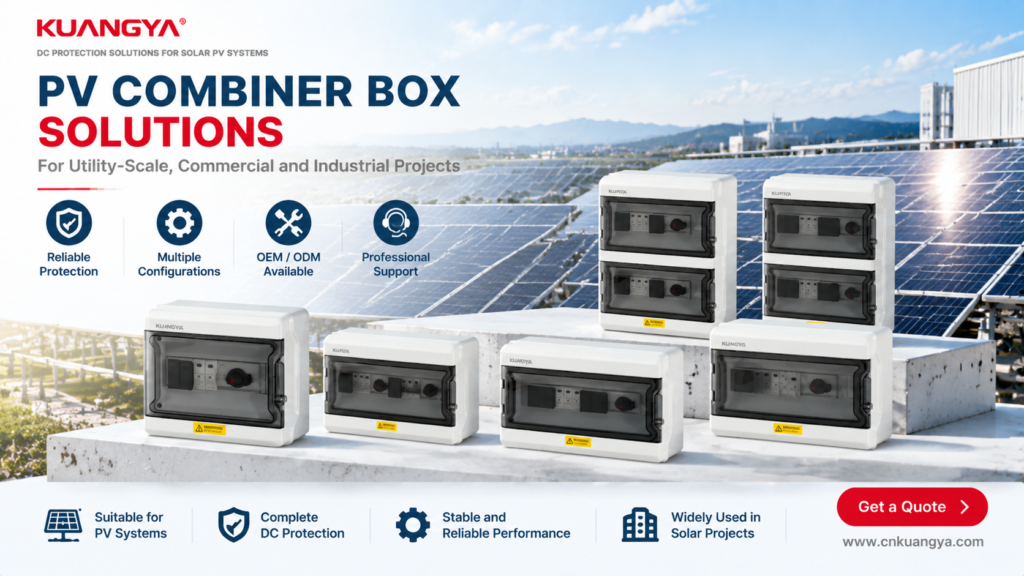
Choosing the right solar PV combiner box is not simply about finding a product with the correct number of inputs.
It requires a complete evaluation of electrical ratings, protection coordination, enclosure requirements, inverter compatibility, and project-specific monitoring functions.
A KUANGYA, we provide PV combiner box solutions for different solar applications, including commercial and industrial photovoltaic systems.
Our product and customization capabilities cover:
We can also discuss OEM/ODM requirements for distributors, panel builders, and project contractors.
Explore our PV Combiner Box product range to learn more about available configurations.
Need a quotation for your project?
Send us your system voltage, number of PV strings, input/output configuration, protection requirements, monitoring needs, and estimated quantity.
Our team can help review your requirements and discuss a suitable PV combiner box solution.
Sito web: https://www.cnkuangya.com/
Contact: sales@cnkuangya.com
KUANGYA – Reliable DC Protection Solutions for Solar PV Systems.

