WengYang Industrial Zone Yueqing Wenzhou 325000
Horas de trabalho
De segunda a sexta-feira: das 7h às 19h
Fim de semana: 10:00 - 17:00
WengYang Industrial Zone Yueqing Wenzhou 325000
Horas de trabalho
De segunda a sexta-feira: das 7h às 19h
Fim de semana: 10:00 - 17:00

Saber como escolher uma caixa de junção solar fotovoltaica é uma decisão importante ao projetar ou adquirir equipamentos para um sistema fotovoltaico. A caixa de junção fotovoltaica correta ajuda a garantir a proteção elétrica adequada, conexões de string confiáveis e compatibilidade com o inversor e a instalação solar como um todo.
Para instaladores solares, empreiteiros EPC, distribuidores e equipes de compras de projetos, selecionar uma caixa de junção envolve mais do que simplesmente contar o número de strings fotovoltaicas ou escolher entre modelos de 1000V e 1500V CC.
É necessário considerar a configuração do inversor, a tensão máxima em corrente contínua (CC), a corrente da string, a proteção por fusíveis, a proteção contra surtos, o seccionamento em CC, os requisitos do invólucro e as funções de monitoramento.
Este guia explica como escolher uma caixa de junção solar fotovoltaica examinando 8 fatores críticos, ajudando-o a avaliar especificações técnicas, comunicar-se com fabricantes e preparar uma solicitação de cotação mais precisa.
Se você é novo no assunto de caixas de junção fotovoltaicas, também pode ler nosso guia completo sobre caixas de junção fotovoltaicas para compreender a sua estrutura, componentes e princípios de funcionamento.
Antes de selecionar um modelo, determine se o seu sistema fotovoltaico requer uma caixa de junção separada.
Uma caixa de junção solar fotovoltaica coleta múltiplos circuitos de corrente contínua (CC) de strings fotovoltaicas e os combina em um ou mais circuitos de saída antes que cheguem ao inversor ou a outros equipamentos a jusante.
No entanto, nem toda instalação solar requer uma caixa de junção externa.
Considere as seguintes situações:
| Configuração do sistema fotovoltaico | É necessária uma caixa de junção? | Consideração principal |
|---|---|---|
| String fotovoltaica única | Frequentemente não é necessário | Verifique a proteção integrada e os requisitos de entrada do inversor |
| Duas strings independentes | Depende do projeto do inversor | Confirme se as strings se conectam a entradas MPPT separadas |
| Múltiplas strings em paralelo | Frequentemente apropriado | Verificar a proteção contra corrente reversa e a capacidade de saída |
| Sistema fotovoltaico comercial em telhado | Frequentemente útil | Proteção centralizada e gestão de cabos |
| Projeto solar de grande porte montado no solo | Depende da arquitetura do sistema | Requisitos de coleta de strings, monitoramento e manutenção |
A decisão deve basear-se na arquitetura elétrica e não apenas no número de painéis solares instalados.
Por exemplo, se um inversor já fornecer entradas independentes suficientes e as funções de proteção necessárias, uma caixa de junção externa adicional pode não ser necessária.
No entanto, quando várias strings precisam ser reunidas em um ponto comum, uma caixa de junção fotovoltaica dedicada pode simplificar o roteamento de cabos, a proteção e a manutenção.
Ponto principal: Confirme a configuração de entrada CC do inversor e o diagrama unifilar do projeto antes de escolher uma caixa de junção.
Uma das primeiras especificações a confirmar é o número de strings fotovoltaicas que precisam ser conectadas.
Uma caixa de junção é comumente descrita usando uma configuração de entrada/saída, como:
O primeiro número representa a quantidade de circuitos de string de entrada, enquanto o segundo representa a quantidade de circuitos de saída.
Por exemplo, uma caixa de junção de 6 entradas/1 saída recebe seis circuitos de string fotovoltaicos e os combina em um único circuito de saída CC.
Uma configuração de 4 entradas/2 saídas, por outro lado, fornece dois circuitos de saída separados.
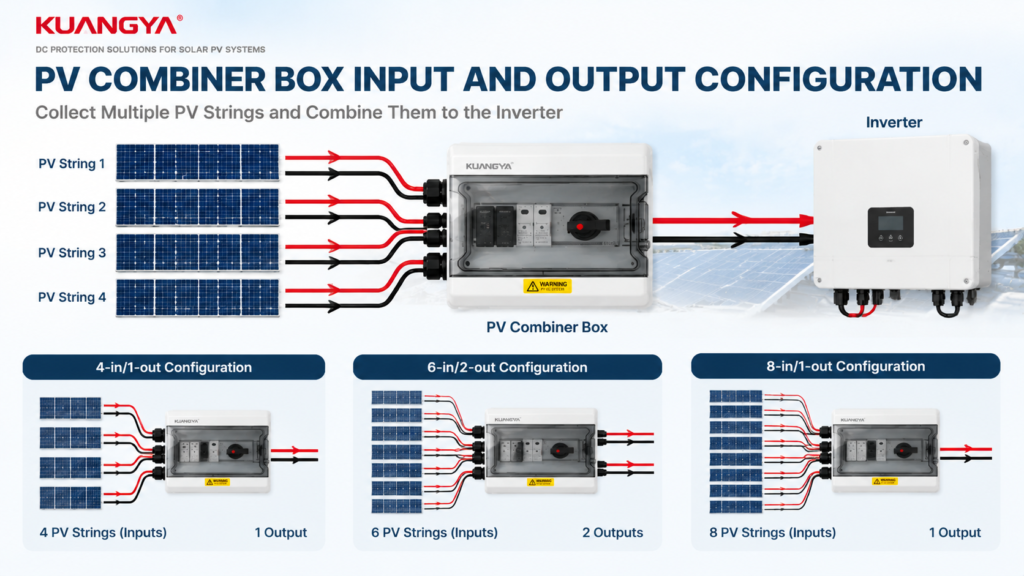
Antes de selecionar o número de entradas e saídas, verifique:
Um ponto importante é que o número de entradas não determina automaticamente o número de strings que podem ser conectadas juntas com segurança.
Diferentes grupos MPPT, configurações de módulos e limites de entrada do inversor devem ser considerados.
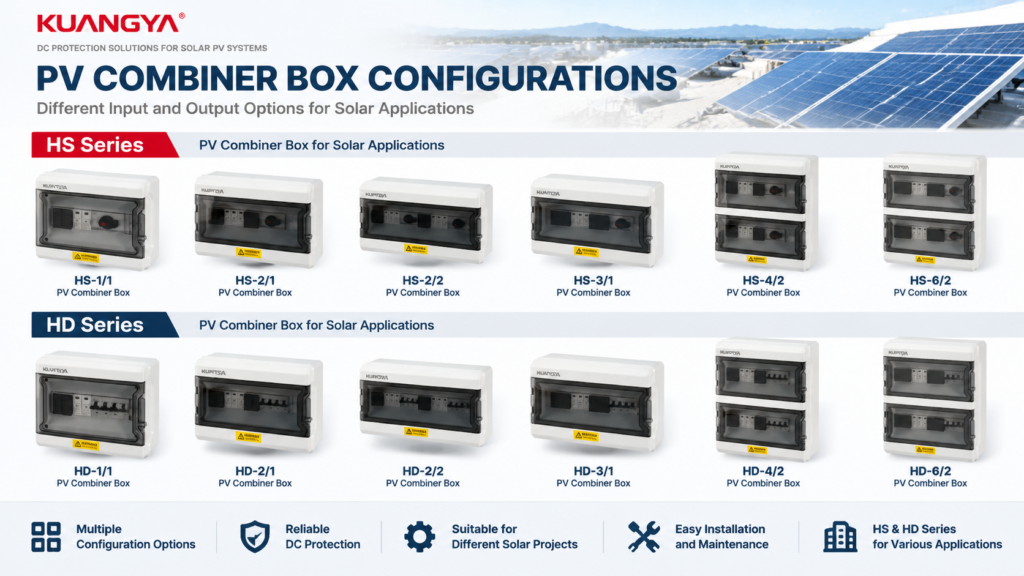
Para instalações maiores, pode ser necessária uma caixa de junção personalizada.
Por exemplo, a KUANGYA trabalhou em um projeto de caixa de junção fotovoltaica personalizada de 16 strings, integrando proteção de string, proteção contra surtos CC e monitoramento remoto.
Leia mais sobre a configuração real em nosso Projeto de Caixa de Junção Fotovoltaica de 16 Strings.
A tensão nominal é uma das especificações mais importantes ao adquirir uma caixa de junção fotovoltaica.
As classes de tensão comuns em sistemas fotovoltaicos incluem:
| Classe de tensão CC | Aplicação típica | Considerações de seleção |
|---|---|---|
| 600V CC | Determinadas arquiteturas residenciais e de menor porte de energia fotovoltaica | Verificar a tensão máxima real do arranjo |
| 1000V CC | Sistemas fotovoltaicos comerciais e industriais | Verificar a tensão de circuito aberto em baixa temperatura |
| 1500V CC | Projetos fotovoltaicos de grande escala e de concessionárias | Verificar a classificação de tensão e os requisitos de isolamento de cada componente |
No entanto, escolher uma caixa de junção baseando-se apenas na tensão nominal do sistema não é suficiente.
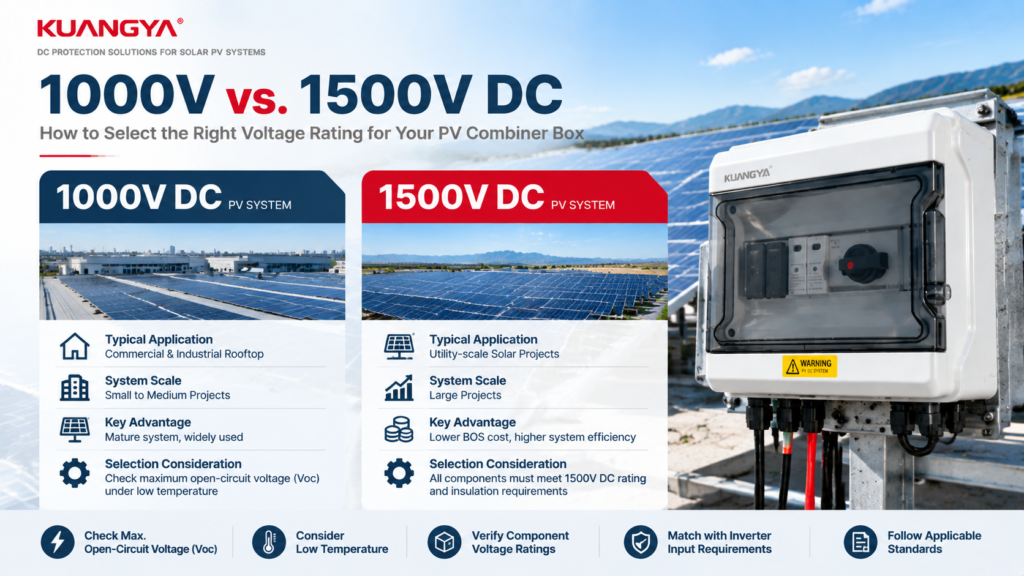
A tensão de circuito aberto de um módulo solar aumenta à medida que a sua temperatura diminui.
Portanto, a tensão máxima da string fotovoltaica deve ser calculada utilizando as especificações elétricas do módulo e a temperatura mínima de projeto do projeto.
O cálculo deve considerar:
A caixa de junção (combiner box) selecionada e todos os componentes internos devem ser adequados para a tensão CC máxima resultante.
Não verifique apenas a etiqueta de tensão do invólucro.
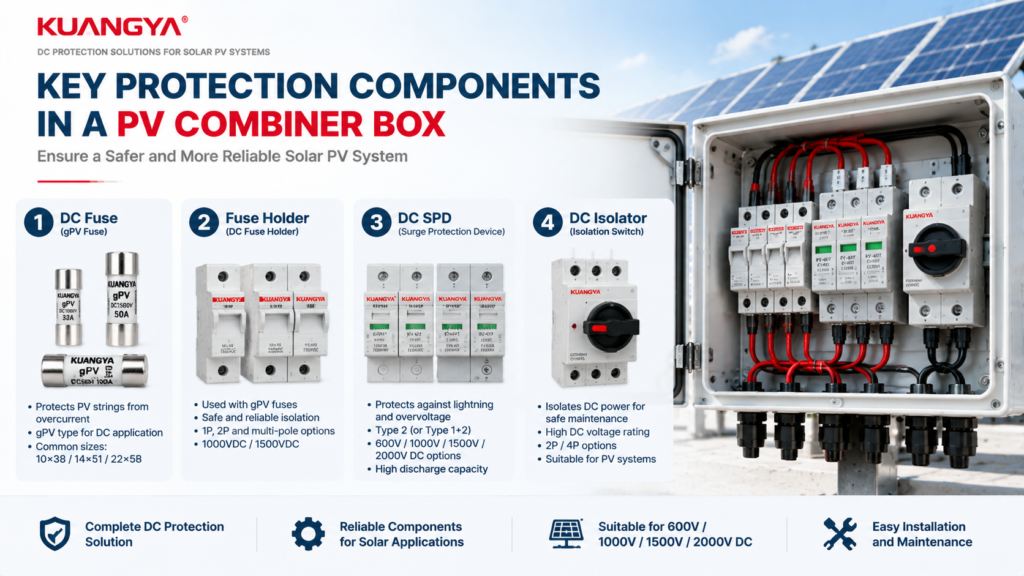
Os seguintes componentes também necessitam de classificações CC adequadas:
Um invólucro de 1000V CC não significa automaticamente que todos os componentes instalados são adequados para uma aplicação de 1000V CC.
Para mais informações, consulte o documento oficial Requisitos de projeto de arranjos fotovoltaicos IEC 62548-1.
A tensão é apenas uma parte do processo de seleção. A capacidade de corrente e a proteção contra sobrecorrente são igualmente importantes.
Uma caixa de junção (combiner box) devidamente especificada deve acomodar a corrente operacional das strings fotovoltaicas conectadas e o circuito de saída combinado.
As seguintes informações devem ser coletadas da folha de dados do módulo solar:
O engenheiro do projeto deve então calcular a corrente de projeto necessária de acordo com as normas aplicáveis e as condições de instalação.
Do not select fuse ratings using a universal multiplier without checking the actual module specifications and local design requirements.
PV string protection commonly uses dedicated gPV fuse links.
When selecting a fuse, verify:
| Especificação | O que verificar |
|---|---|
| Fuse category | Suitable gPV photovoltaic fuse |
| Tensão nominal | Compatible with maximum PV DC voltage |
| Corrente nominal | Coordinated with module and circuit requirements |
| Capacidade de ruptura | Suitable for the prospective fault current |
| Fuse holder | Compatible with the selected fuse and DC rating |
| Temperatura | Consider actual operating and enclosure conditions |
The fuse link and holder must be evaluated as a compatible protection assembly.
An oversized fuse may fail to provide the intended protection, while an undersized fuse may cause unwanted operation.
For more information, see the official IEC 60269-6 photovoltaic fuse standard.
You can also explore KUANGYA’s DC Fuse and Fuse Holder product range for photovoltaic protection applications.
Surge protection is another important consideration when purchasing a solar PV combiner box.
PV systems may be exposed to transient overvoltages caused by lightning activity and switching events.
A suitable DC Surge Protective Device (SPD) helps limit transient overvoltages and protect connected equipment.
However, not every project requires the same SPD configuration.
Before confirming the SPD specification, consider:
1. SPD type
Depending on the lightning protection design and installation conditions, the project may require Type 1, Type 2, or a combined Type 1+2 SPD.
2. Maximum continuous operating voltage (Ucpv)
The SPD’s operating voltage must be compatible with the maximum PV system voltage and grounding arrangement.
3. Discharge current
Check the required nominal discharge current (In), maximum discharge current (Imax), or impulse current (Iimp), as applicable.
4. Voltage protection level (Up)
The selected SPD must provide a suitable protection level for the equipment being protected.
5. Backup protection
Confirm the manufacturer’s requirements for backup overcurrent protection and short-circuit coordination.
6. Status indication
A visual status window helps maintenance personnel identify the operating condition of the SPD.
For projects requiring remote fault indication, an SPD with a remote signaling contact may also be considered.
For additional technical information, refer to IEC 61643-31: Requirements and test methods for SPDs for photovoltaic installations.
A PV combiner box may also incorporate a DC isolator or switch-disconnector to provide a means of disconnecting the DC circuit for maintenance and servicing.
However, isolation and overcurrent protection are not the same function.
A DC isolator is designed for the specified isolation and switching duty. It should not automatically be treated as a replacement for a properly selected fuse or circuit breaker.
Before purchasing, confirm:
The selected device must be suitable for the actual DC circuit and installation conditions.
Also check whether the inverter or another downstream device already provides the required switching function. This helps avoid unnecessary duplication.
For projects with different electrical architectures, the isolator configuration should be confirmed before manufacturing.
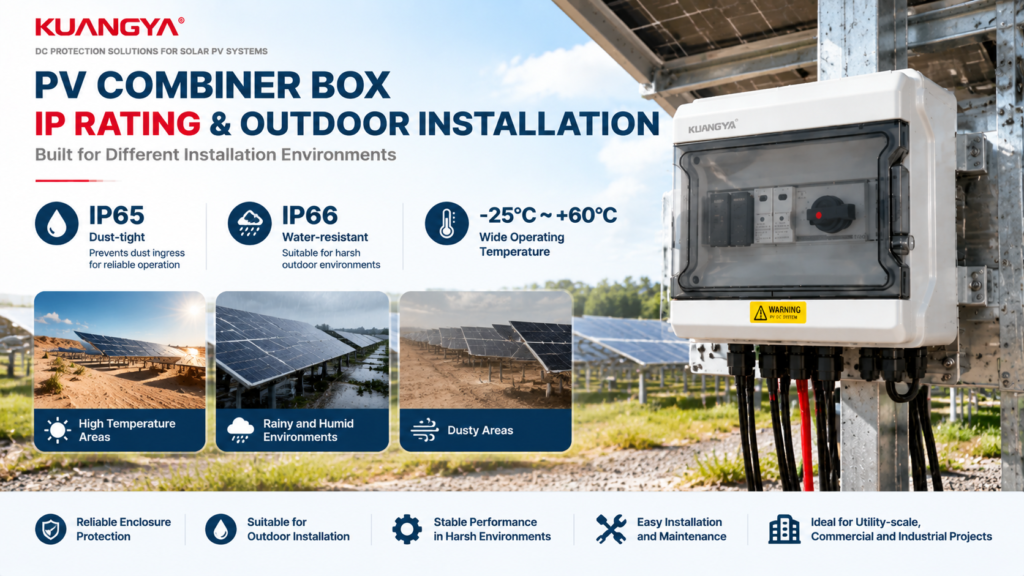
The enclosure protects the internal electrical components from environmental exposure and mechanical damage.
Choosing the wrong enclosure can affect long-term reliability, especially in outdoor PV installations.
Common enclosure protection levels include:
| Classificação IP | General protection description |
|---|---|
| IP54 | Limited dust protection and protection against water splashes |
| IP65 | Dust-tight and protected against water jets |
| IP66 | Dust-tight and protected against powerful water jets |
| IP67 | Dust-tight and protected against temporary immersion under specified test conditions |
The required rating depends on the actual installation environment and project specifications.
Por exemplo:
Commercial rooftop installations
Consider direct sunlight, temperature changes, rain exposure, and cable-entry sealing.
Coastal installations
Pay attention to corrosion resistance, material selection, and the effects of salt exposure.
Industrial environments
Evaluate dust, moisture, vibration, chemical exposure, and maintenance accessibility.
Ground-mounted solar farms
Consider UV exposure, enclosure durability, mounting arrangements, and long-term outdoor operation.
When evaluating a supplier’s enclosure, also check:
Remember that the enclosure’s effective protection depends on the complete installed assembly, including cable glands, unused openings, seals, and installation workmanship.
For larger commercial and industrial PV projects, monitoring functions can provide additional visibility into system operation.
A conventional combiner box mainly provides electrical connection and protection functions.
An intelligent PV combiner box can integrate additional monitoring and communication components.
| Monitoring function | Finalidade |
|---|---|
| Monitoramento de corrente das strings | Identify abnormal current differences between strings |
| DC voltage monitoring | Monitor DC operating conditions |
| Fuse status monitoring | Provide fault indication |
| Monitoramento do status do DPS | Identify SPD failure conditions |
| Monitoramento de temperatura | Monitor internal enclosure temperature |
| Remote alarm | Send fault signals to a monitoring system |
| Communication interface | Transfer operating data to an external controller |
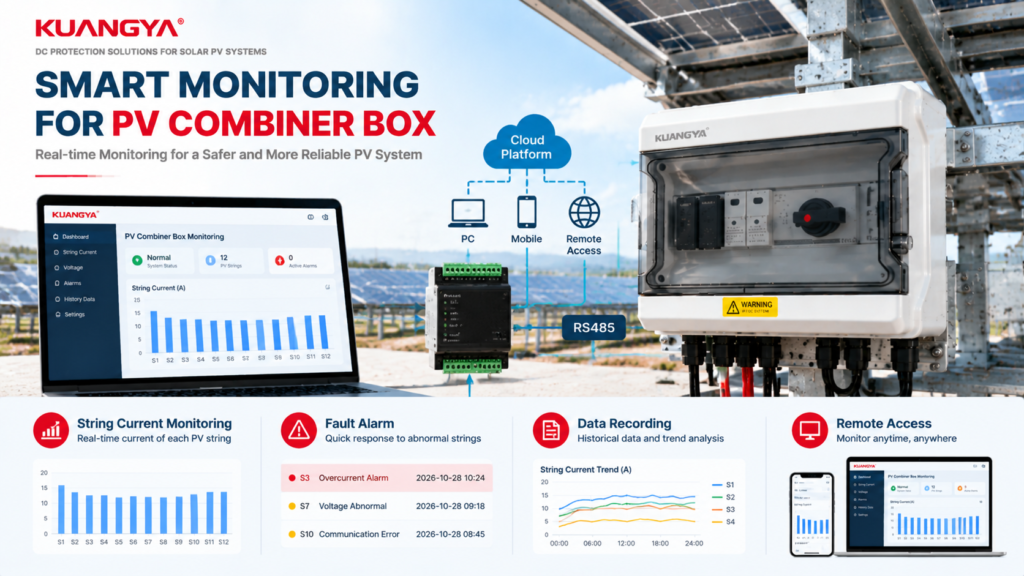
Depending on the project, communication may use RS485 and protocols such as Modbus RTU.
However, not every PV project needs all these functions.
Before purchasing, confirm:
For projects involving many PV strings, remote monitoring can help maintenance teams identify abnormal operating conditions without inspecting every string individually.
You can see how these functions can be integrated into a customized solution in our Projeto de Caixa de Junção Fotovoltaica de 16 Strings.
After confirming the eight factors above, the next step is to prepare a clear Request for Quotation (RFQ).
Providing complete project information helps manufacturers evaluate the required configuration and prepare a more accurate quotation.
Here is a practical checklist you can use.
| Information | Details to provide |
|---|---|
| Aplicativo | Residential, commercial, industrial, or utility-scale PV |
| Tensão do sistema | 600V, 1000V, 1500V DC, or project-specific |
| Número de strings | Total number of PV string inputs |
| Input/output configuration | 4-in/1-out, 8-in/1-out, 16-in/1-out, etc. |
| Corrente da string | Module Isc, Imp, and calculated design current |
| Fuse protection | Required fuse type, rating, and configuration |
| DPS | Type, Ucpv, In, Imax/Iimp, Up, and protection arrangement |
| DC isolation | Required isolator or switch-disconnector specifications |
| Gabinete | Material, IP rating, and installation environment |
| Monitoramento | Required measurement and communication functions |
| Quantidade | Estimated purchasing quantity |
| Destination market | Country and applicable project requirements |
| Documentação | Drawings, BOM, datasheets, certificates, and test records |
Suppose you are purchasing a customized PV combiner box for a commercial solar project.
Your initial inquiry could include:
This information provides a starting point for the manufacturer to review the configuration.
However, it is not a complete engineering specification. The module datasheets, inverter input limits, current calculations, grounding arrangement, and project-specific protection requirements must also be checked before the design is approved.
Even when the basic specifications appear correct, several purchasing mistakes can create problems during installation.
Mistake 1: Selecting a model based only on voltage
A 1000V label does not guarantee that every internal component is correctly rated.
Mistake 2: Ignoring inverter MPPT configuration
Not all PV strings can be combined into one output. Check the inverter architecture first.
Mistake 3: Choosing fuses based only on current
Fuse selection requires coordination with module limits, conductor capacity, fault conditions, and the applicable design requirements.
Mistake 4: Assuming every outdoor project needs the same IP rating
Environmental conditions differ. Specify the enclosure based on the actual installation location.
Mistake 5: Requesting monitoring without defining its functions
Simply asking for an intelligent combiner box is not enough. Specify the channels, measured parameters, communication protocol, and remote alarm requirements.
Mistake 6: Confirming production before reviewing the drawings
Always review the wiring diagram, component list, terminal arrangement, and enclosure layout before mass production.
Choosing a solar PV combiner box requires careful consideration of electrical ratings, protection devices, enclosure specifications, and monitoring requirements. Before placing an order, compare the manufacturer’s technical proposal with your project’s actual requirements to ensure that the selected configuration is suitable for your solar installation.
The number of strings depends on the model and customized design. Common configurations include 2, 4, 6, 8, and 16 inputs.
The final selection must also consider inverter architecture, MPPT grouping, current capacity, and protection requirements.
No. A 1000V-rated assembly should not be used in a 1500V DC application unless the complete assembly has been specifically designed and verified for the required voltage. All internal components must have suitable ratings.
The requirement depends on the project’s surge protection design, lightning risk assessment, installation arrangement, and applicable standards.
Where an SPD is required, its type, operating voltage, protection modes, and discharge ratings must be properly specified.
A standard combiner box primarily provides string collection and electrical protection.
An intelligent combiner box can additionally integrate monitoring sensors, communication modules, remote alarms, and other monitoring functions.
Yes. Depending on the manufacturer’s capabilities, the input/output configuration, voltage class, protection devices, enclosure, monitoring functions, and labeling can be customized to meet project requirements.
Depending on the project, request:
Make sure the documentation corresponds to the actual model, component configuration, and ratings being supplied.
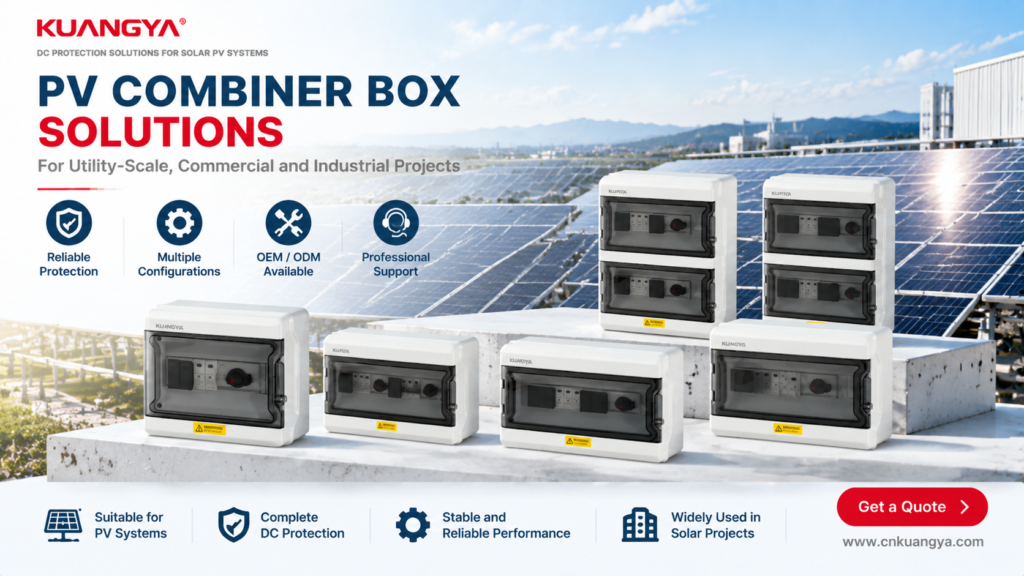
Choosing the right solar PV combiner box is not simply about finding a product with the correct number of inputs.
It requires a complete evaluation of electrical ratings, protection coordination, enclosure requirements, inverter compatibility, and project-specific monitoring functions.
Em KUANGYA, we provide PV combiner box solutions for different solar applications, including commercial and industrial photovoltaic systems.
Our product and customization capabilities cover:
We can also discuss OEM/ODM requirements for distributors, panel builders, and project contractors.
Explore our PV Combiner Box product range to learn more about available configurations.
Need a quotation for your project?
Send us your system voltage, number of PV strings, input/output configuration, protection requirements, monitoring needs, and estimated quantity.
Our team can help review your requirements and discuss a suitable PV combiner box solution.
Site: https://www.cnkuangya.com/
Contact: sales@cnkuangya.com
KUANGYA – Reliable DC Protection Solutions for Solar PV Systems.

