Промышленная зона Вэньян Юэцин Вэньчжоу 325000
Рабочие часы
Понедельник - пятница: 7AM - 7PM
Выходные: 10AM - 5PM
Промышленная зона Вэньян Юэцин Вэньчжоу 325000
Рабочие часы
Понедельник - пятница: 7AM - 7PM
Выходные: 10AM - 5PM

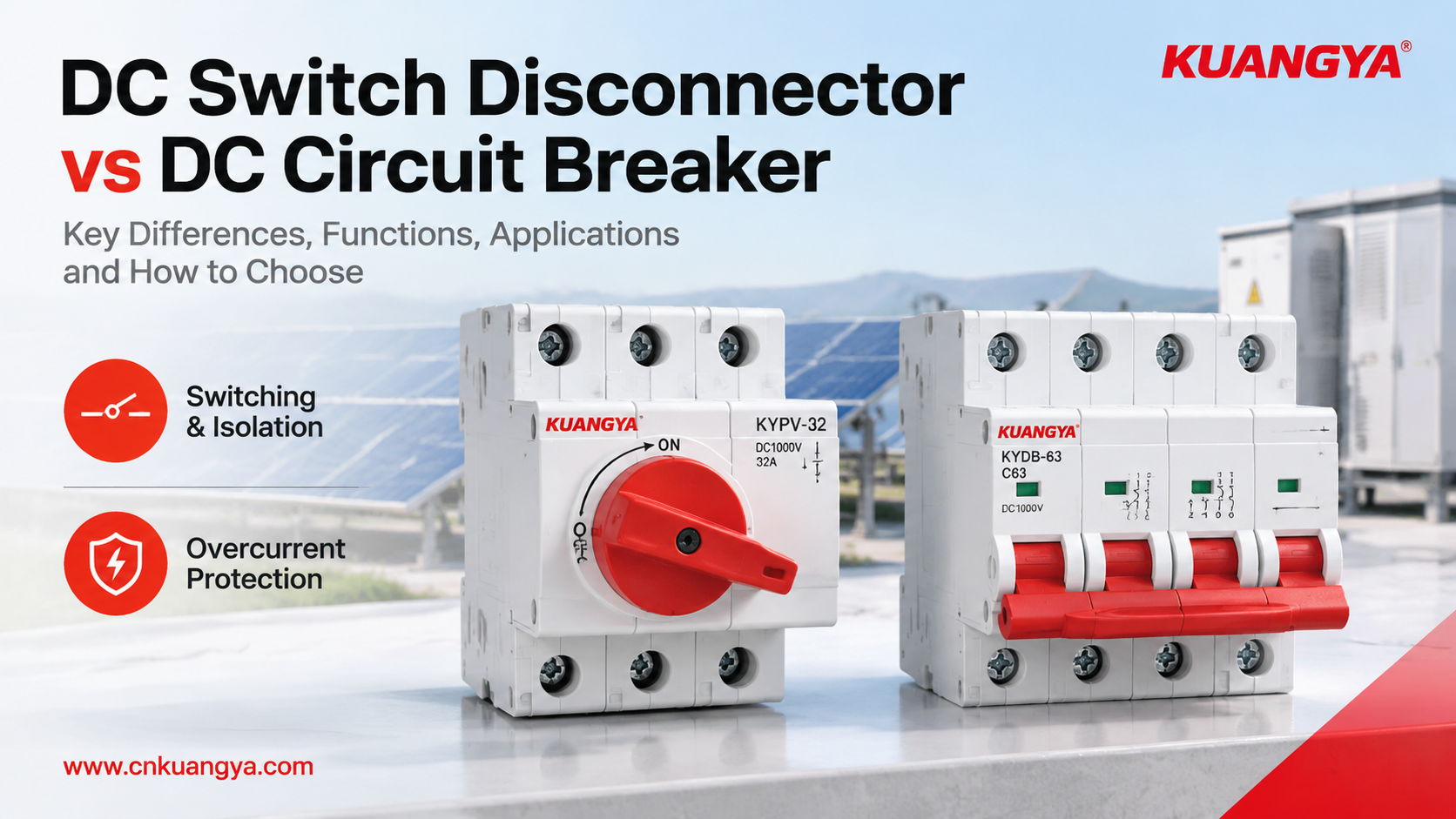
В солнечной фотоэлектрической системе Разъединитель постоянного тока против автоматического выключателя постоянного тока сравнение помогает инженерам и покупателям понять две разные функции: коммутацию и изоляцию против автоматической защиты от сверхтока. Хотя эти устройства могут выглядеть одинаково, выбор неправильного может оставить цепь без необходимой защиты или затруднить техническое обслуживание.
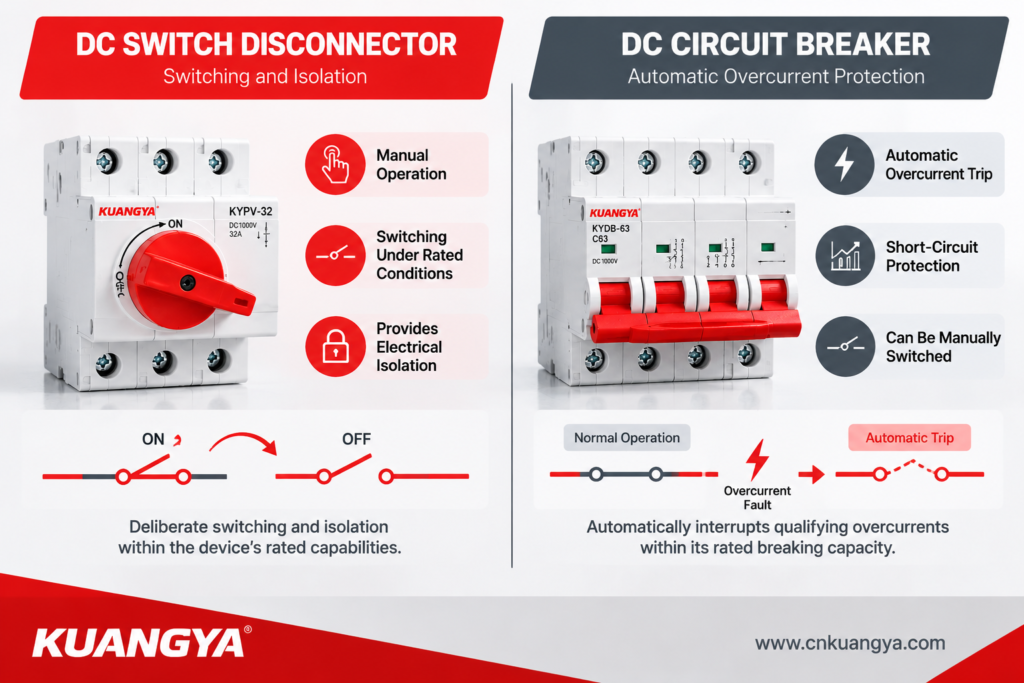
Разница между разъединителем постоянного тока и автоматическим выключателем постоянного тока сводится к их предполагаемым функциям: разъединитель обеспечивает коммутацию и изоляцию в пределах своих номинальных рабочих условий, в то время как автоматический выключатель предназначен для автоматического отключения при заданных сверхтоках и коротких замыканиях.
Однако различие не всегда так просто, как предполагает название продукта. Некоторые устройства сочетают функции коммутации и изоляции, а их фактические возможности зависят от их номинальных характеристик, конструкции и применимых стандартов.
Данное руководство сравнивает два устройства, объясняет шесть практических различий и показывает, как оценивать их в фотоэлектрических (PV) системах, распределительных коробках и других применениях постоянного тока.
Ключевой вывод: Разъединитель не является автоматически устройством защиты от короткого замыкания, и не следует автоматически предполагать, что автоматический выключатель обеспечивает все функции изоляции, необходимые для технического обслуживания.
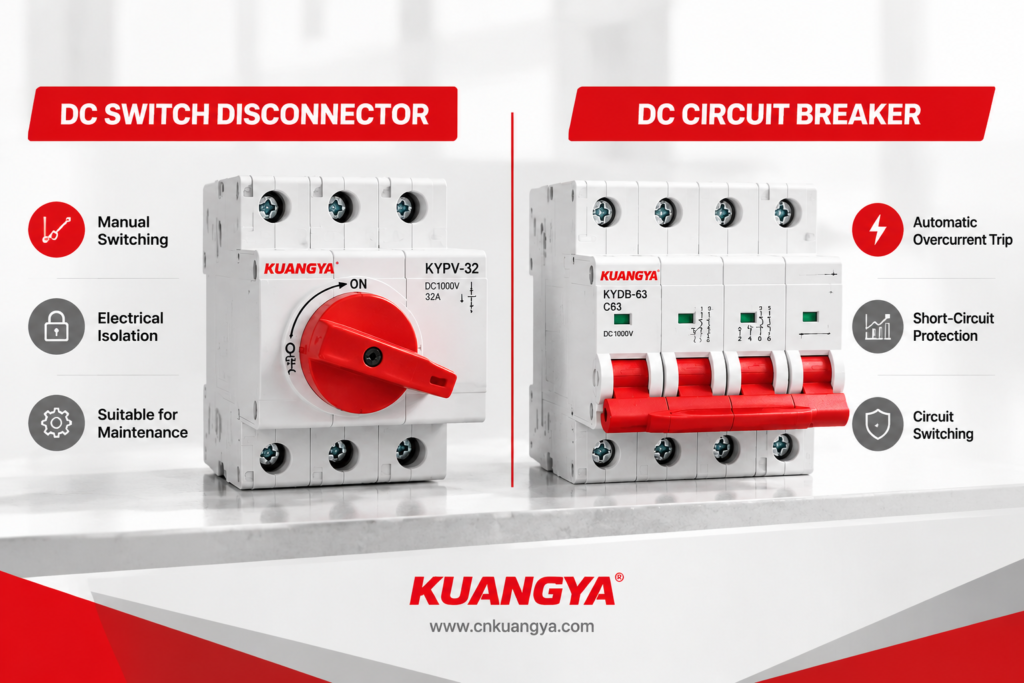
Разъединитель постоянного тока обычно управляется вручную для подключения или отключения цепи при определенных условиях. Автоматический выключатель постоянного тока может автоматически размыкать цепь, когда его защитный механизм обнаруживает перегрузку по току в пределах его рабочих характеристик.
| Точка сравнения | Выключатель постоянного тока Разъединитель | Автоматический выключатель постоянного тока |
|---|---|---|
| Основная функция | Коммутация и электрическая изоляция в соответствии с его номинальными характеристиками | Защита от сверхтока и коммутация цепи |
| Коммутация нормальной нагрузки | Да, если рассчитан на предполагаемую нагрузку | Да, в пределах его номинальных рабочих условий |
| Автоматическое отключение при перегрузке | Обычно не предусмотрено | Доступно в моделях, предназначенных для защиты от перегрузки |
| Прерывание короткого замыкания | Не является его обычной самостоятельной функцией | Да, в пределах его номинальной отключающей способности |
| Функция изоляции | Зависит от заявленной производителем возможности изоляции устройства | Зависит от его конструкции, маркировки и применимых требований |
| Типичная эксплуатация | Рукоятка или поворотный механизм | Ручное управление и автоматическое отключение |
| Средства блокировки | Может поддерживать навесной замок в положении ВЫКЛ | Зависит от модели и аксессуаров |
| Соответствующее семейство стандартов МЭК | IEC 60947-3 | МЭК 60947-2 для промышленных автоматических выключателей |
| Типичное применение в фотовольтаике | Плановое отключение и изоляция для обслуживания | Защита подходящих ответвлений или фидеров |
Сравнение описывает типичные функции продукта, а не каждое устройство на рынке. Всегда проверяйте технические характеристики и сертификацию конкретной модели.
При оценке Разъединитель постоянного тока против автоматического выключателя постоянного тока, не сравнивайте изделия только по номинальному напряжению или току. Проверьте, предназначено ли устройство для коммутации нагрузки, электрической изоляции, автоматического отключения или защиты от короткого замыкания. Эти функции должны соответствовать фактическим требованиям цепи постоянного тока.
Важно: Базовый разъединитель, предназначенный только для изоляции, не следует рассматривать как выключатель нагрузки. Аналогично, от выключателя-разъединителя не следует ожидать отключения короткого замыкания, если его конкретный рейтинг или утвержденная защитная сборка не допускают такой режим работы.
Наиболее важное различие заключается в том, для чего предназначено каждое устройство.
Разъединитель постоянного тока обеспечивает намеренное средство для размыкания цепи. Для вариантов продукции и деталей применения ознакомьтесь с нашим Выключатели-разъединители постоянного тока для солнечных фотоэлектрических систем, накопления энергии и других применений постоянного тока. Он может помочь установить определенную точку изоляции перед проверкой, техническим обслуживанием или заменой оборудования, при условии, что устройство подходит для данного применения.
Автоматический выключатель постоянного тока защищает соответствующим образом спроектированную цепь от указанных условий перегрузки по току. В зависимости от характеристик срабатывания, он может реагировать на перегрузки и короткие замыкания и прерывать ток в пределах своей номинальной мощности.
Рассмотрите следующий пример:
Солнечный распределительный щит подает питание на цепь постоянного тока, подключенную к инвертору. Во время технического обслуживания техническому специалисту необходимо изолировать соответствующую цепь. В случае возникновения аномального тока цепь также нуждается в соответствующем защитном оборудовании для отключения неисправности.
Это связанные, но разные требования. Проект должен предусматривать соответствующее устройство изоляции и защиту от сверхтока, а не ожидать, что один компонент будет выполнять функции, для которых он не предназначен.
Не каждый выключатель подходит для отключения цепи постоянного тока под нагрузкой.
Ток постоянного тока не имеет естественных периодических пересечений нуля, как в переменном токе. При размыкании контактов постоянного тока электрическая дуга может продолжать проводить ток, если устройство не спроектировано для его гашения при заданных условиях.
Выключатель-разъединитель, рассчитанный на соответствующий режим коммутации постоянного тока, может отключить цепь в пределах заявленных ограничений. Разъединитель, предназначенный для отключения под нагрузкой, может потребовать, чтобы ток был предварительно отключен другим подходящим устройством.
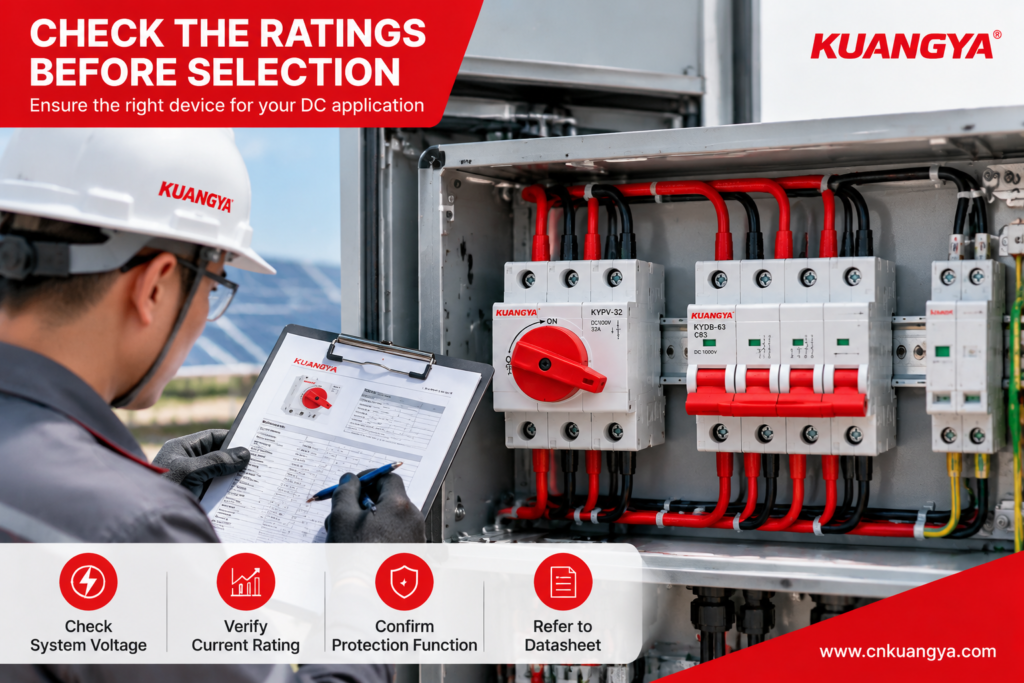
Перед выбором устройства проверьте:
Не следует полагать, что поворотная рукоятка, указанное на этикетке высокое напряжение или видимая маркировка ВКЛ/ВЫКЛ свидетельствуют о том, что устройство может отключать любой тип нагрузки постоянного тока.
Здесь различие становится особенно важным.
Автоматический выключатель постоянного тока предназначен для отключения указанных токов неисправности в пределах его номинальной отключающей способности и условий эксплуатации.
При оценке автоматического выключателя для применения в цепи постоянного тока проверьте его номинальную отключающую способность и совместимость с ожидаемым током короткого замыкания системы. См. наш ассортимент автоматических выключателей постоянного тока для вариантов продукции и номинальных характеристик.
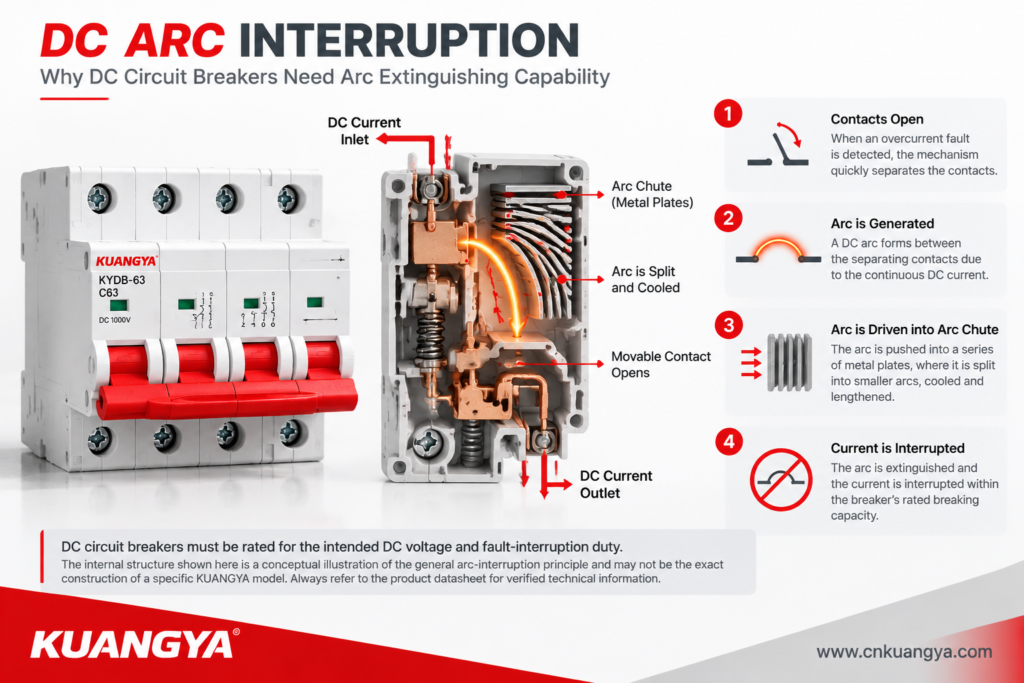
Разъединитель, напротив, обычно не предназначен для обеспечения независимой автоматической защиты от короткого замыкания. Он может иметь указанную способность выдерживать ток короткого замыкания в течение короткого времени или условный номинал короткого замыкания при использовании с назначенным защитным устройством.
Эти номиналы означают разное.
| Номинал или характеристика | Что это означает | Что это не означает автоматически |
|---|---|---|
| Номинальное рабочее напряжение | Напряжение, при котором устройство предназначено для работы в заданных условиях | Что устройство может отключить любой ток короткого замыкания при этом напряжении |
| Номинальный ток | Допустимый ток при указанных условиях | Что перегрузки вызовут автоматическое отключение |
| Разрывная способность | Ток короткого замыкания, который защитное устройство может отключить при заданных условиях | Что устройство подходит для любого напряжения постоянного тока или схемы |
| Короткое время допустимого тока | Ток короткого замыкания, который устройство может выдержать в течение заданного времени | Что оно может самостоятельно устранить неисправность |
| Условный ток короткого замыкания | Производительность при использовании с указанной защитной схемой | Что любой предохранитель или автоматический выключатель может быть заменен |
Для разъединителя постоянного тока проверьте заявленную коммутационную способность при коротком замыкании или условный рейтинг и требуемое вышестоящее защитное устройство.
Для автоматического выключателя постоянного тока проверьте номинальную отключающую способность постоянного тока и убедитесь, что она достаточна для ожидаемого тока короткого замыкания в точке установки.
Обычный выключатель-разъединитель управляется вручную. Обычно он не обнаруживает перегрузку и не отключается автоматически.
Автоматический выключатель с соответствующими защитными функциями может разомкнуть цепь, когда его механизм расцепления обнаружит соответствующую неисправность.
Это различие влияет на работу системы.
| Ситуация | Выключатель-разъединитель | Автоматический выключатель постоянного тока |
|---|---|---|
| Плановое техническое обслуживание | Обеспечивает подходящую точку ручной изоляции | Может обеспечивать коммутацию и изоляцию при наличии специальной пригодности |
| Длительная перегрузка | Does not normally trip automatically | Can trip if its protection characteristics detect the overload |
| Короткое замыкание | Must not be relied upon as standalone fault protection | Can interrupt the fault within its rated capability |
| Удаленный мониторинг | Requires suitable auxiliary contacts or additional equipment | May support auxiliary contacts or electronic monitoring, depending on model |
| Automatic fault response | Обычно не предусмотрено | Available according to the protection design |
A device’s ability to be switched remotely is not the same as its ability to provide automatic fault protection. Remote actuation, status monitoring, and protective tripping should be evaluated separately.
A 2-pole device is not automatically equivalent to a 4-pole device, and a voltage rating printed on a product should not be interpreted without checking the specified wiring arrangement.
Some DC switching devices use multiple contacts in series to achieve their declared voltage or interruption capability. In such cases, the manufacturer’s wiring diagram must be followed.
For example, a device rated for a particular DC voltage with a specified series-pole connection may not retain that rating when wired differently.
When comparing a DC switch disconnector with a DC circuit breaker, verify:
Do not choose a device based on “2P,” “4P,” or “1500V DC” alone. The complete combination of voltage, current, pole arrangement, and switching duty must match the intended application.
Maintenance safety involves more than turning a handle to OFF.
A suitable isolation arrangement should help personnel identify the correct circuit, prevent unintended reconnection, and follow the applicable safe-working procedure.
A DC switch disconnector may provide a lockable OFF position, but this feature must be confirmed for the specific model. A circuit breaker may also support locking accessories, although its suitability as the required isolation device must be verified separately.
For a planned maintenance task, consider the following:
An OFF indication alone is not proof that an electrical circuit is safe to touch.
In many photovoltaic installations, the switch disconnector and circuit breaker serve complementary roles.
A typical protection arrangement may include:
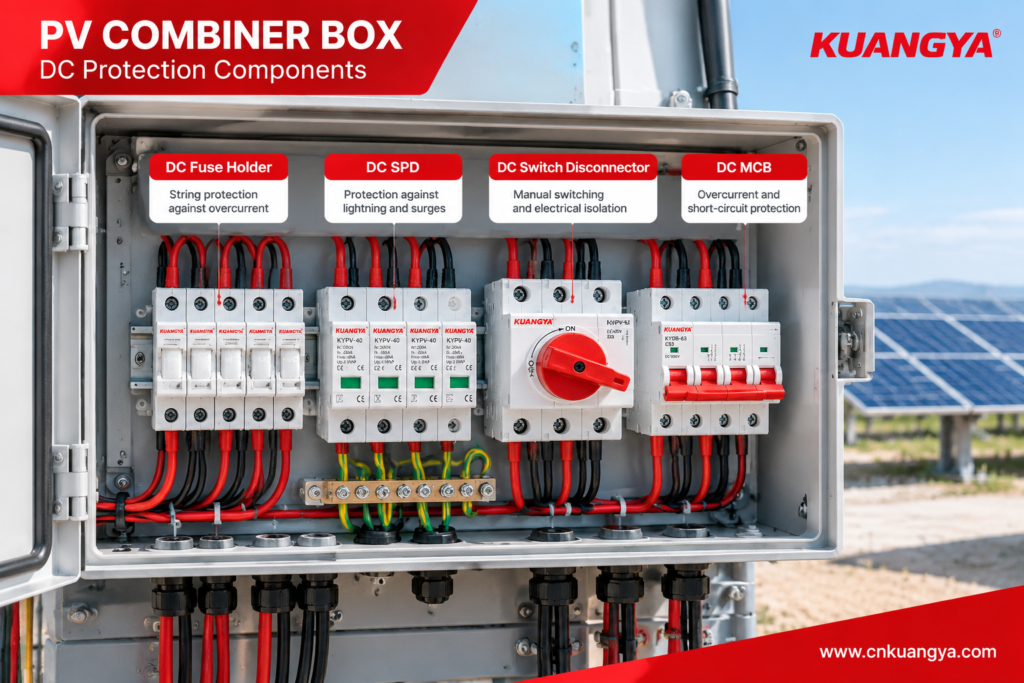
The exact arrangement depends on the system architecture, inverter requirements, prospective fault current, earthing arrangement, and applicable standards. For a closer look at how fuses, SPDs, disconnect switches, and other components work together, read our solar combiner box protection and maintenance guide. Not every installation requires all four devices in the same location.
| Компонент | Главная цель | Selection Check |
|---|---|---|
| gPV fuse and fuse holder | PV string overcurrent protection | Rated voltage, current, fuse characteristic, and fault-interruption capability |
| DC SPD | Transient overvoltage protection | PV-specific rating, protection level, and applicable SPD standard |
| Выключатель-разъединитель постоянного тока | Коммутация и изоляция | Rated DC switching duty, isolation capability, and connection arrangement |
| Автоматический выключатель постоянного тока | Overcurrent protection where required | Trip characteristics, rated breaking capacity, and system compatibility |
A combiner box with a fuse, SPD, and switch disconnector does not automatically provide every protective function that a circuit breaker would provide. Each component must be selected for its intended role.
For related technical guidance, see our Solar DC Protection Guide и PV Combiner Box Guide.
The following cases are illustrative engineering scenarios based on common equipment-selection and system-coordination issues. They are not presented as documented KUANGYA customer incidents or laboratory test results.
Ситуация
A panel designer selects a DC switch disconnector because its voltage and current ratings appear to match the circuit. The design does not include a suitable protective device for the relevant fault condition.
What is wrong?
The selected switch may be suitable for manual switching and isolation but may not have the capability to interrupt the prospective short-circuit current.
Corrective action
Lesson: A matching voltage and current label does not prove that a switch can clear a short circuit.
Ситуация
A buyer chooses an AC-rated switching device because its current rating appears sufficient for a solar DC circuit.
What is wrong?
The device may not have been tested or rated to interrupt the specified DC current. Its arc-extinguishing design and contact arrangement may be unsuitable for the application.
Corrective action
Use a device with an explicit DC rating for the actual system voltage, current, and switching duty. Follow the manufacturer’s approved wiring diagram.
Lesson: AC and DC ratings are not interchangeable unless the manufacturer explicitly declares the relevant capability.
Ситуация
A maintenance team assumes that switching a circuit breaker to OFF automatically satisfies all site isolation requirements.
What is wrong?
The breaker may not provide every required isolation, locking, or work-control feature for the particular installation. Other energy sources or backfeed paths may also remain present.
Corrective action
Check the device’s isolation suitability, locking provisions, circuit arrangement, and site procedures. Use the designated isolation method and verify the absence of voltage before work.
Lesson: Protection, isolation, and safe-work procedures are related but distinct requirements.
Use the following guide as a starting point, then confirm the choice against the applicable standard and the manufacturer’s documentation.
| Application Requirement | Appropriate Direction |
|---|---|
| Manual disconnection for planned maintenance | A suitable DC switch disconnector or isolator |
| Automatic overload protection | A suitably rated DC circuit breaker or other approved protective device |
| Прерывание короткого замыкания | A protective device with sufficient DC breaking capacity |
| Both switching and isolation | A switch disconnector rated for the required duty, or another approved arrangement |
| PV string reverse-current protection | A correctly selected gPV fuse where required by the design |
| Transient overvoltage protection | A suitably rated DC SPD |
| Isolation and overcurrent protection | A coordinated combination of devices, unless an approved integrated solution provides the required functions |
For photovoltaic projects, the decision should be based on the system’s maximum DC voltage, current, prospective fault current, required isolation points, and applicable local requirements.
A device that is suitable for one part of a PV installation may not be suitable for another.
IEC 60947-3 covers switches, disconnectors, switch-disconnectors, and fuse-combination units within its scope. Buyers should check the applicable edition and the device’s declared ratings before selecting a product. IEC 60947-2 specifies requirements for circuit breakers within its scope, including relevant DC applications. Check the applicable edition and the manufacturer’s documentation to verify that the selected device meets the project’s requirements.
The applicable edition, product scope, and any relevant product-specific requirements should be checked for the intended application.
For more information about DC isolation principles and photovoltaic applications, see our DC switch disconnector technical guide.
Before issuing a purchase order, ask the supplier to confirm the following:
| Checkpoint | Information to Request |
|---|---|
| Product identity | Exact model and intended function |
| Номинальное напряжение | Rated DC voltage and any limitations |
| Current rating | Rated operational or continuous current under stated conditions |
| Switching duty | Permitted load-breaking conditions and utilization category |
| Fault performance | Breaking capacity for breakers; applicable withstand or conditional rating for disconnectors |
| Pole arrangement | Approved wiring diagram and pole configuration |
| Изоляция | Declared isolation suitability and operating indication |
| Locking | Whether the OFF position can be secured, if required |
| Стандарты | Applicable standard, edition, and supporting conformity documentation |
| Экологическая пригодность | Temperature limits, enclosure protection, terminals, and derating |
| Traceability | Model-specific datasheet, markings, and relevant test documentation |
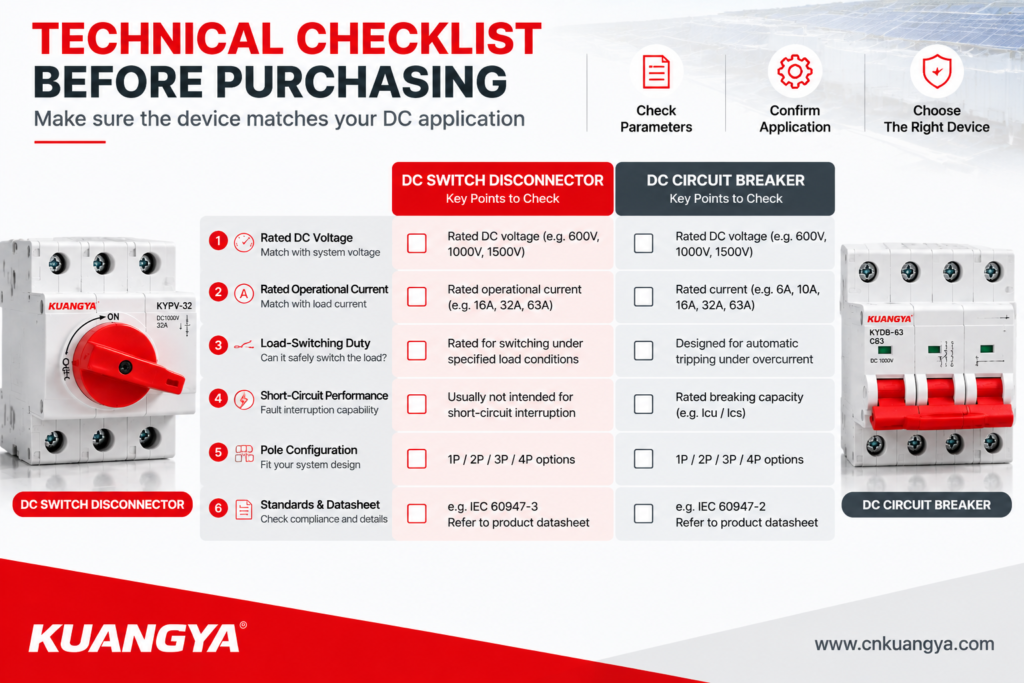
Avoid comparing suppliers solely by voltage, current, or unit price. Two products with similar front-panel markings may have different switching capabilities and short-circuit ratings.
No. A switch disconnector is intended for switching and isolation within its declared ratings. A DC circuit breaker provides automatic overcurrent protection within its rated protective capability. Their functions may overlap in some respects, but the devices are not automatically interchangeable.
Not as a general rule. A switch disconnector does not normally provide standalone automatic overload and short-circuit protection. A suitable protective device must be included where required by the system design.
Not automatically. Confirm that the breaker is suitable for the required isolation function, operating conditions, and maintenance procedures.
Each device must be rated for the actual maximum system voltage and its intended duty. A nominal 1500V system label alone is insufficient; verify the device ratings and approved connection arrangement.
IEC 60947-3 is relevant to switches, disconnectors, and switch-disconnectors. IEC 60947-2 is relevant to industrial circuit breakers. Other standards or requirements may apply depending on the product and installation.
Provide the application, maximum DC voltage, operating current, prospective fault current if known, required poles, switching duty, installation environment, quantity, and any required certifications or documentation. Include the system wiring diagram when possible.
Выбор правильного Разъединитель постоянного тока против автоматического выключателя постоянного тока solution starts with understanding the function each device needs to perform. A switch disconnector provides switching and isolation within its rated capabilities, while a circuit breaker provides automatic overcurrent protection within its rated breaking capacity. The final choice should match the system voltage, operating current, fault conditions, and applicable standards.
For solar PV systems, the right choice depends on the maximum DC voltage, operating current, prospective fault current, required isolation functions, and applicable standards. Always verify the manufacturer’s datasheet and ensure that all protective devices work together as intended.
KUANGYA provides DC switch disconnectors and DC protection components for photovoltaic and other electrical applications. If you are selecting components for a new project, contact our team with your system specifications to discuss a suitable solution.
Explore our Выключатель постоянного тока Разъединитель и DC MCB product ranges for more information.