Zona industriale di WengYang Yueqing Wenzhou 325000
Orario di lavoro
Da lunedì a venerdì: dalle 7.00 alle 19.00
Fine settimana: 10.00 - 17.00
Zona industriale di WengYang Yueqing Wenzhou 325000
Orario di lavoro
Da lunedì a venerdì: dalle 7.00 alle 19.00
Fine settimana: 10.00 - 17.00

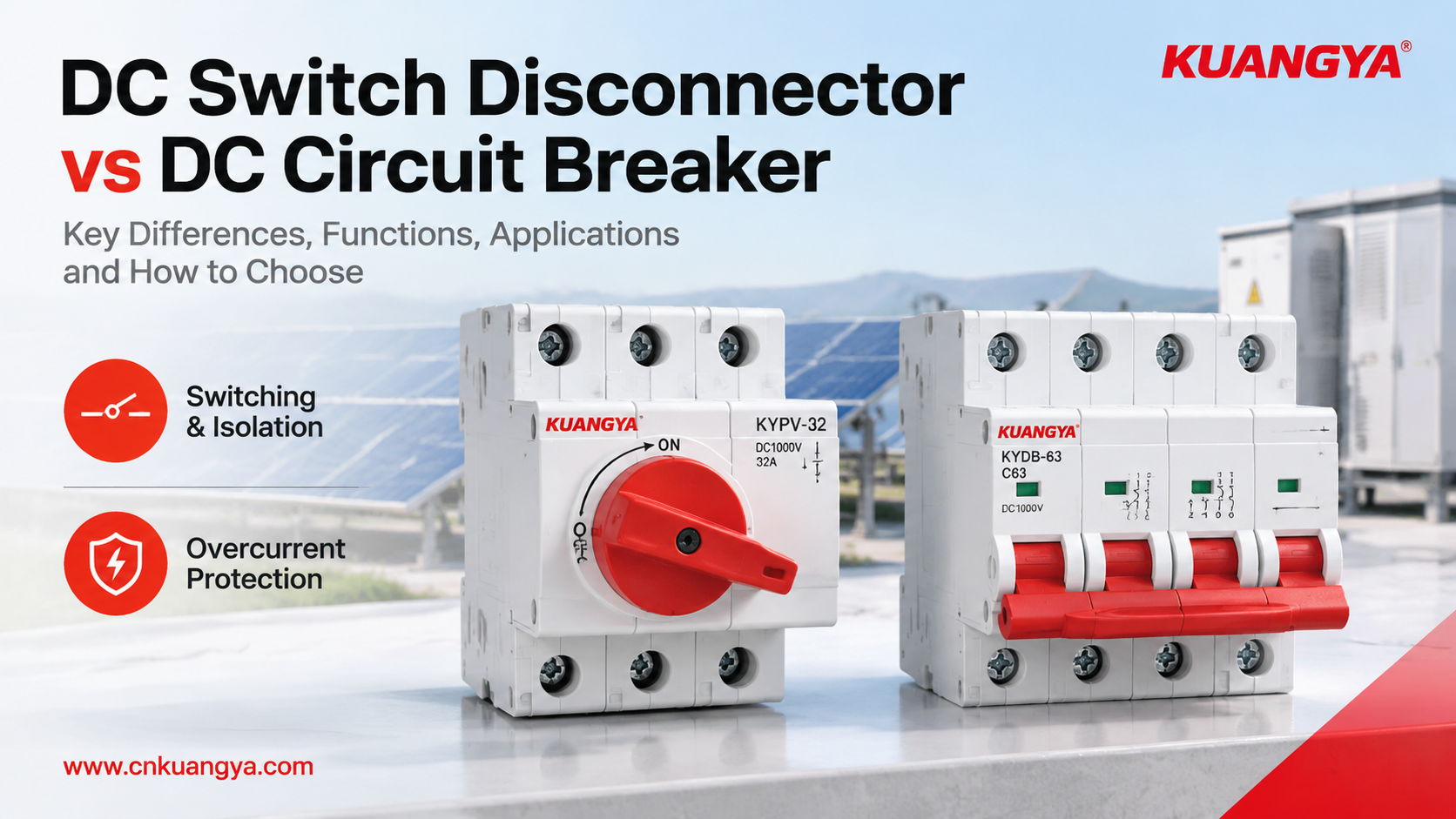
In un sistema fotovoltaico solare, un sezionatore di corrente continua vs interruttore automatico di corrente continua confronto aiuta ingegneri e acquirenti a comprendere due funzioni diverse: commutazione e isolamento rispetto alla protezione automatica da sovracorrente. Sebbene questi dispositivi possano sembrare simili, scegliere quello sbagliato può lasciare un circuito senza la protezione di cui ha bisogno o rendere più difficile la manutenzione.
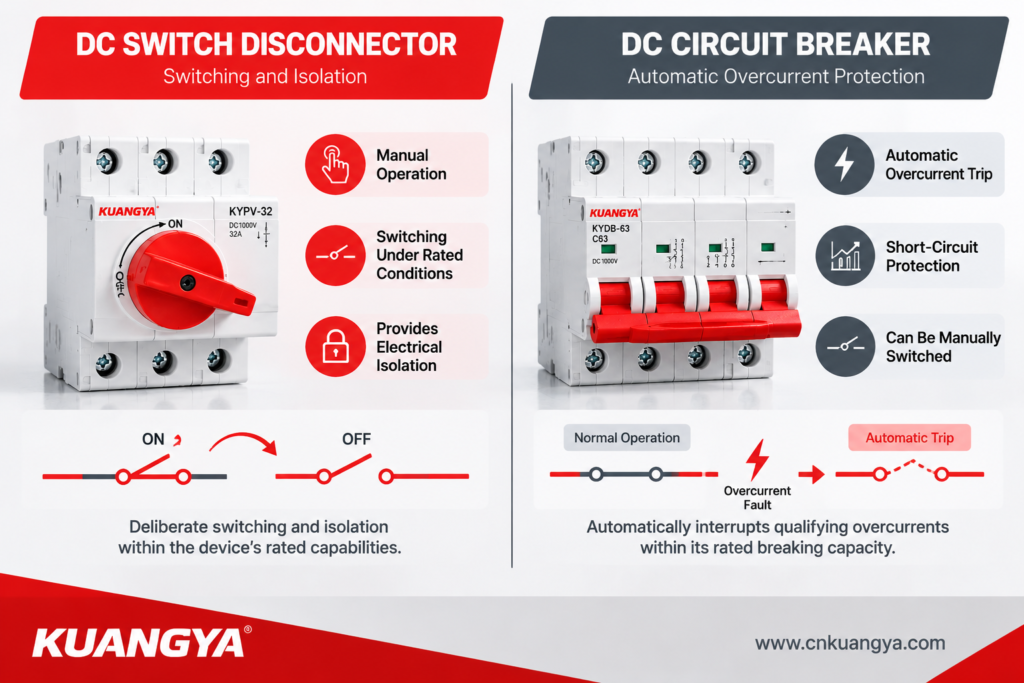
La differenza tra un sezionatore di corrente continua vs. interruttore automatico di corrente continua si riduce alle loro funzioni previste: un sezionatore fornisce commutazione e isolamento entro le sue condizioni operative nominali, mentre un interruttore automatico è progettato per interrompere automaticamente sovracorrenti e cortocircuiti specificati.
Tuttavia, la distinzione non è sempre così semplice come suggerisce il nome del prodotto. Alcuni dispositivi combinano funzioni di commutazione e isolamento, e le loro capacità effettive dipendono dalle loro specifiche, dal design e dagli standard applicabili.
Questa guida confronta i due dispositivi, spiega sei differenze pratiche e mostra come valutarli nei sistemi fotovoltaici (PV), nelle scatole di derivazione e in altre applicazioni DC.
Il punto chiave da ricordare: Uno sezionatore non è automaticamente un dispositivo di protezione da cortocircuito, e un interruttore automatico non dovrebbe essere automaticamente considerato come in grado di fornire tutte le funzioni di isolamento richieste per la manutenzione.
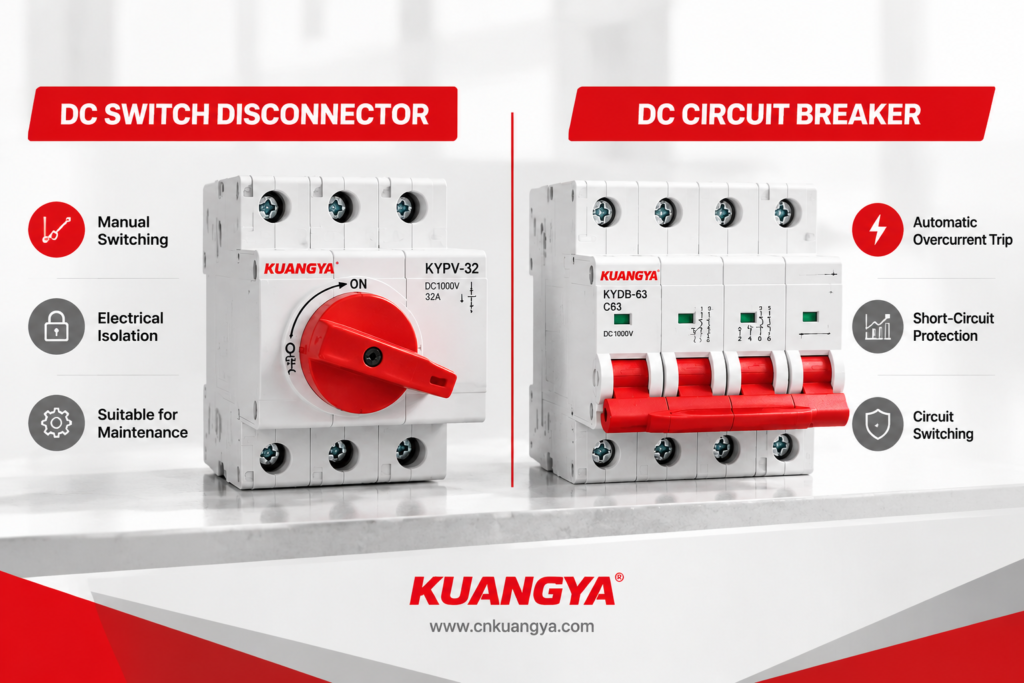
Un sezionatore DC viene generalmente azionato manualmente per connettere o disconnettere un circuito in condizioni specificate. Un interruttore automatico DC può aprire automaticamente un circuito quando il suo meccanismo di protezione rileva una sovracorrente entro le sue caratteristiche operative.
| Punto di confronto | Sezionatore DC | Interruttore CC |
|---|---|---|
| Funzione primaria | Commutazione e isolamento elettrico, secondo la sua specifica | Protezione da sovracorrente e commutazione di circuito |
| Commutazione di carico normale | Sì, se dimensionato per l'uso previsto | Sì, entro le sue condizioni operative nominali |
| Intervento automatico per sovraccarico | Normalmente non fornito | Disponibile sui modelli progettati per la protezione da sovraccarico |
| Interruzione per cortocircuito | Non è la sua normale funzione autonoma | Sì, entro la sua capacità di interruzione nominale |
| Funzione di sezionamento | Dipende dalla capacità di sezionamento dichiarata dal dispositivo | Dipende dal suo design, dalle marcature e dai requisiti applicabili |
| Funzionamento tipico | Maniglia manuale o meccanismo rotativo | Azionamento manuale e sgancio automatico |
| Dispositivi di blocco | Può supportare un lucchetto in posizione OFF | Dipende dal modello e dagli accessori |
| Famiglia di standard IEC pertinente | IEC 60947-3 | IEC 60947-2 per interruttori industriali |
| Tipica applicazione fotovoltaica | Disconnessione pianificata e isolamento per manutenzione | Protezione di rami o linee di alimentazione idonei |
Il confronto descrive le funzioni tipiche del prodotto piuttosto che ogni dispositivo sul mercato. Controllare sempre la scheda tecnica e la certificazione del modello esatto.
Quando si valuta un sezionatore di corrente continua vs interruttore automatico di corrente continua, non confrontare i prodotti solo in base alla tensione o corrente nominale. Verificare se il dispositivo è progettato per la commutazione di carico, l'isolamento elettrico, lo sgancio automatico o l'interruzione di cortocircuito. Queste funzioni devono corrispondere ai requisiti effettivi del circuito CC.
Importante: Un sezionatore di base destinato solo all'isolamento non deve essere trattato come un interruttore di manovra-carico. Allo stesso modo, da un interruttore-sezionatore non ci si deve aspettare che interrompa un cortocircuito, a meno che la sua specifica classificazione o un gruppo di protezione approvato non ne consentano tale impiego.
La distinzione più importante è ciò per cui ciascun dispositivo è progettato.
Un interruttore-sezionatore CC fornisce un mezzo deliberato per aprire un circuito. Per opzioni di prodotto e dettagli applicativi, esplora il nostro Sezionatori DC per applicazioni fotovoltaiche, di accumulo di energia e altre applicazioni DC. Può aiutare a stabilire un punto di isolamento definito prima di ispezioni, manutenzioni o sostituzioni di apparecchiature, a condizione che il dispositivo sia idoneo all'applicazione.
Un interruttore automatico DC protegge un circuito opportunamente progettato da specifiche condizioni di sovracorrente. A seconda delle sue caratteristiche di intervento, può rispondere a sovraccarichi e cortocircuiti e interrompere la corrente entro la sua capacità nominale.
Considerare il seguente esempio:
Una scatola di combinazione solare alimenta un circuito CC collegato a un inverter. Durante la manutenzione, un tecnico deve isolare il circuito pertinente. Se si verifica una corrente anomala, il circuito necessita anche di un'adeguata apparecchiatura di protezione per interrompere il guasto.
Questi sono requisiti correlati ma diversi. La progettazione dovrebbe specificare il dispositivo di isolamento e la protezione da sovracorrente appropriati, piuttosto che aspettarsi che un componente svolga funzioni per le quali non è stato dimensionato.
Non tutti gli interruttori sono adatti per aprire un circuito CC sotto carico.
La corrente CC non presenta gli attraversamenti periodici dello zero naturali presenti nella corrente CA. Quando i contatti CC si separano, un arco elettrico può continuare a condurre corrente a meno che il dispositivo non sia progettato per interromperlo nelle condizioni specificate.
Un sezionatore di manovra rated per il relativo servizio di commutazione CC può aprire un circuito entro i suoi limiti dichiarati. Un sezionatore destinato all'isolamento fuori carico potrebbe richiedere che la corrente venga prima interrotta da un altro dispositivo idoneo.
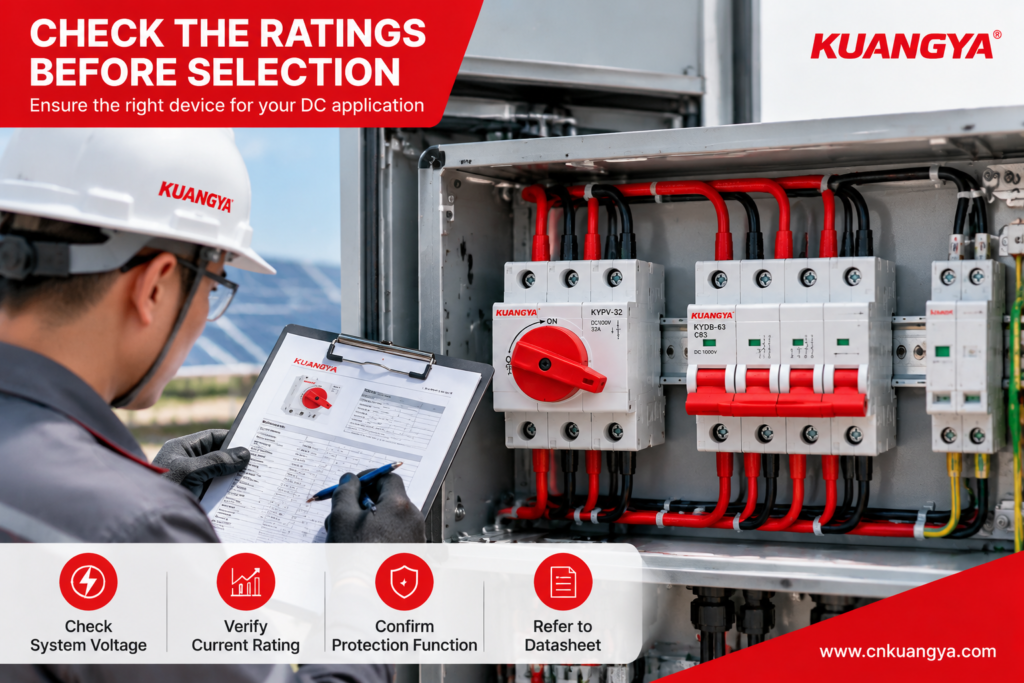
Prima di selezionare un dispositivo, verificare:
Non presumere che una maniglia rotante, una tensione elevata stampata sull'etichetta o un'indicazione ON/OFF visibile dimostrino che un dispositivo può interrompere ogni tipo di carico DC.
È qui che la distinzione diventa particolarmente importante.
Un interruttore CC è progettato per interrompere correnti di guasto specificate entro la sua capacità di interruzione nominale e le condizioni operative.
Quando si valuta un interruttore per un'applicazione CC, esaminare la sua capacità di interruzione nominale e la compatibilità con la corrente di guasto prospettica del sistema. Vedere la nostra gamma di MCB CC per opzioni di prodotto e specifiche nominali.
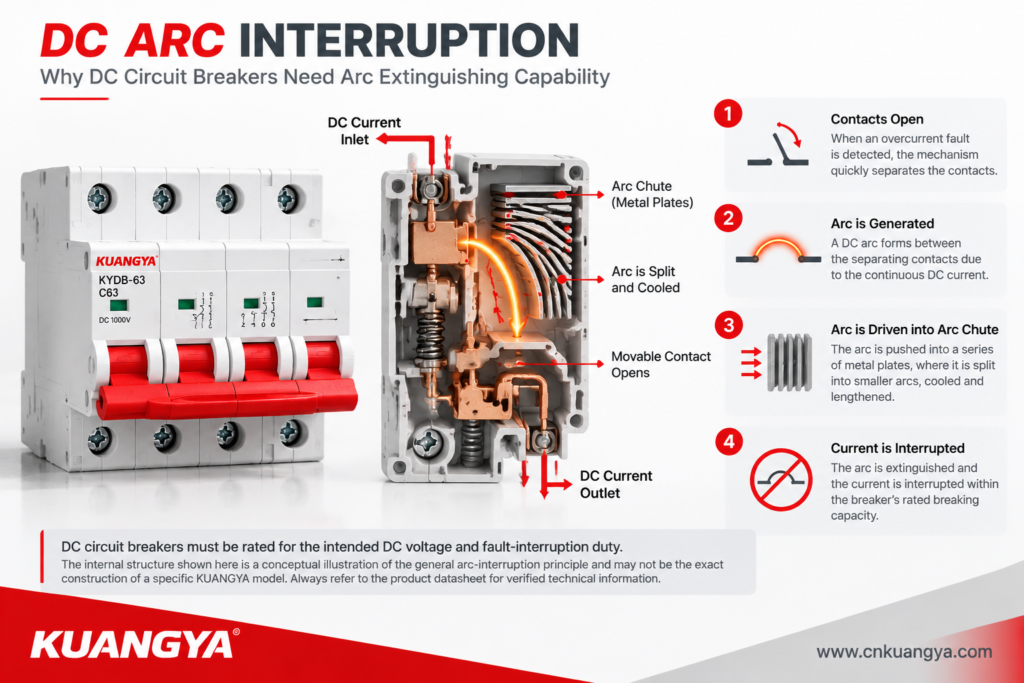
Un sezionatore, al contrario, non è normalmente destinato a fornire una protezione automatica indipendente da cortocircuito. Potrebbe avere una capacità di tenuta a breve termine specificata o una corrente di cortocircuito condizionale quando utilizzato con un dispositivo di protezione designato.
Queste classificazioni significano cose diverse.
| Classificazione o Caratteristica | Cosa Ti Dice | Cosa Non Significa Automaticamente |
|---|---|---|
| Tensione operativa nominale | Tensione alla quale il dispositivo è destinato a funzionare in condizioni specificate | Che il dispositivo può interrompere qualsiasi guasto a quella tensione |
| Corrente nominale | Corrente permessa nelle condizioni dichiarate | Che i sovraccarichi attiveranno uno sgancio automatico |
| Capacità di rottura | Corrente di guasto che un dispositivo di protezione può interrompere in condizioni specificate | Che il dispositivo è adatto per ogni tensione CC o configurazione di circuito |
| Corrente di tenuta di breve durata | Corrente di guasto che il dispositivo può sopportare per una durata specificata | Che può eliminare autonomamente il guasto |
| Potere di interruzione condizionato di cortocircuito | Prestazioni quando utilizzato con il dispositivo di protezione specificato | Che qualsiasi fusibile o interruttore può essere sostituito |
Per un sezionatore di corrente continua, verificare la corrente di cortocircuito nominale dichiarata o la corrente condizionale e il dispositivo di protezione a monte richiesto.
Per un interruttore automatico di corrente continua, controllare la capacità nominale di interruzione in corrente continua e confermare che sia sufficiente per la corrente di cortocircuito presunta nel punto di installazione.
Un sezionatore convenzionale viene azionato manualmente. Normalmente non rileva un sovraccarico e non interviene automaticamente.
Un interruttore automatico con adeguate funzioni di protezione può aprire un circuito quando il suo meccanismo di sgancio rileva un guasto qualificante.
Questa differenza influisce sul funzionamento del sistema.
| Situazione | Interruttore sezionatore | Interruttore CC |
|---|---|---|
| Manutenzione programmata | Fornisce un punto di isolamento manuale idoneo | Può fornire commutazione e isolamento se specificamente idoneo |
| Sovraccarico prolungato | Does not normally trip automatically | Can trip if its protection characteristics detect the overload |
| Cortocircuito | Must not be relied upon as standalone fault protection | Can interrupt the fault within its rated capability |
| Monitoraggio remoto | Requires suitable auxiliary contacts or additional equipment | May support auxiliary contacts or electronic monitoring, depending on model |
| Automatic fault response | Normalmente non fornito | Available according to the protection design |
A device’s ability to be switched remotely is not the same as its ability to provide automatic fault protection. Remote actuation, status monitoring, and protective tripping should be evaluated separately.
A 2-pole device is not automatically equivalent to a 4-pole device, and a voltage rating printed on a product should not be interpreted without checking the specified wiring arrangement.
Some DC switching devices use multiple contacts in series to achieve their declared voltage or interruption capability. In such cases, the manufacturer’s wiring diagram must be followed.
For example, a device rated for a particular DC voltage with a specified series-pole connection may not retain that rating when wired differently.
When comparing a DC switch disconnector with a DC circuit breaker, verify:
Do not choose a device based on “2P,” “4P,” or “1500V DC” alone. The complete combination of voltage, current, pole arrangement, and switching duty must match the intended application.
Maintenance safety involves more than turning a handle to OFF.
A suitable isolation arrangement should help personnel identify the correct circuit, prevent unintended reconnection, and follow the applicable safe-working procedure.
A DC switch disconnector may provide a lockable OFF position, but this feature must be confirmed for the specific model. A circuit breaker may also support locking accessories, although its suitability as the required isolation device must be verified separately.
For a planned maintenance task, consider the following:
An OFF indication alone is not proof that an electrical circuit is safe to touch.
In many photovoltaic installations, the switch disconnector and circuit breaker serve complementary roles.
A typical protection arrangement may include:
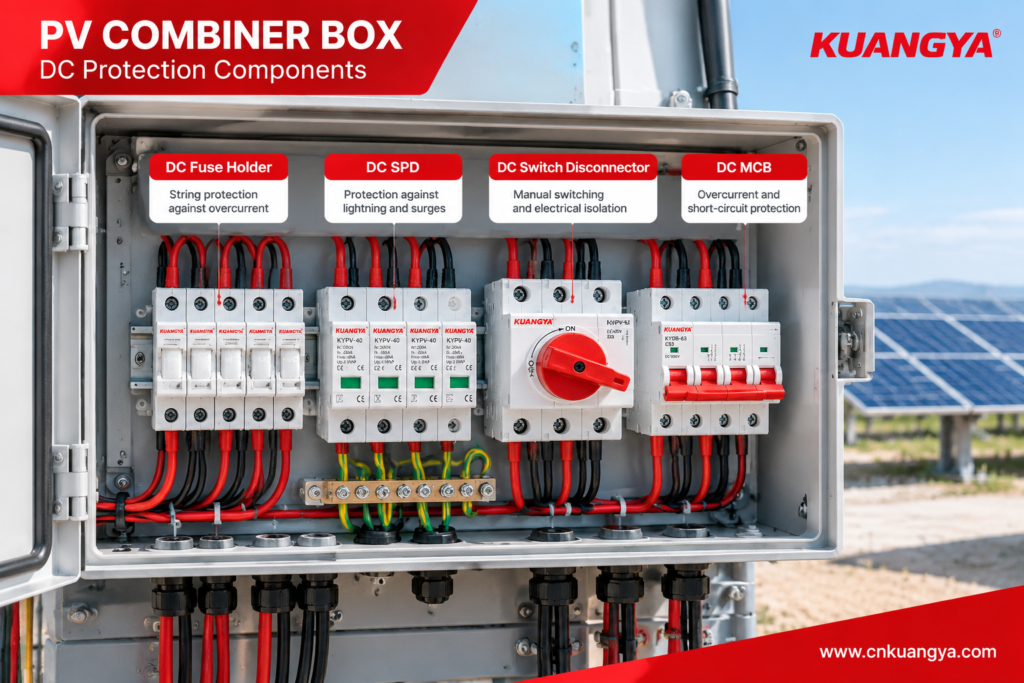
The exact arrangement depends on the system architecture, inverter requirements, prospective fault current, earthing arrangement, and applicable standards. For a closer look at how fuses, SPDs, disconnect switches, and other components work together, read our solar combiner box protection and maintenance guide. Not every installation requires all four devices in the same location.
| Componente | Scopo principale | Selection Check |
|---|---|---|
| gPV fuse and fuse holder | PV string overcurrent protection | Rated voltage, current, fuse characteristic, and fault-interruption capability |
| SPD DC | Protezione da sovratensioni transitorie | PV-specific rating, protection level, and applicable SPD standard |
| Sezionatore DC | Commutazione e sezionamento | Rated DC switching duty, isolation capability, and connection arrangement |
| Interruttore CC | Overcurrent protection where required | Trip characteristics, rated breaking capacity, and system compatibility |
A combiner box with a fuse, SPD, and switch disconnector does not automatically provide every protective function that a circuit breaker would provide. Each component must be selected for its intended role.
For related technical guidance, see our Solar DC Protection Guide e PV Combiner Box Guide.
The following cases are illustrative engineering scenarios based on common equipment-selection and system-coordination issues. They are not presented as documented KUANGYA customer incidents or laboratory test results.
Situazione
A panel designer selects a DC switch disconnector because its voltage and current ratings appear to match the circuit. The design does not include a suitable protective device for the relevant fault condition.
What is wrong?
The selected switch may be suitable for manual switching and isolation but may not have the capability to interrupt the prospective short-circuit current.
Corrective action
Lesson: A matching voltage and current label does not prove that a switch can clear a short circuit.
Situazione
A buyer chooses an AC-rated switching device because its current rating appears sufficient for a solar DC circuit.
What is wrong?
The device may not have been tested or rated to interrupt the specified DC current. Its arc-extinguishing design and contact arrangement may be unsuitable for the application.
Corrective action
Use a device with an explicit DC rating for the actual system voltage, current, and switching duty. Follow the manufacturer’s approved wiring diagram.
Lesson: AC and DC ratings are not interchangeable unless the manufacturer explicitly declares the relevant capability.
Situazione
A maintenance team assumes that switching a circuit breaker to OFF automatically satisfies all site isolation requirements.
What is wrong?
The breaker may not provide every required isolation, locking, or work-control feature for the particular installation. Other energy sources or backfeed paths may also remain present.
Corrective action
Check the device’s isolation suitability, locking provisions, circuit arrangement, and site procedures. Use the designated isolation method and verify the absence of voltage before work.
Lesson: Protection, isolation, and safe-work procedures are related but distinct requirements.
Use the following guide as a starting point, then confirm the choice against the applicable standard and the manufacturer’s documentation.
| Application Requirement | Appropriate Direction |
|---|---|
| Manual disconnection for planned maintenance | A suitable DC switch disconnector or isolator |
| Automatic overload protection | A suitably rated DC circuit breaker or other approved protective device |
| Interruzione per cortocircuito | A protective device with sufficient DC breaking capacity |
| Both switching and isolation | A switch disconnector rated for the required duty, or another approved arrangement |
| PV string reverse-current protection | A correctly selected gPV fuse where required by the design |
| Protezione da sovratensioni transitorie | A suitably rated DC SPD |
| Isolation and overcurrent protection | A coordinated combination of devices, unless an approved integrated solution provides the required functions |
For photovoltaic projects, the decision should be based on the system’s maximum DC voltage, current, prospective fault current, required isolation points, and applicable local requirements.
A device that is suitable for one part of a PV installation may not be suitable for another.
IEC 60947-3 covers switches, disconnectors, switch-disconnectors, and fuse-combination units within its scope. Buyers should check the applicable edition and the device’s declared ratings before selecting a product. IEC 60947-2 specifies requirements for circuit breakers within its scope, including relevant DC applications. Check the applicable edition and the manufacturer’s documentation to verify that the selected device meets the project’s requirements.
The applicable edition, product scope, and any relevant product-specific requirements should be checked for the intended application.
For more information about DC isolation principles and photovoltaic applications, see our DC switch disconnector technical guide.
Before issuing a purchase order, ask the supplier to confirm the following:
| Checkpoint | Information to Request |
|---|---|
| Product identity | Exact model and intended function |
| Tensione nominale | Rated DC voltage and any limitations |
| Current rating | Rated operational or continuous current under stated conditions |
| Switching duty | Permitted load-breaking conditions and utilization category |
| Fault performance | Breaking capacity for breakers; applicable withstand or conditional rating for disconnectors |
| Pole arrangement | Approved wiring diagram and pole configuration |
| Isolamento | Declared isolation suitability and operating indication |
| Locking | Whether the OFF position can be secured, if required |
| Standard | Applicable standard, edition, and supporting conformity documentation |
| Idoneità ambientale | Temperature limits, enclosure protection, terminals, and derating |
| Traceability | Model-specific datasheet, markings, and relevant test documentation |
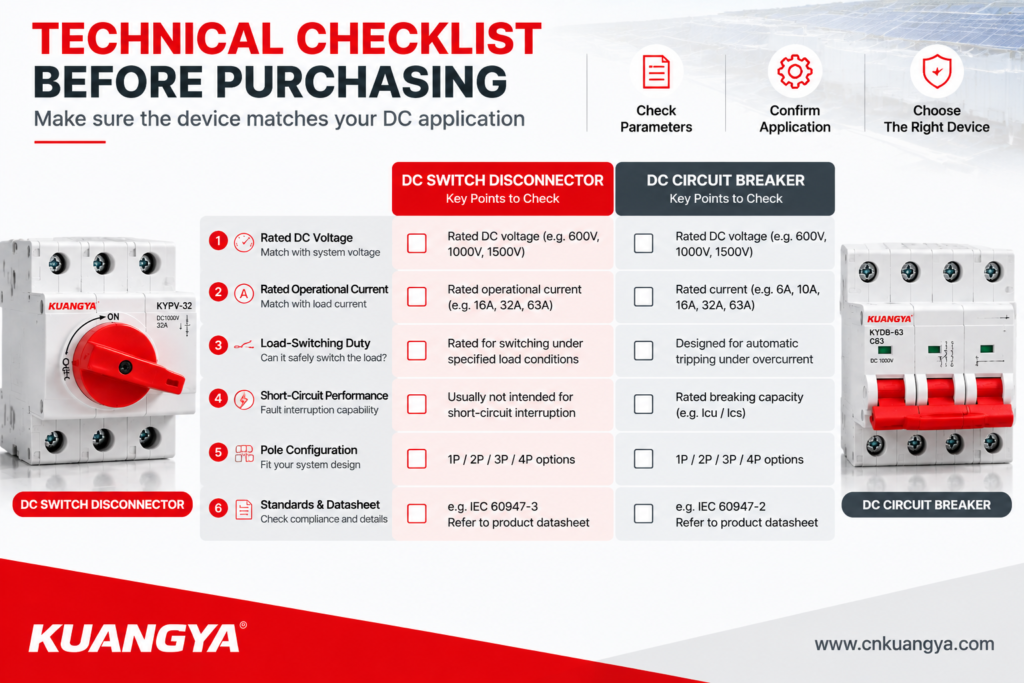
Avoid comparing suppliers solely by voltage, current, or unit price. Two products with similar front-panel markings may have different switching capabilities and short-circuit ratings.
No. A switch disconnector is intended for switching and isolation within its declared ratings. A DC circuit breaker provides automatic overcurrent protection within its rated protective capability. Their functions may overlap in some respects, but the devices are not automatically interchangeable.
Not as a general rule. A switch disconnector does not normally provide standalone automatic overload and short-circuit protection. A suitable protective device must be included where required by the system design.
Not automatically. Confirm that the breaker is suitable for the required isolation function, operating conditions, and maintenance procedures.
Each device must be rated for the actual maximum system voltage and its intended duty. A nominal 1500V system label alone is insufficient; verify the device ratings and approved connection arrangement.
IEC 60947-3 is relevant to switches, disconnectors, and switch-disconnectors. IEC 60947-2 is relevant to industrial circuit breakers. Other standards or requirements may apply depending on the product and installation.
Provide the application, maximum DC voltage, operating current, prospective fault current if known, required poles, switching duty, installation environment, quantity, and any required certifications or documentation. Include the system wiring diagram when possible.
Scegliere il giusto sezionatore di corrente continua vs interruttore automatico di corrente continua solution starts with understanding the function each device needs to perform. A switch disconnector provides switching and isolation within its rated capabilities, while a circuit breaker provides automatic overcurrent protection within its rated breaking capacity. The final choice should match the system voltage, operating current, fault conditions, and applicable standards.
For solar PV systems, the right choice depends on the maximum DC voltage, operating current, prospective fault current, required isolation functions, and applicable standards. Always verify the manufacturer’s datasheet and ensure that all protective devices work together as intended.
KUANGYA provides DC switch disconnectors and DC protection components for photovoltaic and other electrical applications. If you are selecting components for a new project, contact our team with your system specifications to discuss a suitable solution.
Explore our Sezionatore DC e MCB DC product ranges for more information.