웽양 공업구 웨칭 원저우 325000
근무 시간
월요일~금요일: 오전 7시~오후 7시
주말: 주말: 오전 10시 - 오후 5시
웽양 공업구 웨칭 원저우 325000
근무 시간
월요일~금요일: 오전 7시~오후 7시
주말: 주말: 오전 10시 - 오후 5시

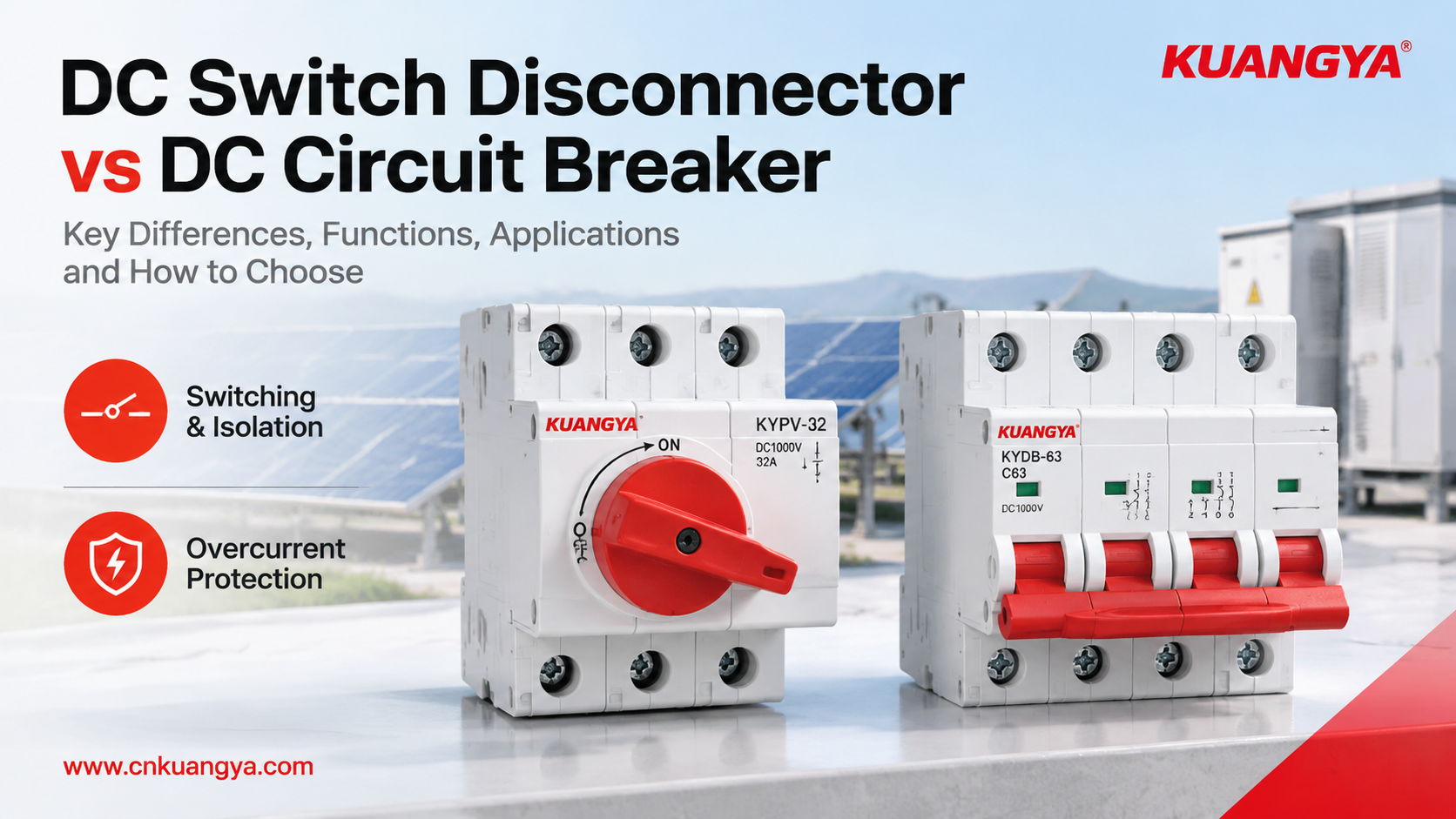
태양광 PV 시스템에서 DC 스위치 분리기 대 DC 회로 차단기 비교는 엔지니어와 구매자가 두 가지 다른 기능, 즉 스위칭 및 분리 대 자동 과전류 보호를 이해하는 데 도움이 됩니다. 이 장치들은 비슷하게 보일 수 있지만, 잘못된 것을 선택하면 회로가 필요한 보호 기능을 갖추지 못하거나 유지보수가 더 어려워질 수 있습니다.
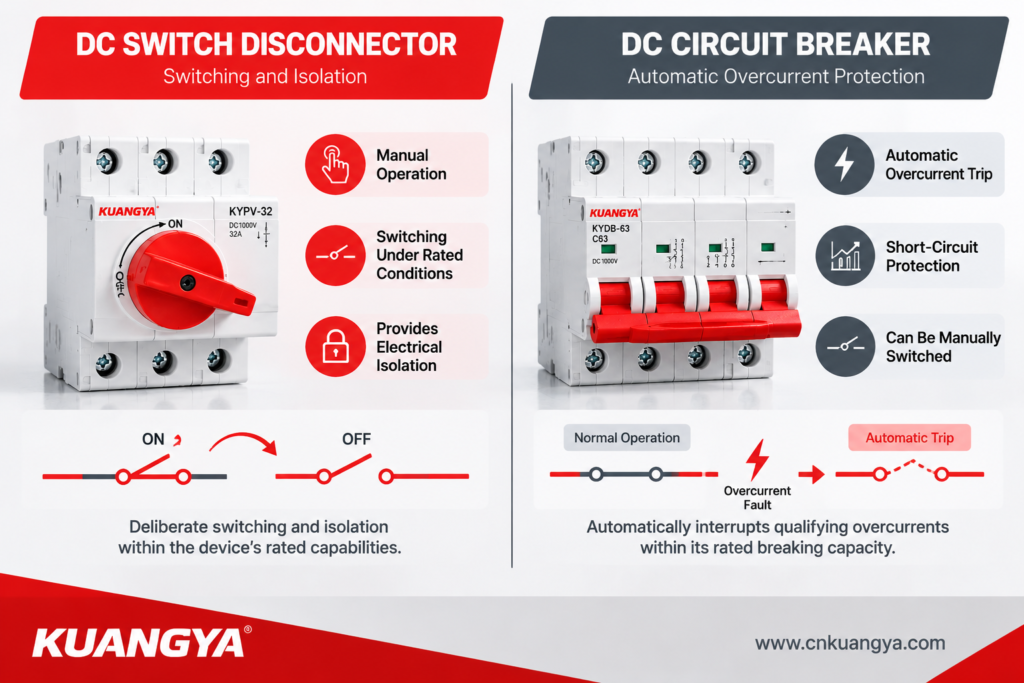
의 차이점 DC 스위치 분리기 대 DC 회로 차단기 는 의도된 기능으로 귀결됩니다. 스위치 분리기는 정격 작동 조건 내에서 스위칭 및 분리를 제공하는 반면, 회로 차단기는 지정된 과전류 및 단락을 자동으로 차단하도록 설계되었습니다.
그러나 제품 이름이 시사하는 것만큼 구분이 항상 간단하지는 않습니다. 일부 장치는 스위칭 및 차단 기능을 결합하며, 실제 기능은 정격, 설계 및 적용 표준에 따라 달라집니다.
이 가이드에서는 두 장치를 비교하고, 여섯 가지 실제 차이점을 설명하며, 태양광(PV) 시스템, 결합함 및 기타 DC 애플리케이션에서 이를 평가하는 방법을 보여줍니다.
핵심 요점: 스위치 차단기는 자동으로 단락 보호 장치가 아니며, 회로 차단기는 유지 보수에 필요한 모든 차단 기능을 자동으로 제공한다고 가정해서는 안 됩니다.
DC 스위치 차단기는 일반적으로 지정된 조건에서 회로를 연결하거나 분리하기 위해 수동으로 작동됩니다. DC 회로 차단기는 보호 메커니즘이 작동 특성 내에서 과전류를 감지하면 회로를 자동으로 열 수 있습니다.
| 비교 항목 | DC 스위치 단로기 | DC 회로 차단기 |
|---|---|---|
| 주요 기능 | 정격에 따른 스위칭 및 전기적 차단 | 과전류 보호 및 회로 개폐 |
| 정상 부하 개폐 | 예, 의도된 용도에 맞게 정격된 경우 | 예, 정격 작동 조건 내에서 |
| 자동 과부하 트립 | 일반적으로 제공되지 않음 | 과부하 보호용으로 설계된 모델에서 사용 가능 |
| 단락 차단 | 정상적인 독립 기능이 아님 | 예, 정격 차단 용량 내에서 |
| 차단 기능 | 장치의 선언된 차단 능력에 따라 다름 | 설계, 표시 및 해당 요구 사항에 따라 다름 |
| 일반적인 작동 | 수동 핸들 또는 회전 메커니즘 | 수동 작동 및 자동 트립 |
| 잠금 장치 조항 | OFF 위치에서 패드락을 지원할 수 있습니다. | 모델 및 액세서리에 따라 다릅니다. |
| 관련 IEC 표준군 | IEC 60947-3 | 산업용 회로 차단기용 IEC 60947-2 |
| 일반적인 PV 애플리케이션 | 계획된 분리 및 유지보수 격리 | 적합한 분기 또는 피더 보호 |
이 비교는 시장의 모든 장치가 아닌 일반적인 제품 기능을 설명합니다. 항상 정확한 모델의 데이터시트와 인증을 확인하십시오.
평가 시 DC 스위치 분리기 대 DC 회로 차단기, 정격 전압 또는 전류만으로 제품을 비교하지 마십시오. 해당 장치가 부하 개폐, 전기적 분리, 자동 트립 또는 단락 차단을 위해 설계되었는지 확인하십시오. 이러한 기능은 DC 회로의 실제 요구 사항과 일치해야 합니다.
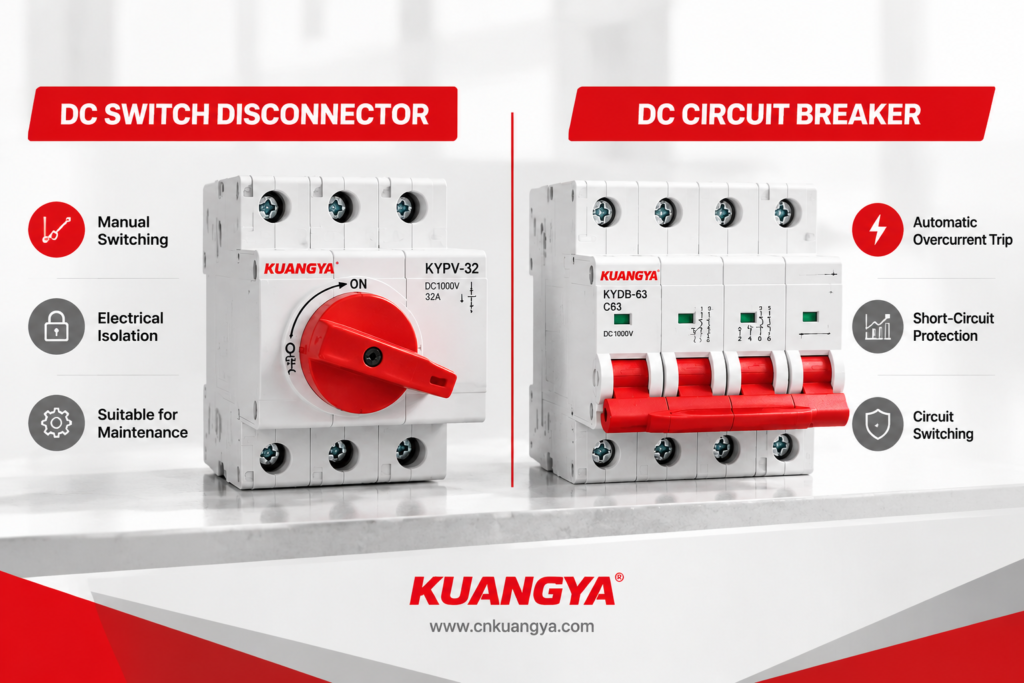
중요: 분리만을 위한 기본 분리기는 부하 개폐 스위치로 취급해서는 안 됩니다. 마찬가지로, 스위치 분리기는 특정 정격 또는 승인된 보호 어셈블리가 해당 용도를 허용하지 않는 한 단락을 차단할 것으로 기대해서는 안 됩니다.
가장 중요한 차이점은 각 장치가 수행하도록 설계된 것입니다.
DC 스위치 분리기는 회로를 개방하는 의도적인 수단을 제공합니다. 제품 옵션 및 적용 세부 정보는 당사 웹사이트를 참조하십시오. DC 스위치 단로기 태양광 PV, 에너지 저장 및 기타 DC 애플리케이션용. 장치가 해당 애플리케이션에 적합하다는 전제 하에 검사, 유지보수 또는 장비 교체 전에 정의된 분리 지점을 설정하는 데 도움이 될 수 있습니다.
DC 회로 차단기는 적절하게 설계된 회로를 지정된 과전류 조건으로부터 보호합니다. 트립 특성에 따라 과부하 및 단락에 응답하고 정격 용량 내에서 전류를 차단할 수 있습니다.
다음 예시를 고려하십시오:
태양광 결합함은 인버터에 연결된 DC 회로에 전원을 공급합니다. 유지보수 중 기술자는 관련 회로를 분리해야 합니다. 비정상 전류가 발생할 경우, 해당 회로는 고장을 차단할 수 있는 적절한 보호 장비도 필요합니다.
이는 관련 있지만 다른 요구 사항입니다. 설계 시에는 하나의 부품이 정격되지 않은 기능을 수행할 것으로 기대하기보다는 적절한 분리 장치와 과전류 보호 기능을 명시해야 합니다.
모든 스위치가 부하가 걸린 DC 회로를 개방하는 데 적합한 것은 아닙니다.
DC 전류는 AC 전류에서 발견되는 자연적인 주기적 영점 교차가 없습니다. DC 접점이 분리될 때, 장치가 지정된 조건에서 이를 차단하도록 설계되지 않은 한 전기 아크는 전류를 계속 전도할 수 있습니다.
관련 DC 스위칭 용도로 정격된 스위치 디스커넥터는 선언된 한계 내에서 회로를 개방할 수 있습니다. 무부하 분리용으로 설계된 디스커넥터는 전류가 먼저 다른 적절한 장치에 의해 차단되어야 할 수 있습니다.
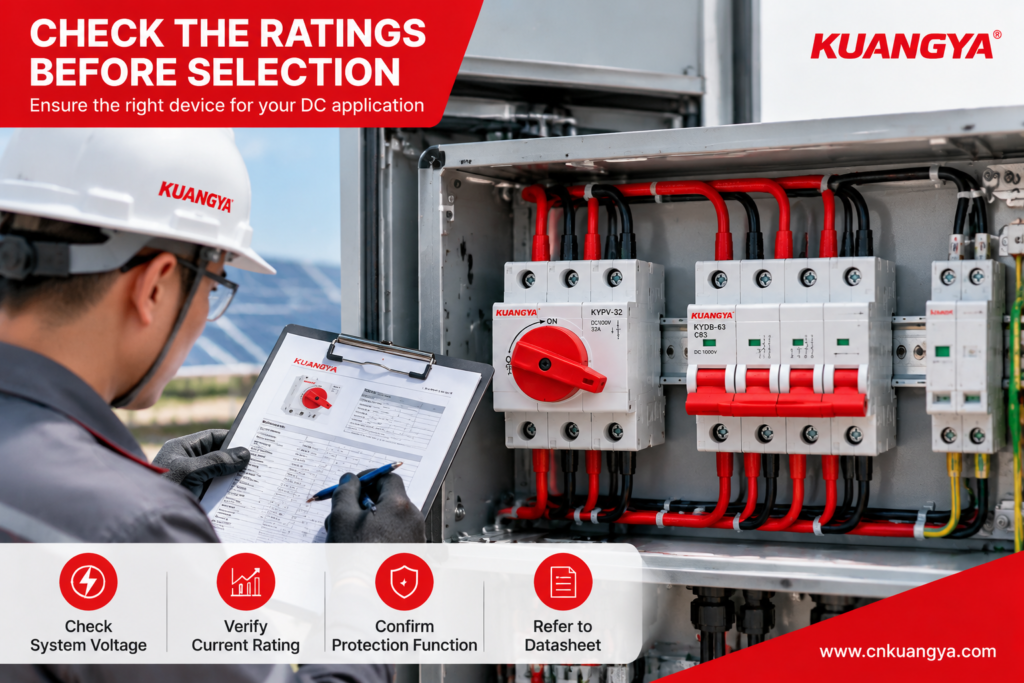
장치를 선택하기 전에 다음 사항을 확인하십시오:
회전식 핸들, 라벨에 인쇄된 높은 전압, 또는 눈에 보이는 ON/OFF 표시가 해당 장치가 모든 유형의 DC 부하를 차단할 수 있음을 보장한다고 가정하지 마십시오.
이 부분에서 구분이 특히 중요해집니다.
DC 회로 차단기는 정격 차단 용량 및 작동 조건 내에서 지정된 고장 전류를 차단하도록 설계되었습니다.
DC 애플리케이션용 회로 차단기를 평가할 때는 정격 차단 용량과 시스템의 예상 고장 전류와의 호환성을 검토하십시오. 당사의 DC MCB 제품군을 참조하십시오. 제품 옵션 및 정격 사양은 해당 제품군에서 확인하실 수 있습니다.
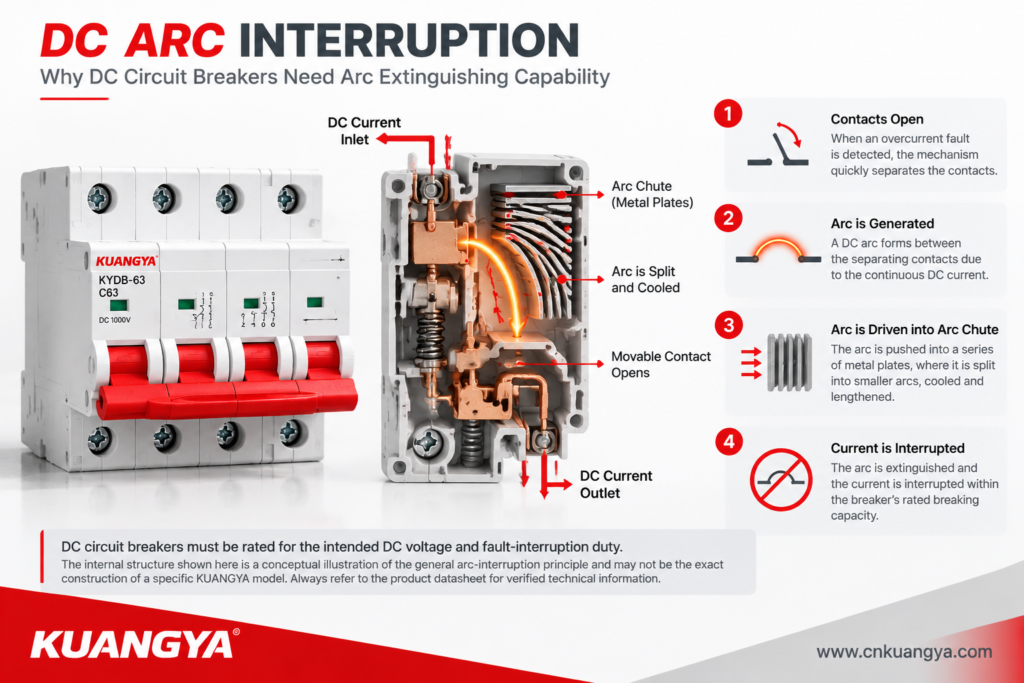
대조적으로, 스위치 디스커넥터는 일반적으로 독립적인 자동 단락 보호를 제공하기 위한 것이 아닙니다. 지정된 보호 장치와 함께 사용될 때 특정 단시간 내전압 또는 조건부 단락 정격을 가질 수 있습니다.
이 정격은 서로 다른 의미를 갖습니다.
| 정격 또는 기능 | 무엇을 알려주는가 | 자동적으로 의미하지 않는 것 |
|---|---|---|
| 정격 작동 전압 | 지정된 조건 하에서 장치가 작동하도록 의도된 전압 | 해당 전압에서 장치가 모든 고장을 차단할 수 있다는 것 |
| 정격 전류 | 명시된 조건 하에서의 허용 전류 | 과부하가 발생하면 자동 트립이 작동한다는 것 |
| 차단 용량 | 특정 조건 하에서 보호 장치가 차단할 수 있는 고장 전류 | 해당 장치가 모든 DC 전압 또는 회로 구성에 적합하다는 것 |
| 단시간 내전류 | 특정 시간 동안 장치가 견딜 수 있는 고장 전류 | 독립적으로 고장을 제거할 수 있다는 것 |
| 조건부 단락 정격 | 지정된 보호 구성과 함께 사용 시 성능 | 모든 퓨즈 또는 차단기를 대체할 수 있다는 것 |
DC 스위치 디스커넥터의 경우, 선언된 단락 내전압 또는 조건부 정격과 필요한 상위 보호 장치를 확인하십시오.
DC 회로 차단기의 경우, 정격 DC 차단 용량을 확인하고 설치 지점에서의 예상 단락 전류에 충분한지 확인하십시오.
일반적인 스위치 디스커넥터는 수동으로 작동합니다. 일반적으로 과부하를 감지하고 자동으로 트립되지 않습니다.
적절한 보호 기능을 갖춘 회로 차단기는 트립 메커니즘이 적격 고장을 감지하면 회로를 개방할 수 있습니다.
이 차이는 시스템 작동에 영향을 미칩니다.
| 상황 | 스위치 단로기 | DC 회로 차단기 |
|---|---|---|
| 계획된 유지보수 | 적절한 수동 차단 지점을 제공합니다. | 특정 용도에 적합한 경우 개폐 및 분리 기능을 제공할 수 있습니다. |
| 지속적인 과부하 | Does not normally trip automatically | Can trip if its protection characteristics detect the overload |
| 단락 회로 | Must not be relied upon as standalone fault protection | Can interrupt the fault within its rated capability |
| 원격 모니터링 | Requires suitable auxiliary contacts or additional equipment | May support auxiliary contacts or electronic monitoring, depending on model |
| Automatic fault response | 일반적으로 제공되지 않음 | Available according to the protection design |
A device’s ability to be switched remotely is not the same as its ability to provide automatic fault protection. Remote actuation, status monitoring, and protective tripping should be evaluated separately.
A 2-pole device is not automatically equivalent to a 4-pole device, and a voltage rating printed on a product should not be interpreted without checking the specified wiring arrangement.
Some DC switching devices use multiple contacts in series to achieve their declared voltage or interruption capability. In such cases, the manufacturer’s wiring diagram must be followed.
For example, a device rated for a particular DC voltage with a specified series-pole connection may not retain that rating when wired differently.
When comparing a DC switch disconnector with a DC circuit breaker, verify:
Do not choose a device based on “2P,” “4P,” or “1500V DC” alone. The complete combination of voltage, current, pole arrangement, and switching duty must match the intended application.
Maintenance safety involves more than turning a handle to OFF.
A suitable isolation arrangement should help personnel identify the correct circuit, prevent unintended reconnection, and follow the applicable safe-working procedure.
A DC switch disconnector may provide a lockable OFF position, but this feature must be confirmed for the specific model. A circuit breaker may also support locking accessories, although its suitability as the required isolation device must be verified separately.
For a planned maintenance task, consider the following:
An OFF indication alone is not proof that an electrical circuit is safe to touch.
In many photovoltaic installations, the switch disconnector and circuit breaker serve complementary roles.
A typical protection arrangement may include:
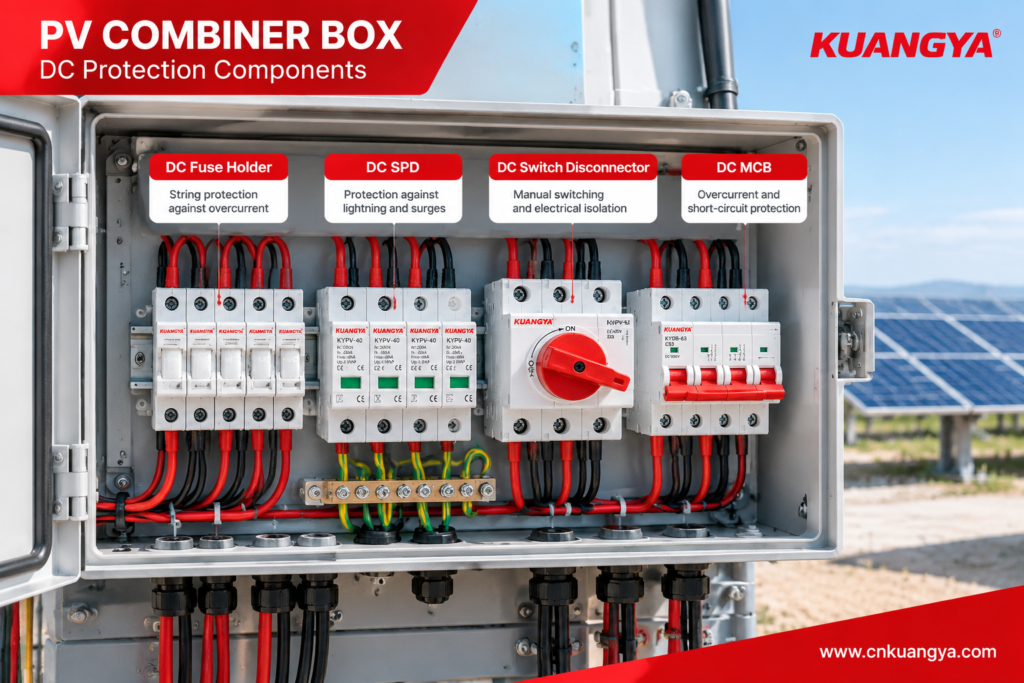
The exact arrangement depends on the system architecture, inverter requirements, prospective fault current, earthing arrangement, and applicable standards. For a closer look at how fuses, SPDs, disconnect switches, and other components work together, read our solar combiner box protection and maintenance guide. Not every installation requires all four devices in the same location.
| 구성 요소 | 주요 목적 | Selection Check |
|---|---|---|
| gPV fuse and fuse holder | PV string overcurrent protection | Rated voltage, current, fuse characteristic, and fault-interruption capability |
| DC SPD | Transient overvoltage protection | PV-specific rating, protection level, and applicable SPD standard |
| DC 스위치 단로기 | 스위칭 및 절연 | Rated DC switching duty, isolation capability, and connection arrangement |
| DC 회로 차단기 | Overcurrent protection where required | Trip characteristics, rated breaking capacity, and system compatibility |
A combiner box with a fuse, SPD, and switch disconnector does not automatically provide every protective function that a circuit breaker would provide. Each component must be selected for its intended role.
For related technical guidance, see our Solar DC Protection Guide 및 PV Combiner Box Guide.
The following cases are illustrative engineering scenarios based on common equipment-selection and system-coordination issues. They are not presented as documented KUANGYA customer incidents or laboratory test results.
상황
A panel designer selects a DC switch disconnector because its voltage and current ratings appear to match the circuit. The design does not include a suitable protective device for the relevant fault condition.
What is wrong?
The selected switch may be suitable for manual switching and isolation but may not have the capability to interrupt the prospective short-circuit current.
Corrective action
Lesson: A matching voltage and current label does not prove that a switch can clear a short circuit.
상황
A buyer chooses an AC-rated switching device because its current rating appears sufficient for a solar DC circuit.
What is wrong?
The device may not have been tested or rated to interrupt the specified DC current. Its arc-extinguishing design and contact arrangement may be unsuitable for the application.
Corrective action
Use a device with an explicit DC rating for the actual system voltage, current, and switching duty. Follow the manufacturer’s approved wiring diagram.
Lesson: AC and DC ratings are not interchangeable unless the manufacturer explicitly declares the relevant capability.
상황
A maintenance team assumes that switching a circuit breaker to OFF automatically satisfies all site isolation requirements.
What is wrong?
The breaker may not provide every required isolation, locking, or work-control feature for the particular installation. Other energy sources or backfeed paths may also remain present.
Corrective action
Check the device’s isolation suitability, locking provisions, circuit arrangement, and site procedures. Use the designated isolation method and verify the absence of voltage before work.
Lesson: Protection, isolation, and safe-work procedures are related but distinct requirements.
Use the following guide as a starting point, then confirm the choice against the applicable standard and the manufacturer’s documentation.
| Application Requirement | Appropriate Direction |
|---|---|
| Manual disconnection for planned maintenance | A suitable DC switch disconnector or isolator |
| Automatic overload protection | A suitably rated DC circuit breaker or other approved protective device |
| 단락 차단 | A protective device with sufficient DC breaking capacity |
| Both switching and isolation | A switch disconnector rated for the required duty, or another approved arrangement |
| PV string reverse-current protection | A correctly selected gPV fuse where required by the design |
| Transient overvoltage protection | A suitably rated DC SPD |
| Isolation and overcurrent protection | A coordinated combination of devices, unless an approved integrated solution provides the required functions |
For photovoltaic projects, the decision should be based on the system’s maximum DC voltage, current, prospective fault current, required isolation points, and applicable local requirements.
A device that is suitable for one part of a PV installation may not be suitable for another.
IEC 60947-3 covers switches, disconnectors, switch-disconnectors, and fuse-combination units within its scope. Buyers should check the applicable edition and the device’s declared ratings before selecting a product. IEC 60947-2 specifies requirements for circuit breakers within its scope, including relevant DC applications. Check the applicable edition and the manufacturer’s documentation to verify that the selected device meets the project’s requirements.
The applicable edition, product scope, and any relevant product-specific requirements should be checked for the intended application.
For more information about DC isolation principles and photovoltaic applications, see our DC switch disconnector technical guide.
Before issuing a purchase order, ask the supplier to confirm the following:
| Checkpoint | Information to Request |
|---|---|
| Product identity | Exact model and intended function |
| 정격 전압 | Rated DC voltage and any limitations |
| Current rating | Rated operational or continuous current under stated conditions |
| Switching duty | Permitted load-breaking conditions and utilization category |
| Fault performance | Breaking capacity for breakers; applicable withstand or conditional rating for disconnectors |
| Pole arrangement | Approved wiring diagram and pole configuration |
| 절연 | Declared isolation suitability and operating indication |
| Locking | Whether the OFF position can be secured, if required |
| 표준 | Applicable standard, edition, and supporting conformity documentation |
| 환경 적합성 | Temperature limits, enclosure protection, terminals, and derating |
| Traceability | Model-specific datasheet, markings, and relevant test documentation |
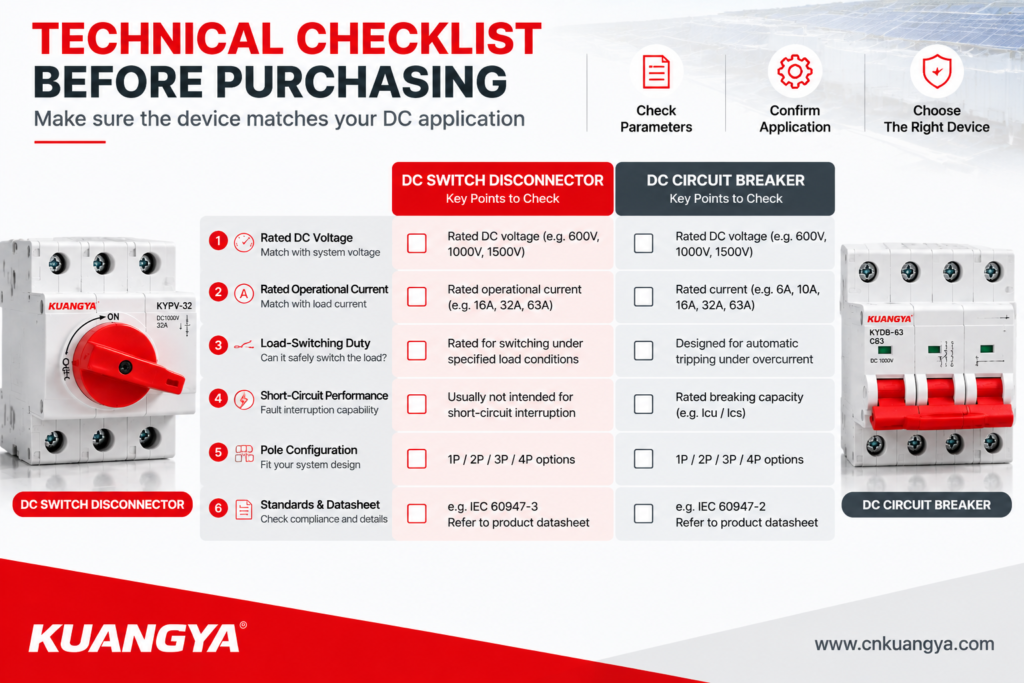
Avoid comparing suppliers solely by voltage, current, or unit price. Two products with similar front-panel markings may have different switching capabilities and short-circuit ratings.
No. A switch disconnector is intended for switching and isolation within its declared ratings. A DC circuit breaker provides automatic overcurrent protection within its rated protective capability. Their functions may overlap in some respects, but the devices are not automatically interchangeable.
Not as a general rule. A switch disconnector does not normally provide standalone automatic overload and short-circuit protection. A suitable protective device must be included where required by the system design.
Not automatically. Confirm that the breaker is suitable for the required isolation function, operating conditions, and maintenance procedures.
Each device must be rated for the actual maximum system voltage and its intended duty. A nominal 1500V system label alone is insufficient; verify the device ratings and approved connection arrangement.
IEC 60947-3 is relevant to switches, disconnectors, and switch-disconnectors. IEC 60947-2 is relevant to industrial circuit breakers. Other standards or requirements may apply depending on the product and installation.
Provide the application, maximum DC voltage, operating current, prospective fault current if known, required poles, switching duty, installation environment, quantity, and any required certifications or documentation. Include the system wiring diagram when possible.
올바른 선택 DC 스위치 분리기 대 DC 회로 차단기 solution starts with understanding the function each device needs to perform. A switch disconnector provides switching and isolation within its rated capabilities, while a circuit breaker provides automatic overcurrent protection within its rated breaking capacity. The final choice should match the system voltage, operating current, fault conditions, and applicable standards.
For solar PV systems, the right choice depends on the maximum DC voltage, operating current, prospective fault current, required isolation functions, and applicable standards. Always verify the manufacturer’s datasheet and ensure that all protective devices work together as intended.
KUANGYA provides DC switch disconnectors and DC protection components for photovoltaic and other electrical applications. If you are selecting components for a new project, contact our team with your system specifications to discuss a suitable solution.
Explore our DC 스위치 단로기 및 DC MCB product ranges for more information.