WengYang Industrial Zone Yueqing Wenzhou 325000
Horas de trabalho
De segunda a sexta-feira: das 7h às 19h
Fim de semana: 10:00 - 17:00
WengYang Industrial Zone Yueqing Wenzhou 325000
Horas de trabalho
De segunda a sexta-feira: das 7h às 19h
Fim de semana: 10:00 - 17:00

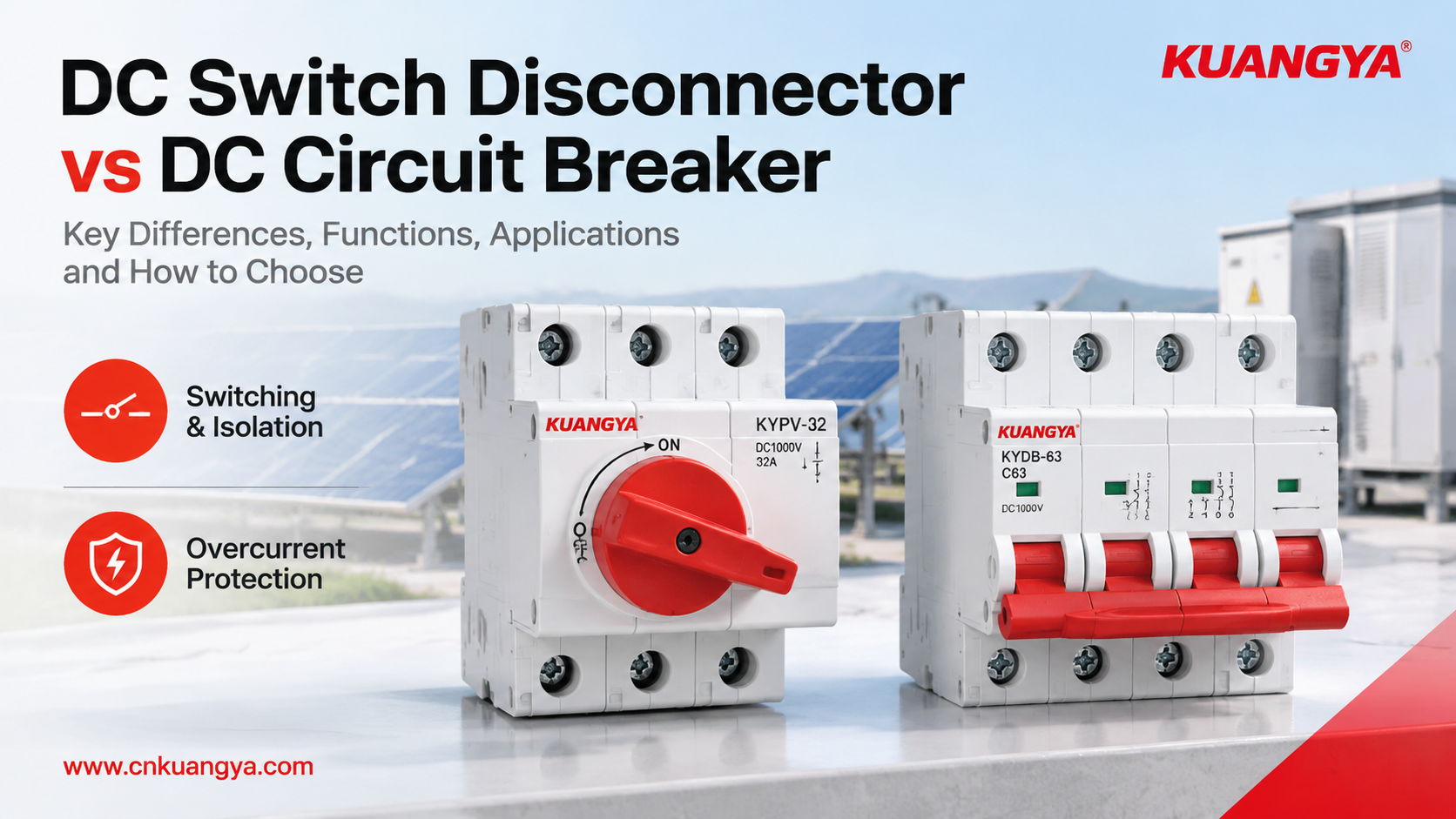
Em um sistema solar fotovoltaico, um seccionador de chave CC vs disjuntor CC comparação ajuda engenheiros e compradores a entender duas funções diferentes: chaveamento e isolamento versus proteção automática contra sobrecorrente. Embora esses dispositivos possam parecer semelhantes, escolher o errado pode deixar um circuito sem a proteção de que precisa ou dificultar a manutenção.
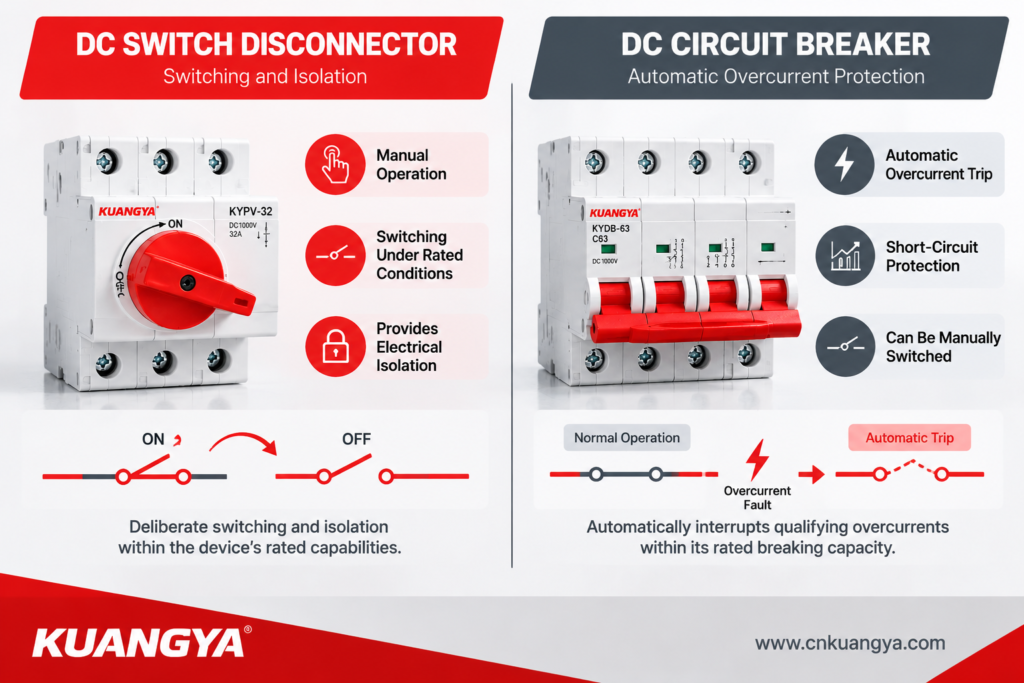
A diferença entre um seccionador de chave CC vs. disjuntor CC resume-se às suas funções pretendidas: um seccionador de chave fornece chaveamento e isolamento dentro de suas condições operacionais nominais, enquanto um disjuntor é projetado para interromper automaticamente sobrecorrentes e curtos-circuitos especificados.
No entanto, a distinção nem sempre é tão simples quanto o nome do produto sugere. Alguns dispositivos combinam funções de comutação e isolamento, e suas capacidades reais dependem de suas classificações, design e normas aplicáveis.
Este guia compara os dois dispositivos, explica seis diferenças práticas e mostra como avaliá-los em sistemas fotovoltaicos (PV), caixas de junção e outras aplicações CC.
O principal ponto a reter: Um seccionador de comutação não é automaticamente um dispositivo de proteção contra curto-circuito, e um disjuntor não deve ser automaticamente considerado como fornecendo todas as funções de isolamento necessárias para manutenção.
Um seccionador CC é geralmente operado manualmente para conectar ou desconectar um circuito sob condições especificadas. Um disjuntor CC pode abrir um circuito automaticamente quando seu mecanismo de proteção detecta uma sobrecorrente dentro de suas características operacionais.
| Ponto de Comparação | Chave seccionadora CC | Disjuntor CC |
|---|---|---|
| Função primária | Comutação e isolamento elétrico, de acordo com sua classificação | Proteção contra sobrecorrente e chaveamento de circuitos |
| Chaveamento de carga normal | Sim, se classificado para a função pretendida | Sim, dentro das suas condições operacionais nominais |
| Desarme automático por sobrecarga | Normalmente não fornecido | Disponível em modelos projetados para proteção contra sobrecarga |
| Interrupção de curto-circuito | Não é sua função autônoma normal | Sim, dentro da sua capacidade nominal de interrupção |
| Função de isolamento | Depende da capacidade de isolamento declarada do dispositivo | Depende do seu projeto, marcações e requisitos aplicáveis |
| Operação típica | Manípulo manual ou mecanismo rotativo | Operação manual e desarme automático |
| Dispositivos de bloqueio | Pode suportar um cadeado na posição DESLIGADO | Depende do modelo e dos acessórios |
| Família de normas IEC relevante | IEC 60947-3 | IEC 60947-2 para disjuntores industriais |
| Aplicação típica de PV | Desconexão planeada e isolamento para manutenção | Proteção de ramais ou alimentadores adequados |
A comparação descreve funções típicas do produto em vez de todos os dispositivos no mercado. Verifique sempre a folha de dados e a certificação do modelo exato.
Ao avaliar um seccionador de chave CC vs disjuntor CC, não compare produtos apenas pela tensão ou corrente nominal. Verifique se o dispositivo foi projetado para comutação de carga, isolamento elétrico, desarme automático ou interrupção de curto-circuito. Essas funções devem corresponder aos requisitos reais do circuito CC.
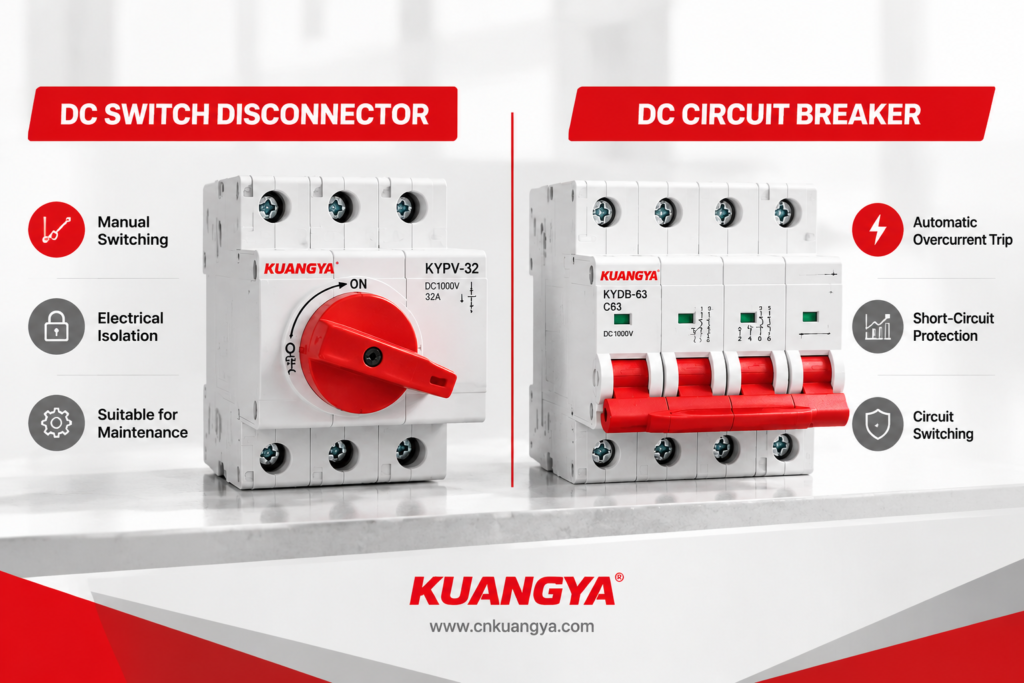
Importante: Um seccionador básico destinado apenas ao isolamento não deve ser tratado como um interruptor de carga. Da mesma forma, não se deve esperar que um seccionador comutador interrompa um curto-circuito, a menos que sua classificação específica ou conjunto de proteção aprovado permita essa função.
A distinção mais importante é para que cada dispositivo foi projetado.
Um seccionador comutador CC fornece um meio deliberado de abrir um circuito. Para opções de produtos e detalhes de aplicação, explore nosso Seccionadores de chave CC para aplicações solares fotovoltaicas, armazenamento de energia e outras aplicações CC. Pode ajudar a estabelecer um ponto de isolamento definido antes da inspeção, manutenção ou substituição de equipamentos, desde que o dispositivo seja adequado para a aplicação.
Um disjuntor CC protege um circuito projetado adequadamente contra condições especificadas de sobrecorrente. Dependendo das suas características de disparo, pode responder a sobrecargas e curtos-circuitos e interromper a corrente dentro da sua capacidade nominal.
Considere o seguinte exemplo:
Uma caixa combinadora solar alimenta um circuito CC conectado a um inversor. Durante a manutenção, um técnico precisa isolar o circuito relevante. Se ocorrer uma corrente anormal, o circuito também precisa de equipamento de proteção adequado para interromper a falha.
Estes são requisitos relacionados, mas diferentes. O projeto deve especificar o dispositivo de isolamento e a proteção contra sobrecorrente apropriados, em vez de esperar que um componente execute funções para as quais não foi classificado.
Nem todo interruptor é adequado para abrir um circuito CC energizado.
A corrente CC não possui as passagens por zero periódicas naturais encontradas na corrente CA. Quando os contatos CC se separam, um arco elétrico pode continuar a conduzir corrente, a menos que o dispositivo seja projetado para interrompê-lo nas condições especificadas.
Um seccionador comutador classificado para a tarefa de comutação CC relevante pode abrir um circuito dentro de seus limites declarados. Um seccionador destinado ao isolamento fora de carga pode exigir que a corrente seja interrompida primeiro por outro dispositivo adequado.
Antes de selecionar um dispositivo, verifique:
Não assuma que uma alavanca rotativa, uma alta tensão impressa na etiqueta ou uma marcação visível de LIGADO/DESLIGADO prova que um dispositivo pode interromper todos os tipos de carga CC.
É aqui que a distinção se torna particularmente importante.
Um disjuntor CC é projetado para interromper correntes de falha especificadas dentro de sua capacidade nominal de interrupção e condições de operação.
Ao avaliar um disjuntor para uma aplicação CC, revise sua capacidade nominal de interrupção e compatibilidade com a corrente de falha prospectiva do sistema. Veja nossa linha de MCBs CC para opções de produtos e especificações nominais.
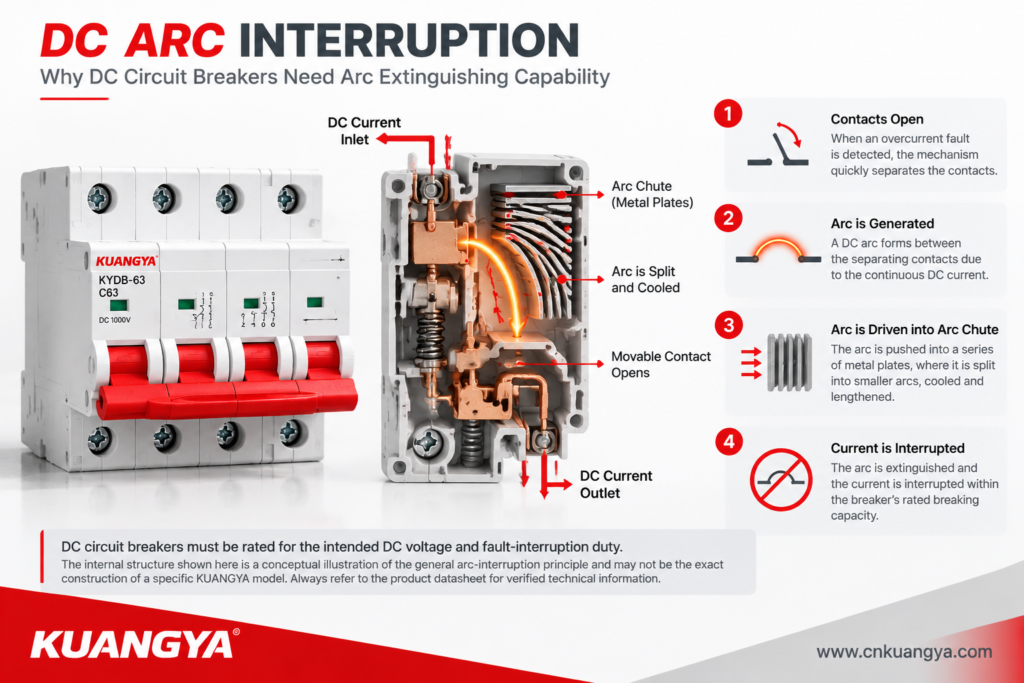
Um seccionador, em contraste, normalmente não se destina a fornecer proteção automática independente contra curto-circuito. Ele pode ter uma capacidade especificada de suportar corrente por um curto período ou uma capacidade nominal condicional de curto-circuito quando usado com um dispositivo de proteção designado.
Estas classificações significam coisas diferentes.
| Classificação ou Característica | O que lhe diz | O que não significa automaticamente |
|---|---|---|
| Tensão operacional nominal | Tensão à qual o dispositivo se destina a operar sob condições especificadas | Que o dispositivo pode interromper qualquer falha a essa tensão |
| Corrente nominal | Corrente permitida sob as condições declaradas | Que sobrecargas acionarão um desligamento automático |
| Capacidade de ruptura | Corrente de falha que um dispositivo de proteção pode interromper sob condições especificadas | Que o dispositivo é adequado para qualquer tensão CC ou arranjo de circuito |
| Corrente de curta duração suportada | Corrente de falha que o dispositivo pode suportar por um tempo especificado | Que ele pode eliminar a falha independentemente |
| Capacidade nominal de curto-circuito condicional | Desempenho quando usado com o arranjo de proteção especificado | Que qualquer fusível ou disjuntor pode ser substituído |
Para um seccionador de CC, verifique a capacidade de suportar curto-circuito declarada ou a capacidade condicional e o dispositivo de proteção a montante necessário.
Para um disjuntor de CC, verifique a capacidade nominal de interrupção de CC e confirme que é suficiente para a corrente de curto-circuito prospectiva no ponto de instalação.
Um seccionador convencional é operado manualmente. Normalmente, não detecta uma sobrecarga e desarma automaticamente.
Um disjuntor com funções de proteção adequadas pode abrir um circuito quando o seu mecanismo de desarme detecta uma falha qualificada.
Esta diferença afeta a operação do sistema.
| Situação | Chave seccionadora | Disjuntor CC |
|---|---|---|
| Manutenção planeada | Fornece um ponto de isolamento manual adequado | Pode fornecer comutação e isolamento se especificamente adequado |
| Sobrecarga sustentada | Does not normally trip automatically | Can trip if its protection characteristics detect the overload |
| Curto-circuito | Must not be relied upon as standalone fault protection | Can interrupt the fault within its rated capability |
| Monitoramento remoto | Requires suitable auxiliary contacts or additional equipment | May support auxiliary contacts or electronic monitoring, depending on model |
| Automatic fault response | Normalmente não fornecido | Available according to the protection design |
A device’s ability to be switched remotely is not the same as its ability to provide automatic fault protection. Remote actuation, status monitoring, and protective tripping should be evaluated separately.
A 2-pole device is not automatically equivalent to a 4-pole device, and a voltage rating printed on a product should not be interpreted without checking the specified wiring arrangement.
Some DC switching devices use multiple contacts in series to achieve their declared voltage or interruption capability. In such cases, the manufacturer’s wiring diagram must be followed.
For example, a device rated for a particular DC voltage with a specified series-pole connection may not retain that rating when wired differently.
When comparing a DC switch disconnector with a DC circuit breaker, verify:
Do not choose a device based on “2P,” “4P,” or “1500V DC” alone. The complete combination of voltage, current, pole arrangement, and switching duty must match the intended application.
Maintenance safety involves more than turning a handle to OFF.
A suitable isolation arrangement should help personnel identify the correct circuit, prevent unintended reconnection, and follow the applicable safe-working procedure.
A DC switch disconnector may provide a lockable OFF position, but this feature must be confirmed for the specific model. A circuit breaker may also support locking accessories, although its suitability as the required isolation device must be verified separately.
For a planned maintenance task, consider the following:
An OFF indication alone is not proof that an electrical circuit is safe to touch.
In many photovoltaic installations, the switch disconnector and circuit breaker serve complementary roles.
A typical protection arrangement may include:
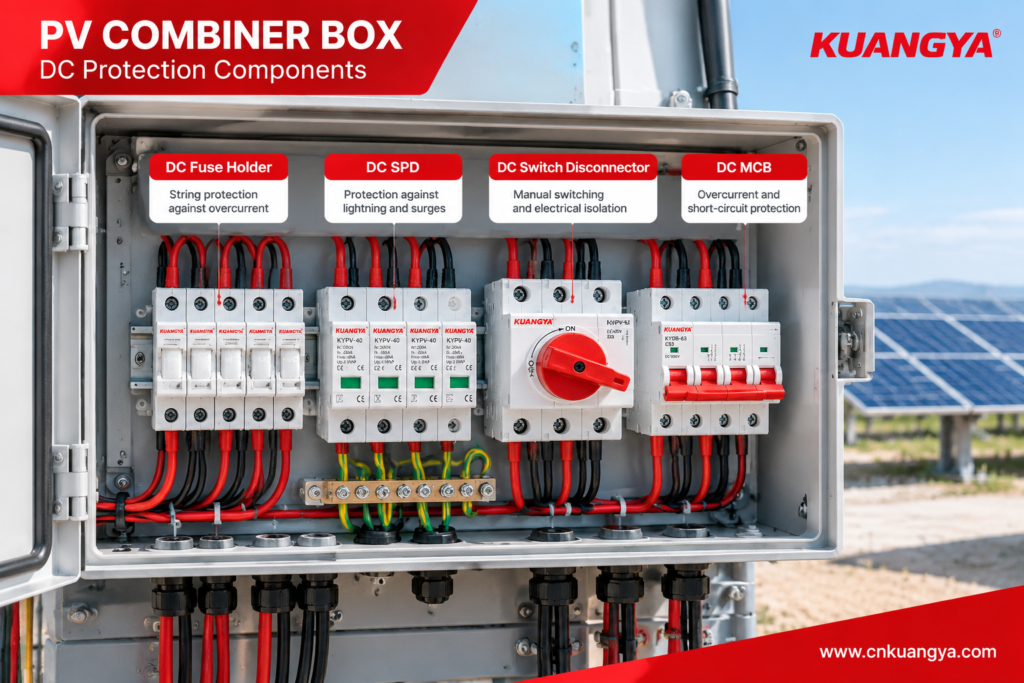
The exact arrangement depends on the system architecture, inverter requirements, prospective fault current, earthing arrangement, and applicable standards. For a closer look at how fuses, SPDs, disconnect switches, and other components work together, read our solar combiner box protection and maintenance guide. Not every installation requires all four devices in the same location.
| Componente | Objetivo principal | Selection Check |
|---|---|---|
| gPV fuse and fuse holder | PV string overcurrent protection | Rated voltage, current, fuse characteristic, and fault-interruption capability |
| DC SPD | Proteção contra sobretensão transitória | PV-specific rating, protection level, and applicable SPD standard |
| Chave seccionadora CC | Comutação e isolamento | Rated DC switching duty, isolation capability, and connection arrangement |
| Disjuntor CC | Overcurrent protection where required | Trip characteristics, rated breaking capacity, and system compatibility |
A combiner box with a fuse, SPD, and switch disconnector does not automatically provide every protective function that a circuit breaker would provide. Each component must be selected for its intended role.
For related technical guidance, see our Solar DC Protection Guide e PV Combiner Box Guide.
The following cases are illustrative engineering scenarios based on common equipment-selection and system-coordination issues. They are not presented as documented KUANGYA customer incidents or laboratory test results.
Situação
A panel designer selects a DC switch disconnector because its voltage and current ratings appear to match the circuit. The design does not include a suitable protective device for the relevant fault condition.
What is wrong?
The selected switch may be suitable for manual switching and isolation but may not have the capability to interrupt the prospective short-circuit current.
Corrective action
Lesson: A matching voltage and current label does not prove that a switch can clear a short circuit.
Situação
A buyer chooses an AC-rated switching device because its current rating appears sufficient for a solar DC circuit.
What is wrong?
The device may not have been tested or rated to interrupt the specified DC current. Its arc-extinguishing design and contact arrangement may be unsuitable for the application.
Corrective action
Use a device with an explicit DC rating for the actual system voltage, current, and switching duty. Follow the manufacturer’s approved wiring diagram.
Lesson: AC and DC ratings are not interchangeable unless the manufacturer explicitly declares the relevant capability.
Situação
A maintenance team assumes that switching a circuit breaker to OFF automatically satisfies all site isolation requirements.
What is wrong?
The breaker may not provide every required isolation, locking, or work-control feature for the particular installation. Other energy sources or backfeed paths may also remain present.
Corrective action
Check the device’s isolation suitability, locking provisions, circuit arrangement, and site procedures. Use the designated isolation method and verify the absence of voltage before work.
Lesson: Protection, isolation, and safe-work procedures are related but distinct requirements.
Use the following guide as a starting point, then confirm the choice against the applicable standard and the manufacturer’s documentation.
| Application Requirement | Appropriate Direction |
|---|---|
| Manual disconnection for planned maintenance | A suitable DC switch disconnector or isolator |
| Automatic overload protection | A suitably rated DC circuit breaker or other approved protective device |
| Interrupção de curto-circuito | A protective device with sufficient DC breaking capacity |
| Both switching and isolation | A switch disconnector rated for the required duty, or another approved arrangement |
| PV string reverse-current protection | A correctly selected gPV fuse where required by the design |
| Proteção contra sobretensão transitória | A suitably rated DC SPD |
| Isolation and overcurrent protection | A coordinated combination of devices, unless an approved integrated solution provides the required functions |
For photovoltaic projects, the decision should be based on the system’s maximum DC voltage, current, prospective fault current, required isolation points, and applicable local requirements.
A device that is suitable for one part of a PV installation may not be suitable for another.
IEC 60947-3 covers switches, disconnectors, switch-disconnectors, and fuse-combination units within its scope. Buyers should check the applicable edition and the device’s declared ratings before selecting a product. IEC 60947-2 specifies requirements for circuit breakers within its scope, including relevant DC applications. Check the applicable edition and the manufacturer’s documentation to verify that the selected device meets the project’s requirements.
The applicable edition, product scope, and any relevant product-specific requirements should be checked for the intended application.
For more information about DC isolation principles and photovoltaic applications, see our DC switch disconnector technical guide.
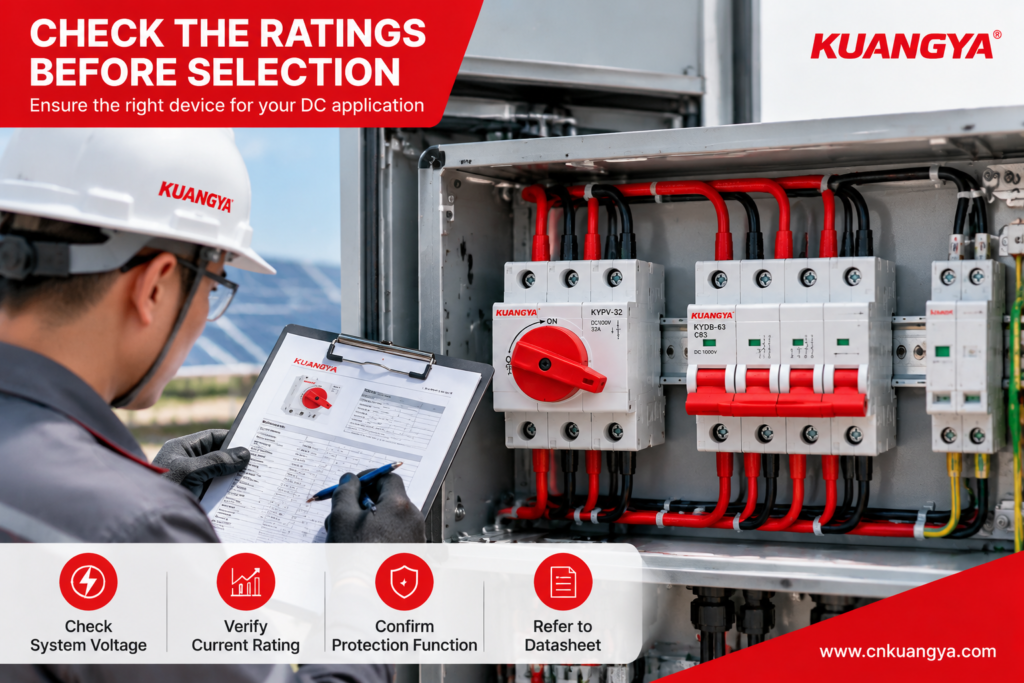
Before issuing a purchase order, ask the supplier to confirm the following:
| Checkpoint | Information to Request |
|---|---|
| Product identity | Exact model and intended function |
| Classificação da tensão | Rated DC voltage and any limitations |
| Current rating | Rated operational or continuous current under stated conditions |
| Switching duty | Permitted load-breaking conditions and utilization category |
| Fault performance | Breaking capacity for breakers; applicable withstand or conditional rating for disconnectors |
| Pole arrangement | Approved wiring diagram and pole configuration |
| Seccionamento | Declared isolation suitability and operating indication |
| Locking | Whether the OFF position can be secured, if required |
| Padrões | Applicable standard, edition, and supporting conformity documentation |
| Adequação ambiental | Temperature limits, enclosure protection, terminals, and derating |
| Traceability | Model-specific datasheet, markings, and relevant test documentation |
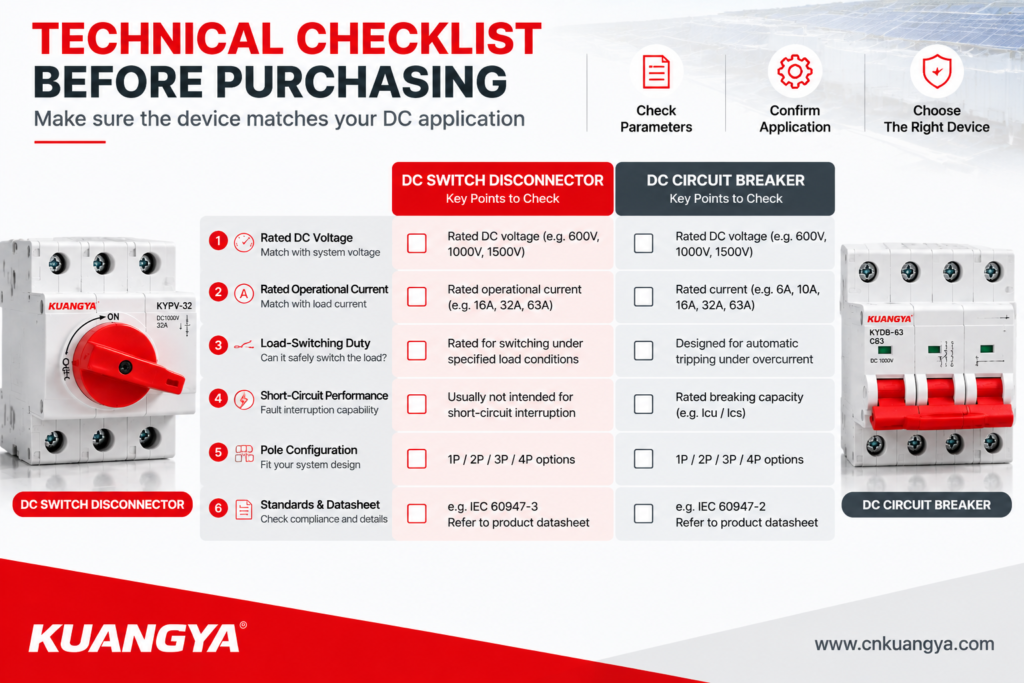
Avoid comparing suppliers solely by voltage, current, or unit price. Two products with similar front-panel markings may have different switching capabilities and short-circuit ratings.
No. A switch disconnector is intended for switching and isolation within its declared ratings. A DC circuit breaker provides automatic overcurrent protection within its rated protective capability. Their functions may overlap in some respects, but the devices are not automatically interchangeable.
Not as a general rule. A switch disconnector does not normally provide standalone automatic overload and short-circuit protection. A suitable protective device must be included where required by the system design.
Not automatically. Confirm that the breaker is suitable for the required isolation function, operating conditions, and maintenance procedures.
Each device must be rated for the actual maximum system voltage and its intended duty. A nominal 1500V system label alone is insufficient; verify the device ratings and approved connection arrangement.
IEC 60947-3 is relevant to switches, disconnectors, and switch-disconnectors. IEC 60947-2 is relevant to industrial circuit breakers. Other standards or requirements may apply depending on the product and installation.
Provide the application, maximum DC voltage, operating current, prospective fault current if known, required poles, switching duty, installation environment, quantity, and any required certifications or documentation. Include the system wiring diagram when possible.
Escolhendo o caminho certo seccionador de chave CC vs disjuntor CC solution starts with understanding the function each device needs to perform. A switch disconnector provides switching and isolation within its rated capabilities, while a circuit breaker provides automatic overcurrent protection within its rated breaking capacity. The final choice should match the system voltage, operating current, fault conditions, and applicable standards.
For solar PV systems, the right choice depends on the maximum DC voltage, operating current, prospective fault current, required isolation functions, and applicable standards. Always verify the manufacturer’s datasheet and ensure that all protective devices work together as intended.
KUANGYA provides DC switch disconnectors and DC protection components for photovoltaic and other electrical applications. If you are selecting components for a new project, contact our team with your system specifications to discuss a suitable solution.
Explore our Chave seccionadora CC e MCB CC product ranges for more information.