WengYang Industrial Zone Yueqing Wenzhou 325000
Horas de trabalho
De segunda a sexta-feira: das 7h às 19h
Fim de semana: 10:00 - 17:00
WengYang Industrial Zone Yueqing Wenzhou 325000
Horas de trabalho
De segunda a sexta-feira: das 7h às 19h
Fim de semana: 10:00 - 17:00

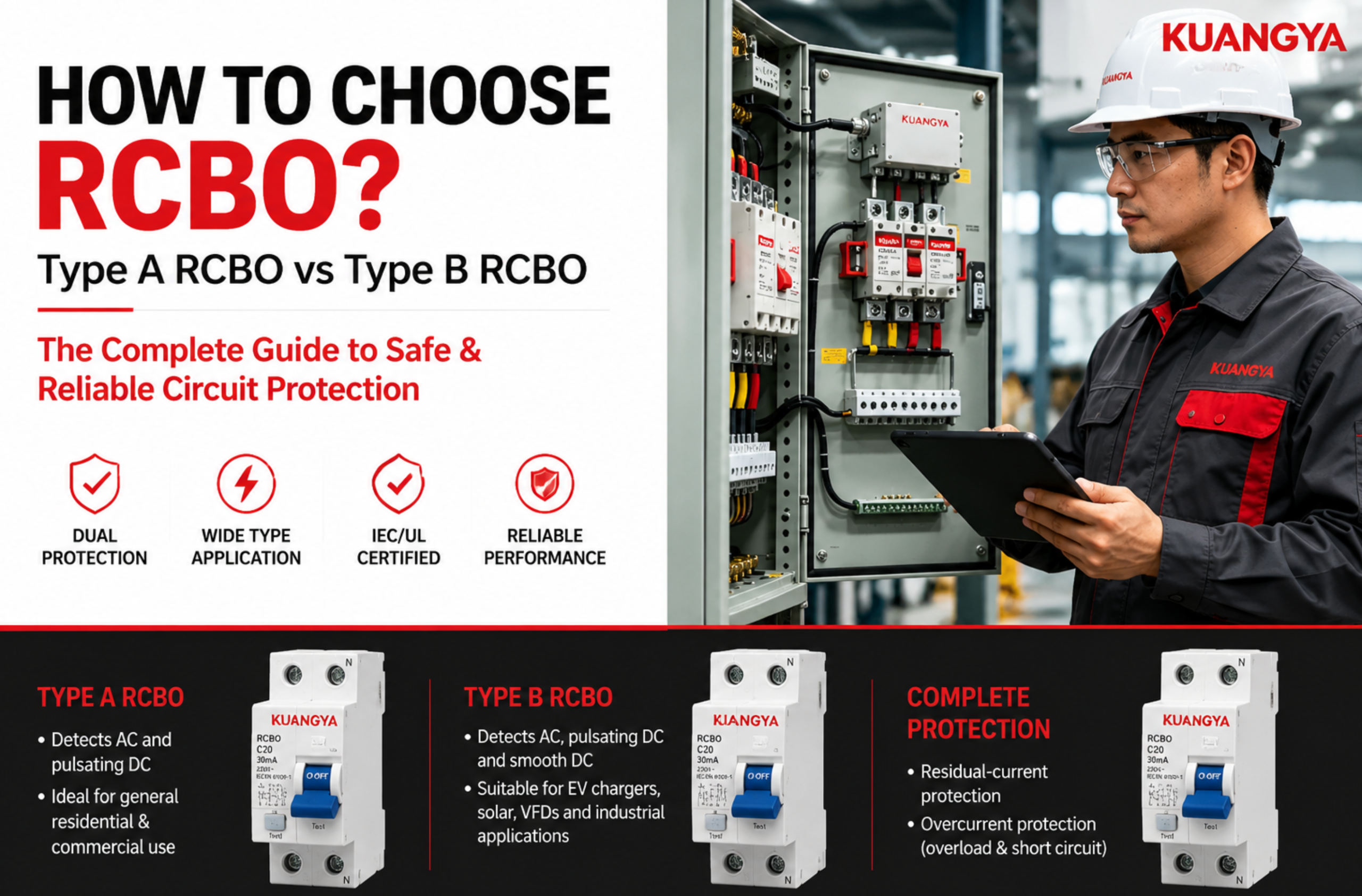
Type A vs Type B RCBO—quick answer: Type A RCBOs detect sinusoidal AC and pulsating DC residual currents. Type B RCBOs additionally cover smooth DC and mixed-frequency residual currents within the device’s specified range. Type B is not a universal upgrade: select the RCBO type according to the connected equipment, DC monitoring arrangement, manufacturer instructions, circuit design and local requirements.
This guide compares RCBO types, explains Type A or Type B selection, and covers poles, current rating, sensitivity, breaking capacity and application-specific checks for EV chargers, PV inverters and motor drives.
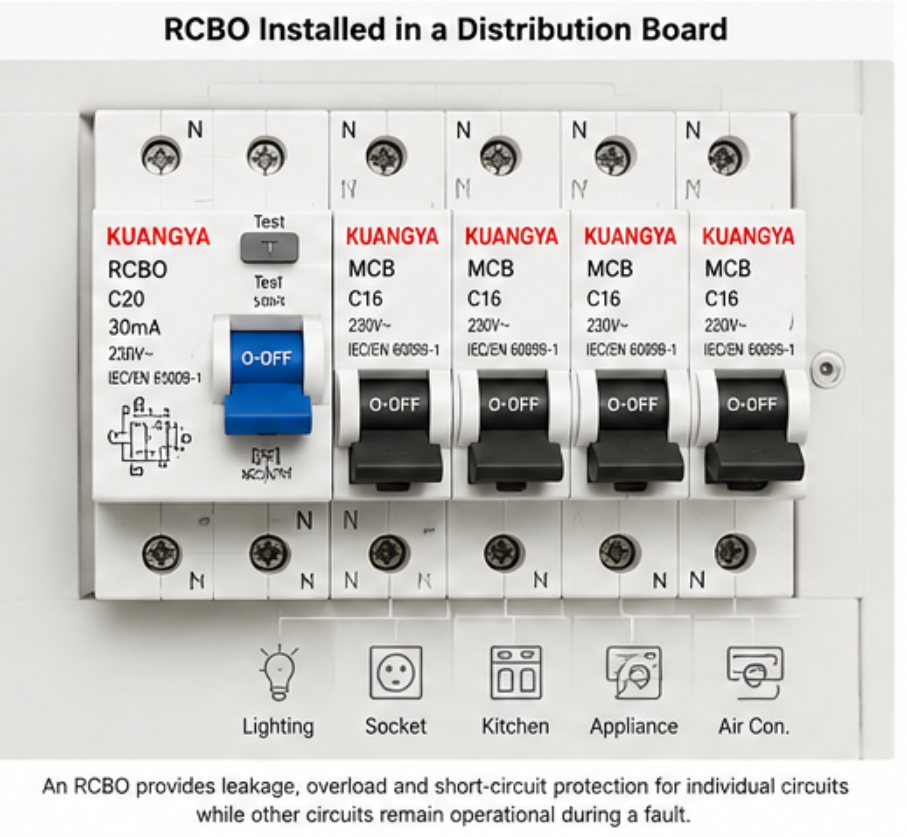
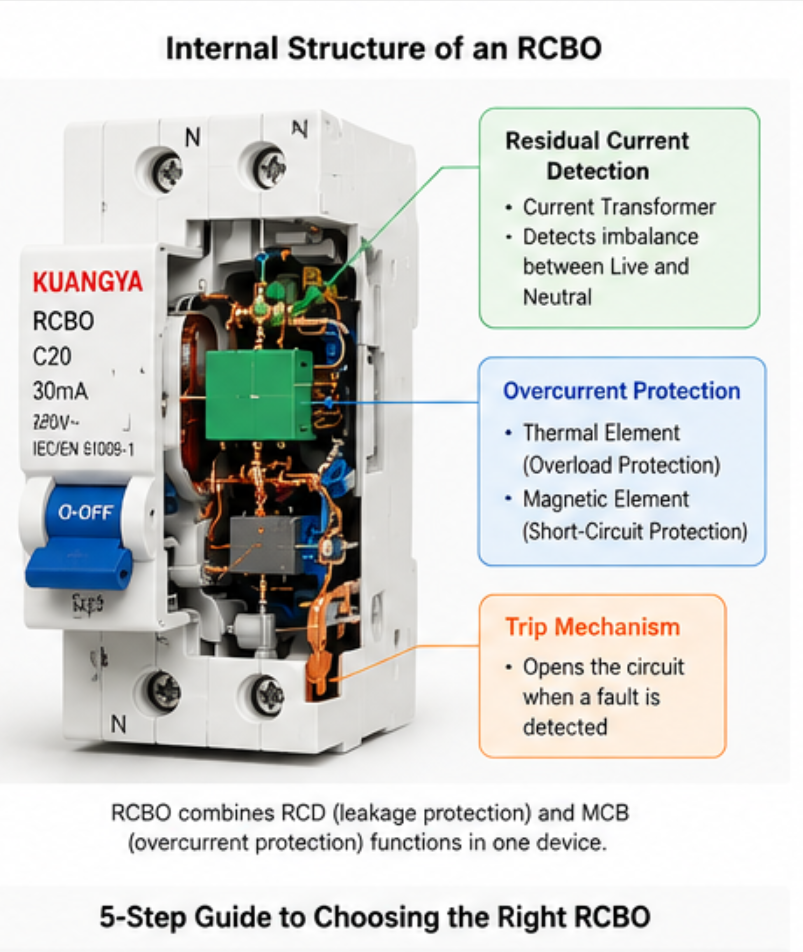
Um RCBO oferece proteção de corrente residual e proteção de sobrecorrente em um único dispositivo. Entretanto, a escolha do tipo errado de RCBO pode reduzir a eficácia da proteção e levar a disparos incômodos ou à não detecção de determinadas condições de falha.
É por isso que entender a diferença entre RCBO tipo A e RCBO tipo B é essencial ao projetar ou atualizar sistemas elétricos.
Muitos instaladores se concentram em:
Embora essas especificações sejam importantes, o tipo de corrente residual é igualmente crítico.
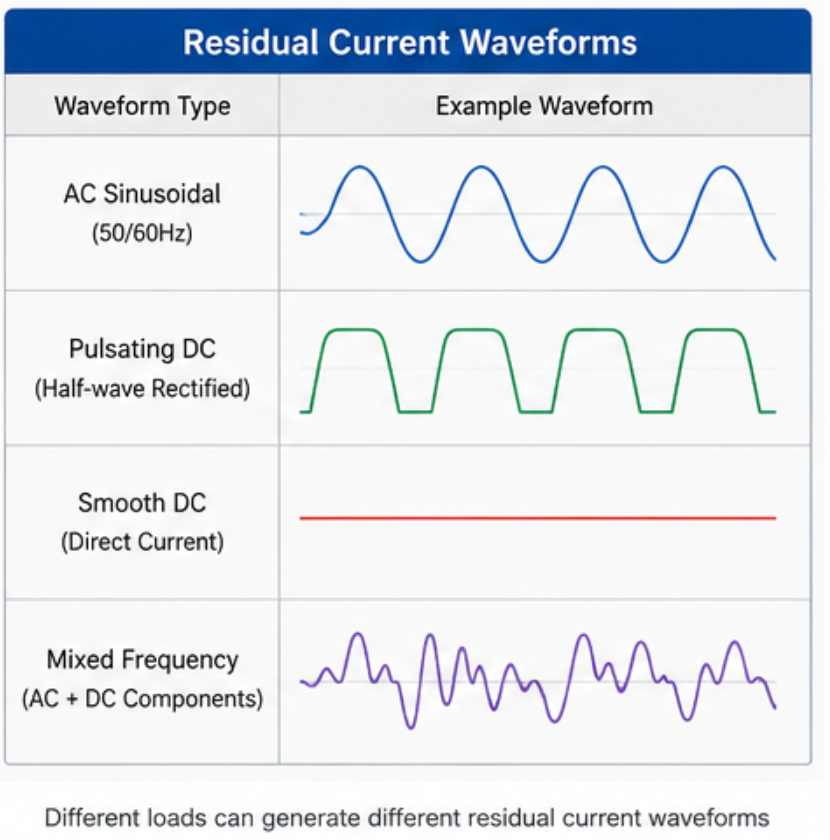
Diferentes cargas elétricas podem produzir diferentes formas de onda de corrente de fuga. Nem todo RCBO é projetado para detectar todas elas.
Se o tipo errado de RCBO for selecionado, as correntes perigosas de falta à terra podem não ser detectadas corretamente.
Um RCBO tipo A foi projetado para detectar:
Isso torna os dispositivos Tipo A adequados para a maioria das instalações residenciais e comerciais modernas em que há equipamentos eletrônicos.
As RCBOs do tipo A são comumente usadas para:
Como muitos aparelhos modernos contêm componentes eletrônicos e retificadores, os RCBOs do tipo A são cada vez mais preferidos em relação aos dispositivos antigos do tipo CA.
| Tipo de corrente residual | Detectado por RCBO tipo A |
|---|---|
| CA senoidal | Sim |
| CC pulsante | Sim |
| CC suave | Não |
| Componentes CC de alta frequência | Limitada |
Type A is commonly used for many residential and commercial electronic loads, but suitability still depends on the connected equipment and applicable requirements.
Um RCBO tipo B foi projetado para detectar:
Os dispositivos do tipo B oferecem a mais ampla capacidade de detecção de corrente residual entre os tipos comuns de RCBO.
Isso os torna adequados para instalações onde podem ser geradas correntes de falha de CC.
Os RCBOs tipo B são comumente usados em:
Essas aplicações podem gerar correntes residuais CC suaves que podem cegar ou saturar os dispositivos convencionais do Tipo A.
| Tipo de corrente residual | Detectado por RCBO tipo B |
|---|---|
| CA senoidal | Sim |
| CC pulsante | Sim |
| CC suave | Sim |
| Frequência mista | Sim |
| Componentes de alta frequência | Sim |
Devido à sua faixa de detecção mais ampla, o RCBO Tipo B é frequentemente especificado para sistemas elétricos avançados.
Essa é a comparação mais importante ao selecionar um RCBO.
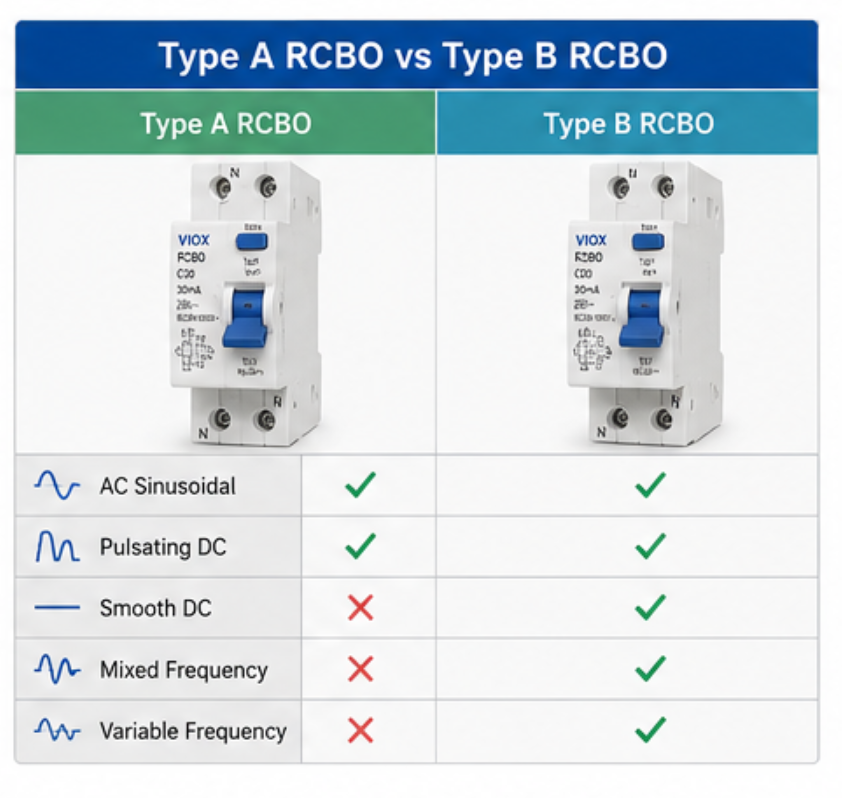
| Recurso | Tipo A RCBO | Tipo B RCBO |
|---|---|---|
| Detecção de corrente residual de CA | Sim | Sim |
| Detecção de CC pulsante | Sim | Sim |
| Detecção suave de CC | Não | Sim |
| Mixed-Frequency Residual Currents | Verify waveform and device specification | Covered only within the device’s specified frequency range |
| Aplicativos de carregadores de EV | Possible with verified DC protection where permitted | Use when required by the charger manual or applicable rules |
| Sistemas solares fotovoltaicos | Verify inverter manual and DC monitoring | Use when required by the inverter manual or applicable rules |
| Acionamentos industriais | Limitada | Verify equipment manual and applicable rules |
| Custo | Inferior | Mais alto |
The key difference is residual-current waveform coverage. Type A detects sinusoidal AC and pulsating DC residual currents, while Type B additionally detects smooth DC and mixed-frequency components within the manufacturer’s specified range.
Do not treat Type B as automatically better. For EV chargers, PV inverters and variable-speed drives, follow the equipment manual and applicable rules to determine whether Type A with verified DC detection, Type F or Type B is required.
Use the tool below to organize a preliminary RCBO specification. It highlights missing parameters and unsafe combinations, but it does not replace engineering verification or local requirements.
How to use this RCBO selector: choose the known circuit and equipment conditions. The result organizes a preliminary specification and highlights information that still requires verification.
Preliminary selection only. This tool does not approve a circuit or replace the equipment manual, product datasheet, coordination study, qualified designer, or local rules.
A escolha do RCBO correto começa com a compreensão da carga conectada.
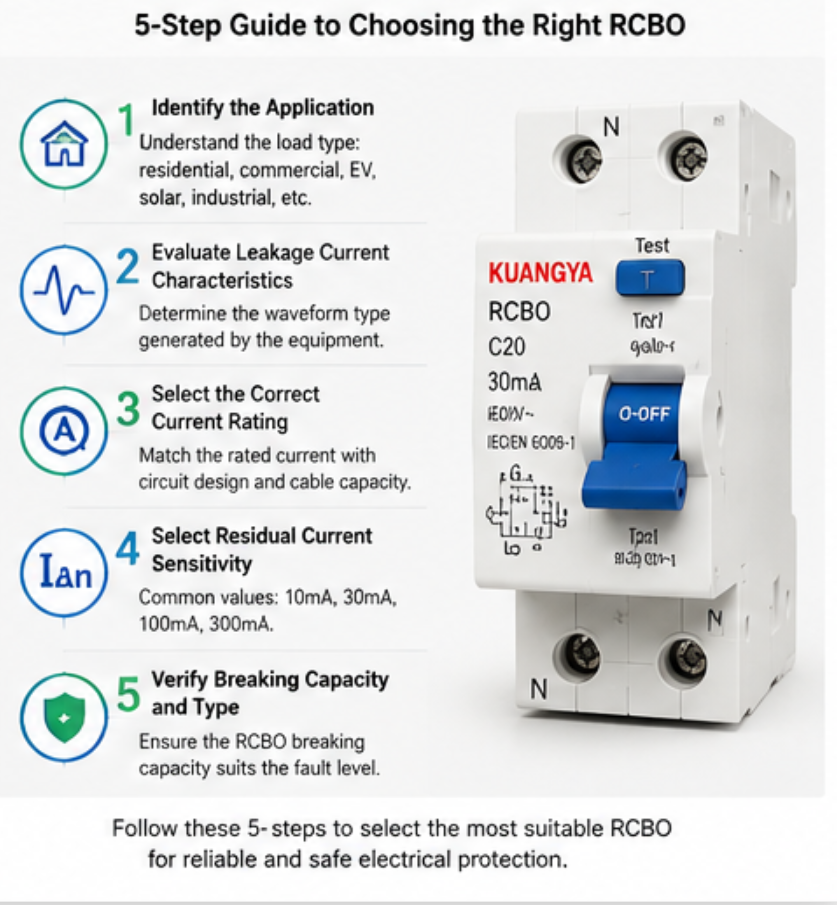
Pergunte:
As respostas orientarão a seleção do tipo de RCBO.
Equipamentos diferentes criam formas de onda de corrente residual diferentes.
| Tipo de equipamento | Tipo de RCBO recomendado |
|---|---|
| Circuitos de iluminação | Tipo A |
| Tomadas de soquete | Tipo A |
| Eletrodomésticos | Tipo A |
| Equipamento de escritório | Tipo A |
| Carregadores de veículos elétricos | Follow the EVSE manual: Type A with verified DC monitoring or Type B, as required |
| Inversores solares | Follow the inverter manual and applicable rules |
| Acionamentos de motor VFD | Verify leakage waveform, frequency behavior and drive manual |
| Sistemas de armazenamento de baterias | Follow the converter/BESS manual and applicable rules |
A corrente nominal deve corresponder:
As classificações comuns incluem:
As classificações de sensibilidade comuns incluem:
| Sensibilidade | Aplicação típica |
|---|---|
| 10mA | Proteção pessoal aprimorada |
| 30mA | Proteção padrão do pessoal |
| 100mA | Proteção do equipamento |
| 300mA | Aplicações de proteção contra incêndio |
30 mA continua sendo a escolha mais comum para os circuitos finais.
O RCBO deve ser capaz de interromper a corrente de falha disponível.
As classificações típicas incluem:
O valor necessário depende do nível de falha no ponto de instalação.
Muitos erros de especificação e de compra decorrem da falta de entendimento dos tipos de RCBO.
Os erros comuns incluem:
O tipo de RCBO deve sempre ser selecionado de acordo com o comportamento real da carga, e não apenas com o preço.
| Parâmetro | What to confirm | Por que é importante |
|---|---|---|
| Sistema | Single/three phase, voltage, frequency and neutral | Determines pole arrangement and operating voltage |
| Load | Electronic, motor/VFD, EVSE, PV inverter, UPS or resistive | Influences waveform type and trip curve |
| Corrente nominal | Design current, cable capacity and derating | A higher ampere rating is not automatically safer |
| RCBO type | AC, A, F or B required by the equipment manual | Determines detectable residual-current waveforms |
| Sensibilidade | 10/30/100/300 mA as permitted | Must match protection objective and selectivity |
| Trip curve | B, C or D after inrush and loop checks | Controls magnetic response to overcurrent |
| Capacidade de ruptura | Prospective short-circuit current at installation point | Catalogue values cannot replace a fault-level calculation |
| Market | Required standard edition and certificate scope | IEC reference does not prove approval in every country |
Stop condition: If breaking capacity, leakage characteristics, pole arrangement or local requirements are unknown, do not finalize the RCBO selection.
| Resultado | When to use it | Next action |
|---|---|---|
| Preliminary match | Every parameter is known and no obvious conflict exists | Compare exact datasheets and certificates; obtain engineering approval |
| Requer verificação | Breaking capacity, waveform, curve, poles or certification is unknown | Collect the missing data before ordering |
| Ainda não selecionar | Phase/poles conflict, EV/PV uses unverified Type AC, or the equipment manual contradicts the choice | Stop and review the circuit and equipment requirements |
System phase and voltage:
Load or equipment:
Rated current:
Poles and neutral requirement:
Residual-current type (AC/A/F/B):
Sensitivity (mA):
Trip curve (B/C/D):
Required breaking capacity (kA):
Frequency:
Target market and certification:
Quantity and purchase stage:
OEM/ODM requirement:
Required delivery date:
Also compare RCCB product families and read the RCCB vs RCBO guide. Final selection must use the exact product documentation and applicable local rules.
A escolha do RCBO correto envolve mais do que a seleção da classificação de corrente correta. O tipo de corrente residual é um fator crítico que afeta diretamente o desempenho da proteção.
Para a maioria dos circuitos residenciais e comerciais, um RCBO Tipo A oferece proteção eficaz contra correntes residuais CA e CC pulsantes.
For EV chargers, solar installations, battery storage systems and inverter-driven equipment, follow the exact equipment manual. Some designs allow Type A with verified DC monitoring; others require Type F or Type B.
Entender a diferença entre o RCBO Tipo A e o RCBO Tipo B ajuda a garantir a conformidade, melhorar a segurança e fornecer proteção confiável para sistemas elétricos modernos.
RCBO (disjuntor de corrente residual com sobrecorrente) - Kuangya seguro e confiável
IEC 61009-1:2024 gives general requirements and tests for RCBOs for household and similar uses within its stated scope. Always verify the applicable national adoption, installation rules, equipment manual and certificate scope of the exact product model.
Type A is common for many residential and commercial electronic circuits. EV, PV, storage and variable-frequency applications require verification against the equipment manual and local rules; do not assume one residual-current type fits every design.
O RCBO tipo A pode detectar correntes residuais CC pulsantes, mas não pode detectar de forma confiável correntes residuais CC suaves.
O RCBO tipo B contém uma tecnologia de detecção mais avançada, capaz de detectar uma gama mais ampla de formas de onda de corrente residual, incluindo falhas suaves de CC.
Muitos aplicativos de carregamento de EV exigem proteção Tipo B ou medidas equivalentes de detecção de falhas de CC, dependendo dos padrões locais e do projeto do carregador.
Do not treat Type B as a universal upgrade. The selected type must match the residual-current waveform, equipment instructions, coordination requirements and certification scope of the exact device.

