웽양 공업구 웨칭 원저우 325000
근무 시간
월요일~금요일: 오전 7시~오후 7시
주말: 주말: 오전 10시 - 오후 5시
웽양 공업구 웨칭 원저우 325000
근무 시간
월요일~금요일: 오전 7시~오후 7시
주말: 주말: 오전 10시 - 오후 5시

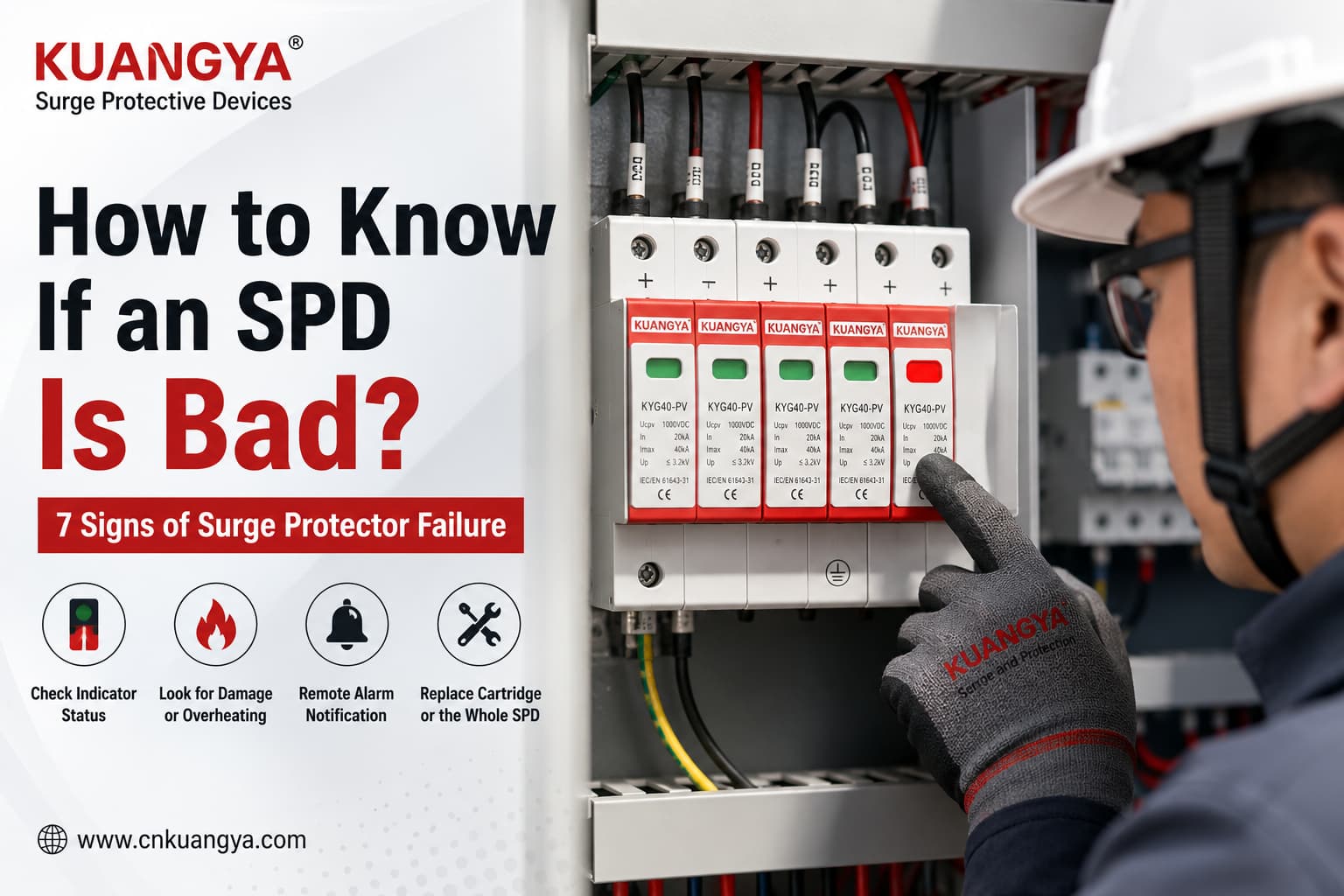
SPD의 불량 여부를 어떻게 알 수 있을까요? 상태 표시기가 가장 먼저 확인해야 할 부분이지만, 서지 보호 장치의 상태에 대한 모든 정보를 제공하지는 않습니다.
서지 보호 장치(SPD)는 보호 기능의 일부가 손실된 후에도 외부적으로는 완전히 정상으로 보일 수 있습니다.
이는 설치자와 시스템 소유자에게 다음과 같은 일반적인 문제를 야기합니다:
SPD가 불량인지 어떻게 알 수 있습니까?
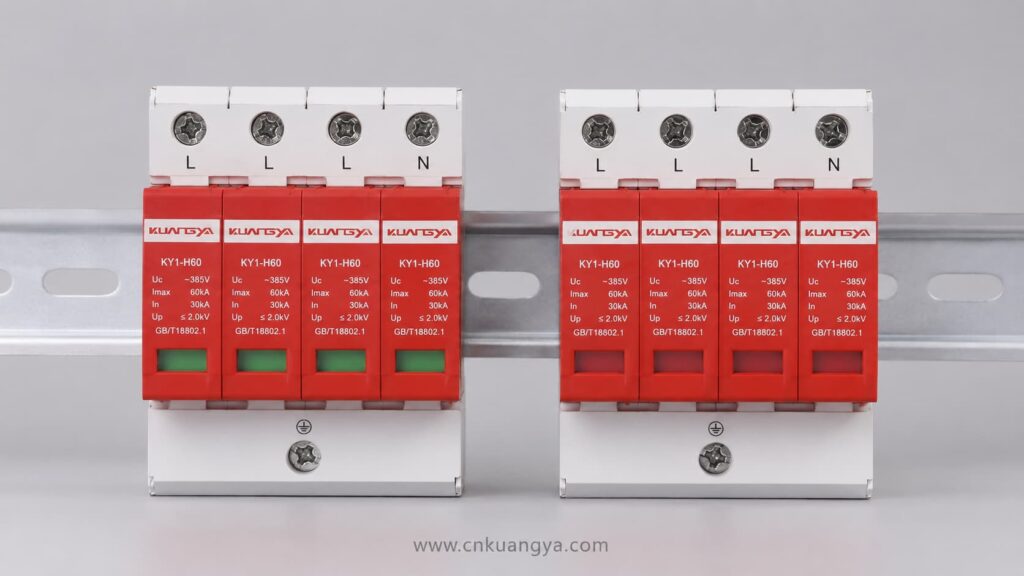
가장 먼저 확인해야 할 곳은 상태 표시기입니다. 많은 모듈형 SPD에서 정상 상태를 나타내는 녹색 표시는 모니터링되는 보호 모듈이 정상적으로 사용 가능한 상태임을 의미하며, 적색 또는 고장 표시는 해당 모듈을 점검하거나 교체해야 함을 의미합니다.
그러나 표시기는 진단의 일부일 뿐입니다.
SPD는 과열, 육안으로 확인되는 손상, 원격 경보, 백업 보호 장치 작동 또는 비정상적으로 심각한 전기적 이벤트 노출로 인해 주의가 필요할 수 있습니다.
그리고 중요한 점은 다음과 같습니다.
녹색 표시기가 전체 서지 보호 시스템이 완벽하다는 것을 보장하지는 않습니다.
SPD 상태를 판단하는 올바른 방법은 제품 표시기, 육안 검사, 설치 상태, 이벤트 이력 및 제조업체 지침을 종합적으로 고려하는 것입니다.
상태 표시기가 고장 상태를 나타내거나, 하나 이상의 모듈이 적색으로 변하거나, 하우징에 화상 자국이나 변형이 있거나, 장치가 과열되거나, 원격 경보가 발생하거나, SPD가 비정상적인 전기적 이벤트를 겪은 경우 SPD가 고장 났을 수 있습니다. 항상 제조업체의 지침에 따라 표시기의 의미를 확인하십시오.
이 가이드는 다음 내용을 설명합니다. SPD가 불량일 수 있음을 나타내는 7가지 실질적인 징후, 각 징후의 실제 의미, 그리고 모듈이나 SPD 전체를 교체해야 하는 시기.
SPD는 과도 과전압을 제한하고 민감한 전기 장비로부터 서지 전류를 우회시키도록 설계되었습니다.
현대의 저압 SPD는 일반적으로 하나 이상의 비선형 보호 부품을 포함합니다. MOV(금속 산화물 바리스터)는 많은 Type 2 및 복합형 SPD 설계에 흔히 사용됩니다.
IEC 표준은 SPD를 서지 전압을 제한하고 서지 전류를 우회시키는 최소 하나의 비선형 부품을 포함하는 장치로 정의합니다. 현재의 IEC 요구 사항은 AC, 일반 DC 및 태양광 DC 애플리케이션을 구분합니다.
정상적인 시스템 전압 상태에서 서지 보호 소자는 대부분 비전도 상태를 유지합니다.
과도 과전압이 발생하면 SPD는 서지 전류를 위한 저임피던스 경로를 제공하여 하위 장비에 도달하는 전압을 제한하는 데 도움을 줍니다.
그러나 이 과정은 전기적 및 열적 스트레스를 유발합니다.
반복적인 서지 이벤트, 심각한 서지, 비정상적인 시스템 전압 또는 기타 스트레스 조건 이후에는 보호 부품이 열화될 수 있습니다.
따라서 많은 MOV 기반 모듈형 SPD는 다음을 포함합니다. 열동형 차단기.
보호 부품이 위험한 상태에 도달하면 차단기가 회로에서 해당 부품을 분리할 수 있습니다. 많은 제품이 이 상태를 기계적으로 연결하여 적색/녹색 상태 표시창으로 보여줍니다.
예를 들어, 피닉스 컨택트(Phoenix Contact)는 다음과 같은 서지 보호 플러그를 문서화하고 있습니다. 바리스터, 열동형 차단 장치 및 현장 녹색/적색 상태 표시기.
예를 들어, 피닉스 컨택트는 열동형 차단 장치와 현장 녹색/적색 표시기가 통합된 플러그인 바리스터 모듈을 문서화하고 있습니다.
이는 SPD가 더 안전하게 고장나도록 돕습니다.
그러나 영향을 받은 보호 경로가 차단되면 시스템은 더 이상 의도된 수준의 서지 보호 기능을 제공하지 못할 수 있습니다.
이는 일반적으로 가장 먼저 확인해야 할 사항입니다.
많은 플러그인형 SPD는 전면에 작은 기계식 상태 표시창이 있습니다.
제품에 따라 정상 상태는 다음과 같이 표시될 수 있습니다:
고장 또는 교체 필요 상태는 다음과 같이 표시될 수 있습니다:
For many modular MOV-based products:
Green → monitored protection module remains available
Red → internal disconnection has occurred and the affected module normally requires replacement
However, this is not a universal color rule for every SPD.
Different manufacturers use different indicators. Some SPDs use LEDs instead of mechanical windows. Others use displays, alarm contacts, symbols, audible alarms, or combinations of these functions.
Schneider Electric, for example, documents SPD families where LED conditions are used to indicate whether surge suppression remains available on each phase.
따라서 항상 정확한 SPD 모델에 대한 표시와 지침을 확인하십시오.
일반적으로 그렇지 않습니다.
많은 패널 장착형 SPD는 병렬로 전원 회로와 함께 설치됩니다.
따라서 전기 부하는 일반적으로 SPD를 통과하는 전류에 의존하지 않습니다.
내부 SPD 차단기가 열리면 보호 대상 장비는 정상적으로 계속 작동할 수 있지만 해당 경로의 서지 보호 기능은 상실됩니다.
이것이 바로 고장 난 SPD를 쉽게 알아차리지 못하는 이유입니다.
조명이 계속 켜져 있습니다.
인버터가 계속 작동합니다.
기계가 계속 작동합니다.
그러나 다음 과도 현상은 더 이상 동일한 방식으로 제한되지 않을 수 있습니다.
다극 SPD는 하나의 카트리지 상태만 보고 판단해서는 안 됩니다.
예를 들어, 다중 모듈 설치 시 다음과 같이 나타날 수 있습니다:
| 모듈 상태 | 가능한 의미 | 권장 조치 |
|---|---|---|
| 모든 필수 모듈 정상 | 로컬 모니터링상 오류 없음 | 정기 점검 계속 수행 |
| 모듈 1개 고장 | 보호 경로 1개가 더 이상 사용 불가능할 수 있음 | 규정에 따라 조사 및 교체 |
| 다수의 모듈 고장 | 상당한 SPD 성능 저하 또는 이벤트가 발생했을 수 있음 | 전체 SPD 및 설치 상태를 점검할 것 |
| 표시기 상태가 불분명함 | 상태를 확실하게 판단할 수 없음 | 데이터시트 또는 제조업체 지침을 확인할 것 |
3상 SPD에 3개 또는 4개의 플러그인 모듈이 있다고 가정함.
3개는 녹색으로 유지되지만 하나가 제조업체의 고장 상태로 변경된 경우 전체 SPD가 완전히 정상 작동한다고 설명해서는 안 됨.
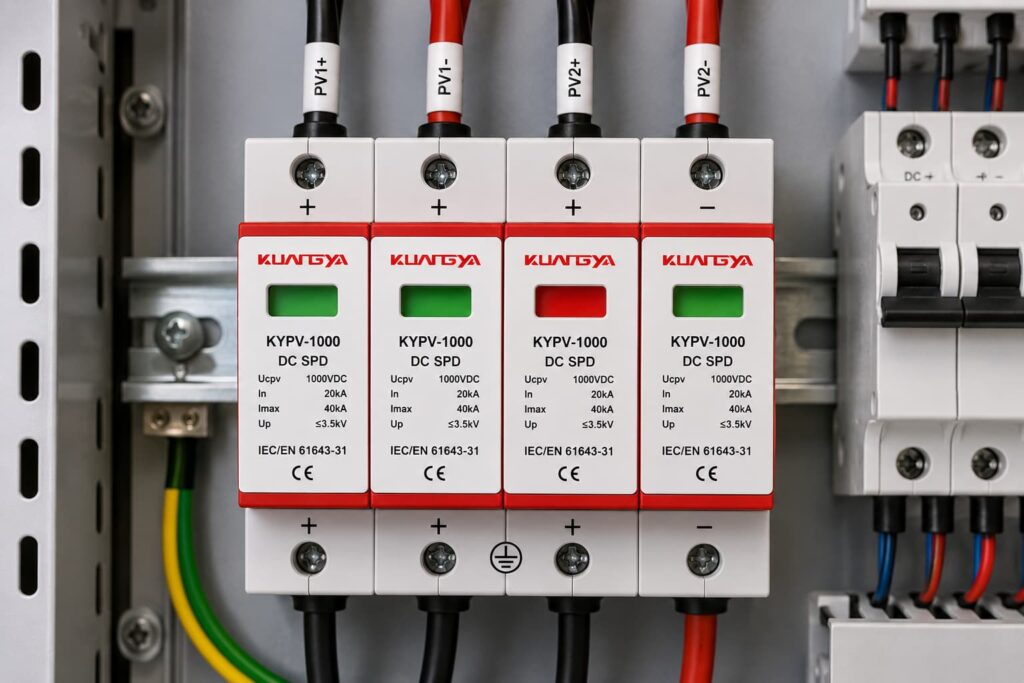
의도된 보호 경로 중 최소 하나가 더 이상 확인되지 않습니다.
Not automatically.
Some modular SPDs are specifically designed so individual cartridges can be replaced.
If:
then replacing the affected cartridge may be sufficient.
However, if there is:
the complete SPD and surrounding installation should be investigated.
The status indicator is not the only thing that matters.
Always inspect the physical condition of the SPD.
Warning signs include:
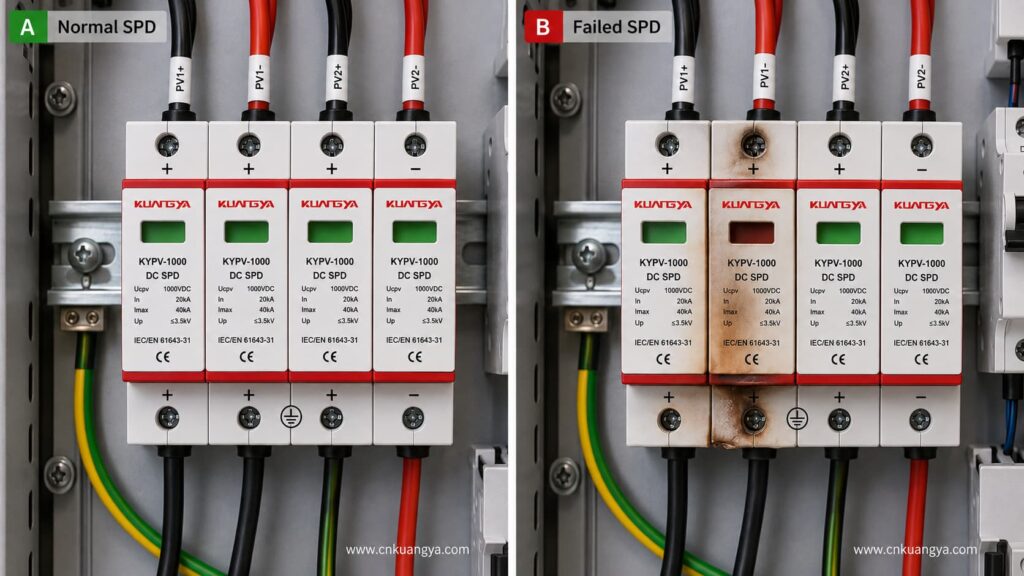
An SPD showing obvious thermal or mechanical damage should not simply be left in service because its indicator still appears green.
Physical damage can be caused by several different conditions, including:
The cause therefore matters.
Simply changing the cartridge without understanding why it was damaged can allow the same problem to happen again.
There is an important difference between:
A clean module that has reached its manufacturer-defined replacement condition
및
An SPD showing burning, melting, arcing, or mechanical damage.
In the second situation, inspection should extend beyond the replaceable cartridge.
Check the:
Severe physical damage is a reason to investigate the entire installation rather than simply installing a new plug.
Electrical equipment naturally operates at different temperatures.
But an SPD that becomes unusually hot, produces a burnt smell, or shows progressive discoloration deserves immediate attention.
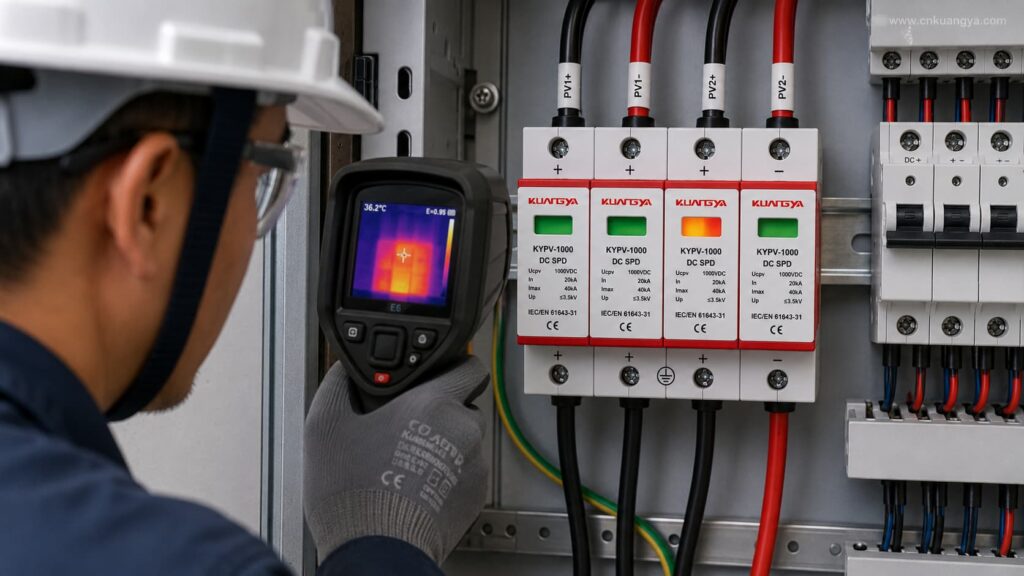
MOV-based protective components can experience increasing leakage and thermal stress as they degrade.
Proper SPD designs therefore use internal disconnecting or protective mechanisms to reduce the risk of an unsafe end-of-life condition.
Do not diagnose an energized SPD by repeatedly touching it.
If abnormal heating is suspected, inspection should be carried out by qualified personnel using appropriate procedures and instruments.
가능한 원인은 다음과 같습니다:
A hot SPD does not automatically prove that the MOV itself has failed.
For example, a poorly tightened terminal can create local resistance and heating even if the surge component has not reached its end of life.
That is why the location of the heat and the overall installation condition should be investigated.
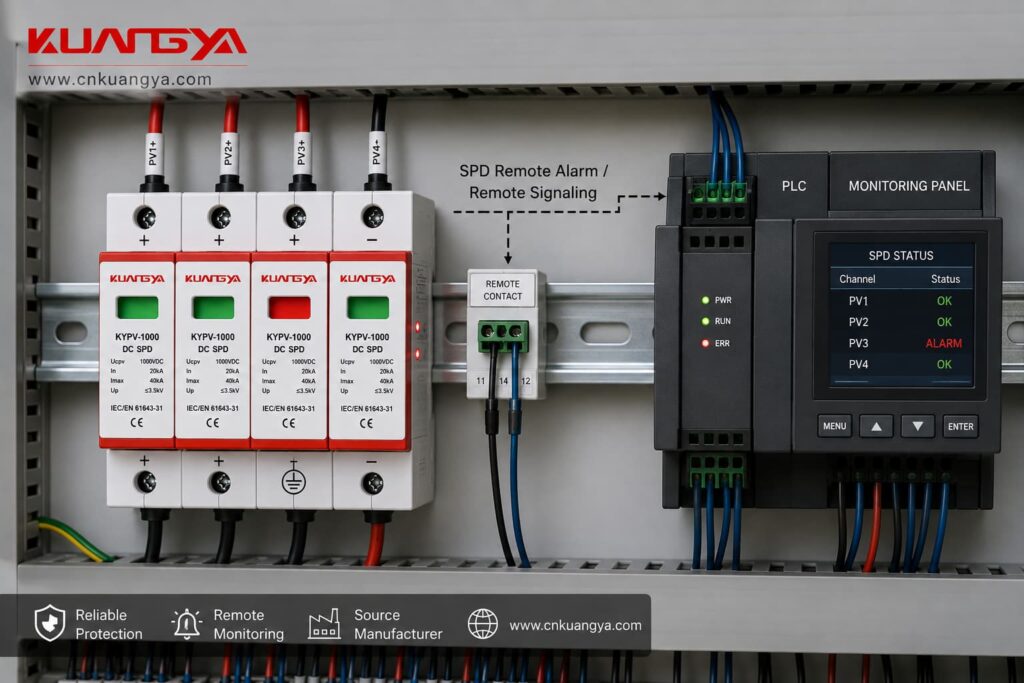
Industrial SPDs frequently offer an optional remote signaling contact.
Instead of requiring someone to open the electrical cabinet and visually check the SPD, the remote contact can communicate the SPD’s model-defined condition to equipment such as:
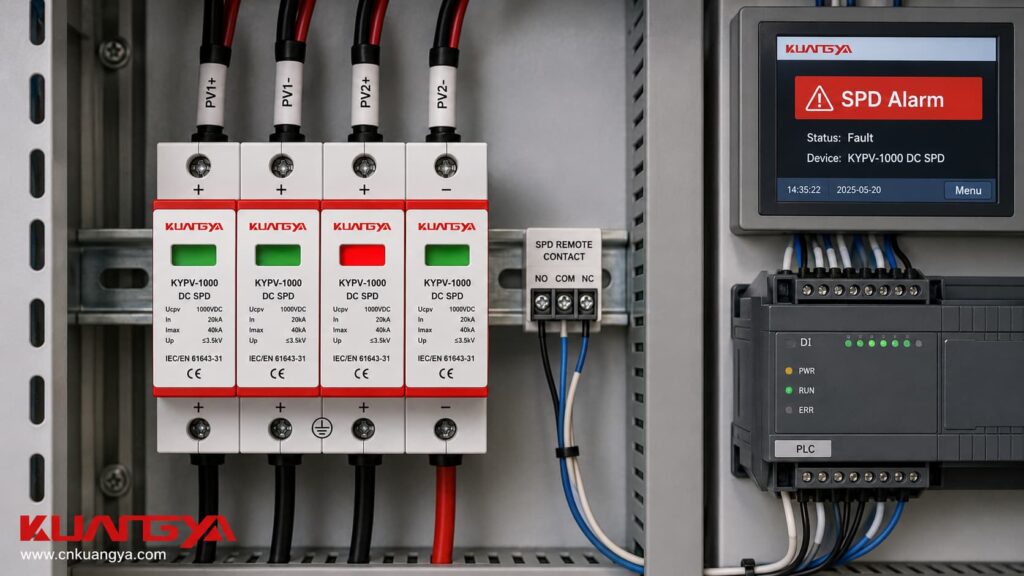
Phoenix Contact, for example, offers SPD assemblies combining local green/red indication with remote signaling.
This is useful in:
Usually, it tells you that the SPD’s monitored mechanism has changed state.
It does not automatically tell you:
Remote signaling is therefore a maintenance tool, not a complete SPD diagnostic system.
If a remote alarm appears, confirm the local SPD status and inspect the device according to the manufacturer’s instructions.
SPDs can be installed with upstream or dedicated overcurrent protection depending on the SPD design and system requirements.
If the associated fuse or circuit breaker operates unexpectedly, do not immediately assume that the breaker itself is faulty.
가능한 원인은 다음과 같습니다:
The backup protective device and the internal SPD disconnector do different jobs.
The internal thermal disconnector may operate because a surge protection element has reached an unsafe thermal condition without necessarily creating the type of sustained overcurrent required to trip a conventional breaker.
So this situation is possible:
SPD = failed
Breaker = still ON
This does not automatically mean the breaker has failed.
Likewise, repeatedly fitting a larger breaker is not a correct solution to repeated SPD disconnection.
The cause of the SPD failure must be investigated first.
A major lightning or switching event is an important reason to inspect an SPD.
But it is important to use careful wording here.
SPDs are specifically designed to handle transient surge currents within their declared performance capabilities.
따라서
Lightning nearby ≠ SPD automatically destroyed
However, after a known severe event, especially at a critical facility, it is good maintenance practice to inspect:
If a module has entered the manufacturer’s failed state, replace it.
If there is visible damage, investigate further.
If everything remains normal, follow the manufacturer’s maintenance and post-event instructions rather than replacing the SPD without evidence.
Select the conditions you can observe and get a quick indication of whether the SPD may need further inspection or replacement.
아니요.
This is one of the most important distinctions when inspecting an SPD.
If the manufacturer defines green as the normal state, a green indicator usually means something like:
The monitored disconnect mechanism has not indicated failure and the protection module remains in its normal available state.
That is useful information.
But it is not the same as proving every aspect of SPD performance.
A green indicator normally cannot prove:
Think of the indicator as a condition signal, not a laboratory test.
If your SPD is still green, see our detailed guide to what an SPD green indicator can — and cannot — confirm about the protection system.
This is also why normal indication should be combined with periodic inspection.
예.
This surprises many people.
A typical shunt-connected SPD is installed parallel to the circuit being protected.
A simplified arrangement looks like this:
Power Supply → Load
with the SPD connected from the live conductors toward the relevant protection path, such as PE.
The load does not normally receive its operating current through the SPD.
Therefore, when the SPD’s internal protective element is disconnected at end of life:
Load power may remain ON
while
surge protection may be reduced or lost.
This is exactly why local indicators and remote alarms are important.
Without inspection, a failed SPD can remain installed for months while everything downstream appears to operate normally.
When learning how to know if an SPD is bad, it is important to understand that a normal digital multimeter cannot fully verify surge protection performance.
이 질문에는 신중한 답변이 필요합니다.
A digital multimeter cannot reproduce the standardized surge conditions used to determine major SPD ratings.
It cannot verify:
These characteristics require controlled test equipment and defined test procedures.
IEC SPD requirements use standardized testing to establish performance and safety characteristics; ordinary low-voltage resistance measurements are not substitutes for those tests.
Depending on the SPD and the manufacturer’s instructions, a multimeter may help with:
But there is no universal resistance reading that means “SPD good.”
For MOV-based products, the small test voltage produced by a normal multimeter may be far below the voltage at which the varistor significantly conducts.
A healthy MOV can therefore appear as very high resistance or open circuit.
A degraded MOV may also appear open under the same low test voltage.
따라서:
Open circuit on a multimeter does not prove the SPD is healthy.
Likewise:
A continuity beep is not a universal SPD pass/fail test.
Dedicated SPD or MOV test equipment can provide more useful diagnostic information for some products, but results must still be compared with manufacturer-defined values for that specific SPD.
Generally, do not apply an insulation resistance tester directly across an SPD unless the manufacturer specifically provides a procedure allowing it.
Megohmmeters use test voltages much higher than an ordinary multimeter.
Because an SPD is intentionally designed to conduct when voltage rises above certain conditions, insulation testing can:
For system insulation testing, SPDs may need to be disconnected or removed according to the manufacturer’s instructions and applicable installation procedures.
Never assume an SPD should behave like ordinary insulation.
Understanding the reason is important because simply installing another SPD may not solve the underlying problem.
Every surge does not necessarily destroy an SPD.
However, repeated surge activity can progressively stress protective components.
The actual service life depends on factors such as:
There is therefore no reliable rule such as:
“An SPD always lasts exactly five years.”
Calendar age alone does not determine SPD condition.
SPDs have declared surge-current capabilities.
A sufficiently severe electrical event can exceed the capability of a particular protection system.
This is one reason correct Type selection and coordinated surge protection are important.
Type 1, Type 2, and combined Type 1+2 SPDs are not simply different quality levels.
If you are unsure which classification applies, see our guide to Type 1 vs Type 2 vs Type 1+2 SPD for a more detailed comparison.
A transient surge and a temporary overvoltage are not the same thing.
A surge is generally very short.
A temporary overvoltage, or TOV, can remain for much longer.
An SPD designed to conduct short transient energy should not be expected to clamp an abnormal power-frequency overvoltage indefinitely.
Improper TOV conditions can therefore create serious stress on an SPD.
Current IEC requirements specifically consider TOV and fault conditions as part of SPD application and testing.
Selecting an SPD with an unsuitable maximum continuous operating voltage can cause problems.
For AC systems, the relevant value is commonly expressed as Uc.
For photovoltaic applications, Ucpv is particularly important.
For photovoltaic DC applications, IEC 61643-31 specifies requirements and test methods for SPDs intended for the DC side of PV installations.
If you are not familiar with these ratings, our guide to DC SPD specifications explains Ucpv, In, Imax, Up and Iscpv separately.
If the SPD’s voltage rating is too low for the maximum voltage that can continuously appear in the system, the protection component can be stressed during normal or abnormal operating conditions.
For PV systems, remember that array voltage changes with temperature.
Maximum PV open-circuit voltage under expected low-temperature conditions therefore needs to be considered when selecting the DC SPD.
For the full selection process, see how to select the correct DC SPD voltage rating for a solar PV system.
Even a good SPD can perform poorly if it is installed incorrectly.
Important installation factors include:
Long connection leads are particularly important because the inductive voltage developed along the conductors during a rapidly changing surge current can add to the voltage seen by the protected equipment.
SPD location and lead length are two different installation issues. See why SPD distance from the inverter matters for a detailed explanation of the 10 m system-distance rule and the approximately 0.5 m connection-lead recommendation.
This means SPD performance depends not only on the number printed next to Up, but also on how the SPD is actually installed.
Environmental stress can also shorten SPD service life.
예를 들면 다음과 같습니다:
These conditions can affect terminals, insulation, contacts, and surrounding installation components even before the internal surge element reaches normal end of life.
A simple field inspection can follow this order.
Check:
Do not install a cartridge just because it physically fits the base.
Confirm what the indicator means for that exact product.
Do not automatically assume every green window means normal and every red window means failure without checking the manufacturer’s markings.
For multi-pole SPDs, inspect all cartridges.
One failed module can mean the complete intended protection arrangement is no longer available.
확인:
If remote signaling is installed, compare the remote alarm state with the local status.
A mismatch should be investigated.
Ask whether the installation recently experienced:
| 조건 | Typical Action |
|---|---|
| Manufacturer-defined normal indicator, no other problems | Continue normal monitoring |
| Failed/red module | Replace according to manufacturer instructions |
| One cartridge failed | Inspect assembly and replace affected cartridge if permitted |
| Multiple cartridges failed | Inspect complete SPD and system |
| Burnt or melted base | Investigate and normally replace complete damaged assembly |
| Remote fault alarm | Confirm local status and investigate |
| Severe event but normal indication | Inspect according to maintenance instructions |
| Repeated replacement failures | Investigate system voltage, wiring, TOV and coordination |
| Condition uncertain | Treat protection as unconfirmed until properly assessed |
Many DIN-rail SPDs are modular.
They consist of:
Base + replaceable protection cartridge
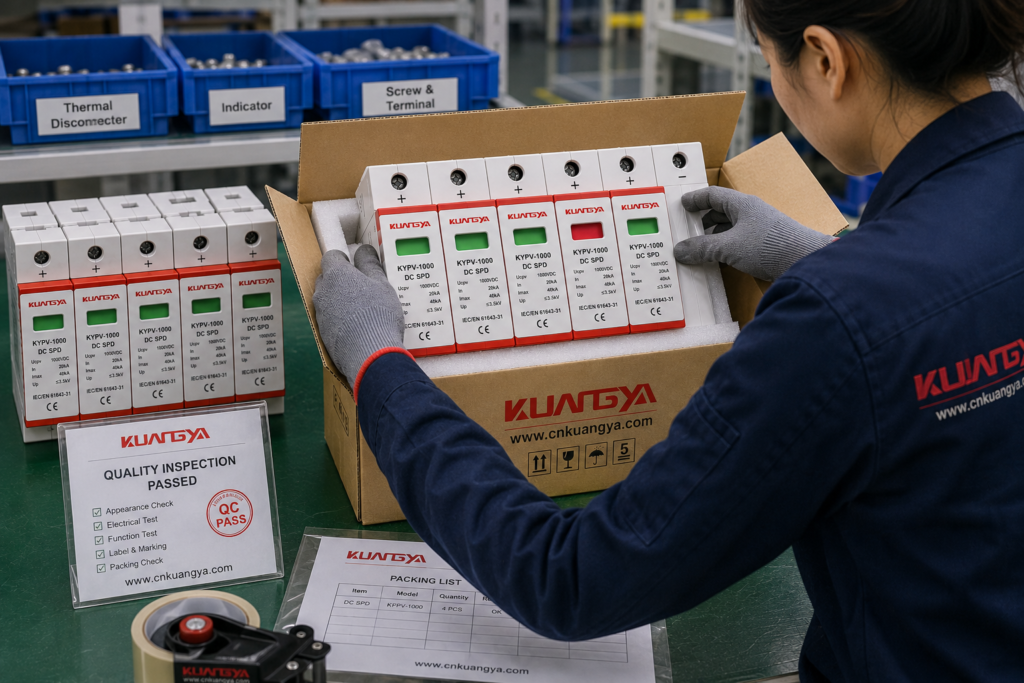
For reference, you can also view our DC surge protective device range, including modular Type 2 and Type 1+2 models with replaceable cartridges.
This allows easier maintenance.
Never bypass the SPD’s internal thermal disconnector or attempt to reset a sealed failed cartridge.
A cartridge that has entered its defined end-of-life condition is normally intended to be replaced rather than repaired.
If the manufacturer-defined indication shows that the intended surge protection path is no longer available, replacement should not be unnecessarily delayed.
The electrical system may continue running without it.
But that does not mean continued operation without surge protection is desirable.
이는 특히 다음과 같은 경우에 중요합니다:
The longer the failed SPD remains in place, the longer the equipment may remain exposed to the next transient event.
There is no single inspection interval suitable for every installation.
Inspection frequency should consider:
Inspection is particularly useful:
For unattended or critical installations, remote signaling can make it easier to detect a failed SPD quickly.
Seeing a failed SPD sometimes leads to the assumption:
“The SPD failed, so it must be defective.”
That conclusion is not always correct.
An SPD is a protective device exposed directly to electrical stress.
A failure indication may mean that it experienced the kind of abnormal condition its protective and disconnecting mechanisms were designed to handle safely.
The more useful question is:
Why did the SPD reach this condition?
Investigate:
If the same SPD position fails repeatedly, replacing cartridges without investigating the system is not enough.
The easiest sign of SPD failure is a manufacturer-defined failure or replacement indication, commonly red on many modular SPDs.
But that should not be the only check.
An SPD should also be investigated if you find:
At the same time, do not assume that a green indicator proves the entire surge protection system is perfect.
It usually confirms only the condition monitored by that particular SPD.
And do not rely on a normal multimeter resistance test to prove surge performance.
Correct SPD assessment combines:
product status + visual inspection + installation condition + event history + manufacturer instructions.
If a modular SPD has reached its defined end-of-life state, replace the affected cartridge or assembly as specified.
More importantly, if failure is repeated or accompanied by physical damage, investigate the underlying electrical system before simply installing another SPD.
Ultimately, how to know if an SPD is bad comes down to combining the status indication, physical inspection, event history, installation condition and manufacturer guidance rather than relying on a single test.
Start with the manufacturer’s status indicator. If the product defines the displayed condition as normal and there is no physical damage or alarm, the monitored module remains in its normal indicated state. However, the status indicator does not prove complete surge performance or remaining lifetime.
On many modular SPDs, green means that the monitored protection module has not entered its failure or disconnection state.
But always confirm the manufacturer’s markings because indicator systems vary between products.
Green should not be interpreted as proof that the complete installation is perfectly protected.
On many plug-in MOV-based SPDs, a red indicator means the protection module has reached a manufacturer-defined failed or replacement condition, often associated with an internal disconnector.
The affected cartridge normally needs to be replaced.
Check the exact product instructions before taking action.
예.
Most panel-mounted SPDs are connected in parallel with the protected circuit.
The load can therefore remain energized even if the SPD protection element has been disconnected.
Only to a limited extent.
A multimeter may help check remote dry contacts or investigate certain basic electrical conditions when permitted by the manufacturer.
It cannot verify surge ratings such as Up, In, Imax, or Iimp, and there is no universal resistance value that proves an SPD is healthy.
Not automatically.
Inspect the SPD after a significant event and follow the manufacturer’s maintenance instructions.
Replace it if it shows a failure indication, physical damage, abnormal condition, or if the manufacturer specifically requires replacement after the event.
Replaceable cartridges are common in modular SPDs. For example, Schneider Electric explains that when the SPD end-of-life indicator turns red, the cartridge should be replaced.
Often yes, if the SPD is designed with replaceable plug-in modules and the base is undamaged.
Use only the correct compatible replacement cartridge specified for that SPD.
If the base, terminals, or surrounding components show heat or arc damage, the complete assembly should be investigated.
Repeated failure can indicate more than ordinary surge aging.
가능한 원인은 다음과 같습니다:
If cartridges repeatedly fail at the same location, investigate the system instead of continuing to replace modules without identifying the cause.
No reliable fixed lifetime can be determined from indicator color alone.
SPD life depends on the electrical stress it experiences, environmental conditions, product design, and installation.
The indicator should be treated as one part of a wider inspection and maintenance process.

