웽양 공업구 웨칭 원저우 325000
근무 시간
월요일~금요일: 오전 7시~오후 7시
주말: 주말: 오전 10시 - 오후 5시
웽양 공업구 웨칭 원저우 325000
근무 시간
월요일~금요일: 오전 7시~오후 7시
주말: 주말: 오전 10시 - 오후 5시

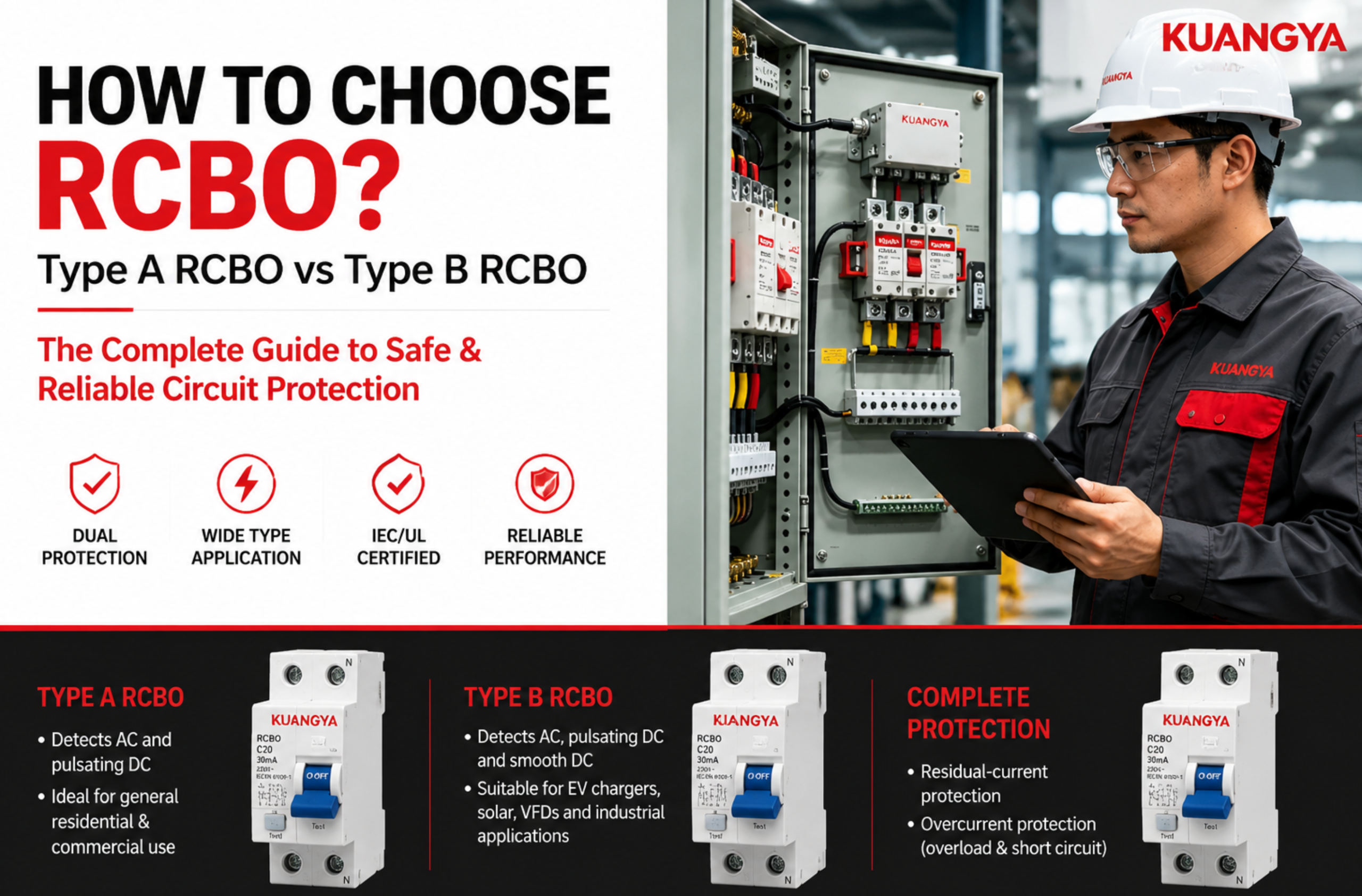
Type A vs Type B RCBO—quick answer: Type A RCBOs detect sinusoidal AC and pulsating DC residual currents. Type B RCBOs additionally cover smooth DC and mixed-frequency residual currents within the device’s specified range. Type B is not a universal upgrade: select the RCBO type according to the connected equipment, DC monitoring arrangement, manufacturer instructions, circuit design and local requirements.
This guide compares RCBO types, explains Type A or Type B selection, and covers poles, current rating, sensitivity, breaking capacity and application-specific checks for EV chargers, PV inverters and motor drives.
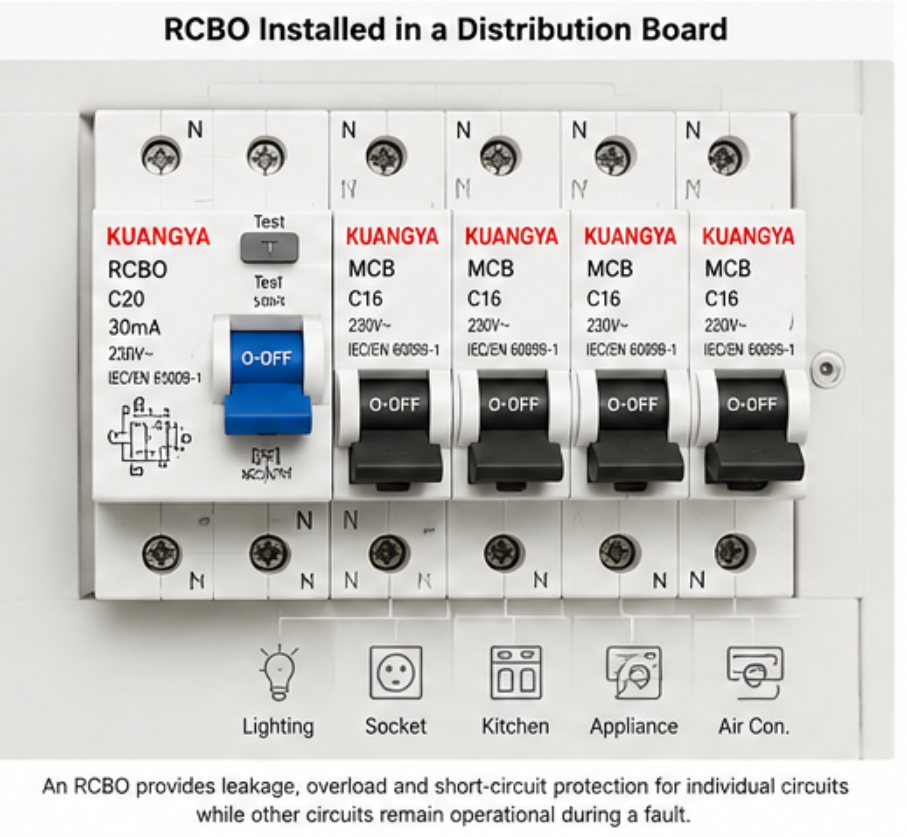
RCBO는 단일 장치에서 잔류 전류 보호와 과전류 보호 기능을 모두 제공합니다. 그러나 잘못된 RCBO 유형을 선택하면 보호 효과가 감소하고 성가신 트립이 발생하거나 특정 오류 조건을 감지하지 못할 수 있습니다.
그렇기 때문에 전기 시스템을 설계하거나 업그레이드할 때 유형 A RCBO와 유형 B RCBO의 차이점을 이해하는 것이 필수적입니다.
많은 설치자가 집중하는 부분입니다:
이러한 사양도 중요하지만 잔류 전류 유형도 그에 못지않게 중요합니다.
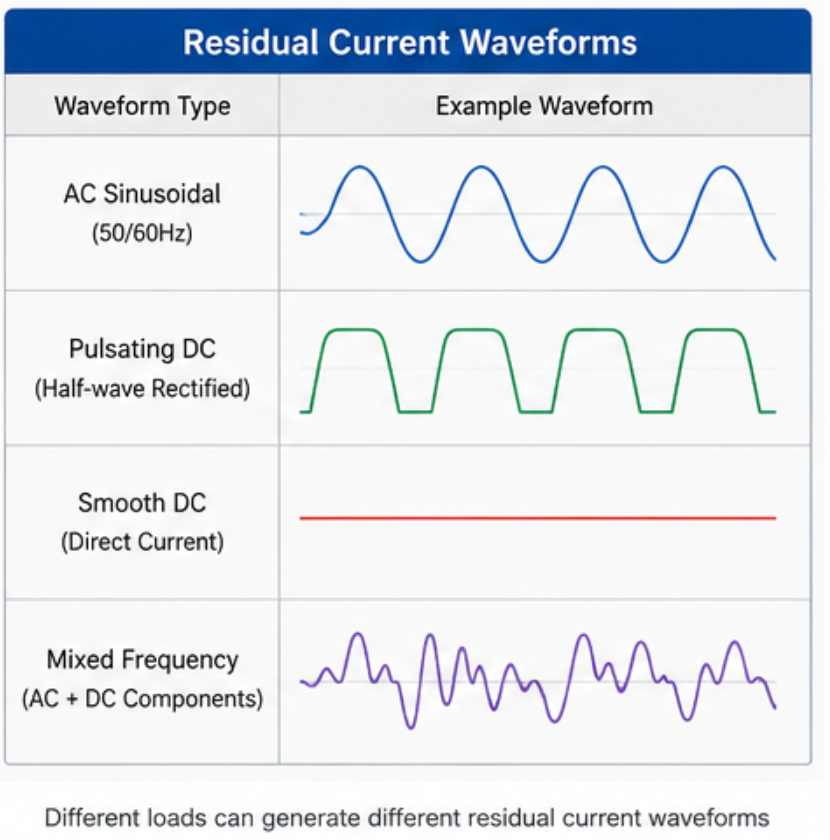
전기 부하에 따라 누설 전류 파형이 달라질 수 있습니다. 모든 RCBO가 이러한 파형을 모두 감지하도록 설계된 것은 아닙니다.
잘못된 RCBO 유형을 선택하면 위험한 지락 전류가 올바르게 감지되지 않을 수 있습니다.
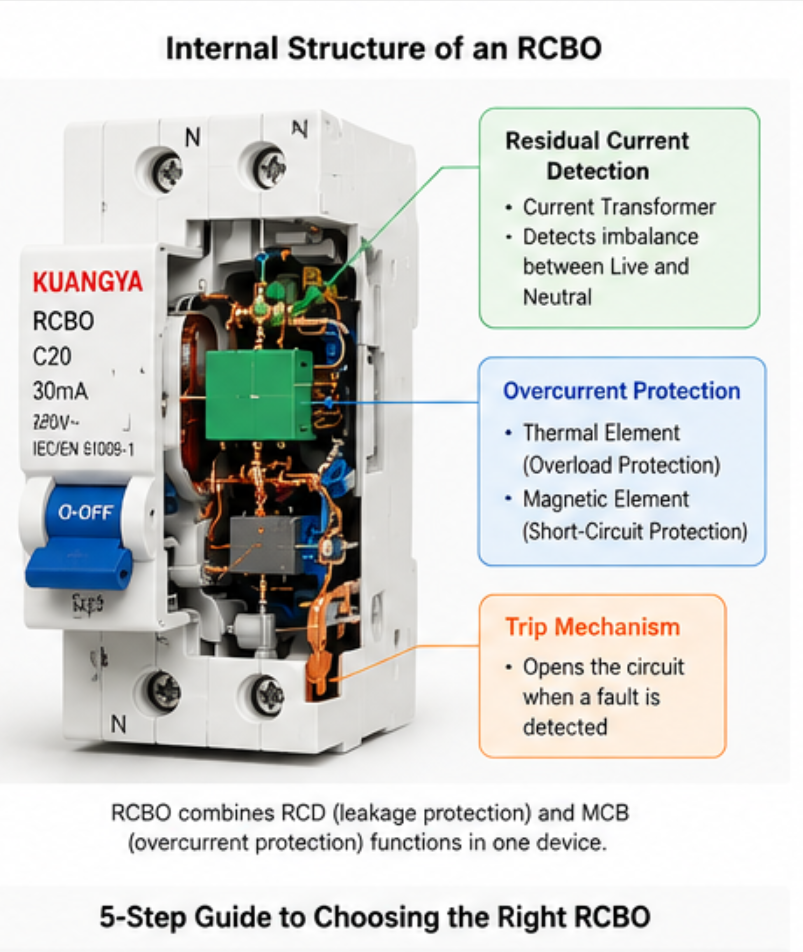
유형 A RCBO는 감지하도록 설계되었습니다:
따라서 A형 장치는 전자 장비가 있는 대부분의 현대식 주거 및 상업 시설에 적합합니다.
유형 A RCBO는 일반적으로 다음과 같은 용도로 사용됩니다:
많은 최신 기기에는 전자 부품과 정류기가 포함되어 있기 때문에 구형 AC 장치보다 A타입 RCBO가 점점 더 선호되고 있습니다.
| 잔류 전류 유형 | 유형 A RCBO에 의해 감지됨 |
|---|---|
| AC 정현파 | 예 |
| 맥동 DC | 예 |
| 부드러운 DC | 아니요 |
| 고주파 DC 부품 | 제한적 |
Type A is commonly used for many residential and commercial electronic loads, but suitability still depends on the connected equipment and applicable requirements.
유형 B RCBO는 감지하도록 설계되었습니다:
유형 B 장치는 일반적인 RCBO 유형 중 가장 광범위한 잔류 전류 감지 기능을 제공합니다.
따라서 DC 고장 전류가 발생할 수 있는 설치에 적합합니다.
유형 B RCBO는 일반적으로 다음과 같은 경우에 사용됩니다:
이러한 애플리케이션은 기존 A타입 디바이스를 막거나 포화시킬 수 있는 부드러운 DC 잔류 전류를 생성할 수 있습니다.
| 잔류 전류 유형 | 유형 B RCBO에 의해 감지됨 |
|---|---|
| AC 정현파 | 예 |
| 맥동 DC | 예 |
| 부드러운 DC | 예 |
| 혼합 주파수 | 예 |
| 고주파 부품 | 예 |
감지 범위가 더 넓기 때문에 유형 B RCBO는 종종 고급 전기 시스템에 지정됩니다.
RCBO를 선택할 때 가장 중요한 비교 항목입니다.
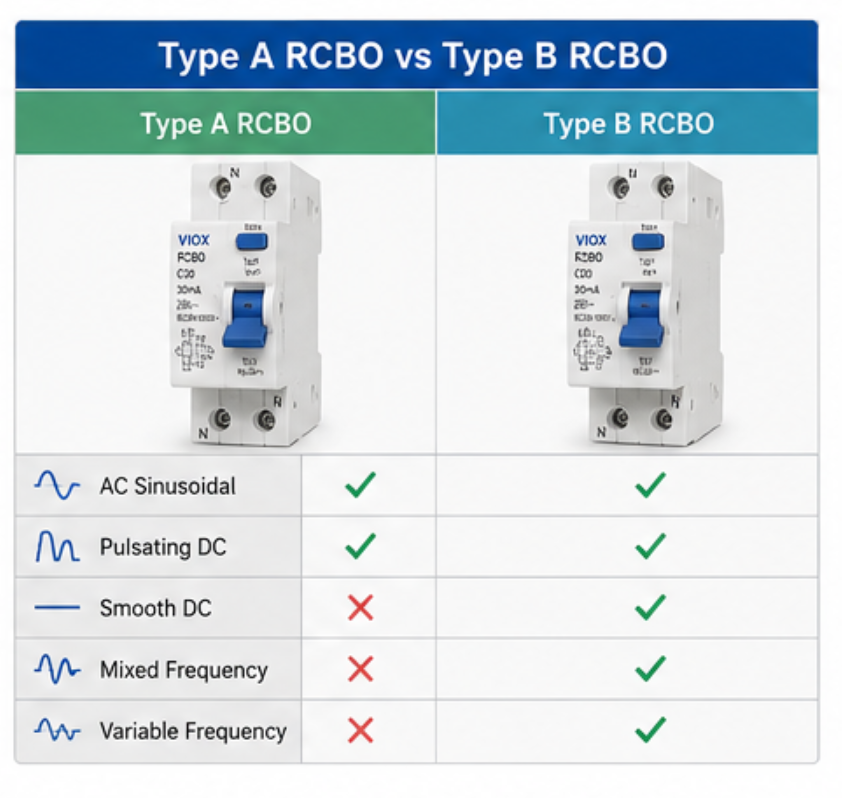
| 기능 | 유형 A RCBO | 유형 B RCBO |
|---|---|---|
| AC 잔류 전류 감지 | 예 | 예 |
| 맥동 DC 감지 | 예 | 예 |
| 부드러운 DC 감지 | 아니요 | 예 |
| Mixed-Frequency Residual Currents | Verify waveform and device specification | Covered only within the device’s specified frequency range |
| EV 충전기 애플리케이션 | Possible with verified DC protection where permitted | Use when required by the charger manual or applicable rules |
| 태양광 발전 시스템 | Verify inverter manual and DC monitoring | Use when required by the inverter manual or applicable rules |
| 산업용 드라이브 | 제한적 | Verify equipment manual and applicable rules |
| 비용 | Lower | 더 높음 |
The key difference is residual-current waveform coverage. Type A detects sinusoidal AC and pulsating DC residual currents, while Type B additionally detects smooth DC and mixed-frequency components within the manufacturer’s specified range.
Do not treat Type B as automatically better. For EV chargers, PV inverters and variable-speed drives, follow the equipment manual and applicable rules to determine whether Type A with verified DC detection, Type F or Type B is required.
Use the tool below to organize a preliminary RCBO specification. It highlights missing parameters and unsafe combinations, but it does not replace engineering verification or local requirements.
How to use this RCBO selector: choose the known circuit and equipment conditions. The result organizes a preliminary specification and highlights information that still requires verification.
Preliminary selection only. This tool does not approve a circuit or replace the equipment manual, product datasheet, coordination study, qualified designer, or local rules.
올바른 RCBO를 선택하려면 연결된 부하를 이해하는 것부터 시작해야 합니다.
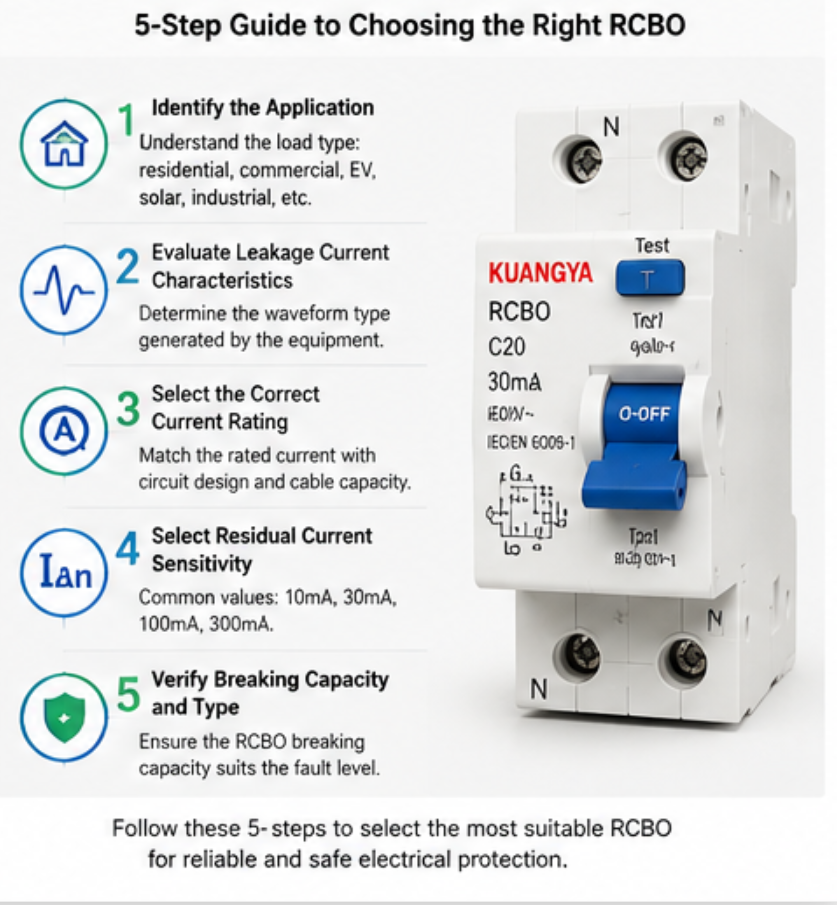
물어보세요:
답변에 따라 RCBO 유형을 선택할 수 있습니다.
장비마다 다른 잔류 전류 파형을 생성합니다.
| 장비 유형 | 권장 RCBO 유형 |
|---|---|
| 조명 회로 | 유형 A |
| 소켓 콘센트 | 유형 A |
| 가전 제품 | 유형 A |
| 사무기기 | 유형 A |
| EV 충전기 | Follow the EVSE manual: Type A with verified DC monitoring or Type B, as required |
| 태양광 인버터 | Follow the inverter manual and applicable rules |
| VFD 모터 드라이브 | Verify leakage waveform, frequency behavior and drive manual |
| 배터리 스토리지 시스템 | Follow the converter/BESS manual and applicable rules |
정격 전류가 일치해야 합니다:
일반적인 등급은 다음과 같습니다:
일반적인 민감도 등급은 다음과 같습니다:
| 감도 | 일반적인 애플리케이션 |
|---|---|
| 10mA | 개인 정보 보호 강화 |
| 30mA | 표준 개인 정보 보호 |
| 100mA | 장비 보호 |
| 300mA | 화재 방지 애플리케이션 |
30mA는 여전히 최종 회로에 가장 일반적으로 선택됩니다.
RCBO는 사용 가능한 오류 전류를 차단할 수 있어야 합니다.
일반적인 등급은 다음과 같습니다:
필요한 값은 설치 지점의 오류 수준에 따라 다릅니다.
많은 사양 및 구매 오류는 RCBO 유형을 잘못 이해하여 발생합니다.
일반적인 실수는 다음과 같습니다:
RCBO 유형은 항상 가격만 고려하지 말고 실제 부하 동작에 따라 선택해야 합니다.
| 매개변수 | What to confirm | 중요한 이유 |
|---|---|---|
| 시스템 | Single/three phase, voltage, frequency and neutral | Determines pole arrangement and operating voltage |
| Load | Electronic, motor/VFD, EVSE, PV inverter, UPS or resistive | Influences waveform type and trip curve |
| 정격 전류 | Design current, cable capacity and derating | A higher ampere rating is not automatically safer |
| RCBO type | AC, A, F or B required by the equipment manual | Determines detectable residual-current waveforms |
| 감도 | 10/30/100/300 mA as permitted | Must match protection objective and selectivity |
| Trip curve | B, C or D after inrush and loop checks | Controls magnetic response to overcurrent |
| 차단 용량 | Prospective short-circuit current at installation point | Catalogue values cannot replace a fault-level calculation |
| 마켓 | Required standard edition and certificate scope | IEC reference does not prove approval in every country |
Stop condition: If breaking capacity, leakage characteristics, pole arrangement or local requirements are unknown, do not finalize the RCBO selection.
| 결과 | When to use it | Next action |
|---|---|---|
| Preliminary match | Every parameter is known and no obvious conflict exists | Compare exact datasheets and certificates; obtain engineering approval |
| 확인 필요 | Breaking capacity, waveform, curve, poles or certification is unknown | Collect the missing data before ordering |
| 아직 선택하지 마십시오. | Phase/poles conflict, EV/PV uses unverified Type AC, or the equipment manual contradicts the choice | Stop and review the circuit and equipment requirements |
System phase and voltage:
Load or equipment:
Rated current:
Poles and neutral requirement:
Residual-current type (AC/A/F/B):
Sensitivity (mA):
Trip curve (B/C/D):
Required breaking capacity (kA):
Frequency:
Target market and certification:
Quantity and purchase stage:
OEM/ODM requirement:
Required delivery date:
Also compare RCCB product families and read the RCCB vs RCBO guide. Final selection must use the exact product documentation and applicable local rules.
올바른 RCBO를 선택하려면 올바른 정격 전류를 선택하는 것 이상을 고려해야 합니다. 잔류 전류 유형은 보호 성능에 직접적인 영향을 미치는 중요한 요소입니다.
대부분의 주거 및 상업용 회로의 경우, 유형 A RCBO는 AC 및 맥동하는 DC 잔류 전류에 대해 효과적인 보호 기능을 제공합니다.
For EV chargers, solar installations, battery storage systems and inverter-driven equipment, follow the exact equipment manual. Some designs allow Type A with verified DC monitoring; others require Type F or Type B.
유형 A RCBO와 유형 B RCBO의 차이점을 이해하면 규정을 준수하고 안전을 개선하며 최신 전기 시스템에 대한 안정적인 보호를 제공하는 데 도움이 됩니다.
RCBO (과전류 잔류 전류 차단기) | 안전하고 신뢰할 수 있는 쿠앙야
IEC 61009-1:2024 gives general requirements and tests for RCBOs for household and similar uses within its stated scope. Always verify the applicable national adoption, installation rules, equipment manual and certificate scope of the exact product model.
Type A is common for many residential and commercial electronic circuits. EV, PV, storage and variable-frequency applications require verification against the equipment manual and local rules; do not assume one residual-current type fits every design.
유형 A RCBO는 맥동하는 DC 잔류 전류는 감지할 수 있지만 부드러운 DC 잔류 전류는 안정적으로 감지할 수 없습니다.
유형 B RCBO에는 부드러운 DC 오류를 포함하여 더 넓은 범위의 잔류 전류 파형을 감지할 수 있는 고급 감지 기술이 포함되어 있습니다.
많은 EV 충전 애플리케이션은 현지 표준 및 충전기 설계에 따라 유형 B 보호 또는 이에 상응하는 DC 오류 감지 조치가 필요합니다.
Do not treat Type B as a universal upgrade. The selected type must match the residual-current waveform, equipment instructions, coordination requirements and certification scope of the exact device.

