웽양 공업구 웨칭 원저우 325000
근무 시간
월요일~금요일: 오전 7시~오후 7시
주말: 주말: 오전 10시 - 오후 5시
웽양 공업구 웨칭 원저우 325000
근무 시간
월요일~금요일: 오전 7시~오후 7시
주말: 주말: 오전 10시 - 오후 5시

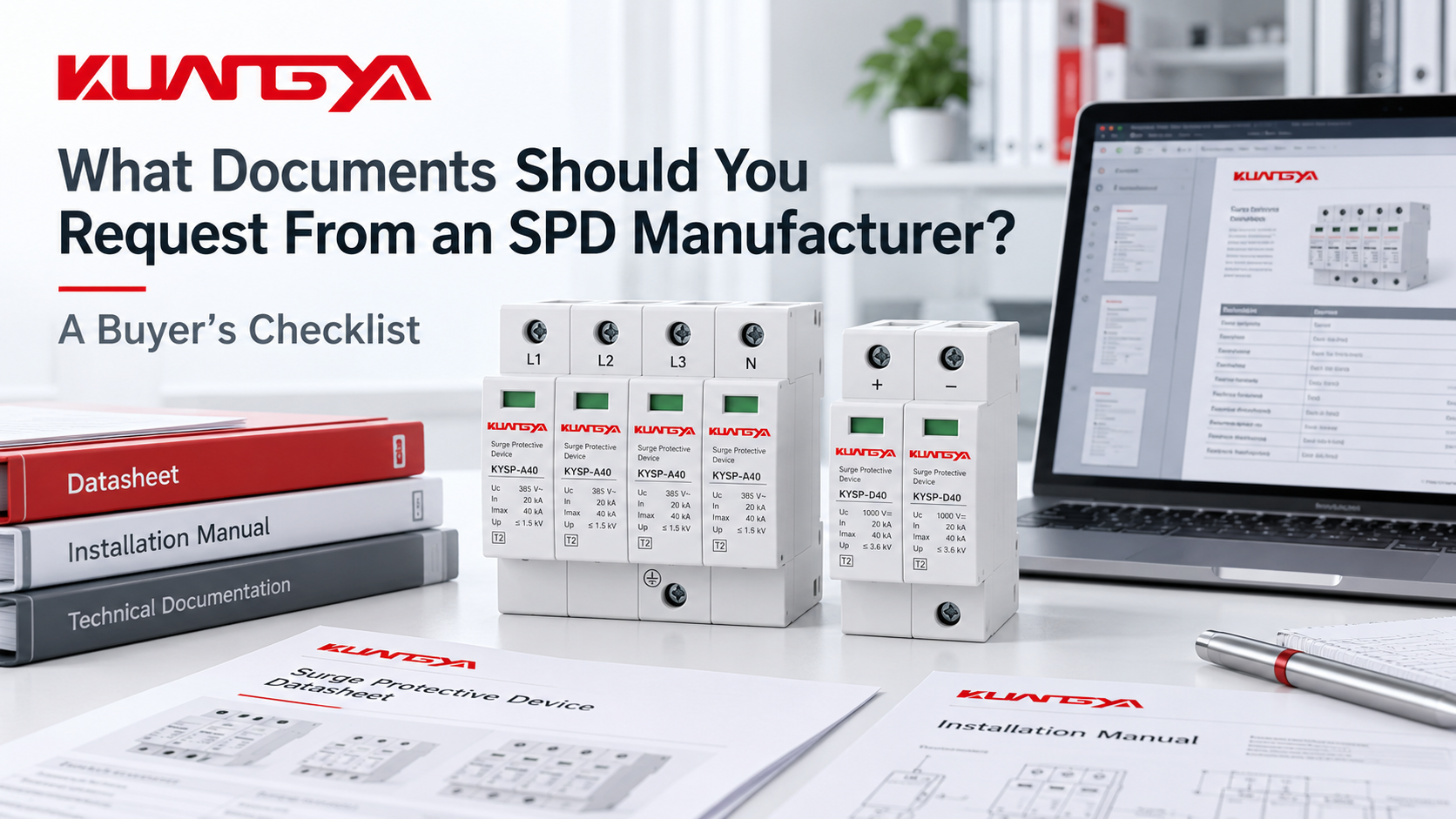
서지 보호 장치(SPD) 데이터시트는 인상적인 등급을 보여줄 수 있지만, 제품이 실제로 프로젝트 요구 사항을 충족하는지 어떻게 확인할 수 있을까요?
전기 유통업체, 수입업체, OEM 제조업체 및 태양광 EPC 계약업체의 경우, SPD 공급업체를 선택하는 것은 가격이나 방전 전류 등급을 비교하는 것 이상을 포함합니다.
공급업체는 최대 방전 전류 40kA의 Type 2 SPD를 인용할 수 있습니다. 다른 공급업체는 CE 관련 문서, 시험 보고서 또는 ISO 9001 인증서를 제공할 수 있습니다.
하지만 이러한 문서들이 모두 같은 것을 증명하는 것은 아닙니다.
시험 보고서는 다른 모델을 참조할 수 있습니다. 인증서는 특정 구성만 다룰 수 있습니다. 데이터시트는 중요한 설치 요구 사항을 누락할 수 있습니다.
가장 중요한 질문은 SPD 제조업체가 얼마나 많은 문서를 제공할 수 있는지 여부가 아니라, 해당 문서가 정확한 제품이 귀하의 애플리케이션에 적합함을 입증하는지 여부입니다.
이 가이드는 9가지 필수 SPD 제조업체 문서, 해당 내용 검증 방법, 그리고 주문 전에 구매자가 배울 수 있는 실제 제조업체 문서에 대해 설명합니다.
최소한 구매자는 모델별 데이터시트, 적용 가능한 테스트 증거 및 설치 지침을 받아야 합니다. 추가적인 선언, 인증, 품질 기록 및 상업 문서는 제품, 대상 시장 및 구매 요구 사항에 따라 달라집니다.
| 문서 | 주요 용도 | 요청 시기 |
|---|---|---|
| 제품 데이터시트 | 전압, SPD 유형, 방전 등급 및 모델 확인 | 견적 승인 전 |
| IEC/EN 또는 해당 시험 보고서 | 성능 및 안전 증거 검토 | 기술 승인 전 |
| 적합성 선언서 | 관련 규정 준수 여부 확인 | 대상 시장에서 요구하는 경우 |
| 제3자 인증 | 독립 인증 및 적용 모델 확인 | 사용 가능하거나 요구되는 경우 |
| 설치 설명서 | 배선, 백업 보호 및 설치 조건 확인 | 샘플 설치 전 |
| 기계 도면 | 물리적 및 장착 호환성 확인 | 패널 설계 승인 전 |
| 공장 품질 검사 기록 | 생산 일관성 평가 | 대량 생산 전 |
| 제품 추적성 및 보증 | 배치 식별 및 사후 관리 책임 | 구매 주문 전 |
| 상업 및 운송 서류 | 선적, 수량 및 수입 정보 확인 | 주문 및 선적 중 |
모든 구매자가 모든 문서를 필요로 하는 것은 아닙니다.
예를 들어, 유럽의 전기 유통업체는 EU 적합성 선언을 우선시할 수 있으며, 태양광 EPC 계약업체는 태양광 발전 관련 특정 시험 증거 및 설치 요구 사항을 더 강조할 수 있습니다.
다음 섹션에서는 결정 방법을 설명합니다.
기술 데이터시트는 모든 SPD 구매 결정의 시작점입니다.
그러나 좋은 데이터시트는 몇 가지 매력적인 사양을 표시하는 것 이상을 해야 합니다.
설치될 전기 시스템에 장치가 적합한지 평가할 수 있는 충분한 정보를 제공해야 합니다.
| 매개변수 | 의미 | 구매자가 확인해야 할 사항 |
|---|---|---|
| Uc | 최대 연속 동작 전압 | 전기 시스템에 적합 |
| Ucpv | Maximum continuous operating voltage for a PV SPD | Suitable for maximum PV array voltage |
| In | 공칭 방전 전류 | Declared value and test waveform |
| Imax | 최대 방전 전류 | Applicable Type 2 impulse rating |
| Iimp | Impulse discharge current | Type 1 capability where applicable |
| Up | 전압 보호 레벨 | Appropriate for equipment protection |
| Isccr / SCCR | Short-circuit current rating | Matches prospective fault conditions |
| Iscpv | PV short-circuit current characteristic | Appropriate for the PV application |
| 보호 모드 | Protected conductor combinations | Compatible with system topology |
| Remote signaling | Status monitoring capability | Terminal arrangement and contact ratings |
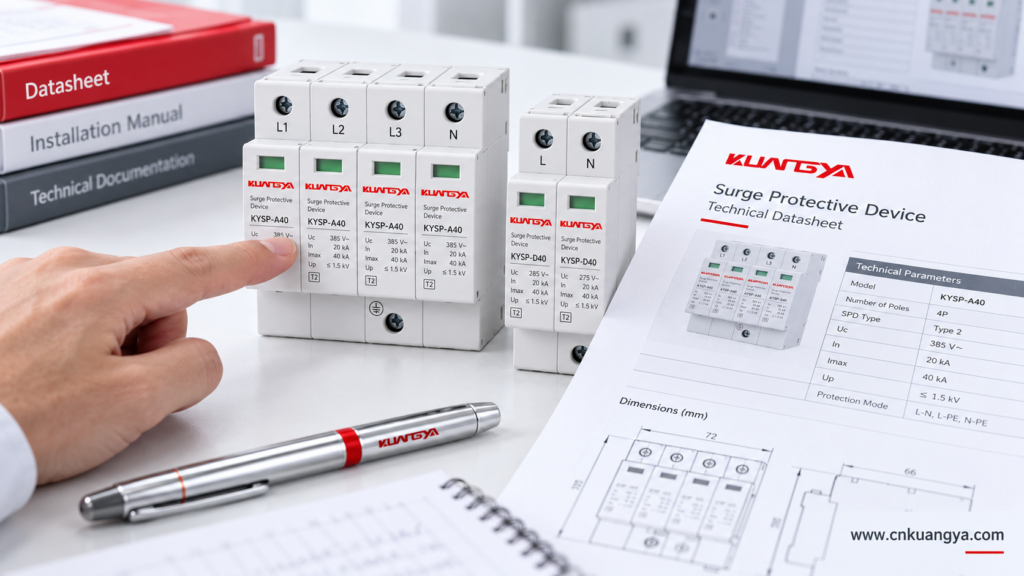
Not all parameters apply to every SPD.
A Type 2 AC SPD and a Type 1+2 photovoltaic DC SPD can require different technical information.
Buyers should therefore avoid evaluating all SPDs with a single generic parameter checklist.
For a deeper explanation of installation and voltage requirements, see our guide to solar inverter built-in and external SPDs.
Phoenix Contact publishes a detailed technical specification for its VAL-MS 230/3+1 FM/32, order number 2908476.
Its publicly listed characteristics include:
| 매개변수 | Published value |
|---|---|
| 제품 | VAL-MS 230/3+1 FM/32 |
| Order number | 2908476 |
| SPD 유형 | 유형 2 |
| 공칭 시스템 전압 | 240/415 V AC |
| Uc, L-N | 275 V AC |
| In(8/20 µs) | 20 kA |
| 아이맥스(8/20 µs) | 40 kA |
| Up, L-N | ≤ 1.35 kV |
| Up, L-PE | ≤ 1.6 kV |
| Short-circuit current rating | 25 kA |
출처: Phoenix Contact — VAL-MS 230/3+1 FM/32 Official Product Data
What makes this example useful?
The manufacturer does not describe the product simply as a “40 kA SPD.”
It publishes voltage characteristics, separate protection-mode values, electrical system compatibility, and short-circuit information.
These details matter when engineers compare products.
Buyer’s lesson: Two SPDs with the same Imax value may have different protection levels, operating voltages, protection modes, and short-circuit ratings.
A purchasing decision based only on “20 kA” or “40 kA” is incomplete.
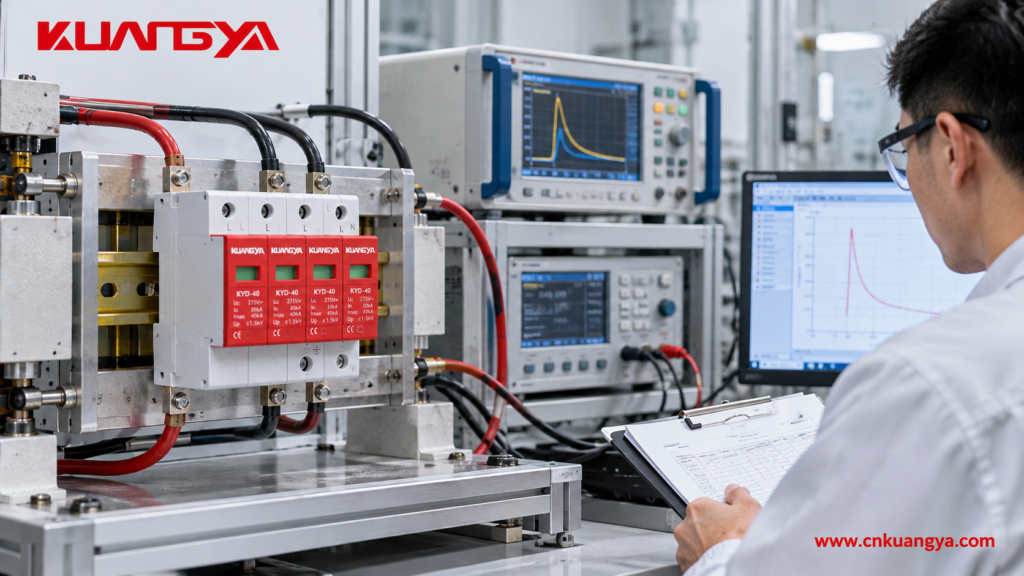
An SPD test report provides evidence concerning the performance and safety evaluation of a tested product.
However, an IEC reference on a document does not automatically mean that the product has been independently certified.
The first step is identifying which standard applies.
| 표준 | 애플리케이션 | Important scope information |
|---|---|---|
| IEC 61643-01:2024 | General SPD requirements | Common requirements and test methods |
| IEC 61643-11:2025 | AC low-voltage power SPDs | AC circuits rated up to 1,000 V RMS |
| IEC 61643-31:2018 | Photovoltaic DC SPDs | DC side of PV installations up to 1,500 V DC |
Official references:
IEC 61643-11:2025 was published on June 18, 2025, and includes revised requirements relating to AC SPD performance and safety testing.
IEC 61643-31:2018 specifically addresses SPDs intended for the DC side of photovoltaic installations up to 1,500 V DC.
These are different application categories.
Consider a buyer sourcing a 1,500 V DC SPD for a utility-scale solar project.
The supplier presents a test report referring only to IEC 61643-11.
Should the buyer accept it?
Not without further clarification.
IEC 61643-11 addresses AC low-voltage power systems, while IEC 61643-31 provides the photovoltaic DC-specific requirements.
A supplier may have additional relevant testing documentation, but the buyer should confirm the applicable assessment for the offered PV model.
| Checkpoint | Acceptable evidence | Warning sign |
|---|---|---|
| Model number | Offered model is covered | Only another product is listed |
| 표준 | Relevant standard and edition | Incorrect application standard |
| Laboratory | Identifiable testing organization | Laboratory details missing |
| Report number | Traceable report identifier | Incomplete or untraceable reference |
| Ratings | Consistent with product datasheet | Different voltage or current values |
| Model family | Documented scope or annex | Coverage is only assumed |
| Test results | Relevant evaluation results provided | Only a cover page is supplied |
| Report limitations | Conditions and exclusions are understood | Important annexes are missing |
중요: A report issued under an older edition is not automatically invalid. Buyers should check the accepted edition for their destination market, customer specification, and certification arrangement.
One of the most common problems in international electrical product procurement is confusion over CE documentation.
Some buyers request a “CE certificate” without specifying which document they actually need.
However, CE marking, an EU Declaration of Conformity, and independent third-party certification are not interchangeable.
The European Commission explains that the manufacturer is responsible for conformity assessment, preparing technical documentation, issuing the EU Declaration of Conformity, and applying CE marking where applicable.
CE marking itself does not indicate that an EU authority has approved the product.
출처: European Commission — CE Marking and Manufacturer Responsibilities
| Document or marking | Who is responsible? | What it demonstrates |
|---|---|---|
| CE 마크 | 제조업체 | Manufacturer’s declaration of conformity with applicable EU requirements |
| EU Declaration of Conformity | Manufacturer or responsible authorized party | Formal declaration identifying applicable EU legislation |
| Supporting technical file | 제조업체 | Evidence supporting the conformity assessment |
| Third-party product certificate | Relevant certification organization | Certification within the specific scheme and product scope |
| ISO 9001 certificate | Quality management certification body | Quality management system certification, not individual SPD product compliance |
A product marked CE should not automatically be described as “EU-certified.”
Similarly, ISO 9001 does not establish that an individual SPD model meets IEC 61643 requirements.
Review the product identification, manufacturer details, relevant EU legislation, applicable standards or technical specifications, issue information, and signature.
For European shipments, the documents and responsibilities must meet the legal requirements applying to the product and market.
A generic certificate cannot replace these obligations.
Practical recommendation: Ask the supplier for the Declaration of Conformity applicable to the exact product rather than relying on a CE logo printed on its packaging.
Independent certification can be valuable, particularly for regulated markets or projects with strict technical approval procedures.
Buyers may encounter IECEE CB Scheme documents, UL certification records, TÜV-issued certificates, and national product approvals.
However, the relevant certification depends on the applicable market and scheme.
| 항목 | What to verify | 중요한 이유 |
|---|---|---|
| Certificate number | Officially traceable | Helps establish authenticity |
| Certificate holder | Identified legal entity | May differ from the trading company |
| 제조업체 | Actual product manufacturer | Confirms manufacturing relationship |
| Factory location | Covered production location | Important for certain certification schemes |
| Product model | Exact model or listed family | Prevents unsupported model claims |
| 표준 | Applicable technical requirements | Confirms relevance |
| Certificate status | Current status and restrictions | Certification scope can change |
| Annexes | Covered variants and ratings | Important for multipole and OEM models |
UL Solutions provides Product iQ, an official database for searching UL certification information.
Users can search using information such as a file number, product category, or other product identifiers.
Official source: UL Solutions — Product iQ Certification Database
For example, a buyer receiving a claimed UL certification can check whether the relevant product or component appears within the applicable UL certification records.
The buyer should also check the covered models and product category rather than assuming certification applies to the entire manufacturer’s catalog.
Buyer’s lesson: A certificate from a recognized organization is valuable only when its scope applies to the product being purchased.
An SPD can have suitable electrical ratings and still be inappropriate for a particular installation if its connection and protection requirements are not followed.
A complete installation guide helps electrical engineers verify the correct arrangement.
| Installation information | 중요한 이유 |
|---|---|
| Connection diagram | Confirms the correct electrical arrangement |
| Earthing and protection modes | Supports proper surge diversion paths |
| Backup fuse or circuit breaker | Ensures protective-device coordination |
| Maximum upstream protection | Helps determine whether additional protection is required |
| Short-circuit conditions | Helps assess suitability for available fault current |
| 터미널 토크 | Supports proper electrical connections |
| 도체 단면적 | Helps confirm compatible wiring |
| Mechanical mounting | Prevents panel assembly conflicts |
| Status indication | Supports maintenance and replacement decisions |
| Remote signaling contacts | Supports external alarm or monitoring integration |
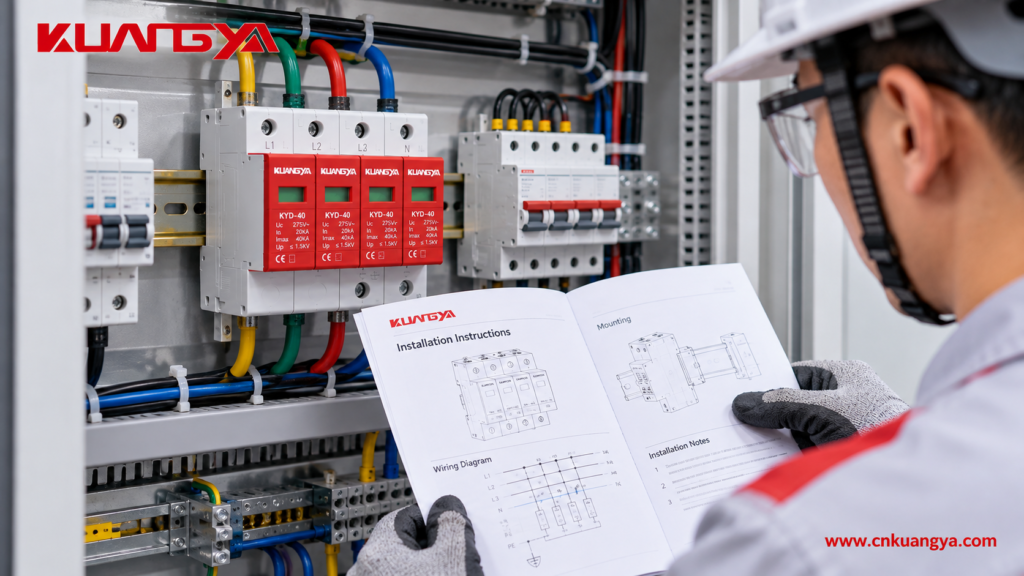
DEHN’s published documentation for its DEHNguard M TNS ACI 275 FM, part number 952 440, identifies several important characteristics.
| 매개변수 | Published value |
|---|---|
| 모델 | DG M TNS ACI 275 FM |
| Part number | 952 440 |
| SPD 유형 | 유형 2 |
| Uc (L-PE) | 275 V AC |
| In(8/20 µs) | 20 kA |
| Up (L-PE) | ≤ 1.5kV |
| Additional external fuse | 필요 없음 |
출처: DEHN — DEHNguard ACI Product Technical Documentation (PDF)
This example illustrates an important purchasing consideration.
Not every SPD requires a separate external backup fuse.
The correct protection arrangement depends on the specific product design, tested configuration, and manufacturer instructions.
A buyer should therefore never select backup protection simply because another Type 2 SPD uses a particular fuse rating.
For further technical guidance, read our SPD backup fuse and circuit breaker selection guide.
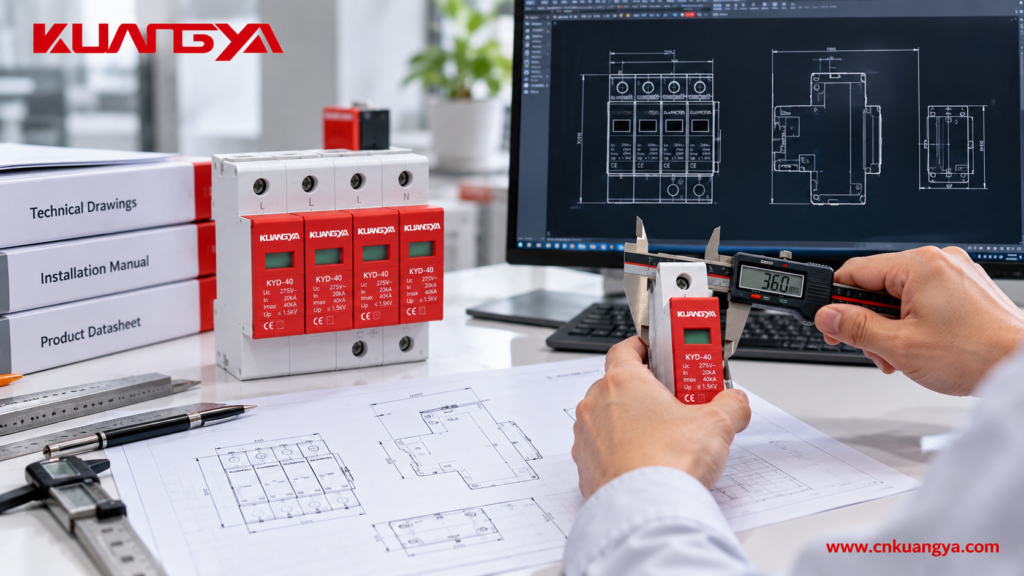
For panel builders and OEM customers, mechanical compatibility can be as important as electrical performance.
An SPD may satisfy the required electrical specifications but still cause problems during panel assembly.
For example, an alternative model may occupy a different DIN-rail width or use a different terminal arrangement.
| Document detail | 애플리케이션 |
|---|---|
| Overall dimensions | Enclosure layout |
| DIN 레일 장착 | Mechanical compatibility |
| Terminal positions | 케이블 라우팅 |
| Required clearances | Installation planning |
| Module width | Panel space calculation |
| Remote contact location | Monitoring wiring |
| Replaceable module structure | Maintenance planning |
Buyers should also confirm whether the product delivered during bulk production matches the approved sample and drawings.
This is particularly relevant for OEM distribution boards, PV combiner boxes, and standardized industrial control panels.
A type-test report provides evidence of a product design evaluated under specified conditions.
It does not automatically establish that every production unit has been manufactured without defects.
This is why factory quality management and traceability are important for larger procurement projects.
| 문서 | What buyers can learn |
|---|---|
| Incoming inspection records | How critical materials are checked |
| Routine inspection procedures | Which tests or checks occur during production |
| Final inspection records | How finished products are evaluated |
| Batch identification | Whether affected production lots can be traced |
| Nonconformity reports | How production defects are handled |
| Corrective-action records | Whether identified problems lead to improvements |
| Quality management certificate | Whether a documented management system is certified |
The exact routine tests and acceptance criteria should be defined by the relevant product requirements and supplier’s quality procedures.
Buyers should avoid assuming that a factory holding ISO 9001 certification has automatically obtained product certification for every SPD it manufactures.
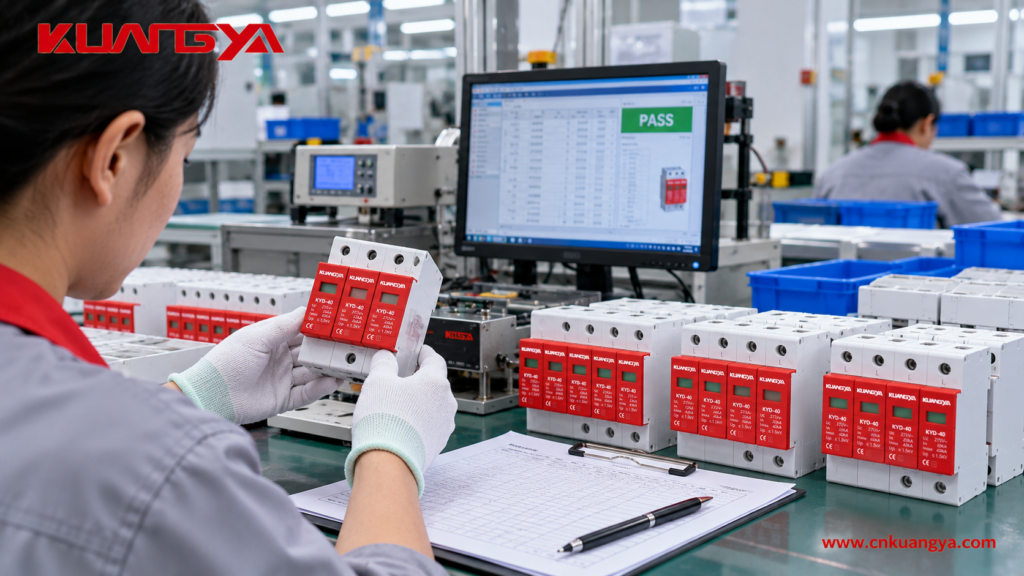
Suppose a distributor plans to purchase 5,000 SPDs under a private label.
Before approving mass production, the buyer could request:
This is an illustrative procurement scenario, not a claim about a particular manufacturer’s inspection results.
The objective is to verify whether the supplier can consistently manufacture the approved product.
Private-label SPD procurement introduces additional documentation questions.
A distributor may purchase an existing SPD design under its own brand with a different printed model number.
However, a new logo does not automatically mean the branded version is independently certified.
Equally, the existence of an original manufacturer’s certificate does not automatically establish that every private-label variation is covered.
| OEM change | What buyers should confirm |
|---|---|
| Brand name change | Relationship to the assessed product |
| Model number change | Documented model equivalence |
| Label redesign | Required technical and regulatory markings |
| Enclosure change | Whether existing assessment remains applicable |
| Internal component change | Whether additional technical evaluation is needed |
| Manufacturing location change | Whether certification or approval scope is affected |
| Wiring modification | Compatibility with original testing and installation instructions |
Before approving an OEM order, request the approved product specification, label artwork, applicable test evidence, and written confirmation of any model-equivalence arrangement.
Where a third-party certification is claimed, confirm that the relevant certification scheme permits the proposed configuration and labeling.
Technical approval should continue through the purchasing and shipping process.
A mismatch between the approved model and the commercial documents can create customs, project acceptance, or inventory problems.
| 문서 | What to verify |
|---|---|
| Proforma Invoice | Approved model, quantity, price and trade terms |
| Commercial Invoice | Correct shipment details and product descriptions |
| Packing List | Package count, quantities, weights and dimensions |
| Certificate of Origin | Origin information when required |
| Bill of Lading / Air Waybill | Consistent shipment information |
| Inspection report | Agreed production or shipment checks |
| Warranty terms | Responsibility for eligible claims |
A Certificate of Origin is a trade document. It does not establish an SPD’s electrical safety or performance.
Likewise, an inspection report covering packaging and quantity does not replace a laboratory test report.
The following examples are drawn from public manufacturer and regulatory documents. They are not estimates of field failure rates or unverified customer stories.
| Official example | Verified information | Purchasing lesson |
|---|---|---|
| Phoenix Contact VAL-MS 230/3+1 FM/32 | In 20 kA, Imax 40 kA, mode-specific Up values | Compare complete electrical characteristics, not one rating |
| DEHNguard M TNS ACI 275 FM | Manufacturer indicates no additional external fuse required | Installation requirements are model-specific |
| European Commission CE guidance | Manufacturer is responsible for EU conformity assessment and DoC | CE marking is not equivalent to independent product certification |
These examples highlight three different areas of risk:
Technical risk: Selecting a product based on incomplete specifications.
Installation risk: Applying protection requirements from another SPD model.
Documentation risk: Misinterpreting what a compliance document actually proves.
Reliable SPD procurement should address all three.
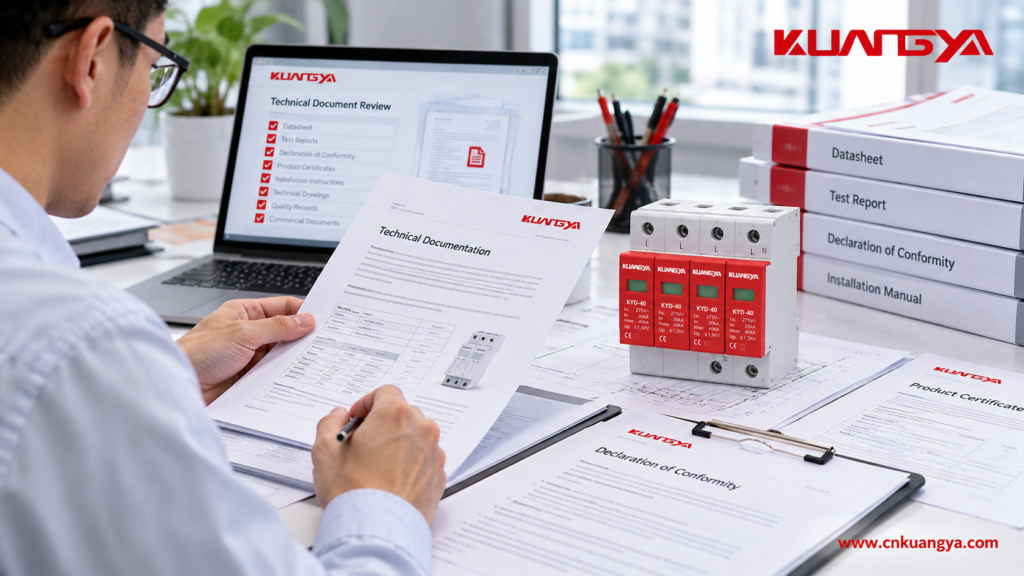
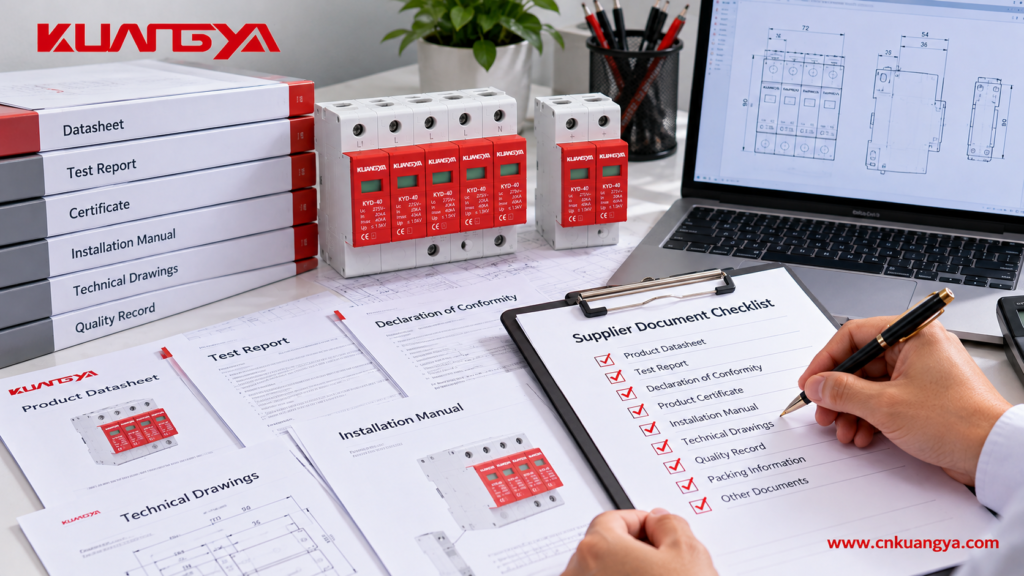
Check which documents your SPD supplier has provided before placing an order.
0% completed
Core = documents generally needed for initial technical review. Additional requirements depend on your market and project.
Have questions about SPD specifications, test reports or documentation? Contact KUANGYA to discuss your requirements.
Contact KUANGYA on WhatsAppYour checklist details will be included in the WhatsApp message. You can review the message before sending.
Note: This tool checks document availability only. It does not confirm certification validity, document authenticity, or regulatory compliance.
The most efficient documentation process is to review information in stages, rather than requesting every possible file without a clear purpose.
Identify the AC or DC system, maximum operating voltage, required SPD Type, installation location, and destination market.
Confirm the quoted model and its electrical ratings.
Check the relevant standards, model coverage, test organization, and report details.
Check declarations and certificates required for the intended market.
Review the manufacturer’s wiring, short-circuit, backup protection, terminal, and mounting requirements.
For repeat or OEM orders, retain approved drawings, labels, specifications, and quality criteria.
Confirm that invoices, packing lists, and product identification correspond to the approved order.
| Purchasing stage | Documents to prioritize |
|---|---|
| Initial inquiry | Datasheet and model identification |
| Supplier comparison | Test evidence and relevant certifications |
| Technical approval | Installation manual and mechanical drawings |
| 샘플 평가 | Label, configuration and sample inspection |
| Purchase order | Warranty, traceability and approved specifications |
| Production | Agreed quality and inspection records |
| Shipment | Commercial Invoice, Packing List and transport documents |
This staged approach can reduce unnecessary communication while keeping critical technical checks ahead of the purchase decision.
Not every missing document means a supplier is unreliable. Some reports may be confidential, market-specific, or held by an external certification body.
However, unresolved inconsistencies are a legitimate reason to delay technical approval.
| Warning sign | Potential issue | 권장 조치 |
|---|---|---|
| Certificate covers a different model | Unclear product coverage | Request scope or annex |
| Datasheet and label disagree | Specification inconsistency | Confirm approved revision |
| Only a CE logo is provided | Insufficient compliance information | Request applicable DoC |
| PV SPD has only AC evidence | Application mismatch | Request relevant PV test evidence |
| Certificate number cannot be verified | Authenticity or status uncertainty | Check with issuer |
| Installation guide omits protection requirements | Incomplete installation information | Request model-specific instructions |
| OEM model is absent from documents | Unclear branding relationship | Request equivalence evidence |
| No production traceability information | Difficult batch investigation | Agree on traceability process |
| Production differs from approved sample | Uncontrolled design change | Investigate before shipment |
Subject: Request for SPD Technical Documents and Model Verification
Hello,
We are reviewing surge protective devices for an upcoming project and would like to verify the technical documentation for your quoted models.
Could you please provide the following?
Please confirm that the supplied documents cover the exact model numbers, voltage ratings, and configurations included in your quotation.
Thank you.
The essential starting documents are a model-specific datasheet, applicable test evidence, and installation instructions.
Additional documentation depends on the installation, destination market, project specification, and purchasing requirements.
For products subject to applicable EU CE-marking legislation, the manufacturer must fulfill the relevant conformity requirements, including the applicable declaration and technical documentation obligations.
A separately marketed “CE certificate” is not necessarily a legally required or sufficient conformity document.
IEC 61643-11 addresses AC low-voltage surge protective devices.
IEC 61643-31 is the relevant product standard for SPDs intended for the DC side of photovoltaic installations within its scope.
아니요.
ISO 9001 concerns quality management systems and does not replace model-specific technical evaluation or product conformity evidence.
Potentially, where the assessment or certification scope explicitly includes the relevant models and configurations.
Buyers should verify model-family coverage rather than assume it.
꼭 그렇지는 않습니다.
Start with the key documents needed for technical evaluation. More detailed evidence can be requested based on project requirements, order size, and supplier qualification procedures.
Check the issuing organization, certificate number, model coverage, applicable standard, and certification status. Use the certification body’s official records where available.
The most valuable SPD manufacturer documents are those that help buyers connect three things:
The actual product being offered.
The performance and compliance evidence supporting that product.
The installation and production conditions under which it will be used.
A complete supplier qualification process should evaluate product specifications, applicable testing, certification scope, installation compatibility, and manufacturing consistency.
The objective is not to collect the largest number of certificates.
It is to obtain the right evidence for the right SPD.
For buyers comparing Chinese SPD manufacturers, our guide to evaluating SPD suppliers in China provides additional supplier-selection considerations.
쿠앙야 supplies surge protective devices and related low-voltage electrical protection products for international customers, distributors, and OEM projects.
Tell us your application, SPD Type, system voltage, destination market, and required specifications.
Our team can help discuss suitable products and the model-specific technical documentation available for review.
Visit KUANGYA — www.cnkuangya.com
Technical note: Standards, certification scopes, and regulatory requirements may change. Always verify the applicable editions and approval requirements for the intended market and exact product model.

