Zona industriale di WengYang Yueqing Wenzhou 325000
Orario di lavoro
Da lunedì a venerdì: dalle 7.00 alle 19.00
Fine settimana: 10.00 - 17.00
Zona industriale di WengYang Yueqing Wenzhou 325000
Orario di lavoro
Da lunedì a venerdì: dalle 7.00 alle 19.00
Fine settimana: 10.00 - 17.00

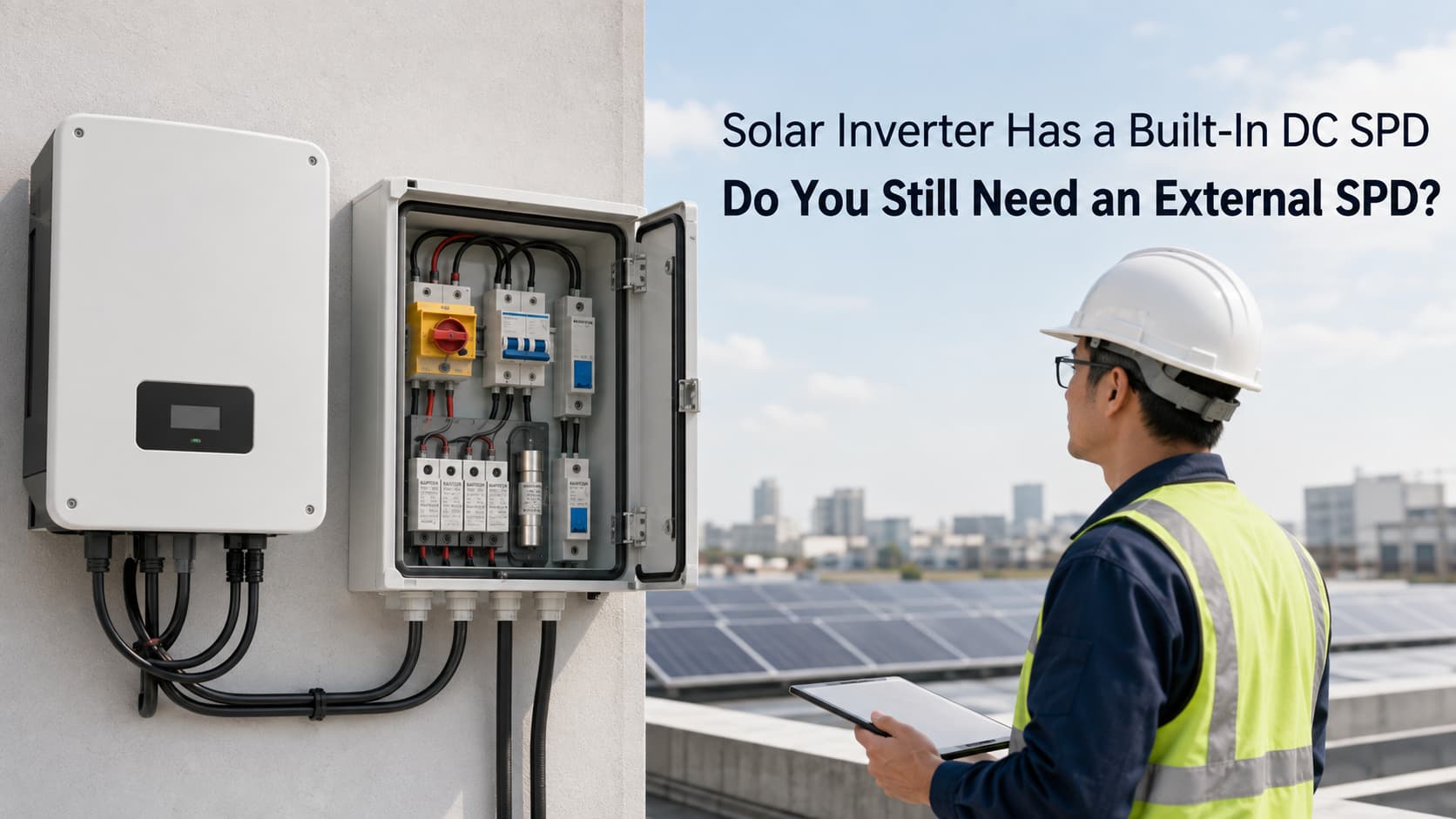
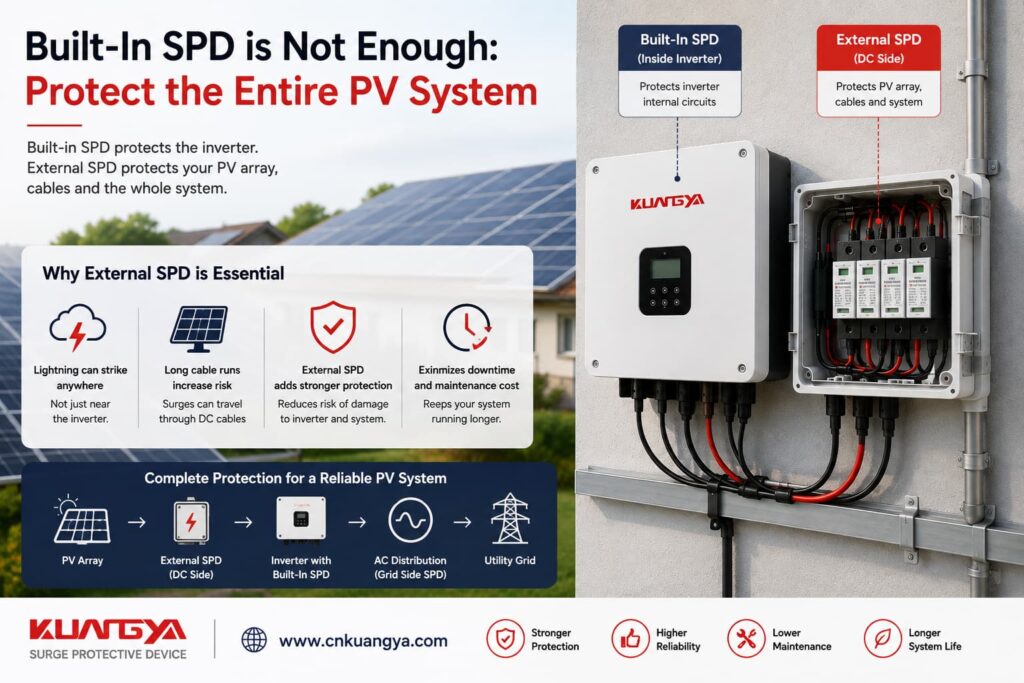
Un SPD integrato in un inverter solare può fornire un'importante protezione contro le sovratensioni, ma leggere “SPD DC Tipo II” sulla scheda tecnica non significa automaticamente che l'intero impianto fotovoltaico sia protetto.
A volte la specifica riporta persino:
SPD DC e AC di Tipo II integrato
A prima vista, la conclusione sembra ovvia:
“L'inverter ha già una protezione contro le sovratensioni. Perché dovrei installare un altro SPD?”
Poi si guarda un quadro di parallelo fotovoltaico e se ne trova un altro all'interno.
Oppure un installatore ti dice che dovrebbe essere installato un SPD aggiuntivo vicino al campo fotovoltaico.
Ora la questione diventa confusa.
Due SPD svolgono la stessa funzione?
L'SPD esterno non è necessario?
Oppure l'SPD all'interno dell'inverter protegge solo una parte dell'impianto fotovoltaico?
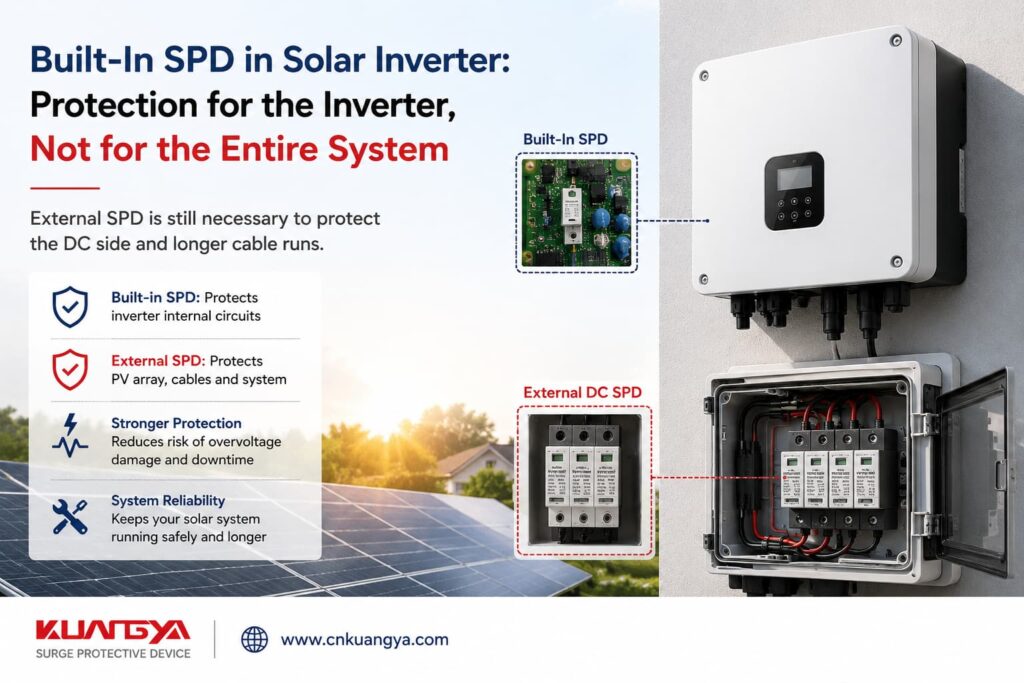
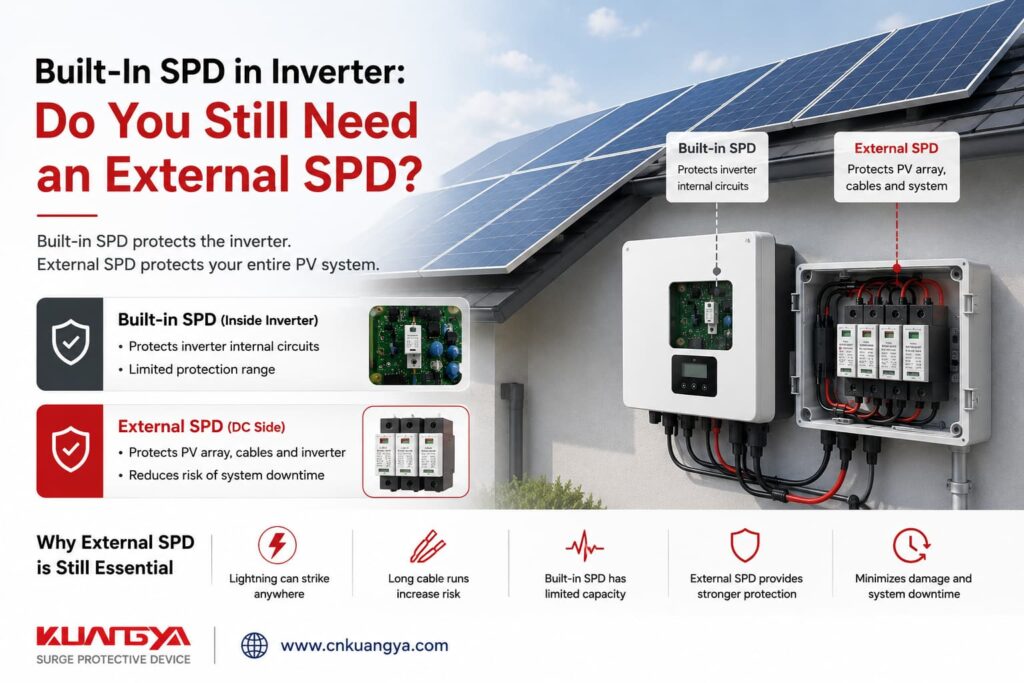
Un SPD CC integrato non significa automaticamente che non sia necessario alcun SPD esterno.
La risposta corretta dipende da:
La domanda chiave quindi non è:
“Il mio inverter è dotato di un SPD?”
Una domanda migliore è:
“Dove si trova l'SPD, quale parte dell'impianto protegge e cosa succede prima che una sovratensione raggiunga quel punto?”
Questo cambio di prospettiva rende l'argomento molto più facile da comprendere.
Quando si legge la scheda tecnica di un inverter, le parole “SPD integrato” forniscono informazioni utili, ma non dicono tutto ciò che è necessario sapere.
| La specifica dell'inverter dice | Cosa sai | Cosa devi ancora controllare |
|---|---|---|
| SPD di tipo 2 CC | La protezione contro le sovratensioni di tipo 2 è presente sul lato CC dell'impianto fotovoltaico | Posizione, valori nominali, distanza dei cavi, LPS esterno ed eventuale necessità di un ulteriore punto di protezione |
| SPD di tipo 2 CA | La protezione contro le sovratensioni è presente sul lato CA dell'inverter | Non conferma la protezione sul lato CC |
| SPD di tipo 2 CC + CA | Entrambi i lati CC e CA dispongono di protezione contro le sovratensioni a livello di inverter | I percorsi lunghi dei cavi e altri punti di installazione richiedono ancora una valutazione |
| SPD CC Tipo 1+2 | La protezione CC possiede capacità di protezione contro le correnti di fulmine e le sovratensioni appropriate al tipo dichiarato | La posizione e il concetto completo di protezione contro i fulmini rimangono rilevanti |
| “Solo ”protezione contro le sovratensioni" | Viene dichiarata una certa funzione di protezione contro le sovratensioni | Il tipo effettivo di SPD, il lato, le caratteristiche nominali e la sostituibilità potrebbero non essere ancora chiari |
Questa è la prima lezione pratica:
Vedere “SPD” nella scheda tecnica di un inverter è solo il primo passo. Verificare il tipo di SPD, se è installato sul lato DC o AC e le sue specifiche tecniche effettive.
Prima di parlare degli SPD integrati negli inverter, esaminiamo rapidamente l'etichetta di un vero SPD DC.
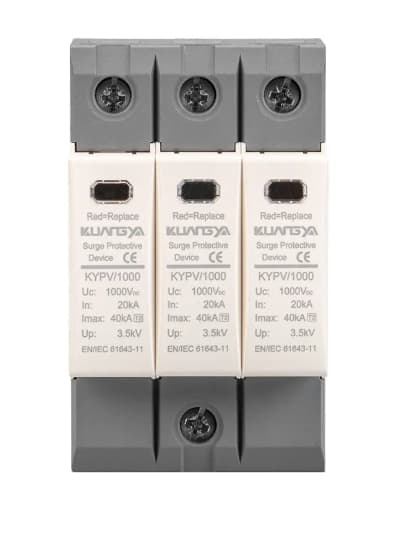
Riesci a identificare i valori chiave su questo vero SPD DC KUANGYA di Tipo 2 da 1000V?
Uc indica la massima tensione di esercizio continuativo che questo SPD è progettato per sopportare.
Imax è la corrente di scarica massima che l'SPD di Tipo 2 può sopportare nelle condizioni di prova specificate.
Up è il livello di protezione dalla tensione. Indica il livello di tensione che può rimanere ai terminali dell'SPD mentre limita una sovratensione.
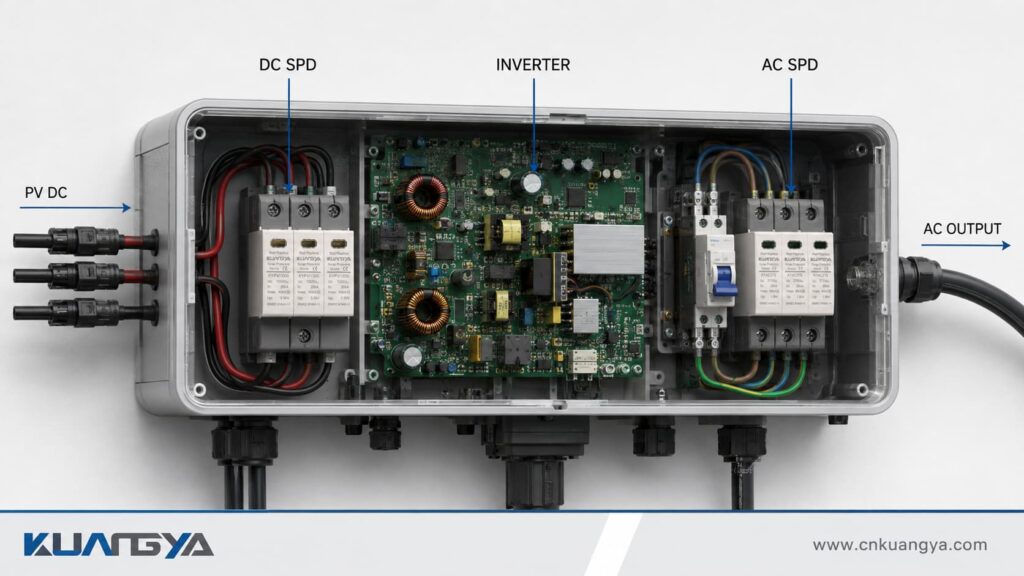
Un SPD CC integrato significa solitamente che la protezione contro le sovratensioni è stata incorporata nel lato ingresso CC dell'inverter.
Tuttavia, i design degli inverter non sono tutti uguali.
Alcuni produttori installano di serie una protezione di Tipo 2.
Alcuni prodotti dispongono di protezione sia sul lato DC che su quello AC.
Alcuni modelli commerciali utilizzano una protezione di Tipo 1+2 sul lato DC.
Alcune piattaforme di inverter consentono di ordinare l'SPD preinstallato o di aggiungerlo in un secondo momento.
Ciò significa che è necessario verificare sempre il modello esatto dell'inverter, invece di dare per scontato che ogni inverter dello stesso produttore utilizzi la medesima configurazione di protezione.
Un manuale o una scheda tecnica dell'inverter dovrebbero aiutare a identificare diversi aspetti:
Questo è fondamentale.
L'impianto fotovoltaico alimenta l'inverter attraverso il lato in corrente continua (DC).
L'inverter si collega al sistema di distribuzione attraverso il lato in corrente alternata (AC).
Un SPD AC non diventa semplicemente una protezione lato DC solo perché è installato all'interno dello stesso involucro dell'inverter.
Cercare:
Non sei sicuro di come differiscano questi tipi? Consulta il nostro Confronto tra SPD DC di Tipo 1, Tipo 2 e Tipo 1+2.
Non sostituire questa domanda con:
“Quale ha il valore di kA più elevato?”
Il tipo di SPD indica qualcosa di diverso rispetto alla corrente di scarica nominale.
Questo è particolarmente importante per la manutenzione.
Alcuni SPD integrati utilizzano moduli o cartucce sostituibili. Altri richiedono procedure di assistenza specifiche.
Fronius, ad esempio, dichiara nella documentazione del Verto che, quando l'SPD è intervenuto, il suo indicatore meccanico passa da verde a rosso e l'SPD attivato deve essere sostituito per mantenere la piena funzione di protezione.
Quindi “integrato” non significa “esente da manutenzione per sempre”.”
Rather than inventing hypothetical inverter specifications, let us look at several real products and their official published documentation.
| Real inverter | Published surge-protection configuration | What it teaches us |
|---|---|---|
| Sungrow SG3.0RS-L | SPD DC e AC di Tipo II integrato | A residential inverter may integrate Type 2 protection on both sides |
| Sungrow SG30CX-P2 / SG50CX-P2 | DC Type I+II / AC Type II | A larger inverter may use different SPD types on the DC and AC sides |
| Huawei SUN2000-150K-MG0 | DC Type II / AC Type II surge arresters | Even high-power string inverters can include Type 2 protection internally |
| Fronius Symo | DC SPD options can be pre-installed or retrofitted; Type 1+2 and Type 2 versions are available depending on device and operating mode | “Built-in SPD” may be configurable rather than identical across all units |
These examples are useful because they show something that a generic statement like “modern inverters have SPD” cannot explain.
Different real inverters use different protection concepts.
For example, Sungrow’s current SG3.0RS-L product information specifies built-in Type II DC & AC SPD.
But Sungrow’s SG30CX-P2 and SG50CX-P2 datasheet lists DC Type I+II / AC Type II.
The conclusion is simple:
“My inverter has an SPD” is only the beginning of the conversation.
Check three things next:
What type is it?
DC side or AC side?
Dove viene installato?
A common way to think about surge protection is:
One SPD = protected
Two SPDs = more protected
That is not a good design principle.
Two SPDs installed at the wrong places do not automatically create better protection than one correctly positioned and coordinated system.
The better question is:
Where is the surge protective device in relation to the equipment and cable route that need protection?
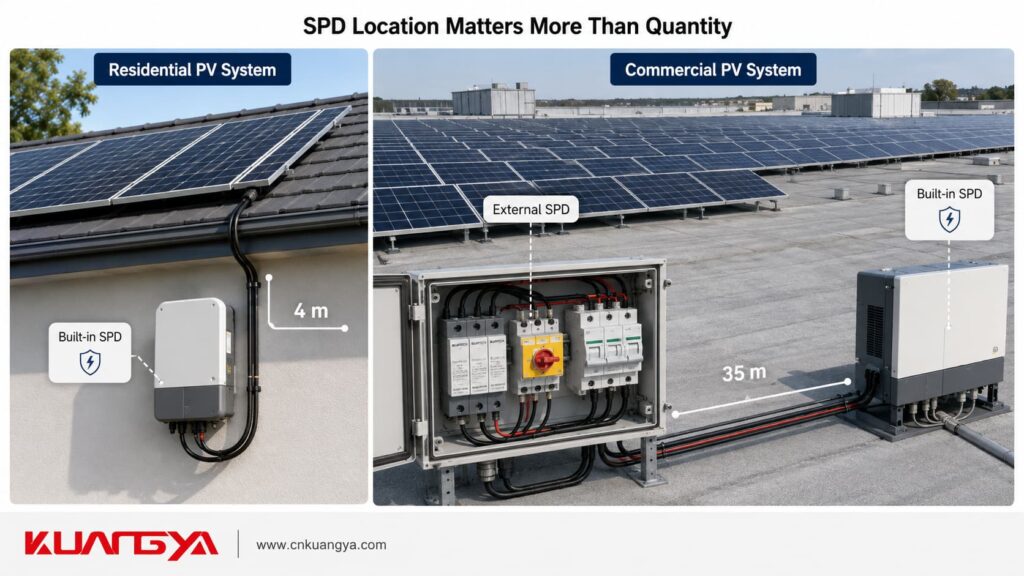
Consider these two simplified systems.
PV array → 4 m DC cable → inverter with built-in Type 2 SPD
PV array → 35 m DC cable → building entry → inverter with built-in Type 2 SPD
The inverter may be exactly the same.
The built-in SPD may also be exactly the same.
But the installation is not the same.
In System B, a much longer outdoor DC cable exists between the PV array and the inverter.
That changes the surge-protection problem.
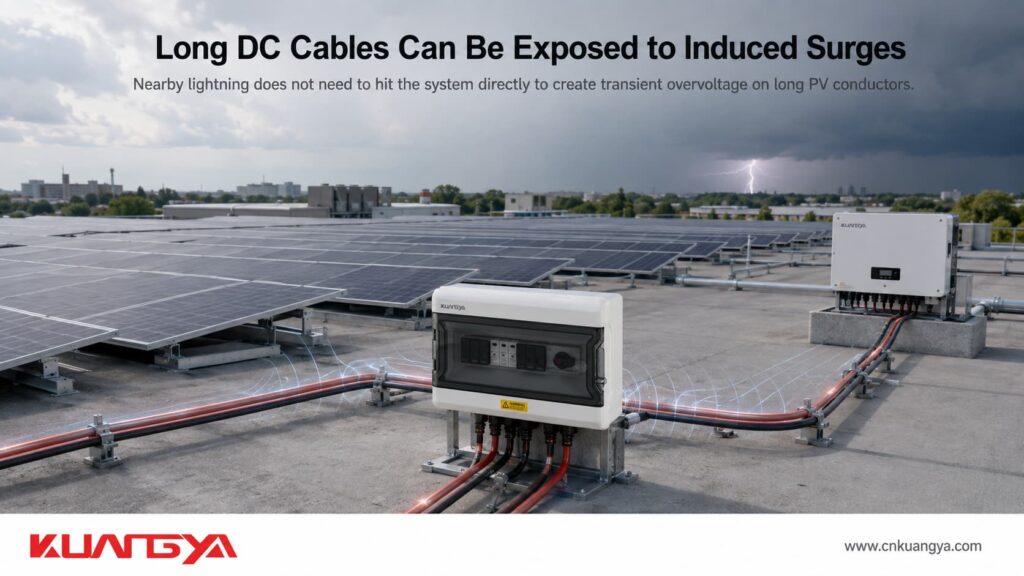
PV systems often contain long conductors exposed across rooftops, facades, open ground or industrial buildings.
During nearby lightning activity, electromagnetic effects can induce transient overvoltages into those conductors.
A surge does not have to arrive only from the utility grid.
This means that long PV cable routes must be considered as part of the protection concept.
If the only SPD is located inside the inverter, that protective point is located at one end of the cable.
It does not physically move closer to the PV modules because the inverter manufacturer integrated it into the enclosure.
This is why published PV surge-protection guidance considers not only what SPD is used, but also where it is installed.
Phoenix Contact’s current PV guidance identifies the DC side of the inverter as an additional protection location when the cable length to the PV panels is pari o superiore a 10 m, and also identifies another protection position near the PV panels or building entrance.
Its technical guidance also states that if the cable length between PV panels and inverter exceeds 10 m, an additional protection device should be installed at the other end of the cable near the PV panels.
DEHN publishes similar rooftop PV guidance, stating that if more than 10 m of cable exists between the PV system and inverter, a further arrester is required in the roof area for the arrangement it describes.
No.
This is where technical articles often become misleading.
Dovreste non take “10 m” and turn it into a universal sentence such as:
“Every PV system longer than 10 meters must always have exactly two Type 2 SPDs.”
The actual design still depends on:
The useful lesson is simpler:
Around this distance, cable length stops being something you should ignore and becomes an important design consideration.
| Installation situation | What you should check |
|---|---|
| PV array is close to the inverter | Check the built-in SPD, inverter instructions and applicable project requirements |
| Long DC cable between array and inverter | Evaluate protection locations at both ends of the cable route |
| Remote PV combiner box | Check whether it already contains a DC SPD |
| Cable enters a building far from inverter | Evaluate the building-entry protection point |
| External lightning protection is present | Check separation distance and whether Type 1 protection is required |
| Separation distance cannot be maintained | Do not assume another Type 2 SPD is automatically the correct answer |
Il punto importante è che distance affects location decisions, not merely product quantity.
A scatola combinatore is another reason why you should inspect the whole PV system before ordering another SPD.
Imagine a project where the inverter datasheet says:
Built-in DC Type 2 SPD
A buyer may then request another external Type 2 SPD because they assume the array side has no protection.
But the project’s combiner box may already include:
In that situation, surge protection may already exist at more than one point.
So before buying another SPD, ask:
“Is there already an SPD inside the combiner box?”
This sounds obvious, but in real purchasing work, different components are often quoted by different suppliers.
The inverter may come from one manufacturer.
The combiner box comes from another.
The electrical protection devices come from a third.
A buyer looking only at individual product datasheets can easily lose sight of the complete single-line diagram.
Now consider a building with an external lightning protection system.
This can include:
At this point, the question:
“Do I need one more Type 2 SPD?”
may be too simple.
One critical factor is whether the required separation distance between the PV installation and the external lightning protection system can be maintained.
Phoenix Contact’s current PV guidance distinguishes between systems:
For the DC side, its published selection table shows Type 2 protection where separation distance is maintained, while Type 1 protection is specified for the relevant protection positions when separation distance is not maintained.
So if your building has external lightning protection, do not simply ask:
“Should I add another SPD?”
Chiedete:
“What lightning protection concept applies to this building, and can the required separation distance be maintained?”
That question is much more useful.
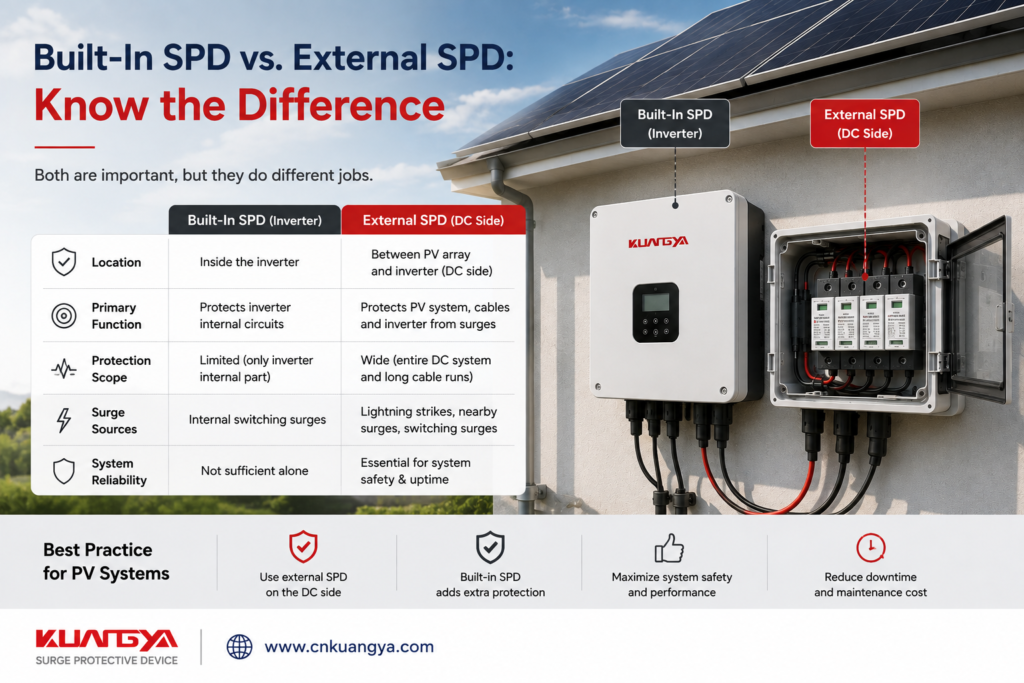
It is easy to assume that one must be better than the other.
That is not really the point.
Advantages can include:
Its main limitation is obvious:
its location is fixed inside or directly at the inverter.
An external SPD can be installed where the system design requires another protection point.
Typical locations include:
So instead of asking:
“Is an external SPD better than the inverter’s built-in SPD?”
ask:
“Which protection locations does this installation require, and which of those locations are already covered?”
That is the more professional question.
Fronius describes the SPD in its Verto documentation as contributing to the protection of PV system components as part of an overall lightning protection concept. It also specifies maintenance behavior: when the SPD has operated, the mechanical status indication changes from green to red and the device should be replaced to maintain protection.
This is an important practical idea.
The inverter’s SPD is not a magical shield around the entire PV installation.
È one protective component inside a larger electrical protection concept.
That concept includes:
This is why the answer cannot come from one specification line alone.
The following are illustrative installation scenarios, not claimed customer projects. They are designed to show how the same inverter specification can lead to different questions.
Sistema:
In this situation, it would be wrong to automatically say:
“You definitely need another external Type 2 SPD.”
Instead, check:
A short and simple installation is very different from a large commercial rooftop.
Sistema:
Now the situation is different.
The built-in SPD provides protection at the inverter end.
But there is a long DC route between the array and inverter.
This is precisely the type of installation where published manufacturer guidance about additional protection locations on long cable runs becomes relevant.
The correct question becomes:
“Is coordinated surge protection also required near the array or combiner box?”
Not:
“Does the inverter have an SPD?”
Sistema:
Before deciding whether to add another Type 2 SPD, you need another piece of information:
Can the required separation distance be maintained?
If it cannot, the required protection concept may involve Type 1 protection at relevant locations rather than simply duplicating Type 2 devices. Phoenix Contact’s published PV guidance explicitly distinguishes these conditions.
The presence of a built-in Type 2 SPD therefore does not answer the whole lightning-protection question.
No.
This is one of the easiest misunderstandings to avoid.
A modern inverter may have:
DC SPD: Type II
e
AC SPD: Type II
because the DC and AC sides are separate electrical paths.
The PV array reaches the inverter through DC conductors.
The grid or AC distribution system connects through the inverter AC side.
Surges can reach equipment through different paths.
Real inverter datasheets demonstrate this separation clearly.
For example, Sungrow’s SG30CX-P2 / SG50CX-P2 specification lists the DC and AC surge protection separately: DC Type I+II / AC Type II.
That would make little sense if one SPD automatically protected both sides.
Power cables are not the only conductors connected to modern PV systems.
An inverter may also use:
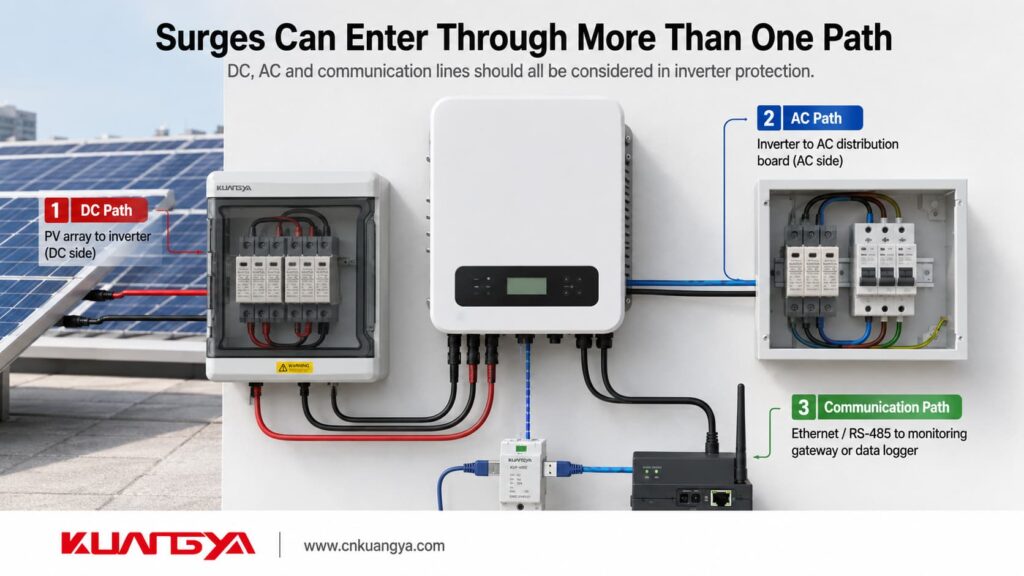
Phoenix Contact specifically points out that overvoltages can also enter inverter electronics through network or control interfaces and recommends considering surge protection for communication interfaces such as Ethernet, RS-485 and weather-station connections.
This is a useful reminder:
“My DC and AC sides both have SPDs” still does not necessarily mean every electrical path entering sensitive equipment has been considered.
| Common assumption | Better way to think about it |
|---|---|
| My inverter has a built-in SPD, so the whole PV system is protected | Check the entire cable route and all relevant protection locations |
| My inverter has an AC SPD, so the PV side is protected | DC and AC sides must be evaluated separately |
| Two SPDs are always better than one | Position and coordination matter more than simply increasing quantity |
| A higher kA rating always means a better SPD | Type, voltage rating, protection level and application also matter |
| Type 1+2 is automatically better for every system | The correct SPD type depends on the installation and lightning exposure |
| Built-in SPD means I never need to inspect it | Integrated SPDs can still reach end of life and require replacement |
| Cable distance does not matter because the inverter has an SPD | Long cable routes can create a need to evaluate an additional protection point |
| “Surge protection” in a datasheet tells me everything | Always verify side, SPD type and actual technical specification |
Non necessariamente.
Surge protection should be coordinated, not accumulated randomly.
Installing another SPD without considering:
does not automatically improve the installation.
Imagine putting two Type 2 SPDs next to each other inside the same cabinet when the actual problem is a 40 m cable route from a remote PV array.
You have increased the number of SPDs.
But you may not have solved the real problem.
This is why good design starts with the system layout.
Even a correctly selected SPD can lose effectiveness if its installation is poor.
During a surge event, connection conductors are not electrically “invisible.”
Long or unnecessarily looped conductors add inductive voltage.
This means two systems can use exactly the same SPD but achieve different real protection performance.
SPD located close to the protected equipment with short, direct conductors.
Same SPD, but connected through long looping conductors inside the cabinet.
The product label is identical.
The installation is not.
This is why selecting a device only by looking at:
1000 V
20 kA
40 kA
is incomplete.
The SPD and its installation must work together.
This is the checklist worth saving.
| Controllo | Information you need | Perché è importante |
|---|---|---|
| 1. Exact inverter model | Brand + complete model number | Different models from the same manufacturer may use different SPD arrangements |
| 2. Built-in SPD location | DC, AC or both | Tells you which electrical path already has protection |
| 3. SPD type | Type 1, Type 2 or Type 1+2 | Helps determine its intended role in the protection concept |
| 4. PV-to-inverter cable distance | Actual cable route in meters | Long cable runs may require another protection location to be evaluated |
| 5. Combiner box configuration | Is an SPD already inside? | Prevents unnecessary duplication |
| 6. External lightning protection | Yes / No + separation condition | Can significantly change the required SPD type and location |
| 7. Manufacturer/project requirements | Inverter manual, single-line diagram and project specification | Final selection must match the actual installation |
If you can provide these seven pieces of information, an installer or SPD supplier can give you a much more useful answer.
Evaluate DC-side surge protection for the PV installation.
Continue to Step 2.
Check:
Tipo 1
Tipo 2
o
Tipo 1+2
Do not guess from the size of the inverter.
Use the actual datasheet.
If it is built into the inverter, you have a protection point at the inverter.
Now look at the rest of the DC cable route.
If the cable route is short, check the inverter instructions and applicable installation requirements before adding another device.
If the cable route is long, evaluate whether another coordinated protection point is required closer to the PV array or combiner box.
Published PV guidance from Phoenix Contact and DEHN specifically treats longer cable distances as a reason to consider protection at additional locations.
Continue with the applicable surge-protection design for the PV installation.
Check whether the required separation distance can be maintained.
If it cannot, Type 1 protection may become relevant at the applicable installation points.
Check:
Do not add products based on assumptions.
Check the actual system.
This is perhaps the easiest way to understand why checking the exact model matters.
Consider two real Sungrow inverter families.
The current official product page states:
Built-in Type II DC & AC SPD.
Now consider:
The official datasheet specifies:
DC Type I+II / AC Type II.
Both products are Sungrow inverters.
Both include surge protection.
But the published DC SPD configuration is not the same.
That alone shows why questions such as:
“Does a Sungrow inverter already have an SPD?”
are too broad.
The correct question is:
“Which Sungrow model, and what does its datasheet specify?”
The same principle applies to other manufacturers.
If you are a purchaser, distributor or project buyer, you do not need to design the complete lightning protection system yourself.
But sending the correct information can dramatically improve the quality of the recommendation you receive.
Instead of sending:
“Need 1000V 40kA SPD. Please quote.”
send:
Why is this better?
Because:
1000V + 40kA
does not tell the supplier whether the SPD is intended:
A specification is useful only when it is connected to an application.
No.
The correct decision depends on the complete installation.
Cable distance, SPD location, combiner-box configuration, external lightning protection, separation distance and manufacturer requirements should all be considered.
Do not automatically add another SPD, but do not automatically remove external protection simply because the inverter includes one.
Do not treat the number as an isolated universal rule.
However, 10 m is an important design threshold in published PV surge-protection guidance.
Phoenix Contact identifies additional DC-side protection locations where the distance between the inverter and PV panels is 10 m or more, while DEHN likewise identifies additional protection on longer cable routes in its rooftop PV guidance.
Use the distance as a reason to evaluate the system—not as a substitute for engineering judgment or applicable requirements.
No.
AC and PV DC are separate electrical paths.
Check the datasheet specifically for SPD DC, PV SPD, or the manufacturer’s equivalent terminology.
Not simply because it sounds like a higher number.
Type 1+2 and Type 2 are intended for different surge and lightning-protection conditions.
For example, Phoenix Contact’s PV guidance differentiates SPD type according to whether external lightning protection is present and whether separation distance is maintained.
Select the appropriate type for the installation rather than choosing by label alone.
Possibly.
The two devices may be protecting different points along a longer cable route.
This is exactly why you should evaluate the distance and location relationship rather than asking which one of the two devices is unnecessary.
Sì.
SPDs are protective components and can reach end of life after electrical stress.
Fronius, for example, documents a mechanical status indication that changes from green to red when its SPD is triggered and states that the SPD should then be replaced to maintain protection.
Always follow the inverter manufacturer’s inspection and replacement instructions.
Look deeper into the technical documentation.
Try to confirm:
Do not assume that every use of the phrase “surge protection” describes the same device.
It is natural to focus on the inverter.
It is one of the most valuable and technically complex components in a PV system.
But a solar installation is larger than the inverter.
Think about the complete path:
Moduli fotovoltaici
↓
DC string cables
↓
combiner or protection equipment
↓
long DC cable route
↓
inverter DC input
↓
inverter
↓
AC output
↓
distribution system
and possibly:
Ethernet / RS-485 / monitoring / control lines
A solar inverter built-in SPD sits at one protection point within this larger system. It should therefore be evaluated together with the PV cables, combiner equipment, AC side and other relevant protection locations.
That is why the best question is not:
“How many SPDs do I have?”
È:
“Where can transient overvoltage enter this system, and where should it be limited before it reaches sensitive equipment?”
Once you start thinking this way, the confusing question of “internal SPD versus external SPD” becomes much easier.
They are not necessarily competitors.
They may be parts of the same coordinated protection concept.
Seeing:
“DC SPD Type II Built-In”
on an inverter datasheet is useful information.
But it is not the end of your surge-protection assessment.
Before deciding whether an external SPD is necessary, check four things first:
DC, AC, Type 1, Type 2 or Type 1+2?
A built-in SPD provides a protection point at the inverter. Consider what exists between that point and the PV array.
Cable distance can change whether another protection location needs to be evaluated.
If yes, the lightning protection concept and separation distance become important.
If you can answer these four questions, you are already making a much better decision than someone who simply reads:
“Built-in SPD”
and stops there.
And if terms such as Ucpv, In, Imax, Up e Iscpv still look confusing, learn how to read the SPD label before comparing different devices.
Related Guide: How to Read a DC SPD Label: Class II, Ucpv, In, Imax, Up & Iscpv Explained
KUANGYA manufactures surge protective devices for photovoltaic DC applications.
If you are unsure which SPD configuration fits your project, you can provide:
This allows the application to be checked before selecting a specification based only on voltage and kA values.

