Zona industrial de WengYang Yueqing Wenzhou 325000
Horas de trabajo
De lunes a viernes: de 7.00 a 19.00 horas
Fin de semana: 10.00 A 17.00 HORAS
Zona industrial de WengYang Yueqing Wenzhou 325000
Horas de trabajo
De lunes a viernes: de 7.00 a 19.00 horas
Fin de semana: 10.00 A 17.00 HORAS

SPD joules vs kA is a common source of confusion when comparing surge protectors. A plug-in surge strip may advertise thousands of joules, while a panel-mounted surge protective device lists tens of kiloamperes. Those numbers describe different quantities and cannot be ranked against each other.
For a useful comparison, identify the application, the exact rating, the test waveform and the protection mode. Then review voltage protection performance and installation requirements. A single large number is not a complete SPD specification.
A joule (J) is a unit of energy. A kiloampere (kA) is a unit of current equal to 1,000 amperes. Energy associated with an electrical event depends on voltage, current and duration; peak current alone does not determine it.
| Marcado | What it describes | What it cannot establish alone |
|---|---|---|
| Joules, J | A published energy-related capability under the stated conditions | The voltage reaching equipment or a universal service life |
| Surge current, kA | A specified impulse-current capability or test level | Energy capacity without the waveform and voltage behavior |
| Up or VPR | Voltage protection performance under the applicable test method | Suitability for every system voltage and installation |
| SCCR, often in kA | Short-circuit current suitability under specified conditions | Surge discharge capacity |
Joule ratings appear frequently in consumer surge-protector product ranges. Eaton’s consumer guide uses this metric when discussing plug-in products. That does not make it a universal basis for comparing those products with a distribution-board SPD.
In contrast, Schneider Electric’s SPD guidance cautions against using joule ratings to judge the protective performance of its specified SPD product lines. The practical lesson is to understand the product category and documented test conditions before comparing numbers.
If a supplier offers only a joule value, ask for the full device datasheet, applicable certification and voltage protection information. Do not infer that a product with no advertised joule figure has no surge protection.
There is no fixed conversion such as “1kA equals a certain number of joules.” For an electrical element, energy transferred during an event is calculated from the time integral of voltage multiplied by current: E = ∫ v(t)i(t) dt.
This requires the voltage and current over the event, not just the peak current. SPD behavior, waveform duration and the point at which the quantities are measured all matter. Eaton’s surge suppression application guide explains how differing waveforms and voltage characteristics make joule comparisons misleading.
For example, a 40kA label and a 2,000J label do not contain enough information to identify a winner. A conversion calculator cannot recover the missing test conditions.
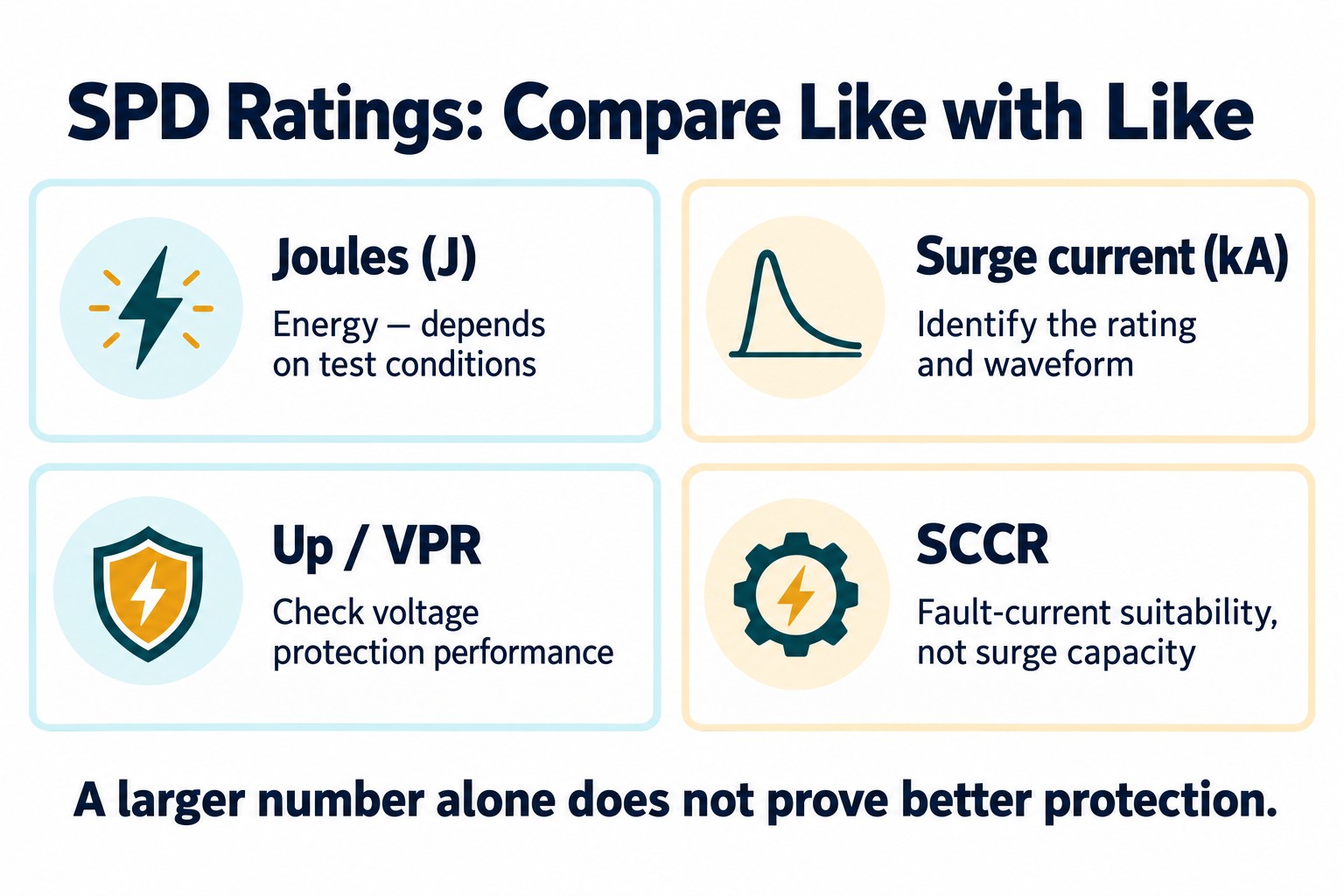
Read the symbol beside the number. Nominal discharge current (In), maximum discharge current (Imax), impulse discharge current (Iimp) and a manufacturer’s stated surge-current capacity are not interchangeable labels.
In IEC-oriented power SPD documentation, In and Imax commonly reference an 8/20µs current waveform, while Iimp references a lightning-current test commonly expressed using a 10/350µs waveform. Comparing the peak values without their test categories loses essential information. Manufacturer catalogues such as Phoenix Contact’s surge protection reference guide list Iimp and Imax separately.
Do not conclude that a Type 2 device with a larger Imax replaces a Type 1 device required by the design. For the individual label fields, see our Guía de especificaciones de SPD de CC.
Two brochures may both say “100kA” while presenting the rating on different bases. Check whether each value applies per phase, per protection mode, per pole or to the complete assembly.
A useful real example is Eaton’s integrated SPD series. Its specifications separately list surge-current capacity per phase, nominal discharge current and short-circuit current rating. These are different rows because they answer different engineering questions.
Create matching columns in your comparison sheet and leave unknown fields blank. Never add several mode ratings together and present the result as though one mode can carry that total.
Surge-current capability does not tell the whole story about the voltage imposed on protected equipment. Review the declared Up for the applicable IEC test framework or VPR for the applicable UL framework, together with the protection mode and test conditions. These are related performance concepts, not automatically equivalent test results.
Schneider Electric’s explanation of clamping voltage and VPR shows why voltage limitation deserves its own check. A lower comparable protection-voltage value can be useful, but the device must first be suitable for the actual supply.
Do not confuse Up or VPR with Uc, Ucpv or MCOV. The latter fields concern continuous operating-voltage suitability. In PV applications, use the array’s design voltage rather than choosing a device from its kA number alone; our DC SPD voltage selection guide covers that step.
Short-circuit current rating also uses amperes, often kiloamperes, but it concerns power-system fault conditions rather than a brief surge impulse. A high SCCR is not a claim that the device can discharge the same numerical lightning current.
Record SCCR and surge ratings in separate fields. Check the supply’s available fault current and any manufacturer’s specified upstream protective device or tested combination. Our SPD backup fuse and circuit breaker guide explains why that coordination needs its own review.
A correctly selected SPD still needs the manufacturer’s intended connection arrangement. Long connection paths can add voltage during a rapidly changing surge. Schneider Electric’s guidance on short SPD leads explains why installed protection can differ from a product’s laboratory rating.
Check the wiring route, bonding, protected modes, backup protection and maintenance access as part of the design. For solar installations, see our SPD distance from inverter guide. Neither a large joule figure nor a large kA figure corrects an unsuitable installation.
Ask suppliers to complete the same fields. This turns a contest between headline numbers into a comparison of documented suitability.
The two figures cannot answer that question. The devices may serve different locations and be tested differently. Establish application, ratings and voltage protection performance first.
No dependable service-life ratio follows from that number alone. Actual exposure and operating conditions vary; follow the manufacturer’s inspection and replacement instructions.
A surge discharge rating describes an impulse, not the continuous load current of your distribution board. Check the exact parameter rather than treating all ampere values as interchangeable.
Comparing SPDs for a project? Send the system voltage, AC/DC application, earthing arrangement, installation location and the complete SPD datasheets for technical review. Those details are more useful than asking for the highest joule or kA number.

