Zona industrial de WengYang Yueqing Wenzhou 325000
Horas de trabajo
De lunes a viernes: de 7.00 a 19.00 horas
Fin de semana: 10.00 A 17.00 HORAS
Zona industrial de WengYang Yueqing Wenzhou 325000
Horas de trabajo
De lunes a viernes: de 7.00 a 19.00 horas
Fin de semana: 10.00 A 17.00 HORAS

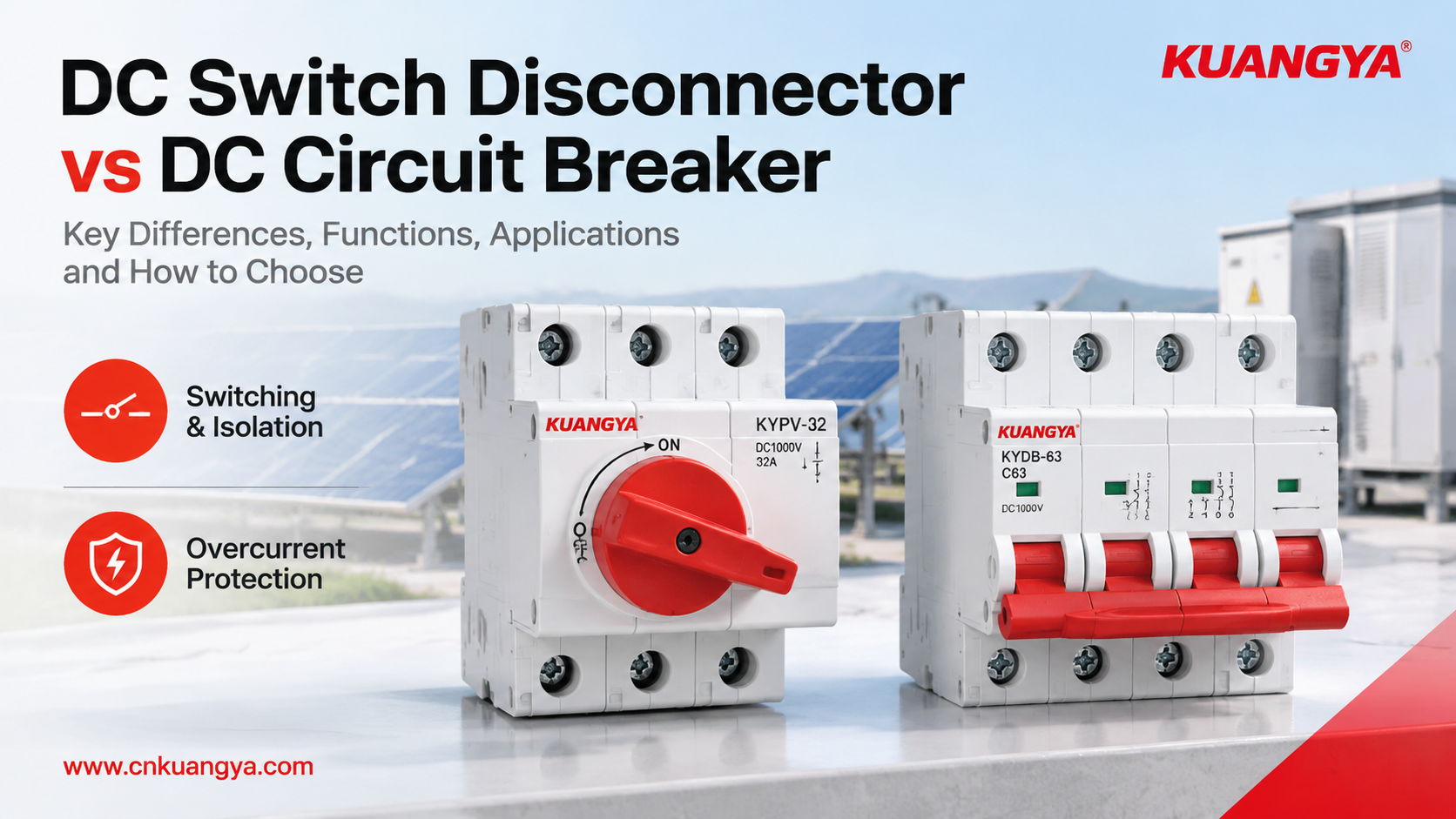
En un sistema fotovoltaico solar, un seccionador de CC frente a interruptor automático de CC La comparación ayuda a ingenieros y compradores a comprender dos funciones diferentes: conmutación y aislamiento frente a protección automática contra sobrecorriente. Aunque estos dispositivos pueden parecer similares, elegir el incorrecto puede dejar un circuito sin la protección que necesita o dificultar el mantenimiento.
La diferencia entre un seccionador de CC frente a un interruptor automático de CC se reduce a sus funciones previstas: un seccionador proporciona conmutación y aislamiento dentro de sus condiciones de funcionamiento nominales, mientras que un interruptor automático está diseñado para interrumpir automáticamente sobrecorrientes y cortocircuitos especificados.
Sin embargo, la distinción no siempre es tan simple como sugiere el nombre del producto. Algunos dispositivos combinan funciones de conmutación y aislamiento, y sus capacidades reales dependen de sus clasificaciones, diseño y normas aplicables.
Esta guía compara los dos dispositivos, explica seis diferencias prácticas y muestra cómo evaluarlos en sistemas fotovoltaicos (FV), cajas combinadoras y otras aplicaciones de CC.
La conclusión clave: Un seccionador conmutador no es automáticamente un dispositivo de protección contra cortocircuitos, y no se debe asumir automáticamente que un interruptor automático proporciona todas las funciones de aislamiento requeridas para el mantenimiento.
Un seccionador conmutador de CC generalmente se opera manualmente para conectar o desconectar un circuito bajo condiciones especificadas. Un interruptor automático de CC puede abrir un circuito automáticamente cuando su mecanismo de protección detecta una sobrecorriente dentro de sus características de operación.
| Punto de comparación | Interruptor-seccionador CC | Disyuntor de CC |
|---|---|---|
| Función principal | Conmutación y aislamiento eléctrico, según su clasificación | Protección contra sobrecorriente y conmutación de circuitos |
| Conmutación de carga normal | Sí, si está clasificado para el uso previsto | Sí, dentro de sus condiciones de operación nominales |
| Disparo automático por sobrecarga | No se proporciona normalmente | Disponible en modelos diseñados para protección contra sobrecargas |
| Interrupción por cortocircuito | No es su función autónoma normal | Sí, dentro de su capacidad nominal de interrupción |
| Función de aislamiento | Depende de la capacidad de aislamiento declarada del dispositivo | Depende de su diseño, marcado y requisitos aplicables |
| Operación típica | Maneta manual o mecanismo giratorio | Operación manual y disparo automático |
| Dispositivos de bloqueo | Puede admitir un candado en la posición de APAGADO | Depende del modelo y los accesorios |
| Familia de normas IEC relevante | IEC 60947-3 | IEC 60947-2 para interruptores automáticos industriales |
| Aplicación fotovoltaica típica | Desconexión planificada y aislamiento para mantenimiento | Protección de ramales o alimentadores adecuados |
La comparación describe funciones típicas del producto en lugar de cada dispositivo del mercado. Siempre consulte la hoja de datos y la certificación del modelo exacto.
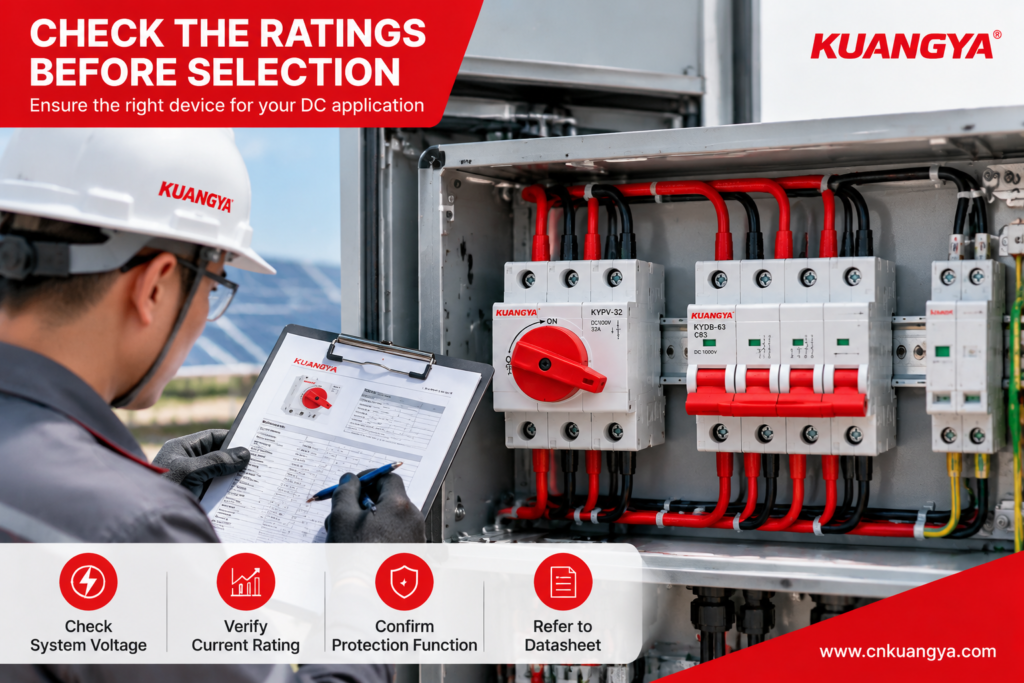
Al evaluar un seccionador de CC frente a interruptor automático de CC, no compare los productos basándose únicamente en la tensión o corriente nominal. Compruebe si el dispositivo está diseñado para conmutación de carga, aislamiento eléctrico, disparo automático o interrupción de cortocircuito. Estas funciones deben coincidir con los requisitos reales del circuito de CC.
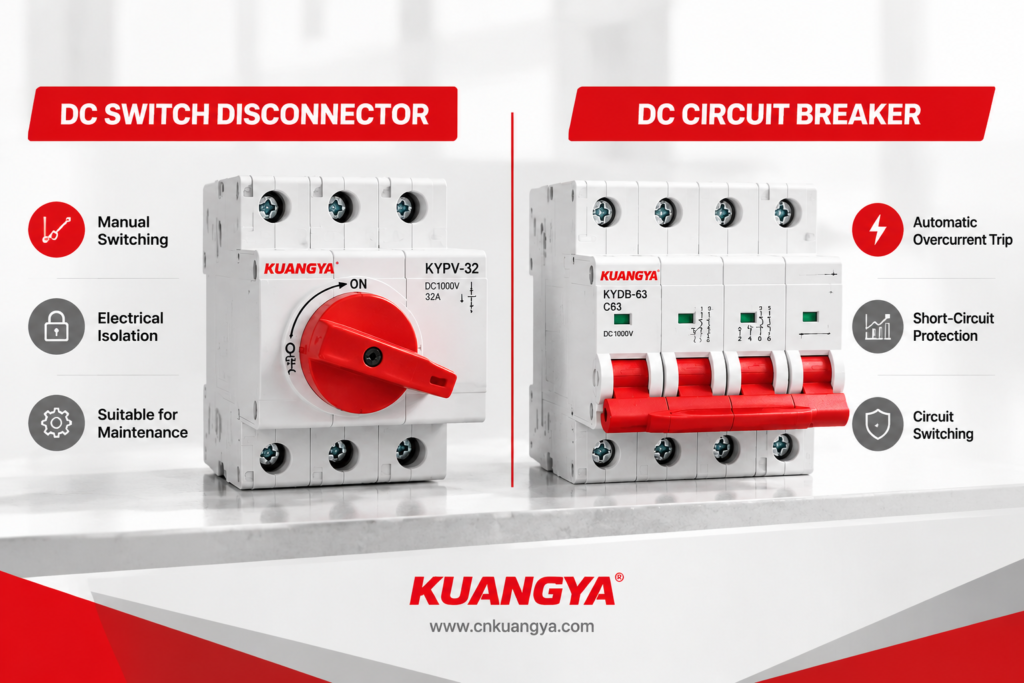
Importante: Un seccionador básico destinado únicamente al aislamiento no debe tratarse como un interruptor de conmutación de carga. Del mismo modo, no se debe esperar que un interruptor seccionador interrumpa un cortocircuito a menos que su capacidad nominal específica o conjunto de protección aprobado permita esa función.
La distinción más importante es para qué está diseñado cada dispositivo.
Un interruptor seccionador de CC proporciona un medio deliberado para abrir un circuito. Para opciones de productos y detalles de aplicación, explore nuestro Interruptores-seccionadores de CC para aplicaciones fotovoltaicas solares, almacenamiento de energía y otras aplicaciones de CC. Puede ayudar a establecer un punto de aislamiento definido antes de la inspección, el mantenimiento o la sustitución de equipos, siempre que el dispositivo sea adecuado para la aplicación.
Un disyuntor de CC protege un circuito diseñado adecuadamente contra condiciones de sobrecorriente especificadas. Dependiendo de sus características de disparo, puede responder a sobrecargas y cortocircuitos e interrumpir la corriente dentro de su capacidad nominal.
Consider the following example:
A solar combiner box supplies a DC circuit connected to an inverter. During maintenance, a technician needs to isolate the relevant circuit. If an abnormal current occurs, the circuit also needs suitable protective equipment to interrupt the fault.
These are related but different requirements. The design should specify the appropriate isolation device and overcurrent protection rather than expecting one component to perform functions for which it has not been rated.
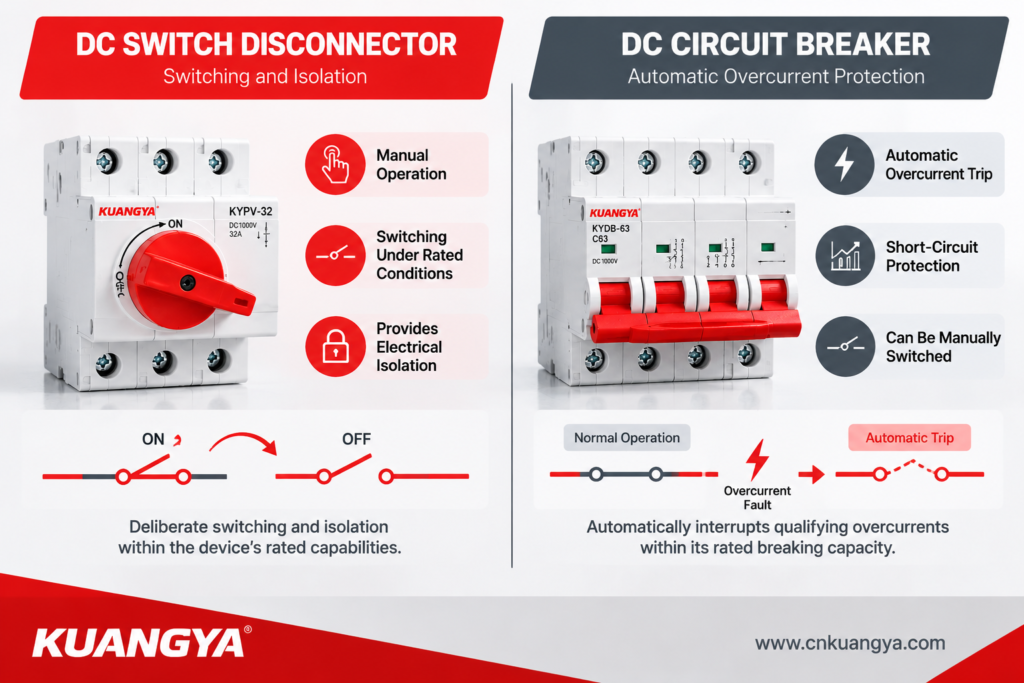
Not every switch is suitable for opening a loaded DC circuit.
DC current does not have the natural periodic zero crossings found in AC current. When DC contacts separate, an electrical arc can continue to conduct current unless the device is designed to interrupt it under the specified conditions.
A switch disconnector rated for the relevant DC switching duty can open a circuit within its declared limits. A disconnector intended for off-load isolation may require the current to be interrupted by another suitable device first.
Before selecting a device, check:
Do not assume that a rotary handle, a high voltage printed on the label, or a visible ON/OFF marking proves that a device can interrupt every type of DC load.
This is where the distinction becomes particularly important.
A DC circuit breaker is designed to interrupt specified fault currents within its rated breaking capacity and operating conditions.
When evaluating a circuit breaker for a DC application, review its rated breaking capacity and compatibility with the system’s prospective fault current. See our DC MCB range for product options and rated specifications.
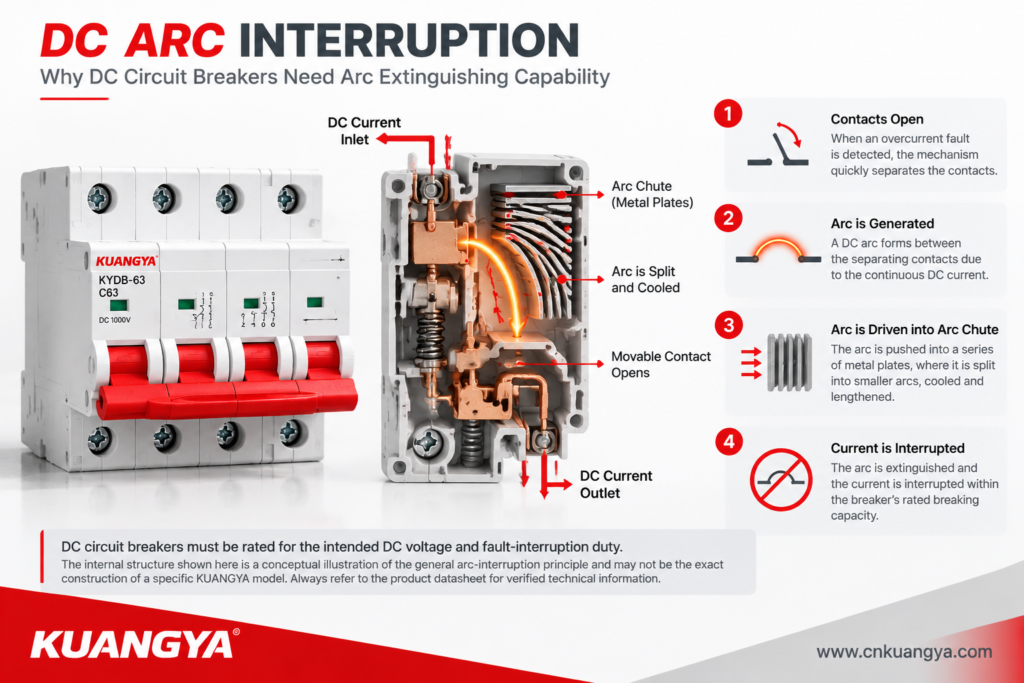
A switch disconnector, by contrast, is not normally intended to provide independent automatic short-circuit protection. It may have a specified short-time withstand capability or conditional short-circuit rating when used with a designated protective device.
These ratings mean different things.
| Rating or Feature | What It Tells You | What It Does Not Automatically Mean |
|---|---|---|
| Tensión nominal de funcionamiento | Voltage at which the device is intended to operate under specified conditions | That the device can interrupt any fault at that voltage |
| Corriente nominal | Permitted current under the stated conditions | That overloads will trigger an automatic trip |
| Capacidad de rotura | Fault current a protective device can interrupt under specified conditions | That the device is suitable for every DC voltage or circuit arrangement |
| Short-time withstand current | Fault current the device can withstand for a specified duration | That it can independently clear the fault |
| Conditional short-circuit rating | Performance when used with the specified protective arrangement | That any fuse or breaker can be substituted |
For a DC switch disconnector, verify the declared short-circuit withstand or conditional rating and the required upstream protective device.
For a DC circuit breaker, check the rated DC breaking capacity and confirm that it is sufficient for the prospective short-circuit current at the installation point.
A conventional switch disconnector is operated manually. It does not normally detect an overload and trip automatically.
A circuit breaker with suitable protective functions can open a circuit when its trip mechanism detects a qualifying fault.
This difference affects system operation.
| Situación | Interruptor Desconectador | Disyuntor de CC |
|---|---|---|
| Planned maintenance | Provides a suitable manual isolation point | May provide switching and isolation if specifically suitable |
| Sustained overload | Does not normally trip automatically | Can trip if its protection characteristics detect the overload |
| Cortocircuito | Must not be relied upon as standalone fault protection | Can interrupt the fault within its rated capability |
| Control remoto | Requires suitable auxiliary contacts or additional equipment | May support auxiliary contacts or electronic monitoring, depending on model |
| Automatic fault response | No se proporciona normalmente | Available according to the protection design |
A device’s ability to be switched remotely is not the same as its ability to provide automatic fault protection. Remote actuation, status monitoring, and protective tripping should be evaluated separately.
A 2-pole device is not automatically equivalent to a 4-pole device, and a voltage rating printed on a product should not be interpreted without checking the specified wiring arrangement.
Some DC switching devices use multiple contacts in series to achieve their declared voltage or interruption capability. In such cases, the manufacturer’s wiring diagram must be followed.
For example, a device rated for a particular DC voltage with a specified series-pole connection may not retain that rating when wired differently.
When comparing a DC switch disconnector with a DC circuit breaker, verify:
Do not choose a device based on “2P,” “4P,” or “1500V DC” alone. The complete combination of voltage, current, pole arrangement, and switching duty must match the intended application.
Maintenance safety involves more than turning a handle to OFF.
A suitable isolation arrangement should help personnel identify the correct circuit, prevent unintended reconnection, and follow the applicable safe-working procedure.
A DC switch disconnector may provide a lockable OFF position, but this feature must be confirmed for the specific model. A circuit breaker may also support locking accessories, although its suitability as the required isolation device must be verified separately.
For a planned maintenance task, consider the following:
An OFF indication alone is not proof that an electrical circuit is safe to touch.
In many photovoltaic installations, the switch disconnector and circuit breaker serve complementary roles.
A typical protection arrangement may include:
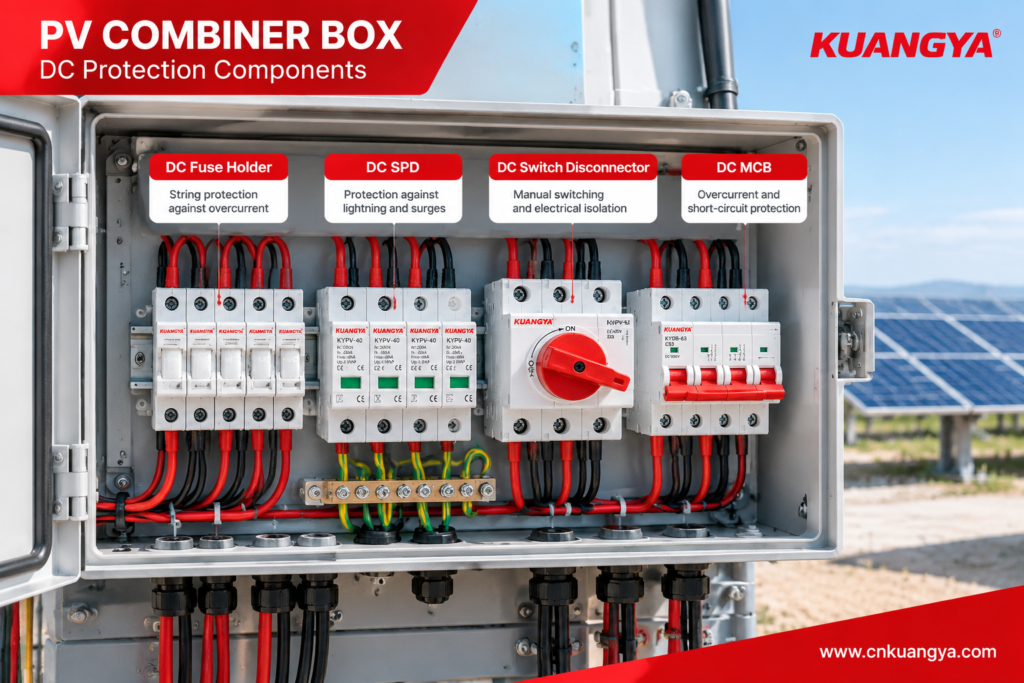
The exact arrangement depends on the system architecture, inverter requirements, prospective fault current, earthing arrangement, and applicable standards. For a closer look at how fuses, SPDs, disconnect switches, and other components work together, read our solar combiner box protection and maintenance guide. Not every installation requires all four devices in the same location.
| Componente | Objetivo principal | Selection Check |
|---|---|---|
| gPV fuse and fuse holder | PV string overcurrent protection | Rated voltage, current, fuse characteristic, and fault-interruption capability |
| DC SPD | Protección contra sobretensiones transitorias | PV-specific rating, protection level, and applicable SPD standard |
| Interruptor-seccionador CC | Conmutación y aislamiento | Rated DC switching duty, isolation capability, and connection arrangement |
| Disyuntor de CC | Overcurrent protection where required | Trip characteristics, rated breaking capacity, and system compatibility |
A combiner box with a fuse, SPD, and switch disconnector does not automatically provide every protective function that a circuit breaker would provide. Each component must be selected for its intended role.
For related technical guidance, see our Solar DC Protection Guide y PV Combiner Box Guide.
The following cases are illustrative engineering scenarios based on common equipment-selection and system-coordination issues. They are not presented as documented KUANGYA customer incidents or laboratory test results.
Situación
A panel designer selects a DC switch disconnector because its voltage and current ratings appear to match the circuit. The design does not include a suitable protective device for the relevant fault condition.
What is wrong?
The selected switch may be suitable for manual switching and isolation but may not have the capability to interrupt the prospective short-circuit current.
Corrective action
Lesson: A matching voltage and current label does not prove that a switch can clear a short circuit.
Situación
A buyer chooses an AC-rated switching device because its current rating appears sufficient for a solar DC circuit.
What is wrong?
The device may not have been tested or rated to interrupt the specified DC current. Its arc-extinguishing design and contact arrangement may be unsuitable for the application.
Corrective action
Use a device with an explicit DC rating for the actual system voltage, current, and switching duty. Follow the manufacturer’s approved wiring diagram.
Lesson: AC and DC ratings are not interchangeable unless the manufacturer explicitly declares the relevant capability.
Situación
A maintenance team assumes that switching a circuit breaker to OFF automatically satisfies all site isolation requirements.
What is wrong?
The breaker may not provide every required isolation, locking, or work-control feature for the particular installation. Other energy sources or backfeed paths may also remain present.
Corrective action
Check the device’s isolation suitability, locking provisions, circuit arrangement, and site procedures. Use the designated isolation method and verify the absence of voltage before work.
Lesson: Protection, isolation, and safe-work procedures are related but distinct requirements.
Use the following guide as a starting point, then confirm the choice against the applicable standard and the manufacturer’s documentation.
| Application Requirement | Appropriate Direction |
|---|---|
| Manual disconnection for planned maintenance | A suitable DC switch disconnector or isolator |
| Automatic overload protection | A suitably rated DC circuit breaker or other approved protective device |
| Interrupción por cortocircuito | A protective device with sufficient DC breaking capacity |
| Both switching and isolation | A switch disconnector rated for the required duty, or another approved arrangement |
| PV string reverse-current protection | A correctly selected gPV fuse where required by the design |
| Protección contra sobretensiones transitorias | A suitably rated DC SPD |
| Isolation and overcurrent protection | A coordinated combination of devices, unless an approved integrated solution provides the required functions |
For photovoltaic projects, the decision should be based on the system’s maximum DC voltage, current, prospective fault current, required isolation points, and applicable local requirements.
A device that is suitable for one part of a PV installation may not be suitable for another.
IEC 60947-3 covers switches, disconnectors, switch-disconnectors, and fuse-combination units within its scope. Buyers should check the applicable edition and the device’s declared ratings before selecting a product. IEC 60947-2 specifies requirements for circuit breakers within its scope, including relevant DC applications. Check the applicable edition and the manufacturer’s documentation to verify that the selected device meets the project’s requirements.
The applicable edition, product scope, and any relevant product-specific requirements should be checked for the intended application.
For more information about DC isolation principles and photovoltaic applications, see our DC switch disconnector technical guide.
Before issuing a purchase order, ask the supplier to confirm the following:
| Checkpoint | Information to Request |
|---|---|
| Product identity | Exact model and intended function |
| Tensión nominal | Rated DC voltage and any limitations |
| Current rating | Rated operational or continuous current under stated conditions |
| Switching duty | Permitted load-breaking conditions and utilization category |
| Fault performance | Breaking capacity for breakers; applicable withstand or conditional rating for disconnectors |
| Pole arrangement | Approved wiring diagram and pole configuration |
| Aislamiento | Declared isolation suitability and operating indication |
| Locking | Whether the OFF position can be secured, if required |
| Normas | Applicable standard, edition, and supporting conformity documentation |
| Idoneidad medioambiental | Temperature limits, enclosure protection, terminals, and derating |
| Traceability | Model-specific datasheet, markings, and relevant test documentation |
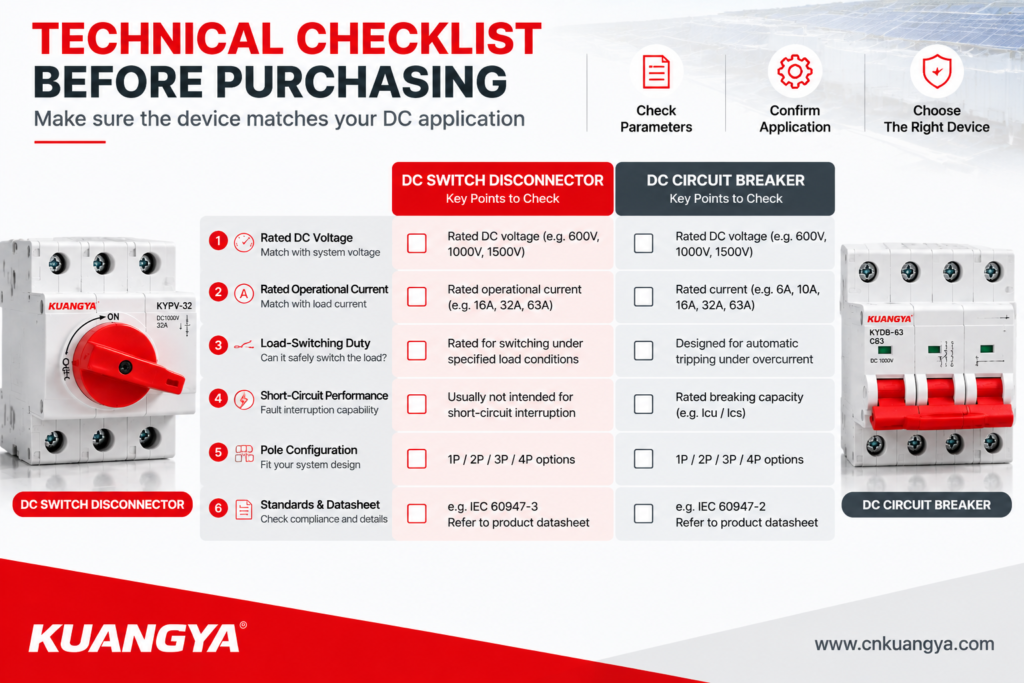
Avoid comparing suppliers solely by voltage, current, or unit price. Two products with similar front-panel markings may have different switching capabilities and short-circuit ratings.
No. A switch disconnector is intended for switching and isolation within its declared ratings. A DC circuit breaker provides automatic overcurrent protection within its rated protective capability. Their functions may overlap in some respects, but the devices are not automatically interchangeable.
Not as a general rule. A switch disconnector does not normally provide standalone automatic overload and short-circuit protection. A suitable protective device must be included where required by the system design.
Not automatically. Confirm that the breaker is suitable for the required isolation function, operating conditions, and maintenance procedures.
Each device must be rated for the actual maximum system voltage and its intended duty. A nominal 1500V system label alone is insufficient; verify the device ratings and approved connection arrangement.
IEC 60947-3 is relevant to switches, disconnectors, and switch-disconnectors. IEC 60947-2 is relevant to industrial circuit breakers. Other standards or requirements may apply depending on the product and installation.
Provide the application, maximum DC voltage, operating current, prospective fault current if known, required poles, switching duty, installation environment, quantity, and any required certifications or documentation. Include the system wiring diagram when possible.
Elegir bien seccionador de CC frente a interruptor automático de CC solution starts with understanding the function each device needs to perform. A switch disconnector provides switching and isolation within its rated capabilities, while a circuit breaker provides automatic overcurrent protection within its rated breaking capacity. The final choice should match the system voltage, operating current, fault conditions, and applicable standards.
For solar PV systems, the right choice depends on the maximum DC voltage, operating current, prospective fault current, required isolation functions, and applicable standards. Always verify the manufacturer’s datasheet and ensure that all protective devices work together as intended.
KUANGYA provides DC switch disconnectors and DC protection components for photovoltaic and other electrical applications. If you are selecting components for a new project, contact our team with your system specifications to discuss a suitable solution.
Explore our Interruptor-seccionador CC y DC MCB product ranges for more information.