Zona industrial de WengYang Yueqing Wenzhou 325000
Horas de trabajo
De lunes a viernes: de 7.00 a 19.00 horas
Fin de semana: 10.00 A 17.00 HORAS
Zona industrial de WengYang Yueqing Wenzhou 325000
Horas de trabajo
De lunes a viernes: de 7.00 a 19.00 horas
Fin de semana: 10.00 A 17.00 HORAS

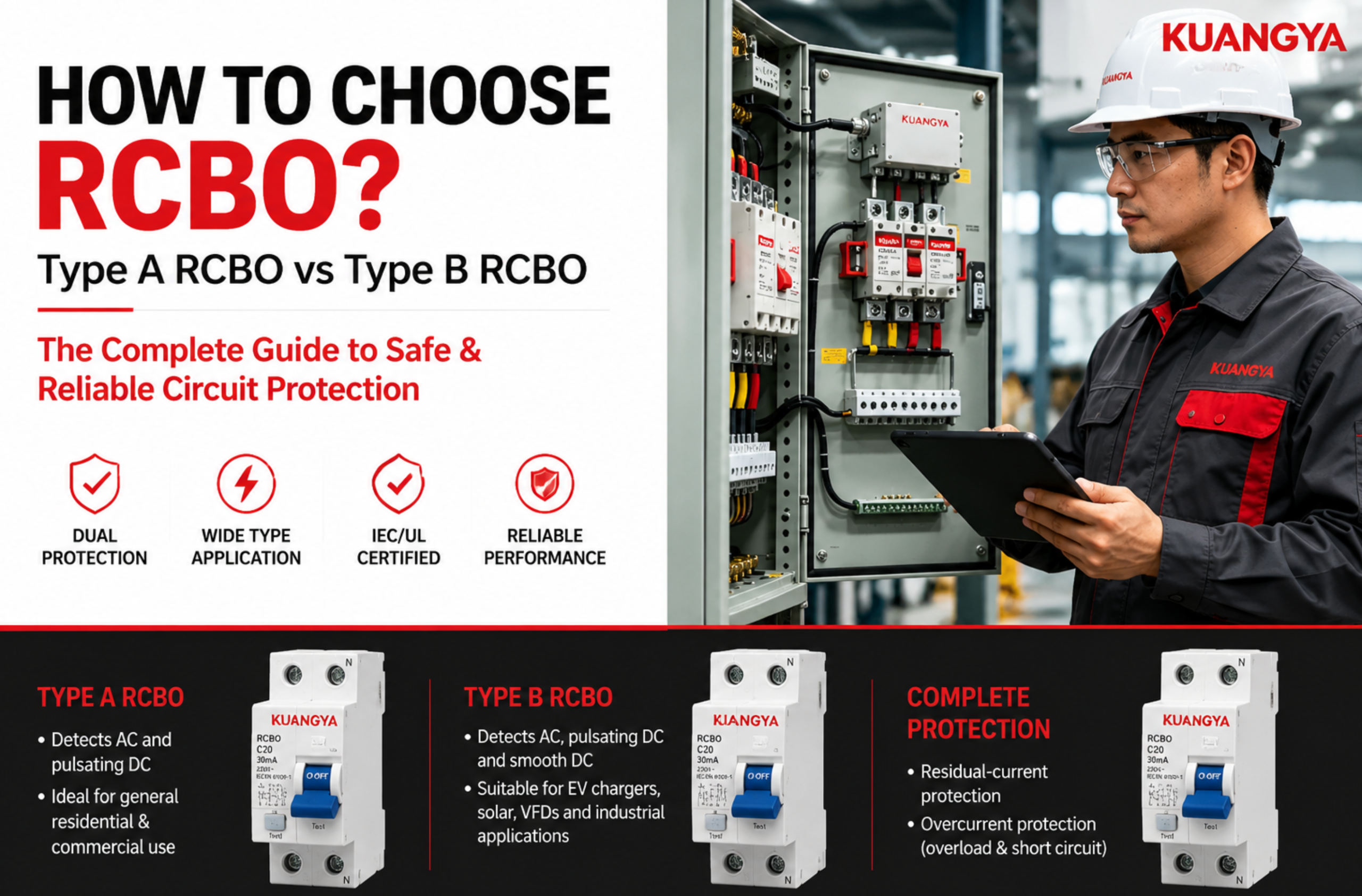
Type A vs Type B RCBO—quick answer: Type A RCBOs detect sinusoidal AC and pulsating DC residual currents. Type B RCBOs additionally cover smooth DC and mixed-frequency residual currents within the device’s specified range. Type B is not a universal upgrade: select the RCBO type according to the connected equipment, DC monitoring arrangement, manufacturer instructions, circuit design and local requirements.
This guide compares RCBO types, explains Type A or Type B selection, and covers poles, current rating, sensitivity, breaking capacity and application-specific checks for EV chargers, PV inverters and motor drives.
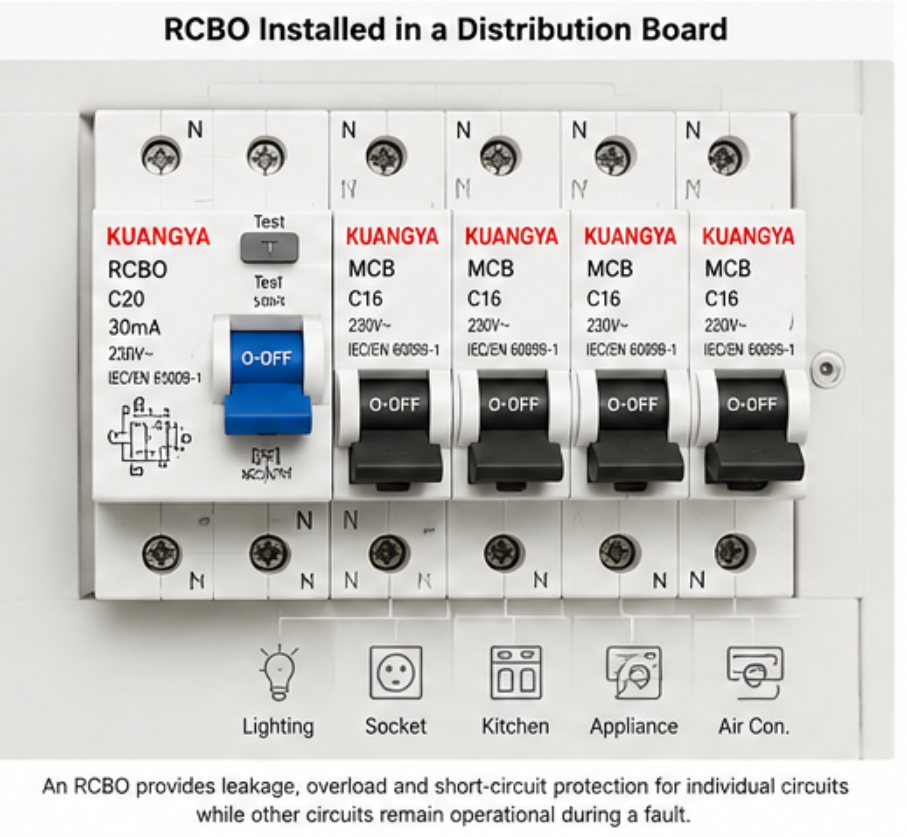
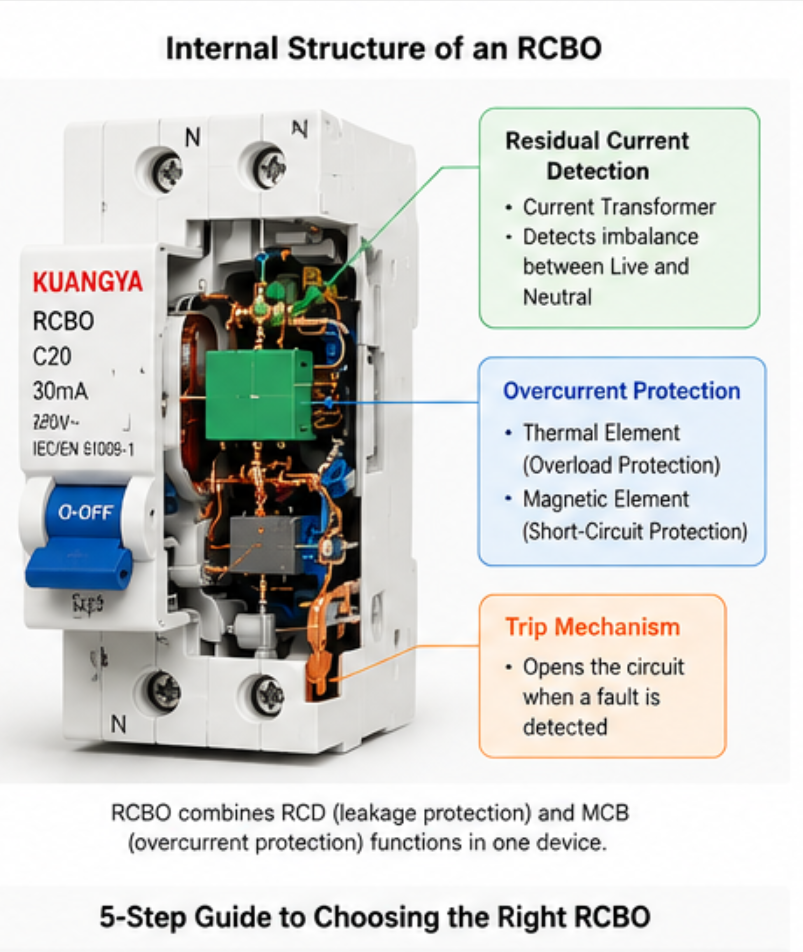
Un RCBO proporciona protección diferencial y protección contra sobreintensidades en un único dispositivo. Sin embargo, la elección de un tipo de RCBO incorrecto puede reducir la eficacia de la protección y provocar disparos molestos o fallos en la detección de determinadas condiciones de fallo.
Por este motivo, comprender la diferencia entre RCBO de tipo A y RCBO de tipo B es esencial a la hora de diseñar o actualizar sistemas eléctricos.
Muchos instaladores se centran en:
Aunque estas especificaciones son importantes, el tipo de corriente residual es igualmente crítico.
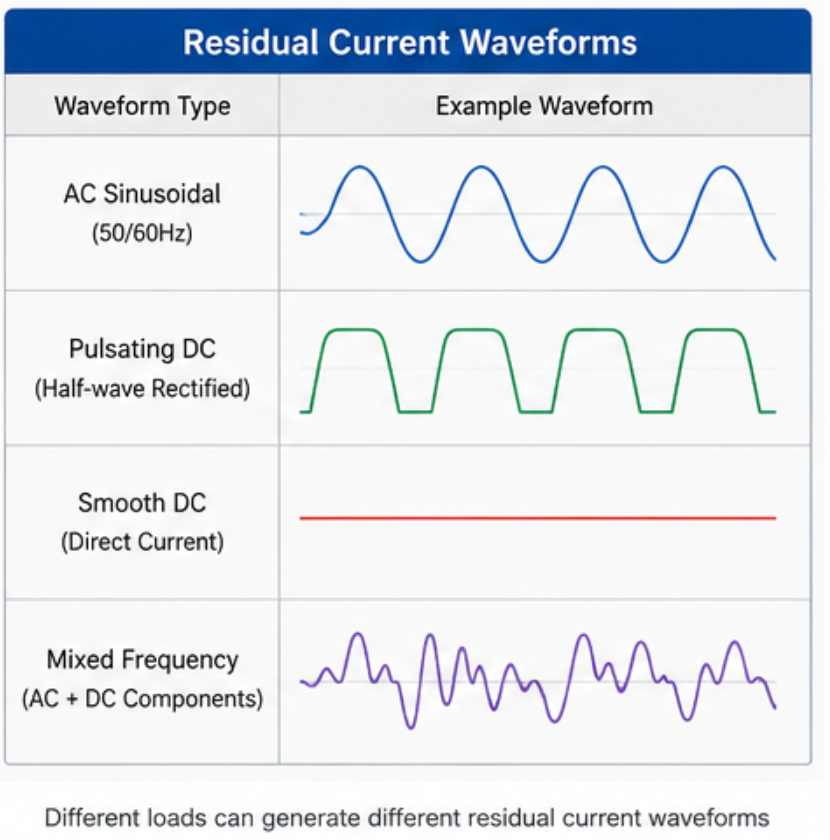
Diferentes cargas eléctricas pueden producir diferentes formas de onda de corriente de fuga. No todos los RCBO están diseñados para detectarlas todas.
Si se selecciona un tipo de RCBO incorrecto, es posible que no se detecten correctamente las corrientes de defecto a tierra peligrosas.
Un RCBO tipo A está diseñado para detectar:
Esto hace que los dispositivos de tipo A sean adecuados para la mayoría de las instalaciones residenciales y comerciales modernas en las que hay equipos electrónicos.
Los RCBO de tipo A se utilizan habitualmente para:
Dado que muchos aparatos modernos contienen componentes electrónicos y rectificadores, cada vez se prefieren más los RCBO de tipo A a los antiguos de tipo CA.
| Tipo de corriente residual | Detectado por el tipo A RCBO |
|---|---|
| CA Sinusoidal | Sí |
| CC pulsante | Sí |
| CC suave | No |
| Componentes de CC de alta frecuencia | Limitado |
Type A is commonly used for many residential and commercial electronic loads, but suitability still depends on the connected equipment and applicable requirements.
Un RCBO Tipo B está diseñado para detectar:
Los dispositivos de tipo B proporcionan la capacidad de detección de corriente residual más amplia entre los tipos comunes de RCBO.
Esto los hace adecuados para instalaciones en las que puedan generarse corrientes de defecto de CC.
Los RCBO de tipo B se utilizan habitualmente en:
Estas aplicaciones pueden generar corrientes continuas residuales suaves que pueden cegar o saturar los dispositivos convencionales de tipo A.
| Tipo de corriente residual | Detectado por el tipo B RCBO |
|---|---|
| CA Sinusoidal | Sí |
| CC pulsante | Sí |
| CC suave | Sí |
| Frecuencia mixta | Sí |
| Componentes de alta frecuencia | Sí |
Debido a su mayor rango de detección, el RCBO de tipo B suele especificarse para sistemas eléctricos avanzados.
Se trata de la comparación más importante a la hora de seleccionar una OBCR.
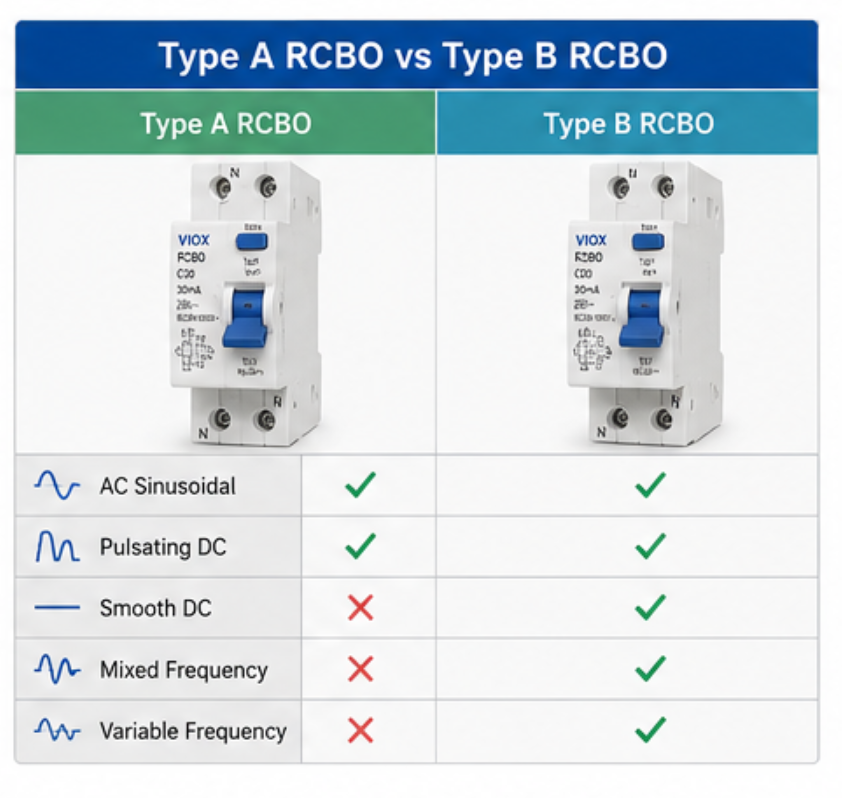
| Característica | Tipo A RCBO | Tipo B RCBO |
|---|---|---|
| Detección de corriente residual de CA | Sí | Sí |
| Detección de CC pulsante | Sí | Sí |
| Detección suave de CC | No | Sí |
| Mixed-Frequency Residual Currents | Verify waveform and device specification | Covered only within the device’s specified frequency range |
| Aplicaciones de los cargadores para VE | Possible with verified DC protection where permitted | Use when required by the charger manual or applicable rules |
| Sistemas solares fotovoltaicos | Verify inverter manual and DC monitoring | Use when required by the inverter manual or applicable rules |
| Accionamientos industriales | Limitado | Verify equipment manual and applicable rules |
| Coste | Baja | Más alto |
The key difference is residual-current waveform coverage. Type A detects sinusoidal AC and pulsating DC residual currents, while Type B additionally detects smooth DC and mixed-frequency components within the manufacturer’s specified range.
Do not treat Type B as automatically better. For EV chargers, PV inverters and variable-speed drives, follow the equipment manual and applicable rules to determine whether Type A with verified DC detection, Type F or Type B is required.
Use the tool below to organize a preliminary RCBO specification. It highlights missing parameters and unsafe combinations, but it does not replace engineering verification or local requirements.
How to use this RCBO selector: choose the known circuit and equipment conditions. The result organizes a preliminary specification and highlights information that still requires verification.
Preliminary selection only. This tool does not approve a circuit or replace the equipment manual, product datasheet, coordination study, qualified designer, or local rules.
La elección del RCBO correcto empieza por conocer la carga conectada.
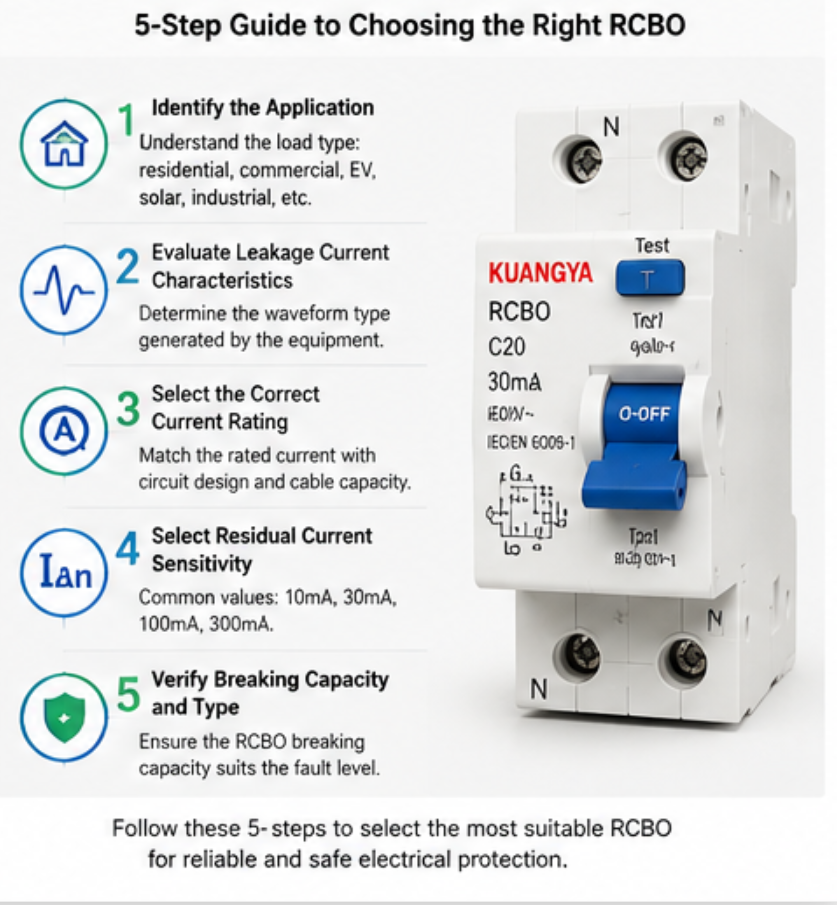
Pregunta:
Las respuestas guiarán la selección del tipo de RCBO.
Diferentes equipos crean diferentes formas de onda de corriente residual.
| Tipo de equipo | Tipo de RCBO recomendado |
|---|---|
| Circuitos de iluminación | Tipo A |
| Tomas de corriente | Tipo A |
| Electrodomésticos | Tipo A |
| Material de oficina | Tipo A |
| Cargadores de VE | Follow the EVSE manual: Type A with verified DC monitoring or Type B, as required |
| Inversores de conexión a red | Follow the inverter manual and applicable rules |
| Accionamientos de motor VFD | Verify leakage waveform, frequency behavior and drive manual |
| Sistemas de almacenamiento en batería | Follow the converter/BESS manual and applicable rules |
La corriente nominal debe coincidir:
Las clasificaciones más habituales son:
Los índices de sensibilidad más comunes son:
| Sensibilidad | Aplicación típica |
|---|---|
| 10 mA | Mayor protección personal |
| 30 mA | Protección estándar del personal |
| 100 mA | Protección de los equipos |
| 300 mA | Aplicaciones de protección contra incendios |
30 mA sigue siendo la opción más común para los circuitos finales.
El RCBO debe ser capaz de interrumpir la corriente de defecto disponible.
Las clasificaciones típicas incluyen:
El valor requerido depende del nivel de avería en el punto de instalación.
Muchos errores de especificación y compra se deben a una mala comprensión de los tipos de RCBO.
Los errores más comunes son:
El tipo de RCBO debe seleccionarse siempre en función del comportamiento real de la carga y no sólo del precio.
| Parámetro | What to confirm | Por qué es importante |
|---|---|---|
| Sistema | Single/three phase, voltage, frequency and neutral | Determines pole arrangement and operating voltage |
| Load | Electronic, motor/VFD, EVSE, PV inverter, UPS or resistive | Influences waveform type and trip curve |
| Corriente nominal | Design current, cable capacity and derating | A higher ampere rating is not automatically safer |
| RCBO type | AC, A, F or B required by the equipment manual | Determines detectable residual-current waveforms |
| Sensibilidad | 10/30/100/300 mA as permitted | Must match protection objective and selectivity |
| Trip curve | B, C or D after inrush and loop checks | Controls magnetic response to overcurrent |
| Capacidad de rotura | Prospective short-circuit current at installation point | Catalogue values cannot replace a fault-level calculation |
| Mercado | Required standard edition and certificate scope | IEC reference does not prove approval in every country |
Stop condition: If breaking capacity, leakage characteristics, pole arrangement or local requirements are unknown, do not finalize the RCBO selection.
| Resultado | When to use it | Next action |
|---|---|---|
| Preliminary match | Every parameter is known and no obvious conflict exists | Compare exact datasheets and certificates; obtain engineering approval |
| Requiere verificación | Breaking capacity, waveform, curve, poles or certification is unknown | Collect the missing data before ordering |
| Aún no seleccionado | Phase/poles conflict, EV/PV uses unverified Type AC, or the equipment manual contradicts the choice | Stop and review the circuit and equipment requirements |
System phase and voltage:
Load or equipment:
Rated current:
Poles and neutral requirement:
Residual-current type (AC/A/F/B):
Sensitivity (mA):
Trip curve (B/C/D):
Required breaking capacity (kA):
Frequency:
Target market and certification:
Quantity and purchase stage:
OEM/ODM requirement:
Required delivery date:
Also compare RCCB product families and read the RCCB vs RCBO guide. Final selection must use the exact product documentation and applicable local rules.
Elegir el OBRC correcto implica algo más que seleccionar la intensidad nominal adecuada. El tipo de corriente residual es un factor crítico que afecta directamente al rendimiento de la protección.
Para la mayoría de los circuitos residenciales y comerciales, un RCBO de tipo A proporciona una protección eficaz contra las corrientes residuales de CA y CC pulsante.
For EV chargers, solar installations, battery storage systems and inverter-driven equipment, follow the exact equipment manual. Some designs allow Type A with verified DC monitoring; others require Type F or Type B.
Comprender la diferencia entre RCBO de tipo A y RCBO de tipo B ayuda a garantizar el cumplimiento, mejorar la seguridad y proporcionar una protección fiable para los sistemas eléctricos modernos.
RCBO (Interruptor diferencial con sobreintensidad) | Kuangya seguro y fiable
IEC 61009-1:2024 gives general requirements and tests for RCBOs for household and similar uses within its stated scope. Always verify the applicable national adoption, installation rules, equipment manual and certificate scope of the exact product model.
Type A is common for many residential and commercial electronic circuits. EV, PV, storage and variable-frequency applications require verification against the equipment manual and local rules; do not assume one residual-current type fits every design.
El RCBO de tipo A puede detectar corrientes continuas residuales pulsantes, pero no puede detectar de forma fiable corrientes continuas residuales suaves.
El RCBO de tipo B contiene una tecnología de detección más avanzada capaz de detectar una gama más amplia de formas de onda de corriente residual, incluidos los fallos de CC suaves.
Muchas aplicaciones de carga de VE requieren protección de tipo B o medidas equivalentes de detección de fallos de CC, en función de las normas locales y del diseño del cargador.
Do not treat Type B as a universal upgrade. The selected type must match the residual-current waveform, equipment instructions, coordination requirements and certification scope of the exact device.

