WengYang Industriegebiet Yueqing Wenzhou 325000
Arbeitszeiten
Montag bis Freitag: 7AM - 7PM
Am Wochenende: 10AM - 5PM
WengYang Industriegebiet Yueqing Wenzhou 325000
Arbeitszeiten
Montag bis Freitag: 7AM - 7PM
Am Wochenende: 10AM - 5PM

Choose a three-phase surge protective device by network arrangement, SPD type, Uc, Up, discharge rating and backup protection. Includes 3P, 4P and 3+1 comparison.
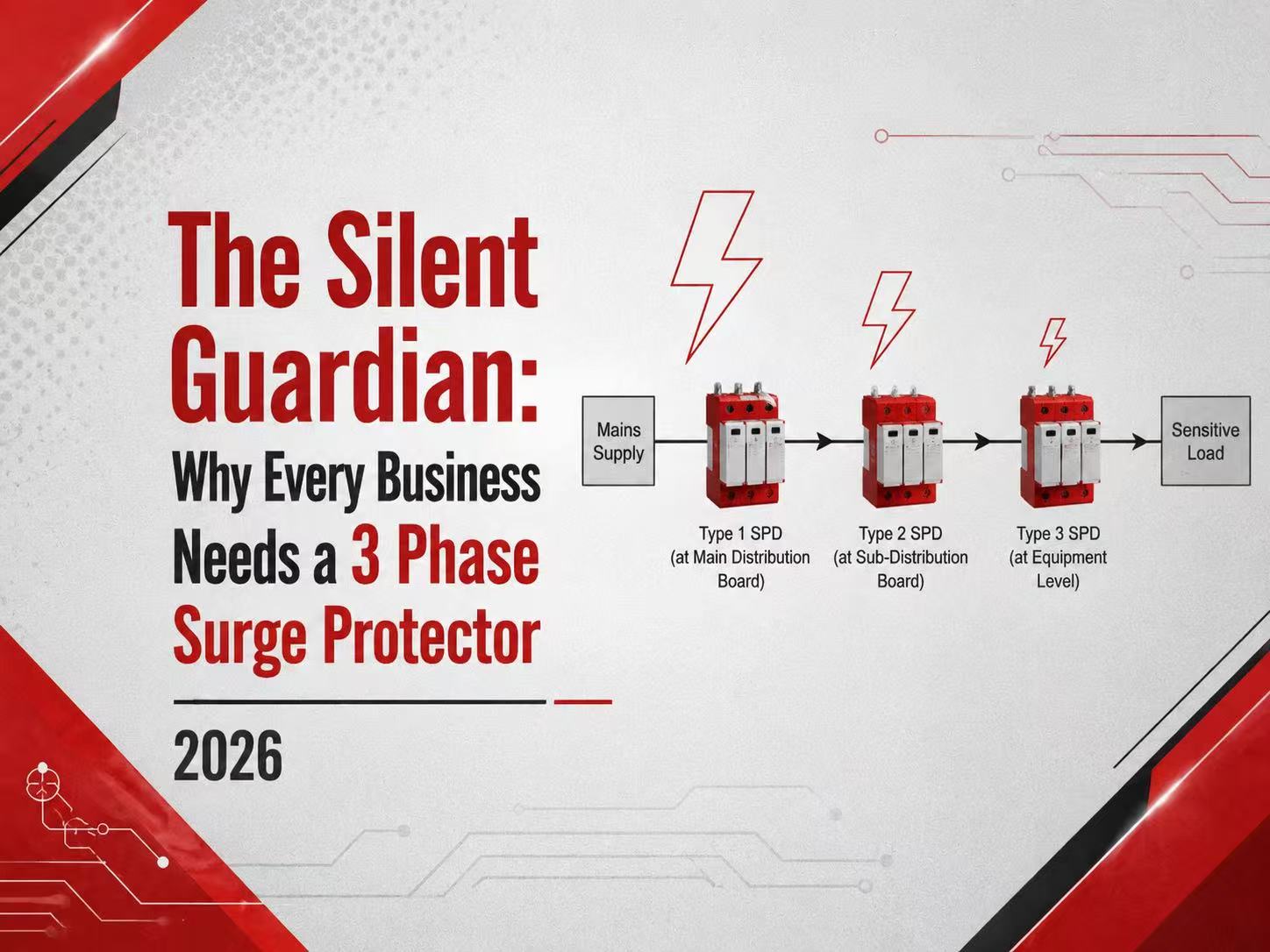
Kurze Antwort: A three-phase surge protective device (SPD) limits transient overvoltage on a three-phase AC distribution system. The right device depends on the network arrangement, voltage, lightning exposure, installation point, and equipment withstand level. A 3-pole SPD is not automatically interchangeable with a 3+1 or 4-pole arrangement.
An SPD is connected to the power system to limit surge voltage and divert surge current during a short transient. It does not regulate normal voltage, correct long-duration overvoltage, or replace the circuit breaker and earthing system. IEC 61643-11:2025 covers requirements and tests for SPDs connected to AC low-voltage systems. The actual protection at equipment also depends on installation and conductor length.
Surges may arrive through a utility supply, nearby lightning, or switching operations. Protection must be considered across every conductor that can carry the transient, including the neutral where one is present.
| Arrangement | Typical conductors considered | What to verify |
|---|---|---|
| 3P | L1, L2, L3 | Whether the installation has a neutral and whether the SPD modes match the earthing system |
| 4P | L1, L2, L3, N | Protection modes and the manufacturer’s wiring diagram |
| 3+1 | Three line-to-neutral paths plus a neutral-to-earth path | Network type, N-PE component, backup protection and approved connection diagram |
These labels describe different connection arrangements; they do not by themselves establish suitability. Confirm whether the supply is TN-S, TN-C, TT or IT, whether a neutral is distributed, and the exact device wiring diagram. Do not infer a connection from the number of modules alone.
Typ 1 devices are evaluated for lightning-current impulse duty and may be needed at a service entrance where the risk assessment and local rules indicate direct lightning-current exposure. Typ 2 devices address induced lightning and switching surges at distribution boards. A combined Typ 1+2 device can meet both classifications when its declared ratings match the design. Sensitive downstream equipment may need a coordinated additional stage.
One large current rating is not a complete design. Check the declared impulse or discharge-current ratings against the location and coordinate the voltage protection level with the equipment withstand level and upstream/downstream SPDs.
For a practical product comparison, see Kuangya’s AC SPD-Reihe, including KYSPD-12.5T1+2-3P und KYSPD-20T2+3-4P. Use each product’s current datasheet and wiring diagram to confirm a specific installation.
Keep the connections from the supply through the SPD to the protective-earth bar short and direct. Long leads add voltage during a surge; Schneider Electric’s installation guide recommends a total connection length of no more than 50 cm where practical. Route phase, neutral and PE conductors together and follow the manufacturer’s conductor-size and backup-protection instructions. A qualified electrician should verify protective bonding, available fault current, isolation and local code requirements before energizing the board.
Inspect the status indicator after a significant surge and during scheduled maintenance. Replace a failed cartridge only with the specified compatible part, and investigate repeated disconnection rather than simply replacing modules.
No. The correct connection depends on the distributed conductors and earthing arrangement. A three-phase system may have no neutral, and a four-module product may use different internal protection modes from a 3+1 product.
No. A breaker provides overcurrent protection under its declared conditions. It does not provide the same transient voltage-limiting function as an SPD; the SPD may itself require coordinated backup protection.
No. Compare ratings with the same waveform and test class, then consider Uc, Up, system configuration, available fault current and the installed connection. A high discharge rating cannot compensate for incorrect wiring or excessive lead length.
Send the distribution-board voltage, earthing system, neutral arrangement, intended installation point, lightning exposure and required Type 1/Type 2 classification when you contact Kuangya for a selection review. For PV inverter systems, also assess the separate DC and AC inverter protection paths; an AC SPD is not a substitute for a PV-rated DC SPD.
Technische Referenzen: IEC 61643-11:2025 and Schneider Electric’s SPD-Anschlussanleitung.

